Company name
Salary slipSeptember 2026
| Earnings | Amount (Rs) |
|---|---|
| Basic salary | 0 |
| Gross earnings | 0 |
| Deductions | Amount (Rs) |
|---|---|
| Provident fund (EPF) | 0 |
| Total deductions | 0 |
Net payRs 0Rupees zero only
Salary slip generator · Free · No login
Fill in earnings and deductions to get a payslip with gross pay, net pay and the amount in words. Download a PDF, with no login and no watermark.
Reviewed by the Goodspace Careers team · Updated October 2026 · Sources cited
Quick answers
A salary slip generator, also called a payslip generator or salary slip maker, is an online form that turns company, employee, earnings and deduction details into a formatted payslip. This one adds up gross pay, total deductions and net pay, writes the net amount in words, and lets you download the slip as a PDF, print it or copy it as text, all inside your browser.
Yes. There is no login, no watermark and no paid tier. Nothing you type is sent to GoodSpace: the slip is built on your device, and the optional draft is saved only in your own browser until you clear it.
A payslip is valid when the employer issues it and the figures match what was actually paid. Section 50(3) of the Code on Wages, 2019 requires a slip in the prescribed form, and rule 52 of the Wages (Central) Rules, 2026 lets it be issued electronically or on paper, so a PDF from this tool is a valid format for an employer to use. A slip you make for yourself is a record or a draft, not proof of income.
Net pay, September 2026
₹0Enter a basic salary, or fill the sample slip, to see net pay.
The calculation:
| Gross earnings | ₹0 |
|---|---|
| Total deductions | - ₹0 |
| Net pay | ₹0 |
Add company details, PF, ESI and TDS, then download.
PreviewUpdates as you type. PDF and print use real A4.
| Earnings | Amount (Rs) |
|---|---|
| Basic salary | 0 |
| Gross earnings | 0 |
| Deductions | Amount (Rs) |
|---|---|
| Provident fund (EPF) | 0 |
| Total deductions | 0 |
Use this free salary slip generator to make a payslip for any month. Enter the company and employee details, the earnings and the deductions, and the payslip generator adds up gross pay, total deductions and net pay, writes the net amount in words and shows the slip as an A4 page. Download it as a PDF, print it or copy it as text. The payslip maker runs in your browser: nothing you type is uploaded, there is no login and no watermark.
Reviewed by the Goodspace Careers team, updated October 2026. PF, ESI, professional tax and wage-slip rules checked against EPFO, ESIC, the Code on Wages, 2019 and state schedules; sources are linked beside each rule below.
Fill the form from top to bottom, watch the preview on the right (below on a phone), then download. The whole thing takes about two minutes for one employee, and the draft stays in your browser so next month you only change the period and the figures.
Priya earns a basic of Rs 25,000, HRA of Rs 10,000, conveyance of Rs 1,600 and a special allowance of Rs 13,400, so her gross for September 2026 is Rs 50,000. Her employer deducts PF at 12% of basic (Rs 3,000) and Karnataka professional tax of Rs 200. Gross is above the Rs 21,000 ESI limit, so there is no ESI, and her estimated total income for the year is within the Rs 12 lakh limit for the section 156 rebate, so TDS is nil.
Net pay
Rs 50,000 gross − Rs 3,200 deductions = Rs 46,800
This is the slip the generator produces for her:
| Earnings | Amount (Rs) |
|---|---|
| Basic salary | 25,000 |
| House rent allowance (HRA) | 10,000 |
| Conveyance allowance | 1,600 |
| Special allowance | 13,400 |
| Gross earnings | 50,000 |
| Deductions | Amount (Rs) |
|---|---|
| Provident fund (EPF) | 3,000 |
| Professional tax | 200 |
| Total deductions | 3,200 |
With three days of unpaid leave (27 paid days of 30) and the pro-rate option on, basic and each allowance are multiplied by 27/30: gross becomes Rs 45,000, and PF should be refilled from the lower basic. Load the sample in the generator above to try it.
Since 21 November 2025, when the Code on Wages, 2019 came into force, every employer must issue a wage slip to every employee in the prescribed form (section 50(3)). For establishments where the Central Government is the appropriate Government, such as railways, mines, major ports, banking and insurance companies and central public sector undertakings (section 2(d)), rule 52 of the Wages (Central) Rules, 2026 (G.S.R. 343(E), 8 May 2026) prescribes Form V, issued electronically or on paper on or before payment of wages. States prescribe the slip for everyone else under their own rules made under the Code, with the same items, so Form V is the reference used here. The generator has a field for each item in it.
| Form V item | What goes there | In this tool |
|---|---|---|
| Date of issue, establishment name, address, period | The header of the slip. | Date of issue, company name, address, month and year |
| 1 to 3: employee name, father's, mother's or spouse's name, designation | Who the slip is for. | Employee name, ID, parent or spouse name, designation |
| 4 and 5: UAN, bank account number | The PF account and the account the salary is credited to. | UAN, bank name, account number (optional) |
| 6 and 7: wage period, rate of wages (basic, DA, allowances) | The month and the earnings for it. | Basic, DA, HRA, conveyance, special, other |
| 8 and 9: attendance, overtime wages | Days paid for and any overtime. | Paid days, loss of pay days, the other-earning line |
| 10 to 12: gross wages, deductions (PF, ESI, others), net wages paid | The arithmetic. | Gross, PF, ESI, professional tax, TDS, other, net in figures and words |
Form V asks for the employer's or pay-in-charge's signature only where the register is kept physically, which is why slips issued by payroll software carry a line saying they are computer-generated. For what each earning means and how a CTC is split into these lines, run the package through the in hand salary calculator, which shows the same lines for every month of the year.
The slip is only arithmetic: gross minus deductions. The auto-fill buttons and the checks under the form use these rules, each verified against the source linked beside it on 28 October 2026.
| Line | Rule used by the tool | Source |
|---|---|---|
| Provident fund (EPF) | Employee 12% of basic plus DA; the employer matches 12%, of which 8.33% goes to the pension scheme on wages up to the ceiling, and this share never appears as a deduction. The statutory wage ceiling is Rs 25,000 a month from 17 September 2026 (Rs 15,000 before that), so an employer that limits PF to the ceiling deducts at most Rs 3,000. | EPFO, EPF scheme; Gazette S.O. 5109(E), 17 Sept 2026; EPFO wage ceiling FAQs |
| ESI | Employee 0.75% and employer 3.25% of wages, where the establishment is covered and gross wages are Rs 21,000 a month or less (Rs 25,000 for persons with disability). An employee whose wages cross the limit after a contribution period (1 April to 30 September, 1 October to 31 March) has begun stays covered until it ends. Employees on an average daily wage up to Rs 176 pay no employee share. | ESIC, contribution; ESIC, coverage; ESI Act, 1948, s.2(9) proviso |
| Professional tax | A state levy, capped by the Constitution at Rs 2,500 a year per person. The state table below has the schedules the tool fills in; for other states, type the amount from the payslip. | Constitution, Article 276(2) |
| Income tax (TDS) | Deducted by the employer at the average rate of tax on the employee's estimated salary for the year, so the monthly figure is roughly one twelfth of the annual tax. Under the new regime the rebate wipes out tax on total income up to Rs 12 lakh, so many slips show nil. The tool takes the amount as entered; estimate it with the in hand salary calculator. | Income-tax Act, 2025, s.392(1); s.156 (rebate) |
| Total deductions | Cannot exceed 50% of wages in any wage period; the tool warns when the slip crosses that line. | Code on Wages, 2019, s.18(3) |
| Wage slip | Mandatory for every employee, in the prescribed form, electronic or physical, on or before payment of wages. Form V for central-sphere establishments; state forms with the same items elsewhere. The earlier Rs 24,000 wage ceiling for these protections no longer applies. | Code on Wages, s.50(3); Wages (Central) Rules, 2026, rule 52 and Form V; PIB explainer |
| Pay date | Monthly wages are due before the expiry of the seventh day of the following month; on resignation or dismissal, within two working days. | Code on Wages, s.17(1) and 17(2) |
| State | Monthly deduction | Source |
|---|---|---|
| Maharashtra | Men: nil up to Rs 7,500; Rs 175 a month for Rs 7,501 to 10,000; above Rs 10,000, Rs 200 a month and Rs 300 in February (Rs 2,500 a year). Women: nil up to Rs 25,000; above that Rs 200 a month and Rs 300 in February. From 1 April 2023. | Maharashtra GST Department, PT rate schedule as on 31 March 2025 (entry 1, from 1 April 2023) |
| Karnataka | Nil below Rs 25,000 a month; at Rs 25,000 and above, Rs 200 a month and Rs 300 in February (Rs 2,500 a year) from 1 April 2025. | Karnataka Gazette, Act 14 of 2023 (Rs 25,000 threshold) and Act 33 of 2025 (Rs 300 in February); gazette copies, the e-gazette has no stable link |
| Gujarat | Nil up to Rs 12,000 a month; Rs 200 a month above that (Rs 2,400 a year) from 1 April 2022. | Gujarat Commercial Tax Department, rate of profession tax (entry 1) |
| Telangana | Nil up to Rs 15,000 a month; Rs 150 a month for Rs 15,001 to 20,000; Rs 200 a month above Rs 20,000. | Telangana Commercial Taxes Department, First Schedule to the PT Act, 1987 (entry 1) |
| Odisha (repealed from 1 April 2026) | The Odisha professional tax Act was repealed by Odisha Ordinance 2 of 2026 with effect from 1 April 2026, so nothing is deducted in FY 2026-27. | Odisha Gazette No. 1496, Repeal Ordinance 2026 (in force from 1 April 2026) |
Tamil Nadu local bodies collect professional tax half-yearly, and Delhi, Haryana, Uttar Pradesh, Rajasthan and several union territories levy none. For any state not in the table, choose "Enter manually" and type the figure from the payslip.
Net salary is gross earnings minus total deductions. Gross is the sum of basic, dearness allowance, HRA, conveyance, special allowance and any other earning for the month. Deductions are the employee's PF, ESI, professional tax, TDS and any recovery such as a loan instalment. The employer's PF and ESI shares are not deducted, so they never appear.
Formula
Net pay = (Basic + DA + HRA + Conveyance + Special + Other) − (PF + ESI + Professional tax + TDS + Other)
In the example above, Rs 50,000 − Rs 3,200 = Rs 46,800, written on the slip as "Rupees forty-six thousand eight hundred only". Net pay is what reaches the bank; it is lower than gross and much lower than CTC, which also counts the employer's PF, gratuity provision and any bonus. To see your own in-hand figure from a CTC, use the in hand salary calculator; for what you are owed when you leave, the gratuity calculator uses the basic plus DA from the same slip.
Yes. Every employer must issue a wage slip under section 50(3) of the Code on Wages, 2019, in the form its rules prescribe, electronically or on paper, on or before paying wages. The duty covers every employee regardless of salary, and monthly wages themselves must be paid before the seventh day of the next month.
Yes, when the employer issues it. Rule 52 allows wage slips to be issued electronically, and Form V requires a signature from the employer or pay-in-charge only where the wage register is kept physically. That is why slips from payroll software say they are computer-generated and need no signature, and why this tool prints the same line.
A bank, embassy or new employer may still ask for a stamped or signed copy, or verify the slip against your bank statement, your UAN passbook and your tax records. If you make the slip here on behalf of an employer, email it from the company address or have HR sign the PDF.
You can, for the right reasons: to keep a record when your employer does not issue one, to check the slip you were given, to prepare a draft for HR to sign, or as a small business paying its first employees. What the slip must never do is show pay you did not actually receive.
Honest uses that people search for: a shop or startup making slips for a handful of staff without payroll software, a freelancer paid a fixed monthly retainer who wants a clean record, a domestic or household employer issuing a slip voluntarily, and an employee rebuilding a lost slip from the bank statement and PF passbook before asking HR for the original.
Check the arithmetic first: gross must equal the sum of the earnings, net must equal gross minus deductions, and the amount in words must match. Then test the deductions against the rules: PF at 12% of basic plus DA, ESI only within the wage limit or a running contribution period, professional tax within the state schedule, and total deductions under half of wages.
Hiring the people whose slips you are making? GoodSpace screens candidates with AI and sends you interviewed shortlists; job seekers find roles across India with real interviews, faster.
Browse jobs on GoodSpaceIf you have any further questions, please don't hesitate to reach out to our support team for assistance.
Use these free tools to maximize your chances of landing interviews.
Check your ATS resume score instantly with AI-powered keyword & formatting analysis.
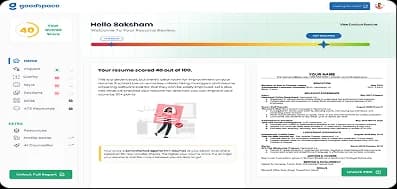
Build an ATS-friendly resume with professional templates designed to get you shortlisted.

Generate compelling cover letters tailored to each job application automatically.

Leave, resignation, salary hike and every other HR letter, in the right format with a ready-to-send email.
Every job you apply to on one board, as a table or Kanban, with the resume you sent kept alongside.
Practice a mock interview online with an AI interviewer that adapts to your role.

End-to-end placement support with curated job matches and expert guidance.

Refer friends to GoodSpace and earn real money for every successful hire.