Veterinarian Resume Format, with 3 Full Samples
A veterinarian is hired on evidence of animals treated, surgeries done cleanly and a herd or a clinic that stayed healthy on your watch, yet most vet resumes list a degree and a species list and stop there. Below are three complete resumes, one for a fresh BVSc graduate straight out of the compulsory internship, one for a small-animal clinician with five years in busy city practice, and one for a senior veterinary officer running livestock health across a district. After the samples come the format rules, where the VCI registration line belongs, the difference between naming a surgery and proving you can do it, the terms a parser matches literally, and the mistakes that get a vet resume set aside.
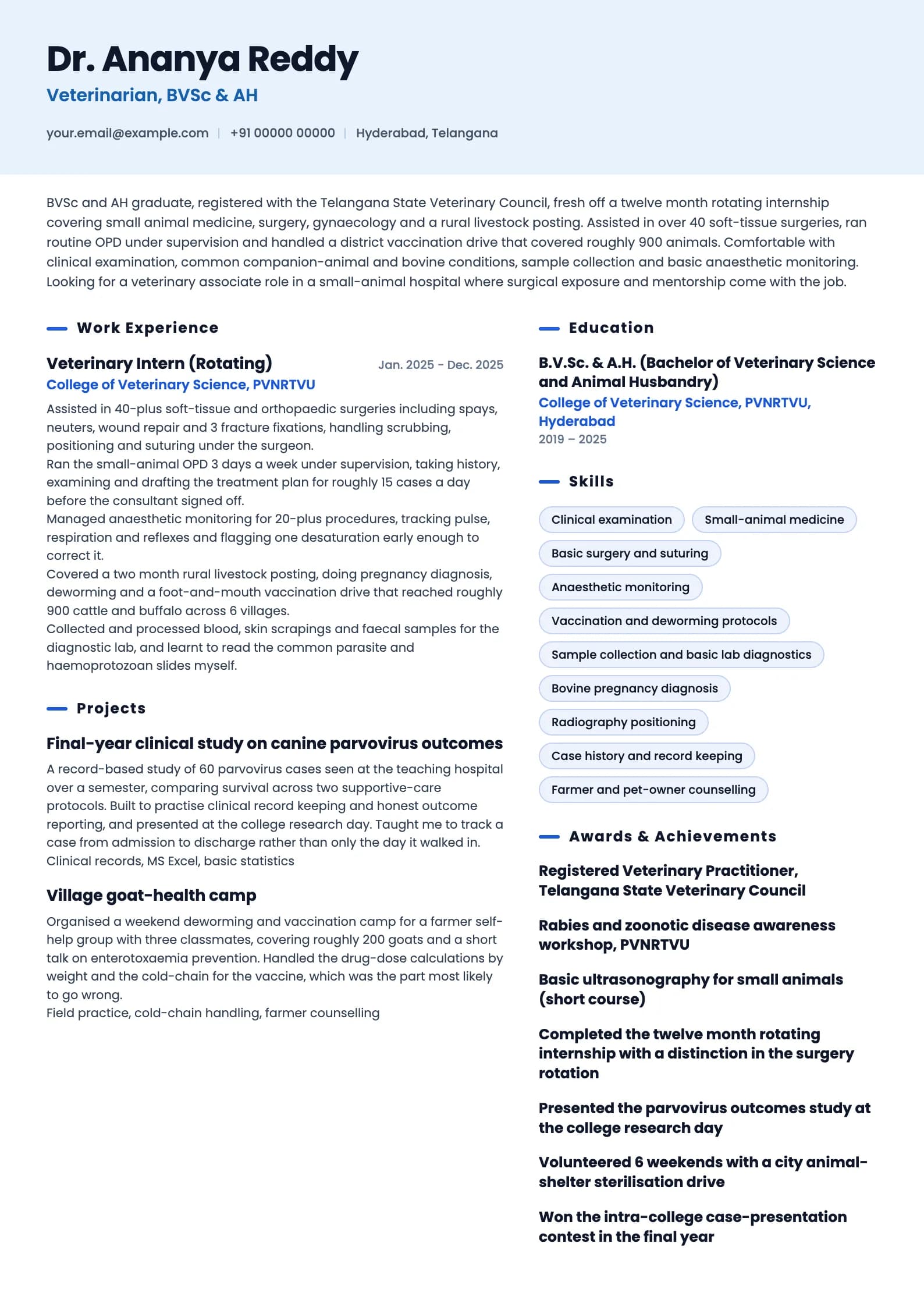
Build my resumeVeterinarian resume example, Fresher (0 years)
ai-era templateIs your resume good enough?
Upload the resume you have now and see what an applicant tracking system reads before a veterinarian recruiter ever does.
Free to run. Sign in with your mobile number to see your score.
Veterinarian resume example, Mid-level (5 years)
professional template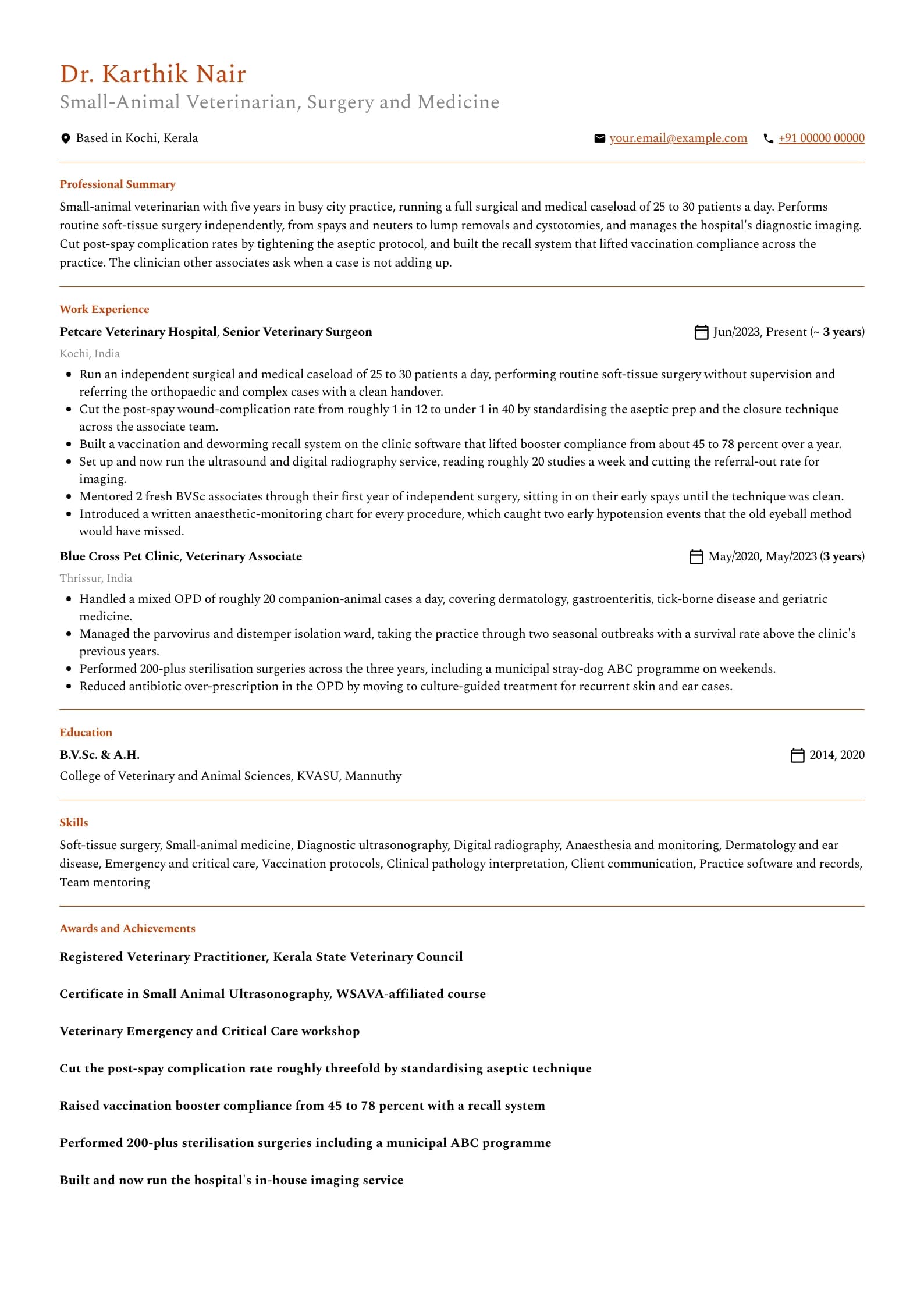
Want this structure with your own details? Build it in the resume builder.
Veterinarian resume example, Senior (12 years)
header-band template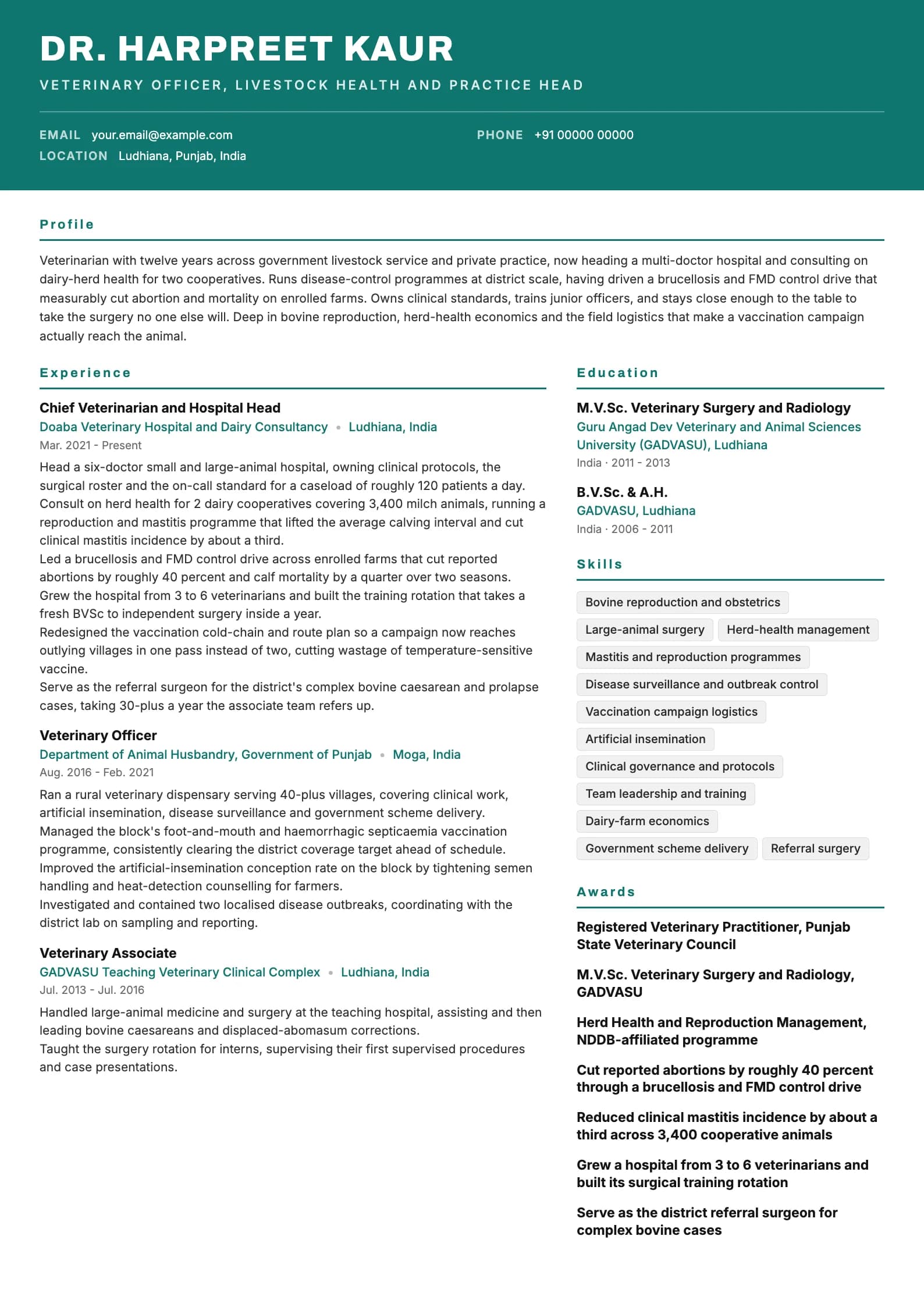
The format that works for veterinarian resumes in India
Reverse chronological is the layout to use. Put the most recent role first, work backwards, and keep the dates visible. The one thing a veterinary resume must surface above everything else is your registration: whether you are registered with a State Veterinary Council under the Indian Veterinary Council Act, and your registration number. An employer, a government recruiter or a hospital cannot let you touch a patient without it, so it belongs in the summary line and again under a licence or certifications block, not buried on page two. Length follows evidence. One page holds a fresher and most clinicians up to roughly six or seven years. A senior officer with a masters, a publication list and a decade of herd-health programmes can justify two, provided the second page carries real work and not a longer list of species you have seen. A page built from a declaration paragraph and a hobbies line is padding either way. Four things do not belong on a clinical resume here: a photograph, date of birth, marital status and father's name. They survive from an older campus template. Nobody screening a veterinarian needs them, and each line they take is a line a surgery count or a herd outcome could have used. The exception is a client-facing or corporate role whose posting explicitly asks for a photo. Send a PDF unless the posting asks otherwise, name the file with your own name and Veterinarian, and keep to a single column so a parser reads it in order. The table below sets out the section order for a vet resume.
| Section | Where it goes | Why |
|---|---|---|
| Name and headline | Top, above everything | Headline is the role you want: small-animal veterinarian, veterinary officer, dairy consultant. |
| Registration line | In the summary and again in a licence block | State Veterinary Council registration and number. Without it you cannot legally practise. |
| Professional summary | Directly under the header | Three lines. Species focus, years, and the single strongest clinical result. |
| Clinical experience | Next, for anyone who has practised | Most recent first. Name caseload, procedures and outcomes. |
| Skills and procedures | Below experience | Grouped: medicine, surgery, diagnostics, species. Not a 40-item wall. |
| Education | Bottom, unless you are a fresher | BVSc, MVSc, institution, years. Freshers keep it near the top with OGPA. |
| Certifications and CME | After education, or beside skills | Ultrasound, emergency care, herd-health courses. Name the issuing body. |
The registration line is the first thing a vet resume is screened on
A veterinarian in India must be registered with a State Veterinary Council to practise, and the recruiter or HR screener reads for that line before they read anything clinical. If it is missing they cannot tell whether you are eligible, and an eligible candidate with a weaker resume beats a strong resume that never confirmed the licence. Put it where it cannot be missed. Write it plainly: Registered Veterinary Practitioner, Kerala State Veterinary Council, with the registration number if you are comfortable including it. Fresh graduates who have applied but not yet received the number should say so honestly, for example registration in process, rather than leave it ambiguous. A recruiter reads silence as not registered. If you hold a postgraduate qualification, an MVSc in surgery, medicine, gynaecology or a related speciality, name the speciality, because it changes what you can be hired for. A vet with an MVSc in Veterinary Surgery and Radiology is a different hire from a general practitioner, and the resume should make that legible in the headline, not leave it for the reader to infer from the degree line at the bottom. For government and public-service roles, the same rules apply with more weight: state the council, the number, and any AI or scheme-delivery training, because departmental recruitment checks these against a list. Do not decorate the licence with adjectives. It is a fact, and its value is that it is verifiable.
Before you fix a single bullet, confirm your resume states your State Veterinary Council registration where a screener will see it in three seconds. A brilliant clinical resume that never confirms the licence gets filtered by someone who is not a clinician.
Writing a summary a hiring vet actually reads
The block under your name is the part you can be reasonably sure gets read, so it should carry four facts: what you treat, how long you have treated it, your registration, and the strongest thing that happened because of your work. Three or four lines, no adjectives a reviewer cannot check. The old objective line, seeking a challenging position in a reputed organisation to utilise my veterinary skills, tells the reader nothing they did not already assume. Replace it with a summary. An objective describes what you want; a summary describes what you have already done, and only one is evidence a hiring veterinarian can weigh. Freshers often think they have nothing to summarise. Look at the fresher sample: it names the internship rotations, the registration, 40-plus surgeries assisted and a 900-animal vaccination drive. That is a genuine summary built from a compulsory internship, which is real supervised clinical work, not coursework. What it avoids is "passionate about animal welfare", a phrase on nearly every graduate vet resume that carries no information because everyone writes it. A practical test: read your summary and ask whether a batchmate with the same degree could paste it onto their resume unchanged. If they could, it describes the BVSc, not you. Add the specific caseload, the specific procedure you do independently and the specific outcome until it stops being transferable.
Professional summary, mid-level clinician
Weak
Dedicated and passionate veterinarian with 5+ years of experience in treating animals, seeking a challenging role in a reputed veterinary hospital to utilise my skills.
Strong
Small-animal veterinarian, five years in city practice, registered with the Kerala State Veterinary Council. Run a 25 to 30 patient daily caseload, perform routine soft-tissue surgery independently, and cut the post-spay complication rate roughly threefold by standardising aseptic technique.
The rewrite trades self-description for a species focus, the licence, an independent-surgery claim and one verifiable outcome.
Experience bullets: procedure, caseload, outcome
Every strong bullet in the samples follows the same shape. It opens with an action verb, names the specific clinical work or programme you ran, and closes with what measurably moved. The verb establishes that you did it yourself. The clinical detail tells a hiring vet whether the work is relevant. The number does the persuading. Start with the outcome and work backwards. Vets usually write the duty first, then struggle to attach a number, which produces bullets like "handled OPD cases and performed surgeries". Instead ask what was different after you were there: a complication rate fell, a survival rate rose, compliance improved, an outbreak was contained, a conception rate went up. Then write the sentence that ends in that fact. Vary the metric. Do not report only surgery counts. Across a real veterinary role you can honestly reach for caseload per day, complication and survival rates, vaccination coverage, mastitis or abortion incidence, calving interval, conception rate and referral volume. The mid-level sample mixes several of these, which reads as range rather than one trick. Where you lack a number, give scope: how many animals in the herd, how many villages covered, how many procedures across a year, how long an outbreak took to contain. "Ran a rural dispensary serving 40-plus villages" carries weight without inventing a percentage. Be honest about what you did alone versus assisted. "Assisted in" is the right phrase for an intern; "performed independently" is a claim a mid-level vet must be able to defend at the table. Overstating it is the fastest way to lose an interview, because a practical skills test follows quickly in this field.
| Level | What bullets must prove | Typical metric |
|---|---|---|
| Fresher / intern | You have real supervised clinical exposure | Surgeries assisted, OPD cases seen, animals vaccinated |
| 1 to 4 years | You handle a caseload and operate independently | Daily caseload, sterilisations done, survival rate, compliance |
| 5 to 8 years | You own outcomes and improve the practice | Complication rate, imaging service, mentoring, recall systems |
| 8 years and up | You run programmes across a herd or a district | Abortion and mastitis incidence, coverage, calving interval, team size |
Experience bullet, small-animal role
Weak
Responsible for handling OPD cases, performing surgeries and vaccinating animals as per the hospital routine.
Strong
Cut the post-spay wound-complication rate from roughly 1 in 12 to under 1 in 40 by standardising the aseptic prep and closure technique across the associate team.
"Responsible for" reads as a job description; the rewrite names the change made and the complication rate it moved.
Experience bullet, livestock role
Weak
Worked on disease control and vaccination programmes which helped in reducing diseases in the area.
Strong
Led a brucellosis and FMD control drive across enrolled farms that cut reported abortions by roughly 40 percent and calf mortality by a quarter over two seasons.
Names the diseases, the programme and two population outcomes, so a reviewer can ask a real follow-up instead of nodding at a vague claim.
If a bullet would read identically on a batchmate's resume, it is describing the degree, not you. Rewrite it until it only fits the caseload and the cases you actually handled.
The skills and procedures section: grouped, honest, defensible
A veterinary resume's skills section has two audiences. A parser or HR screener wants literal terms it can match, ultrasonography, anaesthesia, herd health. A hiring vet wants a short, organised list that signals what kind of clinician you are and what you can be handed unsupervised. Grouping satisfies both. Group by function rather than one long line. Medicine, surgery, diagnostics, species and practice is a grouping that works for almost every veterinarian. The exact headings matter less than the fact that structure exists. Separate what you do independently from what you assist with, because a hiring vet reads a flat list of procedures as claims of independent competence, and a practical test will expose an overclaim fast. Name species and systems specifically. Small-animal, bovine, poultry, equine and exotic pets are different jobs; a resume that says "treatment of all animals" tells a reviewer you have not decided what you are. If your work is companion-animal, say so and let the surgery list reflect it. If it is large-animal and herd health, the reproduction and programme language should dominate. Do not include a proficiency bar. Star ratings invite an argument nobody wins, and no one agrees on what four stars in surgery means. Ten to sixteen grouped, defensible skills is the working range. Every item is a question you have agreed to answer at the table.
| Group | What goes in it | How many |
|---|---|---|
| Medicine | Internal medicine, dermatology, emergency and critical care, geriatrics | 3 to 5 |
| Surgery | Soft-tissue, spay and neuter, obstetrics, orthopaedics (only if you do it) | 2 to 4 |
| Diagnostics | Ultrasonography, radiography, clinical pathology, sample collection | 2 to 4 |
| Species / focus | Small-animal, bovine, poultry, equine, herd health | 1 to 3 |
| Practice | Client counselling, records and software, team mentoring, scheme delivery | 2 to 3 |
Skills section
Weak
Skills: Animal treatment, surgery, medicine, vaccination, all species, injection, dressing, X-ray, ultrasound, lab, communication, MS Office, hardworking, team player.
Strong
Medicine: internal medicine, dermatology, emergency care. Surgery: soft-tissue and sterilisation (independent), obstetrics (assisted). Diagnostics: ultrasonography, digital radiography, clinical pathology. Focus: small-animal. Practice: client counselling, practice software, mentoring.
Cuts the filler traits and the vague "all species", separates independent from assisted surgery, and groups the rest so a hiring vet reads it in one pass.
Species, setting and specialisation: naming what you actually are
Veterinary medicine in India splits into settings that need very different resumes, and the single most common mistake is writing one generic resume for all of them. A small-animal city hospital, a government livestock dispensary, a poultry or dairy company, a veterinary pharmaceutical field role and an animal-welfare NGO each read a resume looking for different evidence. Decide which you are applying to and let the resume lean that way. For small-animal practice, lead with surgical range, diagnostics and client communication, because a city clinic hires on your ability to run a consult room and an OT. For large-animal and dairy roles, lead with reproduction, herd health, mastitis and vaccination logistics, because the employer is buying population outcomes, not individual consults. For a government veterinary officer post, foreground registration, AI training, disease surveillance and scheme delivery, since departmental screening checks these against a list. For industry roles, in veterinary pharma, poultry integration or dairy nutrition, the resume shifts again toward field coverage, farmer or vet detailing, product knowledge and territory outcomes, and it reads closer to a technical sales or field-services resume than a clinical one. A clinician moving into industry should translate the clinical work into that language rather than assume the reader will do the translation. If you genuinely span settings, as the senior sample does, say so with evidence on both sides rather than claiming to do everything. "Runs a small-animal hospital and consults on herd health for two cooperatives" is credible because each half has its own numbers. "Experienced in all types of veterinary work" is not, because it has none.
Where education, internship and certifications belong
Education goes near the top for a fresher, who has nothing stronger to lead with, and at the bottom for anyone with clinical experience. The core entries are your BVSc and AH with institution and years, and any MVSc with its speciality, because the postgraduate speciality changes what you can be hired for and belongs in the headline as well as the education block. The compulsory rotating internship is clinical experience, not education, so a fresher should give it its own experience entry with real bullets, as the fresher sample does, rather than fold it into a degree line. It is the strongest evidence a new graduate has, and burying it wastes it. OGPA or percentage is worth keeping while you are a fresher and it is respectable, since campus and early-career screening still filters on it. Once you have a few years of practice, drop it. A marks number from five years ago competes for space with surgery counts and herd outcomes that predict far more. Continuing education and short courses sit just below education, or beside skills if you hold only one or two. Ultrasonography, veterinary emergency and critical care, herd-health and reproduction programmes, and any WSAVA or NDDB affiliated training are worth naming with the issuing body and year, because they signal you keep current in a field that moves. An expired or half-finished course listed as complete is a small dishonesty that a practical interview exposes quickly, so list only what you actually hold.
Getting a veterinarian resume through the applicant tracking system
Larger hospital chains, pet-care startups, poultry and dairy companies and pharma employers run applications through an applicant tracking system before a human sees them. An ATS is a parser and a search index, not a judge. It reads your file, tries to break it into name, dates, employers, titles and skills, and stores the result so a recruiter can search. Almost every ATS problem is a parsing problem, and parsing problems come from layout, not wording. The layout rules are short. One column. Standard section headings, so use Work Experience rather than My Journey, and Skills rather than My Toolkit. No text inside images, because a clinic-logo strip reads as empty space. Keep the registration line in the body, not only in a header or footer that some parsers drop. Avoid text boxes and nested tables in the resume body. On wording, mirror the language of the posting where it is honest. If it says small-animal surgery, write small-animal surgery. If it says herd health, write herd health rather than only cattle work. Include the expansion alongside an acronym at least once, for example AI (artificial insemination) and ABC (animal birth control), so both searches find you, and spell out BVSc and MVSc once in full. Keyword stuffing does not work. A hidden block of every species and procedure in white text is caught quickly, and the outcome is worse than being filtered. Write real bullets that naturally contain the right terms, because a bullet describing a mastitis programme contains the word mastitis in a context that survives human review too. Save as a text-based PDF, open it, and confirm you can select and copy a sentence. If you cannot select the text, neither can the parser.
Section heading
Weak
My Journey with Animals
Strong
Clinical Experience
Parsers look for standard headings; a creative one can push the whole block into an unclassified bucket the recruiter never searches.
Test your own file before you send it. Copy the text out of the PDF into a plain text editor. Whatever you can read there is roughly what the parser sees, and anything scrambled, especially your registration line, is a real risk.
What gets veterinarian resumes rejected
Most rejections at the resume stage are not close calls. They come from a small set of recurring problems, and all of them are fixable in an afternoon. The list below covers what recruiters and hiring vets see most often on Indian veterinarian resumes, in rough order of how much damage each one does.
- No State Veterinary Council registration line, or it is buried on page two. It is the first thing screened, so put it in the summary.
- "Treatment of all animals" or "all species" instead of naming your actual focus. It reads as a vet who has not decided what they are.
- Overclaiming independent surgery you have only assisted. A practical test follows fast in this field and exposes it immediately.
- Duties copied from the job routine instead of outcomes. "Responsible for OPD and surgeries" is the tell.
- No numbers anywhere. Caseload, complication rate, vaccination coverage, mastitis incidence, conception rate. Pick whichever is honest.
- One generic resume sent to a city clinic, a government post and a pharma field role, when each reads for different evidence.
- A photo, date of birth, marital status or father's name from an old campus template, taking space a surgery count could use.
- A generic objective line. Replace it with a summary that states focus, years, registration and one result.
- The internship folded into a degree line instead of written up as the real supervised clinical experience it is.
- Inflated titles or dates that do not match your registration record and payslips. Verification is standard and a mismatch ends the process.
Read your resume aloud once before sending it. Any procedure you would not be comfortable being handed on your first day is a line to soften from "performed independently" to the truth.
Skills to put on a veterinarian resume
Technical
- Clinical examination and diagnosis
- Small-animal internal medicine
- Soft-tissue surgery
- Spay and neuter surgery
- Bovine obstetrics and reproduction
- Anaesthesia and monitoring
- Diagnostic ultrasonography
- Digital radiography
- Emergency and critical care
- Vaccination and deworming protocols
- Herd-health management
- Disease surveillance and outbreak control
- Artificial insemination
- Clinical pathology interpretation
Tools and platforms
- Ultrasound machine
- Digital X-ray
- Autoclave and OT equipment
- Anaesthesia machine and monitor
- Microscope and lab diagnostics
- Vaccine cold-chain equipment
- Practice-management software
- Electronic medical records
Working skills
- Pet-owner and farmer counselling
- Calm handling under emergency
- Clinical decision-making
- Team mentoring and training
- Case documentation
- Cross-team coordination
- Field and campaign logistics
- Ethical and welfare judgement
Certifications worth listing as a veterinarian
| Certification | Full name | Worth it for |
|---|---|---|
| VCI / State Council Registration | Registered Veterinary Practitioner, State Veterinary Council (under the Indian Veterinary Council Act) | Mandatory for anyone who intends to practise as a veterinarian in India. It is the first line a recruiter or government screener reads, so every practising vet must carry it. Freshers who have applied but not yet received the number should state registration in process rather than leave it blank. |
| MVSc | Master of Veterinary Science (Surgery, Medicine, Gynaecology or allied speciality) | Worth naming in the headline for vets who hold it, because the speciality changes what you can be hired for. Most valuable for referral surgery, teaching, senior hospital and government promotion tracks. A general practitioner without it is not disadvantaged for routine practice roles. |
| Small Animal Ultrasound | Certificate in Small Animal Ultrasonography (WSAVA-affiliated or equivalent) | A practical signal for small-animal clinicians who read their own scans, since imaging is a differentiator in city practice. Worth it if the clinic runs or wants an in-house imaging service. Less relevant for a purely large-animal or field role. |
| Vet Emergency and Critical Care | Veterinary Emergency and Critical Care workshop / certification | Useful for clinicians in busy hospitals and 24-hour practices who handle trauma, poisoning and critical patients. Signals you can run a crash case, not only routine OPD. Most valuable in the one-to-eight-year range at multi-doctor hospitals. |
| Herd Health and Reproduction | Herd Health and Reproduction Management (NDDB-affiliated or university programme) | The credential that matters for large-animal, dairy-consultancy and cooperative roles, where the job is population outcomes. Worth it for vets moving from individual practice into herd-level programme work. Not relevant for a small-animal city clinician. |
| AI Training | Artificial Insemination Technician / Practitioner training | Expected for government veterinary officer and field-services roles where AI delivery is part of the job and scheme targets are checked against it. Worth stating plainly on any livestock or public-service resume. Optional for small-animal practice. |
Keywords an ATS scans for in a veterinarian resume
These are the literal terms a parser matches against the job description. Use the ones that are true of you, in the sentences where you did the work, not as a list at the bottom.
- veterinarian
- veterinary doctor
- bvsc
- mvsc
- veterinary council registration
- small animal surgery
- spay and neuter
- ultrasonography
- radiography
- anaesthesia
- vaccination
- herd health
- mastitis
- artificial insemination
- disease surveillance
- emergency care
- clinical pathology
- veterinary officer
- livestock
- obstetrics
Veterinarian resume FAQ
What salary can a veterinarian expect in India?
A fresh BVSc graduate typically starts around 3 to 6 LPA in private small-animal practice, with corporate pet-hospital chains and pharma field roles at the higher end. A clinician with five to eight years running an independent caseload usually sits in the 6 to 14 LPA band, more in a metro or as a partner. Senior veterinarians, hospital heads and MVSc specialists commonly earn 12 to 25 LPA and above, while government veterinary officer posts carry the relevant state pay scale plus allowances and strong job security. Surgical skill, an MVSc and herd-health or dairy-consultancy expertise push the top of every band upward.
How long should a veterinarian resume be?
One page for a fresher and most clinicians up to about six or seven years. A senior veterinarian with an MVSc, publications and a decade of herd-health programmes can justify two pages, provided the second page carries real work and not a longer species list. Nobody has been rejected for a resume that was too easy to read. If you are struggling to fit one page, cut the oldest role to a single line, drop coursework, and remove any procedure you would not want tested at the table.
Where do I put my Veterinary Council registration on the resume?
In two places: one line inside the professional summary, and again in a licence or certifications block. It is the first thing a recruiter or a government screener reads, because you cannot legally practise without it, so it must be visible in the first few seconds. Write it as Registered Veterinary Practitioner with the State Veterinary Council and, if you are comfortable, the registration number. Freshers who have applied but not yet received the number should write registration in process rather than leave it ambiguous.
How does a BVSc fresher write a resume with no job experience?
Your compulsory rotating internship is real supervised clinical experience, so give it its own experience section with quantified bullets: surgeries assisted, OPD cases seen, animals vaccinated, rotations covered. Then education with OGPA, then skills and any short courses. Add anything checkable, such as your council registration, a research presentation or a field camp you organised. Verifiable facts carry more weight than "passionate about animal welfare", which every graduate writes and which tells a reviewer nothing.
Should I list every species and procedure I have handled?
No. A wall of every species and procedure reads as padding and as a vet who has not decided what they are. Name your actual focus, small-animal, bovine, poultry or herd health, and let the surgery and diagnostics list reflect it. Separate what you perform independently from what you assist with, because a hiring vet reads a flat procedure list as claims of independent competence, and a practical skills test exposes an overclaim quickly.
Do certifications like ultrasound or emergency care help?
They help when they match the setting you are applying to. Small-animal ultrasonography and emergency care matter for busy city hospitals; herd-health and AI training matter for dairy, livestock and government roles. Name the issuing body and the year, and list only what you actually hold, because a practical interview checks it. An MVSc speciality is worth putting in the headline, since it changes what you can be hired for, not just in the education block at the bottom.
Should I use the same resume for a clinic, a government post and a pharma role?
No. A small-animal clinic reads for surgical range and consult-room skill, a government veterinary officer post reads for registration, AI training and scheme delivery, and a veterinary pharma or poultry field role reads more like a technical field-services resume with territory coverage and product knowledge. Keep one master resume and tailor the summary, the skills order and the emphasis of the bullets to whichever setting you are applying to.
Do I need a photo on a veterinarian resume in India?
No. Hiring hospitals and recruiters do not expect one, and it takes space a surgery count or a herd outcome should occupy. The same goes for date of birth, marital status, father's name and a declaration paragraph, all of which come from an older campus template. The only exception is a client-facing corporate or brand-ambassador role whose posting explicitly asks for a photograph.
Does an ATS reject two-column veterinary resumes?
It does not reject them outright, but some parsers read multi-column layouts out of order, which can interleave your sidebar with your experience and, worse, scramble the registration line the screener is looking for. A single-column layout removes the risk, which is why all three samples above use one. Test your own file by copying the text out of the PDF into a plain text editor, and if it reads in order, and your registration line is intact, it will most likely parse correctly.
Related resume examples and guides
Build your veterinarian resume in any of these formats
Start from a blank resume or upload the one you have. Goodspace renders it in 24 templates and flags the registration line, clinical procedures and herd-health keywords an applicant tracking system will look for, and the padding it will not credit.
Build my resume