Medical Officer Resume Format, with 3 Full Samples
A medical officer is hired on the strength of patients seen, emergencies stabilised and programmes run cleanly, yet most MBBS resumes read like a mark sheet with the internship stapled on. Below are three complete resumes, one for a fresher out of a rotating internship, one for a medical officer with five years across a primary health centre and a private hospital, and one for a senior MO running clinical operations at a district hospital. After the samples come the format rules, where your NMC registration and internship belong, the clinical terms a parser matches literally, and the mistakes that get an MBBS resume dropped before a chief medical officer reads it.
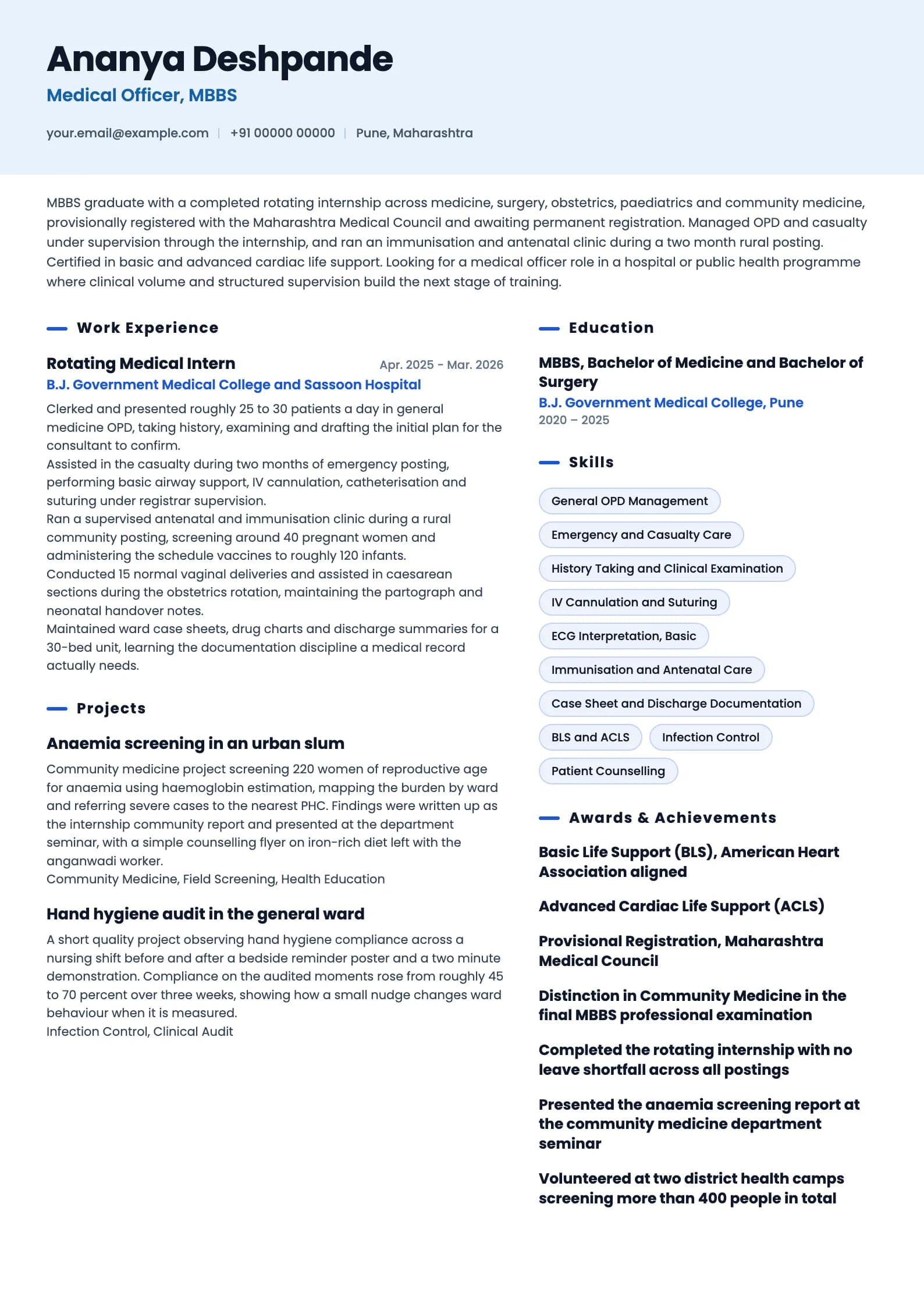
Build my resumeMedical Officer resume example, Fresher (0 years)
ai-era templateIs your resume good enough?
Upload the resume you have now and see what an applicant tracking system reads before a medical officer recruiter ever does.
Free to run. Sign in with your mobile number to see your score.
Medical Officer resume example, Medical Officer (5 years)
professional template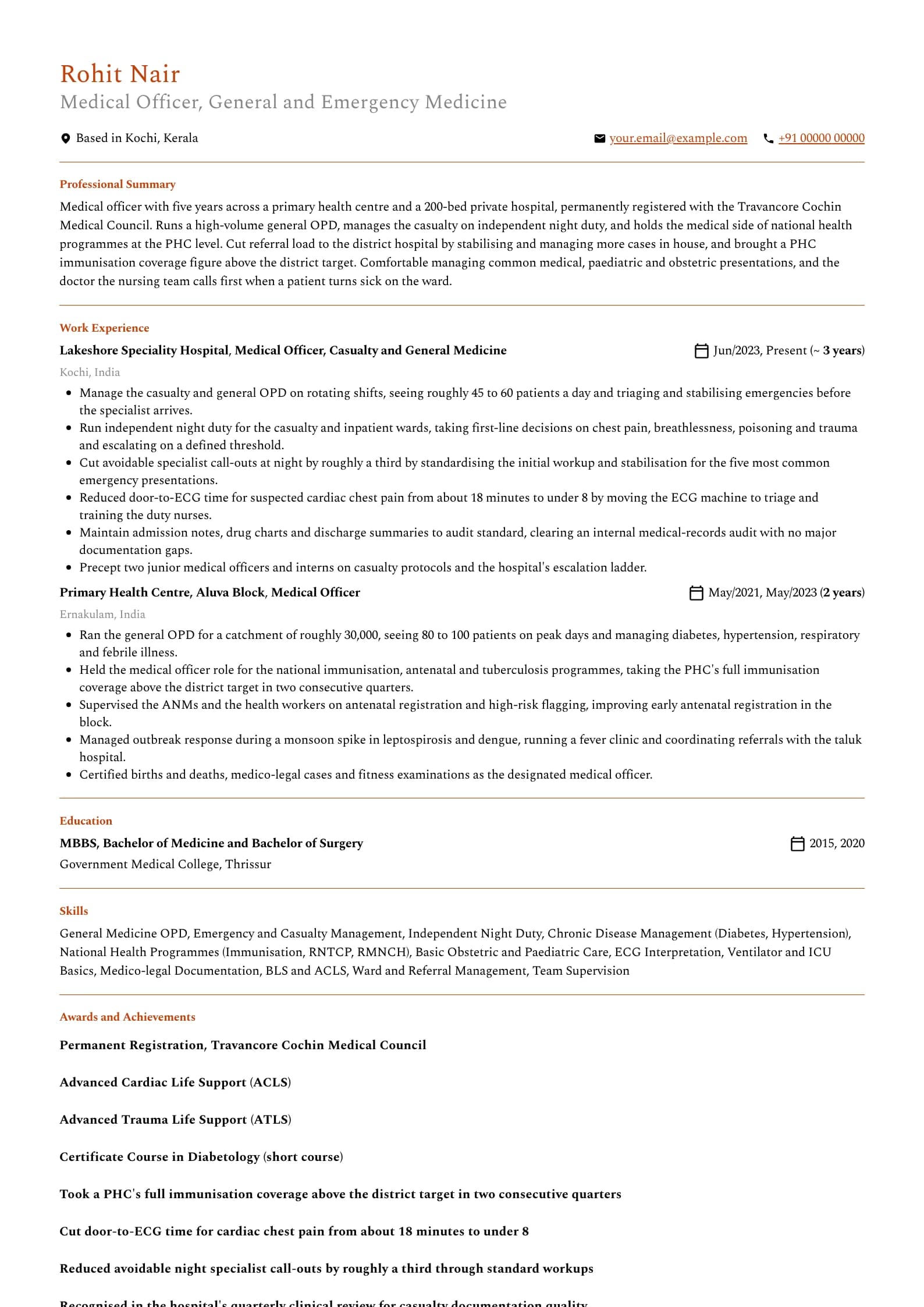
Want this structure with your own details? Build it in the resume builder.
Medical Officer resume example, Senior Medical Officer (12 years)
header-band template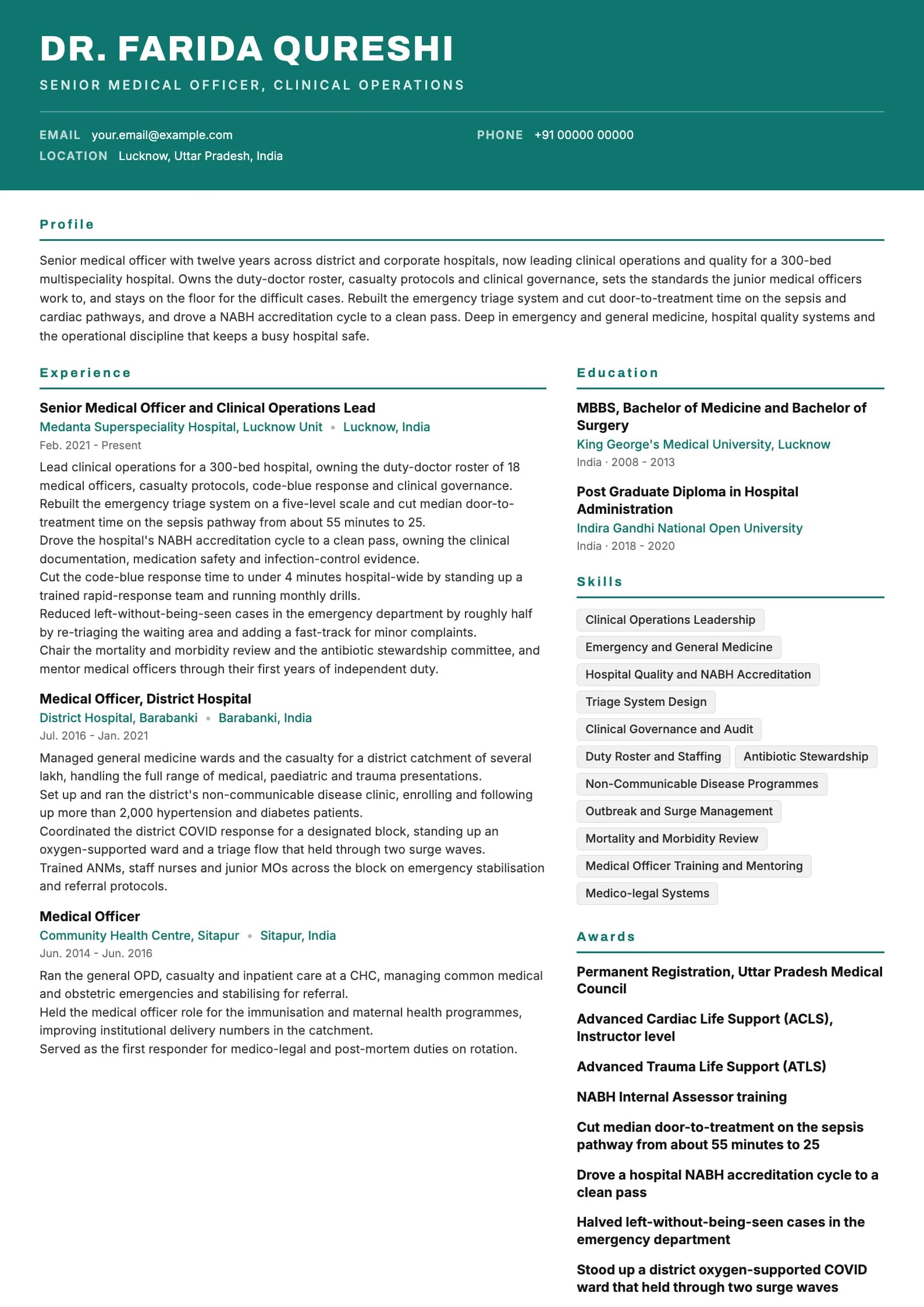
The format that works for medical officer resumes in India
Reverse chronological is the layout to use. Most recent posting first, work backwards, dates in plain view. A functional layout that groups everything under Clinical Skills and drops the dates reads as an attempt to hide a gap or a short stint, and clinical recruiters treat it that way. A gap, a PG attempt year, or a locum stretch is better explained in one honest line than buried. One registration detail decides whether the rest of the resume is even read: your medical council registration. State it near the top, name the council, and say whether it is provisional or permanent. A medical officer without a stated registration is an unverifiable claim, and a busy screener will not chase it. Length follows evidence. A fresher and a medical officer up to roughly six or seven years fit one page comfortably. Beyond that, a second page is fine when it carries real clinical and operational work, not a longer list of camps attended. A page two built from a hobbies line and a declaration is a padded one-pager. Four things do not belong on a clinical resume here: a photograph, marital status, father's name and a religion line. They survive from an old biodata template. What does belong, and is often missed, is the clean block of registration, life-support certification and internship, because those are the first things a chief medical officer checks. Send a PDF unless the posting asks otherwise, name the file with your own name and MBBS, and keep it single column so it parses cleanly. The table below sets the section order.
| Section | Where it goes | Why |
|---|---|---|
| Name and headline | Top, above everything | Headline names the role, Medical Officer, and your degree. Recruiters match on it. |
| Registration and life support | Directly under the header | Council, registration number status, BLS and ACLS. The first thing a clinical screen verifies. |
| Professional summary | Under the registration block | Three lines. Setting, years, patient scope and the single strongest result. |
| Work experience | Next, for anyone past internship | Most recent posting first. State the setting and patient volume. |
| Internship | Above experience for a fresher, folded in later | For a fresher the rotations are the evidence. State volume per posting. |
| Education | Bottom, unless you are a fresher | MBBS, college, years. Add percentage only while it still helps. |
| Certifications and CME | After education, or beside skills | ACLS, ATLS, short courses. Name, body, year, current or expired. |
Registration, internship and where they sit
For a medical officer, the medical council registration is not a footnote, it is the licence to practise, and a resume that hides it or forgets it forces the recruiter to guess. Put it high, name the state council or the National Medical Commission, and state whether it is provisional or permanent. If you have the registration number, it belongs on the resume, because it is a fact a hospital can verify in one lookup. The internship is the fresher's whole clinical case. Do not reduce it to the single word internship. Break it into the rotations that matter, medicine, surgery, obstetrics, paediatrics, casualty and community medicine, and for each one state what you did with your own hands and roughly how much: deliveries conducted, cases clerked a day, procedures assisted. A rotation described by volume and procedure is evidence, the word internship alone is not. For a foreign medical graduate, state the FMGE or NExT clearance and the registration plainly, because a screener needs to know your Indian licensing status before anything else. Hiding it does not help, it only moves the question to a phone call you may never get. Life-support certification sits with registration for a reason: for casualty and hospital roles it is close to mandatory, and a current BLS and ACLS is a clean, dated, checkable line. An expired card listed as current is a small dishonesty that is easy to catch, so renew it or write the expiry honestly.
State your council, your registration status and your BLS and ACLS in the first block of the resume. A medical officer resume without a clear registration line is an unverifiable claim, and unverifiable claims get skipped, not chased.
Writing a summary a chief medical officer actually reads
The block under your registration line is the part you can be reasonably sure gets read, so it should carry three facts: where you practise, how long you have, and the strongest thing that happened because of your work. Three or four lines, no adjectives a reviewer cannot check. The old objective line, seeking a challenging position in a reputed hospital to serve humanity and utilise my medical knowledge, tells the reader nothing they did not assume from the application. Replace it with a summary. An objective says what you want, a summary says what you have already done, and only one is evidence a hospital can act on. Freshers often feel they have nothing to summarise. Look at the fresher sample: it names the completed rotations, the registration status, the life-support certification and a rural posting with real numbers. That is a genuine summary built from an internship. What it avoids is "dedicated and passionate doctor with excellent patient care skills", a phrase so common on MBBS resumes that it now carries no information. A practical test: read your summary and ask whether a batchmate with the same internship could paste it onto their resume unchanged. If they could, it describes the degree, not you. Add the specific setting, the specific patient volume and the specific result until it stops being transferable.
Professional summary, experienced medical officer
Weak
Dedicated and hardworking MBBS doctor with 5 years of experience seeking a challenging medical officer position in a reputed hospital to utilise my clinical skills and serve patients.
Strong
Medical officer with five years across a PHC and a 200-bed private hospital, running a high-volume general OPD and independent casualty night duty. Cut avoidable night specialist call-outs by a third and took a PHC's immunisation coverage above the district target.
The rewrite trades self-description for a setting, a patient scope and two verifiable results a hospital can ask about.
Experience bullets: verb, clinical setting, consequence
Every strong bullet in the samples follows the same shape. It opens with an action verb, names the specific clinical setting or change, and closes with what measurably moved. The verb establishes that you did it. The setting tells a medical reviewer whether the work is relevant. The number does the persuading. Start with the outcome and work backwards. Doctors usually write the duty first, then struggle to attach a number, which produces bullets like "handled OPD and casualty and provided treatment to patients". Instead ask what was different because you were on that floor: a referral avoided, a door-to-ECG time cut, a coverage figure lifted, an audit passed, a response time dropped. Then write the sentence that ends in that fact. Vary the metric. Patient count repeated in every line reads as one number. Across a real posting you can honestly reach for patient volume, referral load, coverage percentage, response time, immunisation targets, mortality review outcomes and cases stabilised. The mid-level sample uses several types across its bullets, which reads as range. Where you lack a hard number, give scope: how large a catchment, how many beds, how many programmes held, how many staff supervised. "Ran the general OPD for a catchment of roughly 30,000" carries weight without inventing a percentage. Allocate bullets by recency. Current posting gets five or six, the previous one four or five, anything older two or three. And keep patient confidentiality: describe volume and pathway, never a named or identifiable patient.
| Level | What bullets must prove | Typical metric |
|---|---|---|
| Fresher / intern | You can safely manage a patient under supervision | Cases clerked a day, deliveries conducted, procedures assisted |
| 1 to 4 years | You take first-line decisions on independent duty | Patient volume, catchment size, referral load, coverage |
| 5 to 8 years | You run a service and its programmes, not just a clinic | Response times, programme targets, audit passes, outbreak response |
| 9 years and up | You set clinical standards across a hospital or district | Door-to-treatment, accreditation, mortality review, staffing |
Experience bullet, casualty duty
Weak
Responsible for managing casualty and OPD patients and providing appropriate treatment as per hospital protocols.
Strong
Reduced door-to-ECG time for suspected cardiac chest pain from about 18 minutes to under 8 by moving the ECG machine to triage and training the duty nurses.
"Responsible for" describes a duty roster; the rewrite names the change made and the delay it removed.
Experience bullet, public health
Weak
Worked on immunisation and various national health programmes at the primary health centre and achieved good coverage.
Strong
Held the medical officer role for the immunisation, antenatal and TB programmes and took the PHC's full immunisation coverage above the district target in two consecutive quarters.
Names the specific programmes, the responsibility held and the measurable target cleared, so a reviewer can ask a real follow-up.
If a bullet would read identically on a batchmate's resume, it is describing the posting, not you. Rewrite it until it only fits the ward, catchment or programme you actually ran.
The skills section: clinical, grouped, and honest
A medical officer's skills section has two audiences with opposite preferences. The parser wants literal clinical terms it can match, casualty, ACLS, ECG, immunisation. A human wants a short, organised list that signals what kind of doctor you are, an emergency-heavy MO, a public-health MO, a ward doctor. Grouping satisfies both. Group by function rather than one long line. Clinical care, emergency and procedures, public health, and systems is a grouping that works for almost every medical officer. The exact headings matter less than the fact that structure exists. Write the terms the way the field writes them: ACLS not ACLs, RNTCP or NTEP correctly, NABH not Nabh. A parser matches on strings. Twelve to sixteen skills is the working range. Below eight the section looks thin. Above twenty it stops being a signal, and a clinical resume is prone to listing every disease as a skill. "Diabetes, hypertension, asthma, COPD, thyroid, anaemia" as six separate skills is padding, group it as chronic disease management instead. The list is a contract: every item is a question you have agreed to answer at interview. Do not put a proficiency bar or a star rating on a clinical skill. Nobody agrees what four stars in emergency medicine means, and it invites an argument you cannot win. Let the experience prove the depth.
| Group | What goes in it | How many |
|---|---|---|
| Clinical care | General medicine OPD, ward management, chronic disease management | 3 to 5 |
| Emergency and procedures | Casualty, triage, ECG, IV cannulation, suturing, catheterisation | 3 to 5 |
| Obstetric and paediatric | Antenatal care, normal delivery, basic neonatal care, immunisation | 2 to 3 |
| Public health | National programmes, outbreak response, camp and screening work | 1 to 3 |
| Systems | Medical documentation, medico-legal, quality and audit, BLS/ACLS | 2 to 4 |
Skills section
Weak
Skills: MBBS, Medicine, Surgery, OPD, IPD, Casualty, Emergency, Diabetes, Hypertension, Asthma, COPD, Thyroid, Anaemia, Fever, Dengue, Malaria, Typhoid, Immunisation, Injection, IV, ECG, First Aid, MS Office, Good communication
Strong
Clinical: general medicine OPD, ward management, chronic disease management. Emergency: casualty and triage, ECG interpretation, IV cannulation, suturing. Public health: immunisation and RMNCH programmes, outbreak response. Systems: medico-legal documentation, BLS and ACLS.
Cuts the single-disease padding and the MS Office filler, collapses the wall to grouped clinical competencies a screener reads in one pass.
Certifications, CME and short courses that carry weight
For a medical officer, the certifications block is where a resume quietly proves it is current. Life-support courses come first because casualty and hospital roles expect them: BLS and ACLS for almost everyone, ATLS if you work trauma, and PALS or NRP if you touch paediatrics and newborns. Name the course, the issuing body, the year, and whether it is current, because these certifications expire and an expired card presented as valid is easy to check. Short clinical courses signal a direction. A certificate course in diabetology, a fellowship in emergency medicine, a family-medicine diploma, or a critical-care course tells a hospital what kind of MO you are becoming. They matter most in the early and middle years, when you are shaping a clinical identity, and less once you have years of the actual work to point at. For a doctor preparing for or holding a postgraduate seat, state it honestly. A dropped year for NEET-PG preparation is far better explained as exactly that than left as an unexplained gap, and many hospitals value an MO who is clinically serious enough to sit the exam. List continuing medical education selectively. A page of every one-day CME attended is noise. Two or three that are relevant to the role, with the credit hours, show engagement without padding. And keep the registration renewal current, because a lapsed registration is not a formatting issue, it is a practising issue a hospital cannot overlook.
Getting a medical officer resume through the ATS
Large hospital groups and government recruitment portals increasingly run resumes through an applicant tracking system before a human sees them. An ATS is a parser and a search index, not a judge. It reads your file, tries to break it into name, dates, employers, titles and skills, and stores the result so a recruiter can search across applicants. Almost every ATS problem is a parsing problem, and parsing problems come from layout, not from your clinical ability. The layout rules are short. One column. Standard section headings, so use Work Experience rather than My Clinical Journey, and Skills rather than My Expertise. No text inside images, because a scanned certificate pasted into the resume reads as empty space. No critical information in the header or footer region, which some parsers drop, and that includes your registration line, so keep it in the body. Avoid text boxes and nested tables. On wording, mirror the language of the posting where it is honest. If the advertisement says casualty medical officer, write casualty. If it says NABH, write NABH. Include the expansion alongside an acronym at least once, for example "ACLS (advanced cardiac life support)" and "NTEP (national tuberculosis elimination programme)", so both searches find you. Keyword stuffing does not work. A hidden block of every disease name in white text is spotted quickly and reads worse than being filtered. Write real bullets that naturally carry the right terms, because a bullet describing your casualty work contains casualty in a context that survives human review too. Save as PDF from a tool that embeds real text, then open the file and confirm you can select and copy a sentence. If you cannot select the text, neither can the parser.
Section heading
Weak
My Medical Odyssey
Strong
Work Experience
Parsers look for standard headings; a creative one can push the whole block into an unclassified bucket the recruiter never searches.
Test your own file before you send it. Copy the text out of the PDF into a plain text editor. Whatever you can read there is roughly what the parser sees, and if your registration line or dates come out scrambled, that is a real risk to fix.
What gets medical officer resumes rejected
Most rejections at the resume stage are not close calls. They come from a small set of recurring problems, and all of them are fixable in an afternoon. The list below covers what screeners of Indian MBBS and medical officer resumes see most often, in rough order of how much damage each one does.
- No medical council registration stated. Without it, the whole resume is an unverifiable claim, and it gets skipped rather than chased.
- The internship reduced to one word instead of rotations with volume. For a fresher this throws away the only clinical evidence there is.
- An expired BLS, ACLS or ATLS listed as current. Life-support cards are dated and easy to verify, so honesty here is not optional.
- A generic objective line about serving humanity. Replace it with a summary that states setting, years and one result.
- No numbers anywhere. Patient volume, referral load, response time, coverage. Pick whichever is honest for the posting.
- A photo, marital status, father's name or religion line carried over from an old biodata template. None of it belongs on a clinical resume.
- Every disease listed as a separate skill to pad the list, which a clinician sees through immediately.
- Confidentiality slips: a named patient, a case detail that identifies someone. It reads as a doctor who cannot be trusted with records.
- Dates or titles that do not match your registration and payslips. Background and council verification is standard and a mismatch ends the process.
- Typos in drug names or clinical terms. Writing a drug or a diagnosis wrong on the one page a doctor should get right undoes an otherwise strong resume.
Read your resume aloud once before sending it. Anything you would be embarrassed to defend to a medical superintendent's face is a line to cut or rewrite.
Skills to put on a medical officer resume
Technical
- General Medicine OPD and Ward Management
- Emergency and Casualty Care
- Triage and Stabilisation
- ECG Interpretation
- IV Cannulation, Suturing and Catheterisation
- Chronic Disease Management
- Basic Obstetric and Neonatal Care
- Immunisation and Antenatal Care
- National Health Programmes (NTEP, RMNCH)
- Outbreak and Fever Clinic Management
- Ventilator and ICU Basics
- Clinical Documentation and Audit
Tools and platforms
- BLS and ACLS
- ATLS
- Hospital Information System (HIS)
- Electronic Medical Records
- Point-of-care Ultrasound, Basic
- Glucometer and Pulse Oximetry
- Defibrillator and Monitor
- NABH Documentation
- e-Hospital / national health portals
- MS Office and reporting
Working skills
- Patient communication and counselling
- Clinical decision making under pressure
- Team coordination with nursing staff
- Mentoring interns and junior MOs
- Time management on high-volume duty
- Empathy and bedside manner
- Cross-department coordination
- Medico-legal awareness
- Ethical and confidential conduct
Certifications worth listing as a medical officer
| Certification | Full name | Worth it for |
|---|---|---|
| BLS | Basic Life Support | The baseline life-support certification for any medical officer, expected for casualty and ward duty. Worth holding current for everyone from intern upward, and cheap to renew. A lapsed card presented as valid is an easy thing for a hospital to catch, so keep the date honest. |
| ACLS | Advanced Cardiac Life Support | Close to mandatory for a medical officer taking independent casualty or night duty, since it certifies you can run a cardiac arrest and the peri-arrest pathways. Most valuable across the first several years of hospital and emergency work, and the instructor-level version signals a senior MO who trains others. |
| ATLS | Advanced Trauma Life Support | Worth doing for medical officers in casualty, district hospitals or any setting that receives trauma, because it standardises the primary and secondary survey. Pairs naturally with emergency-heavy roles. Skip it if your work is purely OPD or public health with no trauma exposure. |
| Diabetology course | Certificate Course in Diabetology or NCD management | A useful short credential for a medical officer whose OPD is dominated by diabetes and hypertension, which describes most PHC and general practice in India. Signals depth in the commonest chronic conditions. Most valuable in the early-to-middle career, less so once your experience shows the same thing. |
| FMGE / NExT | Foreign Medical Graduate Examination / National Exit Test | Not a certification you choose but a licensing fact to state plainly for any doctor with a foreign MBBS. Naming the clearance and the resulting registration is what lets a hospital treat you as eligible. Hiding it only moves the question to a call you may never receive. |
| PGDHA | Post Graduate Diploma in Hospital Administration | Worth it for a senior medical officer moving toward clinical operations, quality or a superintendent track, where the administrative vocabulary matters as much as the clinical. Less useful early on than a clinical short course, and unnecessary if you intend to stay purely on the floor. |
Keywords an ATS scans for in a medical officer resume
These are the literal terms a parser matches against the job description. Use the ones that are true of you, in the sentences where you did the work, not as a list at the bottom.
- medical officer
- MBBS
- medical council registration
- casualty
- emergency medicine
- general medicine
- OPD
- IPD
- triage
- ECG
- ACLS
- BLS
- ATLS
- immunisation
- antenatal care
- chronic disease management
- national health programmes
- clinical documentation
- NABH
- patient care
Medical Officer resume FAQ
What salary can a medical officer expect in India?
A fresher medical officer typically starts around 4.2 to 8 LPA, with private hospitals and corporate chains at the higher end and small nursing homes lower. A medical officer with five to eight years across casualty, OPD and programmes usually sits in the 8 to 16 LPA band, and government contractual MO posts often add allowances on top of a fixed scale. Senior medical officers and clinical operations leads with ten years and above commonly earn 18 to 35 LPA in larger hospital groups. A postgraduate qualification changes the picture entirely, since it moves you from MO pay toward specialist pay.
How long should a medical officer resume be?
One page up to about six or seven years of experience, two pages after that only if the second page carries real clinical and operational work rather than a longer list of camps and CMEs. Keep the registration line, life-support certification and internship or current posting on the first page, since those are what a screener checks first. If you are struggling to fit one page, cut the oldest posting to a line and remove one-day CME entries.
Where do I put my medical council registration on the resume?
High, in the first block under your name, not buried at the bottom and never only in the footer, which some parsers drop. Name the council or the National Medical Commission, state whether it is provisional or permanent, and include the registration number if you have it. For a medical officer this is the single most important verifiable fact on the page, so make it easy to find.
How does a fresher MBBS write a resume with only an internship?
Lead with the internship, broken into its rotations rather than the single word internship. For each rotation state what you did with your own hands and roughly how much: cases clerked a day, deliveries conducted, procedures assisted, a rural posting's screening numbers. Add your registration status, your BLS and ACLS, and any community-medicine project with real figures. Verifiable clinical volume carries far more weight than adjectives like dedicated or passionate.
Do life-support certifications like BLS and ACLS actually matter?
Yes, especially for casualty, hospital and night-duty roles, where a current BLS and ACLS is close to expected. They are dated, checkable credentials that tell a hospital you can run an emergency safely. Add ATLS if you work trauma and PALS or NRP if you handle paediatrics and newborns. Keep them current, because an expired card listed as valid is easy to catch and reads worse than not holding one.
How do I explain a gap year for NEET-PG preparation?
State it plainly as a preparation year for the postgraduate entrance, ideally in one honest line rather than as an unexplained gap. Many hospitals value a medical officer who is clinically serious enough to sit the exam, and an unexplained gap invites worse assumptions than the real reason. If you did any locum, part-time OPD or camp work in that period, list it, because it shows you stayed in clinical practice.
Should a foreign medical graduate mention FMGE or NExT on the resume?
Yes, clearly and near the registration line. A hospital needs to know your Indian licensing status before it can consider you, so state the FMGE or NExT clearance and the resulting state or NMC registration plainly. Hiding it does not remove the question, it only moves it to a screening call that may never come. Presented openly, it simply confirms you are eligible to practise in India.
Do I need a photo on a medical officer resume in India?
No. Clinical recruiters do not expect one, and it takes space that a posting, a programme or a result should occupy. The same goes for marital status, father's name, religion and a declaration paragraph, all of which come from an older biodata template. What does belong, and is often missed, is the clean block of registration, life-support certification and internship rotations, which is what a chief medical officer actually checks first.
Is a two-column resume risky for hospital recruitment portals?
It can be. Some applicant tracking systems and recruitment portals read multi-column layouts out of order, which interleaves a sidebar with your experience and can scramble your registration line and dates in the recruiter's view. A single-column layout removes the risk, which is why all three samples above use one. Test your own file by copying the text out of the PDF into a plain text editor, and if it reads in order there it will most likely parse correctly.
Related resume examples and guides
Build your own in any of these formats
Start from a blank resume or upload the one you have. Goodspace renders it in 24 templates and flags the clinical, casualty and public-health keywords a hospital's applicant tracking system will look for, and the padding it will not credit.
Build my resume