3 Doctor Resume Examples, Format and Guide
A doctor's resume in India has one job before a human reads it: prove you are qualified and registered to practise. Hospital HR systems and job portals screen first on degree, registration number and specialty, and a resume that buries these is filtered out before a consultant ever sees it. Below are three complete resumes, one for a fresher who has just finished internship, one for a medical officer with a few years in practice, and one for a senior consultant, followed by the format rules and the exact details that matter. Each sample is a full document, not a fragment: summary, registration, clinical experience with real caseload numbers, education, certifications and publications, in the order a medical reviewer expects.
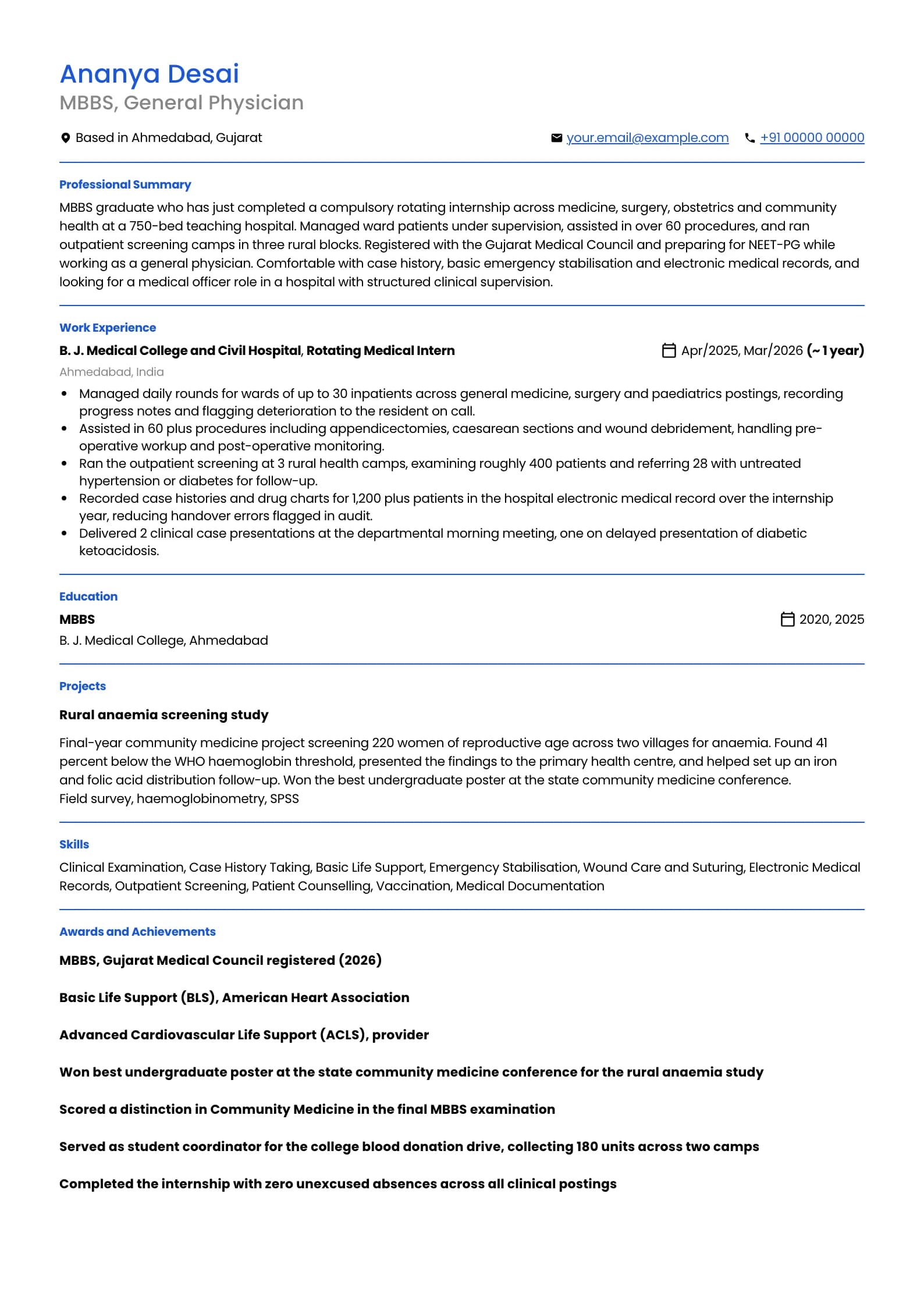
Build my resumeDoctor resume example, Fresher (0 years)
professional templateIs your resume good enough?
Upload the resume you have now and see what an applicant tracking system reads before a doctor recruiter ever does.
Free to run. Sign in with your mobile number to see your score.
Doctor resume example, Medical Officer (4 years)
modern template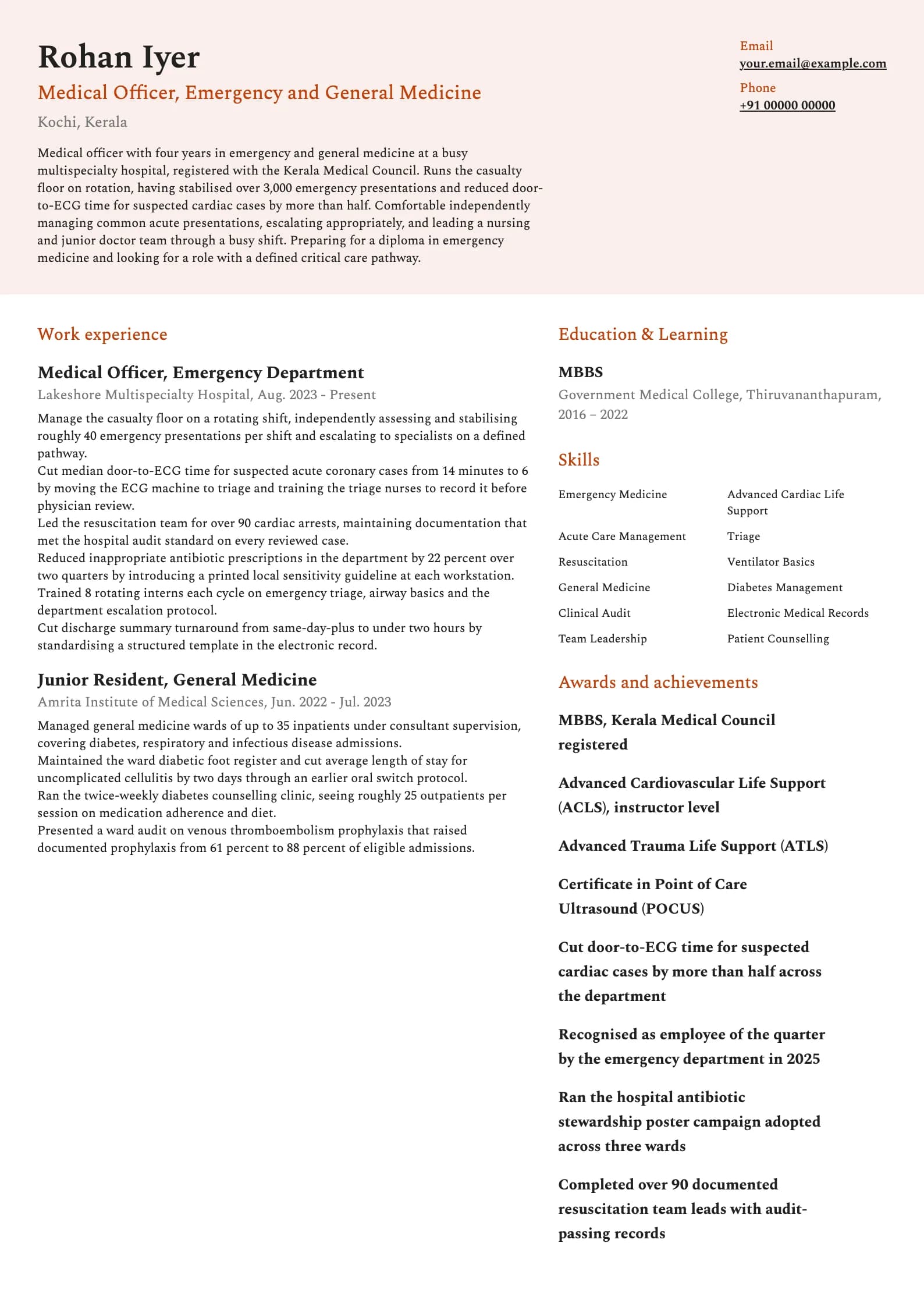
Want this structure with your own details? Build it in the resume builder.
Doctor resume example, Consultant (12 years)
header-band template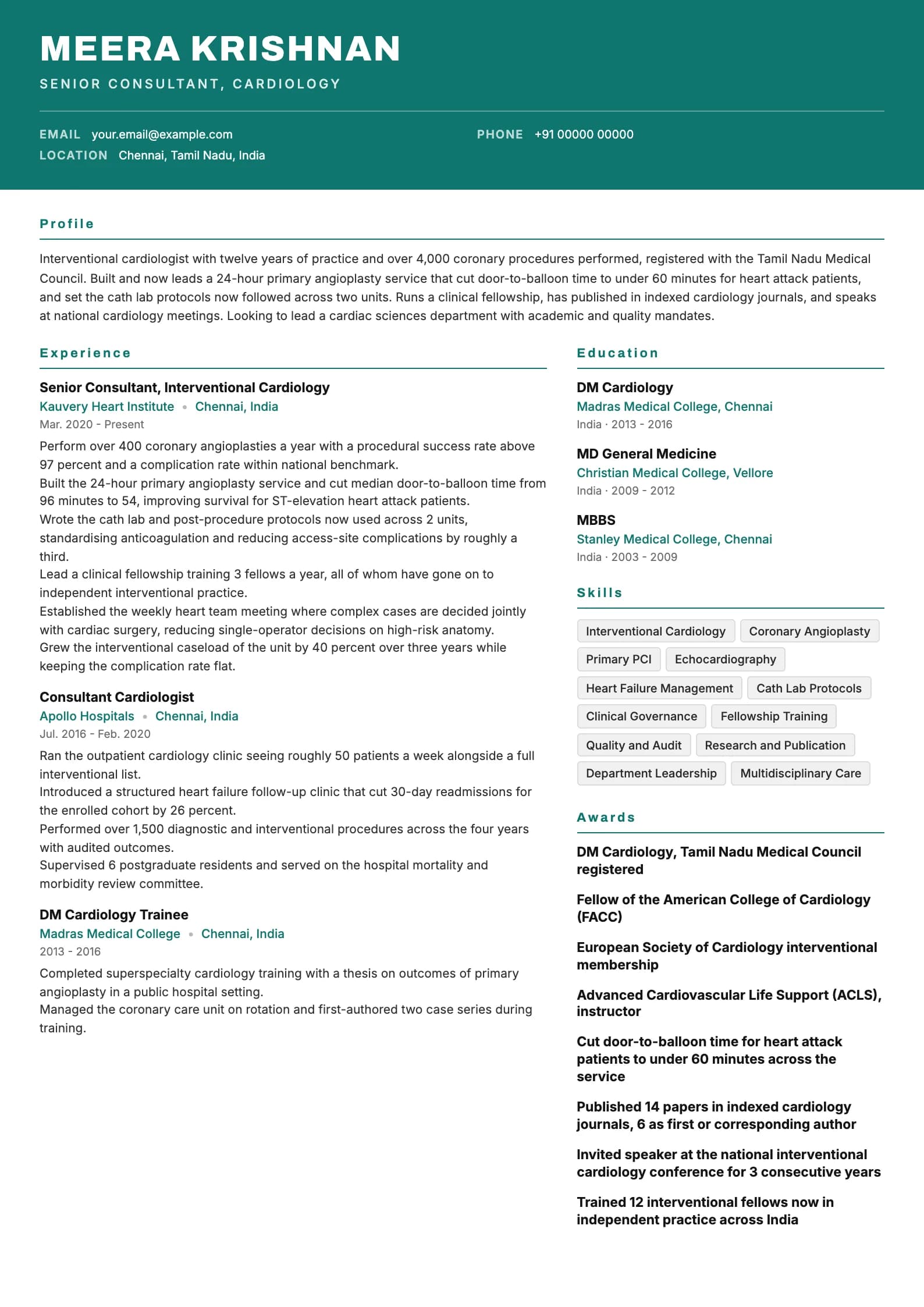
The format that works for doctor resumes in India
Reverse chronological is the right layout for almost every clinical resume in India. The one real exception is the full academic CV a doctor submits for a postgraduate or superspecialty application, which follows a longer institutional format with exhaustive publication and conference lists. For a hospital job, a clinic post or a corporate medical role, use a focused reverse-chronological resume: most recent role first, dates in plain view. The non-negotiable at the top is your qualification and registration. Degree, the council you are registered with, and your registration number belong in the header or the first two lines, because that is the first thing hospital HR verifies and a resume that hides it creates immediate doubt. A doctor who lists a specialty but not a valid registration will be set aside regardless of how strong the rest reads. Length follows evidence. A fresher who has just finished internship fits comfortably on one page. A consultant with a decade of practice, publications and teaching will run to two, and that is expected. What does not justify a second page is a longer list of workshops attended or a hobbies section. If page two is conferences you attended without presenting and a declaration paragraph, it is padding. Four things do not belong on a clinical resume here, the same four that clutter every Indian template: a photograph, date of birth, marital status and father's name. They add nothing to a clinical screen. Where a role genuinely needs a photo, the posting will ask. Send a PDF, name the file with your name and the role, and keep it single column so a portal parser reads it in order. The table below sets the section order.
| Section | Where it goes | Why |
|---|---|---|
| Name and headline | Top, above everything | Headline is your specialty and level, e.g. Consultant, Cardiology. |
| Qualification and registration | In the header or first two lines | Degree, council and registration number. The first thing HR checks. |
| Professional summary | Directly under the header | Three or four lines. Specialty, years, caseload and one strong outcome. |
| Clinical experience | Next, most recent first | Role, hospital, dates. Newest post gets the most detail. |
| Education | Below experience, top for a fresher | MBBS, PG and superspecialty with institution and years. |
| Certifications and licences | After education or beside skills | BLS, ACLS, ATLS and any specialty credential, with year. |
| Publications and research | For anyone who has them | Named journals for a consultant, a project line for a fresher. |
Writing a summary a medical recruiter actually reads
The block under your name is the part most likely to be read, so it must carry what a clinical reviewer screens for: your specialty and level, how long you have practised, the scale of your caseload, and the single strongest outcome you can point to. Three or four lines. Registration belongs here too, because it is the fact that decides whether the rest even matters. The old objective line, seeking a challenging position in a reputed hospital to serve humanity and utilise my skills, tells the reader nothing. Every applicant serves patients; that is the profession, not a differentiator. Replace it with a summary of what you have actually done: the specialty, the volume, and the result. A doctor who writes "stabilised over 3,000 emergency presentations and cut door-to-ECG time by more than half" has said more in one line than a paragraph of aspiration. Freshers often feel there is nothing to summarise after only an internship. Look at the fresher sample. It names the internship postings, the procedures assisted, the patients screened and the council registration. That is a real summary built from a rotating internship. What it avoids is "passionate about patient care", which appears on almost every graduate resume and now carries no information. A practical test: read your summary and ask whether a classmate from the same batch could paste it onto their own resume unchanged. If they could, it describes the degree, not you. Add the specific caseload number, the specific service you improved, the specific specialty focus until it stops being transferable. Rewrite the summary for each meaningfully different role. A summary aimed at a busy casualty post should lead with acute care and resuscitation; one aimed at an outpatient physician role should lead with chronic disease management. It takes two minutes and it is the highest-leverage editing you can do.
Professional summary, medical officer
Weak
Dedicated and hardworking MBBS doctor seeking a challenging position in a reputed hospital to serve humanity and enhance my clinical knowledge.
Strong
Medical officer with four years in emergency medicine, registered with the Kerala Medical Council, having stabilised over 3,000 emergency presentations and cut door-to-ECG time for cardiac cases from 14 minutes to 6.
The rewrite replaces aspiration with a specialty, registration, a caseload number and one verifiable outcome.
Experience bullets: what you managed, at what scale, with what result
A strong clinical bullet names what you managed, the scale you managed it at, and what measurably changed. The verb establishes that you did it. The scale, patients seen, procedures performed, wards covered, tells a reviewer whether your experience matches the post. The result, an outcome, a time saved, a complication rate, a readmission cut, is what persuades. Write bullets that respect what is honest at your level. A supervised intern should not claim independent management of critical cases; "managed under consultant supervision" is both accurate and expected. A medical officer can claim independent management of common acute presentations. A consultant is judged on outcomes and safety, not volume alone. Overstating your independence is the fastest way to lose credibility in the interview, where a single probing question exposes it. Use the metrics that actually exist in clinical work. Caseload and procedure volume, door-to-ECG or door-to-balloon time, length of stay, readmission rate, complication rate, prescribing appropriateness, audit compliance, patients trained or counselled. The medical officer sample uses several different metric types rather than repeating patient count, which reads as range rather than one trick. Where you genuinely have no number, give scope instead: how many beds, how many admissions a week, how many procedures assisted, how many juniors supervised. "Managed general medicine wards of up to 35 inpatients under consultant supervision" carries weight without inventing an outcome nobody measured. Allocate detail by recency and seniority. Current role gets five or six bullets, the previous one four or five, older training posts two or three. A superspecialty training period from years ago can compress to a couple of lines about the thesis and the caseload.
| Level | What bullets must prove | Typical metric |
|---|---|---|
| Fresher / Intern | You have real supervised clinical exposure | Procedures assisted, patients clerked, camps run, records maintained |
| Medical Officer | You manage common cases independently and escalate well | Presentations per shift, door-to-ECG, length of stay, audit compliance |
| Specialist | You run a service and own outcomes | Procedure volume, complication rate, readmissions, protocols set |
| Senior Consultant | You set standards and train others | Door-to-balloon, publications, fellows trained, service built |
Experience bullet, emergency post
Weak
Responsible for treating patients in the casualty and performing duties as assigned by the senior consultant.
Strong
Independently assess and stabilise roughly 40 emergency presentations per shift, escalating to specialists on a defined pathway, and led over 90 documented resuscitation team responses.
"Responsible for" and "duties as assigned" describe a rota; the rewrite names the scope, the volume and the independent decisions made.
Experience bullet, quality work
Weak
Worked on improving the antibiotic usage in the department which led to better patient outcomes.
Strong
Reduced inappropriate antibiotic prescriptions in the department by 22 percent over two quarters by introducing a printed local sensitivity guideline at each workstation.
Names the metric, the mechanism and the timeframe, so a reviewer can ask a real clinical follow-up.
If a bullet would read identically on a batchmate's resume, it is describing the posting, not you. Add the specific caseload, the specific improvement, the specific specialty focus until it only fits you.
The skills and clinical competencies section
A doctor's skills section has two readers with different needs. A hospital job portal parses it for literal terms such as ACLS, echocardiography or emergency medicine. A clinical reviewer wants a short, organised sense of what you can actually do unsupervised. Grouping serves both: the terms are present for the machine, and the structure is readable for the person. Group by function rather than one long paragraph. Clinical skills, procedures, and systems or tools is a grouping that works for most doctors. A surgeon separates operative procedures from perioperative care; a physician separates chronic disease management from acute care. The exact headings matter far less than the fact that some structure exists and that a reviewer can see your competence at a glance. Be honest about independence. A skills list is a set of things you have agreed to be questioned on. Listing a procedure you have only observed, or a modality you cannot interpret alone, invites exactly the question you cannot answer. It is better to list ten competencies you own than twenty you have merely seen. Where independence is partial, the experience section, not the skills list, is the place to say "under supervision". Write the terms the way the field writes them: ACLS not ACLs, echocardiography not echo, electronic medical records or EMR spelled out at least once. Portals match on strings and a spelled-out term plus its acronym catches both searches. Do not add star ratings or proficiency bars to clinical skills. Nobody has agreed what four stars in echocardiography means, and a rating invites an argument you cannot win. Competence in medicine is demonstrated in the experience section, not asserted with a graphic.
| Group | What goes in it | How many |
|---|---|---|
| Clinical skills | History and examination, acute care, chronic disease management | 3 to 6 |
| Procedures | Only procedures you perform or assist competently | 3 to 6 |
| Emergency and critical care | BLS, ACLS, ATLS, resuscitation, ventilator basics | 2 to 4 |
| Systems and tools | Electronic medical records, POCUS, audit, documentation | 2 to 4 |
| Interpersonal | Patient counselling, team leadership, teaching | 2 to 3 |
Skills section
Weak
Skills: Medicine, Surgery, ECG, X-ray, Blood test, Injection, Drip, Ward duty, MS Office, Internet, Communication, Hard working, Team player
Strong
Clinical: acute care, diabetes and hypertension management, ECG interpretation. Procedures: cannulation, wound suturing, lumbar puncture (assisted). Emergency: BLS, ACLS. Tools: electronic medical records, POCUS.
Cuts vague and non-clinical items, names real competencies at the right level of independence, and groups them for a reviewer.
Registration, education and certifications: where they belong
Registration is the one detail that outranks everything on a doctor's resume, so it sits in the header or the first two lines: the medical council you are registered with and your registration number. A specialty claimed without a valid registration is treated as unverified, and hospital HR will not proceed until it is confirmed. If you are registered with more than one state council, list the current one. Education goes near the top for a fresher, who has nothing stronger to lead with, and below experience for anyone in practice. List MBBS, then any postgraduate degree, then superspecialty, each with institution and years. Keep the marks only while you are a fresher and they are strong. Once you have clinical experience, a college percentage competes for space with work that predicts your performance far better, and no interviewer weighs an MBBS aggregate against a consultant's outcome data. Certifications sit below education or beside skills. The life support credentials, BLS, ACLS and ATLS where relevant, are worth naming with the year, because many hospital and emergency roles require them to be current. An expired life support card listed as current is easy to catch and awkward to explain, so renew it or remove it. Specialty credentials and fellowships belong here too, written in full at least once. Publications and research deserve their own place for anyone who has them. A consultant names indexed journals and rough count; a fresher lists a project or a poster. Do not pad this section with conferences merely attended. Presenting or publishing is evidence; attendance is not, and a reviewer can tell the difference immediately. One caution: courses and workshops help most early, when you have little practice to point at, and least once you have years of audited clinical work. A senior clinician's certification list should be short and current. The practice is the credential.
Getting through hospital HR and job portal screening
Most doctor jobs in India are now applied to through a hospital HR portal or a job site, and both parse your file before a human reads it. The parser tries to break your resume into name, qualification, registration, specialty, employers and dates, then stores it so a recruiter can search. Almost every screening failure at this stage is a parsing or a missing-field problem, not a wording one. The rules are short. One column. Put qualification, registration and specialty as plain text near the top, never inside an image or a logo. Use standard headings, Clinical Experience rather than My Medical Journey, and Education rather than Academic Voyage. Keep critical details out of the header and footer region, which some parsers drop. Avoid text boxes and nested tables for the body; a simple skills grid usually survives, but do not gamble your experience section on a fancy layout. On wording, mirror the posting honestly. If it asks for a general physician, use general physician, not the exact synonym you prefer. If it asks for ACLS certification, write ACLS and spell it out once. Include your specialty the way the posting names it, because a search for cardiologist will not always credit interventional cardiology unless the word cardiology is present. Keyword stuffing does not work and looks worse than a filter-out. A hidden block of specialties you do not practise, or a list of every procedure in the textbook, is caught quickly and read as dishonesty, which is fatal in a profession built on trust. Write real experience bullets that naturally contain the right clinical terms, because a bullet describing what you did in the casualty contains the word emergency in a context that survives human review too. One practical step: save as a text-based PDF, not a scan or an image export, and open the file to confirm you can select and copy your registration number and a sentence of experience. If you cannot select the text, neither can the portal.
Section heading
Weak
My Journey in Medicine
Strong
Clinical Experience
Portals look for standard headings; a creative one can push the whole block into an unclassified bucket a recruiter never searches.
Before you upload, copy the text out of your PDF into a plain text editor. If your registration number and most recent role read cleanly there, the portal will most likely parse them correctly.
What gets doctor resumes rejected
Most rejections at the resume stage are not close calls. They come from a small set of recurring problems, and all of them are fixable in an afternoon. The list below covers what reviewers of Indian medical resumes see most often, in rough order of how much damage each does.
- Registration and council missing or buried at the bottom. It is the first fact HR verifies, so it belongs at the top.
- Claiming independent management of cases you handled only under supervision. One interview question exposes it and ends your credibility.
- No caseload or outcome numbers anywhere. Patients seen, procedures performed, time or complication rates moved. Pick whichever is honest.
- A generic objective about serving humanity. Replace it with a summary stating specialty, years, caseload and one result.
- A photo, date of birth, marital status or father's name. None of it belongs on a clinical resume and it takes a project's space.
- Life support certifications listed as current when they have expired. Renew or remove, because it is easy to catch.
- A wall of every procedure and disease from the textbook listed as a skill. It signals padding, not competence.
- The same resume sent to a casualty role, an outpatient physician role and a corporate medical role without reordering the summary.
- Conferences merely attended listed as if they were presentations. A reviewer can tell the difference at a glance.
- Multi-column or image-heavy layouts that a hospital portal reads out of order, scrambling your registration and experience.
Read your resume as if you were the consultant interviewing yourself. Any line you could not defend calmly across a table is a line to cut or rewrite.
Skills to put on a doctor resume
Technical
- Clinical Examination
- History Taking
- Emergency Stabilisation
- Advanced Cardiac Life Support
- Acute Care Management
- Chronic Disease Management
- ECG Interpretation
- Point of Care Ultrasound
- Wound Care and Suturing
- Resuscitation
- Ventilator Basics
- Prescribing and Pharmacology
Tools and platforms
- Electronic Medical Records
- Hospital Information Systems
- Multichannel ECG
- Ultrasound
- Defibrillator and Monitors
- Clinical Audit Tools
- Telemedicine Platforms
- SPSS
- Immunisation Registers
- Drug Interaction Databases
Working skills
- Patient Counselling
- Breaking Difficult News
- Team Leadership
- Clinical Teaching
- Multidisciplinary Coordination
- Time Management Under Load
- Medical Documentation
- Ethical Decision Making
- Empathy and Rapport
Certifications worth listing as a doctor
| Certification | Full name | Worth it for |
|---|---|---|
| State Medical Council Registration | Registration with a State Medical Council or the National Medical Commission | Not optional. Every practising doctor in India must be registered, and the number belongs at the top of the resume. HR verifies it before any interview, so a resume that omits it stalls immediately. |
| BLS | Basic Life Support, American Heart Association or equivalent | Expected of every clinician and often mandatory for hospital roles. Quick to obtain and keep current. A fresher should hold it before the first job application. |
| ACLS | Advanced Cardiovascular Life Support | Important for anyone in emergency, critical care, anaesthesia or acute medicine, and increasingly asked for across hospital posts. Keep it current, since many employers require the card to be in date. |
| ATLS | Advanced Trauma Life Support | Worth it for casualty, surgery and orthopaedics roles, and for anyone working where trauma volume is high. Less relevant for a purely outpatient physician role. |
| POCUS | Point of Care Ultrasound certification | A genuine differentiator for emergency and critical care doctors, since bedside ultrasound is now a core acute-care skill. Only claim it if you can actually acquire and interpret images unsupervised. |
| NEET-PG / INI-CET | National / institute entrance qualifications for postgraduate medicine | Worth naming for a fresher who has qualified or is preparing, as it signals a defined career direction. It is an entrance qualification, not a clinical credential, so it belongs near education rather than in the skills list. |
| Fellowship (FACC, FRCP, etc.) | Specialty fellowships from recognised colleges | Carry weight for consultants and add credibility to a senior clinical resume. Write the full name at least once, and only list fellowships that are current and genuinely earned. |
Keywords an ATS scans for in a doctor resume
These are the literal terms a parser matches against the job description. Use the ones that are true of you, in the sentences where you did the work, not as a list at the bottom.
- MBBS
- medical officer
- general physician
- medical council registration
- clinical experience
- emergency medicine
- ACLS
- BLS
- patient care
- electronic medical records
- ECG
- resuscitation
- outpatient
- inpatient management
- clinical audit
- NEET-PG
- consultant
- case management
- medical documentation
- infection control
Doctor resume FAQ
What salary can a doctor expect in India?
It varies widely by qualification, specialty and city. A fresh MBBS medical officer commonly starts around 6 to 10 LPA in a private hospital, with government posts on their own pay scales. An MD or MS specialist typically earns 12 to 25 LPA depending on specialty and location, and an experienced consultant in a high-demand field such as cardiology, oncology or critical care can earn well beyond that, often with a component tied to procedures or private practice. Your resume does not set the number, but a clear record of caseload and outcomes strengthens your position when it is discussed.
How long should a doctor's resume be?
One page for a fresher who has just finished internship, and up to two pages for a specialist or consultant with publications and teaching. The full academic CV used for postgraduate or teaching applications is a separate, longer document. For a hospital job, keep it focused: registration and specialty at the top, experience with real numbers, and no padding from workshops merely attended.
Where should I put my medical registration number?
In the header or the first two lines, alongside your degree and the council you are registered with. It is the single most important verification detail on a doctor's resume, and hospital HR checks it before anything else. Burying it at the bottom, or leaving it off entirely, is one of the most common reasons a medical resume stalls in screening.
Do doctor resumes go through an ATS in India?
Increasingly yes, because most hospital groups and job portals parse applications before a human reads them. Use a single-column layout, standard headings, and put your qualification, registration and specialty as plain text near the top rather than inside an image. Test your file by copying the text out of the PDF; if your registration number and most recent role read cleanly, a portal will most likely parse them correctly.
How does a fresher doctor write a resume with only internship experience?
Lead with your qualification and registration, then a summary built from your internship, then education and skills. Treat the internship seriously: name the postings, the procedures you assisted, the patients you clerked and any camps or audits you contributed to. A final-year project or a poster counts as evidence. Volume of supervised work is honest and quantifiable even before independent practice begins.
Should I list every procedure I have performed?
List the procedures you can perform or assist competently and unsupervised, not every procedure you have ever observed. A skills list is a set of things you agree to be questioned on, and a procedure you have only watched invites exactly the question you cannot answer. Ten competencies you truly own read stronger than thirty you have merely seen.
Do I need to mention NEET-PG on my resume?
It is worth naming if you have qualified or are actively preparing, because it signals a clear direction toward specialisation. Place it near your education rather than in the clinical skills section, since it is an entrance qualification rather than a competency. Do not overstate it: preparing for NEET-PG is common and honest, and no employer expects a rank you have not achieved.
Should I put my MBBS marks on the resume?
Keep them only while you are a fresher and they are strong, roughly a first class or a distinction. Once you have clinical experience, drop the college aggregate: it competes for space with work that predicts your performance far better, and no interviewer evaluating a medical officer or consultant is weighing an MBBS percentage against your caseload and outcomes.
How do I show research and publications without a full CV?
Give research its own short section. A consultant names the indexed journals and a rough count, marking first or corresponding authorship. A fresher lists a project or a conference poster with the finding. Do not pad the section with conferences you only attended, because presenting and publishing are evidence while attendance is not, and a reviewer distinguishes the two instantly.
Is a photo needed on a doctor's resume in India?
No. Indian hospital recruiters do not expect one, and it takes space a clinical result should occupy. The same goes for date of birth, marital status, father's name and a declaration paragraph, all of which come from an older template that spread through medical colleges. The only exception is a role that explicitly asks for a photograph in the posting.
Related resume examples and guides
Build your own in any of these formats
Start from a blank resume or upload the one you have. The builder renders it in 24 templates and flags what a hospital portal will miss.
Build my resume