Nurse Resume Format, with 3 Full Samples
A nursing resume is read by two different readers: an applicant tracking system looking for registration, speciality and ward keywords, and a nursing superintendent looking for how many patients you can actually hold in a shift. Most resumes serve neither, because they list duties every nurse performs and hide the registration line at the bottom. The gap is rarely about skill. Nurses who run a 32 bed ward without a single medication error still write "responsible for patient care", because nursing training teaches the protocol and nobody teaches the paperwork that gets you in front of the matron. Below are three complete resumes, one each for a B.Sc fresher, a staff nurse with ward experience and a critical care supervisor, followed by the format rules, the registration placement, the ward keywords and the rewrites that make them work.
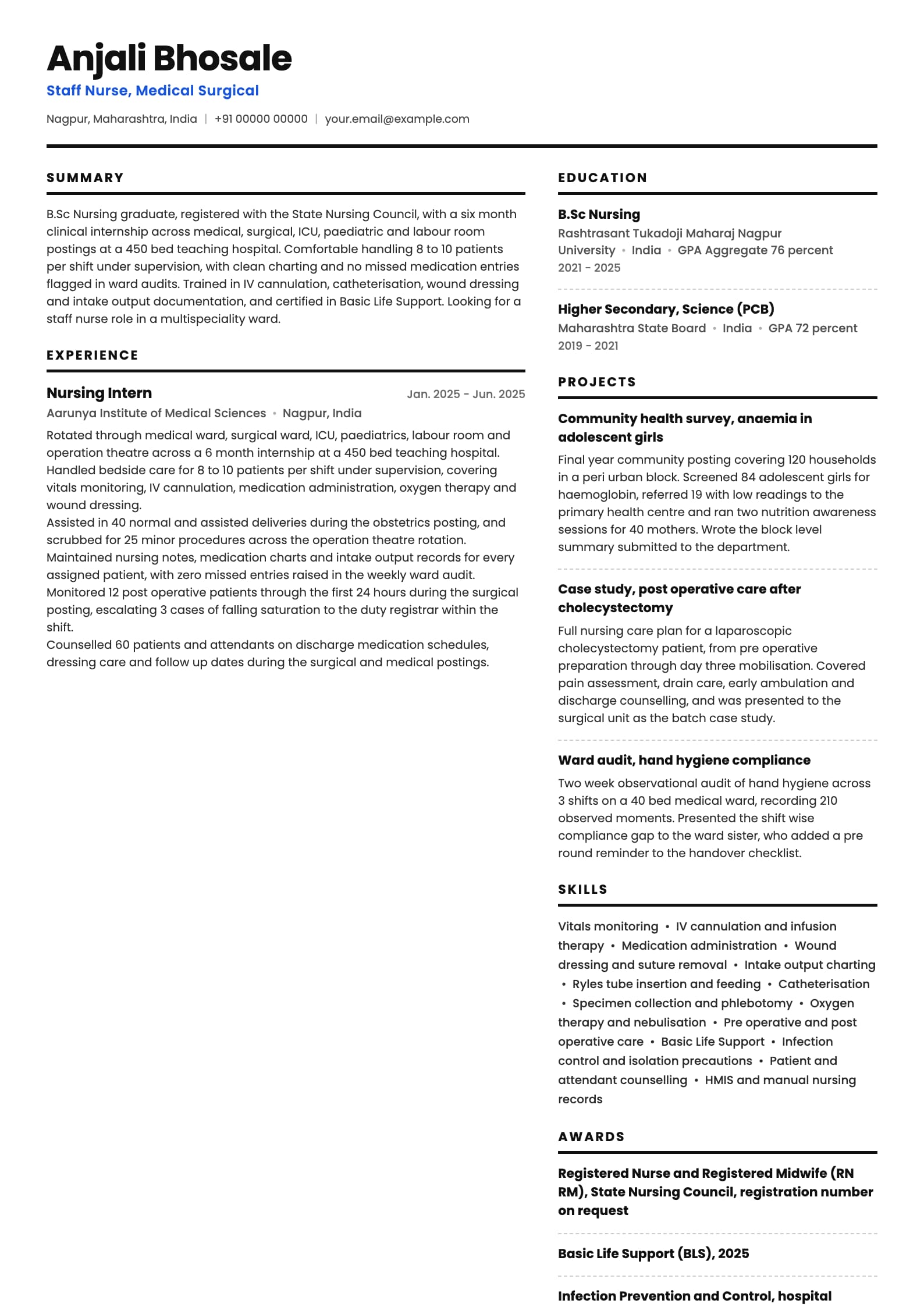
Build my resumeNurse resume example, B.Sc Nursing Fresher (0 years)
split-classic templateIs your resume good enough?
Upload the resume you have now and see what an applicant tracking system reads before a nurse recruiter ever does.
Free to run. Sign in with your mobile number to see your score.
Nurse resume example, Staff Nurse (4 years)
header-band template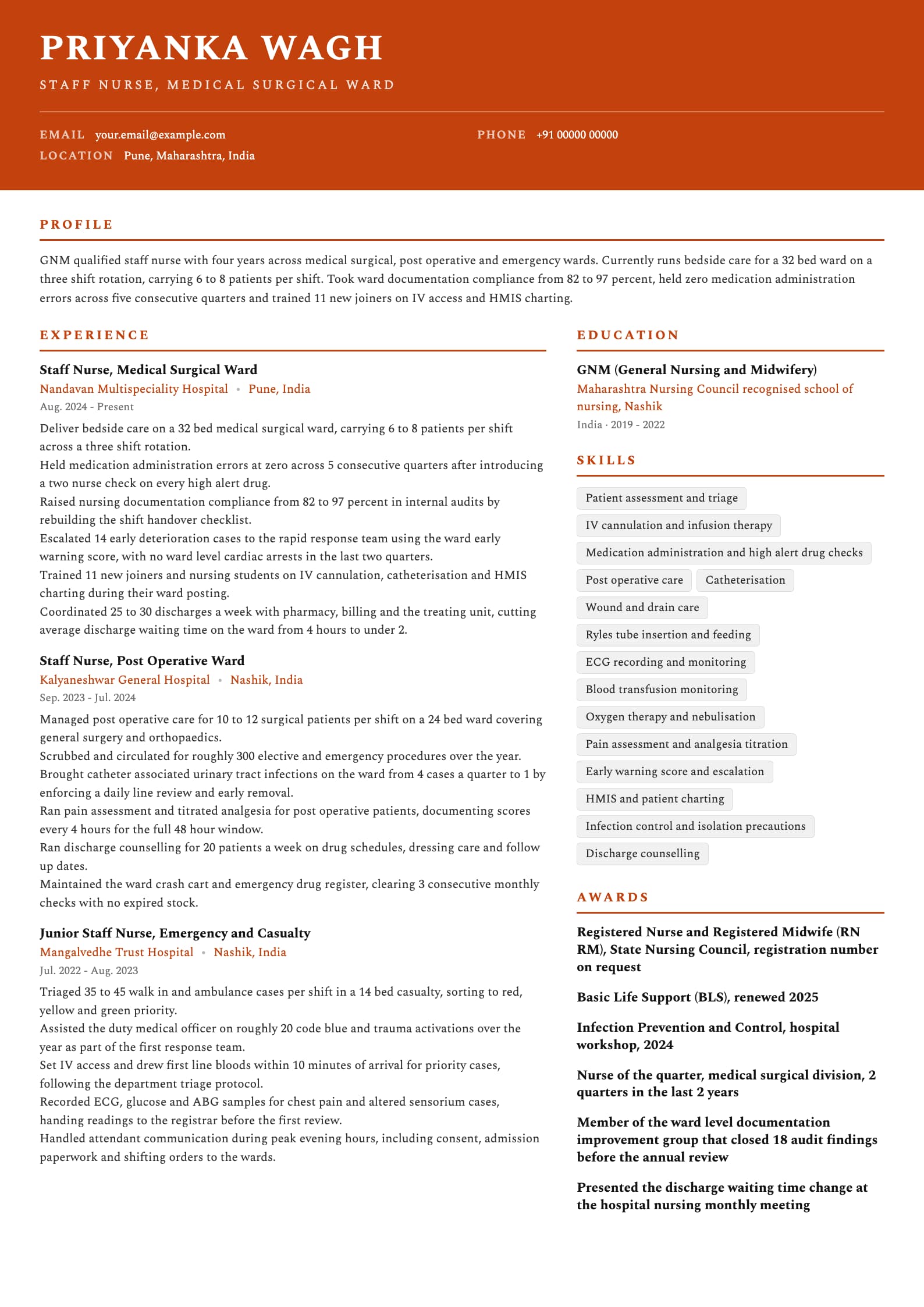
Want this structure with your own details? Build it in the resume builder.
Nurse resume example, Nursing Supervisor, Critical Care (9 years)
tag-pills template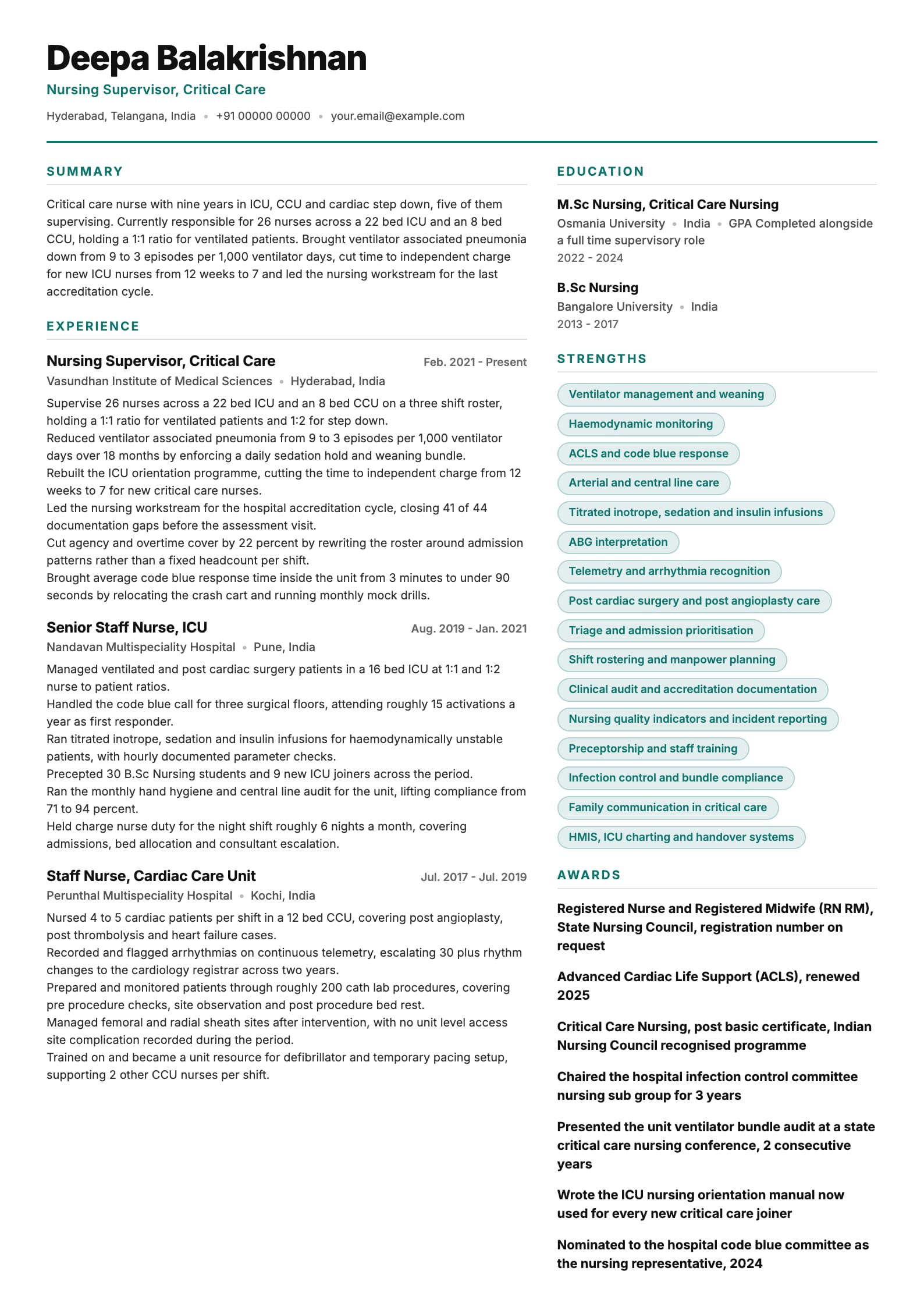
The format that works for nursing resumes in India
Reverse chronological, one page up to roughly six years of experience, two pages after that. Single column, plain headings, no photo, no declaration line, no father's name and no full postal address. City and state is enough. All three samples above follow the same section order, and the order is doing real work: registration and speciality land in the first third of the page, where both the software and the reader look first. The reason nursing resumes need a tighter order than most is that the first pass is not really a reading. A nursing superintendent with 90 applications for six ward vacancies is checking four things, in this sequence: are you registered, what qualification, which ward, and how many patients did you carry. If those four answers are scattered across two pages, the resume gets set aside not because the answers were wrong but because finding them took too long. Everything below the first third is read only by candidates who survived that check. Save the file as a PDF unless the hospital portal specifically asks for a Word document, name it with your own name rather than resume_final_v3, and keep the font size at 10 or 11 points so the page does not force a squint. If the content genuinely runs past one page, break it at a section boundary and repeat your name at the top of page two, because printed shortlists get separated and an unnamed second page belongs to nobody.
| Section | Where it goes | Why |
|---|---|---|
| Name and headline | Top, above everything | The headline is the post you are applying for, with the speciality attached: "Staff Nurse, Medical Surgical" beats "Nurse". |
| Professional summary | Directly under the header | Three to four lines. Qualification, years, ward or speciality, patient load, and the single strongest result. |
| Registration and certifications | Immediately after the summary, or as its own line in the header block | Registration status is a filter, not a footnote. Freshers should place it above education. |
| Work experience | Next, for anyone who has worked a ward | Most recent first. Name the ward type, the bed count and the patient ratio in the first bullet of each role. |
| Clinical rotations and projects | Above experience for freshers, dropped once you have two years of jobs | For a B.Sc or GNM fresher, the internship postings are the evidence. After two ward years they add nothing. |
| Skills | Below experience | Grouped into clinical procedures, equipment and systems, and patient facing skills. Not a 40 item wall. |
| Achievements | After skills, only if you have real ones | Audit wins, awards, committee roles, teaching. Two to four lines. Skip the section entirely rather than pad it. |
| Education | Bottom, unless you are a fresher | Degree, institution, years. Keep the aggregate percentage only until your first job. |
| Languages | Last line | Genuinely used in Indian hospital hiring, because ward communication happens in the patient's language, not yours. |
The professional summary, in four lines that answer four questions
The summary is the only part of a nursing resume that is read in full, every time, by every reader. It is also where most nurses write the weakest sentences on the page, usually some version of a dedicated and hardworking nursing professional seeking a challenging position in a reputed organisation. That sentence describes an applicant's feelings, and nobody hires feelings. The four questions a nursing summary has to answer are fixed: what are you qualified as and registered as, how many years and in which ward or speciality, what patient load do you carry, and what is the one result you would want repeated at your next hospital. Look at the staff nurse sample above. GNM qualified answers the first, four years across medical surgical, post operative and emergency answers the second, 32 bed ward and 6 to 8 patients per shift answers the third, and zero medication errors across five quarters answers the fourth. That is the whole summary, and it took four lines. Write it last, after the experience section is finished, because the summary is a compression of what is already on the page and not a promise about what is coming. If you are a fresher, the same four questions apply with different answers: your qualification and registration status, your internship postings and the hospital's bed count, the patients you handled per shift under supervision, and the strongest single thing from your rotations. Never open with an objective line about career growth. The hospital is not recruiting for your career, it is recruiting for its ward.
Professional summary
Weak
A dedicated and hardworking nursing professional seeking a challenging position in a reputed hospital where I can utilise my skills and grow with the organisation.
Strong
GNM qualified staff nurse with four years across medical surgical, post operative and emergency wards. Currently carries 6 to 8 patients per shift on a 32 bed ward, with zero medication administration errors across five consecutive quarters.
The first version describes what the candidate wants. The second states qualification, years, ward types, patient load and a verified result, which is what the shortlisting decision is actually made on.
Where the nursing council registration goes, and what to actually print
This is the line nurses get wrong most often, and it is the most expensive mistake on the page. Registration with a State Nursing Council, and a qualification recognised by the Indian Nursing Council, is the first thing a hospital HR team checks. If it appears on page two under a heading called "Other details", it is invisible in the first pass, and shortlisting often stops before it is found. The rest of the resume can be excellent and it will not matter, because an unregistered nurse cannot legally be put on a ward and HR is not going to assume in your favour. There is a second, quieter mistake in the other direction. Nurses who know registration matters sometimes print the full registration number in bold on a resume that then gets uploaded to four job portals, forwarded through six WhatsApp groups and left on a consultancy's hard drive. Your registration number is an identity credential tied to your licence, and once it circulates in plain text on documents you do not control, you cannot pull it back. The convention used in all three samples above solves both problems at once: name the council, name the status, name the state, and write that the number is available on request. Every hospital HR team in India understands that line, none of them will reject you for it, and the number itself takes ten seconds to produce at the interview where it is genuinely verified. Inter state transfer is worth a line if it applies to you, because a Kerala registered nurse applying in Telangana raises a question the hospital would rather see answered than discover later.
- Put registration in the top third: either as a line in the header block next to your qualification, or as the first item under certifications, directly below the summary.
- State the council and the status, for example "Registered Nurse and Registered Midwife, State Nursing Council of Maharashtra". Name the state that issued it, since inter state registration transfer is a real hiring question.
- Do not print your registration number on a resume you upload to job portals, share on WhatsApp groups or attach to a public profile. Write "registration number on request" and carry the number to the interview instead.
- If your registration is applied for and not yet issued, say so with the month you applied. Silence reads as an expired or missing licence, which is worse than a pending one.
- If you hold registration in more than one state, list both. Multi state registration is an advantage for hospital groups that move staff across units.
- Keep life support certification dates current. "BLS, renewed 2025" carries weight, "BLS" alone raises a question about whether it lapsed.
- List the speciality certificate separately from the degree. A post basic critical care certificate is a different filter from an M.Sc, and both are worth their own line.
- Do not merge registration into the education block. Education says where you studied, registration says you are legally allowed to nurse, and the reader is checking them at different moments.
Registration line
Weak
Other details: Registered Nurse, Reg. No. XXXXXXXX, D.O.B. 14/03/1998, Marital status: Single, Father's name: ...
Strong
Registered Nurse and Registered Midwife (RN RM), State Nursing Council of Maharashtra, registration number on request
The credential moves out of a junk drawer heading into the top third of page one, the live registration number stops circulating on uploaded files, and three fields no hospital asked for stop taking up space.
A resume that names the issuing council and the year of renewal answers three HR questions before they are asked. A resume that just says "Registered Nurse" answers none of them.
Writing bullets that separate you from every other nurse
Nursing bullets fail in a specific and predictable way: they describe the profession rather than the person. Administering medication, monitoring vitals, maintaining charts and following infection control protocol are what every nurse on the shortlist does, which means writing them down moves you exactly nowhere. The pattern in all three samples is the same, and it is worth learning as a formula: action verb, the clinical setting with its size, and what changed because you were the one on that ward. The objection nurses raise here is that nursing is not a job with numbers. It is one of the most measured jobs in a hospital. You already know your ward's bed count, your patients per shift, your nurse to patient ratio, how many deliveries or procedures you assisted, how many students you precepted, what your documentation audit score was, how many infection episodes the unit recorded and how long the code response took. Every one of those is a number, and none of them require you to exaggerate. If you genuinely do not track a figure, use the range you are confident defending in an interview, because 6 to 8 patients per shift is honest and defensible while 8 patients per shift may not be. Order the bullets by strength rather than chronology inside a role, since the first two are the ones that get read. Give the current role five or six bullets and let older roles compress to four or five, because a hospital cares far more about the ward you are standing on today than the one you left three years ago.
- Weak: "Responsible for patient care and medication administration in the ward."
- Strong: "Deliver bedside care on a 32 bed medical surgical ward, carrying 6 to 8 patients per shift across a three shift rotation."
- Weak: "Maintained patient records and documentation."
- Strong: "Raised nursing documentation compliance from 82 to 97 percent in internal audits by rebuilding the shift handover checklist."
- Weak: "Followed infection control protocols in the ICU."
- Strong: "Reduced ventilator associated pneumonia from 9 to 3 episodes per 1,000 ventilator days over 18 months by enforcing a daily sedation hold and weaning bundle."
- Weak: "Handled emergency cases as per hospital protocol."
- Strong: "Triaged 35 to 45 walk in and ambulance cases per shift in a 14 bed casualty, sorting to red, yellow and green priority."
Experience bullet, teaching and training
Weak
Guided junior nurses and nursing students posted to the ward.
Strong
Trained 11 new joiners and nursing students on IV cannulation, catheterisation and HMIS charting during their ward posting.
A count and three named procedures turn an unverifiable claim into a checkable one, and they add three clinical keywords the first version had none of.
Experience bullet, infection control
Weak
Maintained aseptic technique and followed catheter care protocol.
Strong
Brought catheter associated urinary tract infections on the ward from 4 cases a quarter to 1 by enforcing a daily line review and early removal.
The first states compliance with a rule, which is the baseline expectation. The second states a measured change on a real unit, and names the specific action that caused it.
The numbers a nurse already has are bed count, patients per shift, nurse to patient ratio, procedures assisted, deliveries attended, students precepted, audit compliance, infection episodes and code response time. Pick whichever is honest for your unit and put it in the bullet.
Clinical skills, equipment and soft skills, kept in three separate groups
A nursing skills section fails in two directions. Either it is a wall of thirty ungrouped words that a reader's eye slides straight off, or it is a list of adjectives like dedicated, punctual and hardworking that carry no information at all. The fix is to split the section into three groups and let each group do a different job. Clinical procedures prove you can do the work, equipment and systems prove you can walk onto the ward and use what is already there, and patient facing skills prove you can survive the parts of nursing that are not procedural. The equipment group is the one nurses most often skip, and it is the one hospital HR teams quietly care about. A unit running a specific class of ventilator, a specific multipara monitor and a specific hospital management information system would rather hire someone who has already touched that category of equipment than train from scratch, and the only way they learn you have is if you write it down. Keep the list honest. Every item in your skills section is a question you have agreed to answer at the interview, and a nurse who lists ventilator management and then cannot describe a weaning protocol has spent credibility that was hard to earn. A useful test: read each skill and ask whether you would be comfortable being handed that task on your first shift without supervision. If the answer is no, it belongs in a training section or nowhere.
| Group | What belongs here | What does not |
|---|---|---|
| Clinical procedures | IV cannulation, catheterisation, Ryles tube feeding, wound and drain care, ventilator management, triage, blood transfusion monitoring | Vague umbrellas like "patient care" or "nursing duties", which match nothing specific |
| Equipment and systems | Multipara monitors, infusion and syringe pumps, ventilators, defibrillator and crash cart, ECG machine, ABG analyser, HMIS and charting software | Microsoft Office, unless the role is administrative. It reads as filler on a clinical resume |
| Patient facing and team skills | Shift handover communication, patient and family counselling, preceptorship, multidisciplinary coordination, working under pressure | Dedicated, hardworking, punctual, sincere. Adjectives about character, which every applicant claims |
Skills section
Weak
Skills: Hardworking, dedicated, punctual, good communication, patient care, team player, Microsoft Office, quick learner
Strong
Clinical: IV cannulation and infusion therapy, catheterisation, wound and drain care, ECG recording, blood transfusion monitoring. Equipment: multipara monitors, infusion pumps, defibrillator, HMIS charting. Patient facing: shift handover, discharge counselling, preceptorship.
Eight character adjectives that match no search become fifteen grouped, searchable clinical terms that tell a ward sister exactly what you can be handed on day one.
Speciality and ward experience, the part hospitals actually search on
Hospitals do not recruit nurses in general. They recruit an ICU nurse for a specific ICU, a scrub nurse for a specific theatre list, a dialysis nurse for a specific unit. That means the single most valuable word on a nursing resume is often the ward name, and "hospital experience" written without one is a wasted line. ICU, CCU, NICU, PICU, operation theatre, emergency and casualty, dialysis, labour room, oncology, dialysis and post operative are all distinct search terms, and a recruiter filtering a database is matching on exactly one of them at a time. Write the ward name into the job title where you can, and into the first bullet of the role where you cannot. If you have worked several wards, this is an advantage rather than a dilution, provided you keep them separated. The staff nurse sample above holds medical surgical, post operative and emergency in three distinct roles, which means she surfaces in three different searches without a word of exaggeration. What does not work is collapsing them into a single line that says worked across various departments, because that phrase matches nothing. The same logic applies to the oldest role on a senior resume. The supervisor sample keeps a nine year old CCU role specifically because it carries telemetry, cath lab and pacing vocabulary the recent ICU roles do not. Speciality experience does not expire from a search index the way it fades from memory. If you are trying to move into a new speciality, name the exposure you do have honestly, whether that is a rotation, a relief posting or a certificate course, rather than implying full time experience you have not held.
| Ward or unit | What to quantify | Terms a hospital portal matches |
|---|---|---|
| ICU and critical care | Bed count, nurse to patient ratio, ventilated patients per shift, infection episodes per 1,000 device days | ICU, critical care, ventilator, haemodynamic monitoring, ACLS, central line |
| Emergency and casualty | Cases triaged per shift, bed count, code and trauma activations attended, door to first assessment time | triage, casualty, emergency, code blue, trauma, ABG, ECG |
| Operation theatre | Procedures scrubbed and circulated, speciality lists covered, instrument and count protocol | scrub nurse, circulating nurse, OT, sterilisation, CSSD, surgical count |
| Labour room and maternity | Deliveries attended, assisted deliveries, antenatal cases monitored, newborn immediate care | labour room, midwifery, RM, antenatal, postnatal, partograph |
| NICU and paediatrics | Cot count, ventilated neonates, feeding and weight monitoring load | NICU, neonatal, paediatric nursing, phototherapy, incubator |
| Dialysis | Sessions per shift, machine count, vascular access types managed | dialysis, haemodialysis, AV fistula, dialysis technician, water treatment |
| Medical surgical ward | Bed count, patients per shift, discharges coordinated per week, documentation compliance | medical surgical, ward nurse, post operative care, wound care, discharge counselling |
Getting past the hospital portal and the applicant tracking system
Large hospital groups and most healthcare staffing consultancies run applications through an applicant tracking system before a human sees them. The system is not clever. It reads the text layer of your file, matches it against the terms in the job description, and ranks. Nearly every ATS failure on a nursing resume comes from one of four causes, and all four are avoidable in ten minutes. The first is layout. A two column resume with the skills running down a side panel can be read out of order by older parsers, which turns your ward history into scrambled fragments. Single column removes the risk. The second is file handling. A resume exported as an image, or a scanned printout saved as a PDF, has no text layer at all and parses as a blank document. Test yours by opening the PDF and trying to select a line of text with the cursor. If nothing highlights, the system sees nothing. The third is vocabulary mismatch. If the posting says "staff nurse, medical surgical" and your headline says "nursing professional", the match is weak even though you are the right candidate. Mirror the job title from the posting into your headline, honestly, and use the hospital's own words for the ward. The fourth is abbreviation. Write both forms the first time: Basic Life Support (BLS), Intensive Care Unit (ICU), Advanced Cardiac Life Support (ACLS), because some postings spell it out and some do not, and you want to match either. Tailor the headline and the first two bullets per application. That is usually enough, and it takes less time than rewriting the whole document.
- Use a single column layout with plain section headings: Summary, Certifications, Experience, Skills, Education. Creative heading names confuse parsers for no gain.
- Export as a PDF with a selectable text layer, unless the hospital portal explicitly asks for a Word file. Never upload a photo of a printed resume.
- Mirror the exact job title from the posting into your headline, so long as it is honest for your experience.
- Spell out every abbreviation once with its short form in brackets, then use the short form after.
- Keep dates in a consistent format across every role. Mixed formats are a common reason a parser drops a job entirely.
- Avoid headers and footers for anything load bearing. Some parsers ignore that region of the page completely, which is a bad place for your registration line.
- Do not hide keywords in white text or in the document metadata. Modern systems flag it, and hospital HR treats it as dishonesty.
- Name the file with your own name and the role, so a shortlisting coordinator handling 90 attachments can find you again.
Headline
Weak
Nursing Professional | Passionate About Patient Care | Open To Opportunities
Strong
Staff Nurse, Medical Surgical | RN RM, State Nursing Council | BLS Certified
The second version carries three things a search actually matches on, which are the job title, the registration status and a current certification, in the same space the first spent on adjectives.
What gets nursing resumes rejected
Most rejections at the resume stage are not judgements about your nursing. They are the result of a reader failing to find something in the time they gave the page. The list below is ordered roughly by how often it costs a shortlist, and the first two are worth more attention than the rest combined.
- The registration line hidden on page two, or missing entirely. It is the first filter, so it belongs in the first third of page one.
- A real registration number printed on a resume that gets uploaded to portals and forwarded through WhatsApp. Carry the number to the interview instead.
- Duty lists copied from the job description. "Monitored vitals, administered medication, maintained records" describes every applicant in the pile.
- No ward type, no bed count, no patient ratio. A hospital cannot tell whether you have handled their load, so they assume you have not.
- "Hospital experience" written without naming the unit. ICU, CCU, NICU, OT, emergency, dialysis and labour room are all distinct keywords, and the applicant tracking system is matching on the specific one.
- Photo, date of birth, marital status, father's name and a declaration with a signature block. None of it is expected, and it costs the space a clinical result needs.
- Lapsed BLS or ACLS listed without a year, which reads as an expired certificate rather than a current one.
- Multi column and table heavy layouts that an older applicant tracking system reads out of order, scrambling your ward history into nonsense.
- An objective line asking for career growth, in the slot where a summary should be stating qualification, ward and patient load.
- Unexplained gaps between roles. A one line note saying maternity break or higher studies closes the question that silence leaves open.
- A skills section made of character adjectives. Dedicated and hardworking match no search and prove nothing a reference check would not.
- Four pages for a five year career, usually because every routine ward duty was given its own bullet.
Skills to put on a nurse resume
Technical
- IV cannulation and infusion therapy
- Medication administration and high alert drug checks
- Ventilator management and weaning
- Haemodynamic monitoring
- Triage and patient assessment
- Wound care and dressing
- Catheterisation
- Ryles tube insertion and feeding
- Post operative care
- Central and arterial line care
- Blood transfusion monitoring
- Phlebotomy and sample collection
- ECG recording and arrhythmia recognition
- ABG interpretation
- Oxygen therapy and nebulisation
- Infection control and isolation precautions
Tools and platforms
- HMIS and hospital EMR
- Patient charting and intake output records
- Multipara monitors
- Infusion and syringe pumps
- Mechanical ventilators
- Defibrillator and crash cart
- ECG machine
- Glucometer and ABG analyser
- Pulse oximetry
- Suction and oxygen delivery systems
- Telemetry and central monitoring stations
- Nurse call and shift roster systems
Working skills
- Patient and family counselling
- Shift handover communication
- Working under pressure
- Multidisciplinary team coordination
- Preceptorship and student training
- Empathy and bedside manner
- Attention to documentation detail
- Escalation judgement
- Conflict handling with attendants
- Time management across a patient load
Certifications worth listing as a nurse
| Certification | Full name | Worth it for |
|---|---|---|
| RN RM | Registered Nurse and Registered Midwife, State Nursing Council | Every nurse, without exception. It is the licence, not a bonus. Name the issuing state and write that the number is available on request rather than printing it. |
| BLS | Basic Life Support | Every nurse in a clinical role, and effectively mandatory for ward postings at accredited hospitals. Cheap, quick, and the renewal year matters more than the certificate. |
| ACLS | Advanced Cardiac Life Support | ICU, CCU, emergency and theatre nurses, and anyone applying for charge or supervisor posts. Overkill for a nurse who will spend the next few years on a general ward. |
| Critical Care Nursing | Post basic certificate in critical care nursing, Indian Nursing Council recognised programme | Nurses already working ICU or CCU who want to move to senior or supervisory critical care roles. It only pays back if you stay in critical care, so do not take it as a general upgrade. |
| Infection Control | Infection prevention and control certification or hospital workshop | Anyone on a ward, and genuinely useful for nurses aiming at quality, audit or accreditation work. Also the easiest credential to earn in house at your current hospital. |
| NICU Nursing | Neonatal intensive care nursing certificate | Nurses targeting NICU, paediatric or maternity units. Highly specific, so take it only if you actually want to work with neonates, because it does little for a general ward application. |
| Dialysis Nursing | Dialysis nursing or dialysis technician certification | Nurses moving into nephrology and dialysis units, where demand is steady and the skill is not transferable from general wards. A clear speciality switch, not a general add on. |
| Wound Care | Wound care and ostomy management certification | Surgical, burns and geriatric care nurses, and anyone in home health or long stay units. Worth far less on a resume aimed at emergency or critical care. |
Keywords an ATS scans for in a nurse resume
These are the literal terms a parser matches against the job description. Use the ones that are true of you, in the sentences where you did the work, not as a list at the bottom.
- staff nurse
- registered nurse
- B.Sc Nursing
- GNM
- Indian Nursing Council
- State Nursing Council registration
- ICU nursing
- critical care
- patient care
- medication administration
- IV cannulation
- vitals monitoring
- infection control
- BLS
- ACLS
- patient charting
- operation theatre
- emergency care
- triage
- post operative care
- wound care
- nurse to patient ratio
Nurse resume FAQ
What is the correct resume format for a staff nurse in India?
Reverse chronological, single column, one page until about six years of experience. Header with name and headline, a three to four line summary, registration and certifications, work experience with ward type and bed count, skills grouped into clinical and equipment and patient facing, then education at the bottom. Freshers move clinical rotations and internship above skills, since that is their only evidence. Skip the photo, the declaration and the postal address entirely.
Where should I write my nursing council registration number?
Put the registration line high on page one, either in the header block or as the first certification under your summary, and name the issuing state council. Do not print the actual number on a resume you upload to job portals or share in groups, because you cannot recall a document once it circulates. Write that it is available on request and carry it to the interview, which is the only place it is genuinely verified. Every hospital HR team in India understands that convention.
What should a B.Sc Nursing or GNM fresher put on a resume with no job experience?
The internship, in detail. List each posting by name, so medical ward, surgical ward, ICU, paediatrics, labour room and operation theatre, and attach the numbers you already have: the hospital bed count, patients handled per shift under supervision, deliveries attended, procedures assisted. Add community postings, case studies and any ward audit you ran as projects. That fills a page honestly without inventing a job, and it feeds the ward keywords a hospital portal is searching for.
Should I mention bed count, ward type and nurse to patient ratio?
Yes, in the first bullet of every role. A hospital is trying to work out whether you have carried their patient load before, and that is the whole first pass decision. "22 bed ICU, 1:1 for ventilated patients" settles it in one line, while "worked in ICU" leaves them guessing, and guessing usually goes against the candidate. If your load varies by shift, write the honest range rather than the best night you ever had.
Does a nursing resume in India need a photo and a declaration?
No. Neither is expected, and both take space that a clinical result should occupy. The same goes for date of birth, marital status, father's name and a signature block. If a specific hospital application form asks for a photograph separately, provide it there rather than on the resume. The one exception is an overseas or agency application that explicitly lists a photograph as a requirement, in which case follow their instruction.
How do I show experience across several wards without looking scattered?
Keep them separated rather than merged. Each ward gets its own role entry, or its own labelled block within a role, with the bed count and patient load stated for that unit. That way a recruiter searching for casualty finds your triage bullets and a surgical unit finds your post operative ones, from the same document. What fails is a single line saying you worked across various departments, because that phrase matches no search and tells a reader nothing about your load.
Which certifications actually matter for a nursing job in India?
Registration first, then BLS for any clinical role, then ACLS if you are targeting ICU, CCU, emergency, theatre or a supervisory post. Speciality certificates in critical care, NICU, dialysis or wound care matter only if you intend to work that speciality, since they do very little for a general ward application. Always print the year of certification or renewal, because a life support certificate without a date reads as one that has quietly lapsed.
How long should a nursing supervisor or in charge resume be?
Two pages is reasonable past roughly six years, provided the second page carries weight. At supervisor level the resume has to show scope beyond the bedside: how many nurses you supervise, how many beds across which units, the roster you own, the audits and accreditation work you led, and what measurably changed on the unit. Duty descriptions belong on a staff nurse resume. A supervisor resume that reads like a job description is the most common reason a strong candidate gets read as a senior staff nurse.
Will an applicant tracking system reject my nursing resume?
It will rank it, and a low rank is functionally a rejection at large hospital groups. Four things cause most failures: a two column layout that parses out of order, a scanned or image based PDF with no selectable text, a headline that does not match the posted job title, and abbreviations written only one way. Fix all four by using a single column, exporting a real text PDF, mirroring the job title honestly, and spelling out ICU, BLS and ACLS once each with the short form in brackets.
How do I explain a career break on a nursing resume?
State it in one line where it happened, with the months and a plain reason such as maternity break, family care, higher studies or relocation. An explained gap closes the question immediately. An unexplained one leaves the reader to invent an answer, and the invented answer is rarely generous. If you kept your registration current or completed a certification during the break, add that to the same line, because it shows the clinical thread was never fully dropped.
Related resume examples and guides
Build your own in any of these formats
Start from a blank resume or upload the one you have. Goodspace renders it in 24 templates and flags what an applicant tracking system will miss, including a registration line that has slipped too far down the page.
Build my resume