3 Lab Technician Resume Examples, Format and Guide
A medical lab technician's resume in India is screened first on qualification and the range of testing you can run accurately. Diagnostic labs, hospitals and pathology chains filter on DMLT or BMLT, the departments you have worked in, and whether you have handled an accredited, quality-controlled workflow. Below are three complete resumes, one for a DMLT fresher, one for a medical lab technologist a few years in, and one for a lab supervisor, followed by the format rules and the exact details that matter. Each sample is a full document, not a fragment: summary, qualification, department-wise experience with real sample volumes, education, certifications and skills, in the order a lab reviewer expects.
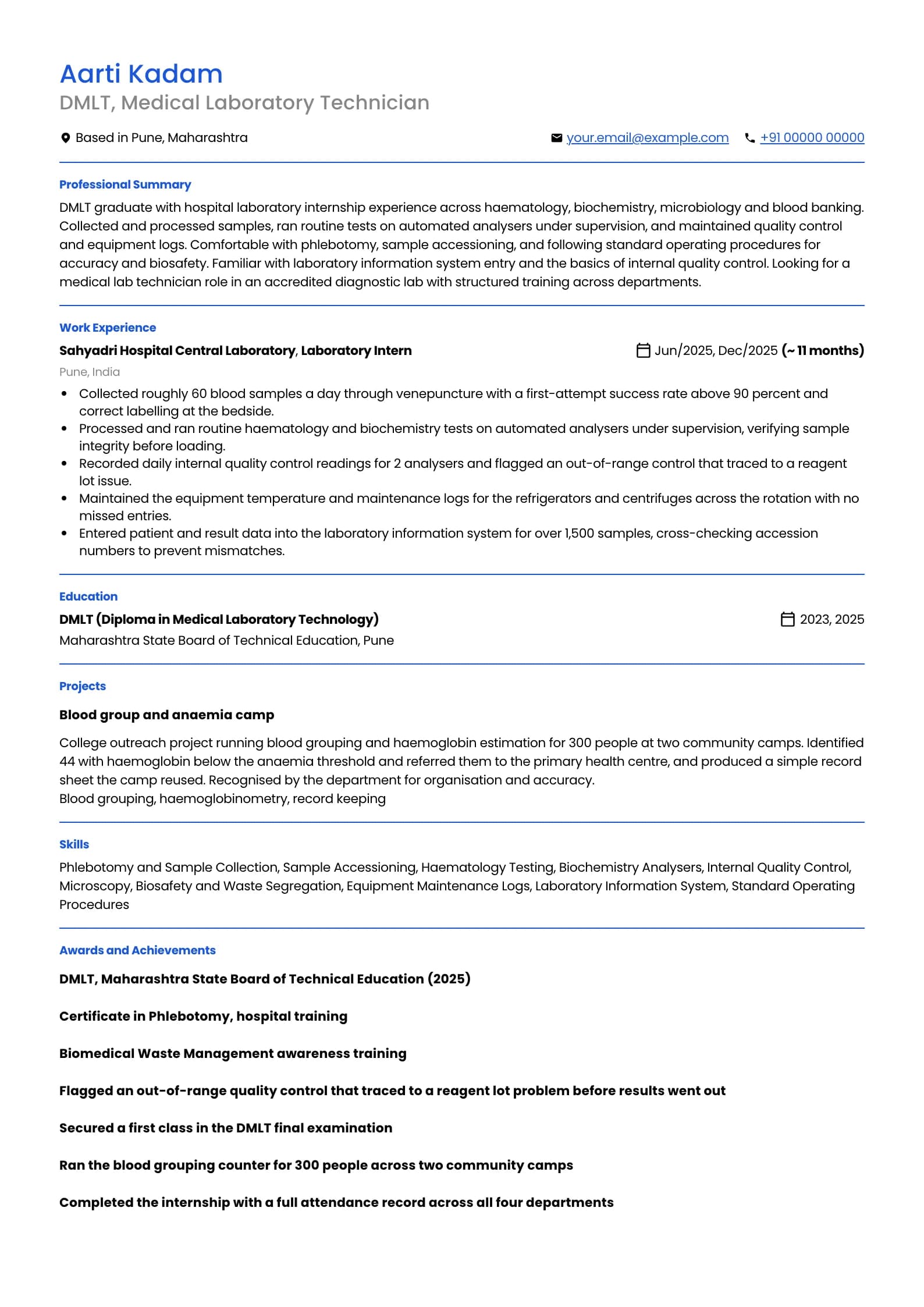
Build my resumeLab Technician resume example, Fresher (0 years)
minimalist templateIs your resume good enough?
Upload the resume you have now and see what an applicant tracking system reads before a lab technician recruiter ever does.
Free to run. Sign in with your mobile number to see your score.
Lab Technician resume example, Lab Technologist (4 years)
ai-era template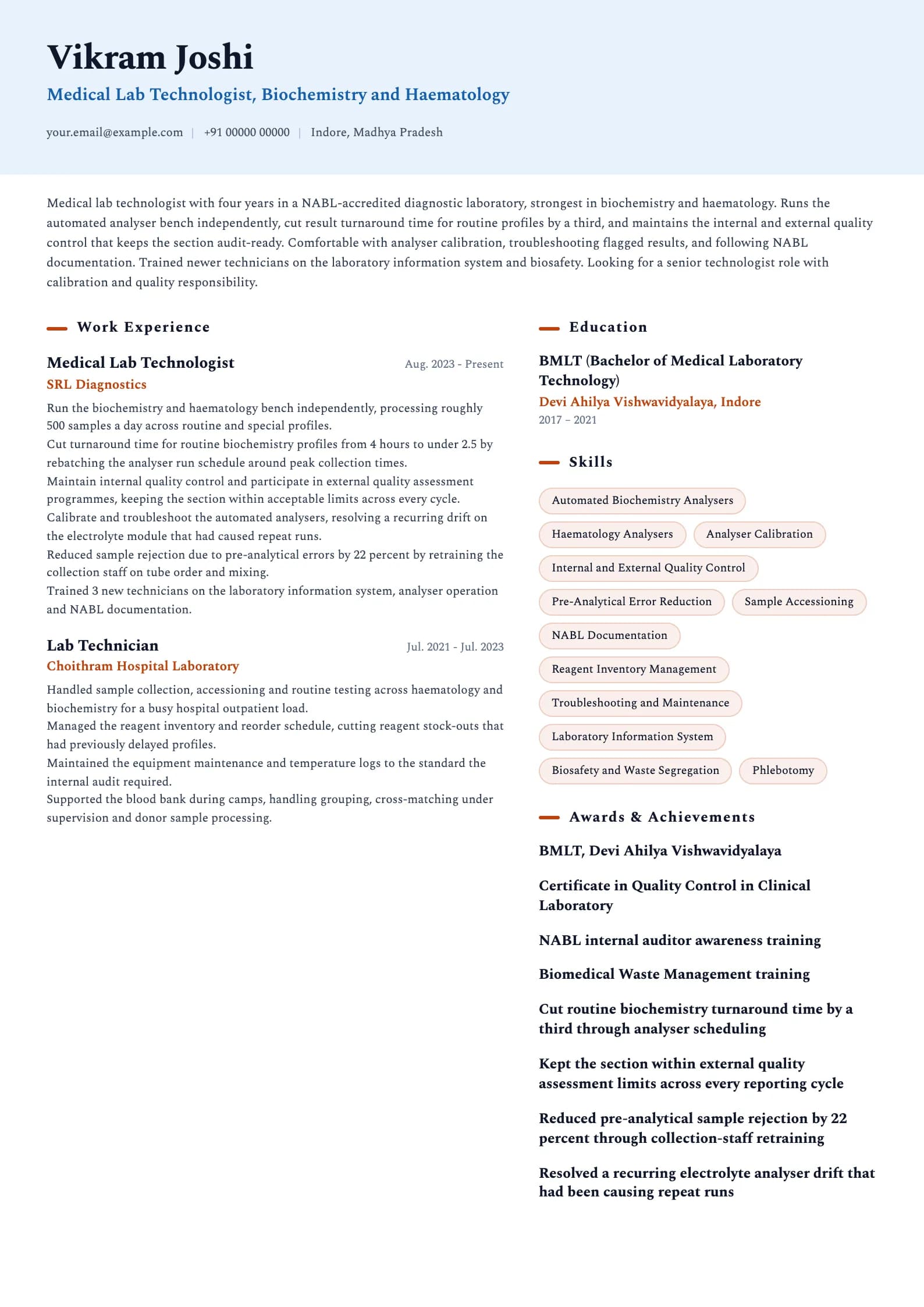
Want this structure with your own details? Build it in the resume builder.
Lab Technician resume example, Lab Supervisor (10 years)
header-band template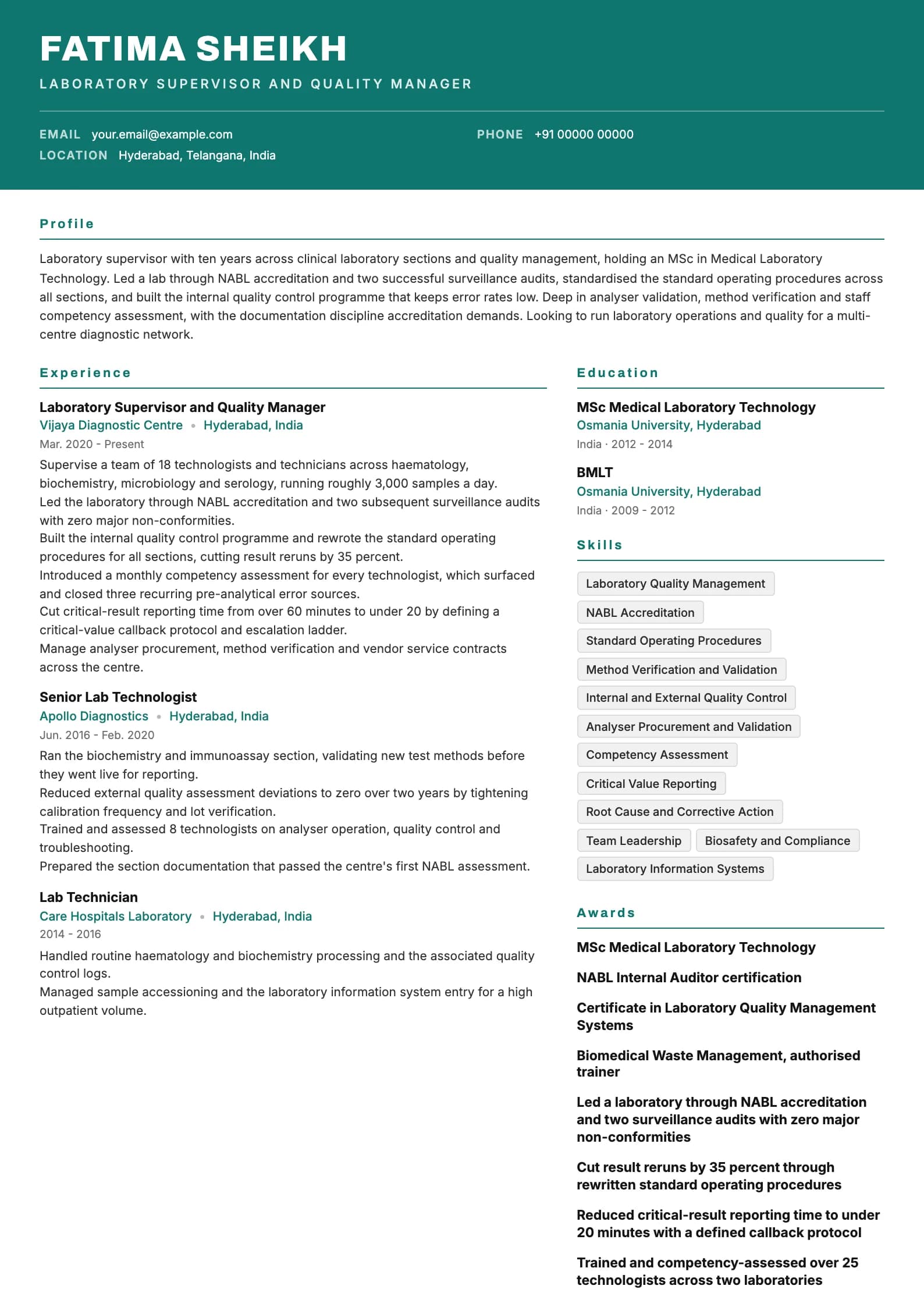
The format that works for lab technician resumes in India
Reverse chronological is the right layout for a medical lab technician's resume in India, whether you are applying to a diagnostic chain, a hospital laboratory or a research lab. Most recent role first, dates in view. Because lab work is organised by department, the resume should make clear which sections you have worked in: haematology, biochemistry, microbiology, serology, histopathology and blood banking are different competencies, and a reviewer needs to see your range. The key qualification belongs at the top: DMLT, BMLT or an MSc in medical laboratory technology, with the institution. Unlike doctors and pharmacists, lab technicians are not always under a statutory registration requirement across every state, so the qualification and any accreditation experience carry the weight registration does elsewhere. If your state or role does require registration, state it up front. Length follows evidence. A fresher fits on one page. A lab supervisor with an MSc, accreditation experience and a team will run to two, and that is fine. What does not justify page two is a list of workshops attended or a hobbies section. Department range and quality exposure matter more than length. The four items that clutter every Indian template belong nowhere here: photograph, date of birth, marital status and father's name. Send a PDF, name the file with your name and the role, keep it single column so a portal reads it in order, and let your qualification, department range and quality-control record do the work. The table below sets the section order.
| Section | Where it goes | Why |
|---|---|---|
| Name and headline | Top, above everything | Headline is your level and strongest section, e.g. Lab Technologist, Biochemistry. |
| Qualification | Header or first two lines | DMLT, BMLT or MSc, with institution. Registration too where required. |
| Professional summary | Directly under the header | Three or four lines. Sections, years, scope and one quality result. |
| Experience | Next, most recent first | Role, lab, departments, dates. Newest gets the most detail. |
| Education | Below experience, top for a fresher | Lab technology qualification with institution and years. |
| Certifications and training | After education or beside skills | Quality control, phlebotomy, biomedical waste, NABL, with year. |
| Skills | Grouped near the end | Department techniques, analysers, quality and software, grouped. |
Writing a summary a lab manager actually reads
The block under your name is the part most likely to be read, so it must carry what a lab manager screens for: which sections you work in, how long you have, the scope you handle independently, and one strong quality result. Three or four lines. Name your accreditation exposure, because in a NABL or CAP environment that is a major differentiator. The old objective, seeking a suitable position in a reputed laboratory to apply my knowledge, tells the reader nothing. Replace it with a summary of what you actually run. A technologist who writes "runs the biochemistry and haematology bench independently and cut routine turnaround by a third" has said more in one line than a paragraph of aspiration. Freshers often feel there is nothing to summarise after an internship. Look at the fresher sample. It names the four departments rotated through, the collection volume, the quality-control catch and the qualification. That is a real summary. What it avoids is "eager to learn and grow", which appears on almost every graduate resume and carries no information. A practical test: read your summary and ask whether a batchmate could paste it onto their own resume unchanged. If they could, it describes the course, not you. Add the specific section, the specific quality or turnaround result, the specific analyser you troubleshoot until it stops being transferable. Rewrite the summary for each meaningfully different role. A summary aimed at a biochemistry-heavy diagnostic lab should lead with analyser and quality-control work; one aimed at a blood bank should lead with grouping, cross-matching and donor processing; one aimed at a research lab should lead with the techniques it uses. Two minutes of editing, and it is the highest-leverage change you can make.
Professional summary, lab technologist
Weak
Hardworking and sincere DMLT holder seeking a suitable position in a reputed laboratory where I can apply my knowledge and gain good experience.
Strong
Medical lab technologist with four years in a NABL-accredited lab, running the biochemistry and haematology bench independently, having cut routine profile turnaround by a third and kept the section within every external quality cycle.
The rewrite replaces aspiration with the sections, accreditation exposure, independent scope and one verifiable quality result.
Experience bullets: technique, volume, and quality result
A strong lab bullet names what you did, the volume you did it at, and what measurably changed, usually a quality or turnaround outcome. The verb establishes that you did it. The volume, samples processed, collections a day, tests run, tells a manager whether your throughput fits the lab. The result, a turnaround cut, a rejection rate reduced, an external quality deviation eliminated, a calibration issue resolved, is what persuades. Write bullets honest to your level. A supervised intern should say so; accuracy and quality-control awareness are exactly what a lab wants, and a control catch is a stronger fresher claim than an inflated one. A technologist can claim an independent bench and analyser troubleshooting. A supervisor is judged on accreditation, error rates and staff competency. Overstating independence you did not have is easy to expose when an interviewer asks how you would handle a specific out-of-control situation. Use the metrics lab work actually produces. Sample volume, turnaround time, sample rejection or pre-analytical error rate, external quality assessment performance, reruns, calibration and downtime, reagent stock-outs, critical-value reporting time, non-conformities in audit. The technologist sample uses several metric types rather than repeating sample volume, which reads as range. Where you have no number, give scope: how many analysers, how many departments, how many samples a day, how many staff trained. "Run the biochemistry and haematology bench independently, processing roughly 500 samples a day" carries weight without inventing a percentage. Allocate detail by recency. Current role gets five or six bullets, the previous one four or five, older roles two or three.
| Level | What bullets must prove | Typical metric |
|---|---|---|
| Fresher / Intern | You collect and process accurately under supervision | Collections a day, samples entered, quality-control catches, sections covered |
| Lab Technician | You run routine testing and keep the logs | Sample volume, stock-outs resolved, log compliance, accessioning |
| Lab Technologist | You run a bench independently and manage quality | Turnaround time, external quality performance, rejection rate, calibration |
| Lab Supervisor | You run the lab and own accreditation | Non-conformities, reruns cut, critical-value time, staff competency |
Experience bullet, diagnostic lab
Weak
Responsible for testing the blood samples and reporting the results on the machine as per the lab requirement.
Strong
Run the biochemistry and haematology bench independently, processing roughly 500 samples a day and cutting routine profile turnaround from 4 hours to under 2.5 by rebatching the run schedule.
"Responsible for" and "as per requirement" describe a duty; the rewrite names the independent scope, the volume and the turnaround result.
Experience bullet, quality work
Weak
Worked on reducing errors in the samples which improved the quality of the reports.
Strong
Reduced sample rejection due to pre-analytical errors by 22 percent by retraining the collection staff on tube order and mixing.
Names the metric, the cause addressed and the mechanism, so a lab manager can see a real, checkable quality improvement.
If a bullet would read identically on a batchmate's resume, it describes the profession, not you. Add the specific section, the specific quality or turnaround number, the specific analyser until it only fits you.
The skills section: techniques, analysers, and quality
A lab technician's skills section has two readers. A diagnostic chain or hospital portal parses it for literal terms such as biochemistry analyser, phlebotomy or NABL documentation. A lab reviewer wants a short, organised sense of which sections you can run and how well you understand quality. Grouping serves both: the terms are present for the machine, and the structure is readable for the person. Group by function rather than one long line. Techniques by department, instrumentation, quality and compliance, and systems is a grouping that works for most lab professionals. Weight it toward the section you are applying to: a biochemistry role leads with analysers and quality control, a blood bank role leads with grouping and cross-matching, a microbiology role leads with culture and sensitivity. The exact headings matter far less than the presence of some structure. Be honest about what you can run unsupervised. A skills list is a set of things you agree to be questioned on. Listing a technique you only observed, or an analyser you cannot troubleshoot alone, invites the exact question you cannot answer. Ten competencies you truly own read stronger than twenty you have merely seen. Write the terms as the field writes them: haematology, biochemistry, NABL, external quality assessment, laboratory information system. Portals match on strings, so use the standard names and spell out an acronym at least once. Do not add star ratings or proficiency bars. Nobody agrees what four stars in quality control means, and a rating invites an argument you cannot win. Competence is shown by the experience section, not asserted with a graphic.
| Group | What goes in it | How many |
|---|---|---|
| Techniques by department | Haematology, biochemistry, microbiology, serology, blood banking | 3 to 6 |
| Collection | Phlebotomy, sample accessioning, pre-analytical handling | 2 to 3 |
| Instrumentation | Automated analysers, calibration, troubleshooting, microscopy | 2 to 4 |
| Quality and compliance | Internal and external QC, NABL documentation, biosafety | 2 to 4 |
| Systems | Laboratory information system, inventory, reporting | 1 to 3 |
Skills section
Weak
Skills: Blood test, Machine operating, CBC, Sugar test, Computer, MS Office, Internet, Hard working, Sincere, Team player, Good communication
Strong
Techniques: haematology (CBC, ESR), biochemistry profiles, microbiology culture basics. Collection: phlebotomy, sample accessioning. Instrumentation: automated analyser operation and calibration. Quality: internal and external quality control, NABL documentation, biosafety.
Replaces casual and generic terms with properly named lab competencies grouped by department and quality, which a reviewer can read at a glance.
Qualification, accreditation and certifications: where they belong
For a lab technician, the qualification carries the weight that statutory registration carries for doctors and pharmacists, so it sits at the top: DMLT, BMLT or MSc, with the institution. Where your state or employer requires paramedical or lab registration, state it in the header too. If you have worked in an accredited environment, NABL or CAP, name it prominently, because a technician who understands and has passed accreditation is worth substantially more to a diagnostic lab than one who has only run tests. Education goes near the top for a fresher and below experience for anyone with a job. List your qualification with institution and years, and keep the aggregate marks only while you are a fresher and they are strong. Once you have experience, drop the college percentage; it competes for space with work that predicts your accuracy and reliability far better. Certifications sit below education or beside skills. The ones that carry weight are matched to lab practice: a certificate in laboratory quality control or quality management systems, phlebotomy, biomedical waste management, and NABL internal auditor training for anyone moving toward quality. List them with the year and only when your experience supports the direction they point to. Accreditation and audit exposure deserve emphasis for anyone senior. Leading or contributing to a NABL assessment, running external quality assessment programmes, or building standard operating procedures are the lines that separate a supervisor from a long-serving technician. Publications are rare in this field but a research or method-validation contribution is worth a line if you have one. One caution: certificates help most early or when you are moving into quality, and least once you have years of audited lab work. A supervisor's certificate list should be selective. The accreditation record is the credential.
Getting through diagnostic chain and hospital screening
Most lab technician jobs at diagnostic chains and hospital groups are applied to through a portal that parses your file before a human reads it. The parser breaks your resume into name, qualification, employers, sections and dates, then stores it for search. Almost every screening failure here is a parsing or a missing-field problem, not a wording one. The rules are short. One column. Put your qualification and strongest sections as plain text near the top, never inside an image or a logo. Use standard headings, Experience rather than My Lab Career, and Education rather than a creative label. Keep critical details out of the header and footer strip, which some parsers drop. Avoid text boxes and nested tables for the body; a simple skills grid usually survives, but do not gamble your experience section on a decorative layout. On wording, mirror the posting honestly. If it asks for a biochemistry technologist, use biochemistry and the analyser families you have run, not only a synonym. If it wants NABL experience, name it and spell it out once. Include the section the way the posting names it, because a search for phlebotomist will not credit a general lab resume unless the word phlebotomy is present. Keyword stuffing does not work and reads worse than a filter-out. A hidden block of tests you have never run, or every technique in the syllabus listed at once, is caught quickly and read as dishonesty, which is fatal in a field built on accuracy. Write real experience bullets that naturally contain the right terms, because a bullet about your quality-control work contains the phrase quality control in a context that survives human review too. One practical step: export a text-based PDF, not a scan, and open it to confirm you can select and copy your qualification and a line of experience. If you cannot select the text, neither can the portal.
Section heading
Weak
My Experience in the Lab World
Strong
Professional Experience
Portals search for standard headings; a creative one can drop the whole block into an unclassified bucket a recruiter never opens.
Before uploading, copy the text out of your PDF into a plain text editor. If your qualification and most recent role read cleanly there, a portal will most likely parse them correctly.
What gets lab technician resumes rejected
Most rejections at the resume stage are not close calls. They come from a small set of recurring problems, and all of them are fixable in an afternoon. The list below covers what reviewers of Indian lab technician resumes see most often, in rough order of how much damage each does.
- Qualification and department range unclear. A reviewer needs to see your degree and which sections you can run, up front.
- Claiming techniques or independent sign-out you only observed. One question about handling an out-of-control result exposes it.
- No numbers anywhere. Sample volume, turnaround, rejection rate, external quality performance. Pick whichever is honest.
- No mention of quality control or accreditation. In a NABL environment this is the single biggest missing signal.
- A generic objective line. Replace it with a summary stating sections, years, scope and one quality result.
- A photo, date of birth, marital status or father's name. None of it belongs on a lab resume and it takes real content's space.
- A wall of generic soft skills, sincere, hard working, punctual, in place of actual lab competencies.
- The same resume sent to a biochemistry lab, a blood bank and a microbiology role without reordering the summary and skills.
- Casual test names like 'sugar test' instead of the proper terminology a reviewer and a parser expect.
- Multi-column or image-heavy layouts that a diagnostic portal reads out of order, scrambling qualification and experience.
Read your resume as if you were the lab manager about to hire yourself. Any technique you could not run and troubleshoot alone is a line to move to 'assisted' or cut.
Skills to put on a lab technician resume
Technical
- Phlebotomy and Sample Collection
- Haematology Testing
- Clinical Biochemistry
- Microbiology Culture and Sensitivity
- Serology and Immunoassay
- Blood Grouping and Cross-Matching
- Automated Analyser Operation
- Analyser Calibration
- Internal and External Quality Control
- Method Verification
- Microscopy
- Sample Accessioning
Tools and platforms
- Automated Biochemistry Analysers
- Haematology Cell Counters
- Immunoassay Systems
- Centrifuges and Microscopes
- Laboratory Information System
- ELISA Readers
- Blood Bank Equipment
- Reagent Inventory Systems
- Quality Control Charting
- Biomedical Waste Systems
Working skills
- Accuracy and Attention to Detail
- Biosafety Discipline
- Documentation and Record Keeping
- Team Coordination
- Training and Mentoring
- Working Under Volume
- Critical Result Communication
- Standard Operating Procedure Compliance
- Problem Solving
Certifications worth listing as a lab technician
| Certification | Full name | Worth it for |
|---|---|---|
| DMLT | Diploma in Medical Laboratory Technology | The common entry qualification for lab technician roles in diagnostic labs and hospitals. Sufficient for many technician posts. A DMLT holder aiming at technologist or supervisory roles usually progresses to BMLT or an MSc. |
| BMLT | Bachelor of Medical Laboratory Technology | The standard degree for medical lab technologist roles and a requirement at many accredited labs for independent bench work. Opens the path to quality and supervisory positions a diploma alone often does not. |
| MSc MLT | Master of Science in Medical Laboratory Technology | The strongest qualification for supervisory, quality management and teaching roles. Worth naming prominently if you are targeting a lab supervisor or quality manager position. |
| Laboratory Quality Control | Certificate in quality control in the clinical laboratory | Valuable for anyone in or moving toward an accredited lab, since quality control is the core of NABL practice. Pair it with experience running internal and external quality assessment so it reads as applied. |
| NABL Internal Auditor | NABL internal auditor training or certification | Worth it for senior technologists and supervisors moving into quality roles. A strong differentiator, because a technician who can audit and maintain accreditation is far more valuable than one who only runs tests. |
| Phlebotomy | Certificate in phlebotomy and sample collection | A useful early credential, especially for collection-heavy roles and diagnostic chain outlets. Confirms safe, competent venepuncture, which is the highest-volume pre-analytical task in most labs. |
| Biomedical Waste Management | Biomedical waste management and biosafety training | A reasonable baseline for any lab role given the handling and disposal requirements. Quick to complete and a sensible line for freshers to hold before applying. |
Keywords an ATS scans for in a lab technician resume
These are the literal terms a parser matches against the job description. Use the ones that are true of you, in the sentences where you did the work, not as a list at the bottom.
- lab technician
- medical laboratory technologist
- DMLT
- BMLT
- phlebotomy
- haematology
- biochemistry
- microbiology
- blood banking
- quality control
- NABL
- sample collection
- automated analyser
- laboratory information system
- calibration
- biosafety
- external quality assessment
- sample processing
- diagnostic laboratory
- standard operating procedures
Lab Technician resume FAQ
What salary can a lab technician expect in India?
It varies by qualification, city and lab type. A DMLT fresher commonly starts around 1.8 to 3 LPA, a BMLT technologist in a diagnostic chain 3 to 5 LPA, and an experienced technologist or senior technician 5 to 8 LPA. A lab supervisor or quality manager with an MSc and accreditation experience can earn well above that, particularly in large diagnostic networks. Your resume does not set the number, but a clear record of department range, quality control and accreditation exposure strengthens your position when it is discussed.
How long should a lab technician's resume be?
One page for a fresher, and up to two pages for a senior technologist or supervisor with an MSc, accreditation experience and a team. Keep it focused: qualification and department range at the top, experience with real sample volumes and quality numbers, and the sections you have worked in made obvious. Avoid padding page two with workshops attended or a hobbies section.
Do lab technicians need a registration on the resume?
It depends on the state and the role. Unlike doctors and pharmacists, lab technicians are not always under a uniform statutory registration requirement, though some states and employers require paramedical or allied-health registration. Where it applies to you, state it in the header. In every case, put your qualification, DMLT, BMLT or MSc, prominently, and name any NABL or accredited-lab experience, which carries similar weight to registration for a diagnostic employer.
Do lab technician resumes go through an ATS in India?
At diagnostic chains and hospital groups, usually yes, because applications are parsed before a human reads them. Use a single-column layout, standard headings, and put your qualification and strongest sections as plain text near the top rather than inside an image. Test your file by copying the text out of the PDF; if your qualification and most recent role read cleanly, a portal will most likely parse them correctly.
How does a DMLT fresher write a resume with only an internship?
Lead with your qualification, then a summary built from your internship, then education and skills. Name the departments you rotated through, the collection and sample volumes, the quality-control readings you maintained and any control issue you caught. A control catch or a zero-error accessioning record is a stronger, more honest fresher claim than an inflated one, because accuracy is exactly what a lab screens for.
Should I mention NABL or quality control experience?
Yes, prominently, if you have it. Understanding and working within a NABL-accredited, quality-controlled environment is one of the strongest signals a lab technician can send, because accreditation is what a diagnostic network is judged on. Name your internal and external quality control work, any audit you contributed to, and any standard operating procedures you followed or wrote. It separates you from a technician who has only run tests.
Should I list every test I can perform?
List the techniques you can run and troubleshoot competently, grouped by department, not every test in the syllabus. A skills list is a set of things you agree to be questioned on, and a technique you only observed invites exactly the question you cannot answer. Ten competencies you truly own, with the analysers you handle, read stronger than a long undifferentiated list.
Should I put my DMLT or BMLT marks on the resume?
Keep them while you are a fresher and they are strong, roughly a first class, since early screening still filters on marks. Once you have work experience, drop the college aggregate. A percentage from years ago competes for space with lab work that predicts your accuracy and reliability far better, and no lab hiring an experienced technologist is weighing a college percentage against your quality record.
How do I move from technician to technologist or supervisor on paper?
Show the responsibilities that define the higher role. For a technologist, that is running a bench independently, calibrating and troubleshooting analysers, and managing quality control. For a supervisor, it is accreditation work, writing standard operating procedures, competency-assessing staff and owning error rates. Progressing your qualification to BMLT or an MSc and naming any NABL internal auditor training reinforces the move.
Is a photo needed on a lab technician's resume in India?
No. Indian diagnostic and hospital recruiters do not expect one, and it takes space a real result should occupy. The same goes for date of birth, marital status, father's name and a declaration paragraph, all of which come from an older template. The only exception is a role that explicitly asks for a photograph in the posting.
Related resume examples and guides
Build your own in any of these formats
Start from a blank resume or upload the one you have. The builder renders it in 24 templates and flags what a diagnostic portal will miss.
Build my resume