3 Pharmacist Resume Examples, Format and Guide
A pharmacist's resume in India is screened first on two facts: your qualification and your State Pharmacy Council registration. Hospitals, retail chains and pharma companies filter on D.Pharm or B.Pharm, the council registration number, and the setting you have worked in before they read anything else. Below are three complete resumes, one for a fresher, one for a hospital pharmacist a few years in, and one for a senior clinical pharmacist, followed by the format rules and the exact details that matter. Each sample is a full document, not a fragment: summary, registration, dispensing and clinical experience with real numbers, education, certifications and skills, in the order a pharmacy reviewer expects.
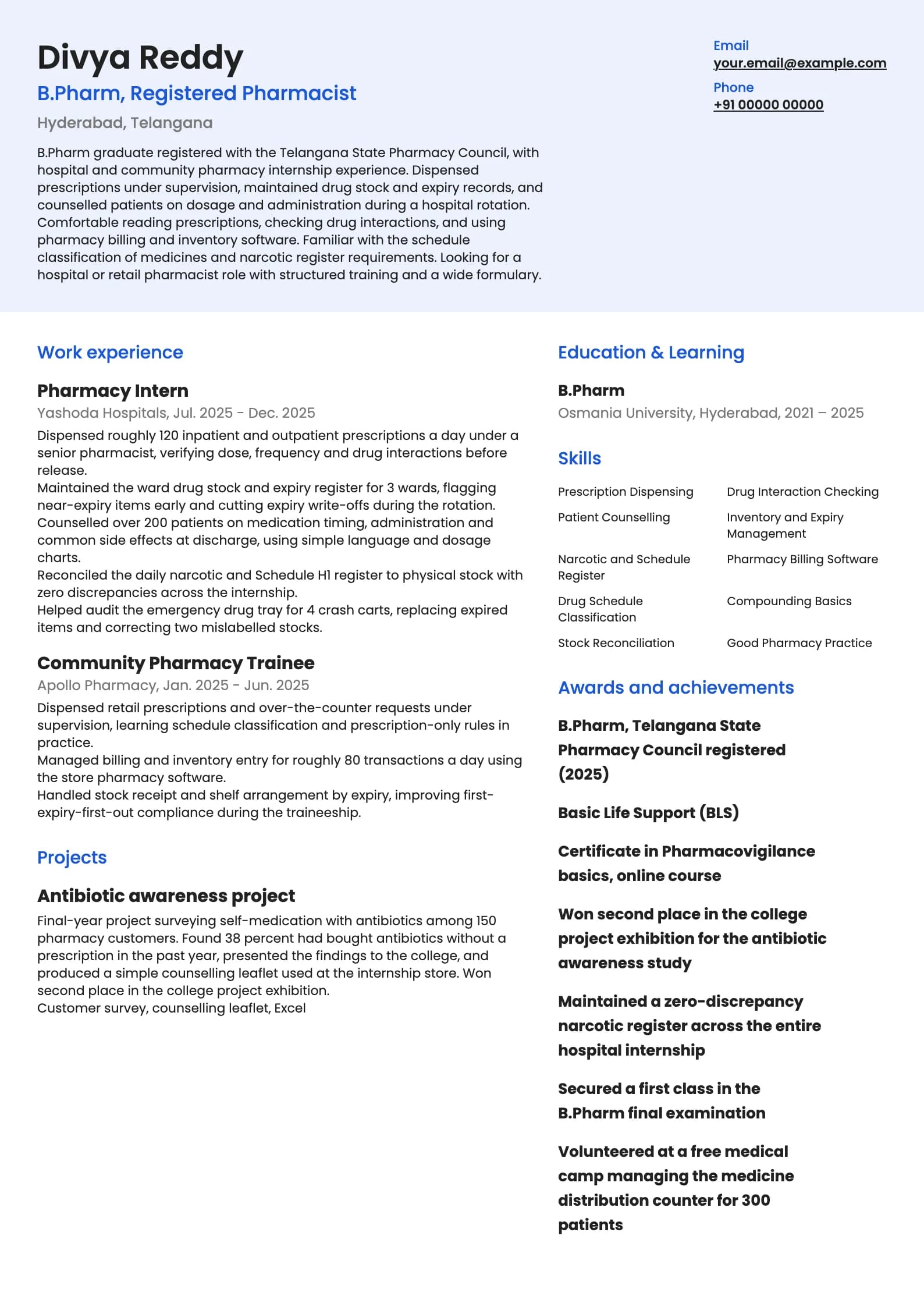
Build my resumePharmacist resume example, Fresher (0 years)
modern templateIs your resume good enough?
Upload the resume you have now and see what an applicant tracking system reads before a pharmacist recruiter ever does.
Free to run. Sign in with your mobile number to see your score.
Pharmacist resume example, Hospital Pharmacist (4 years)
header-band template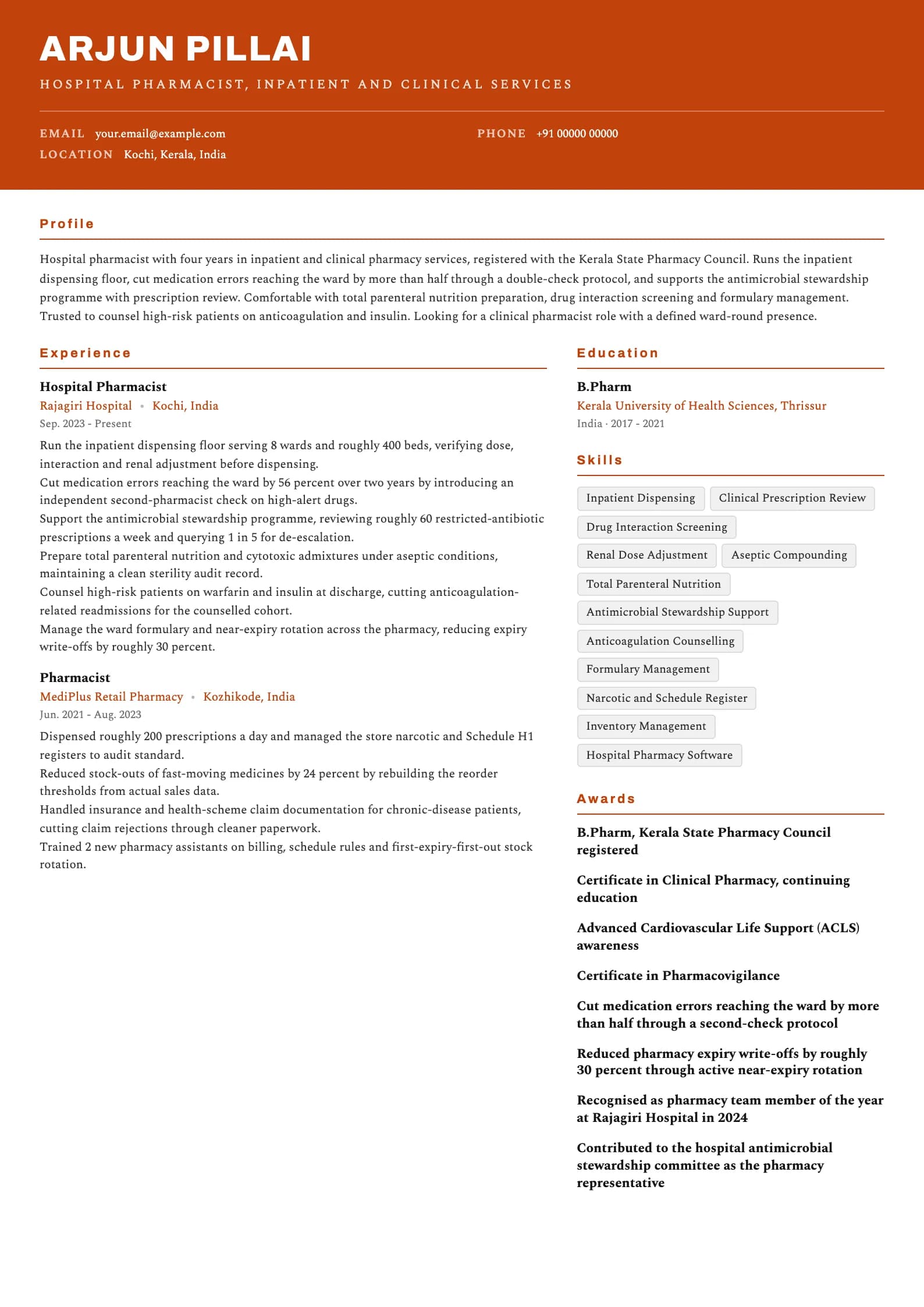
Want this structure with your own details? Build it in the resume builder.
Pharmacist resume example, Clinical Pharmacist (9 years)
professional template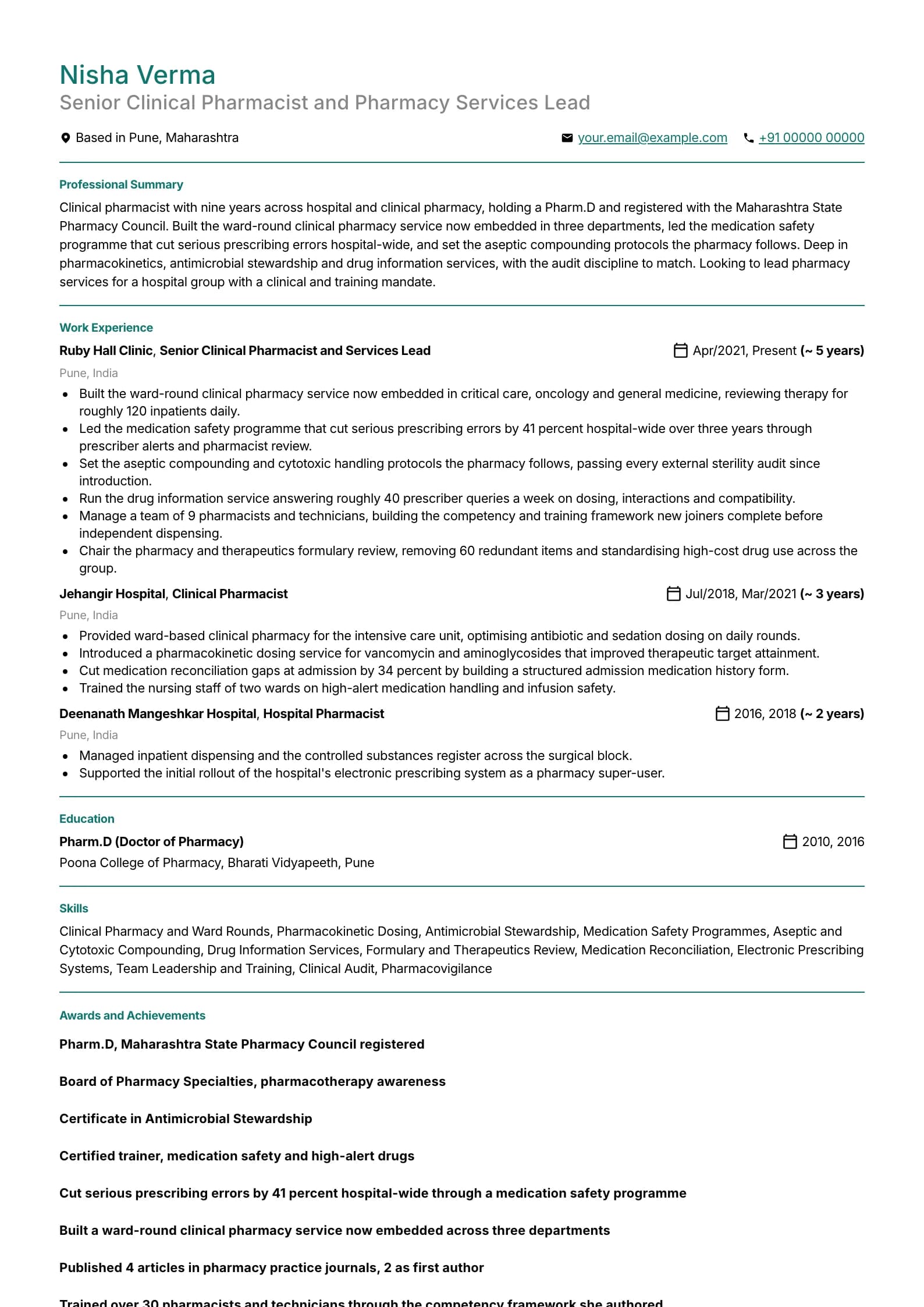
The format that works for pharmacist resumes in India
Reverse chronological is the right layout for a pharmacist's resume in India, whether you are applying to a hospital, a retail chain, a pharma company or a drug regulatory role. Most recent role first, dates in view. A pharmacist's career can branch across settings, so the resume should make the setting of each role obvious: hospital, community, industry or clinical. The non-negotiable at the top is your qualification and registration: D.Pharm, B.Pharm or Pharm.D, the State Pharmacy Council you are registered with, and your registration number. A pharmacist cannot legally dispense without registration, so it is the first thing an employer verifies, and a resume that hides it invites doubt. If you are registered in more than one state, list the current one. Length follows evidence. A fresher fits on one page. A senior clinical pharmacist with a Pharm.D, publications and a team to lead will run to two, and that is fine. What does not justify page two is a list of seminars attended or a hobbies section. The setting of your experience matters more than its length. The four items that clutter every Indian template belong nowhere here: photograph, date of birth, marital status and father's name. Send a PDF, name the file with your name and the role, keep it single column so a portal reads it in order, and let your registration and your dispensing or clinical record do the work. The table below sets the section order.
| Section | Where it goes | Why |
|---|---|---|
| Name and headline | Top, above everything | Headline is your setting and level, e.g. Hospital Pharmacist. |
| Qualification and registration | Header or first two lines | D.Pharm, B.Pharm or Pharm.D, council and registration number. |
| Professional summary | Directly under the header | Three or four lines. Setting, years, scope and one strong result. |
| Experience | Next, most recent first | Role, employer, setting, dates. Newest gets the most detail. |
| Education | Below experience, top for a fresher | Pharmacy degree with institution and years. |
| Certifications and training | After education or beside skills | Clinical pharmacy, pharmacovigilance, stewardship, with year. |
| Skills | Grouped near the end | Dispensing, clinical, compounding and software, grouped not listed flat. |
Writing a summary a pharmacy employer actually reads
The block under your name is the part most likely to be read, so it must carry what a pharmacy employer screens for: your setting and level, how long you have practised, the scope you cover, and one strong result. Three or four lines, and registration belongs here because a pharmacist cannot work without it. The old objective, seeking a responsible position in a reputed organisation to utilise my pharmacy knowledge, tells the reader nothing. Replace it with a summary of what you actually do. A pharmacist who writes "runs the inpatient dispensing floor and cut ward-reaching medication errors by more than half" has said more in one line than a paragraph of aspiration. Freshers often feel there is nothing to summarise after internships. Look at the fresher sample. It names the hospital and community rotations, the dispensing volume, the zero-discrepancy narcotic register and the council registration. That is a real summary. What it avoids is "passionate about healthcare", which appears on almost every graduate resume and carries no information. A practical test: read your summary and ask whether a batchmate could paste it onto their own resume unchanged. If they could, it describes the course, not you. Add the specific setting, the specific safety or inventory result, the specific clinical service until it stops being transferable. Rewrite the summary for each meaningfully different role. A summary aimed at a hospital clinical role should lead with prescription review and ward work; one aimed at a retail chain should lead with dispensing volume, inventory and compliance; one aimed at a pharma company should lead with pharmacovigilance or regulatory exposure. Two minutes of editing, and it is the highest-leverage change you can make.
Professional summary, hospital pharmacist
Weak
Sincere and hardworking B.Pharm graduate seeking a responsible position in a reputed organisation to utilise my knowledge and skills for mutual growth.
Strong
Hospital pharmacist with four years in inpatient and clinical services, registered with the Kerala State Pharmacy Council, having cut ward-reaching medication errors by 56 percent through a second-check protocol.
The rewrite replaces aspiration with a setting, registration, scope and one verifiable safety result.
Experience bullets: task, scale, and safety or business result
A strong pharmacist bullet names what you did, the scale you did it at, and what measurably changed. The verb establishes that you did it. The scale, prescriptions dispensed, beds or wards covered, queries answered, tells an employer whether your experience fits the setting. The result, an error rate cut, expiry write-offs reduced, a stock-out lowered, an intervention rate, is what persuades. Write bullets honest to your level. A supervised intern should say "under supervision" where it applies; accuracy and reliability are exactly what a pharmacy employer wants to see, and a zero-discrepancy register is a stronger fresher claim than an inflated one. A hospital pharmacist can claim independent dispensing and clinical review. A clinical pharmacist is judged on interventions and safety outcomes. Overstating clinical authority you did not have is easy to expose in an interview about a specific drug decision. Use the metrics pharmacy work actually produces. Dispensing volume, medication error rate, intervention or de-escalation rate, expiry write-offs, stock-outs, reconciliation gaps closed, claim rejections reduced, readmissions for a counselled cohort, sterility audit results. The hospital sample uses several different metric types rather than repeating dispensing volume, which reads as range. Where you have no number, give scope: how many wards, how many beds, how many prescriptions a day, how many staff trained. "Run the inpatient dispensing floor serving 8 wards and roughly 400 beds" carries weight without inventing a percentage. Allocate detail by recency. Current role gets five or six bullets, the previous one four or five, older roles two or three.
| Level | What bullets must prove | Typical metric |
|---|---|---|
| Fresher / Intern | You dispense accurately and manage registers | Prescriptions a day, register accuracy, expiry catches, patients counselled |
| Retail Pharmacist | You run a counter and manage stock and compliance | Dispensing volume, stock-outs, claim rejections, register audit |
| Hospital Pharmacist | You dispense and review clinically for wards | Ward-reaching errors, intervention rate, expiry, sterility audit |
| Clinical Pharmacist | You improve prescribing and set safety systems | Prescribing errors cut, dosing target attainment, programmes built |
Experience bullet, hospital pharmacy
Weak
Responsible for dispensing medicines to patients and maintaining the stock in the hospital pharmacy as per the rules.
Strong
Run the inpatient dispensing floor serving 8 wards and roughly 400 beds, cutting ward-reaching medication errors by 56 percent through an independent second-pharmacist check on high-alert drugs.
"Responsible for" and "as per the rules" describe a job description; the rewrite names the scope, the mechanism and the safety result.
Experience bullet, inventory work
Weak
Handled the medicine stock and made sure the medicines did not expire in the pharmacy.
Strong
Reduced pharmacy expiry write-offs by roughly 30 percent through active near-expiry rotation and first-expiry-first-out shelf discipline.
Names the metric and the mechanism, turning a vague duty into a measurable cost saving an employer values.
If a bullet would read identically on a batchmate's resume, it describes the profession, not you. Add the specific setting, the specific safety or inventory number, the specific clinical service until it only fits you.
The skills section: dispensing, clinical, and systems
A pharmacist's skills section has two readers. A hospital or chain portal parses it for literal terms such as inpatient dispensing, drug interaction screening or pharmacovigilance. A pharmacy reviewer wants a short, organised sense of what you can do unsupervised and in which setting. Grouping serves both: the terms are present for the machine, and the structure is readable for the person. Group by function rather than one long line. Dispensing and inventory, clinical and patient care, compounding, and systems and compliance is a grouping that works for most pharmacists. Weight it toward the setting you are applying to: a clinical role leads with prescription review and dosing, a retail role leads with dispensing and stock, an industry role leads with pharmacovigilance and quality. The exact headings matter far less than the presence of some structure. Be honest about what you own. A skills list is a set of things you agree to be questioned on. Listing a clinical service you only observed, or a compounding technique you cannot perform aseptically, invites the exact question you cannot answer. Ten competencies you truly own read stronger than twenty you have merely seen. Write the terms as the field writes them: pharmacovigilance, aseptic compounding, Schedule H1, first-expiry-first-out. Portals match on strings, so use the standard names and spell out an acronym at least once. Do not add star ratings or proficiency bars. Nobody agrees what four stars in clinical pharmacy means, and a rating invites an argument you cannot win. Competence is shown by the experience section, not asserted with a graphic.
| Group | What goes in it | How many |
|---|---|---|
| Dispensing and inventory | Prescription dispensing, stock, expiry, registers | 3 to 5 |
| Clinical and patient care | Prescription review, interaction screening, counselling, dosing | 3 to 5 |
| Compounding | Aseptic compounding, TPN, cytotoxic handling | 1 to 3 |
| Systems and compliance | Pharmacy software, e-prescribing, schedule and narcotic rules | 2 to 4 |
| Quality and safety | Pharmacovigilance, stewardship support, audit, good pharmacy practice | 2 to 4 |
Skills section
Weak
Skills: Dispensing, Medicine knowledge, Billing, Stock, Tally, MS Office, Internet, Hard working, Team player, Good communication, Honest, Punctual
Strong
Dispensing: inpatient and outpatient dispensing, expiry and narcotic register. Clinical: drug interaction screening, renal dose adjustment, patient counselling. Compounding: aseptic TPN preparation. Systems: hospital pharmacy software, Schedule H1 compliance.
Replaces vague and generic terms with properly named pharmacy competencies at the right level, grouped for a reviewer.
Registration, education and certifications: where they belong
Registration outranks everything else on a pharmacist's resume, so it sits in the header or the first two lines: your pharmacy degree, the State Pharmacy Council you are registered with, and your registration number. A pharmacist cannot legally dispense without it, which is why it is verified before anything else. If you hold registration in more than one state, list the current one, and keep it in date. Education goes near the top for a fresher and below experience for anyone in practice. List your D.Pharm, B.Pharm or Pharm.D with institution and years. Keep the aggregate marks only while you are a fresher and they are strong, roughly a first class, since early screening still filters on them. Once you have experience, drop the college percentage; it competes for space with work that predicts your performance far better. Certifications sit below education or beside skills. In pharmacy the ones that carry weight are the ones matched to a track: a certificate in clinical pharmacy or antimicrobial stewardship for a hospital clinical role, pharmacovigilance for an industry or drug safety role, good manufacturing or good distribution practice for a pharma supply role. List them with the year and only when your experience supports the direction they point to. Professional and safety credentials such as BLS are a reasonable baseline for a hospital pharmacist and quick to keep current. Publications deserve a short section for anyone who has them, named journals for a senior clinical pharmacist and a project or poster for a fresher. One caution: certificates help most when you are entering a track or changing setting, and least once you have years of audited work in that area. A senior clinical pharmacist's certificate list should be selective. The clinical record is the credential.
Getting through hospital HR and pharmacy chain screening
Most pharmacist jobs at hospitals, chains and pharma companies are applied to through a portal that parses your file before a human reads it. The parser breaks your resume into name, qualification, registration, employers and dates, then stores it for search. Almost every screening failure here is a parsing or a missing-field problem, not a wording one. The rules are short. One column. Put your qualification, registration and setting as plain text near the top, never inside an image or a logo. Use standard headings, Experience rather than My Pharmacy Journey, and Education rather than a creative label. Keep critical details out of the header and footer strip, which some parsers drop. Avoid text boxes and nested tables for the body; a simple skills grid usually survives, but do not gamble your experience section on a decorative layout. On wording, mirror the posting honestly. If it asks for a hospital pharmacist, use hospital pharmacist and inpatient dispensing, not only a synonym. If it wants pharmacovigilance experience, name it and spell it out once. Include the setting the way the posting names it, because a search for clinical pharmacist will not always credit ward pharmacy unless the word clinical is present. Keyword stuffing does not work and reads worse than a filter-out. A hidden block of skills you do not have, or every pharmacy term listed at once, is caught quickly and read as dishonesty, which is fatal in a field built on accuracy. Write real experience bullets that naturally contain the right terms, because a bullet about your antimicrobial stewardship work contains the word stewardship in a context that survives human review too. One practical step: export a text-based PDF, not a scan, and open it to confirm you can select and copy your registration number and a line of experience. If you cannot select the text, neither can the portal.
Section heading
Weak
My Growth in Pharmacy
Strong
Professional Experience
Portals search for standard headings; a creative one can drop the whole block into an unclassified bucket a recruiter never opens.
Before uploading, copy the text out of your PDF into a plain text editor. If your registration number and most recent role read cleanly there, a portal will most likely parse them correctly.
What gets pharmacist resumes rejected
Most rejections at the resume stage are not close calls. They come from a small set of recurring problems, and all of them are fixable in an afternoon. The list below covers what reviewers of Indian pharmacist resumes see most often, in rough order of how much damage each does.
- Council registration missing or buried. A pharmacist cannot dispense without it, so it belongs at the top and is verified first.
- Claiming clinical authority or compounding you only observed. One drug-specific question in the interview exposes it.
- No numbers anywhere. Dispensing volume, error rate, expiry write-offs, intervention rate. Pick whichever is honest for the setting.
- A generic objective line. Replace it with a summary stating setting, years, scope and one result.
- A photo, date of birth, marital status or father's name. None of it belongs on a pharmacy resume and it takes real content's space.
- Not stating the setting of each role. Hospital, retail, industry and clinical are different jobs and the reviewer needs to know which.
- A wall of generic soft skills, honest, punctual, hard working, in place of actual pharmacy competencies.
- The same resume sent to a hospital, a retail chain and a pharma company without reordering the summary and skills.
- Certificates listed with no experience to back the track they point to, which reads as padding.
- Multi-column or image-heavy layouts that a hospital portal reads out of order, scrambling registration and experience.
Read your resume as if you were the chief pharmacist about to hire yourself. Any clinical claim you could not defend with a specific case is a line to soften or cut.
Skills to put on a pharmacist resume
Technical
- Prescription Dispensing
- Clinical Prescription Review
- Drug Interaction Screening
- Renal and Hepatic Dose Adjustment
- Aseptic Compounding
- Total Parenteral Nutrition
- Pharmacokinetic Dosing
- Medication Reconciliation
- Antimicrobial Stewardship Support
- Pharmacovigilance
- Compounding and Extemporaneous Preparation
- Good Pharmacy Practice
Tools and platforms
- Hospital Pharmacy Software
- Retail Pharmacy Billing Systems
- Electronic Prescribing Systems
- Inventory Management Systems
- Drug Interaction Databases
- Narcotic and Schedule Registers
- Micromedex and Formulary References
- Adverse Event Reporting Forms
- Laminar Air Flow and Aseptic Units
- Spreadsheet Stock Analysis
Working skills
- Patient Counselling
- Prescriber Communication
- Accuracy Under Volume
- Team Leadership
- Training and Mentoring
- Attention to Detail
- Ethical and Regulatory Judgement
- Multidisciplinary Coordination
- Documentation Discipline
Certifications worth listing as a pharmacist
| Certification | Full name | Worth it for |
|---|---|---|
| State Pharmacy Council Registration | Registration with a State Pharmacy Council under the Pharmacy Act | Mandatory for every practising pharmacist in India, and the number belongs at the top of the resume. Employers verify it before any interview because a pharmacist cannot legally dispense without it, so a resume that omits it stalls at once. |
| D.Pharm | Diploma in Pharmacy | The minimum qualification to register and dispense. Sufficient for many retail and some hospital dispensing roles. A D.Pharm holder aiming at clinical roles usually needs to progress to B.Pharm or Pharm.D to compete. |
| B.Pharm | Bachelor of Pharmacy | The standard degree for hospital, retail management and industry roles. Opens pharma company positions in production, quality and regulatory that a diploma alone usually does not. |
| Pharm.D | Doctor of Pharmacy | The strongest qualification for clinical pharmacy and ward-based roles, with far more patient-facing clinical training. Worth naming prominently if you are targeting clinical pharmacist or drug information posts. |
| Pharmacovigilance certificate | Certification in pharmacovigilance and drug safety | Valuable for anyone targeting pharma industry drug-safety roles or hospital adverse-event reporting. A clean signal for a track many pharmacists move into, and useful even for hospital pharmacists on the safety committee. |
| Antimicrobial Stewardship | Certificate in antimicrobial stewardship | Worth it for hospital and clinical pharmacists, since stewardship is now a core clinical pharmacy function. Pair it with experience reviewing restricted-antibiotic prescriptions so it reads as applied, not theoretical. |
| GMP / GDP | Good Manufacturing Practice / Good Distribution Practice training | Relevant for pharmacists moving into pharma production, quality assurance or supply chain rather than dispensing. Name it only when your target roles are industry rather than hospital or retail. |
Keywords an ATS scans for in a pharmacist resume
These are the literal terms a parser matches against the job description. Use the ones that are true of you, in the sentences where you did the work, not as a list at the bottom.
- pharmacist
- B.Pharm
- D.Pharm
- Pharm.D
- state pharmacy council registration
- prescription dispensing
- hospital pharmacy
- clinical pharmacy
- drug interaction
- inventory management
- pharmacovigilance
- antimicrobial stewardship
- aseptic compounding
- patient counselling
- narcotic register
- Schedule H1
- medication safety
- good pharmacy practice
- formulary management
- dispensing accuracy
Pharmacist resume FAQ
What salary can a pharmacist expect in India?
It varies by qualification and setting. A D.Pharm or B.Pharm fresher in retail commonly starts around 2 to 4 LPA, a hospital pharmacist around 3 to 6 LPA, and an experienced hospital or clinical pharmacist 6 to 12 LPA. Pharma industry roles in quality, regulatory or pharmacovigilance often pay more, and a Pharm.D clinical pharmacist or a pharmacy services lead can earn well above the hospital range. Your resume does not set the number, but a clear record of setting, scope and safety or inventory results strengthens your position when it is discussed.
How long should a pharmacist's resume be?
One page for a fresher, and up to two pages for a senior hospital or clinical pharmacist with a Pharm.D, publications and a team to lead. Keep it focused: registration and qualification at the top, experience with real dispensing and safety numbers, and the setting of each role made obvious. Avoid padding page two with seminars attended or a hobbies section.
Where does my pharmacy council registration go on the resume?
In the header or the first two lines, with your degree and the State Pharmacy Council you are registered with. A pharmacist cannot legally dispense without registration, so employers verify it before anything else. Omitting it, or hiding it at the bottom, is one of the most common reasons a pharmacist resume stalls in screening.
Do pharmacist resumes go through an ATS in India?
At hospitals, retail chains and pharma companies, usually yes, because applications are parsed before a human reads them. Use a single-column layout, standard headings, and put your qualification, registration and setting as plain text near the top rather than inside an image. Test your file by copying the text out of the PDF; if your registration number and most recent role read cleanly, a portal will most likely parse them correctly.
How does a pharmacy fresher write a resume with only internships?
Lead with your qualification and registration, then a summary built from your internships, then education and skills. Name both the hospital and community rotations if you have them, with dispensing volume, register accuracy, expiry catches and patients counselled. A zero-discrepancy narcotic register is a stronger, more honest fresher claim than an inflated clinical one, because accuracy is exactly what a pharmacy employer screens for.
Should I make different resumes for hospital, retail and pharma jobs?
Keep one base resume and reorder the top third for each. A hospital clinical role wants prescription review, ward work and dosing led first; a retail chain wants dispensing volume, inventory and compliance; a pharma company wants pharmacovigilance, quality or regulatory exposure. Rewriting the summary and the skills order for the setting takes two minutes and does most of the work, without rebuilding the whole document.
Do certifications like pharmacovigilance help a pharmacist?
They help most when they match the track you are moving toward. A pharmacovigilance certificate is a clean signal for a drug-safety or industry role, and antimicrobial stewardship training strengthens a hospital clinical resume. The key is to pair a certificate with experience that shows you have applied it. A certificate pointing at a track your experience does not support reads as padding rather than capability.
Should I put my B.Pharm marks on the resume?
Keep them while you are a fresher and they are strong, roughly a first class, since early screening still filters on marks. Once you have work experience, drop the college aggregate. A percentage from years ago competes for space with dispensing and clinical work that predicts your performance far better, and no employer hiring an experienced pharmacist is weighing a B.Pharm percentage against your safety record.
How do I show I am more than a dispensing counter pharmacist?
Add the clinical and safety interventions your work produced, because that is what lifts a pharmacist from operational to clinical. Prescription review that changed a dose, restricted-antibiotic queries, medication reconciliation gaps closed, error rates cut, counselling that reduced readmissions. A pharmacist who shows interventions and outcomes stands apart from one who lists only dispensing and stock duties.
Is a photo needed on a pharmacist's resume in India?
No. Indian pharmacy recruiters do not expect one, and it takes space a real result should occupy. The same goes for date of birth, marital status, father's name and a declaration paragraph, all of which come from an older template. The only exception is a role that explicitly asks for a photograph in the posting.
Related resume examples and guides
Build your own in any of these formats
Start from a blank resume or upload the one you have. The builder renders it in 24 templates and flags what a hospital or chain portal will miss.
Build my resume