3 Dentist Resume Examples, Format and Guide
A dentist's resume in India is screened first on one thing: are you a registered dental surgeon, and what can you actually do at the chair. Clinic owners, dental chains and hospital HR filter on degree, State Dental Council registration and procedural range before anyone reads your summary. Below are three complete resumes, one for a BDS fresher, one for an associate dentist a few years in, and one for a specialist with a postgraduate degree, followed by the format rules and the exact details that matter. Each sample is a full document, not a fragment: summary, registration, clinical experience with real procedure counts, education, certifications and continuing education, in the order a dental reviewer expects.
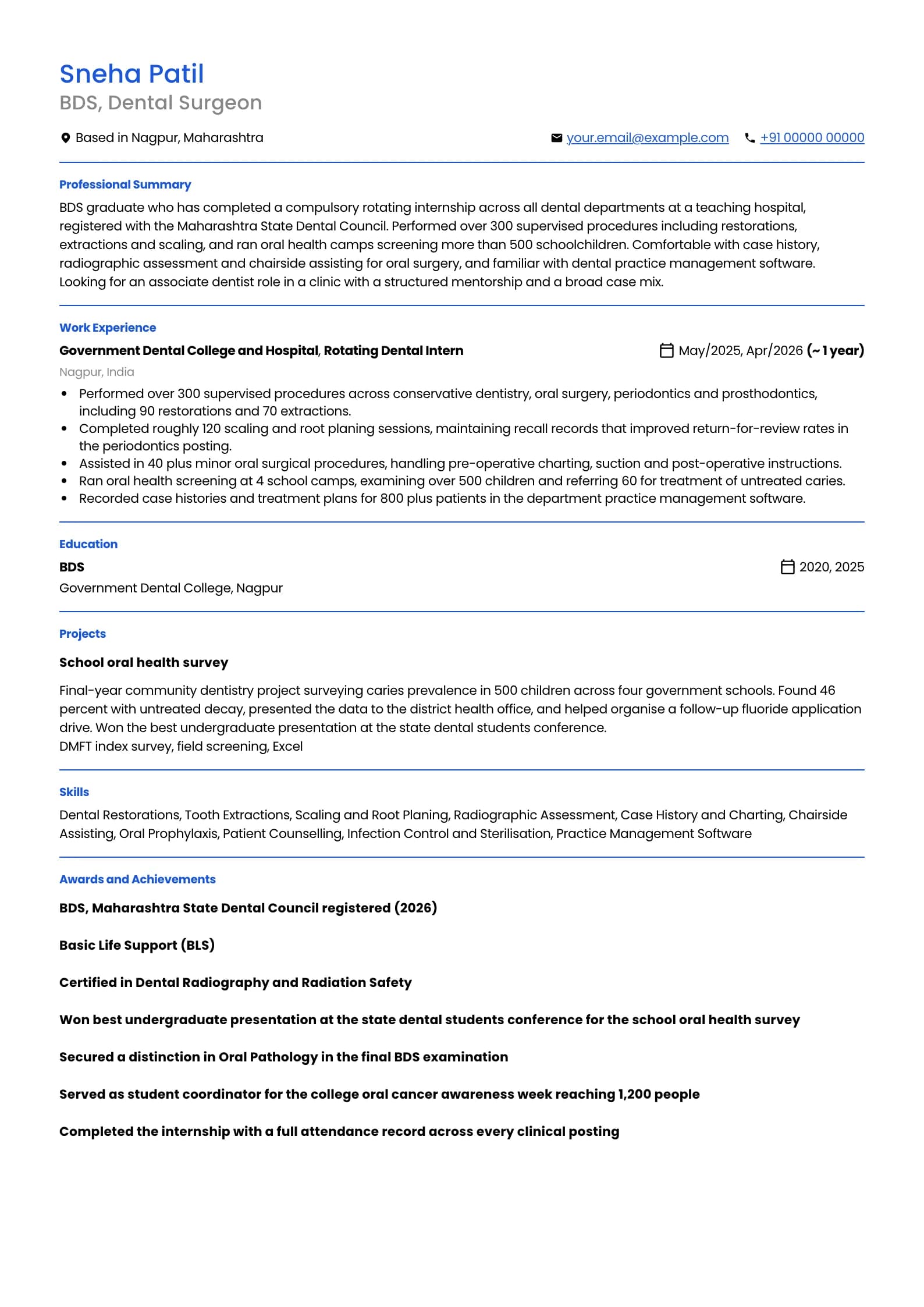
Build my resumeDentist resume example, Fresher (0 years)
minimalist templateIs your resume good enough?
Upload the resume you have now and see what an applicant tracking system reads before a dentist recruiter ever does.
Free to run. Sign in with your mobile number to see your score.
Dentist resume example, Associate Dentist (4 years)
ai-era template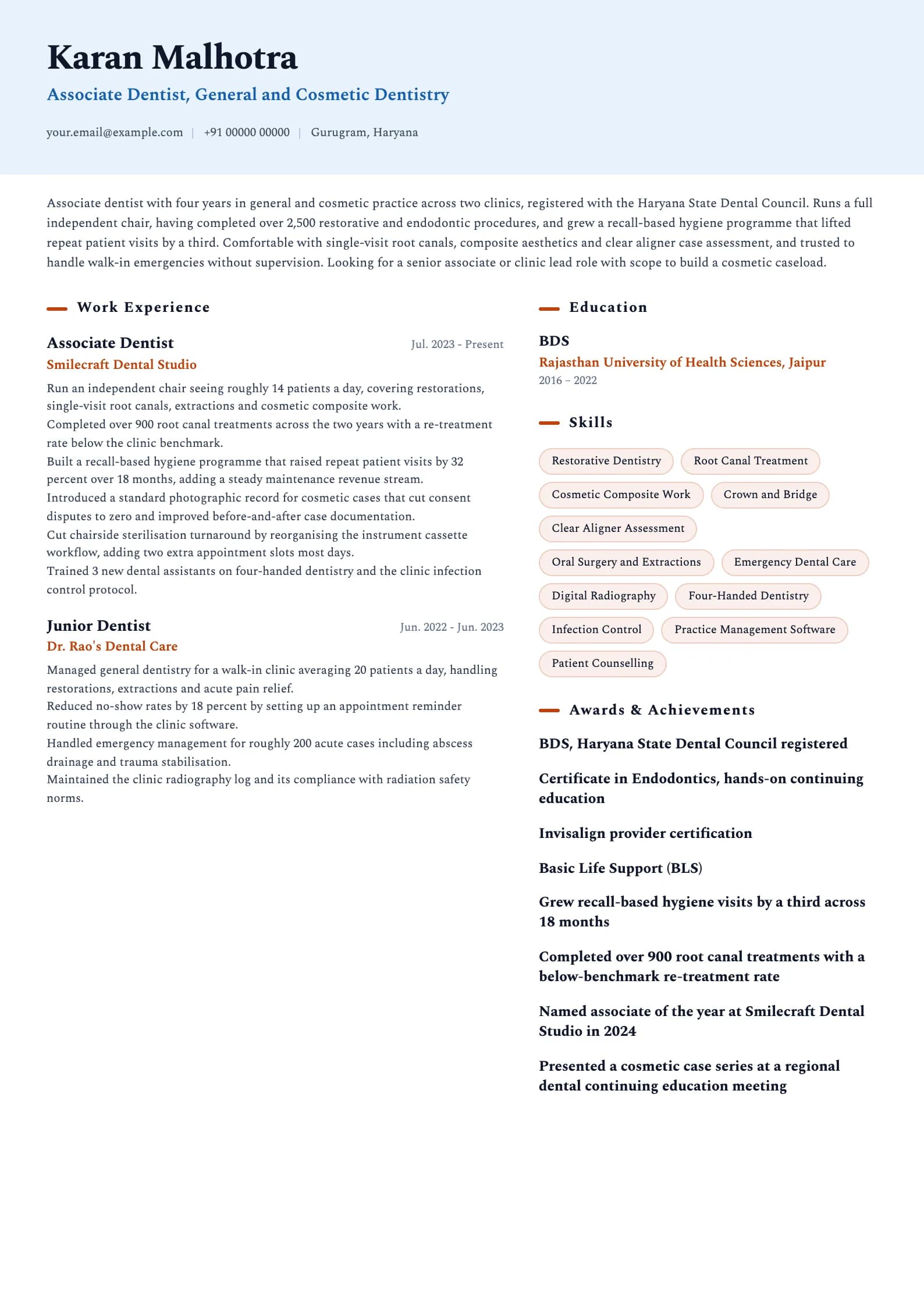
Want this structure with your own details? Build it in the resume builder.
Dentist resume example, Specialist (10 years)
professional template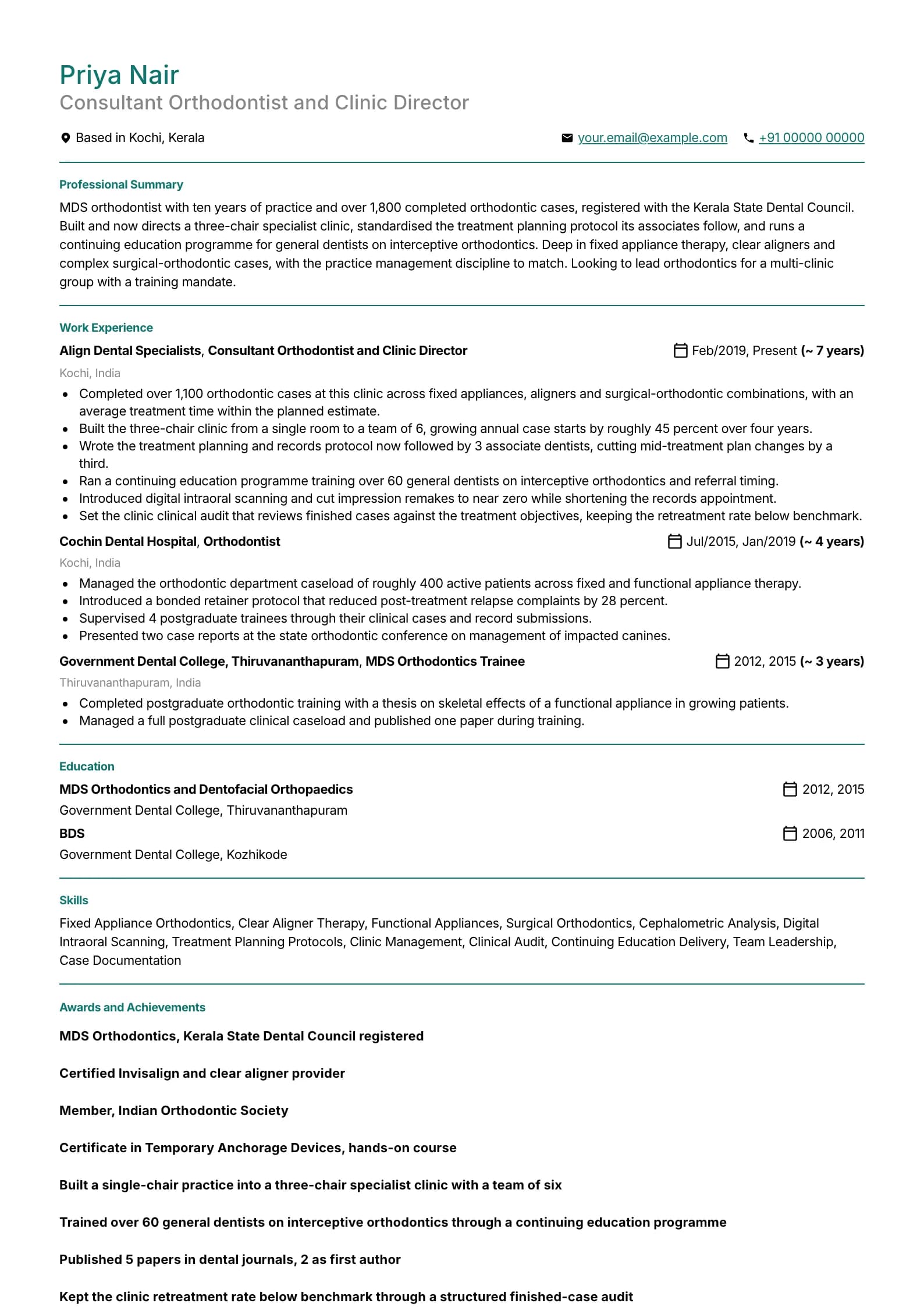
The format that works for dentist resumes in India
Reverse chronological is the right layout for a dentist's job resume in India, whether you are applying to a private clinic, a dental chain or a hospital. Most recent role first, dates visible. The one exception is the longer academic CV used for a postgraduate or teaching application, which follows a separate institutional format with full publication and case lists. The non-negotiable at the top is your qualification and registration: BDS or MDS, the State Dental Council you are registered with, and your registration number. This is the first thing a clinic owner or HR verifies, and a resume that hides it invites doubt. A dentist listing procedures but no valid registration will be set aside no matter how strong the caseload reads. Length follows evidence. A BDS fresher fresh out of internship fits on one page. A specialist with a postgraduate degree, publications and a clinic to their name will run to two, and that is fine. What does not justify page two is a list of continuing education courses attended without any case work to show for them, or a hobbies section. The four items that clutter every Indian template belong nowhere on a clinical resume: photograph, date of birth, marital status and father's name. Where a clinic genuinely wants a photo, the posting will say so. Send a PDF, name the file with your name and the role, keep it single column so a portal reads it in order, and let your procedure range and registration do the work. The table below sets the section order.
| Section | Where it goes | Why |
|---|---|---|
| Name and headline | Top, above everything | Headline is your level and focus, e.g. Associate Dentist, Cosmetic. |
| Qualification and registration | Header or first two lines | BDS or MDS, council and registration number. Verified first. |
| Professional summary | Directly under the header | Three or four lines. Focus, years, procedure range and one result. |
| Clinical experience | Next, most recent first | Role, clinic or hospital, dates. Newest gets the most detail. |
| Education | Below experience, top for a fresher | BDS and any MDS with institution and years. |
| Certifications and courses | After education or beside skills | Provider credentials, hands-on courses, BLS, with year. |
| Publications or case work | For anyone who has them | Named journals for a specialist, a project for a fresher. |
Writing a summary a clinic owner actually reads
The block under your name is the part most likely to be read, so it must carry what a dental employer screens for: your focus and level, how long you have practised, the range and volume of procedures you handle at the chair, and one strong result. Three or four lines, and registration belongs here because it decides whether the rest counts. The old objective, seeking a challenging position in a reputed dental clinic to utilise my skills, tells the reader nothing they did not assume the moment you applied. Replace it with a summary of what you actually do at the chair. A dentist who writes "completed over 2,500 restorative and endodontic procedures and grew recall-based hygiene visits by a third" has said more in one line than a paragraph of aspiration. Freshers often feel there is nothing to summarise after only an internship. Look at the fresher sample. It names the procedure counts, the camps and the council registration. That is a real summary built from a rotating internship. What it avoids is "passionate about dentistry", which appears on nearly every graduate resume and now carries no information. A practical test: read your summary and ask whether a batchmate could paste it onto their own resume unchanged. If they could, it describes the degree, not you. Add the specific procedure volume, the specific case type you are strong in, the specific programme you built until it stops being transferable. Rewrite the summary for each meaningfully different role. A summary aimed at a high-volume walk-in clinic should lead with restorative and emergency throughput; one aimed at a cosmetic practice should lead with aesthetic and endodontic work. Two minutes of editing, and it is the highest-leverage change you can make.
Professional summary, associate dentist
Weak
Enthusiastic and dedicated BDS dentist seeking a challenging role in a reputed dental clinic where I can apply my knowledge and grow professionally.
Strong
Associate dentist with four years in general and cosmetic practice, registered with the Haryana State Dental Council, having completed over 2,500 procedures and grown recall-based hygiene visits by 32 percent.
The rewrite replaces aspiration with a focus, registration, a procedure count and one verifiable business result.
Experience bullets: procedure, scale, and result
A strong dental bullet names the procedure or programme, the scale you handled it at, and what measurably changed. The verb establishes that you did it. The scale, procedures completed, patients seen a day, chairs run, tells an employer whether your throughput fits the clinic. The result, a re-treatment rate, a recall increase, a no-show reduction, a slot gained, is what persuades. Write bullets honest to your level. A supervised intern should say "supervised" where it applies; it is expected and it is not a weakness. An associate can claim an independent chair and independent emergency management. A specialist is judged on case outcomes and predictability, not procedure count alone. Overstating independence is the quickest way to lose credibility, because a single interview question about a case exposes it. Use the metrics dental work actually produces. Procedure volume, re-treatment rate, recall and repeat-visit rate, no-show reduction, chair time saved, appointment slots gained, camps run, patients screened, remakes reduced. The associate sample uses several different metric types rather than repeating a procedure count, which reads as range. Where you have no number, give scope: how many patients a day, how many chairs, how many assistants trained, how many cases active. "Run an independent chair seeing roughly 14 patients a day" carries weight without inventing an outcome nobody tracked. Allocate detail by recency. Current role gets five or six bullets, the previous one four or five, older training posts two or three. A postgraduate training period can compress to the thesis and the caseload.
| Level | What bullets must prove | Typical metric |
|---|---|---|
| Fresher / Intern | You have real supervised chairside exposure | Procedures performed, scaling sessions, camps run, patients screened |
| Junior Dentist | You handle general dentistry with light supervision | Patients a day, emergency cases, no-show reduction, radiography log |
| Associate Dentist | You run an independent, productive chair | Procedure volume, re-treatment rate, recall growth, slots gained |
| Specialist | You own case outcomes and build the practice | Case outcomes, treatment time, clinic growth, protocols, trainees |
Experience bullet, general practice
Weak
Responsible for doing fillings, extractions and cleaning of teeth for patients coming to the clinic.
Strong
Run an independent chair seeing roughly 14 patients a day across restorations, single-visit root canals and cosmetic composite work, with a below-benchmark re-treatment rate.
"Responsible for" and a task list describe a job description; the rewrite names the independent scope, the throughput and a quality outcome.
Experience bullet, practice growth
Weak
Helped the clinic get more patients and improve the number of people coming back for treatment.
Strong
Built a recall-based hygiene programme that raised repeat patient visits by 32 percent over 18 months, adding a steady maintenance revenue stream.
Names the mechanism, the metric and the timeframe, so a clinic owner can see the commercial value directly.
If a bullet would read identically on a batchmate's resume, it describes the profession, not you. Add the specific procedure range, the specific programme, the specific outcome until it only fits you.
The clinical skills and procedures section
A dentist's skills section has two readers. A clinic or chain portal parses it for literal terms such as root canal treatment, crown and bridge or digital radiography. A dental reviewer wants a short, organised sense of what you can do at the chair unsupervised. Grouping serves both: the terms are present for the machine, and the structure is readable for the person. Group by function rather than one long line. Restorative, surgical, prosthetic and preventive is a grouping that works for most general dentists. A specialist leads with their specialty procedures and keeps a short general block below. The exact headings matter far less than the presence of some structure that lets a reviewer read your competence in one pass. Be honest about independence. A skills list is a set of procedures you agree to be questioned on. Listing a complex procedure you have only assisted, or a modality you cannot handle alone, invites the exact case discussion you cannot carry. Ten procedures you truly own read stronger than twenty you have merely seen. Where independence is partial, say so in the experience section rather than the skills list. Write terms as the field writes them: root canal treatment or endodontics, scaling and root planing, digital radiography. Portals match on strings, so include the common term and its formal name at least once between the summary and skills. Do not add star ratings or proficiency bars. Nobody has agreed what four stars in endodontics means, and a rating invites an argument you cannot win. Competence in dentistry is shown by the case work in the experience section, not asserted with a graphic.
| Group | What goes in it | How many |
|---|---|---|
| Restorative and endodontic | Fillings, composites, root canal treatment, crowns | 3 to 5 |
| Surgical | Extractions, minor oral surgery, abscess management | 2 to 4 |
| Preventive and periodontal | Scaling, root planing, oral prophylaxis, fluoride | 2 to 4 |
| Diagnostics and tools | Digital radiography, intraoral scanning, practice software | 2 to 4 |
| Patient and clinic | Infection control, counselling, four-handed dentistry | 2 to 3 |
Skills section
Weak
Skills: Filling, RCT, Extraction, Cleaning, Braces, Cap, X-ray, Injection, MS Office, Internet, Hard working, Good communication, Punctual
Strong
Restorative: composite restorations, single-visit root canal treatment, crown and bridge. Surgical: extractions, abscess drainage. Preventive: scaling and root planing. Tools: digital radiography, intraoral scanning, practice management software.
Replaces casual and non-clinical terms with properly named procedures at the right level of independence, grouped for a reviewer.
Registration, education and continuing education: where they belong
Registration outranks everything else on a dentist's resume, so it sits in the header or the first two lines: your BDS or MDS, the State Dental Council you are registered with, and your registration number. A procedure list without a valid registration is treated as unverified, and no clinic proceeds until it is confirmed. If you hold registration in more than one state, list the current one. Education goes near the top for a fresher and below experience for anyone in practice. List BDS, then MDS if you have it, each with institution and years. Keep your marks only while you are a fresher and they are strong, a first class or a distinction, since early screening still filters on them. Once you have clinical experience, drop the college aggregate; a percentage from years ago competes for space with case work that predicts your performance far better. Continuing education and hands-on courses sit below education or beside skills. In dentistry these matter more than in many fields, because so much clinical capability is added through short courses: endodontic hands-on training, aligner provider certification, implant courses. List them with the year and, crucially, only when your experience section shows you have actually used the skill. A provider certification with no matching case work reads as a line bought rather than earned. Professional society membership, such as the Indian Dental Association or a specialty society, is worth a line for the credibility and the referral network it signals. Publications deserve their own short section for anyone who has them, named journals for a specialist and a project or poster for a fresher. One caution: courses help most when you are building capability or changing focus, and least once you have a large audited caseload in that area. A specialist's course list should be selective. The completed cases are the credential.
Getting through clinic HR and job portal screening
Most dentist jobs, especially at chains and corporate clinics, are applied to through a portal that parses your file before a human reads it. The parser breaks your resume into name, qualification, registration, employers and dates, then stores it for search. Almost every screening failure here is a parsing or missing-field problem, not a wording one. The rules are short. One column. Put your qualification, registration and level as plain text near the top, never inside an image or a logo. Use standard headings, Clinical Experience rather than My Dental Career, and Education rather than Academic Background if you must be plain. Keep critical details out of the header and footer strip, which some parsers drop. Avoid text boxes and nested tables for the body; a simple skills grid usually survives, but do not gamble your experience section on a decorative layout. On wording, mirror the posting honestly. If it asks for an endodontist or root canal specialist, use root canal treatment and endodontics, not only a synonym. If it wants an aligner provider, name the provider certification you hold. Include the common procedure name and the formal term at least once so both searches find you. Keyword stuffing does not work and reads worse than a filter-out. A hidden block of procedures you do not perform, or every treatment in the syllabus listed at once, is caught quickly and read as dishonesty, which is fatal in a clinical field. Write real experience bullets that naturally contain the right terms, because a bullet describing your endodontic caseload contains the word endodontics in a context that survives human review too. One practical step: export a text-based PDF, not a scan, and open it to confirm you can select and copy your registration number and a line of experience. If you cannot select the text, neither can the portal.
Section heading
Weak
My Journey at the Dental Chair
Strong
Clinical Experience
Portals search for standard headings; a creative one can drop the whole block into an unclassified bucket a recruiter never opens.
Before uploading, copy the text out of your PDF into a plain text editor. If your registration number and most recent role read cleanly there, a portal will most likely parse them correctly.
What gets dentist resumes rejected
Most rejections at the resume stage are not close calls. They come from a small set of recurring problems, and all of them are fixable in an afternoon. The list below covers what reviewers of Indian dental resumes see most often, in rough order of how much damage each does.
- Registration and State Dental Council missing or buried. It is the first fact a clinic verifies, so it belongs at the top.
- Claiming complex procedures you have only assisted. One case discussion in the interview exposes it and ends your credibility.
- No procedure counts or outcome numbers. Cases completed, re-treatment rate, recall growth, patients a day. Pick whichever is honest.
- A generic objective line. Replace it with a summary stating focus, years, procedure range and one result.
- A photo, date of birth, marital status or father's name. None of it belongs on a clinical resume and it takes real content's space.
- Provider certifications with no matching case work. A certificate you have never used reads as bought, not earned.
- A wall of every procedure in the syllabus listed as a skill. It signals padding rather than competence.
- The same resume sent to a walk-in clinic, a cosmetic practice and a government post without reordering the summary.
- Continuing education courses listed as if they were qualifications, with no cases to show for them.
- Multi-column or image-heavy layouts that a clinic portal reads out of order, scrambling registration and experience.
Read your resume as if you were the clinic owner about to hire yourself. Any procedure you could not talk through confidently is a line to move to 'assisted' or cut.
Skills to put on a dentist resume
Technical
- Dental Restorations
- Root Canal Treatment
- Crown and Bridge
- Tooth Extractions
- Minor Oral Surgery
- Scaling and Root Planing
- Cosmetic Composite Work
- Clear Aligner Assessment
- Cephalometric Analysis
- Radiographic Interpretation
- Emergency Dental Care
- Oral Prophylaxis
Tools and platforms
- Digital Radiography
- Intraoral Scanner
- Dental Practice Management Software
- Rotary Endodontics
- Apex Locator
- Light Cure Units
- Autoclave and Sterilisation
- Dental Loupes
- Impression Systems
- Aligner Planning Software
Working skills
- Patient Counselling
- Managing Dental Anxiety
- Four-Handed Dentistry
- Team Leadership
- Treatment Plan Explanation
- Chairside Manner
- Clinic Coordination
- Continuing Education Delivery
- Time Management
Certifications worth listing as a dentist
| Certification | Full name | Worth it for |
|---|---|---|
| State Dental Council Registration | Registration with a State Dental Council under the Dental Council of India | Mandatory for every practising dentist in India, and the number belongs at the top of the resume. Clinics and HR verify it before any interview, so a resume that omits it stalls at once. |
| Endodontics course | Hands-on continuing education in rotary endodontics and single-visit root canals | A common and worthwhile capability-builder for general dentists who want to keep endodontic work in-house rather than refer it. List it only when your experience section shows real root canal caseload behind it. |
| Aligner provider certification | Invisalign or equivalent clear aligner provider certification | Valuable for a general or cosmetic dentist building an aligner caseload, since it is often required to accept cases from the provider. Back it with case work, or it reads as a line without substance. |
| Implant course | Certified hands-on implantology training | Worth it for general dentists moving into implant placement, one of the higher-value procedures in private practice. Employers will expect matching case evidence, so pair the certificate with a caseload. |
| BLS | Basic Life Support | Expected across clinical roles and quick to keep current. A dentist manages medical emergencies at the chair, so an in-date BLS card is a reasonable baseline every practitioner should hold. |
| IDA / specialty society membership | Indian Dental Association or a recognised specialty society membership | A credibility and network signal rather than a clinical credential. Worth a line for the standing and referral relationships it indicates, particularly for a specialist or clinic owner. |
| Dental radiography and safety | Certification in dental radiography and radiation safety | Useful for freshers and for anyone running or overseeing a clinic's radiography, given the compliance requirements around dental imaging. A reasonable early credential to hold. |
Keywords an ATS scans for in a dentist resume
These are the literal terms a parser matches against the job description. Use the ones that are true of you, in the sentences where you did the work, not as a list at the bottom.
- BDS
- MDS
- dental surgeon
- state dental council registration
- restorative dentistry
- root canal treatment
- endodontics
- extractions
- scaling and root planing
- crown and bridge
- cosmetic dentistry
- orthodontics
- digital radiography
- infection control
- oral surgery
- clear aligners
- practice management
- patient counselling
- dental radiography
- clinical experience
Dentist resume FAQ
What salary can a dentist expect in India?
It varies with degree, city and setup. A BDS fresher joining a clinic as an associate commonly earns around 3 to 6 LPA to start, often on a mix of fixed pay and a share of procedures. An experienced associate with a strong caseload can reach 8 to 15 LPA, and an MDS specialist or a clinic owner with an established practice earns well beyond that, with income tied closely to case mix and location. Your resume does not set the number, but a clear record of procedure range and caseload strengthens your position when it is discussed.
How long should a dentist's resume be?
One page for a BDS fresher, and up to two pages for an MDS specialist with publications, a clinic and continuing education to show. The longer academic CV used for a postgraduate or teaching application is a separate document. Keep the job resume focused: registration and qualification at the top, experience with real procedure numbers, and no padding from courses attended without matching case work.
Where does my dental council registration go on the resume?
In the header or the first two lines, with your BDS or MDS and the State Dental Council you are registered with. It is the single most important verification detail, and clinics check it before anything else. Listing procedures without a valid registration, or hiding the registration at the bottom, is one of the most common reasons a dental resume stalls in screening.
Do dentist resumes go through an ATS in India?
At dental chains and corporate clinics, usually yes, because applications are parsed before a human reads them. Use a single-column layout, standard headings, and put your qualification, registration and level as plain text near the top rather than inside an image. Test your file by copying the text out of the PDF; if your registration number and most recent role read cleanly, a portal will most likely parse them correctly.
How does a BDS fresher write a resume with only internship experience?
Lead with your qualification and registration, then a summary built from your internship, then education and skills. Name the procedures you performed under supervision with counts, the camps you ran, the patients you screened and any community project. Supervised procedure volume, restorations, extractions and scaling sessions, is honest and quantifiable, and it shows a clinic you are ready at the chair.
Should I list every procedure I can do?
List the procedures you perform or assist competently and unsupervised, not every procedure in the syllabus. A skills list is a set of things you agree to discuss as cases in the interview, and a complex procedure you have only assisted invites exactly the discussion you cannot carry. Ten procedures you truly own read stronger than twenty you have merely observed.
Do continuing education courses help a dentist's resume?
They help significantly in dentistry, because so much clinical capability is added through short hands-on courses in endodontics, aligners or implants. The key is to list a course only when your experience section shows you have used the skill on real cases. A provider certification with no matching case work reads as a line bought rather than a capability earned.
Should I put my BDS marks on the resume?
Keep them while you are a fresher and they are strong, roughly a first class or a distinction, since early screening still filters on them. Once you have clinical experience, drop the college aggregate. A percentage from years ago competes for space with case work that predicts your chairside performance far better, and no clinic hiring an associate is weighing a BDS percentage against your caseload.
Is a photo needed on a dentist's resume in India?
No. Indian clinic recruiters do not expect one, and it takes space a procedure or result should occupy. The same goes for date of birth, marital status, father's name and a declaration paragraph, all of which come from an older template. The only exception is a role that explicitly asks for a photograph in the posting.
How do I show I can grow a clinic's revenue, not just treat patients?
Add the business metrics your work produced, because clinic owners hire associates partly for productivity. Recall and repeat-visit growth, appointment slots gained, no-show reduction, and the value of a maintenance programme you built are all honest, clinic-relevant numbers. A dentist who shows both clinical range and commercial impact stands out from one who lists only procedures performed.
Related resume examples and guides
Build your own in any of these formats
Start from a blank resume or upload the one you have. The builder renders it in 24 templates and flags what a clinic portal will miss.
Build my resume