Staff Nurse Resume Format, with 3 Full Samples
A staff nurse is hired on evidence of safe patient care across a ward or unit, backed by a valid council registration, yet many nursing resumes list duties in the abstract and forget the two things a hospital screens on first: the qualification and the registration. The ward gets named, the responsibilities get copied from a job description, and the patient load, the unit specialisation and the clinical care the nurse actually delivered go missing. Below are three complete resumes, one for a GNM or B.Sc Nursing fresher, one for a ward and ICU staff nurse with four years, and one for a senior staff nurse moving toward a nursing in charge role. After the samples come the format rules, the registration and qualification that gate every hospital job, the clinical detail a nursing resume must carry, and the mistakes that end a screening early.
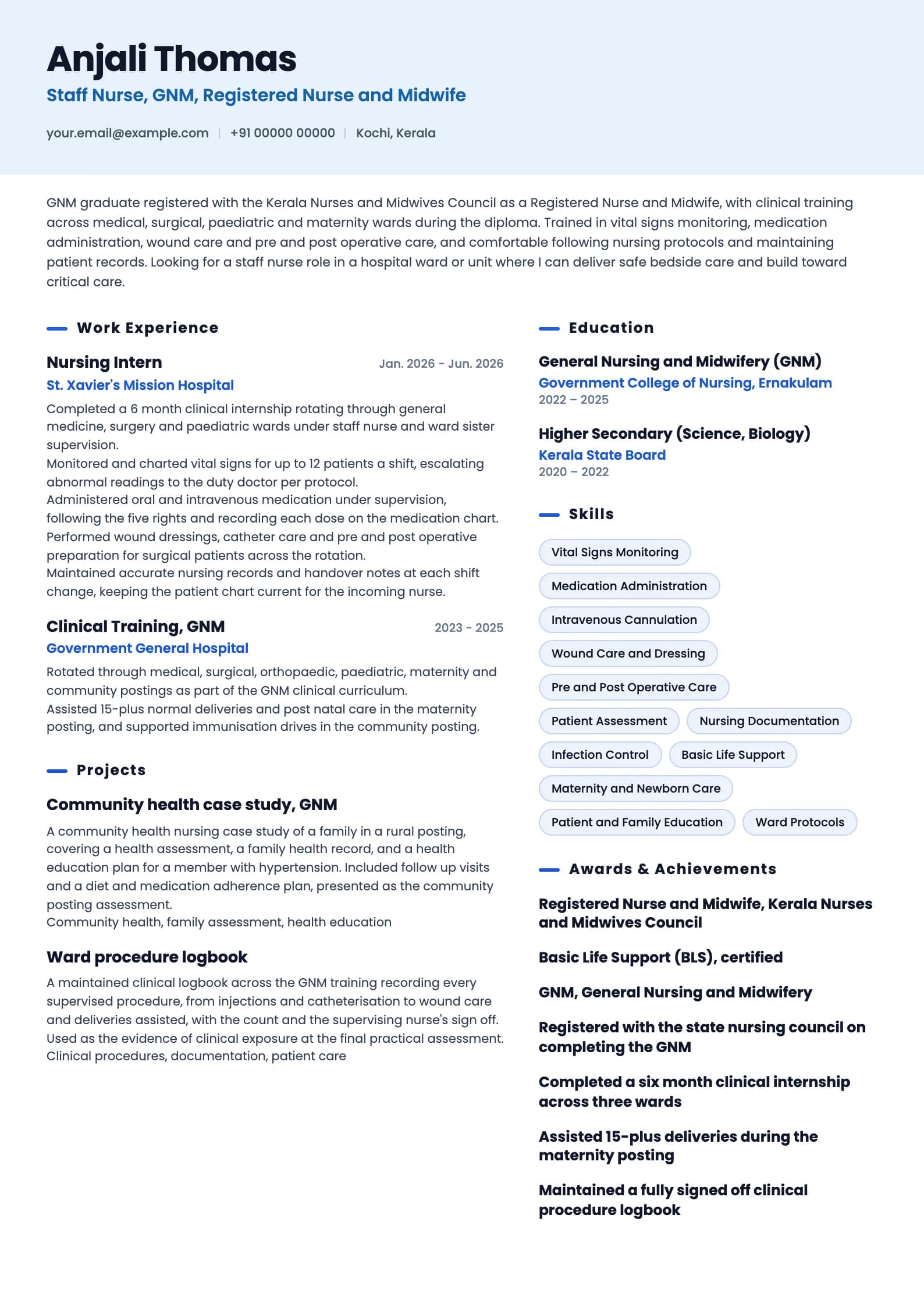
Build my resumeStaff Nurse resume example, Fresher (0 years)
ai-era templateIs your resume good enough?
Upload the resume you have now and see what an applicant tracking system reads before a staff nurse recruiter ever does.
Free to run. Sign in with your mobile number to see your score.
Staff Nurse resume example, Mid-level (4 years)
header-band template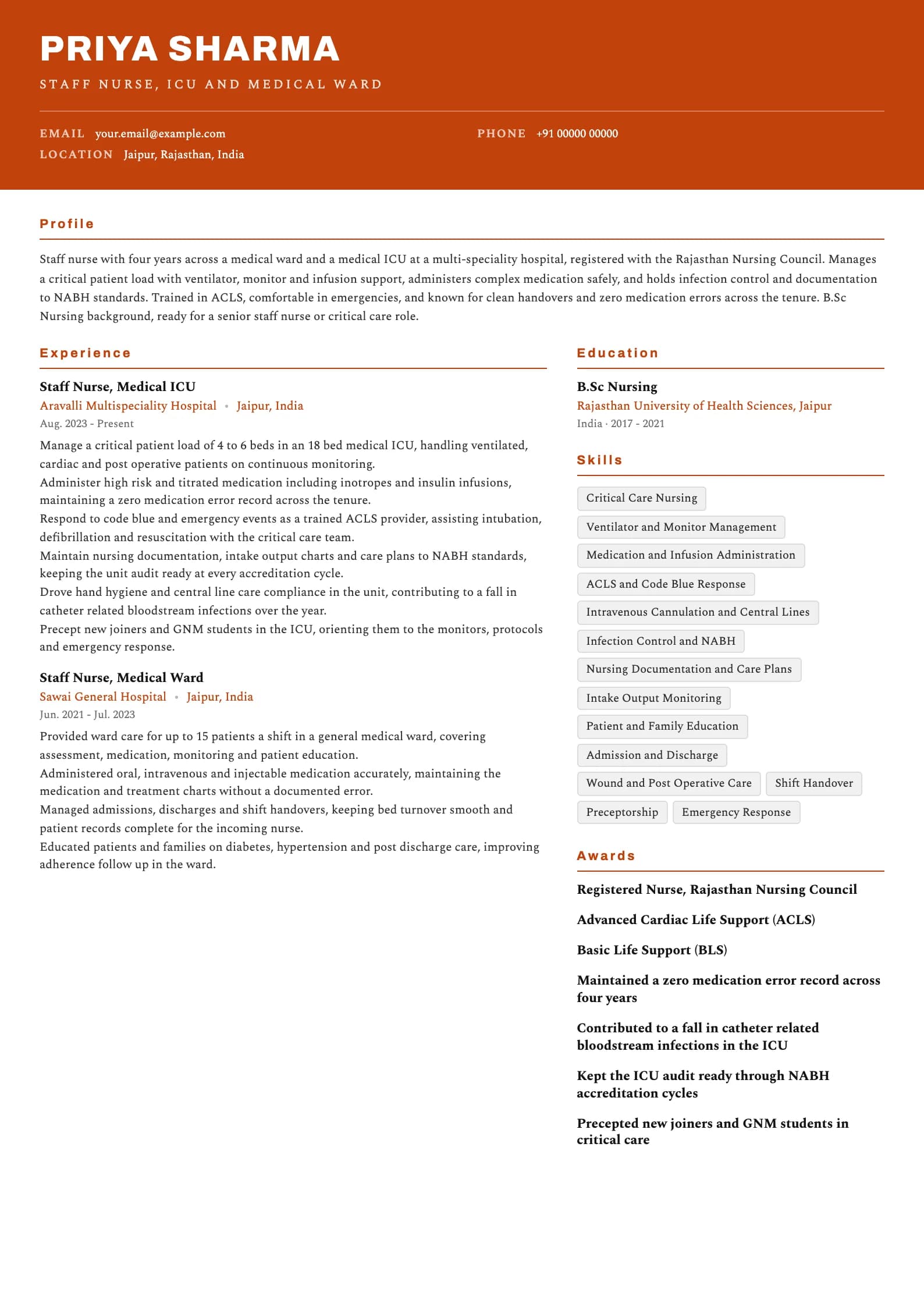
Want this structure with your own details? Build it in the resume builder.
Staff Nurse resume example, Senior (9 years)
minimalist template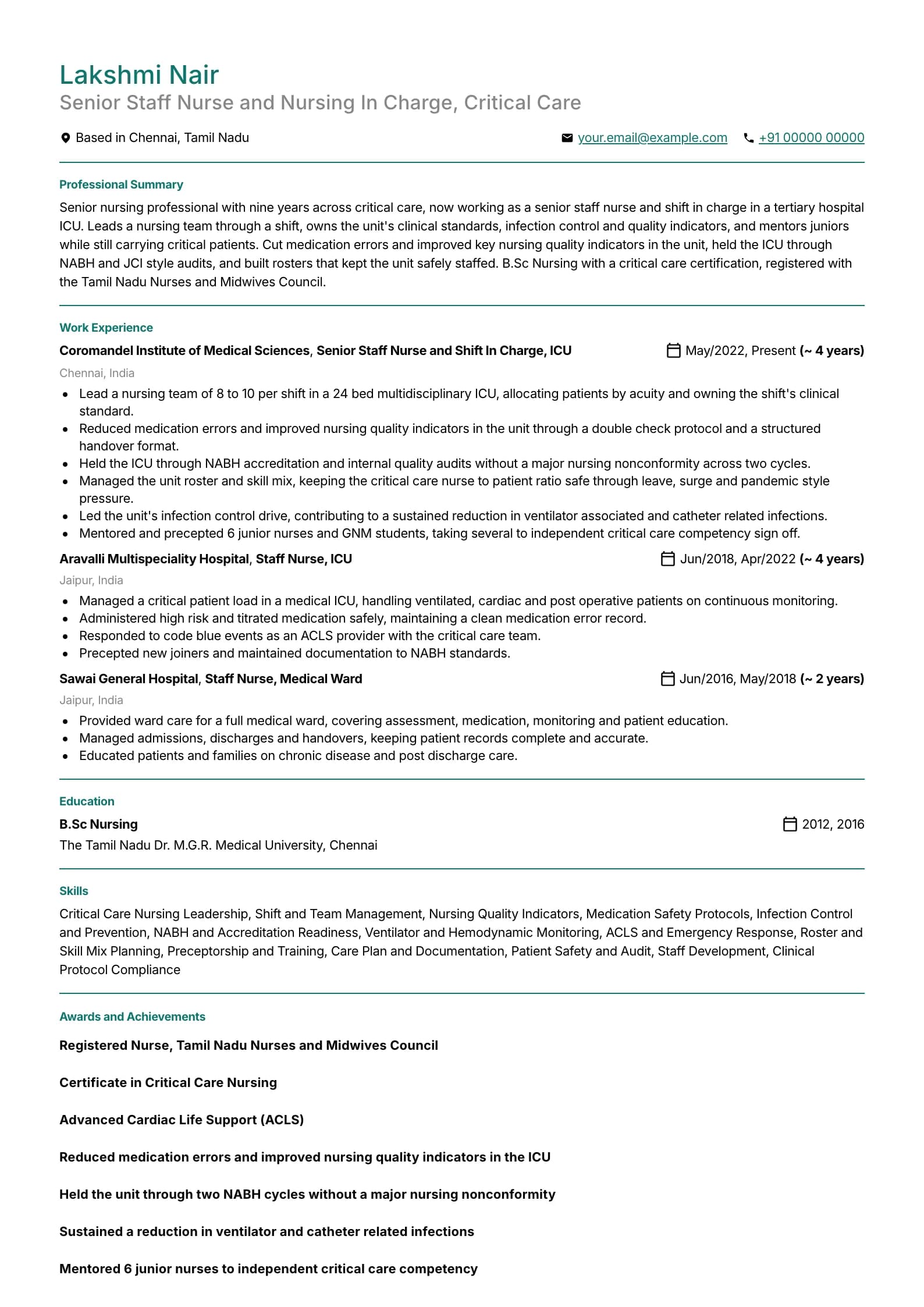
The format that works for staff nurse resumes in India
Reverse chronological is the layout to use. Put the most recent role first, work backwards, and let the dates sit in plain view. Functional resumes that group everything under Areas of Expertise and quietly drop the dates read as an attempt to hide a gap, and nursing recruiters, who verify tenure against experience certificates, treat them that way. A staff nurse resume is screened on two non-negotiables before any bullet is read: the qualification and the state council registration. GNM or B.Sc Nursing, and a valid registration with the state Nurses and Midwives Council, decide whether you are even eligible. So both belong at the top, near the name, not buried on page two. A hospital cannot legally roster an unregistered nurse, so a resume that hides the registration reads as a problem. Beyond that, the resume has to show the unit and the acuity you work at. A general medical ward, an ICU, a paediatric unit, an operation theatre and a dialysis unit are different jobs, and the patient load and the equipment you handle place you instantly. Lead with the specialisation and the level of care. Four things belong nowhere here: a photograph, date of birth, marital status and father's name. Send a PDF unless the posting asks otherwise, name the file with your own name and the role, and use a single column so the parser reads it cleanly. The table below sets out the section order.
| Section | Where it goes | Why |
|---|---|---|
| Name and title | Top, above everything | Staff Nurse, with the qualification like GNM or B.Sc Nursing. |
| Registration line | High, near the name | State council registration and number. This gates every hospital job. |
| Professional summary | Under the header | Three lines. Years, unit specialisation, and a patient safety result. |
| Work experience | Next, for anyone with a job | Most recent first. Name the unit, the bed count and the patient load. |
| Clinical training | Above experience for freshers | For a fresher, the ward rotations and procedures are the evidence. |
| Skills and certifications | Below experience | Clinical skills grouped, plus BLS, ACLS and any speciality course. |
| Education | Bottom, unless you are a fresher | GNM or B.Sc Nursing, institution and year. |
Registration and qualification: the gate before the resume
In nursing, the credential is not a bonus at the bottom of the page, it is the eligibility gate. Every hospital in India requires a staff nurse to hold a recognised qualification, GNM or B.Sc Nursing, and a current registration with a State Nurses and Midwives Council. Without both, the application cannot proceed, so the resume must put them where a screener sees them in the first two seconds. Put the qualification next to your name or title, GNM or B.Sc Nursing, and the registration line high on the page. State the council and the registration number, for example Registered Nurse and Midwife with the relevant state council. If you have registered in more than one state or hold a reciprocal registration, note it, because it tells a recruiter you can be posted without a delay. Name the qualification precisely. GNM is General Nursing and Midwifery, a diploma. B.Sc Nursing is the degree, and Post Basic B.Sc Nursing is the route for a GNM nurse who upgrades. A recruiter and an ATS both read these as distinct, so write the exact one you hold rather than a vague "nursing qualification". Keep the registration current and never list a lapsed one as valid. Renewal is periodic, and a hospital will verify it, so an expired registration presented as active is the fastest way to lose an offer. If a renewal is in process, say so honestly rather than imply it is complete. The registration is the single most load-bearing line on a nursing resume, so treat it with the same care you would a patient chart.
Put GNM or B.Sc Nursing next to your name and the state council registration line directly under it. A nursing recruiter filtering for a registered nurse should confirm your eligibility before reading a single duty.
Writing a summary a nursing superintendent actually reads
The block under your name is the part you can be reasonably sure gets read, so it should carry three facts: your qualification and registration, the unit and acuity you work at, and the strongest patient safety or care result you own. Three or four lines, no adjectives that cannot be checked. The old objective line, seeking a challenging position in a reputed hospital to serve patients with dedication, tells the reader nothing they did not assume from the application. Replace it with a summary. An objective describes what you want, a summary describes the care you have already delivered, and only one gets a nursing leader to read on. Freshers often believe they have nothing to summarise. Look at the fresher sample: it names the GNM and the state registration, cites a six month internship across three wards, and points at the vitals, medication and procedures done under supervision. That is a genuine summary built from a diploma, clinical training and an internship. What it avoids is "caring and dedicated nurse", a phrase so common it now carries no information. A practical test: read your summary and ask whether another nurse with the same qualification could paste it onto their resume unchanged. If they could, it describes the training, not you. Add the specific unit, the specific patient load and the specific result until it stops being transferable.
Professional summary, ICU staff nurse
Weak
Caring and dedicated staff nurse with 4+ years of experience seeking a challenging position in a reputed hospital to serve patients with compassion and dedication.
Strong
Staff nurse with four years across a medical ward and an 18 bed medical ICU, registered with the state nursing council and ACLS certified. Manages a critical patient load with a zero medication error record and holds documentation to NABH standards.
The rewrite trades self-description for the registration, the unit and acuity, and a patient safety result a nursing leader screens on first.
Experience bullets: verb, clinical care, patient consequence
Every strong bullet in the samples follows the same shape. It opens with an action verb, names the specific clinical care you delivered, and closes with what it protected or improved for the patient or the unit. The verb establishes that you did it. The care tells a reviewer the acuity you work at. The outcome, the zero error record, the infection reduction, the audit cleared, does the persuading. Start with the outcome and work backwards. Nurses usually write the duty first, then leave it generic, which produces bullets like "provided nursing care to patients as per hospital norms". Instead ask what actually happened: a medication error record stayed clean, a code blue was managed, an infection rate fell, an audit was cleared, patient education improved adherence. Then write the sentence that ends in that fact. Nursing rewards a specific kind of detail: the unit and bed count, the patient load per shift, the acuity and equipment, medication safety, infection control indicators, accreditation readiness, procedures and emergency response. "Manage a critical patient load of 4 to 6 beds in an 18 bed medical ICU" carries the level and the scope in one line. Vary the detail so the resume does not read as one duty repeated. Where you genuinely lack a headline metric, give scope and specificity: patients per shift, procedures performed, admissions and discharges managed, students precepted. "Administered high risk and titrated medication including inotropes and insulin infusions" is a real, checkable claim of competence. Allocate bullets by recency. Current role gets five or six, the previous role four or five, anything older two or three.
| Level | What bullets must prove | Typical detail |
|---|---|---|
| Fresher | You can give safe supervised bedside care | Wards rotated, vitals and meds, procedures, patients per shift |
| 1 to 4 years | You run a patient load independently | Unit and beds, medication safety, documentation, emergencies |
| 5 to 8 years | You handle high acuity and quality | ICU load, ACLS, infection indicators, NABH readiness |
| 8 years and up | You lead a shift and set the standard | Team led, quality indicators, audits cleared, nurses mentored |
Experience bullet, staff nurse
Weak
Provided nursing care to patients and administered medication as per doctor's orders and hospital norms in the ward.
Strong
Administer high risk and titrated medication including inotropes and insulin infusions, maintaining a zero medication error record across the tenure.
The generic duty becomes a specific competence and a patient safety result a nursing leader can verify against incident records.
Experience bullet, quality
Weak
Followed infection control practices and maintained cleanliness and hygiene in the unit at all times.
Strong
Drove hand hygiene and central line care compliance in the unit, contributing to a fall in catheter related bloodstream infections over the year.
Names the practice and ties it to a measurable infection indicator, which is exactly what an accreditation-focused hospital tracks.
If a bullet would read identically on any nurse's resume, it is describing the profession, not your unit. Rewrite it until it only fits the acuity and the care you actually delivered.
The clinical detail a nursing resume must carry
A nursing resume is read by a clinical person, a nursing superintendent or a ward sister, who can tell instantly whether you understand the level of care you claim. That is why generic duty lines fall flat: they signal someone who has held a role rather than delivered a level of care. The detail that lands is the unit, the acuity, the equipment and the safety record. Name the unit and its scale. A general medical ward, a surgical ward, an ICU or CCU with a bed count, an operation theatre, a dialysis unit, an NICU or PICU, an emergency department. The unit tells a reviewer the acuity, and the bed count and your patient load per shift tell them the intensity. "A 24 bed multidisciplinary ICU" places you far more precisely than "critical care unit". Show the equipment and the interventions you are competent with, honestly. Ventilators, multiparameter monitors, infusion and syringe pumps, central lines, defibrillators. Titrated and high risk medication, code blue response, ACLS interventions. These separate a critical care nurse from a general ward nurse, and they are the terms a specialist recruiter searches. Carry the safety and quality record, because patient safety is the outcome a hospital cares about most. A clean medication error record, infection control indicators like ventilator associated or catheter related infections, accreditation readiness under NABH, incident reporting. These are the nursing equivalent of business metrics, and they are checkable. The trap is claiming acuity or interventions you have not done. A nurse who lists ventilator management without ICU experience is exposed in the first clinical interview question, and in nursing that is a patient safety red flag, not just an exaggeration. Claim only what you can perform under scrutiny.
Unit and scope line
Weak
Worked in the hospital taking care of patients and doing all the nursing duties assigned by seniors.
Strong
Managed a critical patient load of 4 to 6 beds in an 18 bed medical ICU, handling ventilated, cardiac and post operative patients on continuous monitoring.
Swaps a vague duty for the unit, the bed count, the patient load and the acuity, which is what a clinical reviewer reads to place your competence.
The skills section: grouped, honest, defendable
A staff nurse's skills section has two audiences with opposite preferences. The parser wants literal terms it can match, ACLS and infection control and IV cannulation. A human, a clinical reviewer, wants a short, organised list that signals the level of care you deliver. Grouping satisfies both. Group by function rather than one long line. Clinical care, critical care and emergency, safety and quality, documentation is a grouping that works for most nurses. The exact headings matter less than the fact that structure exists. Write the terms the profession uses: BLS, ACLS, NABH, intake output, care plan. A parser matches on strings, and a nursing leader reads them as proof you know the work. Name the skills you can perform under scrutiny. Vital signs and assessment, medication and infusion administration, IV cannulation, wound care, ventilator and monitor handling, code blue response. Match the emphasis to the role: critical care skills for an ICU post, maternity and newborn care for an obstetric unit, dialysis for a nephrology unit. Twelve to sixteen skills is the working range. Below eight the section looks thin. Above twenty it stops being a signal. The list is a contract: every item is a competence you have agreed to demonstrate. Do not include a proficiency bar. Let the unit, the acuity and the safety record prove the depth instead.
| Group | What goes in it | How many |
|---|---|---|
| Clinical care | Vitals, assessment, medication, IV, wound care, mobility | 3 to 5 |
| Critical and emergency | Ventilator, monitors, infusions, ACLS, code blue, defibrillation | 2 to 4 |
| Safety and quality | Infection control, medication safety, NABH, incident reporting | 2 to 4 |
| Documentation | Nursing records, care plans, intake output, handover | 1 to 3 |
| Speciality | Maternity, newborn, paediatric, dialysis, OT as relevant | 1 to 2 |
Skills section
Weak
Skills: nursing, patient care, injection, medicine, cleanliness, caring, hard working, punctual, honest, dedicated, sincere, MS Office, English, Hindi, team player
Strong
Clinical: vitals, medication administration, IV cannulation, wound care. Critical: ventilator, monitors, ACLS, code blue. Safety: infection control, medication safety, NABH. Documentation: care plans, intake output, handover.
Cuts the vague words and the soft skills masquerading as clinical competence, then groups the rest so a clinical reviewer reads your level in one pass.
Where education, certifications and registration belong
For a staff nurse the registration and qualification punch above everything, so they sit near the top, as covered above. Education itself, the GNM or B.Sc Nursing degree with the institution and years, goes at the foot of the page for anyone with a job, and higher for a fresher, alongside the clinical training that is much of a fresher's evidence. Name the qualification precisely. GNM is the three and a half year diploma. B.Sc Nursing is the four year degree. Post Basic B.Sc Nursing is the upgrade route for a GNM nurse, and worth naming distinctly because it changes your career ceiling. A recruiter and a parser both treat these as different, so write the exact one you hold. Certifications that carry real weight are the life support and speciality ones. Basic Life Support is expected from the start. Advanced Cardiac Life Support matters for critical care and emergency roles, and often gates an ICU posting. A certificate in critical care nursing, dialysis, or a speciality course signals depth for a specialist unit. Name each with the awarding body and keep them current, because a hospital verifies them. Languages matter in nursing because you communicate with patients and families in their own language, and a multilingual nurse is genuinely more employable across regions. List the languages you can care and educate a patient in. Keep marks only while you are a fresher and they are good; once you have unit experience and a safety record, the clinical evidence carries the resume. Never list a lapsed registration or life support certificate as current.
Getting through the applicant tracking system
Large hospitals and the portals they recruit through run an applicant tracking system, so the same parsing rules apply to nurses as to any other field. The system reads your file, tries to break it into name, dates, employers, titles and skills, and stores the result for search. Almost every ATS problem is a parsing problem, and parsing problems come from layout, not wording. The layout rules are short. One column. Standard section headings, so use Work Experience rather than My Nursing Journey, and Certifications rather than My Achievements. No tables or text boxes for your core content, because some parsers scramble them. No critical information in the header or footer region, which some parsers drop, and for a nurse that includes the registration line, so keep it in the body. On wording, mirror the language of the job description where it is honest. If the posting says B.Sc Nursing, write B.Sc Nursing. If it says ICU or critical care, and you have that experience, write it. If it names ACLS or NABH, and you hold or work to them, include them. Include the expansion alongside an acronym at least once, for example "ACLS (advanced cardiac life support)", so both searches find you. Keyword stuffing does not work. A hidden block of clinical terms helps nothing, because a nurse is judged in a clinical interview a stuffed resume rarely reaches. Write real bullets that naturally contain the right terms. Save as PDF from a tool that embeds real text, then open the file and confirm you can select and copy a sentence. If you cannot select the text, neither can the parser.
Section heading
Weak
My Nursing Journey
Strong
Work Experience
Parsers look for standard headings; a decorative one can push your roles and your unit experience into an unclassified bucket the recruiter never searches.
Keep the registration and qualification in the body text, not a header or footer, and name the exact unit and certifications the posting asks for. A recruiter searching for a registered ICU nurse with ACLS will only surface resumes carrying those literal terms.
What gets staff nurse resumes rejected
Most rejections at the resume stage are not close calls. They come from a small set of recurring problems, and all of them are fixable in an afternoon. The list below covers what nursing recruiters reviewing Indian staff nurse resumes see most often, in rough order of how much damage each one does.
- No registration line, or it sits so low the screener assumes you are not registered and drops the file, since a hospital cannot roster an unregistered nurse.
- Claiming an acuity or intervention you have not done, such as ventilator management without ICU experience, which is a patient safety red flag in the interview.
- Generic duty lines. "Provided nursing care as per hospital norms" tells a clinical reviewer nothing about your level.
- No unit or patient load, so a reviewer cannot tell whether you ran a general ward or a critical care unit.
- No safety or quality record: no medication error line, no infection indicator, no accreditation readiness, in a field measured on exactly those.
- A lapsed registration or expired BLS or ACLS presented as current, which a hospital verifies and which costs the offer.
- The wrong or vague qualification, "nursing diploma" instead of GNM, or B.Sc left ambiguous, which a parser and a recruiter both misread.
- A wall of generic words, caring and dedicated and hard working, with none of the clinical vocabulary a superintendent looks for.
- A photo, date of birth, marital status or father's name padding the page, none of which belongs on a professional resume here.
- A generic objective line. Replace it with a summary that states qualification, registration, unit and one patient safety result.
Read your resume once as if you were the nursing superintendent deciding who joins the unit. Any clinical claim you could not perform under a scenario question is a line to correct, because in nursing an exaggeration is a safety risk, not just a stretch.
Skills to put on a staff nurse resume
Technical
- Vital Signs Monitoring
- Medication and Infusion Administration
- Intravenous Cannulation and Central Lines
- Ventilator and Monitor Management
- ACLS and Code Blue Response
- Wound and Post Operative Care
- Infection Control and Prevention
- Patient Assessment
- Nursing Documentation and Care Plans
- Intake Output Monitoring
- Maternity and Newborn Care
- Admission and Discharge
- NABH and Accreditation Standards
- Patient and Family Education
Tools and platforms
- Multiparameter Patient Monitors
- Mechanical Ventilators
- Infusion and Syringe Pumps
- Defibrillator and Crash Cart
- Glucometer and Point of Care Devices
- Hospital Information System (HIS)
- Electronic Medical Records
- Central Line and IV Access Kits
- Nebulisers and Oxygen Delivery
Working skills
- Compassionate patient care
- Calm under emergency pressure
- Clear clinical handover
- Patient and family communication
- Teamwork with the clinical team
- Attention to safety detail
- Preceptorship and mentoring
- Multilingual patient communication
- Ethical and confidential conduct
Certifications worth listing as a staff nurse
| Certification | Full name | Worth it for |
|---|---|---|
| State Council Registration | Registration with a State Nurses and Midwives Council | Not a bonus but the legal eligibility gate for every staff nurse job in India, since a hospital cannot roster an unregistered nurse. It belongs high on the page with the council name and number, for a fresher above all. Keep it current, and note any reciprocal registration that lets you be posted in another state without delay. |
| GNM | General Nursing and Midwifery diploma | A recognised entry qualification for a staff nurse, valued across hospitals and the common route into ward and unit roles. Name it precisely, since a parser reads it as distinct from B.Sc Nursing. A GNM nurse can upgrade later through Post Basic B.Sc Nursing to widen the career ceiling. |
| B.Sc Nursing | Bachelor of Science in Nursing | The degree qualification, preferred for larger and tertiary hospitals and for a faster path toward in charge and speciality roles. Worth naming clearly with the university. Post Basic B.Sc Nursing, the upgrade for a GNM holder, is worth naming distinctly since it changes eligibility for senior posts. |
| BLS | Basic Life Support | An expected, practical certificate from the very start of a nursing career, since safe emergency response is assumed in any ward. Cheap to hold and quick to renew, it belongs on every nursing resume and should always be shown current rather than lapsed. |
| ACLS | Advanced Cardiac Life Support | The credential that separates a critical care ready nurse from a general ward one, and it often gates an ICU, CCU or emergency posting. Genuinely worth earning for anyone on a critical care track, and best paired with real code blue and titrated medication experience in the bullets. |
| Critical Care Nursing | Certificate or diploma in Critical Care Nursing | A speciality credential that signals depth for ICU, CCU and high dependency roles, and helps a ward nurse move into critical care. Most valuable alongside genuine unit experience with ventilators, monitors and infusions, rather than listed on its own without the clinical exposure behind it. |
Keywords an ATS scans for in a staff nurse resume
These are the literal terms a parser matches against the job description. Use the ones that are true of you, in the sentences where you did the work, not as a list at the bottom.
- staff nurse
- registered nurse
- GNM
- B.Sc Nursing
- state nursing council registration
- ICU
- critical care
- medication administration
- IV cannulation
- ventilator
- ACLS
- BLS
- infection control
- NABH
- patient care
- nursing documentation
- code blue
- wound care
- vital signs
- care plan
Staff Nurse resume FAQ
What salary can a staff nurse expect in India?
A GNM or B.Sc Nursing fresher typically starts around 1.8 to 3.5 LPA, often quoted as roughly 15,000 to 29,000 a month, higher in large corporate and metro hospitals and lower in small nursing homes. A staff nurse with four to seven years, especially in ICU or a speciality unit, usually sits in the 3.5 to 7 LPA band. Senior staff nurses and nursing in charge roles with eight years and above commonly earn 7 to 14 LPA and more in tertiary and corporate hospitals. Government posts add pay scale stability and allowances, and Gulf and overseas roles pay well above Indian bands.
Do I need state council registration on my nursing resume?
Yes, and it is the single most important line. A hospital cannot legally roster an unregistered nurse, so your registration with a State Nurses and Midwives Council, with the council name and number, must sit high on the page near your name and qualification. Keep it current, never present a lapsed registration as active since the hospital will verify it, and note any reciprocal registration in another state so a recruiter knows you can be posted without a delay.
How is a staff nurse resume different from a general nurse resume?
A staff nurse resume focuses specifically on hospital ward and unit roles, so it leads with the unit and acuity you work at, a general medical ward, an ICU, an operation theatre, a paediatric unit, and the patient load and equipment you handle. It carries the safety and quality record a hospital screens on, medication error record, infection indicators, accreditation readiness. A broader nursing resume might cover community, teaching or administrative paths, but the staff nurse version keeps the emphasis on bedside clinical care and the ward or unit you run.
How does a fresher write a staff nurse resume with no job experience?
Lead with the registration and qualification, then use the clinical training and internship as the evidence. Name the wards you rotated through, the procedures you performed under supervision, the patients per shift, the deliveries assisted. Look at the fresher sample: it carries a six month internship across three wards, vitals and medication done under supervision, and a signed off procedure logbook. That shows a ward sister you can give safe bedside care from day one, which is what a fresher hire turns on.
What should be in the skills section of a nursing resume?
Group your clinical skills by function rather than listing single words. Clinical care such as vitals, medication administration, IV cannulation and wound care; critical and emergency such as ventilator handling, monitors, ACLS and code blue; safety and quality such as infection control, medication safety and NABH; and documentation such as care plans and handover. List only what you can perform under a clinical scenario question, since in nursing an overstated skill is a patient safety concern, not just a stretch on paper.
How long should a staff nurse resume be?
One page up to about six years of experience, two pages after that only if you have moved toward a senior or in charge role and the second page carries leadership, quality and audit results rather than a longer duty list. Keep the registration, qualification and strongest safety result on page one where a nursing leader catches them. If you are struggling to fit one page, cut the oldest role to a line, remove marks, and drop generic words that add nothing.
Do I need a photo on a staff nurse resume in India?
No. Hospitals do not expect one, and it takes space a registration line or a clinical result should occupy. The same goes for date of birth, marital status, father's name, nationality and a declaration paragraph. These come from an older template and add nothing to a clinical hire. Put that space toward the registration, the unit and acuity, and the patient safety record, which is what actually gets a staff nurse shortlisted.
Does ACLS or a critical care certificate help a staff nurse?
Yes, especially for ICU, CCU and emergency roles. Basic Life Support is expected from the start, and Advanced Cardiac Life Support is what separates a critical care ready nurse from a general ward one, often gating an ICU posting. A critical care nursing certificate signals depth for a specialist unit. They help most when paired with real experience, so list them alongside bullets that show genuine ventilator, monitor and code blue work rather than on their own.
Related resume examples and guides
Build your own in any of these formats
Start from a blank resume or upload the one you have. Goodspace renders it in 24 templates, puts your council registration, qualification and unit experience where a hospital recruiter catches them, and flags what an applicant tracking system will miss.
Build my resume