Nurse Resume Skills: What to List, Grouped, With ATS Keywords
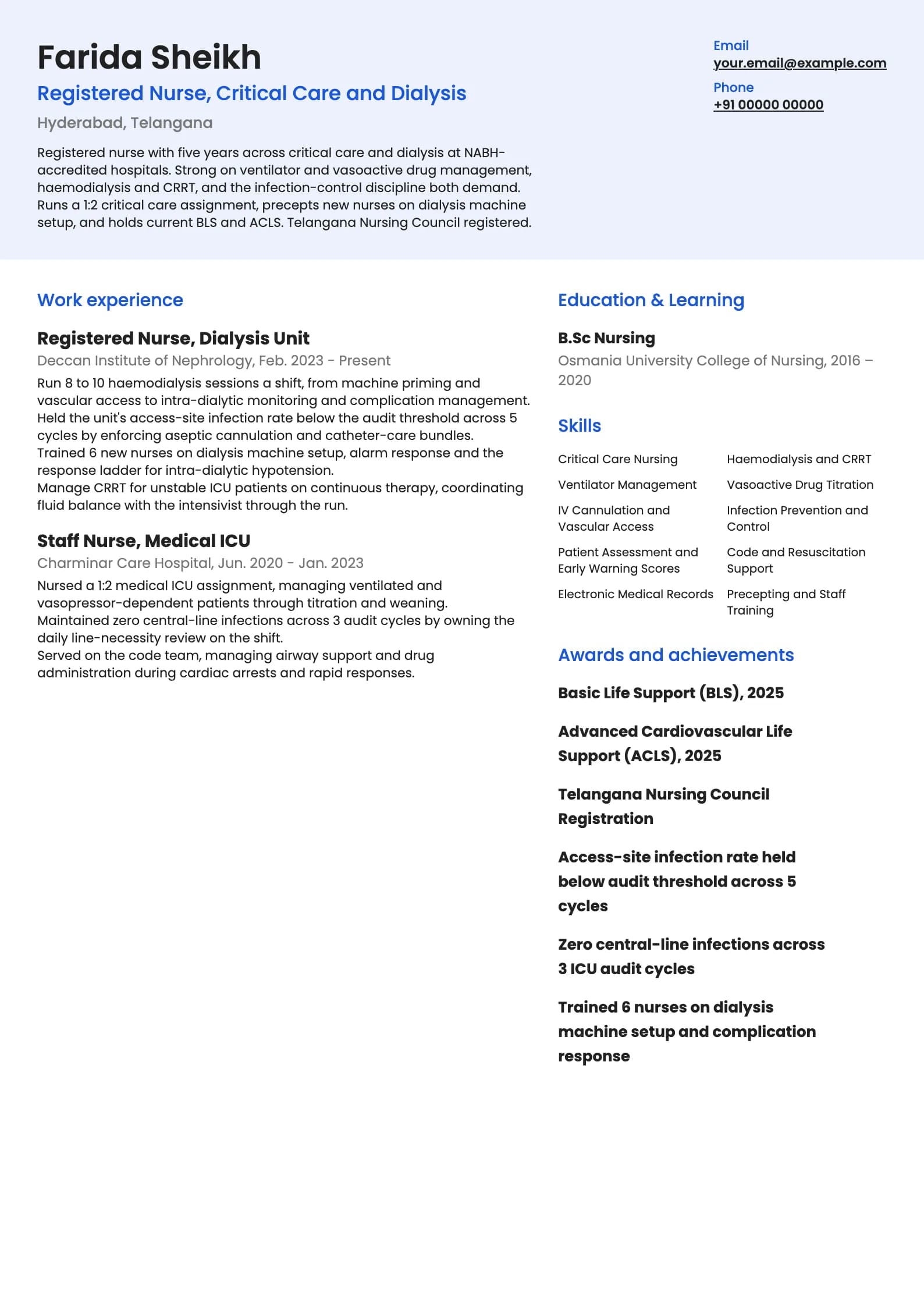
A nurse's skills section has two readers with opposite wants. The hospital parser wants literal terms it can match against the posting, ICU, ACLS, IV cannulation, infection control. A ward matron wants a short, organised list that signals what kind of nurse you are. Grouping satisfies both. This page gives you the full skills taxonomy for a nurse resume in India, split into clinical, tools and soft skills, one complete sample that uses it, the right and wrong way to word a skill, and the ATS keyword lists a hospital HR system actually scans for.
Build my nurse resumeNurse resume example, Nurse (5 years, skills-led)
modern templateIs your resume good enough?
Upload the resume you have now and see what an applicant tracking system reads before a nurse recruiter ever does.
Free to run. Sign in with your mobile number to see your score.
The three groups every nurse skills section needs
Group your skills, do not dump them into one paragraph. A nurse's competencies split cleanly into three: clinical skills, which are the procedures and assessments you perform on a patient; tools and systems, which are the machines and records you operate; and soft skills, which are the human and judgement abilities that decide whether a ward trusts you. All three matter, and a resume that lists only clinical procedures reads as technically capable but says nothing about whether you can hold a frightened family together at three in the morning. Eight to fourteen skills is the working range for most nurses. Below six the section looks thin even when the experience is strong; above about sixteen it stops distinguishing you, because a list that includes everything signals nothing. Order within each group matters more than nurses expect: put the competencies you would be happy to be examined on first, because a matron skims the start of a line and stops. Every skill on the page is a question you have agreed to answer, so a machine you set up once in training is a keyword that costs you a bad five minutes in the interview. Match the mix to the role. A critical care posting wants clinical depth, so weight that group. A community health or OPD role leans harder on communication, counselling and coordination, so let the soft and tools groups carry more. Reorder the groups for each meaningfully different application, which takes two minutes and does more than any other edit.
| Group | What goes in it | How many |
|---|---|---|
| Clinical | Patient assessment, IV cannulation, wound care, ventilator management, medication administration, code response | 4 to 8 |
| Tools and systems | Electronic medical records, infusion pumps, monitors, ventilators, glucometers, SBAR documentation | 3 to 5 |
| Soft | Patient communication, composure under pressure, teamwork, empathy, time management, documentation | 3 to 5 |
Clinical skills: name the procedure, not the department
Clinical skills are the core of a nurse's resume, and the common failure is listing the department instead of the competency. "Worked in ICU" is a location, not a skill. "Ventilator management, vasoactive drug titration, arterial line monitoring" tells a critical care matron exactly what you can do the day you start. Name the specific procedures and assessments you perform, because those are the literal terms a hospital parser matches and the questions an interviewer asks. Be honest about the level. There is a real difference between assisting with a procedure and performing it independently, and a resume that claims independence you do not have collapses in the first week on the ward. If you assist rather than lead, say so, or simply list the competencies you own outright. Weight the list towards your target specialty: a dialysis role wants haemodialysis and CRRT near the top, an OT role wants scrubbing, instrument handling and surgical counts, a paediatric role wants weight-based dosing and neonatal assessment. The strongest clinical line is the one that could only have been written by someone who has actually done that specialty's work.
Clinical skills line
Weak
Skills: Hardworking, dedicated, ICU, ward experience, good in nursing duties, patient handling, injections.
Strong
Clinical: Ventilator management, vasoactive drug titration, IV cannulation, arterial line monitoring, wound care, code and resuscitation support.
The rewrite drops adjectives and locations for named procedures a critical care unit searches for and can interview on.
If a skill line would read identically on every nurse's resume from your batch, it describes the diploma, not you. Add the specific procedure and the specific unit until it stops being transferable.
Tools and soft skills: the two groups nurses undersell
Tools and systems are the group nurses most often leave off, and hospitals increasingly search for them. Corporate chains run electronic medical records, and a nurse who has charted, ordered and handed over in an EMR is faster to onboard than one who has only worked on paper. Name the systems and machines you operate: EMR and the specific product if you know it, infusion and syringe pumps, multipara monitors, ventilators, glucometers and point-of-care devices, and the documentation formats you use such as SBAR handover and nursing care plans. These are honest, checkable and frequently the exact keyword a posting carries. Soft skills are the group nurses either omit or fill with empty adjectives. "Hardworking and dedicated" says nothing, because every applicant claims it and none can prove it. The soft skills that belong on a nurse resume are the ones tied to the job's real demands: communication with anxious patients and families, composure during a code, attention to detail on a medication chart, teamwork across a rotating shift, and clear documentation that survives a handover. Do not rate them with stars or bars, which invite an argument nobody can win. List them plainly, and let your experience bullets prove them.
| Weak soft skill | Stronger version | Why |
|---|---|---|
| Hardworking and dedicated | Composure under pressure during codes and emergencies | Ties the trait to a real clinical situation a ward can picture. |
| Good communication | Patient and family communication, including end-of-life | Names the hardest communication a nurse actually does. |
| Team player | Teamwork and handover across rotating shifts | Points at the specific coordination a busy ward depends on. |
| Detail-oriented | Accurate medication and vitals documentation | Attaches the trait to the chart where errors actually hurt. |
Matching the ATS: keywords a hospital parser scans for
A hospital applicant tracking system stores your skills so a recruiter can search across hundreds of nursing applicants for the exact competency a vacancy needs: ICU experience, a current ACLS card, dialysis, NABH familiarity. To surface in those searches, the literal term has to be on your page, written the way the industry writes it. Write ICU as well as intensive care, spell out BLS and ACLS at least once alongside the acronym, and use the standard term the posting uses rather than a personal paraphrase. The reliable way to carry keywords is inside real experience bullets, not a stuffed block at the bottom. A bullet that describes managing a ventilated patient contains the word ventilator in a context that survives human review too, whereas a hidden list of forty terms is something recruiters spot quickly and penalise. Mirror the posting where it is honest: if it says medication administration, write medication administration, not drug giving. If it says CRRT, write CRRT, because a search for CRRT will not credit you for continuous therapy. The keyword list below is a starting bank for a nurse resume in India; take the ones that are true for you and let them appear both in the skills section and, more importantly, in the bullets.
- Write both the acronym and the expansion once: BLS (Basic Life Support), ACLS (Advanced Cardiovascular Life Support).
- Use the posting's exact term: ICU, not just intensive care; CRRT, not continuous therapy.
- Put your council registration keyword on the page, since hospitals filter on licensure.
- Carry the specialty keyword in a bullet, not only the skills line, so it survives a human read.
- Name the systems you use, such as electronic medical records, because chains search for EMR experience.
- Never stuff a hidden block of forty terms; recruiters find it and it reads worse than being filtered out.
The skills section is for the machine to match and the human to skim. The bullets are where you prove the skill. Get the same keyword into both and you satisfy both readers at once.
Skills to put on a nurse resume
Technical
- Patient Assessment and Monitoring
- IV Cannulation and Vascular Access
- Ventilator and Airway Management
- Vasoactive Drug Titration
- Haemodialysis and CRRT
- Wound and Drain Care
- Medication Administration
- Infection Prevention and Control
- Code and Resuscitation Support
- Triage and Acuity Assessment
- Pre and Post-operative Care
- Sample Collection and Lab Coordination
Tools and platforms
- Electronic Medical Records
- Infusion and Syringe Pumps
- Multipara Monitors
- Ventilators
- Dialysis Machines
- Glucometers and Point-of-care Devices
- SBAR Handover Documentation
- Nursing Care Plans
Working skills
- Patient and Family Communication
- Composure Under Pressure
- Attention to Detail on Charts
- Teamwork Across Rotating Shifts
- Empathy and Bedside Manner
- Time Management on a Busy Ward
- Clear Clinical Documentation
- Precepting and Mentoring
Certifications worth listing as a nurse
| Certification | Full name | Worth it for |
|---|---|---|
| BLS | Basic Life Support | Expected of every clinical nurse and a hard filter for most acute-care roles. It is a skill and a keyword at once, so keep it current and put the year on the page. |
| ACLS | Advanced Cardiovascular Life Support | The certification that turns code and resuscitation support from a claim into a credential. Strongly worth it for critical care, emergency and cardiac nurses, and searched for on those postings. |
| State Council Registration | State Nurses and Midwives Council Registration | The licence to practise and a search filter for licensure. Keep the number on the page in the certifications block; a nurse resume without it cannot be shortlisted. |
| Specialty course | Post Basic Diploma or unit-specific course (e.g. Critical Care, Dialysis, Emergency Nursing) | Worth naming if you hold one, since it makes a specialty skill credible rather than self-declared. Most useful when you are moving into a specialty unit and want the keyword and the proof together. |
Keywords an ATS scans for in a nurse resume
These are the literal terms a parser matches against the job description. Use the ones that are true of you, in the sentences where you did the work, not as a list at the bottom.
- registered nurse
- staff nurse
- critical care
- ICU
- patient care
- patient assessment
- BLS
- ACLS
- IV cannulation
- ventilator management
- haemodialysis
- CRRT
- wound care
- infection control
- medication administration
- electronic medical records
- NABH
- triage
- nursing council registration
- SBAR handover
Nurse resume FAQ
What skills should I put on a nurse resume?
Split them into three groups. Clinical skills are the procedures and assessments you perform, such as IV cannulation, ventilator management, wound care and medication administration. Tools and systems are what you operate, such as electronic medical records, infusion pumps and monitors. Soft skills are the human abilities the job depends on, such as patient communication, composure under pressure and accurate documentation. List eight to fourteen in total, weighted towards the specialty you are applying to.
How many skills should a nurse list on a resume?
Eight to fourteen for most nurses, grouped rather than listed as one long line. Below six the section looks thin even with strong experience, and above about sixteen it stops distinguishing you because a list of everything signals nothing. Every skill is a question you have agreed to answer in the interview, so drop any competency you performed once in training rather than owning it outright. Order each group with your strongest, most defensible skills first.
What are the best clinical skills to put on a nurse resume?
Name specific procedures, not departments. The strongest clinical skills are the ones that match your target unit: ventilator management and vasoactive drug titration for critical care, haemodialysis and CRRT for nephrology, scrubbing and instrument handling for OT, weight-based dosing for paediatrics. Across most roles, patient assessment, IV cannulation, wound care, medication administration and code support are core. Write the procedure a hospital would search for, not a generic phrase like patient handling.
What soft skills matter most for a nurse?
The ones tied to the real demands of the ward: communication with anxious patients and families including at end of life, composure during a code, attention to detail on a medication chart, teamwork and handover across rotating shifts, and clear documentation. Avoid empty adjectives like hardworking and dedicated, which every applicant claims and none can prove. Name the situation the trait applies to, and let your experience bullets do the proving.
What ATS keywords do hospitals scan nurse resumes for?
Licensure and specialty terms above all: registered nurse, staff nurse, the council registration, ICU, critical care, BLS, ACLS, and unit-specific terms such as haemodialysis, CRRT, triage or NABH. Write both the acronym and its expansion once, use the exact term the posting uses, and carry the keyword inside a real experience bullet as well as the skills line so it survives a human read. Never stuff a hidden block of terms, which recruiters find and penalise.
Should I rate my nursing skills with stars or a percentage bar?
No. Star ratings and percentage bars invite an argument nobody can win, because there is no agreed meaning for four stars out of five in IV cannulation, and they also confuse the parser. List your skills plainly, grouped and ordered strongest first, and let your experience bullets demonstrate the level. A rewrite that shows zero central-line infections across three audits proves competence far better than a filled progress bar ever could.
How do I show skills on a fresher nurse resume?
Draw them from your clinical postings and training rotations, honestly labelled. A fresher has performed patient assessment, vitals monitoring, IV cannulation, medication administration and basic wound care during training, so list those clinical skills, name the systems you used, and include the soft skills the rotations demanded. Keep any skill you only observed out of the list, and let your training bullets, with the units you rotated through, carry the same keywords into a context a reviewer trusts.
Related resume examples and guides
Put the right nursing skills on the page
Start from a blank resume or upload the one you have. Goodspace groups your clinical, tool and soft skills, renders them in 24 templates, and flags the ATS keywords a hospital parser will look for.
Build my nurse resume