Surgeon Resume Format, with 3 Full Samples
A surgeon is hired on the operative logbook, the complication rate and the cases that can be done independently, yet most surgical resumes list degrees and society memberships and never state what the candidate can actually operate. Below are three complete resumes, one for a surgeon fresh out of an MS in General Surgery, one for a consultant surgeon with seven years and a laparoscopic practice, and one for a senior surgeon and department head with sixteen years and a minimal-access speciality. After the samples come the format rules, why the operative logbook is the centre of a surgical resume, the surgical terms a parser matches literally, and the mistakes that get a surgeon's resume dropped before a chief of surgery reads it.
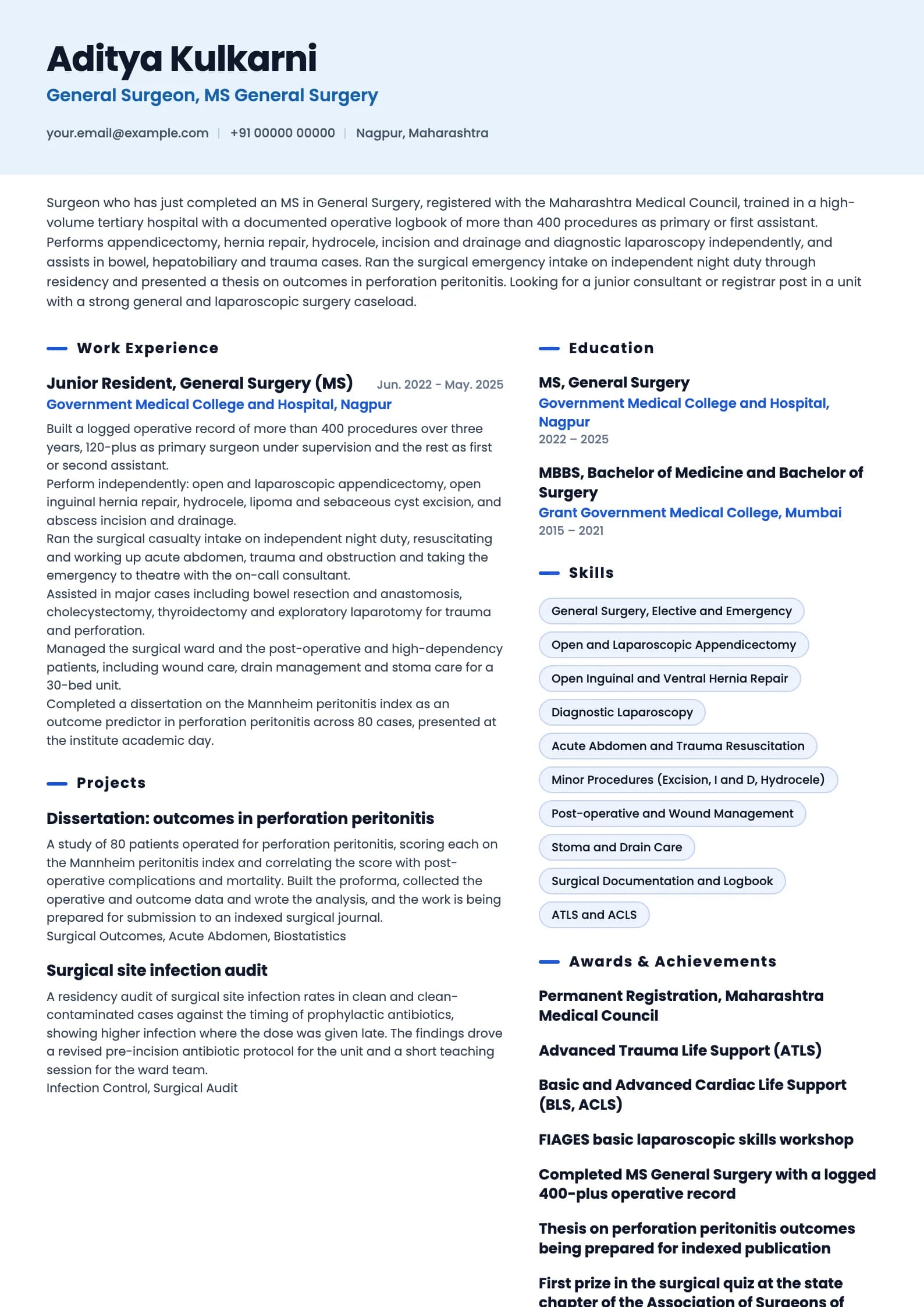
Build my resumeSurgeon resume example, Fresh MS (0 to 1 year)
ai-era templateIs your resume good enough?
Upload the resume you have now and see what an applicant tracking system reads before a surgeon recruiter ever does.
Free to run. Sign in with your mobile number to see your score.
Surgeon resume example, Consultant Surgeon (7 years)
professional template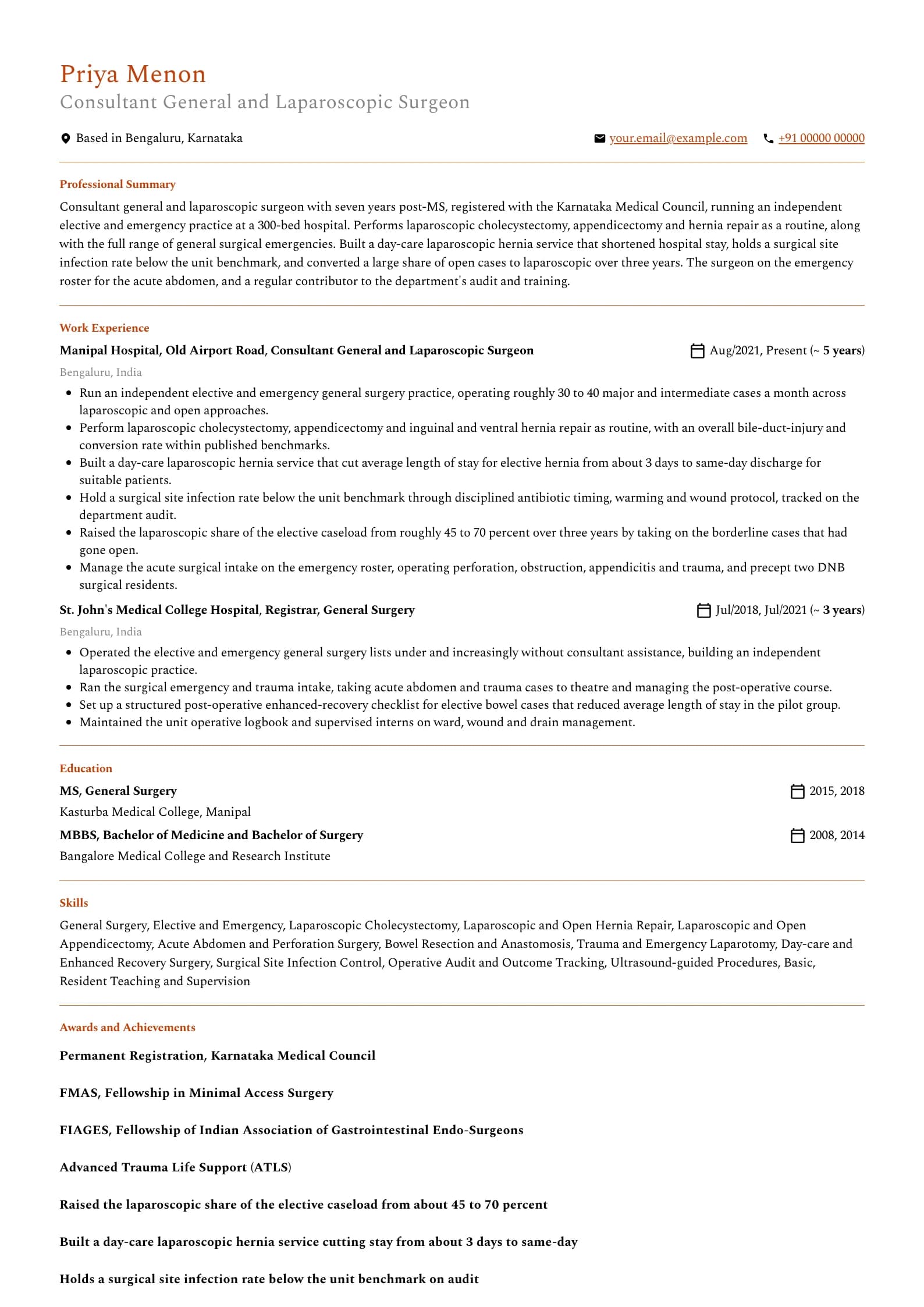
Want this structure with your own details? Build it in the resume builder.
Surgeon resume example, Senior Surgeon and HOD (16 years)
header-band template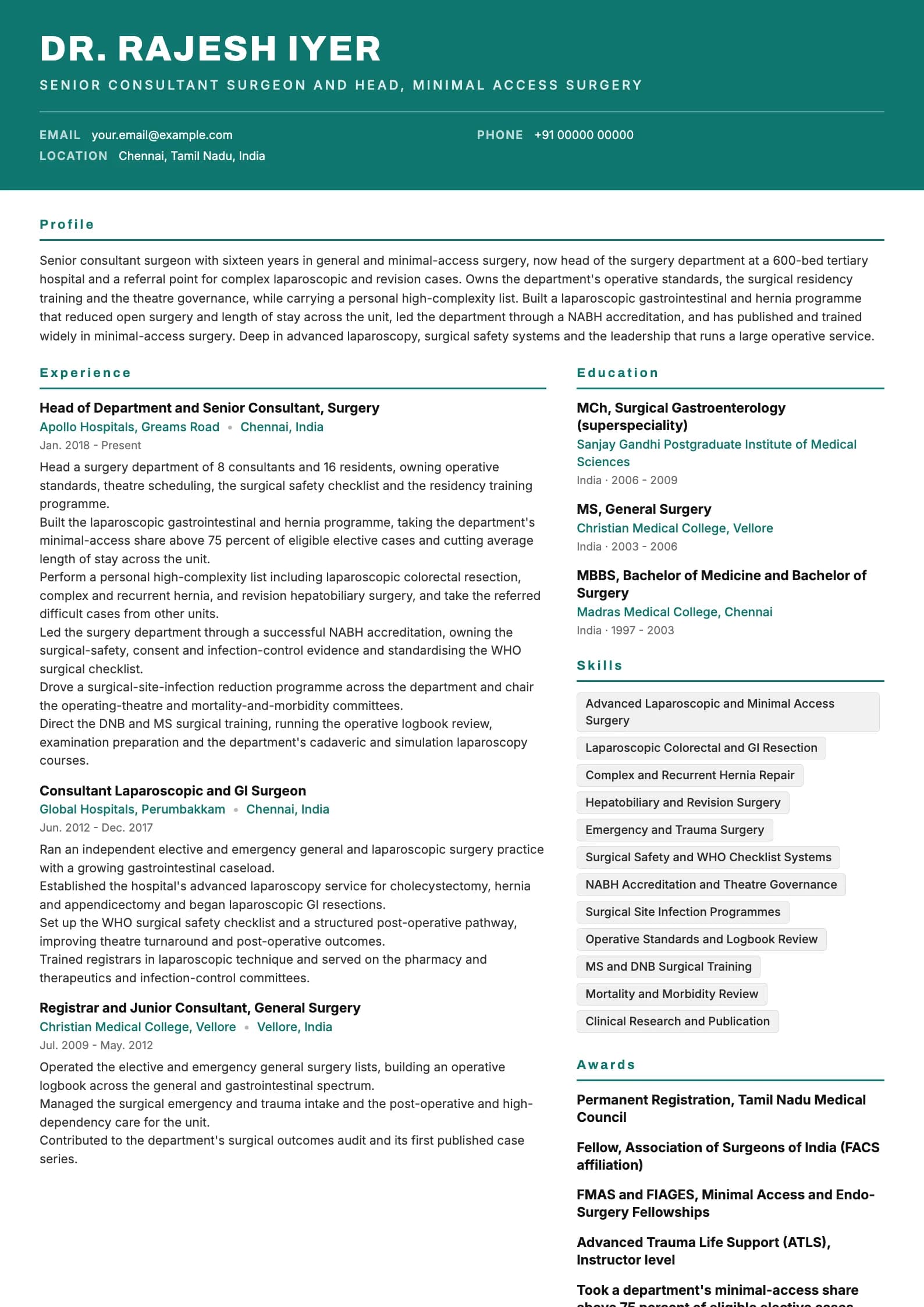
The format that works for surgeon resumes in India
Reverse chronological is the layout to use. Most recent post first, work backwards, dates in plain view. A functional layout that groups everything under Surgical Skills and drops the dates reads as an attempt to hide a training gap or a thin operative period, and a chief of surgery treats it that way. A superspeciality attempt year or a fellowship abroad is better explained in one honest line than buried. A surgeon's resume has a centre that a physician's does not: the operative logbook. What you can operate, how much of it you have done, and how much of that was as primary surgeon rather than assistant, is the core of the page. State the registration high with the council named, make the MS or DNB in surgery unmissable, and give the operative record real space, because everything else is context around what you can do in theatre. Length follows evidence. A fresh MS fits one page if the logbook is stated efficiently. A consultant with a real operative record and audit trail can run to two, and a senior surgeon and department head will legitimately use two, because the operative range, publications and training record earn the space. What does not earn a second page is a list of every workshop attended and a hobbies line. Four things do not belong on a surgical resume here: a photograph, marital status, father's name and a religion line, all carried over from an old biodata format. What does belong, and is sometimes buried, is the operative logbook summary, the registration and the fellowships, because those are the first things a surgical chief checks. Send a PDF, keep it single column, and let the table below set the section order.
| Section | Where it goes | Why |
|---|---|---|
| Name and headline | Top, above everything | Headline names the role and focus, Consultant General and Laparoscopic Surgeon. |
| Registration and qualification | Directly under the header | Council and MS or DNB Surgery. This is a PG surgical role, so the qualification leads. |
| Professional summary | Under the qualification block | Three lines. What you operate independently, years, and the strongest outcome. |
| Operative experience and logbook | The centre of the resume | Named procedures, volume, primary versus assisted, and complication metrics. |
| Education | Below experience, higher for a fresh MS | MCh track, MS, MBBS, with institutions. |
| Fellowships and publications | After education | FMAS, FIAGES, indexed papers. Grows in weight with seniority. |
| Certifications and memberships | Near the end, or beside skills | ATLS, ACLS, ASI membership. |
The operative logbook is the centre of a surgical resume
The single thing that separates a surgical resume from any other clinical resume is the operative record, and it is the thing most surgeons under-state. A hospital hiring a surgeon needs to know exactly what you can take into theatre and do without help. So name the procedures, and be specific: laparoscopic cholecystectomy, open and laparoscopic inguinal hernia repair, appendicectomy, bowel resection and anastomosis, not the vague phrase all general surgical procedures, which tells a chief of surgery nothing and reads as evasive. Separate what you do as primary surgeon from what you assist. This is the most important honesty on the page. A logbook that lists 400 procedures without saying how many were as primary is easy to see through, because the very first operative discussion at interview will expose the gap. Stating 400 total with 120 as primary is more credible than 400 unqualified, and far more credible at the moment it is tested. Where you honestly can, attach outcome numbers, because a surgeon is judged on results as much as volume. A conversion rate for laparoscopic cases, a surgical site infection rate against the unit benchmark, a complication or reoperation rate, a length of stay: these turn a volume claim into a quality claim. The consultant sample leans on exactly these, and they carry more weight than a longer procedure list. Show trajectory. A rising laparoscopic share, a new procedure taken on independently, a day-care service built, tells a hospital where you are heading, not just where you have been. For a surgeon that direction, toward minimal access, toward a subspecialty, toward complexity, is often what a unit is actually hiring for.
Name the procedures you can perform as primary surgeon, and separate them from those you assist. A logbook that hides the primary-versus-assisted split does not survive the first operative question at interview, so state it honestly on the page.
Writing a summary a chief of surgery actually reads
The block under your qualification line is the part you can be reasonably sure gets read, so it should carry three facts: what you operate independently, how long you have post-MS, and the strongest measurable thing your surgery has produced. Three or four lines, no adjectives a reviewer cannot check. The old objective line, seeking a challenging surgical position in a reputed hospital to utilise my surgical skills and serve patients, tells the reader nothing. Replace it with a summary. An objective says what you want, a summary says what you can already do in theatre and what it has achieved, and only one moves a surgical hire. A fresh MS often feels there is nothing to summarise before the first consultant post. Look at the fresher sample: it names the logbook size, the primary-versus-assisted split, the procedures done independently, the emergency ownership and a thesis with real numbers. That is a genuine summary built from a residency. What it avoids is "skilled and dedicated surgeon with excellent surgical hands", a phrase so common it now carries no information and, for a surgeon, no verifiable claim. A practical test: read your summary and ask whether a co-resident with the same MS could paste it onto their resume unchanged. If they could, it describes the training, not you. Add the specific procedures, the specific volume and the specific outcome until it stops being transferable.
Professional summary, consultant surgeon
Weak
Skilled and dedicated general surgeon with 7 years of experience and excellent surgical skills seeking a consultant position in a reputed hospital to provide the best surgical care.
Strong
Consultant general and laparoscopic surgeon with seven years post-MS running an independent practice, performing laparoscopic cholecystectomy, hernia and appendicectomy as routine. Raised the laparoscopic share of the elective caseload from about 45 to 70 percent and holds a surgical site infection rate below the unit benchmark.
The rewrite trades self-praise for the actual procedures performed, a trajectory and a quality metric a surgical chief can probe.
Experience bullets: verb, procedure, surgical outcome
Every strong bullet in the samples follows the same shape. It opens with an action verb, names the specific procedure or surgical service, and closes with a measured outcome. The verb establishes that you did it. The procedure tells a surgical reviewer exactly what you can do. The outcome does the persuading, and for a surgeon the most valuable outcomes are operative: a complication rate, a conversion rate, an infection rate, a length of stay, a laparoscopic share. Start with the outcome and work backwards. Surgeons usually write the responsibility first, then struggle to attach a number, producing bullets like "performed various general surgical procedures with good outcomes". Instead ask what was measurably true about your operating: a conversion rate within benchmark, an infection rate below the unit average, a stay shortened by a day-care pathway, a share of cases moved to laparoscopic. Then write the sentence that ends in that fact. Vary the metric and reach for the operative ones. Case volume alone is weak, because a busy roster is expected. Complication and reoperation rate, surgical site infection rate, conversion rate, length of stay and laparoscopic share are the numbers that separate a surgeon who owns outcomes from one who merely fills a list. State them honestly and against a benchmark where you can, since an unbenchmarked rate is hard to read. Where a hard outcome is genuinely unavailable, give scope: the monthly major-case volume, the emergency roster carried, the residents trained, the new service built. And keep patient confidentiality absolute: describe procedures and cohorts, never a named or identifiable patient. Allocate bullets by recency. Current post gets five or six, the previous one four or five, older ones two or three.
| Level | What bullets must prove | Typical metric |
|---|---|---|
| Fresh MS | What you can operate as primary, and your logbook | Total cases, primary count, named independent procedures |
| 1 to 5 years | You run an independent list with sound outcomes | Monthly volume, conversion rate, infection rate, complications |
| 6 to 10 years | You own outcomes and build a surgical service | Laparoscopic share, length of stay, day-care service, audit |
| 11 years and up | You set operative standards and take the complex cases | Department minimal-access share, accreditation, SSI programme, training |
Experience bullet, laparoscopic surgery
Weak
Performed various laparoscopic and open surgeries with good results and low complication rates.
Strong
Perform laparoscopic cholecystectomy, appendicectomy and inguinal and ventral hernia repair as routine, with an overall bile-duct-injury and conversion rate within published benchmarks.
Names the actual procedures and a benchmarked quality rate, so a surgical chief can ask a real operative follow-up instead of nodding at good results.
Experience bullet, service improvement
Weak
Worked to improve patient recovery and reduce hospital stay for surgical patients.
Strong
Built a day-care laparoscopic hernia service that cut average length of stay for elective hernia from about 3 days to same-day discharge for suitable patients.
Names the specific service built, the procedure and the before-and-after stay, turning a vague aim into a measured result.
For a surgeon, case volume alone is a weak bullet because a busy roster is expected. Reach for an operative outcome: a conversion rate, an infection rate, a stay shortened. That is the difference between owning your results and merely filling a list.
The skills section: procedures, grouped and honest
A surgeon's skills section has two audiences with opposite preferences. The parser wants literal surgical terms it can match, laparoscopy, cholecystectomy, hernia, trauma. A human wants a short, organised list that signals what kind of surgeon you are, a general surgeon, a laparoscopic surgeon, a GI-leaning operator. Grouping satisfies both, and for a surgeon the grouping is essentially a structured logbook. Group by function rather than one long line. Core general surgery, laparoscopic and minimal access, emergency and trauma, and surgical systems is a grouping that works for almost every general surgeon. The exact headings matter less than the fact that structure exists. Write the terms the way the specialty writes them: cholecystectomy spelled correctly, FMAS and FIAGES in their proper form, laparoscopic not laproscopic. A parser matches on strings, and a misspelt procedure on a surgeon's resume is read as carelessness in the one place a surgeon cannot afford it. Twelve to sixteen skills is the working range. Below eight the section looks thin for a surgical role. Above twenty it stops being a signal, and it is tempting to pad by listing every minor procedure separately. Group the minor work as minor procedures and excisions rather than listing lipoma, sebaceous cyst, hydrocele, abscess as four items. The list is a contract: every procedure is one you have agreed to defend in theatre, and a surgical interview will test it directly. Never put a proficiency bar on a surgical skill. A star rating on cholecystectomy is meaningless and slightly alarming, and it invites an argument you cannot win. Let the logbook and the outcomes prove the depth.
| Group | What goes in it | How many |
|---|---|---|
| Core general surgery | Hernia repair, appendicectomy, bowel resection, thyroid, breast | 3 to 5 |
| Laparoscopic | Laparoscopic cholecystectomy, appendicectomy, hernia, GI resection | 2 to 4 |
| Emergency and trauma | Acute abdomen, perforation, obstruction, trauma laparotomy | 2 to 4 |
| Minor procedures | Excisions, hydrocele, incision and drainage, biopsies | 1 to 2 |
| Surgical systems | WHO checklist, SSI control, operative audit, ATLS | 2 to 4 |
Skills section
Weak
Skills: MS, Surgery, Operations, Laproscopy, Appendix, Hernia, Gall bladder, Lipoma, Sebaceous cyst, Hydrocele, Abscess, Circumcision, Suturing, Dressing, Emergency, Trauma, ICU, Communication, Team work, MS Office
Strong
Core: inguinal and ventral hernia repair, appendicectomy, bowel resection and anastomosis. Laparoscopic: cholecystectomy, appendicectomy, hernia. Emergency: acute abdomen, perforation and trauma laparotomy. Minor procedures and excisions. Systems: WHO surgical checklist, SSI control, ATLS.
Fixes the misspelt laparoscopy, cuts the minor-procedure padding and MS Office filler, and groups the work into a structured, defensible operative profile.
Fellowships, publications and courses that carry weight
For a surgeon the fellowship block is a real signal of direction and capability, not decoration. A minimal-access fellowship such as FMAS or FIAGES tells a hospital you have formal laparoscopic training, and a superspeciality MCh in surgical gastroenterology, urology or another branch changes what kind of surgeon you are entirely. Name the fellowship, the awarding body and the year, and place them by relevance to the role rather than by how impressive the acronym sounds. Hands-on courses matter more for a surgeon than for most clinicians, because surgery is a manual craft. A cadaveric or simulation laparoscopy course, an advanced-suturing or an ultrasound course, a trauma course such as ATLS: these signal specific operative capability. ATLS in particular is close to expected for any surgeon who receives trauma, and the instructor level marks a senior surgeon who trains others. Publications belong once you have them, formatted properly with authors in order, title, journal and year. For a surgeon an outcomes audit or a case series carries real weight because it shows you measure your own results, which is exactly the discipline a surgical department wants. Two credible papers beat a page of every abstract submitted. If you are pursuing a superspeciality or a fellowship in progress, state it as in progress and honest. An implied MCh that turns out to be incomplete is precisely the kind of thing that ends a process at credential verification, and for a surgeon, whose qualifications gate exactly which operations a hospital will let you do, the verification is thorough.
Getting a surgeon resume through the ATS
Large hospital groups run consultant surgeon applications through an applicant tracking system before a human sees them. An ATS is a parser and a search index, not a judge. It reads your file, tries to break it into name, dates, employers, titles and skills, and stores the result so a recruiter can search. Almost every ATS problem is a parsing problem, and parsing problems come from layout, not from your operative ability. The layout rules are short. One column. Standard section headings, so use Work Experience or Operative Experience rather than My Surgical Journey, and Education rather than Academic Milestones. No text inside images, which rules out pasting a scanned logbook page as a picture, so type the operative summary as text. No critical information in the header or footer, which some parsers drop, and that includes your registration and qualification. Avoid text boxes and nested tables. On wording, mirror the posting where it is honest. If it asks for a laparoscopic surgeon, and you are one, write laparoscopic surgeon. If it names a procedure you genuinely perform, write it. Include the expansion alongside an acronym at least once, for example "MS (master of surgery) General Surgery" and "FMAS (fellowship in minimal access surgery)", so both searches find you. Spell the procedures correctly, because a parser matching laparoscopy will not match laproscopy, and a human reading a misspelt procedure on a surgeon's resume marks it down. Keyword stuffing does not work, and a hidden block of every procedure in white text is spotted quickly. Write real bullets that carry the right terms, because a bullet describing your laparoscopic hernia work contains the terms in a context that survives human review. Save as PDF from a tool that embeds real text, then open the file and confirm you can select a sentence. If you cannot select it, neither can the parser.
Procedure spelling
Weak
Laproscopic Cholecystctomy and Appendisectomy
Strong
Laparoscopic cholecystectomy and appendicectomy
A parser matching the correct terms misses the misspelt ones entirely, and a surgical reviewer reads a misspelt procedure as carelessness in the one place it cannot be afforded.
Test your own file before you send it. Copy the text out of the PDF into a plain text editor. If your operative summary, qualification and registration come out clean and in order, a parser will read them; if a scanned logbook image comes out as nothing, that is exactly what the recruiter sees.
What gets surgeon resumes rejected
Most rejections at the resume stage are not close calls. They come from a small set of recurring problems, and all of them are fixable in an afternoon. The list below covers what chiefs of surgery and medical directors reviewing surgical resumes see most often, in rough order of how much damage each one does.
- No operative logbook or only the vague phrase all general surgical procedures. A surgeon who will not say what they operate has hidden the most important thing on the page.
- A logbook that does not separate primary from assisted cases. The inflation is exposed by the first operative question at interview.
- No surgical outcomes anywhere, only case volume. A benchmarked complication, infection or conversion rate is what turns volume into quality.
- The MS or DNB Surgery buried or ambiguous. For a surgical role the qualification gates which operations you are allowed to do, so it must be unmissable.
- No medical council registration stated, leaving the licence to operate as an unverifiable claim.
- Misspelt procedures. Laproscopy for laparoscopy on a surgeon's own resume reads as carelessness in the one place it cannot be afforded.
- A generic objective about serving patients and utilising surgical skills. Replace it with a summary that states what you operate and one outcome.
- A photo, marital status, father's name or religion line carried from an old biodata template.
- Confidentiality slips: a named patient or an identifiable operative case. For a surgeon this reads as a real professional lapse.
- An implied but incomplete superspeciality or fellowship. Since qualifications gate operating privileges, verification here is thorough and a mismatch ends the process.
Read your resume aloud once before sending it, then ask whether you could defend every named procedure and every rate in an operative discussion. Anything you could not is a line to verify, qualify or cut.
Skills to put on a surgeon resume
Technical
- General Surgery, Elective and Emergency
- Laparoscopic Cholecystectomy
- Laparoscopic and Open Hernia Repair
- Laparoscopic and Open Appendicectomy
- Bowel Resection and Anastomosis
- Acute Abdomen and Perforation Surgery
- Trauma and Emergency Laparotomy
- Advanced and GI Laparoscopy
- Minor Procedures and Excisions
- Post-operative and Critical Care
- Surgical Site Infection Control
- Operative Audit and Outcome Tracking
Tools and platforms
- Laparoscopic Instrumentation and Energy Devices
- WHO Surgical Safety Checklist
- Electrosurgery and Ultrasonic Devices
- Surgical Staplers and Mesh Systems
- Point-of-care and Intra-operative Ultrasound
- Hospital Information System (HIS)
- Electronic Operative Records and Logbook
- NABH Surgical Documentation
- Simulation and Laparoscopy Trainers
- ATLS and ACLS
Working skills
- Operative decision making under pressure
- Theatre team leadership
- Patient and family consent counselling
- Surgical resident training and mentoring
- Multidisciplinary and anaesthesia coordination
- Composure in surgical emergencies
- Ethical and confidential conduct
- Outcome audit discipline
- Committee and governance work
Certifications worth listing as a surgeon
| Certification | Full name | Worth it for |
|---|---|---|
| MS / DNB Surgery | MS General Surgery or DNB General Surgery | The core qualification for a surgeon and the credential that gates which operations a hospital will grant you, so it is a fact to state prominently, not one to bury. MS and DNB are treated as equivalent by most Indian hospitals, so a DNB holder should present it with the same confidence and never dress it up as something else. |
| FMAS | Fellowship in Minimal Access Surgery | A recognised laparoscopic-training fellowship worth naming for any surgeon building a minimal-access practice, which is most of general surgery's direction now. Signals formal laparoscopic capability beyond what the logbook alone shows. Most valuable in the early-to-middle career while you are establishing a laparoscopic identity. |
| FIAGES | Fellowship of Indian Association of Gastrointestinal Endo-Surgeons | A widely respected Indian minimal-access and endo-surgery fellowship, worth it for a surgeon focused on laparoscopic and gastrointestinal work. Pairs naturally with a growing GI caseload. Carries real recognition in Indian surgical hiring, especially for units investing in laparoscopy. |
| ATLS | Advanced Trauma Life Support | Close to expected for any surgeon who receives trauma, since it standardises the primary and secondary survey and the resuscitation before theatre. Worth keeping current across a surgical career, and the instructor level marks a senior surgeon who trains others. Skip only if your practice is purely elective with no trauma exposure. |
| MCh / superspeciality | MCh in Surgical Gastroenterology, Urology or another branch | Not a certification but a superspeciality qualification that changes what kind of surgeon you are, worth stating prominently for anyone who holds one. It moves you from general surgery toward a defined subspecialty and its pay and referral base. State an in-progress MCh honestly, since qualifications gate operating privileges and verification is thorough. |
| FAIS / ASI | Fellow or Member, Association of Surgeons of India | A standing credential and professional membership for an established surgeon, signalling recognition within the specialty. It belongs on a mid-to-senior resume but never substitutes for the operative logbook or the core MS or DNB, and it should not lead the page ahead of what you can actually operate. |
Keywords an ATS scans for in a surgeon resume
These are the literal terms a parser matches against the job description. Use the ones that are true of you, in the sentences where you did the work, not as a list at the bottom.
- surgeon
- general surgeon
- laparoscopic surgeon
- MS general surgery
- DNB surgery
- medical council registration
- laparoscopic cholecystectomy
- hernia repair
- appendicectomy
- acute abdomen
- trauma surgery
- operative logbook
- minimal access surgery
- surgical site infection
- bowel resection
- FMAS
- FIAGES
- ATLS
- surgical audit
- patient care
Surgeon resume FAQ
What salary can a surgeon expect in India?
A surgeon just out of an MS or DNB typically starts around 12 to 22 LPA as a junior consultant, with corporate hospitals and metros at the higher end. A consultant surgeon with seven to ten years and an established laparoscopic practice usually sits in the 25 to 50 LPA band, and a large part of a busy surgeon's income is often tied to surgical volume and case share rather than a flat salary. Senior surgeons and department heads with sixteen years and above commonly earn 50 LPA to well over a crore in large hospital groups, and a superspeciality MCh shifts the whole picture upward. Private practice, a personal referral base and a high-complexity caseload change the maths again.
How long should a surgeon resume be?
One page for a fresh MS if the operative logbook is stated efficiently, and two pages is legitimate for a consultant or senior surgeon whose operative range, outcomes, fellowships and publications earn the space. Keep the registration, the MS or DNB and the operative summary on the first page, since those are what a chief of surgery checks first. What does not earn a second page is a list of every workshop attended, a hobbies line, or a declaration paragraph.
What is the most important part of a surgeon's resume?
The operative logbook. A hospital hiring a surgeon needs to know exactly what you can take into theatre and do without help, so name the procedures specifically rather than writing all general surgical procedures, and separate what you do as primary surgeon from what you assist. Attach honest outcome numbers where you can, a conversion rate, an infection rate, a complication rate, because a surgeon is judged on results as much as volume. This is the centre of the page and everything else is context around it.
How does a fresh MS write a surgeon resume with no consultant experience?
Lead with the residency operative record: the total logbook, how many procedures were as primary surgeon, and the specific operations you can perform independently. Add the emergency intake you ran on night duty, the major cases you assisted, and a thesis with real numbers. Your registration, ATLS and a laparoscopy workshop belong too. A logbook stated honestly with a clear primary-versus-assisted split carries far more weight than adjectives like skilled or dedicated, which a surgeon cannot verify anyway.
Should I list complication and infection rates on the resume?
Yes, where you have them honestly and can benchmark them, because for a surgeon these turn a volume claim into a quality claim. A surgical site infection rate below the unit benchmark, a laparoscopic conversion rate within published ranges, a low reoperation rate: these are exactly the numbers a surgical department wants to see, and they show you measure your own results. State them against a benchmark where possible, since an unbenchmarked rate is hard for a reviewer to read, and never inflate them, because they are the first thing an operative interview probes.
Do laparoscopic fellowships like FMAS or FIAGES help?
Yes, especially now that minimal-access surgery is the direction of most general surgery. FMAS and FIAGES signal formal laparoscopic training beyond what the logbook alone shows, and they matter most while you are establishing a laparoscopic identity in the early-to-middle career. Name the fellowship, the body and the year. For a hospital investing in laparoscopy, a surgeon with these fellowships and a rising laparoscopic share is often exactly what the unit is hiring for.
How do I show surgical outcomes without breaking patient confidentiality?
Describe volumes, procedures and rates, never a named or identifiable patient or a case detail that could point to one. A line like holds a surgical site infection rate below the unit benchmark across the elective caseload conveys the outcome without touching any individual. Aggregate figures, cohort-level rates and named procedures are the language of a surgical resume, and staying at that level is both safer and more persuasive than any single dramatic case, which a chief of surgery reads as a confidentiality lapse anyway.
Does a two-column layout hurt on hospital recruitment portals?
It can. Some applicant tracking systems and portals read multi-column layouts out of order, which interleaves a sidebar with your operative experience and can scramble the registration line, the qualification and the dates. A single-column layout removes the risk, which is why all three samples above use one. Type the operative summary as text rather than pasting a scanned logbook image, since a parser reads an image as nothing. Test your file by copying the text out of the PDF into a plain text editor, and if the operative summary and qualification read in order there, a parser will most likely read them too.
Related resume examples and guides
Build your own in any of these formats
Start from a blank resume or upload the one you have. Goodspace renders it in 24 templates and flags the operative, laparoscopic and surgical-safety keywords a hospital's applicant tracking system will look for, and the padding it will not credit.
Build my resume