Paramedic Resume Format, with 3 Full Samples
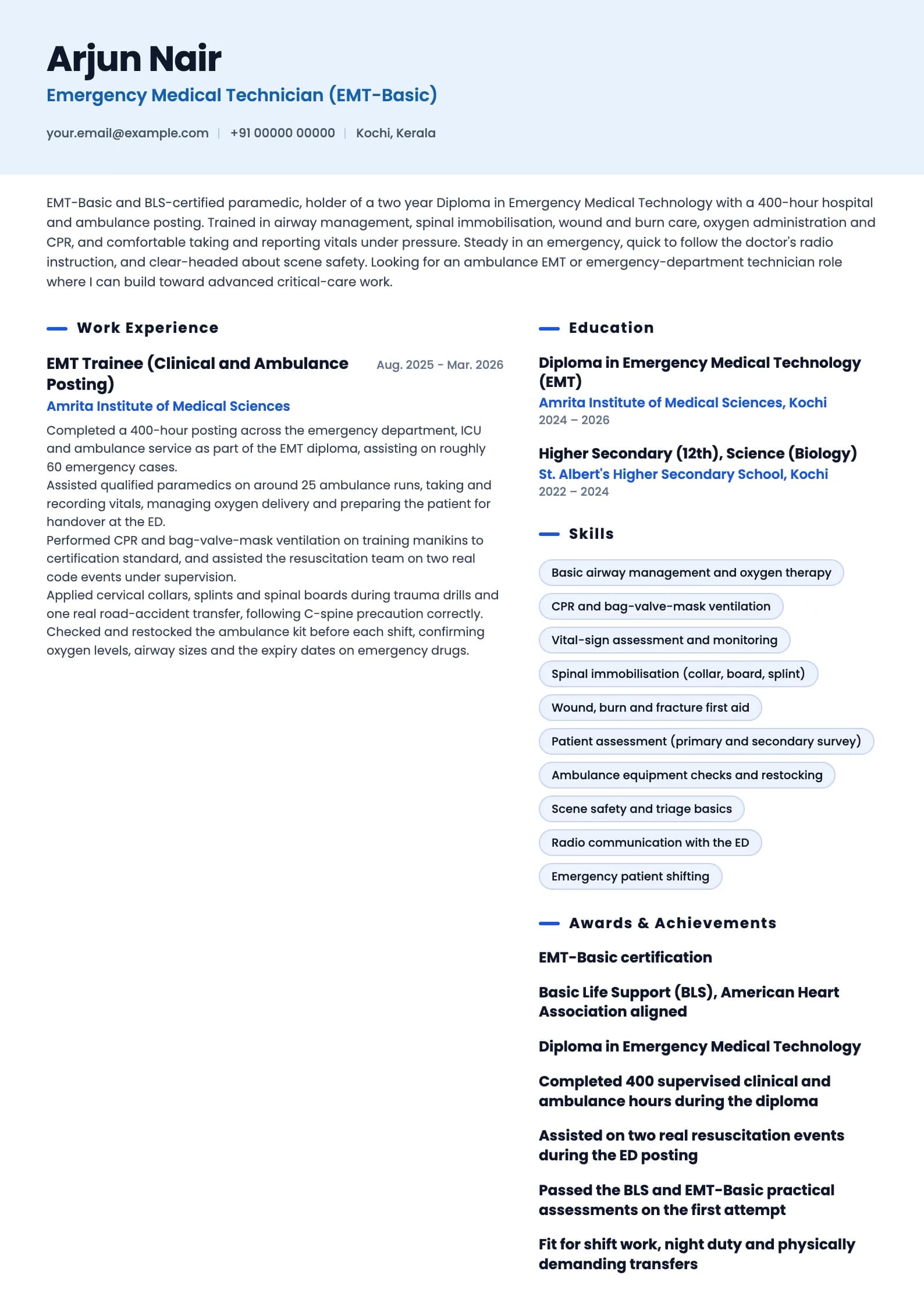
A paramedic is hired on evidence of calm, correct decisions made in the back of a moving ambulance with no doctor in reach. The job is measured in response times, airways secured and patients delivered stable, yet most paramedic resumes list equipment and forget the outcomes. Below are three complete resumes, one for an EMT-Basic fresher fresh out of a paramedical course, one for an ambulance paramedic with four years on 108 and private critical-care transfers, and one for an EMS supervisor who runs a fleet and trains crews. After the samples come the format rules, the certifications that gate the role, the terms a screening reads literally, and the mistakes that cost a paramedic an interview.
Build my resumeParamedic resume example, Fresher (0 years)
ai-era templateIs your resume good enough?
Upload the resume you have now and see what an applicant tracking system reads before a paramedic recruiter ever does.
Free to run. Sign in with your mobile number to see your score.
Paramedic resume example, Experienced (4 years)
professional template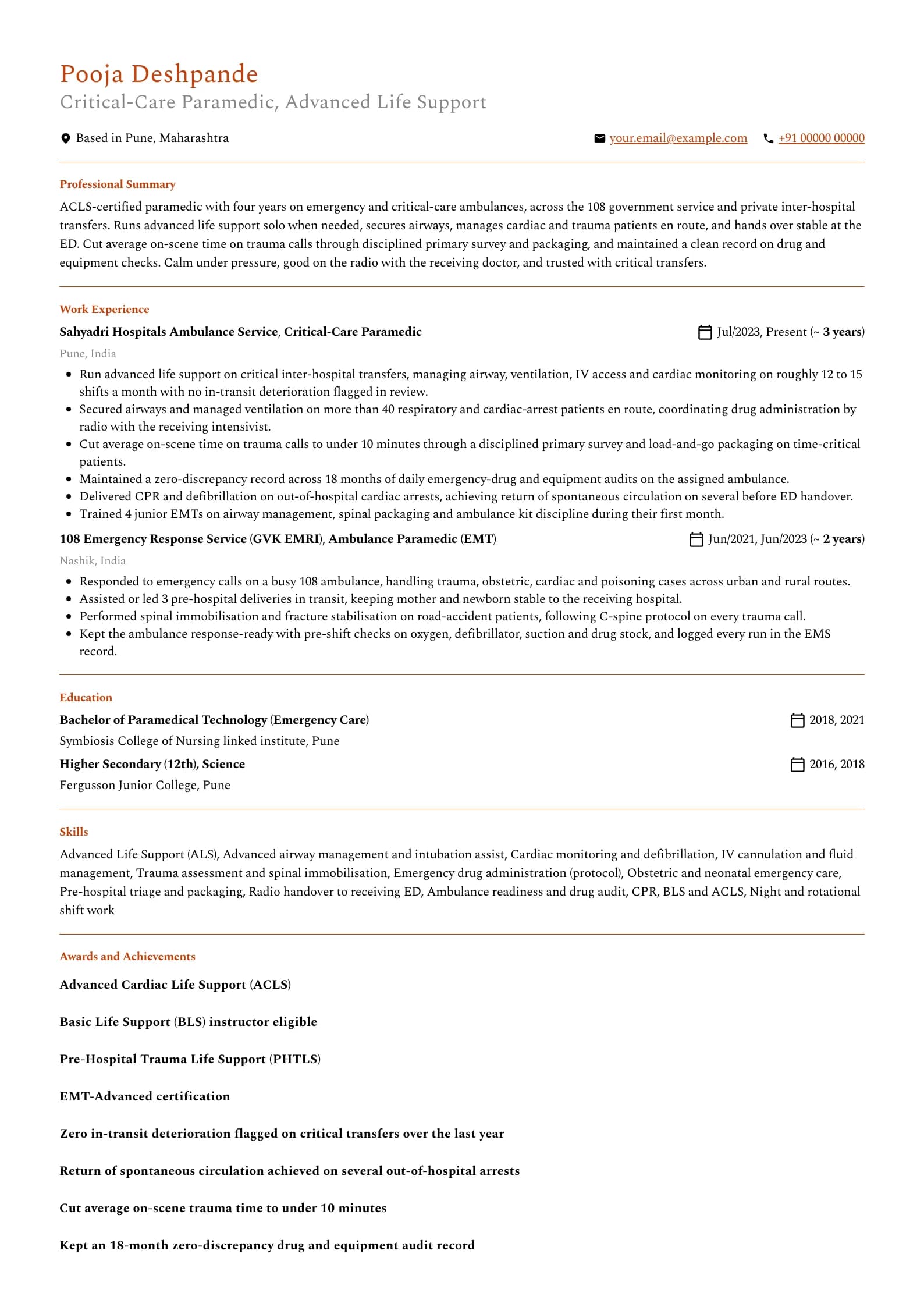
Want this structure with your own details? Build it in the resume builder.
Paramedic resume example, EMS Supervisor (9 years)
header-band template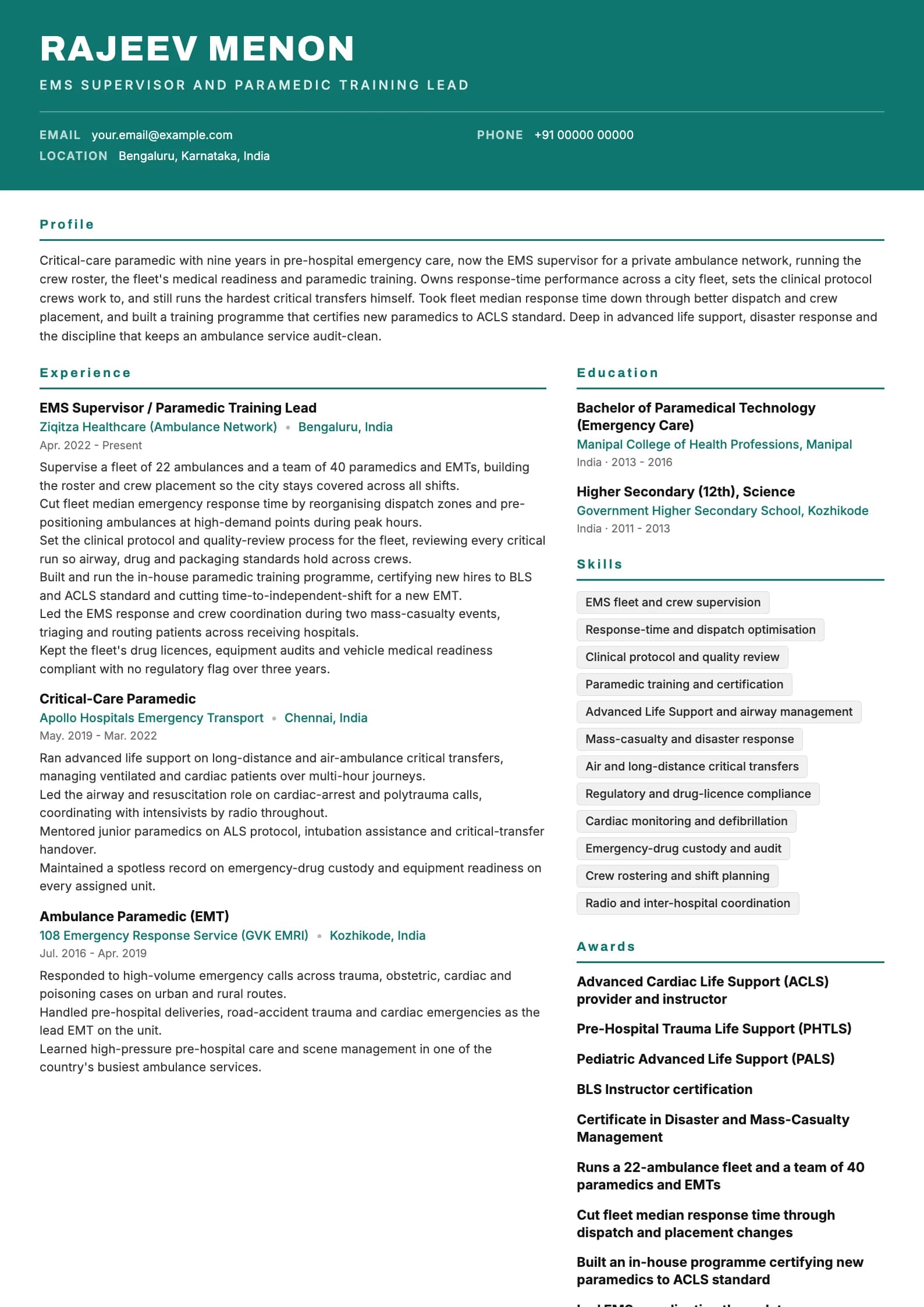
The format that works for a paramedic resume in India
Reverse chronological is the layout to use. Most recent role first, then work backwards, with clear month-and-year dates. Ambulance services and hospital emergency departments verify employment and licences, so the dates and the certifications on the page must be true. A functional layout that hides the timeline behind a skills grid reads as an attempt to cover a gap, and reviewers treat it that way. One page holds everything for a fresher and most paramedics up to about six or seven years. A second page is justified only when it carries real critical-care and supervisory work, not a longer equipment list. A page two built from a hobbies line and a declaration paragraph is a padded one-page resume. Certifications come high on a paramedic resume, because they gate the job. BLS, ACLS, EMT-Basic or EMT-Advanced and PHTLS are not optional extras, they are the licence to do the work. For a fresher they sit near the top, right after the summary, because a service cannot hire an uncertified paramedic. Put the certifying body and, where relevant, the validity, because these expire and a lapsed ACLS is a real problem. Send a PDF so the layout holds, and name the file with your own name and the word paramedic. Use a single column. Skip the photo, date of birth, marital status and father's name. The table below sets out the order.
| Section | Where it goes | Why |
|---|---|---|
| Name and headline | Top of the page | Headline is the role: Paramedic, EMT or Critical-Care Paramedic. |
| Professional summary | Under the header | Three lines: certification level, years, and the strongest outcome. |
| Certifications | High, especially for freshers | BLS, ACLS, EMT level, PHTLS. These gate the role, so they lead. |
| Work experience | Next, for anyone with a job | Most recent service first, with call type and outcomes. |
| Clinical / ambulance posting | Above experience for freshers | The diploma posting is a fresher's evidence: cases, runs, hours. |
| Skills | Below experience | Airway, ALS, trauma, cardiac. Grouped, not a 30-item wall. |
| Education | Bottom, unless a fresher | Diploma or degree, institution, years. |
Certifications gate the paramedic role, so lead with them
Unlike most jobs, a paramedic resume is filtered on certification before anything else, because a service legally and clinically cannot put an uncertified person in the back of an ambulance. This changes where the certifications go: high on the page, named exactly, with the issuing body and validity. Get the levels right. EMT-Basic and EMT-Advanced describe your scope of practice, Basic Life Support is the floor for anyone in emergency care, and Advanced Cardiac Life Support is what lets you manage cardiac emergencies with drugs and defibrillation. Pre-Hospital Trauma Life Support and Pediatric Advanced Life Support signal trauma and paediatric competence. A service reading your resume matches the certifications against the ambulance they want to staff, so list the ones you hold and do not imply ones you do not. Validity matters. ACLS and BLS certifications expire, usually every two years, and a lapsed one is worse than none because it looks like you stopped keeping current. If a certification is valid, you can note the year; if it has lapsed, renew it before you apply rather than list it as though it holds. Do not confuse a certificate with a degree. A Diploma or Bachelor in Emergency Medical Technology is your qualification and goes in education. BLS, ACLS and PHTLS are certifications and go in their own block. Mixing them makes it hard for a reviewer to see at a glance what you are licensed to do.
For a paramedic, the certification block is the first filter, not a footnote. List BLS, ACLS, your EMT level and PHTLS by exact name with the issuing body, and never let a lapsed ACLS sit on the page as if it were current.
Writing a summary an EMS recruiter actually reads
The three lines under your name should carry the facts a service screens on: your certification level, how long you have worked in pre-hospital or emergency care, and the strongest thing that happened because of your work. An EMS recruiter is asking whether you can be trusted alone in the back of an ambulance with a critical patient, so answer that. The old objective, "seeking a challenging role in a reputed hospital to serve humanity", proves nothing and wastes the most-read part of the page. Replace it with a summary built from real work: the call types you handle, the ALS scope you run, the outcome record you keep. A fresher can still write a genuine summary. The fresher sample names the EMT-Basic and BLS certification, the diploma and its 400-hour posting, and the specific skills, airway, C-spine, oxygen. That is a real summary drawn from a course and a clinical posting, and it avoids empty phrases like "passionate about saving lives", which every emergency-care resume carries and which no recruiter reads as information. Test it: could another paramedic with the same diploma paste your summary onto their page unchanged. If yes, it describes the course, not you. Add the specific call types, the specific outcome and the specific service until it fits only you.
Professional summary, experienced paramedic
Weak
Passionate and dedicated paramedic with 4+ years of experience seeking a challenging role in a reputed ambulance service to serve humanity and save lives.
Strong
ACLS-certified critical-care paramedic with four years on emergency and inter-hospital transfers, running advanced life support solo. Secured airways on 40-plus arrests en route and kept an 18-month zero-discrepancy drug audit record.
The rewrite trades self-description for the certification level, the ALS scope and two verifiable outcomes a service can trust.
Experience: call type, action taken, and how the patient arrived
A strong paramedic bullet names the kind of call, what you did clinically, and how the patient was when you handed over. "Handled emergency cases in the ambulance" tells a service nothing. "Secured airways and managed ventilation on more than 40 respiratory and cardiac-arrest patients en route, coordinating drugs by radio with the receiving intensivist" tells them the call type, the intervention and the level you work at. Name the call types you handle, because they define the job. Trauma, cardiac arrest, respiratory, obstetric, paediatric and poisoning are different competencies, and a service staffing a critical-care unit wants to see cardiac and airway work, while a general 108 role wants breadth. Show the mix you have. Use the numbers that are honest for emergency care. Response time, on-scene time, calls or shifts a month, arrests worked, return of spontaneous circulation achieved, transfers with no in-transit deterioration, and a clean drug-and-equipment audit record are all real, checkable facts. They read far stronger than "provided quality patient care". Show discipline off the clinical side too. Pre-shift equipment checks, emergency-drug custody with no discrepancy, and every run logged in the EMS record are exactly what a service worries about, because a missing drug or an unready defibrillator is a serious failure. Give your current role the most bullets and let older ones shrink.
| Level | What the bullets must show | Typical proof |
|---|---|---|
| Fresher / EMT-Basic | You are trained and safe under supervision | Clinical hours, ambulance runs, cases assisted, kit checks |
| 1 to 3 years | You run a call without a doctor on board | Call types handled, C-spine protocol, deliveries, log discipline |
| 4 to 6 years / ALS | You manage critical patients solo en route | Arrests worked, ROSC, airways secured, scene time, drug audit |
| 7 years and up | You run the fleet and set the protocol | Crew size, response time, training, compliance, disaster response |
Experience bullet, ambulance paramedic
Weak
Responsible for providing first aid and emergency care to patients and shifting them to the hospital in the ambulance.
Strong
Cut average on-scene time on trauma calls to under 10 minutes through a disciplined primary survey and load-and-go packaging on time-critical patients.
"Responsible for" is a job description; the rewrite names the call type, the technique and the measurable outcome.
If a bullet would read identically on any EMT's resume, it is describing the ambulance, not you. Add the call type, the intervention and how the patient arrived until it only fits the runs you actually worked.
The skills section: clinical scope, grouped and honest
A paramedic's skills section has two readers. A parser wants the literal terms, airway management, ACLS, defibrillation, spinal immobilisation. A clinical reviewer wants to see your scope of practice at a glance. Grouping serves both. Group by function. Airway and breathing covers oxygen therapy, bag-valve-mask, advanced airway and intubation assist. Circulation covers CPR, defibrillation, IV cannulation and cardiac monitoring. Trauma covers spinal immobilisation, splinting and haemorrhage control. Then emergency care covers ALS and BLS protocol, drug administration within scope, and triage. The headings matter less than the fact that a reviewer can read your competencies in one pass. Be honest about scope, because a paramedic's skills line is a claim about what you are allowed and able to do to a patient. Listing intubation or ACLS drug administration when your certification does not cover it is caught fast and is a serious credibility problem in emergency care. Put down what your certification and experience actually support. Name the settings you have worked. Pre-hospital, inter-hospital transfer, emergency department, air ambulance and disaster response each tell a service something specific. Keep the list to what you can defend, and let the experience prove the depth rather than a star rating, which nobody in emergency care takes seriously.
Skills line
Weak
Skills: First aid, CPR, injections, ambulance driving, patient care, hardworking, team player, ready for any emergency.
Strong
Airway management and BVM ventilation, ACLS and defibrillation, IV cannulation, cardiac monitoring, spinal immobilisation, emergency-drug administration within scope, pre-hospital triage and packaging.
Swaps vague duties and adjectives for the specific clinical scope a service can match against the ambulance it needs to staff.
Where the diploma, degree and clinical posting belong
A paramedic's qualification is either a Diploma or a Bachelor in Emergency Medical Technology or paramedical emergency care, and it goes in the education block near the bottom for someone with experience, and near the top for a fresher who has nothing stronger to lead with. Name the degree, the institution and the years. Keep it short. The clinical and ambulance posting from the diploma is a fresher's single most important piece of evidence, so treat it like a job, not a line in education. State the hours, the departments, the number of cases and ambulance runs, and the real events you assisted. The fresher sample does this: 400 hours, roughly 60 cases, 25 ambulance runs, two real code events. That is what turns a fresh diploma-holder into a credible hire. Coursework and marks are for freshers only, and only where relevant. Naming anatomy, emergency medicine and trauma-care modules can help a first-time applicant. Once you have worked real calls, the posting and the job replace all of it. Keep certifications out of the education block. BLS, ACLS and PHTLS are certifications with their own high-priority section, because a service filters on them first. Mixing a two-year diploma in with a two-year-valid ACLS card makes it harder for a reviewer to see what you are qualified and licensed to do.
Getting past the ATS and the EMS recruiter
Hospital chains and large ambulance networks run resumes through an applicant tracking system, and smaller services have an HR person scanning for the certifications and call types they need. Either way, make the important terms easy to find and the layout easy to parse. Keep it one column. A two-column layout with a photo box and skill bars can be read out of order by a parser, interleaving your certifications with your experience. A plain single column is safest and reads cleanly to a human. Use the exact terms the posting uses. If it says paramedic, write paramedic; if it says EMT, use that too. Spell out the certifications in full alongside the acronym at least once, for example "ACLS (Advanced Cardiac Life Support)", so both searches find you. Include the call types and settings you have worked, trauma, cardiac, pre-hospital, inter-hospital transfer, because a service hiring for a specific unit searches on them. Do not stuff the page with repeated certification acronyms in hidden text. Recruiters in emergency care check credentials carefully, and a claim that does not hold up ends the process faster than a missing keyword. Let real experience bullets carry the terms naturally, because a bullet about airway management on cardiac arrests already contains the words that matter. Save as a text-based PDF, not a photo of a printout, and confirm you can select and copy a line before sending. A scanned image cannot be parsed at all, and a paramedic resume that a system cannot read is one no recruiter ever sees.
| What the screening looks for | Weak version | Screen-ready version |
|---|---|---|
| Certification level | First aid trained | EMT-Advanced, BLS, ACLS, PHTLS certified |
| Clinical scope | Gave emergency treatment | Airway management, defibrillation, IV, drug administration |
| Call experience | Attended many cases | Trauma, cardiac-arrest, obstetric and inter-hospital transfers |
| Readiness | Available anytime | Night and rotational shifts, zero-discrepancy drug audit record |
What gets a paramedic resume rejected
Most paramedic resumes are set aside for a small set of recurring reasons, and all of them are fixable in an evening. Here are the ones EMS recruiters see most often, in rough order of how much damage each does.
- Certifications buried at the bottom or missing. BLS, ACLS and your EMT level gate the role, so they belong high and named exactly.
- A lapsed ACLS or BLS listed as if current. It is easy to check and reads worse than not holding it, so renew before you apply.
- Listing equipment instead of outcomes. Name the arrests worked and how the patient arrived, not just the defibrillator and oxygen kit.
- No call types named. Trauma, cardiac and obstetric are different competencies, and leaving them out costs you the specific unit.
- A generic objective about serving humanity. Replace it with a summary of certification level, years and one real outcome.
- Claiming a scope your certification does not cover, like intubation or ACLS drugs. In emergency care this is caught fast and is serious.
- A photo, date of birth, marital status and father's name from an old template. None of it belongs and it takes real space.
- Dates or employers that do not match verification. Services check, and a mismatch on a safety-critical role ends the process.
- No mention of shift or night readiness. Ambulance work is round the clock, and a service screens for it early.
- Sending a blurry scan of a printout. A parser cannot read an image, so send a clean, text-based PDF.
Read your resume once as the EMS supervisor who will trust you alone with a critical patient. If it does not show your live certifications, the calls you have run and how your patients arrived, it is not finished.
Skills to put on a paramedic resume
Technical
- Advanced and basic airway management
- CPR, BLS and ACLS
- Defibrillation and cardiac monitoring
- IV cannulation and fluid management
- Emergency drug administration (protocol)
- Trauma assessment and spinal immobilisation
- Oxygen therapy and ventilation support
- Obstetric and neonatal emergency care
- Pre-hospital triage and patient packaging
- Primary and secondary patient survey
Tools and platforms
- Defibrillator and AED
- Cardiac and vital-sign monitors
- Bag-valve-mask and airway kit
- Spinal board, collar and splints
- Suction unit and oxygen cylinders
- IV and cannulation kit
- Ambulance drug box
- EMS run-record and radio
Working skills
- Calm decision-making under pressure
- Radio handover and communication
- Scene safety and situational awareness
- Teamwork with drivers, nurses and doctors
- Physical stamina for transfers
- Night and rotational shift readiness
- Patient and family reassurance
- Discipline on drug and equipment custody
Certifications worth listing as a paramedic
| Certification | Full name | Worth it for |
|---|---|---|
| BLS | Basic Life Support | The floor for anyone in emergency care, and non-negotiable for a paramedic. It certifies CPR, AED use and choking management to a recognised standard. Renew it on schedule, usually every two years, because a lapsed BLS is a real problem on a safety-critical role. Every paramedic resume should carry a current one. |
| ACLS | Advanced Cardiac Life Support | The certification that lets a paramedic manage cardiac emergencies with drugs, defibrillation and advanced airways. It is what separates a critical-care paramedic from a basic EMT, and most private and inter-hospital transfer roles expect it. Keep it current, and pursue the instructor version once you are senior enough to train crews. |
| EMT-A | Emergency Medical Technician, Advanced | Defines your legal scope of practice above the EMT-Basic level, covering advanced interventions a service needs for critical work. Worth progressing to once you have basic ambulance experience, because it widens the roles you can be hired for. List your exact EMT level so a service can match it to the ambulance they staff. |
| PHTLS | Pre-Hospital Trauma Life Support | A focused trauma-care credential valued for road-accident and polytrauma work, which is a large share of Indian ambulance calls. Worth it for any paramedic who runs trauma, and a strong signal on a resume aimed at a busy 108-style or highway ambulance service. Pairs naturally with ACLS. |
| PALS | Pediatric Advanced Life Support | Certifies paediatric emergency and resuscitation competence, worth it for paramedics who cover children's hospitals, obstetric transfers or general services where paediatric calls come in. Less essential for a purely adult critical-transfer role, but a clear differentiator where paediatric cases are common. |
Keywords an ATS scans for in a paramedic resume
These are the literal terms a parser matches against the job description. Use the ones that are true of you, in the sentences where you did the work, not as a list at the bottom.
- paramedic
- EMT
- emergency medical technician
- BLS
- ACLS
- PHTLS
- advanced life support
- airway management
- defibrillation
- CPR
- IV cannulation
- spinal immobilisation
- trauma care
- pre-hospital care
- ambulance
- inter-hospital transfer
- cardiac arrest
- triage
- 108
- night shift
Paramedic resume FAQ
What salary can a paramedic expect in India?
A fresher EMT typically starts around 1.8 to 3 LPA on a government 108 service or an entry private role. A paramedic with three to five years, especially ACLS-certified with critical-transfer experience, usually sits in the 3.5 to 6 LPA band, higher in corporate hospital ambulance services and air ambulance. An EMS supervisor or training lead with nine years and above commonly earns 7 to 12 LPA and more in large private networks. ACLS and PHTLS certification, critical-care experience and a willingness to do air and long-distance transfers push you toward the top of each band.
How long should a paramedic resume be?
One page up to about six or seven years of experience, and two pages after that only if the second page carries real critical-care and supervisory work rather than a longer equipment list. An EMS recruiter reads fast, and a clean one-page resume that leads with current certifications and clear outcomes beats a padded two-pager. If you are struggling to fit one page, cut the oldest role to a line and remove any equipment list that is not attached to a real outcome.
Which certifications does a paramedic resume need?
At minimum Basic Life Support, and for most ambulance and critical-transfer roles Advanced Cardiac Life Support, along with your EMT level, either EMT-Basic or EMT-Advanced. Pre-Hospital Trauma Life Support is strongly valued for trauma-heavy services, and Pediatric Advanced Life Support helps where paediatric calls are common. List them high on the page with the issuing body, and keep them current, because these expire and a lapsed ACLS reads worse than not holding it. Certifications gate the role, so they are the first filter, not a footnote.
How do I write a paramedic resume as a fresher?
Lead with your certifications, BLS, EMT level and any ACLS, then your diploma's clinical and ambulance posting treated like a real job. State the hours, the departments, the number of cases and ambulance runs, and the real events you assisted, as the fresher sample does with its 400 hours and two code events. Then list your clinical skills, airway, C-spine, oxygen, CPR, and your education. Make clear you are fit for shift and night work. A posting described in real detail turns a fresh diploma-holder into a credible hire.
What is the difference between an EMT and a paramedic on a resume?
The terms overlap in India, but the certification level is what matters. EMT-Basic covers basic airway, oxygen, CPR and immobilisation, while EMT-Advanced and paramedic-level certification with ACLS cover advanced airways, IV drugs, defibrillation and cardiac management. On the resume, state your exact certification level and let the experience show the scope you actually work at. A service matches your certifications against the ambulance they want to staff, so be precise and never imply a scope your certification does not cover.
What skills should a paramedic put on a resume?
Group them by clinical function: airway and breathing (oxygen, BVM, advanced airway), circulation (CPR, defibrillation, IV, cardiac monitoring), trauma (spinal immobilisation, splinting, haemorrhage control), and emergency care (ALS and BLS protocol, drug administration within scope, triage). Add the settings you have worked, pre-hospital, inter-hospital transfer, air ambulance, disaster response. Keep every item to what your certification and experience actually support, because in emergency care an overclaimed skill is caught fast and costs you your credibility.
Should I list my ambulance driving on a paramedic resume?
Only if the role specifically combines driving and paramedic duties, which some smaller services do. For a clinical paramedic post, driving is secondary and should not crowd out your emergency-care scope. If you do hold a valid ambulance or heavy-vehicle licence and the posting values it, mention it briefly in a line, but lead with your certifications, call experience and clinical skills, which are what the role is really hired on.
Do I need a photo on a paramedic resume in India?
No, unless the posting specifically asks for one. A photo, along with date of birth, marital status and father's name, comes from an old template and takes space your certifications, call experience and outcomes should fill. Emergency-care services hire on live certifications, clinical scope and a clean record, none of which a photo shows. Keep the page single-column and let your credentials and the calls you have run do the work.
How do I show emergency outcomes without breaking patient privacy?
Describe the type of call and the intervention and how the patient was on handover, in aggregate, without naming any patient or hospital detail. "Secured airways on 40-plus arrests en route with return of spontaneous circulation achieved on several" is honest, useful and breaks no confidence, because it describes your work, not an individual. Never put identifiable patient information on a resume. Aggregate counts, response and scene times, and audit records are the right way to prove competence in emergency care.
Related resume examples and guides
Build your paramedic resume in minutes
Start from a blank page or upload the resume you have. Goodspace renders it in 24 clean templates and highlights the BLS, ACLS and emergency-care terms an EMS recruiter and an applicant tracking system look for, so your certifications and outcomes land first.
Build my resume