ICU Nurse Resume Format, with 3 Full Samples
An ICU nurse is hired on evidence of judgement under pressure: that you can watch an unstable patient, read the numbers before the alarm and act inside the window that matters. Yet most critical-care resumes list equipment and forget the patient outcomes that equipment served. Below are three complete resumes, one for a fresher placed into an ICU straight from a BSc Nursing degree, one for a critical-care nurse with five years across medical and surgical ICUs, and one for a charge nurse who now runs a unit and its staffing. After the samples come the format rules, the difference between listing a ventilator and proving you managed one, the certifications and registration India requires, and the mistakes that end an ICU nurse's screening early.
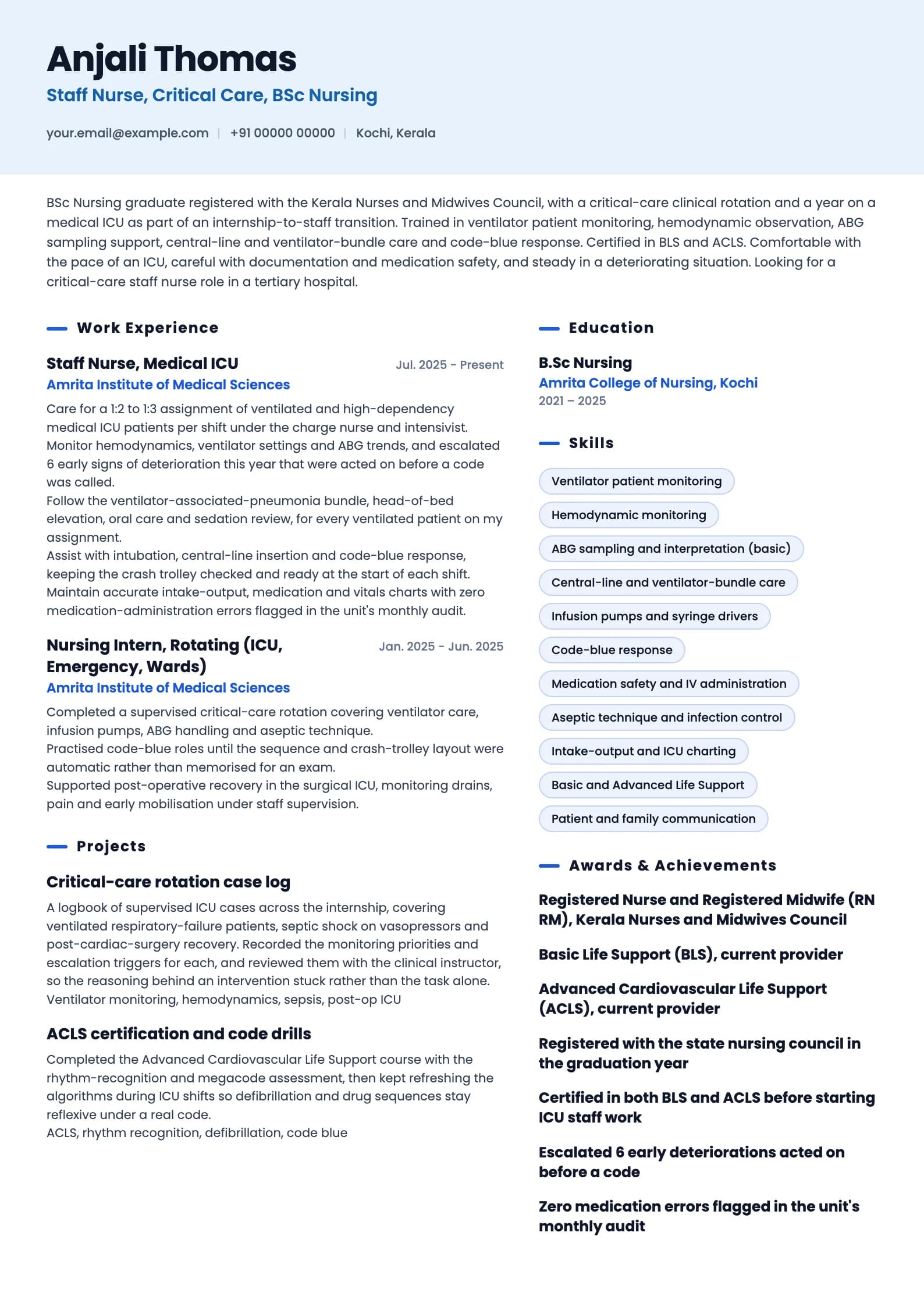
Build my resumeICU Nurse resume example, Fresher (0 to 1 year)
ai-era templateIs your resume good enough?
Upload the resume you have now and see what an applicant tracking system reads before a icu nurse recruiter ever does.
Free to run. Sign in with your mobile number to see your score.
ICU Nurse resume example, Critical care (5 years)
professional template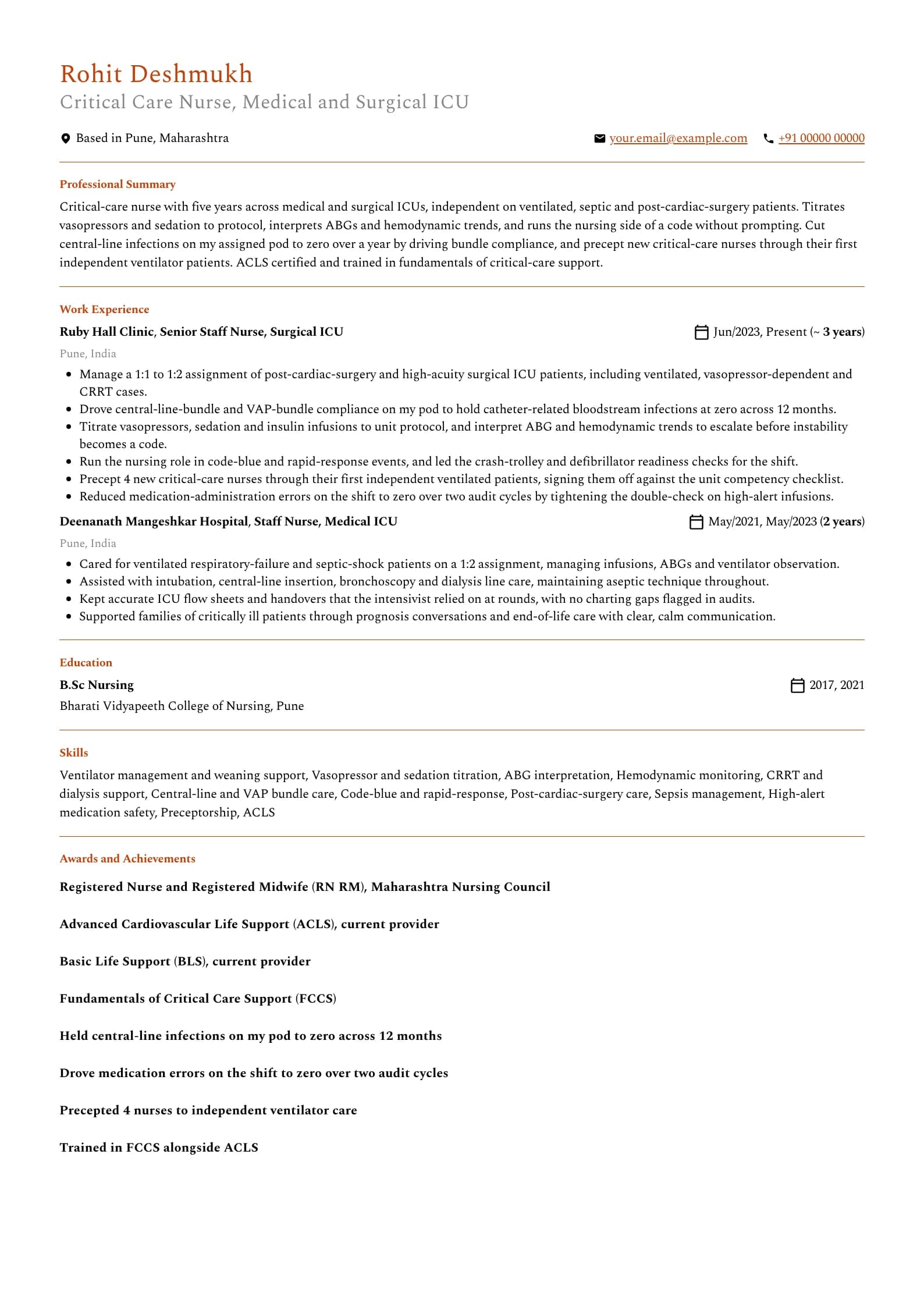
Want this structure with your own details? Build it in the resume builder.
ICU Nurse resume example, Charge nurse (10 years)
header-band template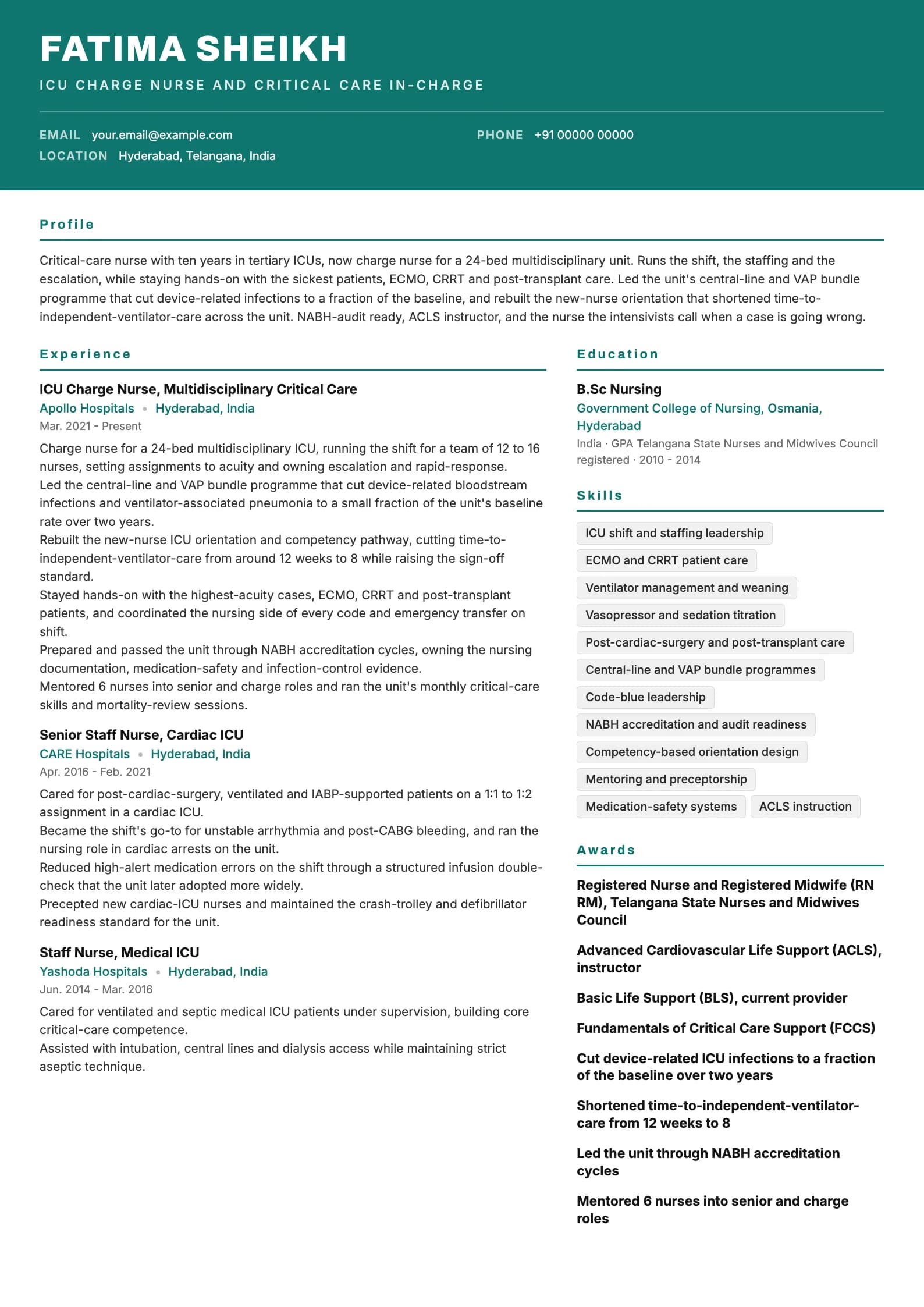
The format that works for ICU nurse resumes in India
Reverse chronological is the layout to use. Current or most recent role first, working backwards, dates in plain view. A functional resume that groups everything under Clinical Skills and hides the dates reads to a nursing superintendent as an attempt to mask a gap, and they treat it that way. If you have a break, one honest line handles it better than a hidden one. One page holds everything a fresher and most nurses up to roughly six years need to say. Beyond that, a second page is fine when it carries real unit and leadership work rather than a longer equipment list. A page two built from a declaration and a hobbies line is a padded one-page resume. One thing an ICU nurse resume must not do is bury the registration. Your RN RM registration and its council, plus BLS and ACLS validity, decide whether you can be hired at all, so they belong in the summary and a clearly headed certifications block, not at the bottom. What does not belong is a photograph, marital status, date of birth beyond a form field and father's name. Send a PDF unless the posting asks otherwise, and name the file with your own name and ICU or critical care. Use a single column top to bottom. The table below sets out the section order for a critical-care nurse resume.
| Section | Where it goes | Why |
|---|---|---|
| Name and headline | Top, above everything | Headline names the role: Critical Care Nurse, or ICU Charge Nurse. Recruiters match on it. |
| Professional summary | Directly under the header | Three lines. Years, unit type, patient acuity and your registration. |
| Registration and certifications | High, near the summary | RN RM, council, BLS and ACLS validity are the hiring gate; make them easy to find. |
| Work experience | Next | Most recent first. Name the unit, the patient ratio, the acuity and the outcome. |
| Skills | Below experience | Grouped: critical-care procedures, monitoring, safety, leadership. |
| Education | Below skills | BSc or GNM Nursing, institution, year. Add the council here too. |
| Languages | Bottom | Real for patient and family communication, especially in a tertiary hospital. |
Listing a ventilator is not the same as proving you managed one
The most common ICU resume failure is an equipment list standing in for experience: ventilator, monitor, infusion pump, defibrillator, ABG, central line, dialysis, with no bullet anywhere showing what you did with any of them. It reads exactly like a general ward nurse who saw the machines rather than a critical-care nurse who ran them. An intensivist reading it cannot tell the two apart. The fix is to let the patient and the judgement prove the skill. Instead of ventilator, write that you managed ventilated respiratory-failure patients and followed the VAP bundle. Instead of infusion pump, write that you titrated vasopressors and sedation to protocol. Titration, weaning support, bundle compliance and early escalation are the verbs that show critical-care judgement, and they are what separate an ICU nurse from a nurse who worked near an ICU. Be specific about acuity and ratio. A 1:1 or 1:2 assignment on ventilated, vasopressor-dependent or CRRT patients tells a reader the real weight of your work, where a general 1:6 ward ratio does not. Name the case types, medical, surgical, cardiac, post-transplant, ECMO, because each is a different level of unit and skill. Do not overstate scope. A nurse supports intubation and central-line insertion and manages the patient around them; claiming to perform procedures reserved for physicians reads as either inflation or a safety risk. Stating your role precisely, and doing it at a high level, is what earns the interview.
For every device on your resume, ask: what did I decide or manage with it, and for which patient. A machine named without a patient and a judgement is a ward nurse's line. The judgement is what makes it a critical-care nurse's.
Writing a summary a nursing superintendent actually reads
The lines under your name are the part most likely to be read, so they must carry four facts: how long you have worked in critical care, the unit type and acuity you have handled, your registration, and the strongest quality result you drove. Three or four lines, no adjectives that cannot be checked. The old objective, seeking a challenging position in a reputed hospital to apply my nursing skills, tells the reader nothing they did not assume from the application. Replace it with a summary of what you have handled. An objective says what you want, a summary says what you have carried, and only one earns a shortlist in critical care. Freshers often think they have nothing to summarise. The fresher sample names the degree, the council registration, the ICU rotation and year, the bundle and code work, and BLS with ACLS. That is a real summary built from a degree, an internship and a first year, not invented seniority. What it avoids is dedicated and passionate, phrases so common on nursing resumes they now carry no information. A practical test: read your summary and ask whether any BSc Nursing graduate from your batch could paste it on unchanged. If they could, it describes the degree, not you. Add the specific unit, the specific acuity and the specific result until it stops being transferable.
Professional summary, critical-care nurse
Weak
Dedicated and passionate ICU nurse with 5 years of experience in critical care seeking a challenging position in a reputed multispeciality hospital to apply my skills.
Strong
Critical-care nurse with five years across medical and surgical ICUs, independent on ventilated, septic and post-cardiac-surgery patients. Held central-line infections on my pod to zero over a year and precept new nurses to independent ventilator care. RN RM, ACLS certified.
The rewrite trades self-description for unit type, acuity, a quality outcome and the registration a superintendent needs to see.
Experience bullets: action, patient acuity, outcome
Every strong bullet in the samples follows the same shape. It opens with an action, names the acuity of the patient or the specific critical-care task, and closes with what measurably resulted. The action shows you did it. The acuity tells a reader the weight of the work. The outcome does the persuading. Start from the result and work backwards. Nurses usually write the task first and then cannot attach anything to it, producing lines like provided care to critically ill patients. Instead ask what was true about your patients or your unit because you were there: an infection rate held, a deterioration caught early, a medication error driven to zero, a code run cleanly, a new nurse signed off. Then write the sentence that ends in that fact. Vary what you count. Patient ratio, infection rate, medication-error count, deteriorations escalated early, codes run, nurses precepted, weaning successes. A resume that only ever says provided quality care reads as one duty repeated, while a spread of real ICU metrics reads as range. Where you have no number, give acuity and scope: which unit, what ratio, which case types, how many beds. A 1:1 assignment on post-cardiac-surgery and CRRT patients carries weight without inventing a percentage. Allocate bullets by recency. Current role gets five or six, the previous role three or four, anything older two.
| Level | What bullets must prove | Typical metric |
|---|---|---|
| Fresher | You can hold a real ICU assignment safely | Patient ratio, deteriorations escalated, medication-audit result |
| 2 to 4 years | You manage acuity independently | Acuity handled, bundle compliance, code roles, aseptic record |
| 5 to 8 years | You drive quality and develop nurses | Infection rate, medication errors, nurses precepted, weaning |
| 9 years and up | You run the unit and set the standard | Beds and team run, programme results, orientation time, accreditation |
Experience bullet, ICU role
Weak
Provided nursing care to critically ill patients on ventilators and monitored them as per doctor's instructions.
Strong
Managed a 1:2 assignment of ventilated respiratory-failure and septic-shock patients, and escalated 6 early deteriorations this year that were acted on before a code.
Swaps a generic care statement for the acuity, the ratio and the early-escalation outcome that critical care is really judged on.
Experience bullet, quality work
Weak
Followed infection-control protocols and maintained cleanliness in the ICU.
Strong
Drove central-line and VAP bundle compliance on my pod to hold catheter-related bloodstream infections at zero across 12 months.
Names the specific bundles and closes on a unit-quality metric an ICU manager is measured on, not a generic protocol claim.
If a bullet would read identically on a general ward nurse's resume, it is not showing critical care. Rewrite it until the acuity and the judgement make it unmistakably an ICU line.
The skills section: grouped, honest, and matched to the unit
An ICU nurse's skills section has two readers. A hospital HR system scans for literal terms like ventilator management, ACLS, hemodynamic monitoring and CRRT. A nursing superintendent wants a short, organised list that tells her what kind of critical-care nurse you are. Grouping serves both. Group by function rather than one long line. Critical-care procedures, monitoring and interpretation, safety and infection control, and leadership is a grouping that fits almost every ICU nurse. The exact headings matter less than the fact that structure exists. Write terms the way the field writes them: ABG interpretation, not blood gas; vasopressor titration, not giving injections. Twelve to sixteen skills is the working range. Below eight the section looks thin, above twenty it stops being a signal. Match the emphasis to the unit you are applying to: a cardiac ICU wants IABP and post-CABG care, a medical ICU wants ventilator and sepsis management, a transplant unit wants CRRT and immunosuppression monitoring. Tailoring beats sending one list everywhere. Do not add a proficiency bar with stars. Nobody agrees what four stars in ventilator management means, and in critical care it invites exactly the question you least want. Let the experience prove the depth instead.
Registration and certifications India requires
For an ICU nurse in India, registration is not optional, it is the licence to practise. Your Registered Nurse and Registered Midwife registration with the relevant State Nurses and Midwives Council must be current, and it should appear in both your summary and a clearly headed certifications block. A resume that omits it, or that lists a lapsed registration, cannot pass a hospital's first check. Basic Life Support and Advanced Cardiovascular Life Support are the two clinical certifications a critical-care unit expects, and their validity is part of the credential. Both are typically valid for two years, so write the year and renew before they lapse. For an ICU role, ACLS is close to mandatory, because you are expected to hold a defined role in a code without hesitation. Beyond those, targeted critical-care credentials raise your standing. Fundamentals of Critical Care Support, a post-basic diploma or certificate in critical-care nursing, and unit-specific training in CRRT, ECMO or cardiac care each signal depth for a specific setting. For senior nurses, an ACLS instructor status or NABH-audit experience is a genuine differentiator. Write each credential with its full name, the issuing body and the year. Do not pad with unrelated general certificates, because a long list of weak items buries the registration, BLS and ACLS that actually decide whether you can be hired.
| Credential | What it proves | Worth it for |
|---|---|---|
| RN RM registration | Legal licence to practise, current with the state council | Every nurse; the hiring gate, not optional |
| ACLS | Current, defined role in advanced cardiac codes | All ICU nurses; near-mandatory in critical care |
| BLS | Current CPR and basic emergency competence | Every nurse; the base credential |
| FCCS | Structured critical-care assessment and management | Nurses building or deepening ICU competence |
| Critical Care Nursing (post-basic) | Formal specialisation in critical care | Mid and senior nurses targeting tertiary ICUs |
Getting through hospital screening
Large tertiary hospitals and staffing agencies screen nursing resumes through software before a human reads them, and even manual readers rely on searchable files. Almost every screening problem is a parsing problem, and parsing problems come from layout, not wording. The layout rules are short. One column, so a sidebar does not interleave with your experience. Standard section headings, so use Work Experience rather than My Critical Care Path, and Skills rather than My Expertise. No text inside images, because a decorative badge strip reads as blank space. Keep your registration and certification detail in the body, not in a footer some parsers drop. On wording, mirror the posting where it is honest. If it says critical care nurse, make sure the phrase appears; if it says ACLS, write Advanced Cardiovascular Life Support (ACLS) so both forms are found; if it names a unit type such as MICU or cardiac ICU that you have worked, use the same term. Spell out RN RM once as Registered Nurse and Registered Midwife. Do not stuff keywords. A hidden block of every critical-care term in white text is found quickly and reads worse than an honest gap. Write real bullets that naturally contain the right terms, because a bullet describing your ventilated septic-shock patients already carries the words ventilator and sepsis in a context that survives a human read. Save as a PDF that holds real text, then open it and confirm you can select and copy a sentence. If you cannot select the text, neither can the screening software.
Section heading
Weak
My Critical Care Journey
Strong
Work Experience
Screening software looks for standard headings; a creative one can push your whole ICU history into a bucket the recruiter never searches.
What gets ICU nurse resumes rejected
Most rejections at the resume stage are not close calls. They come from a small set of recurring problems, and all of them are fixable in an afternoon. The list below covers what nursing superintendents and hospital HR see most often on Indian ICU nurse resumes, in rough order of how much damage each one does.
- Registration missing, lapsed or hidden. RN RM with the council must be current and easy to find, or the resume fails the first check.
- An expired or undated BLS or ACLS card shown as current. Write the year and renew before it lapses.
- An equipment list standing in for experience, so a reader cannot tell an ICU nurse from a ward nurse who saw the machines.
- No patient ratio or acuity, so the real weight of the work is invisible. Name the ratio and the case types.
- Generic care statements with no outcome. "Provided care to critically ill patients" is the tell.
- Claiming physician procedures rather than the nurse's role around them, which reads as inflation or a safety risk.
- A photo, date of birth, marital status or father's name filling space a quality outcome should occupy.
- A generic objective line instead of a summary that states years, unit, acuity and registration.
- Inflated titles or dates that do not match your service certificates. Verification is standard and a mismatch ends the process.
- A wall of unrelated online certificates burying the registration, BLS and ACLS that actually decide the shortlist.
Read your resume as the intensivist deciding who to trust with the sickest patient on the unit tonight. Any line that would not reassure them is a line to sharpen or cut.
Skills to put on a icu nurse resume
Technical
- Ventilator management and weaning
- Vasopressor and sedation titration
- ABG interpretation
- Hemodynamic monitoring
- CRRT and dialysis support
- ECMO patient care
- Central-line and VAP bundle care
- Code-blue and rapid-response
- Post-cardiac-surgery care
- Sepsis management
- High-alert medication safety
- Aseptic technique and infection control
Tools and platforms
- Mechanical ventilators
- Multiparameter monitors
- Infusion and syringe pumps
- Defibrillators and IABP
- ABG analysers
- CRRT and dialysis machines
- Central-line and arterial-line setups
- ICU flow-sheet and EMR charting
Working skills
- Judgement under pressure
- Early deterioration recognition
- Clear SBAR handover
- Family and end-of-life communication
- Teamwork in a code
- Preceptorship and mentoring
- Attention to detail
- Calm in emergencies
Certifications worth listing as a icu nurse
| Certification | Full name | Worth it for |
|---|---|---|
| RN RM | Registered Nurse and Registered Midwife, State Nurses and Midwives Council | The legal licence to practise nursing in India, and the first thing any hospital checks. It must be current with the relevant state council and appear in both the summary and the certifications block. Not optional at any level; a lapsed or missing registration fails the resume before the experience is read. |
| ACLS | Advanced Cardiovascular Life Support | Near-mandatory for ICU and critical-care nurses, because you are expected to hold a defined role in a code without hesitation. Certifies advanced rhythm recognition, defibrillation and drug algorithms, is typically valid two years, and must be renewed before it lapses. Senior nurses can go further and hold instructor status. |
| BLS | Basic Life Support (CPR) Provider | The base clinical certification every nurse holds, covering CPR and basic emergency response. Expected across all roles and a prerequisite for ACLS. Typically valid two years; list it with the year, because an expired card shown as current costs you credibility on a page where safety is the whole point. |
| FCCS | Fundamentals of Critical Care Support | A structured course in recognising and managing the critically ill in the first hours, valuable for nurses building or consolidating ICU competence. A genuine differentiator for a nurse moving from general wards into critical care, and a solid signal of depth for mid-career ICU nurses. |
| Critical Care Nursing | Post-Basic Diploma or Certificate in Critical Care Nursing | A formal specialisation for nurses committed to critical care, recognised by tertiary hospitals. Most valuable for mid and senior nurses targeting high-acuity units or charge roles, where a documented specialisation supports both the clinical work and the move into unit leadership. |
Keywords an ATS scans for in a icu nurse resume
These are the literal terms a parser matches against the job description. Use the ones that are true of you, in the sentences where you did the work, not as a list at the bottom.
- icu nurse
- critical care nurse
- staff nurse
- registered nurse
- RN RM
- ventilator management
- hemodynamic monitoring
- ABG interpretation
- vasopressor titration
- CRRT
- central line care
- VAP bundle
- code blue
- ACLS
- BLS
- sepsis management
- post cardiac surgery
- infection control
- medication safety
- NABH
ICU Nurse resume FAQ
What salary can an ICU nurse expect in India?
A fresher staff nurse in critical care typically starts around 2.5 to 4.5 LPA in private hospitals, higher in large corporate chains and metros, with government posts following pay-scale bands. A critical-care nurse with four to seven years commonly sits in the 4.5 to 9 LPA range. Charge nurses and ICU in-charges with nine years and above can reach 9 to 16 LPA and more at top tertiary hospitals. Overseas roles in the Gulf, UK and Ireland pay several times the Indian band, which is why registration, ACLS and clean documentation matter so much.
How long should an ICU nurse resume be?
One page up to roughly six years, two pages after that only if the second page carries real unit and leadership work rather than a longer equipment list. A nursing superintendent wants your registration, unit type, acuity and quality outcomes visible quickly. If you are struggling to fit one page, cut the oldest role to a line, remove schooling detail once you hold a degree, and delete any credential that is not decision-relevant.
What certifications does an ICU nurse need in India?
Current RN RM registration with your state nursing council is the licence to practise and the first check. BLS and ACLS are the two clinical certifications a critical-care unit expects, with ACLS close to mandatory because you hold a role in every code. Beyond those, FCCS and a post-basic critical-care nursing qualification signal depth, and unit-specific CRRT, ECMO or cardiac training helps for a specialised ICU. Always list the issuing body and the year.
How do I write an ICU nurse resume as a fresher?
Lead with your registration and your critical-care rotation or first ICU months, then education and skills. Treat the rotation as real experience: name the unit, the patient ratio you carried, the acuity, the bundle and code work you did, and outcomes like deteriorations escalated early. Add BLS and ACLS with their year. Verifiable facts and a real patient ratio carry far more weight than the words dedicated and passionate.
What is the difference between an ICU nurse and a ward nurse resume?
The difference is acuity and judgement. A ward nurse resume can list monitoring and care in general terms; an ICU nurse resume has to show a 1:1 or 1:2 assignment on ventilated, vasopressor-dependent or CRRT patients, plus the decisions that go with it, titration, weaning support, bundle compliance and early escalation. If your bullets would read the same on a general ward resume, they are not yet showing critical care.
Should I list the equipment I have used?
List it, but never let it stand in for experience. A ventilator named with no patient and no judgement reads like a ward nurse who saw the machine, not an ICU nurse who ran it. Tie each device to what you managed: ventilated respiratory-failure patients on the VAP bundle, vasopressors titrated to protocol, CRRT circuits maintained. The judgement around the equipment is what marks you as a critical-care nurse.
Do ICU nurse resumes get screened by software?
Large tertiary hospitals and staffing agencies commonly screen through software before a human reads the resume. Use a single column, standard headings like Work Experience and Skills, and no text inside images. Mirror the posting's wording where honest, spell out ACLS and RN RM once in full, and test the file by copying its text into a plain editor. If it reads in order there, it will most likely parse correctly for the recruiter.
Do I need a photo on an ICU nurse resume in India?
No. A photograph adds nothing to a clinical screen and takes space a quality outcome or a certification should occupy. The same goes for date of birth beyond a form field, marital status, father's name and a declaration paragraph, all of which come from an older template. What genuinely helps instead is your current registration, your BLS and ACLS validity, your patient acuity and the languages you speak.
Related resume examples and guides
Build your own ICU nurse resume
Start from a blank resume or upload the one you have. Goodspace renders it in 24 templates and flags the critical-care, ACLS and registration keywords a hospital will look for, and the equipment-list filler it will not credit.
Build my resume