Nursing Assistant Resume Format, with 3 Full Samples
A nursing assistant is hired on trust: that a ward or a family can hand over the daily care of a vulnerable patient and it will be done safely, cleanly and without drama. Yet most resumes for the role list duties in the abstract and never show the patient load carried or the incident avoided. Below are three complete resumes, one for a fresher who has just finished a General Duty Assistant course, one for an assistant with three years on a hospital ward, and one for a senior patient-care attendant who now supervises a home-care roster. After the samples come the format rules, the difference between listing patient care and proving it, the certifications that matter in India, and the mistakes that get a nursing assistant resume set aside.
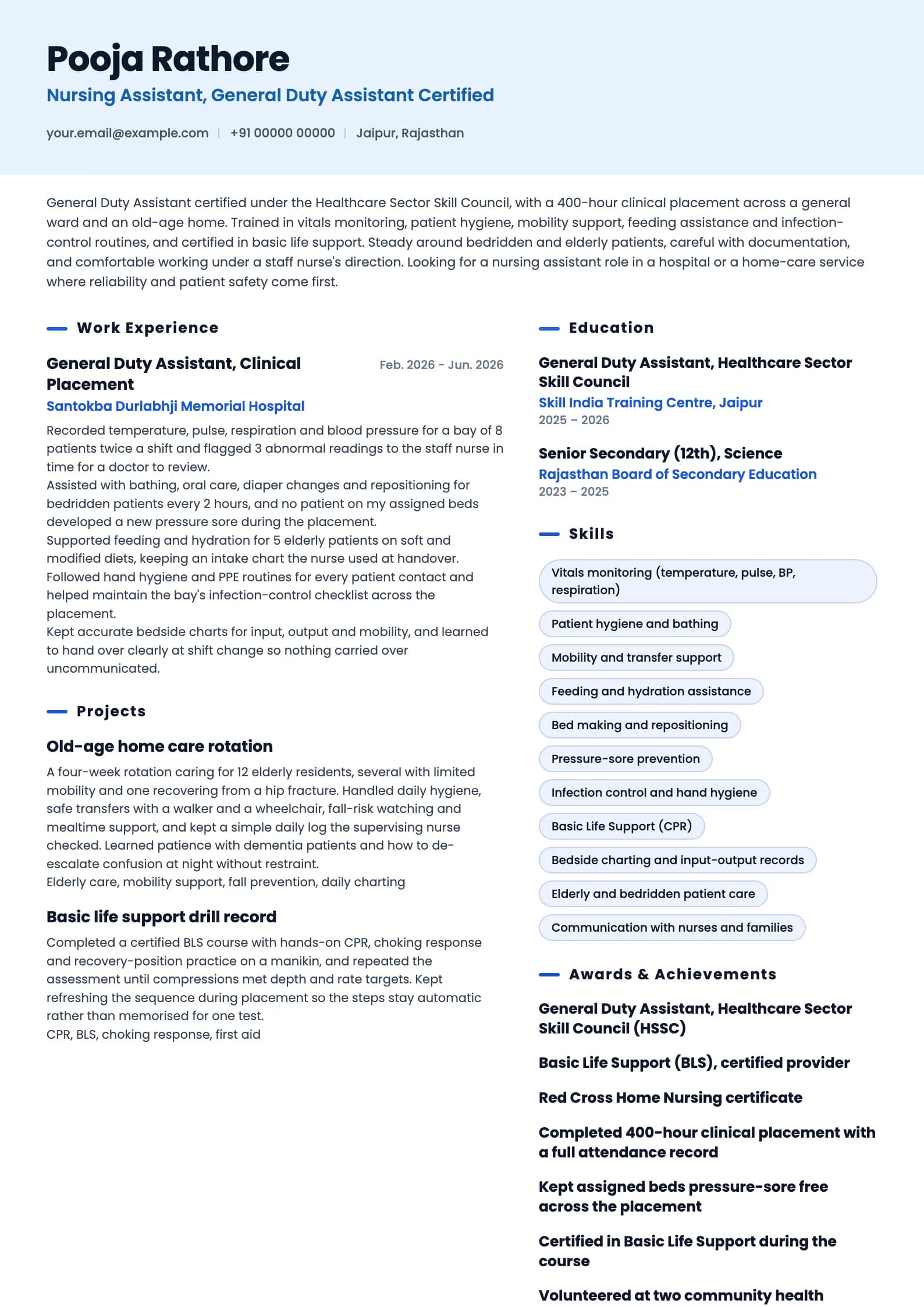
Build my resumeNursing Assistant resume example, Fresher (0 years)
ai-era templateIs your resume good enough?
Upload the resume you have now and see what an applicant tracking system reads before a nursing assistant recruiter ever does.
Free to run. Sign in with your mobile number to see your score.
Nursing Assistant resume example, Ward experience (3 years)
professional template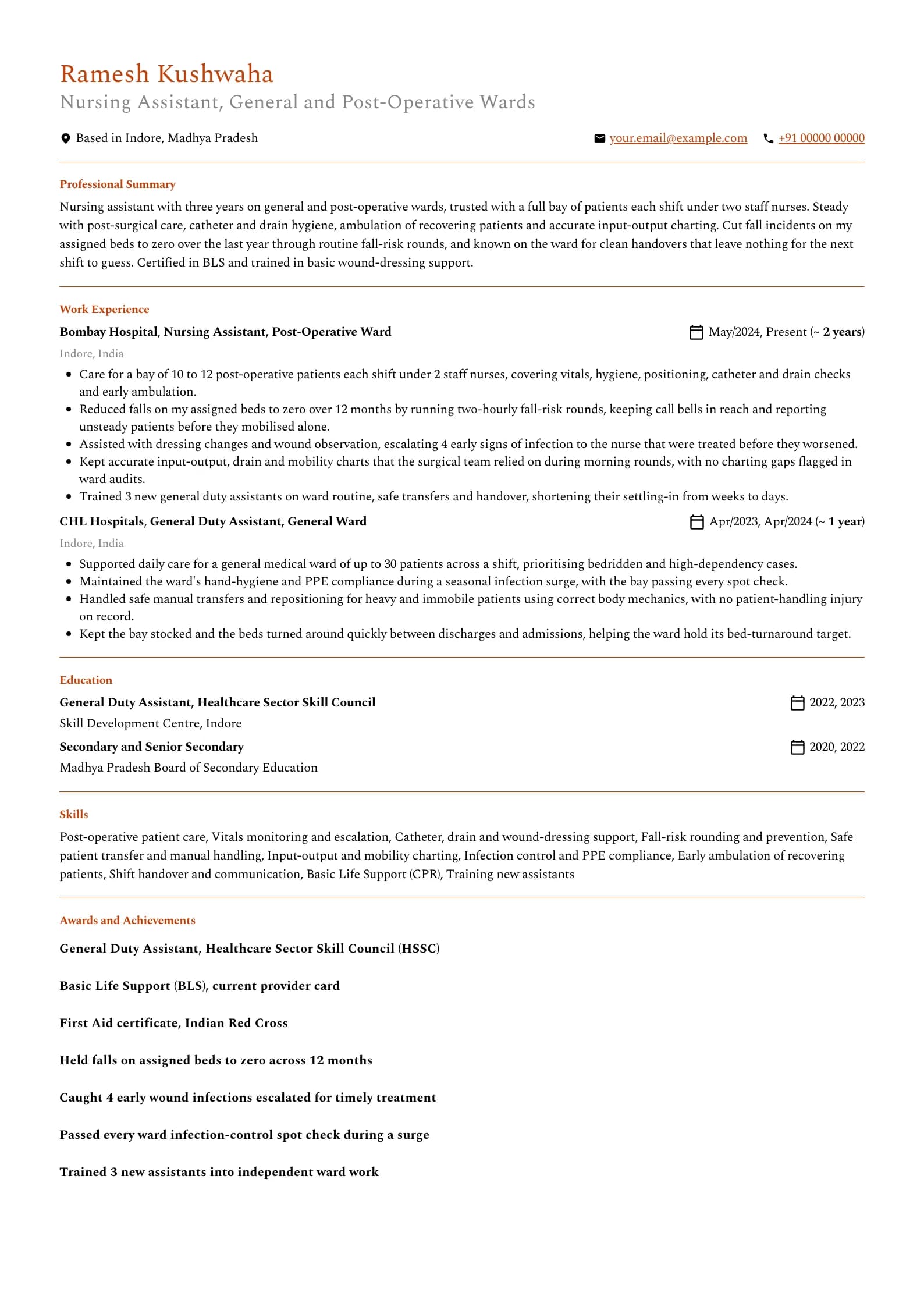
Want this structure with your own details? Build it in the resume builder.
Nursing Assistant resume example, Senior (8 years)
header-band template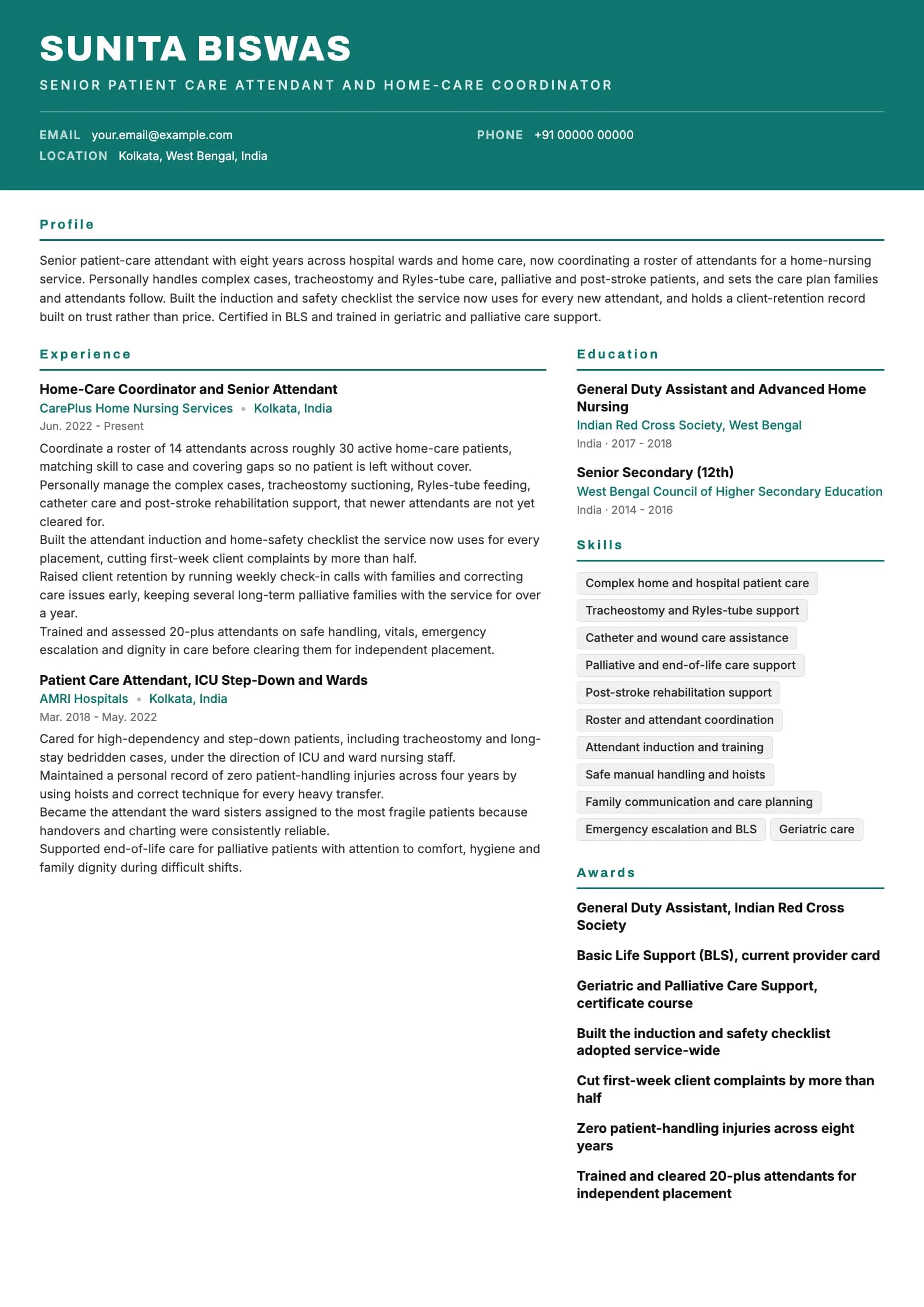
The format that works for nursing assistant resumes in India
Reverse chronological is the layout to use. Put your current or most recent role first, work backwards, and keep the dates in plain view. A functional resume that hides everything under a Skills heading and drops the dates reads to a hospital HR as an attempt to cover a gap, and they treat it that way. If you have a break, one honest line explains it better than a hidden one. One page is right for almost every nursing assistant, fresher or experienced. This is not a role where a longer document helps. A ward sister or an agency manager wants to see, in one glance, your patient-care experience, your certifications and that you are reliable. A second page padded with a declaration and hobbies works against you. Four things do not belong on this resume even though an old template puts them there: a photograph, marital status, date of birth beyond what a form asks, and father's name. What does belong, and what many candidates leave off, is your certification status, your BLS validity and the kind of patients you have handled. Those decide the shortlist. Send a PDF unless the posting asks otherwise, and name the file with your own name and the words nursing assistant. Use a single column top to bottom. The table below sets out the section order for a nursing assistant resume.
| Section | Where it goes | Why |
|---|---|---|
| Name and headline | Top, above everything | The headline names the role and your certification: Nursing Assistant, GDA certified. Recruiters match on it. |
| Professional summary | Directly under the header | Three lines. Years, kind of patients handled, and your certifications. |
| Certifications | High, near the summary | GDA, BLS and its validity decide whether a hospital can shortlist you at all. |
| Work experience | Next, for anyone with a job or placement | Most recent first. Name the ward, the patient load and the outcome. |
| Skills | Below experience | Grouped: clinical support, safety, documentation, soft skills. |
| Education and training | Below skills | GDA or ANM course, schooling, years. Keep it short. |
| Languages | Bottom | Real for this role: patient and family communication depends on it. |
Listing patient care is not the same as proving it
The most common nursing assistant resume failure is a duties list that could belong to anyone with the certificate: monitoring vitals, maintaining hygiene, assisting patients, following doctor's orders. Every line is true and none of it separates you from the hundred other applicants who wrote the same sentences. A ward sister reading it learns nothing about whether you are safe with a fragile patient. The fix is to attach the patient and the outcome. Instead of maintaining patient hygiene, write that you repositioned bedridden patients every two hours and kept your assigned beds free of new pressure sores. Instead of monitoring vitals, write that you flagged abnormal readings in time for a doctor to act. The task becomes evidence the moment it carries a patient load and a result. Be specific about the kind of patient you have handled, because that is what decides fit. Post-operative, geriatric, bedridden, palliative, tracheostomy, post-stroke: each names a different level of skill, and a home-care agency placing a complex case needs to know which you can take. The senior sample leads on tracheostomy and Ryles-tube care precisely because those are the cases that command a higher rate. Do not inflate. A nursing assistant works under a nurse's direction and does not administer medication or make clinical decisions, and a resume that claims otherwise reads as either dishonest or unsafe. Stating your scope accurately, and doing it well, is what earns trust.
For every duty on your resume, ask: which patient, how many, and what was the result. A line that survives those three questions is evidence. A line that does not is filler any certificate-holder could have written.
Writing a summary a ward sister actually reads
The lines under your name are the part most likely to be read, so they must carry three facts: how long you have done the work, the kind of patients you have handled, and your certification status. Three or four lines, no adjectives that cannot be checked. The old objective, seeking a position in a reputed hospital to serve patients and gain experience, tells the reader nothing they did not already assume. Replace it with a summary of what you have actually done. An objective says what you want, a summary says what you have handled, and only one earns a shortlist. Freshers often think they have nothing to summarise. Look at the fresher sample: it names the GDA certification, the 400-hour placement, the patient types handled and a current BLS card. That is a real summary built from a training course and supervised hours, not invented experience. What it avoids is the phrase caring and hardworking, which every applicant writes and which therefore signals nothing. A practical test: read your summary and ask whether a classmate from the same GDA batch could paste it onto their resume unchanged. If they could, it describes the course, not you. Add the specific ward, the specific patient type and the specific outcome until it stops being transferable.
Professional summary, experienced assistant
Weak
Caring and hardworking nursing assistant with 3 years of experience seeking a position in a reputed hospital to utilise my skills in patient care and gain further experience.
Strong
Nursing assistant with three years on general and post-operative wards, trusted with a full bay under two staff nurses. Held falls on my assigned beds to zero over a year and caught four early wound infections. BLS certified.
The rewrite trades self-description for a ward, a patient load and two safety outcomes a matron can verify at interview.
Experience bullets: verb, patient, outcome
Every strong bullet in the samples follows the same shape. It opens with an action, names the patient or the task specifically, and closes with what safely resulted. The verb shows you did it. The patient tells the reader whether the work is relevant. The outcome does the persuading. Start from the result and work backwards. Assistants usually write the duty first and then cannot attach anything to it, which produces lines like assisted patients with daily needs. Instead ask what was true about your patients because you were on shift: no new pressure sore, no fall, an infection caught early, a clean handover, a family that stayed calm. Then write the sentence that ends in that fact. Vary what you count. Patient load, staffing ratio, fall count, pressure-sore count, infections caught early, patient-handling injuries avoided, attendants trained. A resume that only ever says maintained hygiene reads as one duty repeated, while a spread of real numbers reads as range. Where you have no number, give scope: how many beds, how many patients, which ward, what kind of case. A bay of 10 to 12 post-operative patients under two nurses carries weight without inventing a percentage. Allocate bullets by recency. Current role gets four or five, the previous role three or four, anything older two.
| Level | What bullets must prove | Typical evidence |
|---|---|---|
| Fresher / GDA | You are safe with a patient under supervision | Placement hours, patient load, pressure-sore and fall outcomes |
| 1 to 3 years | You carry a bay without close supervision | Bed load, staffing ratio, falls prevented, infections caught |
| 4 to 7 years | You take the complex cases and train juniors | Tracheostomy and tube care, injuries avoided, assistants trained |
| 8 years and up | You coordinate care and set the standard | Roster size, client retention, checklists built, complaints cut |
Experience bullet, ward work
Weak
Responsible for taking care of patients, checking vitals and maintaining cleanliness as per hospital rules.
Strong
Ran two-hourly fall-risk rounds for a bay of 10 to 12 post-operative patients and held falls on my assigned beds to zero across 12 months.
"Responsible for" describes a job description; the rewrite names the routine, the load and the safety result it produced.
Experience bullet, patient handling
Weak
Helped in shifting and moving patients whenever required in the ward.
Strong
Handled safe manual transfers and repositioning for heavy and immobile patients using hoists and correct technique, with no patient-handling injury on record.
Names the technique and the equipment and closes on the injury record, which is the outcome a ward actually cares about.
If a bullet would read identically on any GDA graduate's resume, it is describing the certificate, not you. Rewrite it until it only fits the ward and the patients you actually carried.
The skills section: grouped, honest, and matched to the ward
A nursing assistant's skills section has two readers. A hospital HR system scans for literal terms like vitals monitoring, BLS, infection control and patient hygiene. A ward sister wants a short, organised list that tells her what kind of assistant you are. Grouping serves both. Group by function rather than one long line. Clinical support, safety and handling, documentation, and soft skills is a grouping that fits almost every nursing assistant. The exact headings matter less than the fact that structure exists. Write terms the way the sector writes them: Basic Life Support, not just first aid; input-output charting, not just paperwork. Ten to fifteen skills is the working range. Below eight the section looks thin. Above eighteen it stops being a signal. Include the skills that match the kind of role you are applying to: a home-care agency looking for a complex case wants to see tracheostomy and tube care, while a general ward wants ambulation and infection control. Tailor the emphasis to the posting rather than sending one list everywhere. Do not add a proficiency bar with stars. Nobody agrees on what four stars in patient hygiene means, and it invites a question you cannot win. Let the experience prove the depth instead.
Certifications and training that carry weight
Certification is not a nice-to-have for a nursing assistant in India, it is often the shortlist filter. The General Duty Assistant qualification under the Healthcare Sector Skill Council, or an equivalent from the Indian Red Cross or a recognised institute, is what tells a hospital you have completed supervised clinical hours rather than picked the work up informally. Put it high on the page with the issuing body and the year. Basic Life Support is the second credential that matters, and its validity is part of the credential. A BLS card is typically valid for two years, so write the year and renew it before it lapses; an expired card listed as current is easy to catch and costs you trust. For anyone applying to critical or emergency-adjacent settings, it is close to mandatory. Beyond those two, targeted training raises your rate for specific work. Geriatric care, palliative care support, home nursing and basic wound-care courses each open a segment: elderly home care, hospice support, post-surgical home recovery. The senior sample lists geriatric and palliative training because those are exactly the cases that command a premium in home care. Write each certificate with its full name, the issuing body and the year. Do not pad the list with unrelated online certificates that have nothing to do with patient care, because a long list of weak credentials reads as filler and buries the two that actually matter.
| Certification | What it proves | Worth it for |
|---|---|---|
| GDA (HSSC) | Completed supervised clinical training as a general duty assistant | Every nursing assistant; often the shortlist filter |
| BLS | Current, hands-on CPR and emergency-response competence | All roles; near-mandatory near critical care |
| Home Nursing (Red Cross) | Trained for care outside a hospital setting | Home-care and agency roles |
| Geriatric / Palliative Care | Skill with elderly and end-of-life patients | Home care, hospices, higher-paying complex cases |
| First Aid | Basic emergency and wound response | Freshers building a credential base |
Getting through hospital and agency screening
Larger hospitals and home-care agencies increasingly screen resumes through software before a human reads them, and even where the first reader is a person, the file has to be searchable. Almost every screening problem is a parsing problem, and parsing problems come from layout, not wording. The layout rules are short. One column, so a sidebar does not interleave with your experience when the parser reads it. Standard section headings, so use Work Experience rather than My Nursing Journey, and Skills rather than My Abilities. No text inside images, because a decorative header reads as blank space. Keep your certification status in the body, not tucked into a footer some parsers drop. On wording, mirror the language of the posting where it is honest. If the advertisement says patient care assistant, make sure that phrase appears. If it says BLS certified, write Basic Life Support (BLS) so both the acronym and the expansion are found. If it names a patient type such as post-operative or geriatric that you have handled, use the same word. Do not stuff keywords. A hidden block of every clinical term in white text is found quickly and reads worse than an honest gap. Write real bullets that naturally contain the right terms, because a bullet describing your post-operative ward work already contains the words post-operative and ward in a context that survives a human read too. Save as a PDF that holds real text, then open it and confirm you can select and copy a sentence. If you cannot select the text, neither can the screening software.
Section heading
Weak
My Caring Journey
Strong
Work Experience
Screening software looks for standard headings; a creative one can push your whole ward history into a bucket the recruiter never searches.
What gets nursing assistant resumes rejected
Most rejections at the resume stage are not close calls. They come from a small set of recurring problems, and all of them are fixable in an afternoon. The list below covers what hospital HR and home-care agencies see most often on Indian nursing assistant resumes, in rough order of how much damage each one does.
- No certification named. GDA, ANM equivalent or a recognised home-nursing course is often the filter, so state it high with the issuing body and year.
- An expired or undated BLS card listed as current. Write the year and renew before it lapses; a mismatch is easy to catch.
- Duties copied straight from the certificate syllabus with no patient load and no outcome. "Responsible for patient care" is the tell.
- No mention of the kind of patients handled, so an agency cannot tell whether you can take a complex case.
- Claiming clinical tasks outside a nursing assistant's scope, such as administering medication or making decisions, which reads as unsafe.
- A photo, date of birth, marital status or father's name filling space a patient-care result should occupy.
- A generic objective line. Replace it with a summary that states years, patient types and certifications.
- Leaving off languages, which for this role genuinely matter because patient and family communication depends on them.
- Inflated titles or dates that do not match your experience letters. Verification is standard in hospital hiring and a mismatch ends it.
- A wall of unrelated online certificates that bury the GDA and BLS that actually decide the shortlist.
Read your resume as if you were the ward sister deciding who to trust with a fragile patient overnight. Any line that would not reassure her is a line to sharpen or cut.
Skills to put on a nursing assistant resume
Technical
- Vitals monitoring
- Patient hygiene and bathing
- Mobility and safe transfers
- Feeding and hydration support
- Pressure-sore prevention
- Catheter and drain care support
- Wound-dressing assistance
- Tracheostomy and Ryles-tube support
- Post-operative care
- Infection control and PPE
- Basic Life Support (CPR)
- Input-output charting
Tools and platforms
- Sphygmomanometer and digital BP monitor
- Thermometer and pulse oximeter
- Glucometer (basic)
- Wheelchairs and walkers
- Patient hoists and transfer aids
- Hospital beds and positioning aids
- Suction apparatus (assist)
- Bedside charts and registers
Working skills
- Patient dignity and compassion
- Reliability and punctuality
- Clear shift handover
- Family communication
- Working under a nurse's direction
- Calm in emergencies
- Attention to detail
- Patience with elderly and confused patients
Certifications worth listing as a nursing assistant
| Certification | Full name | Worth it for |
|---|---|---|
| GDA (HSSC) | General Duty Assistant, Healthcare Sector Skill Council | The core qualification for a nursing assistant in India, covering theory and supervised clinical hours. Often the shortlist filter for hospital and agency roles, so it belongs high on the page. Essential for a fresher and worth naming even years later, because it proves formal training rather than informally picked-up work. |
| BLS | Basic Life Support (CPR) Provider | A current BLS card is expected across most patient-care roles and close to mandatory near critical care. It certifies hands-on CPR and emergency response, is typically valid two years, and must be renewed before it lapses. List it with the year, because an expired card shown as current costs you trust. |
| Home Nursing | Home Nursing Certificate, Indian Red Cross Society | Worth it for anyone targeting home-care and agency placements, where the work happens without a ward's structure and support. Signals you can care for a patient safely in a home setting, and pairs well with geriatric or palliative training for the higher-paying complex cases. |
| Geriatric / Palliative | Geriatric and Palliative Care Support certificate | A targeted credential for elderly and end-of-life care, the segment that commands a premium in home nursing. Most valuable for experienced attendants moving toward complex and long-stay cases, where families pay for demonstrated skill with fragile patients rather than the lowest rate. |
| First Aid | First Aid Certificate, Indian Red Cross Society | A useful base credential for a fresher building a patient-care resume before or alongside the GDA. Covers basic emergency and wound response. Once you hold BLS and a GDA qualification it adds little, so it is an entry credential rather than a career-long one. |
Keywords an ATS scans for in a nursing assistant resume
These are the literal terms a parser matches against the job description. Use the ones that are true of you, in the sentences where you did the work, not as a list at the bottom.
- nursing assistant
- general duty assistant
- patient care assistant
- nursing attendant
- vitals monitoring
- patient hygiene
- infection control
- basic life support
- BLS
- CPR
- post-operative care
- geriatric care
- mobility support
- catheter care
- pressure sore prevention
- input output charting
- manual handling
- GDA certified
- home nursing
- palliative care
Nursing Assistant resume FAQ
What salary can a nursing assistant expect in India?
A fresher general duty assistant typically starts around 10,000 to 16,000 rupees a month in hospitals, roughly 1.2 to 2 LPA, with home-care and night shifts often paying more per case. With three to five years and reliable ward experience, 16,000 to 26,000 a month is common. Senior attendants who handle complex cases and coordinate rosters, or who specialise in palliative and post-operative home care, can reach 26,000 to 45,000 a month and more. Overseas placements in the Gulf pay several times the Indian band, which is why certification and clean documentation matter.
How long should a nursing assistant resume be?
One page, for freshers and experienced assistants alike. This is not a role where a longer document helps you; a ward sister or agency manager wants your experience, patient types and certifications visible at a glance. If you are struggling to fit one page, cut the oldest role to a line, remove schooling detail once you have a qualification, and drop any unrelated online certificate.
What certifications do I need to become a nursing assistant?
The General Duty Assistant qualification under the Healthcare Sector Skill Council, or an equivalent from the Indian Red Cross or a recognised institute, is the core credential and often the shortlist filter. A current Basic Life Support card is the second must-have, especially near critical care. Beyond those, geriatric, palliative and home-nursing training open specific higher-paying segments. List each with the issuing body and the year.
How do I write a nursing assistant resume as a fresher?
Lead with your certification and your clinical placement, then education and skills. Treat the placement as real experience, because it is: name the ward, the patient load you carried, the patient types you handled and the safe outcomes, such as no new pressure sore on your beds. Add a current BLS card and any camp or volunteer patient-care work. Verifiable facts carry far more weight than the phrase caring and hardworking.
What is the difference between a nursing assistant and a nurse?
A nurse holds a nursing degree or diploma such as BSc Nursing, GNM or ANM, is registered with a state nursing council, administers medication and takes clinical decisions. A nursing assistant, general duty assistant or patient-care attendant works under a nurse's direction on daily care: vitals, hygiene, mobility, feeding and observation. Your resume should state your scope accurately, because claiming clinical tasks outside it reads as unsafe rather than ambitious.
Should I put patient types on my resume?
Yes, and it is one of the strongest things you can do. Post-operative, geriatric, bedridden, palliative, tracheostomy and post-stroke each name a different level of skill, and an employer placing a specific case needs to know which you can take. Naming the complex cases you have handled, honestly, is what lets an agency put you on the higher-paying work rather than the routine roster.
Do nursing assistant resumes get screened by software?
Larger hospitals and home-care agencies often screen resumes through software before a human reads them, and even manual readers rely on searchable files. Use a single column, standard headings like Work Experience and Skills, and no text inside images. Mirror the posting's wording where it is honest, spell out BLS as Basic Life Support once, and test the file by copying its text into a plain editor. If it reads in order there, it will most likely parse correctly.
Do I need a photo on a nursing assistant resume in India?
No. A photograph adds nothing to a patient-care screen and takes space a certification or an outcome should occupy. The same goes for date of birth beyond what a form asks, marital status, father's name and a declaration paragraph. These come from an older template that spread through training centres. What genuinely helps instead is your certification status, your patient types and the languages you speak.
Related resume examples and guides
Build your own nursing assistant resume
Start from a blank resume or upload the one you have. Goodspace renders it in 24 templates and flags the GDA, BLS and patient-care keywords a hospital or home-care agency will look for, and the filler it will not credit.
Build my resume