Ward Boy Resume Format, with 3 Full Samples
A ward boy is hired on trust: a hospital is handing over the physical safety of patients who cannot move themselves, so the resume has to show a steady, careful attendant who follows instruction and never cuts a corner on hygiene. Most ward boy resumes read like a school leaving certificate with a job title bolted on. Below are three complete resumes, one for a fresher with a nursing-assistant certificate and no hospital job yet, one for a patient-care attendant with four years across general wards and the ICU, and one for a head ward boy who runs the attendant roster for a shift. After the samples come the format rules, the skills a hospital HR desk looks for, the terms a screening reads literally, and the mistakes that get a ward boy resume set aside before an interview.
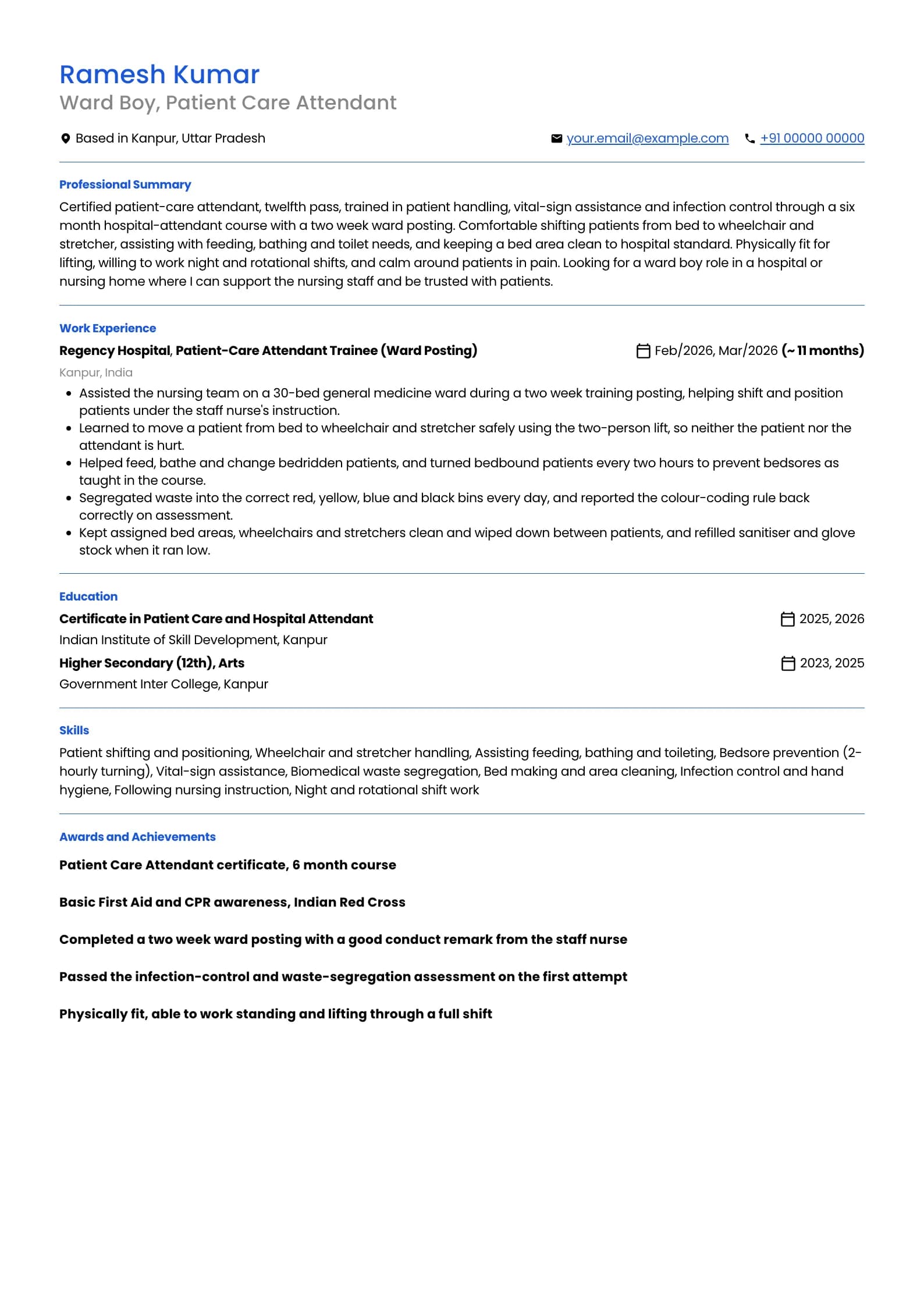
Build my resumeWard Boy resume example, Fresher (0 years)
minimalist templateIs your resume good enough?
Upload the resume you have now and see what an applicant tracking system reads before a ward boy recruiter ever does.
Free to run. Sign in with your mobile number to see your score.
Ward Boy resume example, Experienced (4 years)
professional template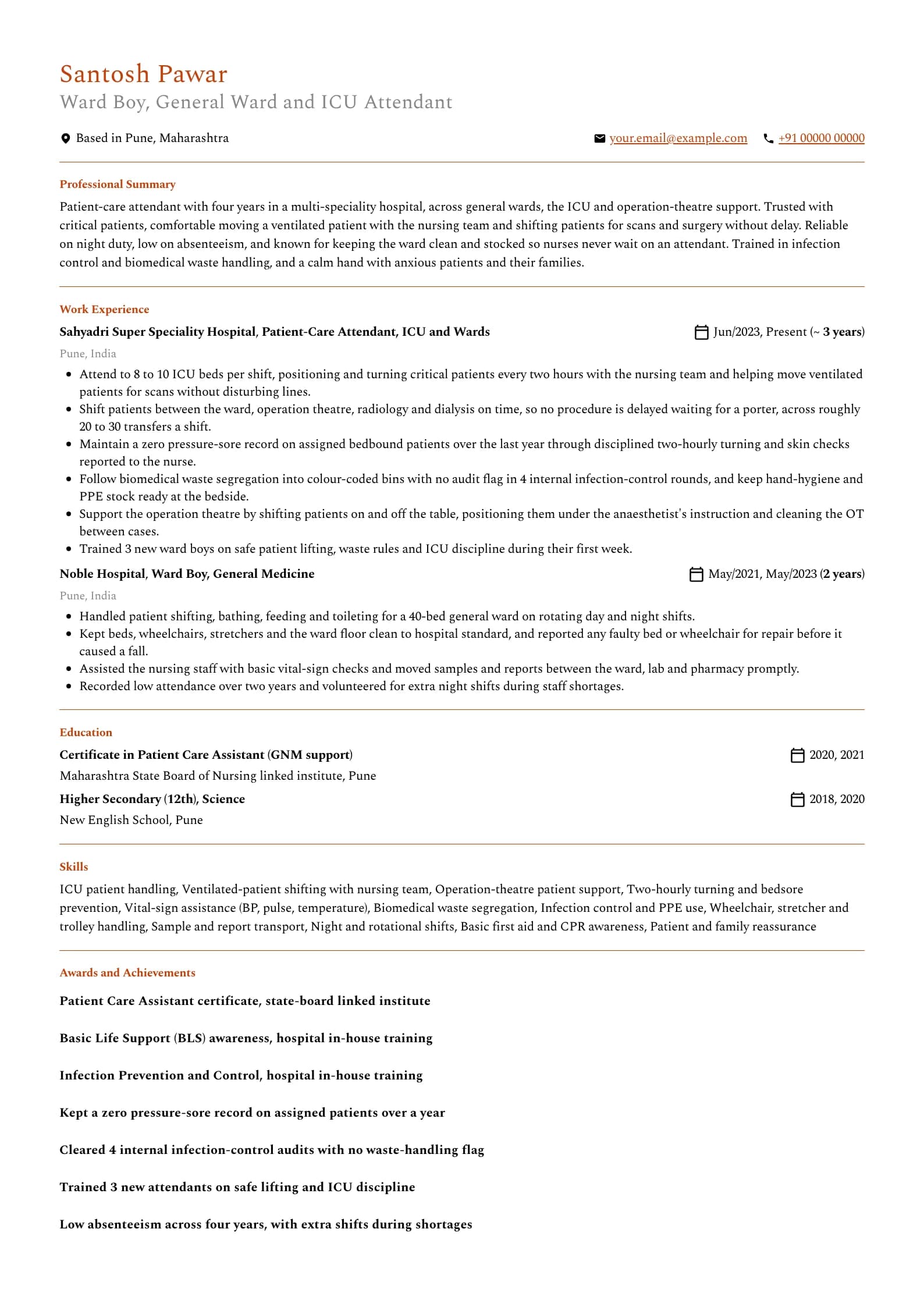
Want this structure with your own details? Build it in the resume builder.
Ward Boy resume example, Head Ward Boy (8 years)
header-band template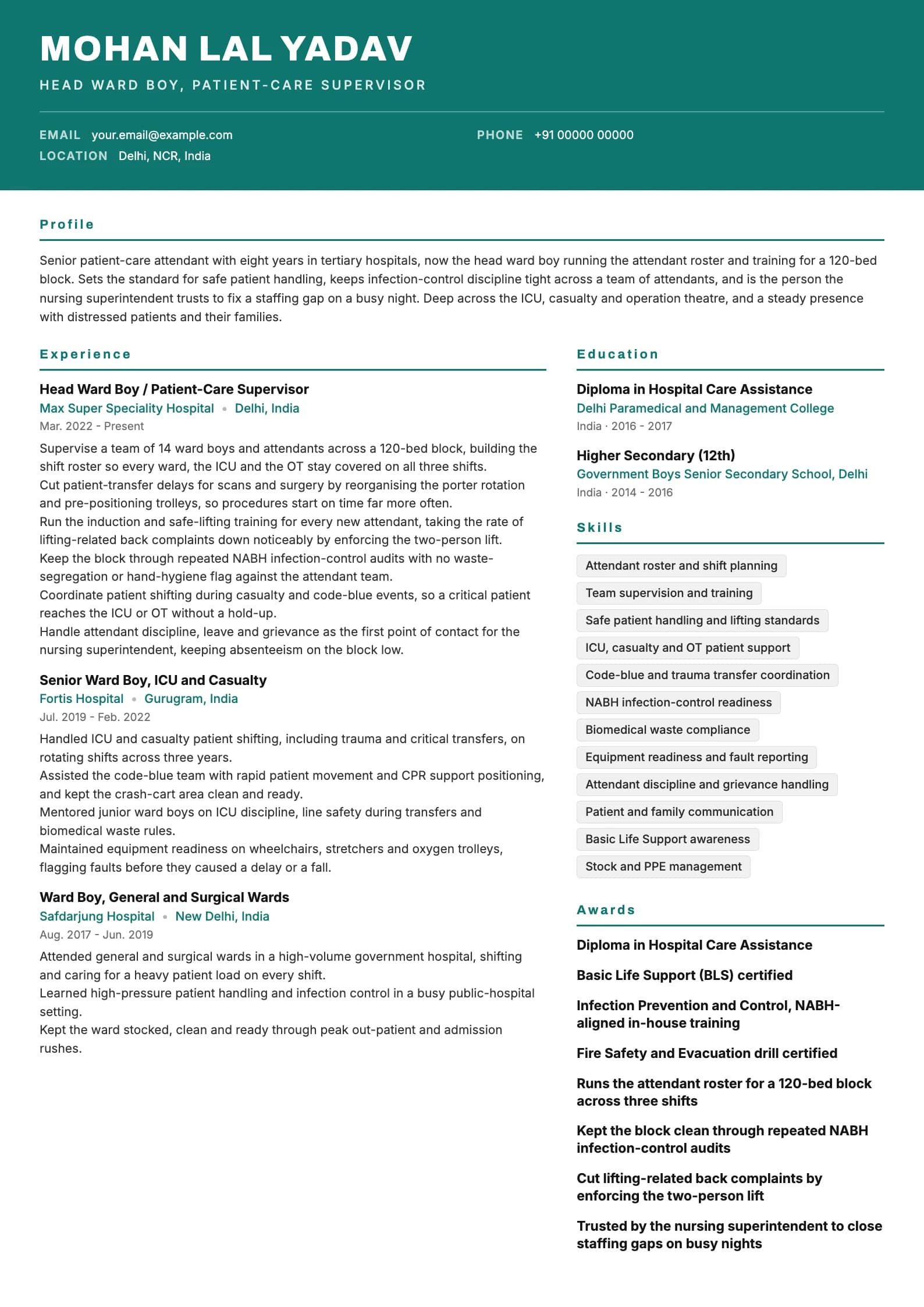
The format that works for a ward boy resume in India
Keep it to one page. A ward boy resume is read fast by a hospital HR desk or a nursing superintendent who has a stack of them, and everything they need fits on a single sheet: who you are, whether you have hospital experience, whether you can lift and do nights, and whether you follow instruction. A second page adds nothing and often does not get turned. Use reverse chronological order, most recent job first, with clear month-and-year dates. If you have gaps, one honest line explains them better than a confusing layout that tries to hide them. Hospitals verify employment, so the dates need to be true. Lead with a short summary, then experience if you have it, then skills, then education and certificates. For a fresher with no hospital job, put your patient-care certificate and any training posting near the top, because that is your evidence. Do not open with a long objective that says you are hardworking and sincere. Everyone writes that, and it tells the reader nothing. Write in simple, correct language. This is not a role where fancy words help, and a clean, readable page in plain English or Hindi transliteration beats a decorated one. Send a PDF so the layout does not break, and name the file with your own name and the words ward boy, not resume_final. Skip the photo, date of birth, marital status and father's name. The table below shows the order that works.
| Section | Where it goes | Why |
|---|---|---|
| Name and headline | Top of the page | Headline is the job you want: Ward Boy or Patient-Care Attendant. |
| Summary | Under the header | Two to three lines: experience, that you can lift, that you do shifts. |
| Work experience | Next, for anyone with a job | Most recent hospital first, with the ward type and bed count. |
| Skills | Below experience | Patient handling, hygiene, waste segregation, shift readiness. |
| Certificates and training | Near the top for a fresher, below skills otherwise | Patient-care certificate, BLS, first aid. This is a fresher's evidence. |
| Education | Bottom | 12th or diploma, school or institute, years. |
| Languages | Bottom | Hindi, English and the local language help with patients and families. |
Writing a summary a hospital HR desk actually reads
The two or three lines under your name are the part that gets read first, so put the facts a hospital cares about there: how long you have worked in hospitals, what kind of wards you have handled, that you can lift and shift patients safely, and that you will do night and rotational shifts. A supervisor screening for a ward boy is really asking two questions, can this person be trusted with patients, and will they turn up for nights. Answer both in the summary. Drop the old objective line that says "seeking a challenging position in a reputed hospital to utilise my skills". It describes what you want and proves nothing. Replace it with what you have already done: the ward types, the ICU or OT exposure, the clean infection-control record. A fresher can still write a real summary. The fresher sample names the patient-care certificate, the ward posting, the lifting technique and the willingness to do nights. That is built from a course and one training stint, and it avoids empty words like "sincere and hardworking", which every resume carries and no reader believes. A quick test: could a completely different ward boy paste your summary onto their resume without changing a word. If yes, it is too generic. Add the real hospital, the real ward, the real years until it fits only you.
Summary, experienced ward boy
Weak
Hardworking and sincere ward boy looking for a good hospital job where I can use my skills and grow in my career.
Strong
Patient-care attendant with four years across general wards, ICU and OT support, trusted with critical patients and ventilated-patient shifting. Reliable on night duty with a zero pressure-sore record on assigned patients.
The rewrite trades self-praise for the ward types, the ICU skill and one checkable result a supervisor can trust.
Experience: name the ward, the task, and what you kept safe
A strong ward boy bullet names where you worked, what you actually did, and the outcome you protected. "Did patient care work in the hospital" tells a supervisor nothing. "Attend 8 to 10 ICU beds per shift, turning critical patients every two hours with the nursing team" tells them the ward, the load and the exact task. The specifics are what separate a real attendant from a resume that could belong to anyone. Always state the ward type and, where you can, the number of beds. General medicine, surgical, ICU, casualty, dialysis and operation theatre are very different jobs, and a hospital hiring for an ICU attendant wants to see ICU on your page. The bed count shows the load you are used to. Count what you can honestly count. A ward boy resume can carry real numbers: beds attended per shift, patient transfers per shift, a zero pressure-sore record, the number of infection-control audits passed with no flag, the number of new attendants you trained. These are not invented percentages, they are facts about your work, and they read far stronger than "maintained cleanliness". Show reliability, because on this job it is a real skill. Low absenteeism, willingness to do nights, volunteering during staff shortages. A supervisor who has been let down by no-shows reads these lines carefully. Give your current or most recent hospital the most bullets and let older roles shrink.
| Level | What the bullets must show | Typical proof |
|---|---|---|
| Fresher | You were trained and can follow ward routine safely | Course posting, lifting technique, waste rule, willingness for shifts |
| 1 to 3 years | You handle a ward without close supervision | Beds per shift, transfers, cleanliness, low absenteeism |
| 4 to 6 years | You are trusted with critical patients and the OT | ICU and OT support, zero pressure sores, audits passed |
| 7 years and up | You run the attendant team and set the standard | Roster size, block beds covered, training, audit readiness |
Experience bullet, ward duties
Weak
Responsible for taking care of patients and maintaining cleanliness in the ward as per hospital rules.
Strong
Attend 8 to 10 ICU beds per shift, turning critical patients every two hours with the nursing team and maintaining a zero pressure-sore record on assigned patients over the last year.
"Responsible for" is a job description; the rewrite names the ward, the load, the exact task and the outcome protected.
If a bullet could be copied onto any ward boy's resume unchanged, it is describing the job, not you. Add the ward type, the bed count and the outcome until it only fits the work you actually did.
The skills a hospital screens a ward boy for
A ward boy's skills section should list the real tasks of the job in words a nursing supervisor recognises, not soft qualities. "Hardworking, sincere, honest, dedicated" is a list of adjectives, and every applicant claims all four. Replace them with skills that name what you can do at the bedside. Group the skills so they read fast. Patient handling covers shifting, positioning, wheelchair and stretcher, two-hourly turning and bedsore prevention. Care support covers feeding, bathing, toileting and vital-sign assistance. Hygiene and safety covers infection control, hand hygiene, PPE use and biomedical waste segregation into the colour-coded bins. Work readiness covers night and rotational shifts, first aid and BLS awareness, and following nursing instruction. Name the wards you know as skills too. ICU handling, operation-theatre support, casualty and dialysis attendance each tell a hospital something specific, because an ICU attendant is not the same hire as a general-ward one. If you have real ICU or OT experience, it belongs high on the list. Keep it honest. Every skill is something an interviewer or a supervisor on your first shift can ask you to do. Listing a skill you cannot perform is caught within a day, so put down what you can actually be trusted with and let the ward speak for the rest.
Skills line
Weak
Skills: Hardworking, sincere, honest, punctual, good communication, team player, ready to work anywhere.
Strong
Patient shifting and two-person lift, ICU and OT patient support, two-hourly turning and bedsore prevention, vital-sign assistance, biomedical waste segregation, infection control and PPE, night and rotational shifts.
Swaps a wall of adjectives everyone claims for the concrete ward tasks a supervisor can check on the first shift.
For every skill on the line, ask whether a supervisor could hand you that task on day one and trust it done right. If not, cut it. A short list of real skills beats a long list of adjectives.
Certificates and training that carry weight
For a ward boy, the right certificate can be the thing that gets you the interview, especially as a fresher. A patient-care attendant or hospital-attendant course, ideally one with a ward posting, tells a hospital you have been shown the basics of safe patient handling, hygiene and waste rules rather than learning them the hard way on the job. Name the course, the institute and the duration, and mention the posting if you did one. Basic Life Support and first-aid awareness are worth listing, because a ward boy is often the first person at the bedside when a patient collapses, and knowing how to call the code and position for CPR support matters. Many hospitals run BLS training in-house, so if you have it, put it down. Infection-prevention and biomedical-waste training is valued because hospitals are audited on it. If you have done an in-house infection-control session or a fire-safety and evacuation drill, list them. They show you can be trusted not to create an audit problem. Education for a ward boy is usually a 12th pass or a diploma, and that is enough. Put it near the bottom in one or two lines: the qualification, the school or institute, and the years. Do not pad it with subject marks from years ago. The certificate and the ward experience carry far more weight than a school percentage.
Getting past the hospital screening and the ATS
Large hospital chains increasingly run resumes through an applicant tracking system before a human sees them, and smaller hospitals have an HR person scanning for a few key words. Either way the goal is the same: make the important terms easy to find and the layout easy to read. Keep it one column. A two-column layout with a photo box and skill bars can confuse a parser, which then reads your experience out of order or drops it. A plain single column is safest and reads fine to a human too. Use the words the hospital uses. If the posting says ward boy, write ward boy, not only "hospital helper". If it says patient-care attendant, use that too. Include the ward types you have worked, ICU, operation theatre, casualty, because a hospital hiring for a specific ward searches for that word. Terms like biomedical waste, infection control, BLS, patient shifting and night shift are the ones a screening looks for. Do not stuff the page with repeated words in an attempt to trick the parser. It reads badly to the human who follows, and the human decides. Instead let your real experience bullets contain the right terms naturally, because a bullet describing ICU patient handling already contains the words ICU and patient handling. Save as PDF from a phone or computer that keeps the text selectable, not a photo of a printed page. A scanned image cannot be read by a parser at all. Open the file and check you can select and copy a line before you send it.
| What the screening looks for | Weak version | Screen-ready version |
|---|---|---|
| Role match | Hospital helper | Ward Boy / Patient-Care Attendant |
| Ward experience | Worked in hospital | ICU, general ward and OT patient handling |
| Safety and hygiene | Kept things clean | Infection control, biomedical waste segregation, PPE |
| Availability | Can work hard | Night and rotational shifts, low absenteeism |
What gets a ward boy resume rejected
Most ward boy resumes are set aside for a handful of avoidable reasons, and all of them can be fixed in an evening. Here are the ones a hospital HR desk sees most often, in rough order of how much they hurt.
- A page of adjectives, hardworking and sincere and honest, with nothing about actual ward tasks. Replace them with real skills.
- No mention of which wards you worked. General, ICU, casualty and OT are different jobs, and leaving it out costs you the specific hire.
- Hiding whether you can do nights and lift patients. A supervisor screens for this first, so state it plainly.
- A long, vague objective at the top. Swap it for a two-line summary of experience and availability.
- A photo, date of birth, marital status and father's name copied from an old template. None of it belongs and it wastes the page.
- Dates that do not match your actual employment. Hospitals verify, and a mismatch ends the process.
- Sending a blurry photo of a printed resume from WhatsApp. Send a clean PDF that keeps the text readable.
- Spelling the medical terms wrong, writing ICU care as if guessing. If you claim ICU experience, spell and describe it right.
- No certificate or training listed even when you have one. A patient-care certificate is exactly what a fresher should lead with.
- One giant paragraph with no bullets. Break the work into short bullet lines a busy reader can scan.
Read your resume once as if you were the nursing superintendent. If it does not tell them which wards you know, whether you do nights, and that you can be trusted with a patient, it is not finished.
Skills to put on a ward boy resume
Technical
- Patient shifting and positioning
- Two-person and mechanical lift technique
- Wheelchair, stretcher and trolley handling
- Two-hourly turning and bedsore prevention
- Vital-sign assistance (BP, pulse, temperature)
- ICU and ventilated-patient support
- Operation-theatre patient handling
- Biomedical waste segregation
- Infection control and hand hygiene
- Basic Life Support and first aid
Tools and platforms
- Hospital beds and side rails
- Wheelchairs and stretchers
- Patient hoist and transfer sheets
- Oxygen cylinders and trolleys
- PPE (gloves, mask, gown)
- Colour-coded waste bins
- Vital-sign monitors (assist)
- Sanitiser and cleaning supplies
Working skills
- Following nursing instruction
- Reliability and punctuality
- Night and rotational shift readiness
- Patient and family reassurance
- Physical fitness and stamina
- Calm under pressure
- Teamwork with nurses and doctors
- Attention to hygiene detail
Certifications worth listing as a ward boy
| Certification | Full name | Worth it for |
|---|---|---|
| Patient Care Attendant | Certificate in Patient Care Assistant / Hospital Attendant | The core credential for a ward boy, worth doing before your first hospital job. A course with a ward posting is best, because it teaches safe lifting, hygiene and waste rules the right way and gives a fresher real evidence to lead with. Choose an institute linked to a hospital or a state nursing board over an unknown one. |
| BLS | Basic Life Support | Worth it for any ward boy, because you are often first at the bedside when a patient collapses. It teaches how to raise the alarm and support CPR correctly. Many hospitals run it in-house for staff, so take it there if offered and list it. |
| First Aid | Basic First Aid, Indian Red Cross or equivalent | A useful entry credential, especially for freshers and for nursing homes and clinics without in-house training. Cheap, quick and recognised. Pair it with the patient-care certificate rather than treating it as a substitute for one. |
| Infection Control | Infection Prevention and Control training | Valued because hospitals are audited on infection control and biomedical waste. An in-house or short external course tells a NABH-accredited hospital you will not create an audit problem. Most useful for experienced attendants moving to a larger, accredited hospital. |
Keywords an ATS scans for in a ward boy resume
These are the literal terms a parser matches against the job description. Use the ones that are true of you, in the sentences where you did the work, not as a list at the bottom.
- ward boy
- patient care attendant
- hospital attendant
- patient shifting
- ICU
- operation theatre
- biomedical waste
- infection control
- BLS
- first aid
- bedsore prevention
- vital signs
- PPE
- night shift
- nursing support
- wheelchair and stretcher
- OT support
- casualty
- hand hygiene
- NABH
Ward Boy resume FAQ
What salary can a ward boy expect in India?
A fresher ward boy typically starts around 10,000 to 14,000 rupees a month in a private hospital or nursing home, sometimes with accommodation. With three to five years of experience, especially ICU or OT exposure, the range is usually 15,000 to 22,000 a month. A head ward boy or patient-care supervisor running a team can reach 22,000 to 32,000 a month, and more in large metro chains. Government hospital posts through recruitment boards often pay more with better job security. A recognised patient-care certificate and ICU experience push you toward the top of each band.
How long should a ward boy resume be?
One page. A hospital HR desk reads it fast, and everything that matters, your experience, the wards you know, whether you do nights and lift patients, and your training, fits on a single sheet. A second page is not read. If you are struggling to fill even one page as a fresher, add your course posting, your certificates and your languages, and describe the training tasks in real detail.
How do I write a ward boy resume with no experience?
Lead with your patient-care or hospital-attendant certificate and any training or ward posting you did during the course, then your skills, then education. Describe the posting like a real job: the ward, the bed count, the lifting technique you learned, the waste rules. State clearly that you are physically fit, will do night and rotational shifts, and can follow nursing instruction. Those are the things a hospital most wants to know from a first-time ward boy, and a certificate with a posting gives you real evidence to show.
Do I need a certificate to become a ward boy?
It is not always mandatory, but it helps a lot, especially for a fresher. A patient-care attendant or hospital-attendant certificate, ideally one with a ward posting, tells a hospital you have been taught safe patient handling, hygiene and biomedical waste rules rather than learning them by trial and error. It is often the difference between getting an interview and being passed over. Add Basic Life Support or first aid if you can, because a ward boy is often first at the bedside in an emergency.
Should I mention ICU or OT experience separately?
Yes, always. General ward, ICU, casualty and operation theatre are very different jobs, and a hospital hiring for a specific ward searches for that word. ICU work, moving a ventilated patient without disturbing lines, and OT patient positioning are skilled tasks that separate an experienced attendant from a fresher. If you have that experience, put it high on the page in both your summary and your skills.
What skills should a ward boy put on a resume?
List the real tasks of the job, not adjectives. Patient shifting and the two-person lift, wheelchair and stretcher handling, two-hourly turning and bedsore prevention, feeding, bathing and toileting support, vital-sign assistance, infection control and biomedical waste segregation, and readiness for night and rotational shifts. Add the wards you know, ICU or OT, and any first aid or BLS training. Skip "hardworking and sincere", because every applicant writes it and it proves nothing.
Should I put a photo on my ward boy resume?
No, unless the hospital's job posting specifically asks for one. A photo, along with date of birth, marital status and father's name, comes from an old template and takes up space your experience and skills should fill. Hospitals hire a ward boy on trust, reliability and training, none of which a photo shows. Keep the page clean and let the wards you have worked and your certificates do the talking.
Is a ward boy resume different from a nursing assistant resume?
They overlap but are not the same. A ward boy focuses on patient shifting, physical care, hygiene and ward support under nursing instruction, while a nursing assistant or GNM-support role often includes more clinical tasks like recording vitals, basic wound care and medication assistance. If you are applying for a nursing-assistant post, lean the resume toward the clinical skills you have; for a ward boy post, lead with patient handling, ward experience and reliability. Use the exact job title from the posting in your headline.
In what language should I write my ward boy resume?
English is the safest choice because most hospital HR systems and job portals expect it, and it travels across states. Keep the English simple and correct rather than fancy. If you are more comfortable, you can add that you speak Hindi and the local language, which genuinely helps with patients and families, so list your languages near the bottom. What matters most is that the page is clean, readable and free of spelling mistakes in the medical terms you claim to know.
Related resume examples and guides
Build your ward boy resume in minutes
Start from a blank page or upload the resume you have. Goodspace renders it in 24 clean templates and highlights the patient-handling, infection-control and shift-readiness words a hospital HR desk looks for, so your page reads right to the person deciding.
Build my resume