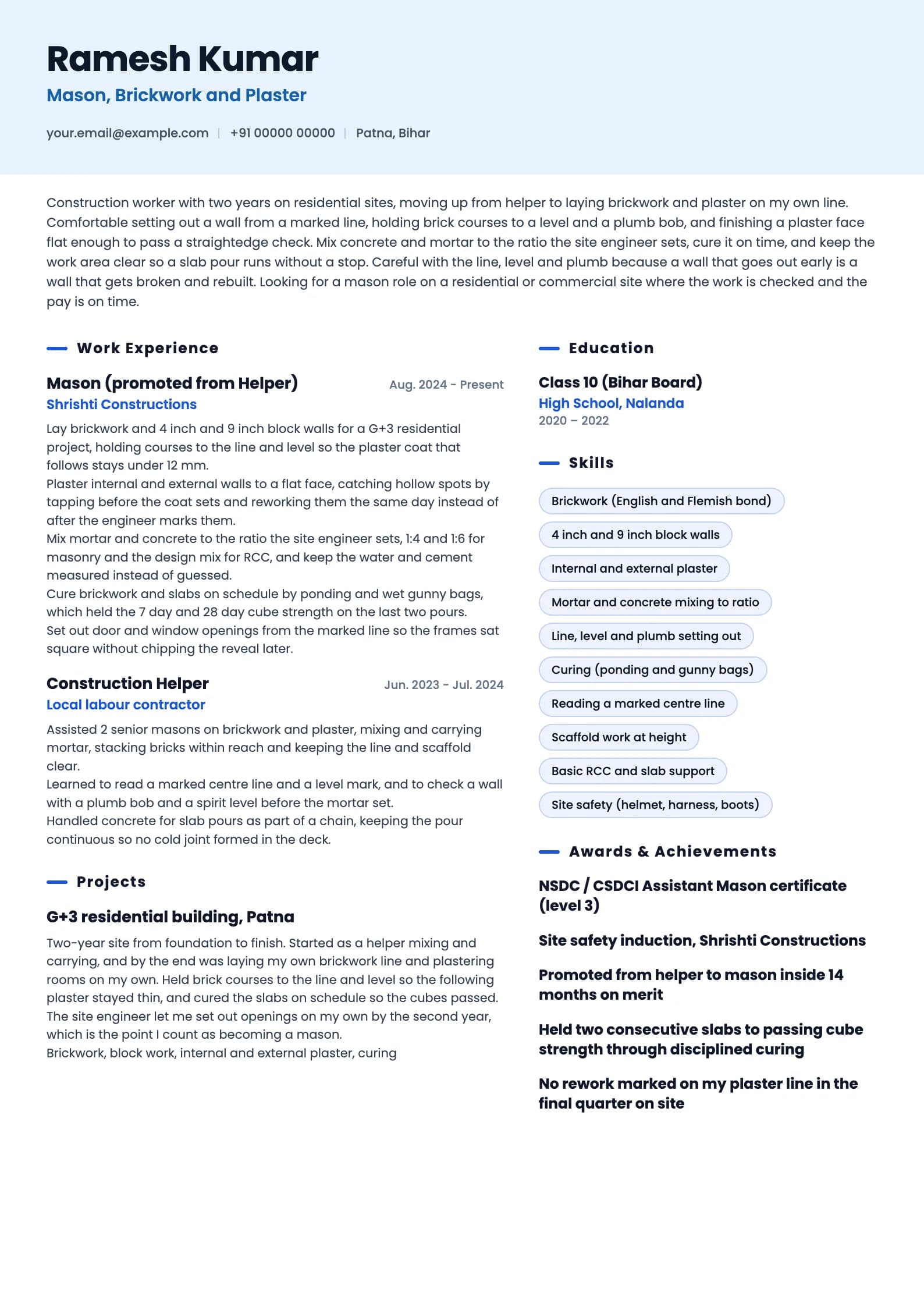
Mason Resume Format, with 3 Full Samples
A mason is hired on evidence of a wall that stands plumb, a plaster face that reads flat under a straightedge, and a slab handed over without a leak, yet most resumes write only building work and helper and forget the brickwork line held to a level, the concrete cube that passed at 28 days, and the crew that finished a floor a day ahead. Below are three complete resumes, one for a helper stepping up to mason with two years on site, one for a mason with eight years across brickwork, plaster and RCC, and one for a mason supervisor running a labour gang on a high-rise. After the samples come the format rules, the difference between listing skills and proving them, the certifications a contractor actually reads, and the mistakes that get a resume set aside before a site call.
Build my resumeMason resume example, Helper to Mason (2 years)
ai-era templateIs your resume good enough?
Upload the resume you have now and see what an applicant tracking system reads before a mason recruiter ever does.
Free to run. Sign in with your mobile number to see your score.
Mason resume example, Mason (8 years)
professional template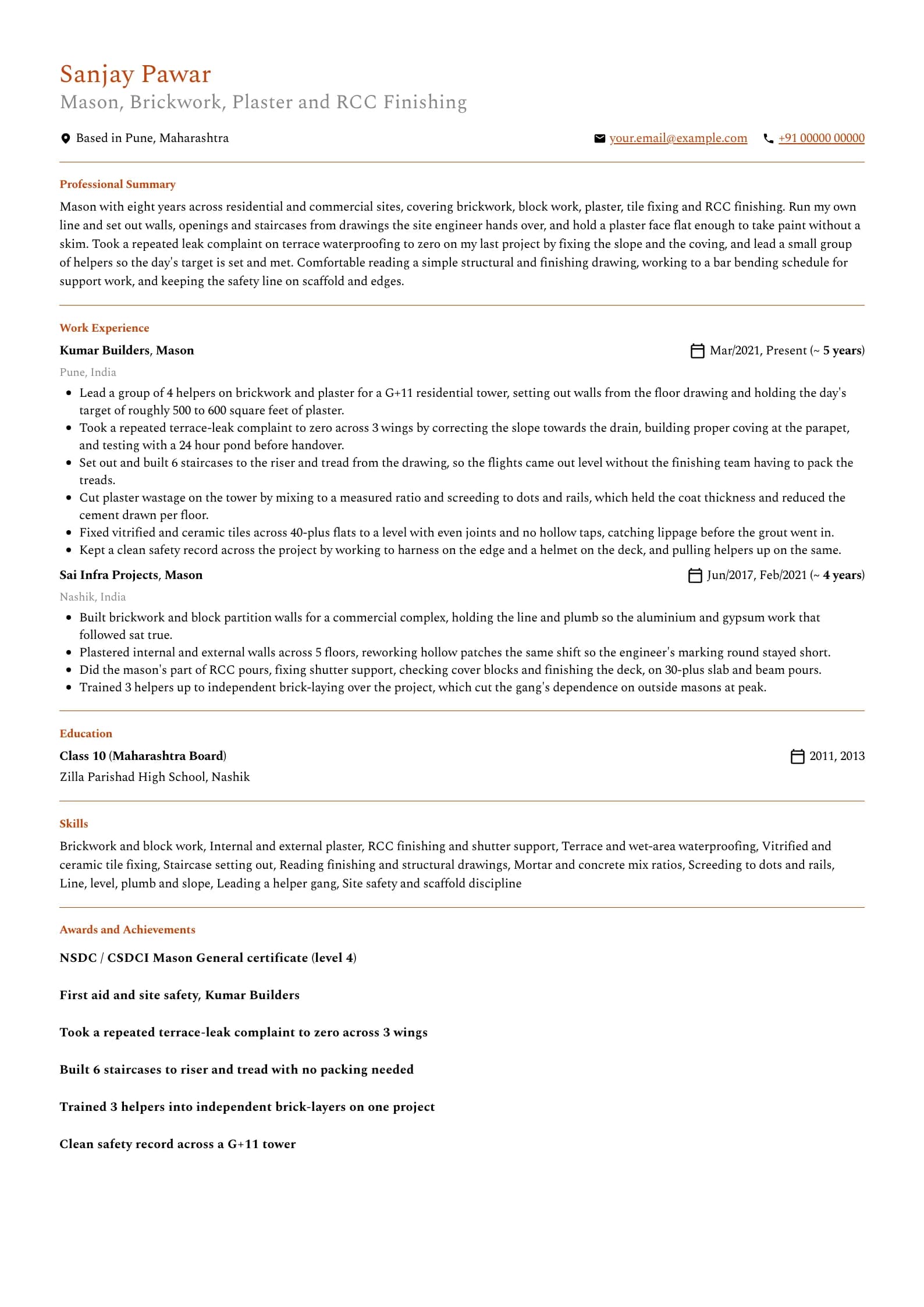
Want this structure with your own details? Build it in the resume builder.
Mason resume example, Mason Supervisor (16 years)
header-band template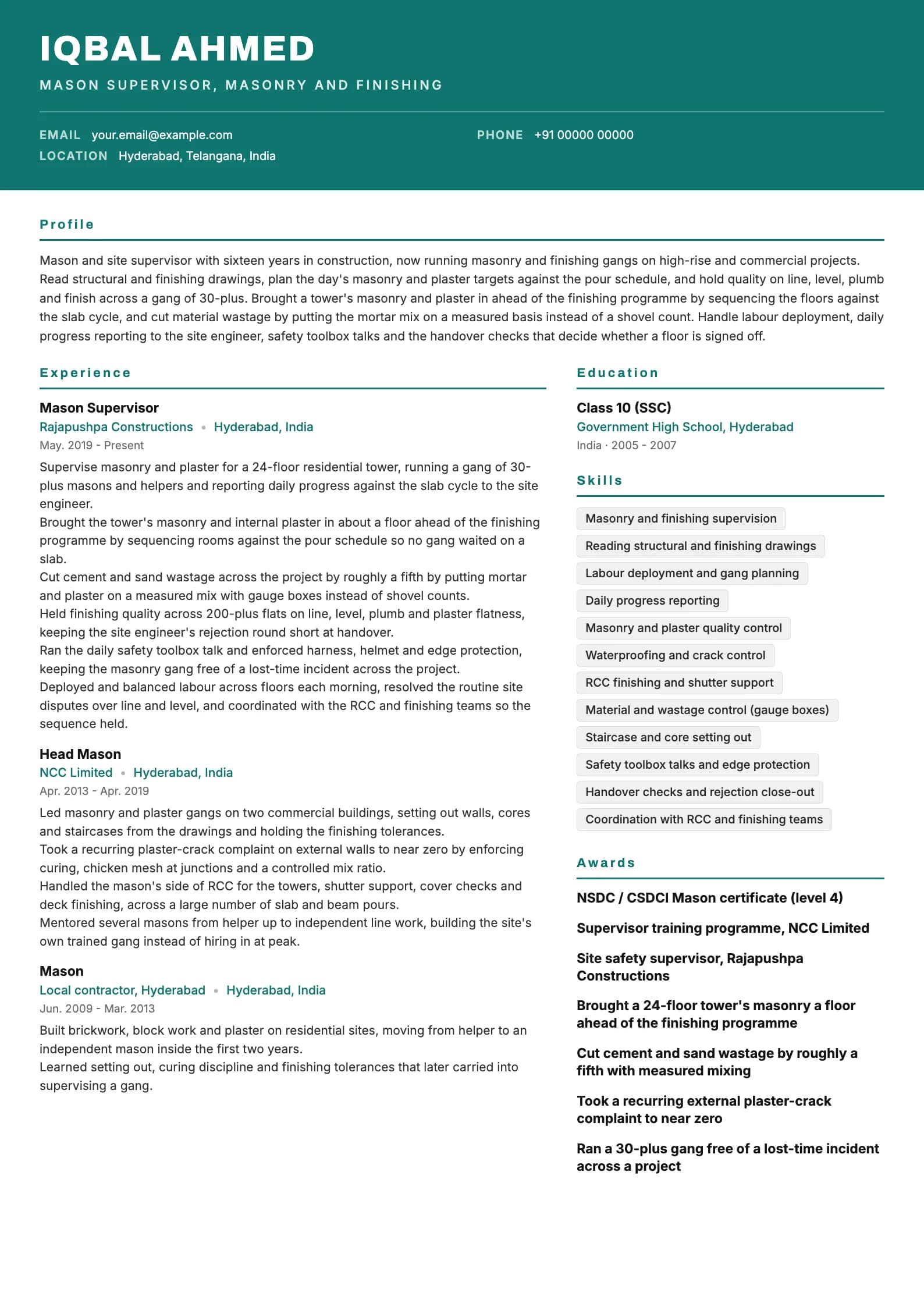
The format that works for mason resumes in India
Reverse chronological is the layout to use. Put your current or most recent site first, work backwards, and keep the dates in plain view. A mason's work history is a chain of sites and contractors, and a reviewer wants to read it in order, so grouping everything under Skills and dropping the dates reads as hiding a gap. If there is a gap because a project ended or work was seasonal, one honest line explains it better than a hidden one. Most mason resumes are one page, and that is the right length. A helper or a mason with a few years fits on one page easily. A mason supervisor with fifteen years can run to a second page only if it carries real project scope, gang sizes and quality numbers, not a longer list of the same skills. A page built from a declaration line and a hobby is padding. Contact details, a photo, date of birth, marital status and father's name do not belong on the page. This surface deliberately leaves the contact fields out and shows a placeholder, so no sample can ship a phone number, and you should follow the same rule. A site engineer or contractor calls the number on the top of the page and reads the work; the rest is wasted space. Name the file with your own name and the word mason, not resume_final. Keep it one column top to bottom, because a two-column sheet confuses both a parser and a person reading quickly on a phone at a site office. The table below sets the section order.
| Section | Where it goes | Why |
|---|---|---|
| Name and headline | Top, above everything | The headline is the trade, mason or mason supervisor. That is what a contractor matches on. |
| Summary | Directly under the header | Three or four lines. Years, the trades you cover, and one result. |
| Work experience | Next, most recent site first | Site, contractor, dates, and what you built and held. |
| Skills | Below experience | Grouped: masonry, finishing, tools, safety. Not one long line. |
| Certifications | After skills, or beside it if only one | NSDC or CSDCI trade certificate, safety induction, first aid. |
| Education | Bottom | Class 8, 10 or ITI. One line. It is not the deciding factor here. |
| Languages | Bottom | Useful on a mixed-labour site and for a supervisor briefing a gang. |
Listing brickwork is not the same as proving it
The most common mason resume failure is a skills line that reads brickwork, plaster, tiling, RCC, waterproofing, POP, painting with no line anywhere that shows any of it done to a standard. A contractor reads that wall and assumes it is padded, because the same seven words sit on every helper's page. The fix is to let the work prove the trade. If you write waterproofing, a bullet should describe the terrace or bathroom you sealed and how you knew it held, a pond test or a monsoon with no complaint. If you write plaster, a bullet should carry the tolerance you held or the rework you avoided. The mid-level sample lists waterproofing precisely because a bullet takes a leak complaint to zero with a slope fix, coving and a 24 hour pond test. The skills line and the experience agree, which is what makes both believable. Be specific with the mason's own numbers. A mason does not quantify in percentages, but the work has real measures: plaster thickness held under 12 mm, mortar mixed 1:4 and 1:6, cubes that passed at 7 and 28 days, square feet of plaster a day, floors kept ahead of a slab cycle. These read as a mason who works to a standard, not one who just turns up. Do not pad the trade list with everything you have ever touched once. If you fixed tiles on one site five years ago and never again, it is not a headline skill. List the trades you can be handed a wall in tomorrow and do well, because a contractor who tests a claimed skill and finds it thin sets the whole page aside.
For every trade on your skills line, ask: is there a bullet that proves I held it to a standard. If not, add the bullet or cut the trade. A wall of unproven trades helps nobody and costs you the moment a contractor tests one.
Writing a summary a contractor actually reads
The block under your name is the part most likely to be read before a call, so it should carry three things: how long you have been on the trowel, the trades you cover, and the single strongest result you can point to. Three or four lines, in plain words, no phrases a contractor cannot check. The old objective line, looking for a suitable position in a reputed company to utilise my skills, says nothing a contractor did not already assume. Replace it with a summary that states the work. A summary describes what you have already built and held; an objective describes what you want, and only the first is evidence on a site. A helper stepping up often thinks there is nothing to summarise. Look at the first sample: it states two years, the move from helper to an independent line, the tolerances held and the curing discipline that passed the cubes. That is a real summary built from two years on one site, not a claim. What it avoids is hardworking and sincere, words so common on these pages that a contractor's eye slides straight past them. A practical test: read your summary and ask whether any helper on your site could put it on their page unchanged. If they could, it describes the trade, not you. Add the specific site, the specific tolerance and the specific result until it only fits your own hands.
Summary, experienced mason
Weak
Hardworking and sincere mason with 8 years of experience in all types of building and construction work looking for a good position in a reputed company.
Strong
Mason with eight years across brickwork, plaster, tile and RCC finishing, running my own line and a small helper gang. Took a repeated terrace-leak complaint to zero by fixing the slope and coving and testing with a 24 hour pond.
The rewrite trades self-praise and all types of work for the specific trades covered, the scope of leading a gang, and one verifiable result a contractor can ask about.
Experience lines: what you built, held and handed over
Every strong line in the samples follows the same shape. It opens with what you did, names the specific work, wall, plaster, slab, staircase, terrace, and closes with the standard you held or the problem you fixed. The verb says you did it. The work tells a site engineer whether it is relevant. The measure does the persuading. Start from what was true at handover and work backwards. Masons usually write the task first, worked on plastering and brickwork, and then have nothing to attach. Instead ask what the site engineer could check after you finished: a plaster face that passed a straightedge, a terrace that held a pond, a staircase that needed no packing, cubes that passed, a floor kept ahead of the pour schedule. Then write the line that ends in that fact. Vary the measure. Plaster thickness, square feet a day, cube strength, a defect taken to zero, floors ahead of programme, wastage cut, a gang trained. A page that says finished the work five times reads as one line repeated. A page that moves across tolerance, schedule, cost and quality reads as range. Where there is no number, give scope: how many floors, how many flats, how big a gang, how long a project. Built brickwork and plaster across a G+11 tower carries weight without inventing a percentage. Give the current or biggest site the most lines, five or six. The site before it gets three or four. Older work gets one or two, or a single summary line.
| Level | What lines must prove | Typical measure |
|---|---|---|
| Helper to mason | You can lay and finish on your own line | Plaster tolerance, curing passed, openings set square |
| Mason (2 to 8 years) | You cover the finishing chain and hold quality | Defect taken to zero, floors done, tile lippage, wastage |
| Head mason | You set out and lead a small gang | Staircases built, helpers trained, rejection round short |
| Mason supervisor | You run a gang against the schedule and cost | Gang size, floors ahead of programme, wastage cut, safety |
Experience line, finishing work
Weak
Responsible for plastering and brickwork of the building as per company requirement and site engineer instruction.
Strong
Plastered internal and external walls across 5 floors to a flat face, reworking hollow patches the same shift so the engineer's marking round stayed short.
Responsible for reads as a job description; the rewrite names the work, the standard held and why the engineer had less to reject.
Experience line, waterproofing
Weak
Did waterproofing work on the terrace and bathrooms to stop water leakage problems.
Strong
Took a repeated terrace-leak complaint to zero across 3 wings by correcting the slope to the drain, building proper coving at the parapet, and testing with a 24 hour pond before handover.
Names the three fixes and the pond test, so a site engineer can ask a real question instead of nodding at a vague claim.
If a line would sit unchanged on any helper's page, it describes the trade, not you. Rewrite it until it only fits the wall, terrace or gang you actually worked.
The skills section: grouped, honest, and short enough to test
A mason's skills section has two readers. A contractor's clerk may run the sheet past a keyword filter, and wants literal terms, brickwork, plaster, RCC, waterproofing. A site engineer wants a short, organised list that tells him what he can hand you. Grouping serves both. Group by kind of work rather than one long line. Masonry, finishing, tools and safety is a grouping that fits almost every mason. The headings matter less than the fact that there is structure. Write the words the trade uses: RCC not concrete slab, plumb not straight, curing not water work, so a filter and an engineer both read them the way they expect. Eight to fourteen skills is the working range. Below eight the page looks thin. Above sixteen it stops being a signal and reads as everything I have ever seen on a site. The list is a promise: every trade on it is one a contractor can hand you a wall in on day one, so keep only the trades you can actually stand behind. Do not add star ratings or a proficiency bar. Nobody agrees what four stars in plaster means, and it invites an argument you cannot win on paper. Let the work lines carry the depth, and keep the skills list clean.
| Group | What goes in it | How many |
|---|---|---|
| Masonry | Brickwork, block work, stone, RCC finishing, shutter support | 3 to 5 |
| Finishing | Internal and external plaster, tile fixing, POP, waterproofing | 2 to 4 |
| Setting out | Line, level, plumb, slope, staircase, openings, drawings | 2 to 3 |
| Tools and materials | Trowel, float, plumb bob, spirit level, mix ratios, gauge box | 2 to 3 |
| Safety and gang | Helmet and harness, scaffold, toolbox talk, leading helpers | 1 to 3 |
Skills section
Weak
Skills: Brickwork, Plaster, Tiles, RCC, Waterproofing, POP, Painting, Carpentry, Plumbing, Electrical, Welding, Bar bending, Shuttering, Marble, Granite, All construction work
Strong
Masonry: brickwork, block work, RCC finishing. Finishing: internal and external plaster, vitrified tile fixing, terrace waterproofing. Setting out: line, level, plumb, staircases, reading finishing drawings. Safety: harness and helmet, scaffold, leading a helper gang.
Cuts the trades you do not really run, drops all construction work, and groups the rest so a site engineer reads in one pass what he can actually hand you.
Sites and project work: how to describe what you built
A mason does not list projects the way an office worker does, but naming the sites you built is exactly the same evidence. A site line should carry what the building was, what you did on it, and what you held or fixed. G+11 residential tower, led a 4-helper plaster gang, terrace leak taken to zero is a stronger site line than a longer one that only names the builder. The common failure is naming the contractor and nothing else. Worked at Kumar Builders for four years tells a reviewer nothing about the wall you can lay. Describe the building, the trades you ran on it, and the one thing that was genuinely hard or genuinely good: a staircase that came out level, a plaster face that took paint without a skim, a floor kept ahead of the pour. For a helper or a young mason, the site is the resume, the way projects are for a fresher in any trade. Describe the one big site you grew up on: what you started doing, what you were doing by the end, and the point at which the engineer trusted you with your own line. That progression is worth more than a list of five sites named without detail. If you have a photo of finished work, a plastered wall, a terrace, a staircase, that is a genuine work sample a contractor will look at. Keep a small set on your phone to show at the site call. The resume gets the interview; the photos and the trial day close it.
Site description, mason resume
Weak
Worked in Rajapushpa Constructions Hyderabad in building construction work for residential project.
Strong
24-floor residential tower, Rajapushpa Constructions: ran a 30-plus masonry and plaster gang, sequenced floors against the slab cycle to stay a floor ahead of the finishing programme, and held finishing across 200-plus flats.
Swaps a builder name and building construction work for the tower size, the gang, the sequencing win and the finishing scope a contractor can weigh.
Where education and certifications belong
Education goes at the bottom for a mason, and it is one line. Class 8, Class 10 or an ITI trade, the school or institute, and the years. Nobody is hired or rejected as a mason on a board percentage, so it does not lead and it does not need a mark unless you are very young and it is the only thing you have. Certifications matter more than schooling here, and they belong just below skills or beside them if you hold only one. The NSDC and CSDCI trade certificates, Assistant Mason and Mason at the skill-council levels, are worth naming because they are the formal proof of the trade and some organised contractors and overseas recruiters ask for them. Write the certificate, the level and the body. Safety credentials pull real weight, especially for high-rise and commercial work. A site safety induction, a first-aid card, a scaffold or work-at-height training, and for a supervisor a safety-supervisor course, all tell a contractor you will not be the reason for a stoppage. On an organised site a mason who works to harness and helmet is worth more than one who is slightly faster and cuts the safety line. An overseas Gulf recruiter will often ask for a trade test and a certificate, so if you hold an NSDC or CSDCI certificate or have passed a trade test, name it plainly. If a certificate has lapsed, renew it or leave it off; a lapsed safety card listed as current is easy to catch and reads as careless on the one topic a site cannot be careless about.
Getting past the filter and the site office
Not every mason job runs through software, but the organised builders, the overseas recruiters and the larger contractors increasingly do, and even a human clerk on a site office reads a sheet the same rough way. Both scan for the trade, the years, the certificates and the safety words, so the page has to make those easy to find. The layout rules are short. One column. Plain headings, so use Work Experience rather than My Journey, and Skills rather than What I Can Do. No text inside a photo or a logo, because it reads as blank. Keep the trade word, mason, near the top in the headline and again in the summary, because that is the first thing anyone searches on. On wording, use the words the job asks for where they are honest. If the posting says shuttering, write shuttering, not only formwork. If it says waterproofing, write waterproofing. Where a term has two names, put both once, for example RCC (reinforced cement concrete), so either search finds you. Do not stuff the page with every construction word in small text to beat a filter. A clerk reads it as padding and a site engineer tests one claim and finds it thin, which is worse than not listing it. Real work lines that name the trade in context carry the keyword and survive a human reading it too. If you send the resume as a file, save it as a PDF and open it once to check it reads cleanly on a phone, because most site people will open it there. A clean, plain page that loads fast and states the trade beats a decorated one that scrambles.
Section heading
Weak
My Building Life
Strong
Work Experience
A filter and a busy clerk look for the standard heading; a creative one can drop the whole block into a bucket nobody searches or reads.
Before you send it, open the file on a phone. If the trade, the years and the certificate are readable in the first few seconds, it will pass both the filter and the site office. If they are buried, move them up.
What gets mason resumes set aside
Most mason resumes that get set aside fail for a small set of reasons, and all of them are fixable in an evening. The list below covers what contractors and site engineers see most often on Indian mason resumes, in rough order of how much damage each does.
- A trade list with no line proving any of it held to a standard. Every trade you claim is one a contractor can test on a trial day.
- All construction work or all types of building work as the summary. It tells a contractor nothing about the wall you can actually lay.
- No measures anywhere. Plaster tolerance, cube strength, floors done, a defect fixed, wastage cut, a gang led. Pick whichever is honest.
- Only the contractor's name for each site, with no building, no trade and no result. Name what you built and held.
- A photo, date of birth, marital status or father's name taking the space a site or a certificate should have.
- No safety word anywhere for a high-rise or commercial applicant. Harness, helmet, toolbox talk and a first-aid card matter on an organised site.
- A generic objective line. Replace it with a summary that states years, trades and one result.
- Padding the trade list with plumbing, electrical and welding you touched once, which a site engineer sees through and tests.
- Dates and site names that do not hold together, since organised contractors and overseas recruiters check references and a mismatch ends it.
- A decorated two-column sheet that scrambles on a phone, where most site people will actually open it.
Read your resume as if you were the contractor about to put you on a trial day. Any trade you would not want tested tomorrow is a line to cut or prove.
Skills to put on a mason resume
Technical
- Brickwork (English and Flemish bond)
- Block work (4 inch and 9 inch)
- Internal and external plaster
- RCC finishing and shutter support
- Terrace and wet-area waterproofing
- Vitrified and ceramic tile fixing
- Staircase and core setting out
- Mortar and concrete mix ratios
- Screeding to dots and rails
- Curing discipline
- Reading finishing and structural drawings
- Line, level, plumb and slope
Tools and platforms
- Trowel and float
- Plumb bob and spirit level
- Straightedge and dots
- Gauge box for mixing
- Line and pins
- Tile cutter and spacer
- Concrete mixer
- Scaffold and staging
- Vibrator (RCC pours)
- Measuring tape and marking
Working skills
- Leading a helper gang
- Daily progress reporting
- Coordinating with site engineer
- Labour deployment
- Quality and rejection control
- Safety discipline and toolbox talks
- Material and wastage control
- Reliability and attendance
- Resolving on-site disputes
Certifications worth listing as a mason
| Certification | Full name | Worth it for |
|---|---|---|
| CSDCI Assistant Mason | Construction Skill Development Council of India, Assistant Mason (level 3) | The entry trade certificate for a helper moving up to mason, worth it for a young worker who needs formal proof of the trade for an organised contractor or an overseas trade test. Once you have years of site work and a mason-level certificate, it becomes redundant. |
| CSDCI Mason | Construction Skill Development Council of India, Mason General (level 4) | The mason-level skill-council certificate, worth it for a mason applying to organised builders or planning Gulf work where a certificate and a trade test are asked for. Most valuable in the early-to-mid career range; a supervisor with a long site record leans on the record more than the badge. |
| NSDC / RPL | National Skill Development Corporation, Recognition of Prior Learning | A route for an experienced mason with no formal certificate to get the trade recognised on paper through an assessment. Worth it if you have years of real work but nothing to show a formal recruiter, since it turns experience into a credential they accept. |
| Work-at-height | Work-at-height and scaffold safety training | Worth it for any mason on high-rise or commercial sites, where organised contractors require it before you go on the edge. It signals you will not be the cause of a stoppage, which on a safety-audited site is worth as much as speed on the trowel. |
| First Aid | Basic first-aid and site-safety certificate | A small, quick credential that carries weight for supervisors and gang leaders, since a contractor wants someone on the floor who can handle the first minutes of an incident. Pairs naturally with a safety induction on any organised project. |
Keywords an ATS scans for in a mason resume
These are the literal terms a parser matches against the job description. Use the ones that are true of you, in the sentences where you did the work, not as a list at the bottom.
- mason
- brickwork
- block work
- plaster
- RCC
- shuttering
- waterproofing
- tile fixing
- curing
- line and level
- plumb
- mortar mix
- staircase
- site work
- mason supervisor
- labour gang
- safety
- helper
- reading drawings
- handover
Mason resume FAQ
What salary can a mason expect in India?
A helper moving into masonry usually earns around 500 to 750 rupees a day, roughly 15,000 to 22,000 a month with regular work. An experienced mason with brickwork, plaster and finishing skill commonly earns 800 to 1,200 a day, about 22,000 to 35,000 a month, more in metros and on organised sites. A head mason or mason supervisor running a gang typically sits in the 35,000 to 60,000 a month band, and Gulf mason contracts with a trade test pay well above domestic rates. Waterproofing, tile finishing and drawing-reading skill, plus a safety and NSDC certificate, push the top of every band upward.
How long should a mason resume be?
One page for a helper or a mason with up to about ten years. A mason supervisor with a long record can run to a second page only if it carries real project scope, gang sizes and quality numbers rather than a longer skills list. Nobody is set aside for a resume that was easy to read on a phone. If you are struggling to fit a page, cut the oldest site to one line and drop any trade you would not want tested on a trial day.
I have never made a resume. What do I even put on it?
Put your name and the word mason at the top, then three or four lines saying how many years you have been on the trowel and which trades you cover. Below that, list your sites, most recent first, and for each one write the building, what you did and one thing you held or fixed. Add your skills grouped by kind of work, any NSDC, CSDCI or safety certificate, and your schooling in one line. That is a complete mason resume; the detail is what separates it from every other helper's page.
Do I need a certificate to work as a mason?
For day-to-day site work through a contractor, no; the trial day and your reputation matter most. But an NSDC or CSDCI trade certificate helps with organised builders, and it is often required for a Gulf trade test where a certificate plus an on-site test decides the contract. If you have years of experience but no certificate, the NSDC Recognition of Prior Learning route can turn that experience into a credential a formal recruiter accepts.
How does a helper show they are ready to be a mason?
Show the progression on the page. State the site you grew up on, what you started doing as a helper, what you were doing by the end, and the point the site engineer trusted you with your own line. Back it with the mason's own measures: plaster held flat, cubes that passed after your curing, openings set square. A promotion from helper to mason on a real site, with dates, is the single strongest thing a young worker can put on the page.
Should I list every construction trade I have touched?
No. List only the trades a contractor can hand you a wall in tomorrow and trust the result. A mason who claims plumbing, electrical, welding and painting alongside masonry reads as padded, and a site engineer tests one claim on a trial day. Keep to your real trades, brickwork, plaster, RCC, tile, waterproofing, and let a work line prove each one. A short list you can stand behind beats a long one that falls over on the first test.
Do safety certificates actually help a mason get hired?
On organised high-rise and commercial sites, yes, and increasingly so. A work-at-height or scaffold-safety card and a first-aid certificate tell an audited contractor you will not be the cause of a stoppage, which is worth as much as speed. For a supervisor, a safety-supervisor course is close to expected. On these sites a mason who works to harness and helmet is preferred over one who is slightly faster and cuts the safety line.
How do I write a mason resume for a Gulf job?
Keep it plain, in English, one page, and lead with the trades an overseas contractor tests, brickwork, block work, plaster and finishing. Name any NSDC or CSDCI certificate and any trade test you have passed, since Gulf recruiters ask for both a certificate and an on-site test. State your years, your best sites with the building type, and your safety training. Avoid photos and personal details; the recruiter wants the trade, the certificate and the test result, and a clean page that shows those moves fastest.
Should I put a photo of my finished work on the resume?
Not on the resume itself, but keep a small set of photos on your phone for the site call. A plastered wall reading flat under a light, a level staircase, a sealed terrace, these are genuine work samples a contractor will look at and they close a trial-day decision. The resume gets you the call and states the trade; the photos and the trial day prove the hands. Do not put your own photograph on the page, only the work.
Related resume examples and guides
Build your own mason resume in any of these formats
Start from a blank page or the details you already have. Goodspace lays your sites, trades and certificates out in a clean single-column format that reads on a phone at a site office, and flags the brickwork, plaster and safety keywords a contractor scans for.
Build my resume