Carpenter Resume Format, with 3 Full Samples
A carpenter is hired on evidence of joints that stay tight, a finish that reads clean under a light, and a fit-out handed over on time, yet most resumes list wood and furniture and forget the modular kitchen, the site shuttering and the veneer that matched across a wall. Below are three complete resumes, one for an ITI fresher, one for a carpenter with six years across furniture and site work, and one for a senior carpenter running a fit-out crew. After the samples come the format rules, the difference between listing skills and proving them, the certifications a contractor actually reads, and the mistakes that get a resume set aside before a callback.
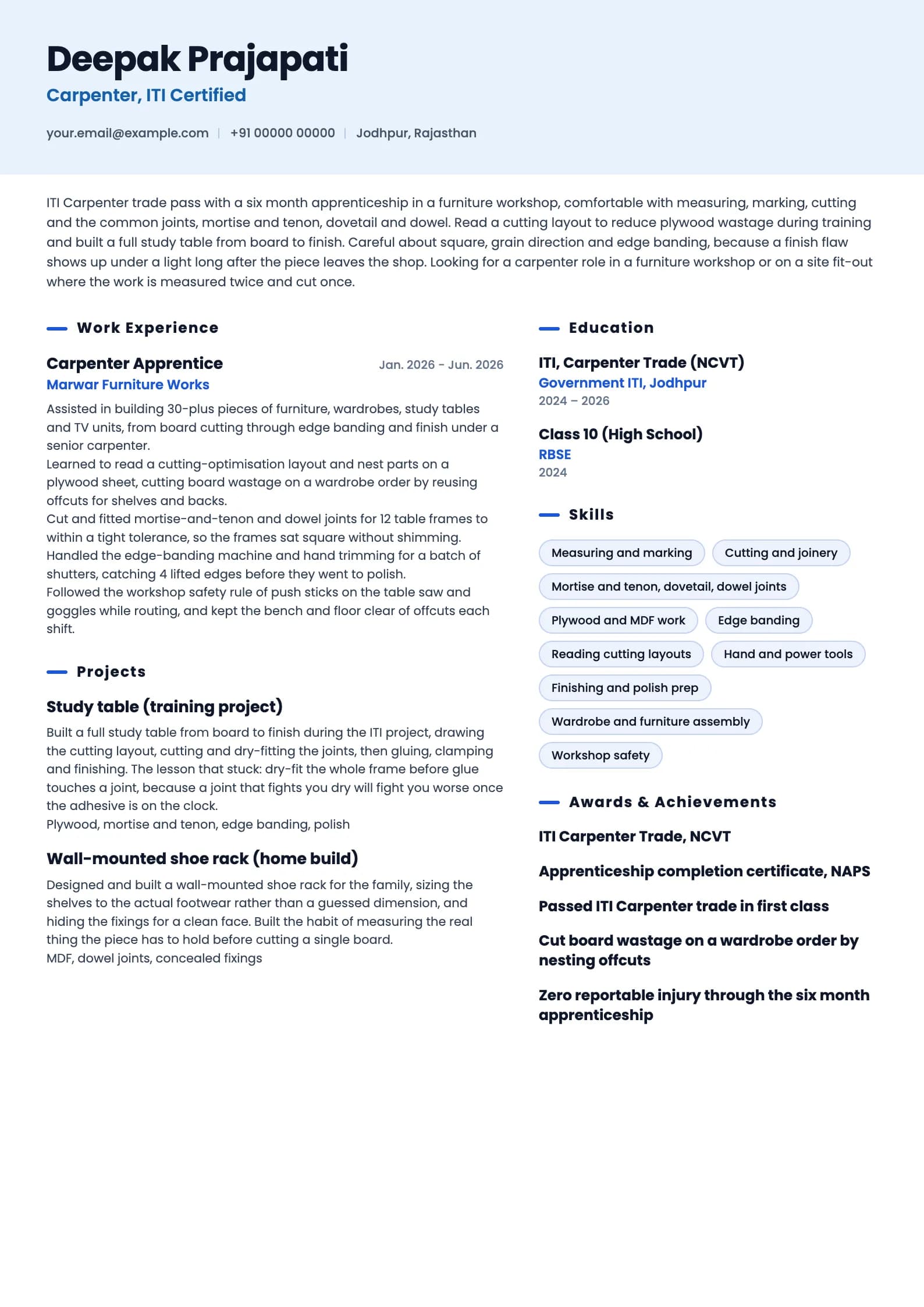
Build my resumeCarpenter resume example, Fresher (ITI, 0 years)
ai-era templateIs your resume good enough?
Upload the resume you have now and see what an applicant tracking system reads before a carpenter recruiter ever does.
Free to run. Sign in with your mobile number to see your score.
Carpenter resume example, Mid-level (6 years)
modern template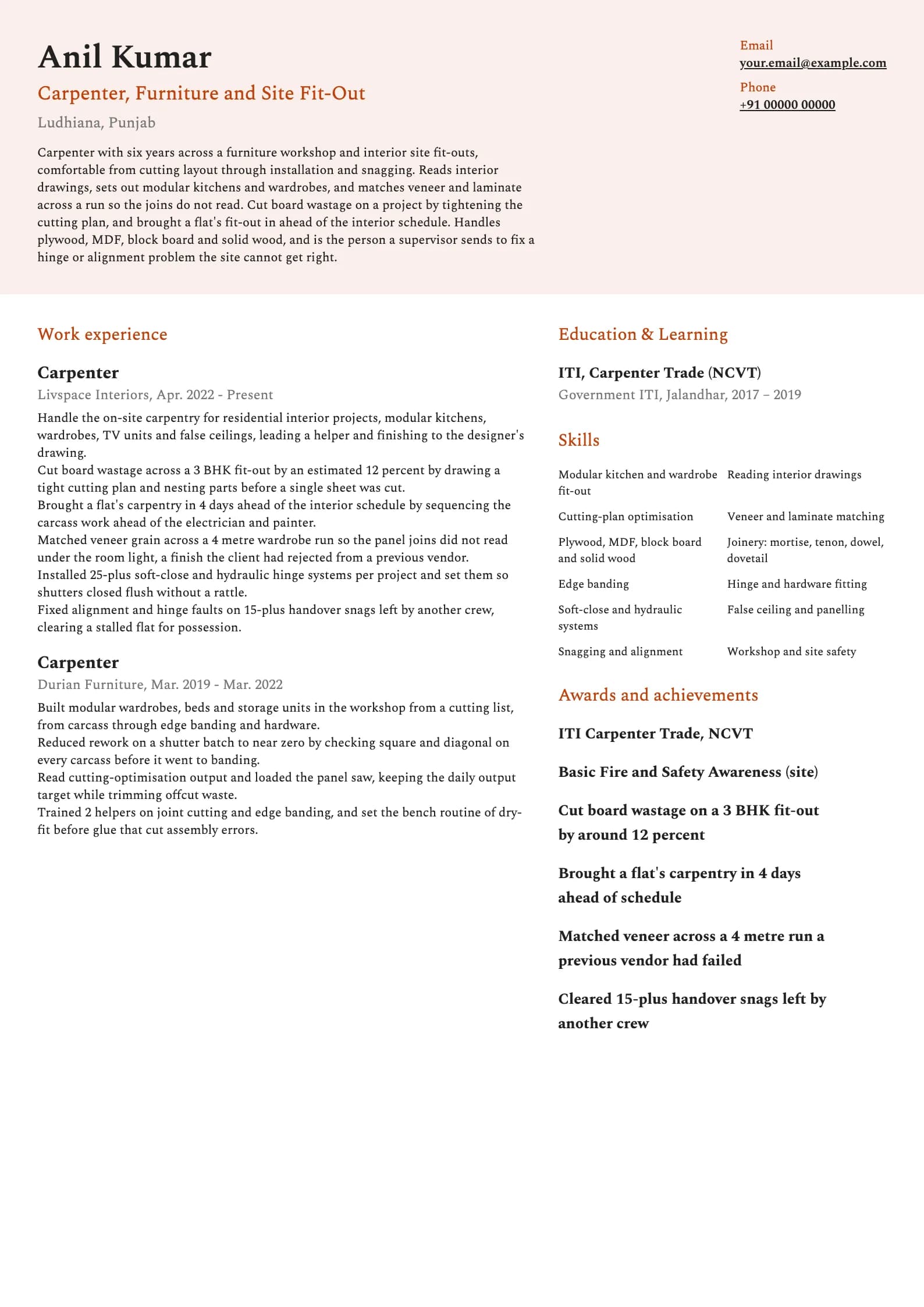
Want this structure with your own details? Build it in the resume builder.
Carpenter resume example, Senior (14 years)
header-band template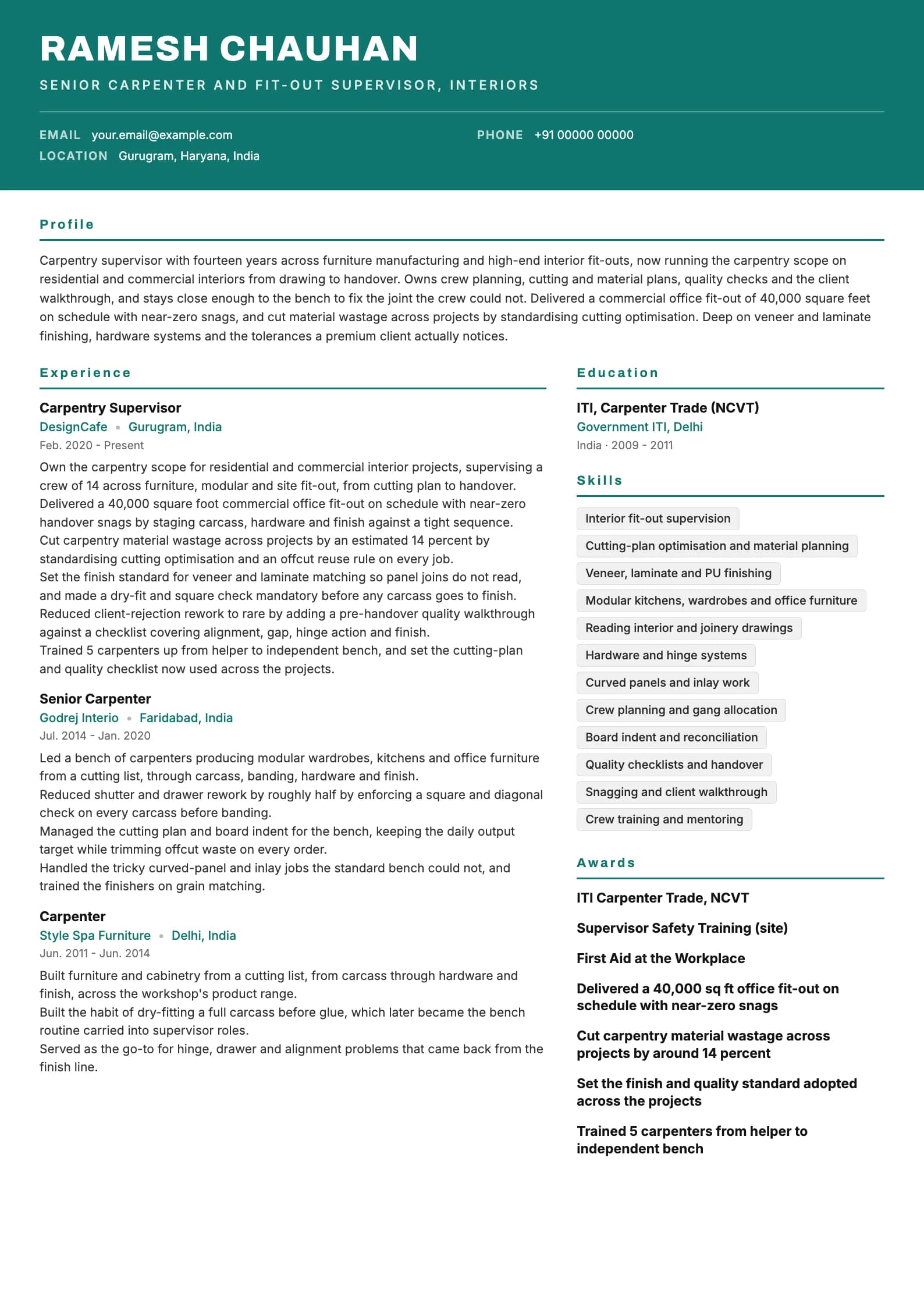
The format that works for carpenter resumes in India
Reverse chronological is the layout to use. Put the most recent workshop or contractor first, work backwards, and keep the dates visible. A carpenter's page is read for where you have worked and what you have finished, so hiding the timeline reads as hiding a gap. If there is a gap, one honest line explains it better than a rearranged page. One page is enough for almost every carpenter, including a supervisor with over a decade behind them. A contractor or interior firm skims the page in under a minute, so the projects, the materials and finishes you know, and your safety record need to sit at a glance, not spread over two pages. Four things belong nowhere on the page: a photograph, date of birth, marital status and father's name. They come from an old campus template and add nothing an interior contractor is looking for. Every line they take is a line a project or a skill could have used. Lead the header with the role you want, Carpenter, and if it fits, the kind of work, furniture or interior fit-out. Below that, three lines of summary: your trade credential, your years, and the strongest thing you have delivered. Then projects or experience, then skills, then ITI and certifications. The table below sets out the order.
| Section | Where it goes | Why |
|---|---|---|
| Name and headline | Top, above everything | The headline is the role, Carpenter. A contractor matches on it in one glance. |
| Summary | Directly under the header | Three lines. Trade credential, years, and the strongest delivery. |
| Work experience | Next, for anyone with a workshop or site behind them | Most recent employer first, with the work type and materials. |
| Projects | Above experience for a fresher, below it after that | For an ITI fresher the apprenticeship or a built piece is the evidence. |
| Skills | Below experience | Grouped: joinery, materials, finishing, hardware. Not a 30-item wall. |
| Education and ITI | Near the top for a fresher, lower once you have work | ITI Carpenter trade, board, year. The credential a contractor scans for. |
| Certifications | After education, or beside skills if only one or two | Safety training, first aid, any finishing course. Name and issuer. |
Listing skills is not the same as proving them
The most common carpenter-resume failure is a skills line that reads carpentry, furniture, wardrobe, plywood, MDF, cutting, joinery, polish, hardware with no line anywhere that shows any of it on a real piece. A contractor reads that wall and cannot tell a helper who has held the tools from a carpenter who has finished a fit-out a client accepted. The fix is to let the experience prove the skill. If you write veneer matching on the skills line, a bullet should say where you matched grain across a run and why it mattered. If you write cutting optimisation, a bullet should describe the wastage you cut and how. The mid-level sample lists veneer matching precisely because a bullet shows a 4 metre wardrobe run whose joins did not read, which a previous vendor had failed. The skill and the work agree, and that is what makes both believable. Be specific about materials and work types. Writing furniture workshop and interior site fit-out tells a contractor the range you have worked, which matters because a modular-kitchen fit-out on a live site is not the same job as a bench in a workshop. Name the materials you have actually worked, plywood, MDF, block board, solid wood, veneer, laminate, not every board you have heard of. Do not pad with things that are not carpentry. A list that folds in painting, tiling and general site labour reads as someone who has not specialised. An interior firm wants a carpenter who owns the carpentry scope, so keep the page to the trade.
For every skill on your line, ask: is there a bullet that shows me doing it on a real piece. If not, either add the bullet or cut the skill. A wall of unproven trade words helps nobody read your page.
Writing a summary a contractor actually reads
The block under your name is the part most likely to be read, so it should carry three facts: what you build, how long you have been on the tools, and the strongest thing you have delivered. Three or four lines, no adjectives a workshop cannot check. The old objective line, seeking a suitable position in a reputed company to utilise my carpentry skills, tells a contractor nothing they did not already assume. Replace it with a summary. An objective says what you want, a summary says what you have already finished, and only one is evidence. Freshers often think they have nothing to summarise. Look at the fresher sample: it names the ITI trade, the apprenticeship length, the pieces built, the joints, and the one habit that matters, dry-fitting before glue. That is a real summary built from an ITI course and one workshop stint. What it avoids is hardworking and dedicated, words that appear on every page and carry no information. A practical test: read your summary and ask whether another ITI carpenter from your batch could paste it onto their page unchanged. If they could, it describes the trade, not you. Add the specific piece, the specific finish and the specific delivery until it only fits you.
Summary, mid-level carpenter
Weak
Hardworking and dedicated carpenter with 6+ years of experience in all types of wood and furniture work seeking a good position in a reputed company.
Strong
Carpenter with six years across a furniture workshop and interior site fit-outs, comfortable from cutting layout through installation. Cut board wastage on a project by tightening the cutting plan and matched veneer across a run a previous vendor had failed.
The rewrite trades a vague self-description for the work types and two things actually delivered.
Experience bullets: verb, work, result
Every strong bullet in the samples follows the same shape. It opens with an action verb, names the specific piece or fit-out you built, and closes with what measurably changed. The verb says you did it. The material and work type tell a contractor whether it is relevant. The number does the persuading. Start with the result and work backwards. Carpenters usually write the task first, then cannot attach a number, which produces lines like "did furniture work in the workshop". Instead ask what was different after you finished: a run of veneer that matched, a fit-out that beat the schedule, wastage cut, rework halted, a snag list cleared. Then write the sentence that ends in that fact. Vary the number. Pieces built, wastage percentage, days ahead of schedule, hinges set, snags cleared, rework cut. Reaching for different measures across the page reads as range rather than one figure repeated. Where you lack a number, give scope: how many pieces, how big a fit-out, what materials, what work type, how big a crew. "Handle the carpentry for residential interiors, leading a helper, finishing to the drawing" carries weight without inventing a percentage. Allocate bullets by recency. Current or last employer gets five or six, the one before four or five, anything older two or three.
| Level | What bullets must prove | Typical number |
|---|---|---|
| Fresher (ITI) | You can build a real piece under a senior and it holds square | Pieces built, joints cut, edges caught, wastage saved |
| 1 to 4 years | You build and finish a piece without close supervision | Pieces per day, rework cut, hinges set, wastage |
| 5 to 8 years | You own the carpentry on a fit-out, helper and all | Fit-out size, schedule beaten, wastage cut, snags cleared |
| 9 years and up | You supervise and set the finish and quality standard | Project size, rejection rework, material wastage, crew trained |
Experience bullet, site carpenter
Weak
Responsible for making all types of furniture and doing carpentry work as per the requirement of the client.
Strong
Brought a flat's carpentry in 4 days ahead of the interior schedule by sequencing the carcass work ahead of the electrician and painter.
"Responsible for" describes a job title; the rewrite names what was sequenced and the time it saved.
Experience bullet, finish work
Weak
Did polishing and finishing work on wardrobes and other furniture items in the workshop.
Strong
Matched veneer grain across a 4 metre wardrobe run so the panel joins did not read under the room light, a finish the client had rejected from a previous vendor.
Names the exact finish, the scale and the fact a vendor before you failed at it, so a contractor can picture the standard.
If a bullet would read identically on any helper's page, it is describing the trade, not you. Rewrite it until it only fits the piece you actually finished.
The skills section: grouped, honest, and short enough to defend
A carpenter's skills section has two readers. A contractor or interior firm wants a short, organised list that shows what kind of carpenter you are. Some larger firms also run resumes through a keyword filter that wants literal terms, veneer and modular and edge banding. Grouping satisfies both. Group by function rather than one long line. Joinery, materials, finishing, and hardware is a grouping that works for almost every carpenter. The exact headings matter less than the fact that structure exists. Write the material and process names the way workshops write them, MDF not mdf, edge banding not beading when you mean banding. Ten to sixteen skills is the working range. Below eight the section looks thin. Above twenty it stops being a signal and starts reading as padding, especially when it folds in general site labour that is not the carpentry trade. Every item on the line is something you have agreed to demonstrate if a contractor hands you a board and a drawing. Do not include a star rating or a percentage bar. Nobody agrees what four stars in joinery means, and it invites an argument you cannot win. Let the experience prove the depth instead.
| Group | What goes in it | How many |
|---|---|---|
| Joinery | Mortise and tenon, dovetail, dowel, biscuit, carcass work | 3 to 5 |
| Materials | Plywood, MDF, block board, solid wood, veneer, laminate | 3 to 5 |
| Finishing | Edge banding, polish prep, PU, veneer and grain matching | 2 to 4 |
| Hardware and install | Hinges, soft-close, hydraulics, drawer channels, fitting | 2 to 4 |
| Reading and safety | Interior drawings, cutting plans, workshop and site safety | 2 to 3 |
Skills section
Weak
Skills: Carpentry, Furniture, Wardrobe, Plywood, MDF, Wood, Cutting, Joinery, Polish, Hardware, Painting, Tiling, POP, False ceiling, Electrical, General labour, Hard working, Punctual
Strong
Joinery: mortise and tenon, dovetail, dowel, carcass work. Materials: plywood, MDF, block board, veneer. Finishing: edge banding, PU, veneer matching. Hardware: soft-close hinges, hydraulics, drawer channels. Reading: interior drawings, cutting plans.
Cuts the non-carpentry labour and the character words, groups the trade so a contractor reads it in one pass, and keeps only what you can demonstrate.
Projects and work: what to include and how to describe it
For an ITI fresher, projects and the apprenticeship are the resume. They sit above experience, they get the most space, and they are where a contractor decides whether you can actually build or only pass the trade test. For an experienced carpenter the work moves into the experience section and any project entries shrink to a piece that showed a skill the day job did not. The common failure is naming the piece instead of the work. "Made a wardrobe" tells a contractor nothing, because thousands of pages carry that line. Describe what you built, in what material, and what was genuinely hard. The study table in the fresher sample is a stronger entry than a bigger piece named without detail, because it states the joints, the process and the one lesson that stuck. Pick work that shows range rather than the same piece three times. One built from board to finish, one that shows a finish such as veneer matching, and one with a genuinely tricky element such as a curve or an inlay is a stronger set than three identical wardrobes. Two well-described pieces beat five listed by name only. If a piece or a fit-out was accepted by a client with a high standard, say so plainly. A finish a demanding client signed off is a work sample a contractor trusts, because someone paying for quality accepted it.
Project line, fresher resume
Weak
Study Table: made a study table as part of the ITI project using plywood and other materials.
Strong
Study table (training project): built from board to finish, drawing the cutting layout, cutting and dry-fitting the mortise-and-tenon joints, then gluing, clamping and finishing so the frame sat square without shimming.
Swaps a name and a material list for the joints, the process and the habit that keeps a frame square.
Where ITI and certifications belong
For a carpenter, the ITI Carpenter trade is the credential a contractor scans for, so it sits near the top for a fresher and moves lower, but never disappears, once you have work behind you. Write the trade, whether it is NCVT or SCVT, the ITI and the year. That is the whole entry for most people. Keep the ITI percentage while you are a fresher and it is good, because early screening still reads it. Once you have a few years of work, the percentage matters far less than the pieces and fit-outs you have delivered, so let the projects lead and keep the ITI as a line. Apprenticeship and NAPS completion is worth naming for a fresher, because it proves supervised bench time on top of the trade course. Class 10 and Class 12 are worth a single line each and nothing more once you hold the ITI. Certifications sit just below education. Safety training, first aid, and any finishing or modular-furniture course carry weight, because a carpenter who has cleared a safety course is one a contractor can put on a live site without a second thought. Name the training and who ran it. An expired first-aid card listed as current is an easy thing to catch, so renew it or drop it.
Getting past the filter and the contractor
Larger interior firms and staffing agencies increasingly collect carpenter resumes through a portal that stores and searches them, so a resume has two readers: a keyword filter and the contractor or project manager who shortlists. Almost every filter problem is a layout problem, not a wording one. The layout rules are short. One column. Standard headings, so use Work Experience rather than My Projects Journey, and Skills rather than My Expertise. No text inside an image, because a photo of a finished wardrobe with your name across it reads as empty space. Keep your name, the role and the key facts in the body of the page, not tucked into a header or footer strip some parsers drop. On wording, use the terms a posting uses, where they are honest. If the job says modular, write modular. If it says veneer or laminate, and that is your work, write it. Spell out a credential in full at least once, ITI Carpenter trade, NCVT, so both the short and long form get found. Stuffing keywords does not work. A hidden block of every material and every furniture type helps nobody, because the contractor who reads the page sees straight through it. Write real bullets that naturally contain the right terms, because a bullet about matching veneer across a 4 metre run contains veneer, wardrobe and the scale in a context that survives a human read too. Save and send a PDF unless the posting asks for a Word file, and name it with your own name and the word carpenter rather than resume final. Open the PDF once and confirm you can select and copy a line of text, because whatever you cannot select, the filter cannot read either.
Section heading
Weak
My Furniture Journey
Strong
Work Experience
A filter looks for standard headings; a creative one can push the whole block into a bucket the contractor never searches.
Test your own file before you send it. Copy the text out of the PDF into a plain notes app. Whatever reads there is roughly what the filter sees, and anything scrambled is a real risk.
What gets carpenter resumes set aside
Most rejections at the resume stage are not close calls. They come from a small set of recurring problems, and all of them are fixable in an evening. The list below covers what contractors and interior firms reviewing Indian carpenter resumes see most often, in rough order of how much damage each one does.
- A wall of trade words with no bullet showing any of it on a real piece. Every skill is a claim you have agreed to demonstrate.
- Duties copied off a job description instead of what you finished. "Responsible for all carpentry work" is the tell.
- No numbers anywhere. Pieces built, wastage cut, schedule beaten, snags cleared. Pick whatever is honest.
- Folding in painting, tiling and general labour, which reads as someone who never specialised in the trade.
- No ITI trade or safety training shown, when those are the first two things a contractor scans for.
- A photo, date of birth, marital status or father's name, which belong on no trade resume and take a project's space.
- No work types or finishes named, so a contractor cannot tell veneer and modular fit-out from a single rough bench job.
- A generic objective line. Replace it with a summary that states trade, years and one delivery.
- Nothing about finish quality or a clean snag record, which is what a premium interior client is actually buying.
- Inflated years or employer names that do not match your experience letters. Reference checks are routine and a mismatch ends it.
Read your resume aloud once before sending it. Anything you would not want to say to a project manager's face is a line to cut or rewrite.
Skills to put on a carpenter resume
Technical
- Joinery: mortise, tenon, dovetail, dowel
- Carcass and frame construction
- Modular kitchen and wardrobe fit-out
- Plywood, MDF, block board and solid wood
- Veneer and laminate matching
- Edge banding
- PU and polish finishing
- Hinge and hardware fitting
- Soft-close and hydraulic systems
- False ceiling and panelling
- Reading interior and joinery drawings
- Cutting-plan optimisation
Tools and platforms
- Panel and table saw
- Router and trimmer
- Edge-banding machine
- Planer and jointer
- Chisel and mallet set
- Cordless drill and driver
- Jigsaw and circular saw
- Clamps and vices
- Measuring and marking tools
- Sander
Working skills
- Crew supervision
- Reading drawings
- Attention to finish
- Problem diagnosis
- Safety discipline
- Time and schedule management
- Material accountability
- Handover and snagging
- Training helpers
Certifications worth listing as a carpenter
| Certification | Full name | Worth it for |
|---|---|---|
| ITI Carpenter (NCVT) | Industrial Training Institute, Carpenter Trade, National Council for Vocational Training | The core trade credential every carpenter resume should carry, and the first thing a contractor or interior firm scans for. Essential for a fresher and worth keeping visible even for a supervisor, since it is the recognised proof of the trade. The SCVT variant is the state-council equivalent and reads the same to an employer. |
| NAPS Apprenticeship | National Apprenticeship Promotion Scheme completion certificate | Worth naming for a fresher or an early-career carpenter, because it proves supervised bench time on top of the ITI course. Most valuable in the first two years when an employer is deciding whether you have actually held the tools. Once you have your own body of work, the pieces themselves carry it. |
| Fire and Safety Awareness | Basic Fire and Safety Awareness training | A practical signal on any interior or construction resume, since a carpenter works with power tools and on live sites where safety is the first thing a contractor cares about. Worth doing at any level, and often required for a safety induction before you can work on a large firm's site. |
| First Aid | First Aid at the Workplace certification | A useful add for a carpenter moving into a charge-hand or supervisor role, where being the person who can respond to a power-tool injury on the bench or the site is part of the job. Low effort, and it pairs well with the safety training large interior firms already expect. |
Keywords an ATS scans for in a carpenter resume
These are the literal terms a parser matches against the job description. Use the ones that are true of you, in the sentences where you did the work, not as a list at the bottom.
- carpenter
- iti carpenter
- joinery
- modular kitchen
- wardrobe
- plywood
- mdf
- veneer
- laminate
- edge banding
- furniture
- interior fit-out
- hardware fitting
- soft-close hinges
- cutting plan
- finishing
- false ceiling
- site safety
- handover
- snagging
Carpenter resume FAQ
What salary can a carpenter expect in India?
An ITI fresher in a furniture workshop or on an interior site typically starts around 12,000 to 18,000 rupees a month, higher in metros and with premium interior firms. A carpenter with five to eight years running a fit-out usually earns 22,000 to 42,000 a month, and a carpentry supervisor on high-end interiors commonly sits at 45,000 to 75,000 and more. Skilled finish work such as veneer matching, curved panels and inlay, and overseas contracts, push the top of every band well above the domestic figure.
How long should a carpenter resume be?
One page. A contractor or interior firm skims the page in under a minute, so the pieces and fit-outs you have finished, the materials and finishes you know, and your safety record all need to sit at a glance. If you are struggling to fit one page, cut the oldest employer to a single line and drop any skill you would not want to be tested on with a board and a drawing in front of you.
Do I need an ITI to put on a carpenter resume?
An ITI Carpenter trade is the credential a contractor scans for first, and it makes shortlisting far easier, so put it near the top if you have it. That said, many skilled carpenters learned on the bench without the ITI. If that is you, lead with the pieces and fit-outs you have finished and the finishes you can produce, and if you can, add a short safety or finishing certificate so the page carries a recognised credential.
Should a fresher put projects above work experience?
Yes. With no full-time role yet, the apprenticeship and any built piece are the strongest evidence you can offer, so they sit directly under the summary. State the material, the joints, what you built and what was hard, not just that you made a piece of furniture. An apprenticeship still goes in a separate experience section below the projects if it was a paid, dated stint.
What certifications help a carpenter the most?
The ITI Carpenter trade carries the most weight because it is the recognised proof of the trade. After that, a basic fire and safety awareness certificate and a first-aid card help the most, because power tools and live sites make safety the first thing a contractor cares about. Large interior firms and construction projects often require a safety induction, so the certificate saves you time at the gate.
How do I write a carpenter resume with no experience?
Lead with your ITI and apprenticeship, then any built piece, then skills. Treat the apprenticeship as a job: the pieces, the materials, the joints you cut and finished, and the one habit that matters, such as dry-fitting before glue. A home build like a shoe rack counts if you describe what you sized it to and how you hid the fixings. Verifiable facts, an ITI mark, an apprenticeship certificate, carry more weight than adjectives.
Which work types should I mention on my resume?
Name the ones you have actually done, furniture workshop, modular kitchen and wardrobe fit-out, false ceiling and panelling, site interiors, because they differ in tolerance and finish and a contractor reads range from the list. Premium veneer and laminate finishing and curved or inlay work are harder than a rough bench job, so if you have done them, say so. Do not claim a work type you have only watched, because the trade test will find it out.
Does an ATS or portal reject carpenter resumes with two columns?
It does not reject them outright, but some parsers read a two-column layout out of order, which mixes your sidebar into your experience and produces nonsense for the person shortlisting. A single-column layout removes the risk, which is why all three samples above use one. Copy the text out of your PDF into a notes app, and if it reads in order there it will most likely be read correctly by a portal too.
Should I show finish quality on a carpenter resume?
Yes, and prominently for interior and premium furniture work. What a client is actually buying is a finish that reads clean, joins that do not show and shutters that close flush, so a bullet about matching veneer across a run or clearing a client's snag list is exactly what a contractor wants to see. It is the difference between a carpenter who can rough-build and one who can hand over a room a demanding client accepts.
Related resume examples and guides
Build your own in any of these formats
Start from a blank resume or upload the one you have. Goodspace renders it in 24 templates and flags the ITI, joinery and finishing keywords a contractor or hiring portal will look for, and the padding it will not credit.
Build my resume