Painter Resume Format, with 3 Full Samples
A painter is hired on the surfaces they can prepare, the finishes they can hold and how little the work gets rejected at handover, yet most resumes list paint types and forget the coverage, the coats and the finish that actually win the job. Below are three complete resumes, one for a painting helper and apprentice, one for a skilled interior and exterior painter with seven years on decorative and PU work, and one for an industrial spray painter who now runs a site painting crew. After the samples come the format rules, the difference between naming enamel and proving a clean two-coat finish over prepared putty, the terms a contractor and a project engineer scan for, and the mistakes that get a resume set aside before the trade test.
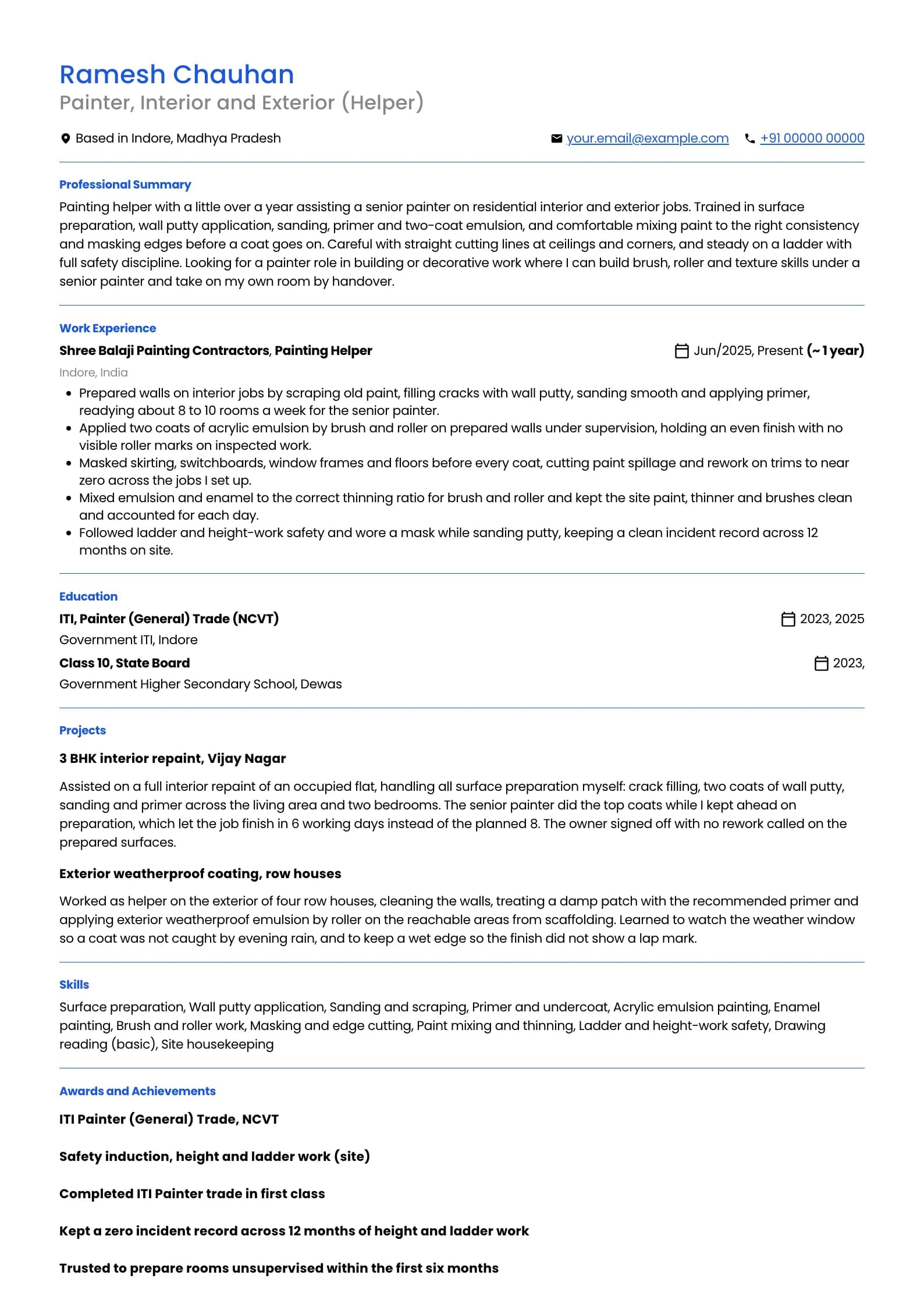
Build my resumePainter resume example, Helper and Apprentice (0 to 1 year)
minimalist templateIs your resume good enough?
Upload the resume you have now and see what an applicant tracking system reads before a painter recruiter ever does.
Free to run. Sign in with your mobile number to see your score.
Painter resume example, Skilled Painter (7 years)
professional template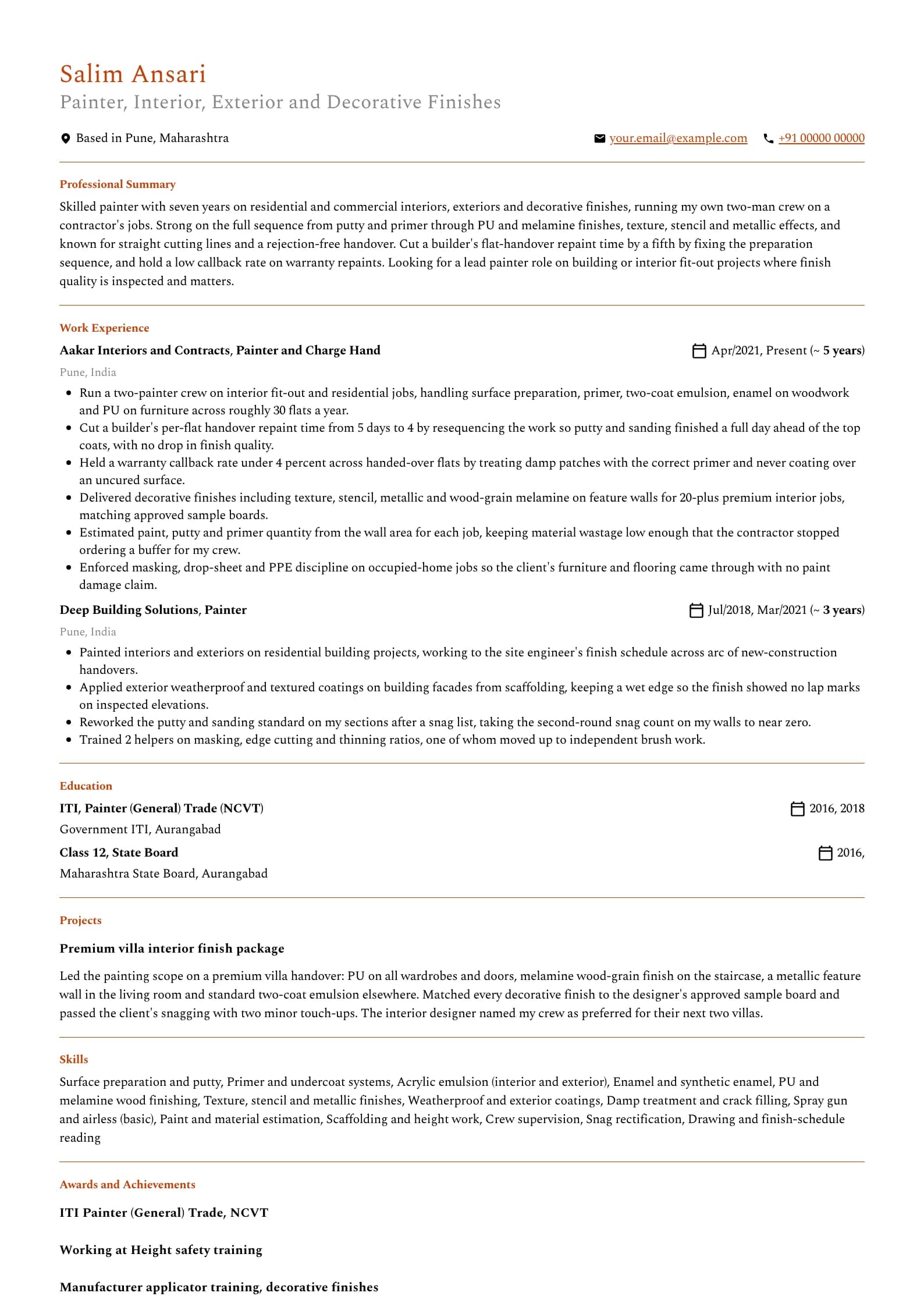
Want this structure with your own details? Build it in the resume builder.
Painter resume example, Industrial Painter and Supervisor (14 years)
header-band template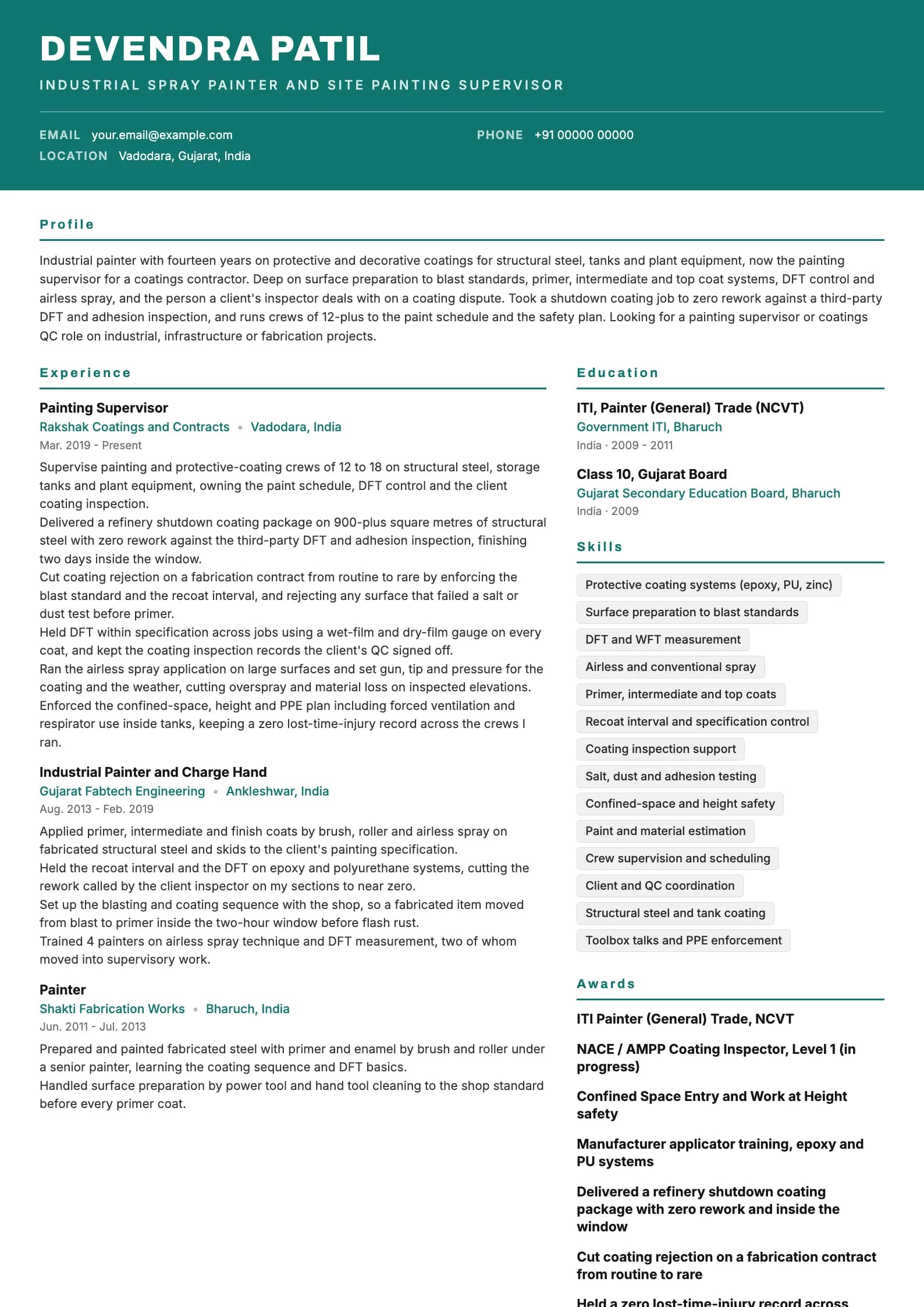
The format that works for painter resumes in India
Reverse chronological is the layout to use. Put your most recent job first, work backwards, and let the periods sit in plain view. A painter's resume that hides dates and groups everything under a skills heading reads as an attempt to cover a gap, and a contractor treats it that way. If there was a gap, one honest line explains it better than a scrambled layout does. Keep it to one page. A helper, a skilled painter and most supervisors up to a long career all fit on a single page, because the trade is proven by jobs done and finishes held, not by length. A second page padded with a hobbies line and a declaration paragraph is a one-page resume stretched thin. Four things do not belong on a trade resume: a photograph, date of birth, marital status and father's name. They come from an old campus and shop template and take space a job or a finish result could use. What a contractor wants instead is the surfaces you prepare, the coatings you run, the finishes you deliver and how clean the handover is. Send a PDF unless the contractor asks for something else, and name the file with your own name and the word painter rather than resume_final. Use a single column all the way down, because a two-column sidebar can confuse an applicant tracking system when a company runs one. The table below sets out the section order.
| Section | Where it goes | Why |
|---|---|---|
| Name and headline | Top, above everything | The headline names the trade: painter, industrial painter or painting supervisor. That is what a contractor matches on. |
| Summary | Directly under the header | Three lines. Years, the coatings and finishes you run, and the strongest quality result. |
| Work experience | Next, for anyone with a job | Most recent first. Newest job gets the most bullets. |
| Skills | Below experience | Grouped: preparation, coatings, finishes, safety. Not a 30-item wall. |
| Projects or key jobs | Above experience for a fresher, below it after that | For a helper this is the evidence. For a skilled painter it names a standout finish. |
| Education and trade | Bottom, unless you are a fresher | ITI Painter trade, institution, years. A fresher can lead with it. |
| Certifications and safety | After education, or beside skills | ITI trade, height and confined-space training, applicator or coating-inspector courses. |
Listing enamel is not the same as proving a clean finish
The most common painter resume failure is a skills line that reads emulsion, enamel, PU, melamine, texture, primer, putty, distemper, spray with no bullet anywhere that shows a finish delivered or an inspection passed. A contractor reads that wall and assumes it is copied, then looks for the one finish you can actually stand behind on a wall. The fix is to let the work prove the coating. If you write PU on the skills line, a bullet should name the wardrobes or doors you finished in PU and that it matched the sample board. If you write exterior weatherproof, a bullet should mention the facade you coated and that it held no lap marks. The skilled sample lists texture, metallic and melamine precisely because the bullets show a feature wall, a staircase and a snagging that passed. The skills line and the experience agree, which is what makes both believable. Be specific about the surface and the system, not just the paint. Painting new plaster, old distempered walls, fabricated steel and wood are different jobs, and a contractor wants to know which you have done. Naming putty, primer, intermediate and top coat as a sequence tells a reviewer you understand a coating system, not just a top coat. For industrial work, the language is DFT, recoat interval, blast standard and adhesion, and a resume that uses it correctly stands out immediately from a decorative-only painter. For decorative work, the language is finish match, snag count and callback rate. Use the vocabulary of the job you are applying for.
For every coating on your skills line, ask: is there a bullet that names the surface I put it on and how the finish held. If not, either add the bullet or cut the coating. A wall of unproven finishes helps nobody and invites a trade-test question you cannot answer.
Writing a summary a contractor actually reads
The lines under your name are the part a contractor is most likely to read, so they should carry three facts: how long you have been painting, what surfaces and coatings you run, and the strongest quality result you can point to. Three or four lines, no adjectives that cannot be checked on a wall. The old objective line, seeking a challenging position to utilise my painting skills in a reputed organisation, tells a contractor nothing they did not already assume. Replace it with a summary. An objective says what you want, a summary says what you have already delivered, and only one of those helps a contractor decide whether to trade-test you. A helper often feels there is nothing to summarise. Look at the helper sample: it names the preparation sequence, the coats applied under supervision and the safety record, built from one apprenticeship. That is a real summary. What it avoids is "hardworking and dedicated painter", a phrase so common it now carries no information. A practical test: read your summary and ask whether any painter with the same ITI could paste it onto their resume unchanged. If they could, it describes the trade, not you. Add the specific finish, the specific number and the specific surface until it stops being transferable.
Summary, skilled painter
Weak
Hardworking and dedicated painter with 7+ years of experience in all types of painting work seeking a good position in a reputed company for growth.
Strong
Skilled painter with seven years on interiors, exteriors and decorative finishes, running a two-man crew. Cut a builder's per-flat repaint time by a day and held a warranty callback rate under 4 percent across handed-over flats.
The rewrite trades self-description for the scope run, a delivery result and a quality number a contractor can check.
Experience bullets: verb, surface, result
Every strong bullet in the samples follows the same shape. It opens with an action verb, names the surface and the coating or finish, and closes with what measurably came out of it. The verb says you did the work. The surface and system tell a contractor whether the work is the kind they hire for. The number does the persuading. Start with the result and work backwards. Painters usually write the task first, then cannot attach a number, which produces bullets like "did painting work of walls using emulsion and enamel". Instead ask what was true at handover: the snags were near zero, the callback rate was low, the job finished a day early, the material wastage dropped, the finish matched the sample board. Then write the sentence that ends in that fact. Vary the metric. Every bullet ending in "finished on time" reads as one claim repeated. Across a real career you can honestly reach for snag count, callback or warranty rate, flats or square metres done, days saved, material wastage, DFT within specification and a safety record. The industrial sample moves across rework, rejection, DFT and injury rate, which reads as range. Where you lack a number, give scope: how many flats a year, how many square metres, how many painters in the crew, how long a job ran. "Delivered a shutdown coating package on 900-plus square metres with zero rework" carries weight without inventing a percentage. Allocate bullets by recency. Current job gets five or six, the previous job four, anything older two.
| Level | What bullets must prove | Typical metric |
|---|---|---|
| Helper and apprentice | You prepare a surface right and a coat holds | Rooms a week prepared, spillage cut, snags on your prep, safety record |
| Skilled painter (2 to 6 yrs) | You deliver a finish to a standard on your own | Callback rate, snag count, flats a year, days saved, material wastage |
| Lead and charge hand (6 to 10 yrs) | You run a crew and a finish schedule | Crew size, jobs a year, decorative range, rework rate, helpers trained |
| Supervisor and industrial (10 yrs +) | You own quality, safety and the client inspection | DFT within spec, zero rework against inspection, square metres, LTI record |
Experience bullet, decorative work
Weak
Responsible for doing all types of painting work including walls, wood and metal as per company requirement.
Strong
Delivered PU on wardrobes and doors, a melamine wood-grain staircase and a metallic feature wall across 20-plus premium jobs, matching the designer's approved sample board.
"Responsible for" describes a job title; the rewrite names the finishes, the volume and the standard they were matched to.
Experience bullet, quality
Weak
Completed painting work with good quality and finished the projects on time to client satisfaction.
Strong
Held a warranty callback rate under 4 percent across handed-over flats by treating damp with the correct primer and never coating over an uncured surface.
Names the quality number and the two practices behind it, so a contractor can ask a real follow-up instead of nodding at "good quality".
If a bullet would read identically on any painter's resume, it is describing the trade, not you. Rewrite it until it only fits the finish you actually delivered on the wall you actually painted.
The skills section: grouped, honest, and short enough to defend on a wall
A painter's skills section has two readers with opposite tastes. An applicant tracking system, where a larger contractor runs one, wants literal terms it can match, emulsion and PU and airless. A contractor or site engineer wants a short, organised list that signals what kind of painter you are. Grouping satisfies both. Group by function rather than one long line. Preparation, coatings, finishes, and safety and site is a grouping that works for almost every painter. The exact headings matter less than the fact that structure exists. Write terms the way the trade writes them: emulsion not imulsion, melamine not malamine, DFT written out once as dry film thickness. A parser matches on strings and a contractor reads a misspelled coating as a painter who has not actually run it. Twelve to sixteen skills is the working range. Below eight the section looks thin. Above twenty it stops being a signal, and a painter resume is prone to listing every paint brand and every finish as a separate item. The list is a contract: every skill on it is a question you have agreed to answer at the trade test. Do not add star ratings or a proficiency bar. Nobody agrees what four stars in spray painting means, and it invites an argument you cannot win. Let the experience prove the depth instead.
| Group | What goes in it | How many |
|---|---|---|
| Preparation | Putty, sanding, crack filling, primer, damp treatment, blasting | 3 to 5 |
| Coatings | Emulsion, enamel, weatherproof, epoxy, PU, primer systems | 3 to 5 |
| Finishes and application | Brush, roller, airless spray, texture, stencil, melamine, DFT | 3 to 5 |
| Safety and site | Ladder, scaffolding, working at height, confined space, PPE | 2 to 4 |
| Other | Material estimation, drawing reading, crew supervision | 2 to 3 |
Skills section
Weak
Skills: Painting, Wall Painting, Interior, Exterior, Emulsion, Enamel, Distemper, Putty, Primer, Texture, PU, Melamine, Spray, Brush, Roller, Asian Paints, Berger, Nerolac, Dulux, Waterproofing, Hard Working, Good Communication
Strong
Preparation: putty, crack filling, primer, damp treatment. Coatings: emulsion, enamel, exterior weatherproof, PU. Finishes: brush, roller, texture, melamine, airless spray. Safety: working at height, scaffolding, PPE.
Cuts the brand names and soft-skill filler, collapses the overlapping terms, and groups the rest so a contractor reads it in one pass.
Key jobs and site experience: what to include and how to describe it
For a helper, a couple of key jobs are the resume. They sit above experience, get real space, and are where a contractor decides whether you can actually prepare a surface and hold a coat or only carry a bucket. For a skilled painter they move below experience and shrink to one standout job, kept only if it shows something the regular bullets do not. The common failure is describing the site instead of the work. "Worked on a residential building painting project" tells a contractor nothing, because thousands of painters can write it. Describe what you prepared, what you coated, what finish you delivered and what was hard. The occupied-flat repaint in the helper sample is a stronger entry than a bigger site named without detail, because it says what the helper actually did and that the prepared surfaces passed with no rework. Pick jobs that show range rather than three of the same. One interior with a clean handover, one exterior or facade with a weather-window problem solved, and one decorative or industrial job with a real quality standard is a stronger set than three plain repaints. Two well-described jobs beat five site names in a row. Be honest about your role. If you were the helper, say helper and say what you owned, the preparation or the reachable areas. A contractor who trade-tests you will find out quickly, and an honest scope that you can defend on a wall beats an inflated one you cannot.
Key job description, helper resume
Weak
Residential Painting Project: worked on painting of a 3 BHK flat doing interior and exterior painting work with the team.
Strong
3 BHK interior repaint: handled all surface preparation myself, crack filling, two coats of putty, sanding and primer across the hall and two bedrooms, which let the job finish in 6 days instead of 8 with no rework on the prepared surfaces.
Swaps a site name and "worked with the team" for the exact scope owned, the surfaces prepared and the result at handover.
Where the trade certificate and safety training belong
The ITI Painter trade and schooling go at the bottom for a painter with work behind them, and near the top for a helper or fresh passout, who has nothing stronger to lead with. Trade, institution, years. That is the whole entry for most people. The ITI marks or class grade are worth keeping while you are a fresher and they are good, because a building contractor's early screening still looks at them. Once you have a few years and real jobs to point at, the trade line stays but the grade can go. A completed job with a clean handover predicts more than a mark from years ago. Safety training carries real weight in this trade and belongs on the page: working at height, ladder and scaffolding, and for industrial painters confined-space entry. A contractor who puts you on a facade or inside a tank needs to see it. Name the training and the year. Manufacturer applicator training and a coating-inspector course sit just below education, or beside skills if you hold only one or two. Write the full name and the year. For a decorative painter, a paint-brand applicator course for PU or texture is a genuine signal. For an industrial painter, a NACE or AMPP coating-inspector course, even in progress, marks the move toward QC and is worth naming. A safety card listed as current when it has lapsed is easy to catch, so renew it or remove it.
Getting through an applicant tracking system
A larger contractor, a facilities company or a coatings firm may run an applicant tracking system, which is a parser and a search index, not a judge. It reads your file, tries to break it into name, dates, employers, titles and skills, and stores the result so a hirer can search across applicants. Almost every problem it causes is a parsing problem, and parsing problems come from layout, not wording. The layout rules are short. One column. Standard headings, so use Work Experience rather than My Painting Journey, and Skills rather than My Toolbox. No text inside images, because a photo of a finished wall reads as empty space to a parser. No critical information in the header or footer strip, which some parsers drop. Avoid text boxes and nested tables in the body. On wording, mirror the language of the job advert where it is honest. If the advert says industrial painter, put industrial painter in your headline. If it says airless spray or DFT, and you have done it, use those exact words. Write an acronym out once, for example "DFT (dry film thickness)", so both searches find you. Keyword stuffing does not work. A hidden block of every paint type in tiny text is caught quickly and the outcome is worse than being filtered. Write real bullets that naturally carry the right terms, because a bullet describing the PU finish you delivered contains the word PU in a context that survives a human read too. Save as a PDF that holds real text, then open it and check you can select and copy a line. If you cannot select the text, neither can the parser, and a photographed or scanned resume is invisible to it.
Section heading
Weak
My Colourful Career
Strong
Work Experience
A parser looks for standard headings; a creative one can push the whole block into an unclassified bucket a hirer never searches.
Test your own file before you send it. Copy the text out of the PDF into a plain notes app. Whatever you can read there is roughly what the parser sees, and anything scrambled is a real risk.
What gets painter resumes set aside
Most rejections at the resume stage are not close calls. They come from a small set of recurring problems, and all of them are fixable in an afternoon. The list below covers what contractors and site engineers reviewing painter resumes in India see most often, in rough order of how much damage each one does.
- A wall of coatings and finishes on the skills line with no bullet proving a single one on a real surface. Every item is a trade-test question you have agreed to answer.
- Job duties copied from a description instead of what you delivered. "Responsible for all painting work" is the tell.
- No numbers anywhere. Snags, callback rate, flats or square metres, days saved, material wastage, DFT, safety record. Pick whichever is honest for the work.
- No mention of surface preparation, when preparation is what decides whether the top coat holds and is half the actual trade.
- A photo, date of birth, marital status or father's name. None of it belongs on a trade resume, and it takes a job's space.
- Brand names listed as skills, Asian Paints and Berger and Nerolac, instead of the finishes and systems you can actually run.
- A generic objective line. Replace it with a summary that states years, coatings and one quality result.
- No safety training named, when a contractor cannot legally put you on a facade or in a tank without it.
- Inflated role, a helper written as a senior painter, which a trade test exposes in the first hour.
- Misspelled coatings, writing emulsion or melamine wrong, which reads as a painter who has not actually run them.
Read your resume aloud once before sending it. Anything you would be uneasy defending in front of a site engineer at a trade test is a line to cut or rewrite.
Skills to put on a painter resume
Technical
- Surface preparation and putty
- Crack filling and damp treatment
- Primer and undercoat systems
- Acrylic emulsion (interior and exterior)
- Enamel and synthetic enamel
- PU and melamine wood finishing
- Texture, stencil and metallic finishes
- Exterior weatherproof coatings
- Epoxy and protective coatings
- Airless and conventional spray
- Brush and roller application
- DFT and WFT measurement
- Blast and power-tool cleaning
- Paint and material estimation
Tools and platforms
- Brushes and rollers
- Airless spray unit
- Conventional spray gun
- Putty knife and scraper
- Sanding block and orbital sander
- Wet and dry film gauge
- Masking tape and drop sheets
- Ladders and scaffolding
- Grit blasting equipment
- Power wire brush
- Spirit level and plumb line
- PPE (respirator, harness, goggles)
Working skills
- Finish-quality discipline
- Reading a finish schedule and drawing
- Crew supervision
- Client and site coordination
- Snag rectification
- Time and job planning
- Safety awareness
- Material discipline
- Reliability and punctuality
Certifications worth listing as a painter
| Certification | Full name | Worth it for |
|---|---|---|
| ITI Painter Trade | ITI Painter (General) Trade, NCVT / SCVT | The core trade credential for a painter in India, worth naming for a helper, a fresh passout or a career switcher who needs to prove painting fundamentals on paper. It anchors a building-contractor screening and stays on the resume through your career as the trade line, even after the grade comes off. |
| Work at Height | Working at Height, Ladder and Scaffolding Safety | A practical safety credential for any painter who works on exteriors, facades or scaffolding, which is most of them. A contractor cannot legally put you on height work without it, so it is close to mandatory and worth keeping current on the page. |
| Confined Space | Confined Space Entry and Work Safety | Worth it for industrial painters who coat the inside of tanks, vessels and pipes. It certifies you can work safely with forced ventilation and a respirator in an enclosed space, which is exactly the risk an industrial coating contractor has to manage before hiring. |
| Applicator Training | Manufacturer Applicator Training (PU, texture, epoxy) | Paint-manufacturer courses that certify you can apply a specific system to spec, PU and texture for decorative painters, epoxy and PU for industrial ones. A useful signal in the skilled-to-lead range, since it shows a contractor you were trained on the exact finish, not just told to figure it out. |
| NACE / AMPP CIP | AMPP (formerly NACE) Coating Inspector, Level 1 or 2 | The recognised coating-inspection credential, worth it for senior industrial painters moving toward QC and supervision. Even listed as in progress it marks the shift from applying coatings to inspecting them, which is the arc a coatings contractor wants in a supervisor and pays for. |
Keywords an ATS scans for in a painter resume
These are the literal terms a parser matches against the job description. Use the ones that are true of you, in the sentences where you did the work, not as a list at the bottom.
- painter
- industrial painter
- spray painter
- surface preparation
- putty
- primer
- emulsion
- enamel
- PU finish
- melamine
- texture finish
- weatherproof coating
- epoxy coating
- airless spray
- DFT
- protective coating
- ITI painter
- working at height
- painting supervisor
- coating inspection
Painter resume FAQ
What salary can a painter expect in India?
A helper or fresh ITI passout typically starts around 12,000 to 18,000 a month, or a daily wage of roughly 500 to 700, depending on the city and the contractor. A skilled painter with a few years on decorative and PU work usually earns 20,000 to 35,000 a month, and more on piece-rate premium interior jobs. An industrial spray painter or painting supervisor with a long record commonly earns 35,000 to 70,000 and more, with coating-inspection skill and a NACE or AMPP course pushing the top of every band upward. Gulf and offshore coating jobs pay well above these figures for qualified industrial painters.
How long should a painter resume be?
One page. A helper, a skilled painter and most supervisors all fit on a single page, because the trade is proven by jobs done and finishes held rather than by length. If you are struggling to fit one page, cut the oldest job to a single line, drop the schooling detail, and remove any coating you would not want to be trade-tested on. Nobody was ever rejected for a resume that was too easy to read.
Do I need an ITI Painter trade certificate to get a job?
Not always for a helper or a small residential contractor, who often hire on a trade test alone, but the ITI Painter trade helps at every level and is close to required for a company job, a large building contractor or an industrial coating firm. It anchors an early screening and proves your fundamentals on paper. If you learned on site without it, lead the resume with your jobs and finishes, and consider the trade certificate to open the company roles that ask for it.
How do I write a painter resume with no experience?
Lead with your ITI Painter trade, then a couple of key jobs or your apprenticeship, then grouped skills. Treat each job as evidence: what you prepared, what you coated, what you owned and what came out clean. An apprenticeship counts, helping a senior painter counts, and even a family or neighbourhood paint job counts if you describe the real work. Add anything checkable, the trade certificate, a safety induction, a clean incident record, because verifiable facts carry more weight than "hardworking".
Should I put paint brands like Asian Paints on my resume?
No, not as skills. A contractor does not hire on which brand you have opened, they hire on the surfaces you prepare, the coatings and finishes you run and how the work holds. List the systems and finishes instead, emulsion, enamel, PU, texture, weatherproof, epoxy, and prove them in your bullets. You can mention a manufacturer applicator training course under certifications, because that is a real credential, but a row of brand names reads as filler.
What is the difference between a decorative and an industrial painter resume?
The vocabulary. A decorative painter's resume speaks in finishes, snag counts, callback rate and sample-board matches, because they are judged at a client handover. An industrial painter's resume speaks in coating systems, surface preparation to a blast standard, DFT within specification, recoat interval and adhesion, because they are judged by a coating inspector. Use the language of the job you are applying for, and if you have done both, split the bullets so each speaks to its own reader.
Do safety certificates matter on a painter resume?
Yes, more than most painters expect. Working at height, ladder and scaffolding training is close to mandatory for any exterior or facade work, and a contractor cannot legally put you on height work without it. For industrial painters, confined-space entry is required before you coat the inside of a tank. Naming these certificates, with the year, is often what lets a contractor put you on the job rather than turn you away at the gate.
Should an ATS-run contractor see a photo of my finished work?
Not on the resume itself. An applicant tracking system reads a photo as blank space, and a technical hirer wants text they can search. Keep the resume as selectable text in a single column, describe the finishes in words, and if you want to show a portfolio, offer it as a separate file or a link the hirer can open after the parser has already matched you. A wall photo pasted into the resume can even push a parser to misread the page.
Is a painting supervisor resume different from a painter resume?
Yes. A painter's resume proves the trade: surfaces, coatings, finishes and a clean handover. A supervisor's resume adds the crew and the quality system: how many painters you run, how you hold DFT and the recoat interval, how you handle the client inspection and the safety plan, and the jobs delivered with zero rework against an inspection. If you are applying for a supervisor role, lead the bullets with the crew, the schedule and the inspection result, not just your own brush work.
Related resume examples and guides
Build your own painter resume in any of these formats
Start from a blank resume or upload the one you have. Goodspace renders it in 24 templates and flags the surface, coating and finish keywords a contractor and an applicant tracking system look for, and the brand-name padding they will not credit.
Build my resume