Plumber Resume Format, with 3 Full Samples
A plumber is hired on evidence of joints that do not leak, sites handed over on time and a clean safety record, yet most resumes list pipe and tap and forget the flat, the tower and the pressure test that held. Below are three complete resumes, one for an ITI fresher, one for a plumber with five years on residential and commercial sites, and one for a senior plumber running a crew on high-rise projects. After the samples come the format rules, the difference between listing skills and proving them, the certifications a supervisor actually reads, and the mistakes that get a resume set aside before a callback.
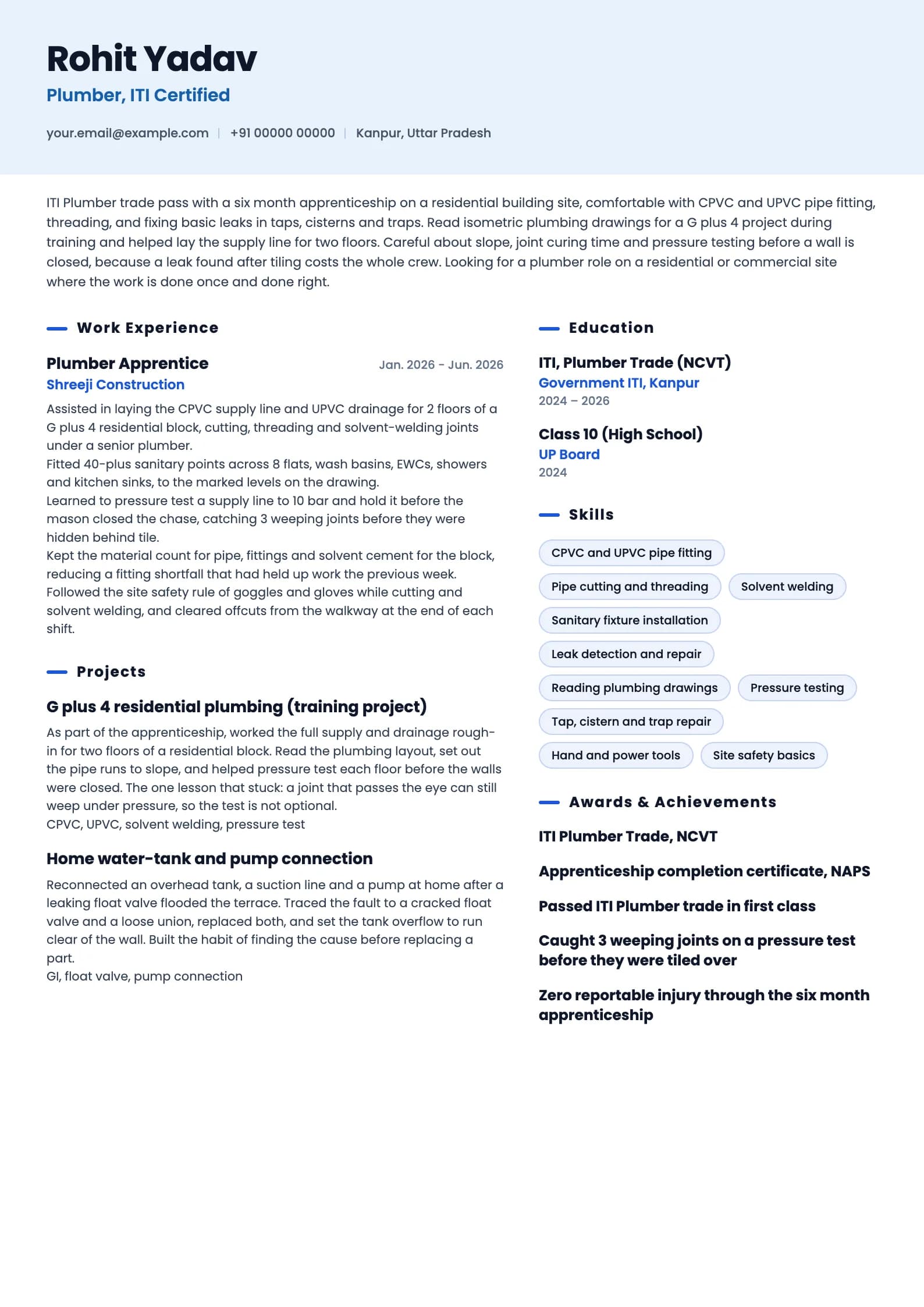
Build my resumePlumber resume example, Fresher (ITI, 0 years)
ai-era templateIs your resume good enough?
Upload the resume you have now and see what an applicant tracking system reads before a plumber recruiter ever does.
Free to run. Sign in with your mobile number to see your score.
Plumber resume example, Mid-level (5 years)
professional template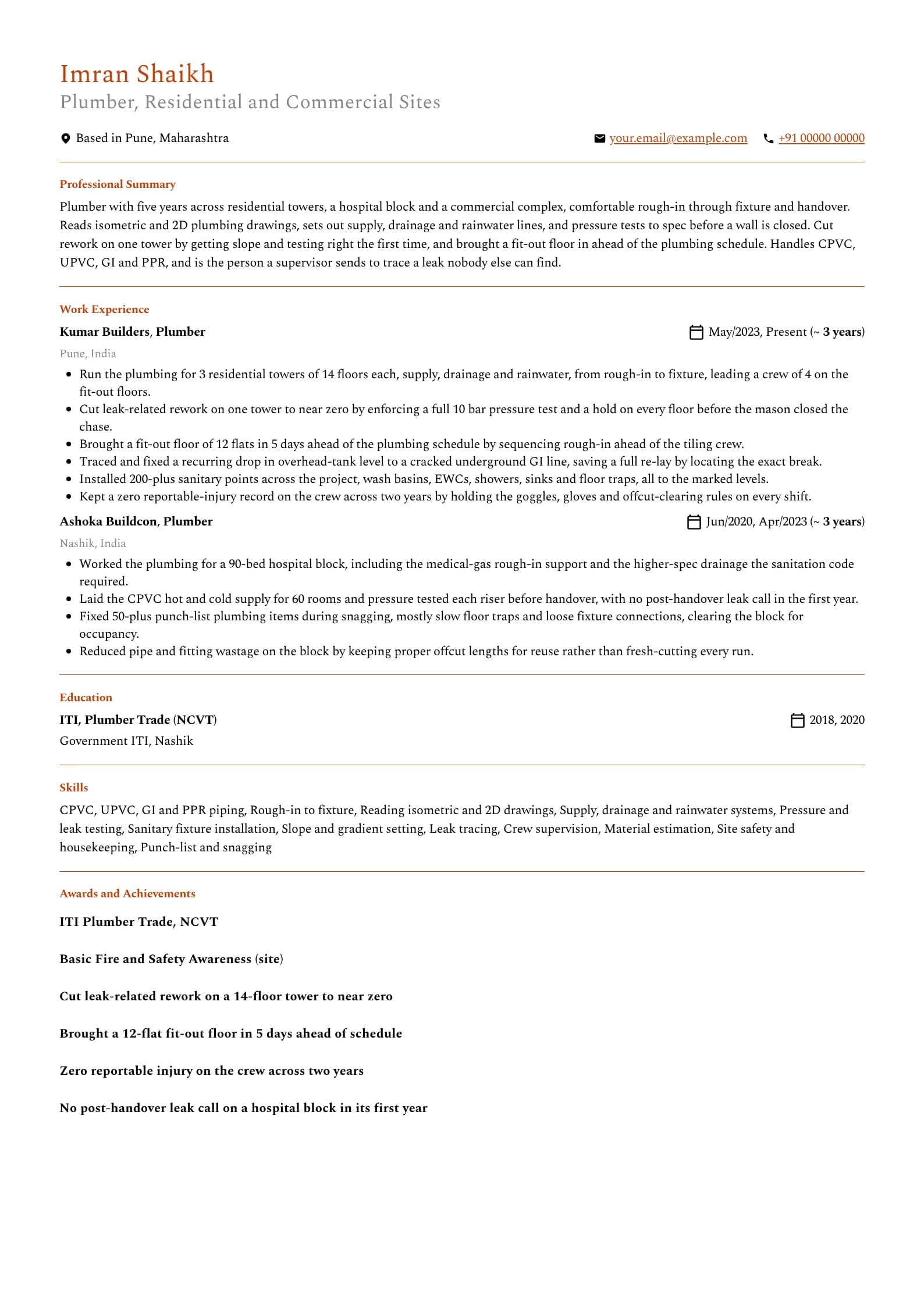
Want this structure with your own details? Build it in the resume builder.
Plumber resume example, Senior (12 years)
header-band template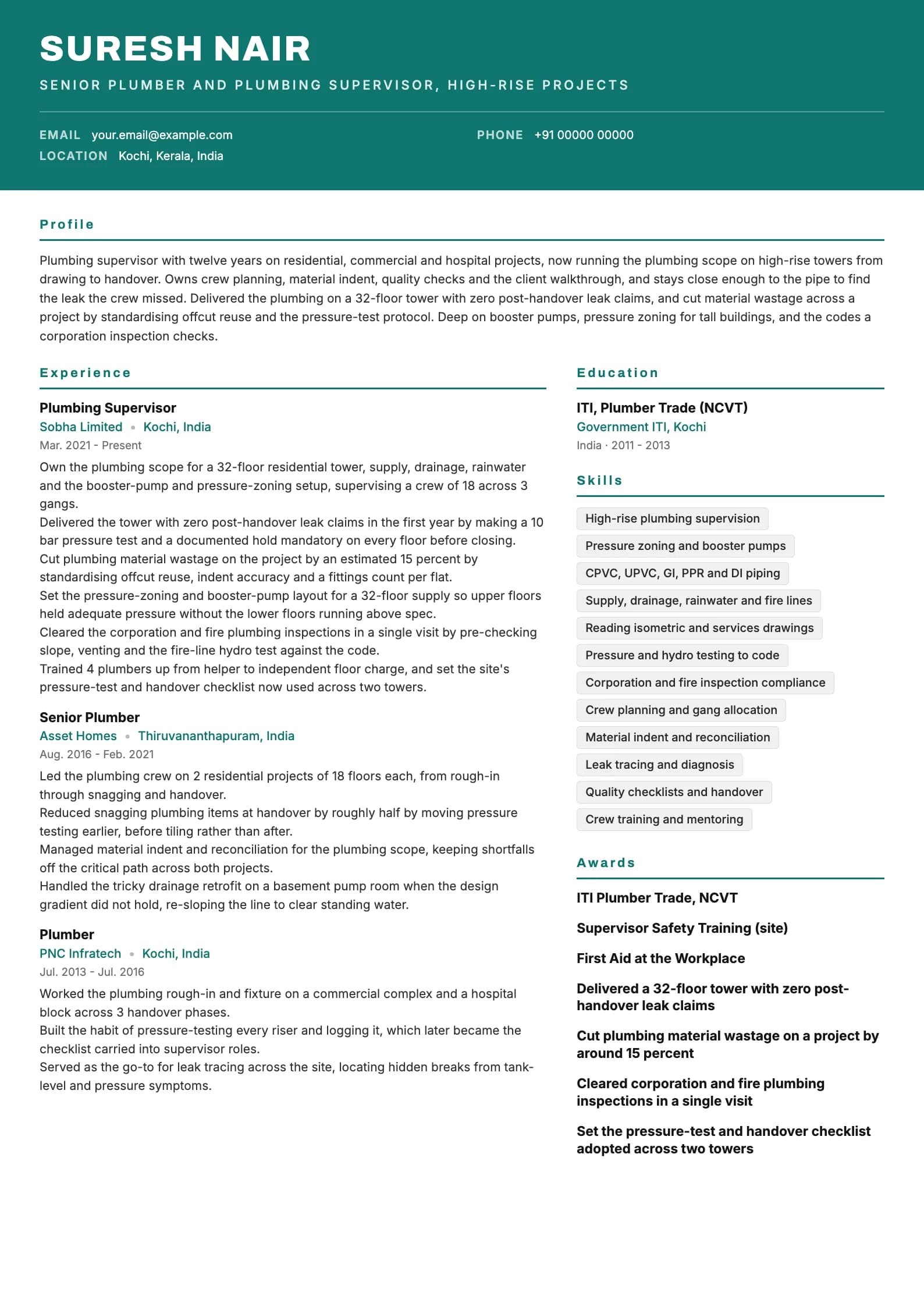
The format that works for plumber resumes in India
Reverse chronological is the layout to use. Put the most recent site or contractor first, work backwards, and keep the dates in plain view. A plumber's page is judged on where you have worked and what you handed over, so hiding the timeline reads as hiding a gap. If there is a gap, one honest line explains it better than a rearranged page. One page is enough for almost every plumber, including a supervisor with a decade behind them. This is a trade where a contractor or site engineer skims the page in under a minute, so the projects, the systems you have worked and the safety record need to be visible at a glance, not spread across two pages of description. Four things belong nowhere on the page: a photograph, date of birth, marital status and father's name. They come from an old campus template and add nothing a site supervisor is looking for. Every line they take is a line a project or a skill could have used. Lead the header with the role you want, Plumber, and if it fits, the kind of work, residential and commercial or high-rise. Below that, three lines of summary: your trade credential, your years, and the strongest thing you have delivered. Then projects or experience, then skills, then ITI and certifications. The table below sets out the order.
| Section | Where it goes | Why |
|---|---|---|
| Name and headline | Top, above everything | The headline is the role, Plumber. A contractor matches on it in one glance. |
| Summary | Directly under the header | Three lines. Trade credential, years, and the strongest handover. |
| Work experience | Next, for anyone with a site behind them | Most recent contractor first, with the building type and systems worked. |
| Projects | Above experience for a fresher, below it after that | For an ITI fresher the apprenticeship or training project is the evidence. |
| Skills | Below experience | Grouped: piping, systems, testing, safety. Not a 30-item wall. |
| Education and ITI | Near the top for a fresher, lower once you have sites | ITI Plumber trade, board, year. The trade credential a supervisor scans for. |
| Certifications | After education, or beside skills if only one or two | Safety training, first aid, any code training. Name and issuer. |
Listing skills is not the same as proving them
The most common plumber-resume failure is a skills line that reads pipe fitting, plumbing, tap repair, drainage, CPVC, UPVC, GI, PPR, welding, fitting with no line anywhere that shows any of it on a real site. A contractor reads that wall and cannot tell a helper who has held the tools from a plumber who has run a floor. The fix is to let the experience prove the skill. If you write pressure testing on the skills line, a bullet should say what you tested, to how many bar, and what it caught. If you write leak tracing, a bullet should describe a leak you found from symptom to break. The mid-level sample lists leak tracing precisely because a bullet shows a tank-level drop traced to an exact underground break. The skill and the work agree, and that is what makes both believable. Be specific about systems and building types. Writing residential towers, a hospital block and a commercial complex tells a supervisor the range of code and spec you have worked, which matters because hospital drainage and high-rise pressure zoning are not the same job as a two-storey house. Name the pipe systems you have actually run, CPVC, UPVC, GI, PPR, DI, not every material you have heard of. Do not pad with things that are not plumbing. A long list that folds in tiling, painting and general labour reads as someone who has not specialised. A site wants a plumber who owns the plumbing scope, so keep the page to the trade.
For every skill on your line, ask: is there a bullet that shows me doing it on a real site. If not, either add the bullet or cut the skill. A wall of unproven trade words helps nobody read your page.
Writing a summary a contractor actually reads
The block under your name is the part most likely to be read, so it should carry three facts: what you build, how long you have been on the tools, and the strongest thing you have delivered. Three or four lines, no adjectives a site cannot check. The old objective line, seeking a suitable position in a reputed company to utilise my plumbing skills, tells a contractor nothing they did not already assume. Replace it with a summary. An objective says what you want, a summary says what you have already handed over, and only one is evidence. Freshers often think they have nothing to summarise. Look at the fresher sample: it names the ITI trade, the apprenticeship length, the building type, the pipe systems, and the one habit that matters, pressure testing before a wall closes. That is a real summary built from an ITI course and one site apprenticeship. What it avoids is hardworking and dedicated, words that appear on every page and carry no information. A practical test: read your summary and ask whether another ITI plumber from your batch could paste it onto their page unchanged. If they could, it describes the trade, not you. Add the specific building, the specific system and the specific delivery until it only fits you.
Summary, mid-level plumber
Weak
Hardworking and dedicated plumber with 5+ years of experience in all types of plumbing work seeking a suitable position in a reputed construction company.
Strong
Plumber with five years across residential towers, a hospital block and a commercial complex, comfortable rough-in through fixture. Cut leak-related rework on a 14-floor tower to near zero and brought a fit-out floor in ahead of schedule.
The rewrite trades a vague self-description for the building types worked and two things actually delivered.
Experience bullets: verb, work, result
Every strong bullet in the samples follows the same shape. It opens with an action verb, names the specific work or system you built, and closes with what measurably changed. The verb says you did it. The system tells a supervisor whether the work is relevant. The number does the persuading. Start with the result and work backwards. Plumbers usually write the task first, then cannot attach a number, which produces lines like "did plumbing work on residential building". Instead ask what was different after you handed over: a floor closed with no leak, a snag list cleared, a schedule beaten, wastage cut, a hidden break found. Then write the sentence that ends in that fact. Vary the number. Sanitary points installed, floors run, days ahead of schedule, bar of pressure tested, wastage percentage, injury record, snag items cleared. Reaching for different measures across the page reads as range rather than one figure repeated. Where you lack a number, give scope: how many floors, how many flats, how big a crew, what building type, how long a project ran. "Ran the plumbing for 3 towers of 14 floors, leading a crew of 4" carries weight without inventing a percentage. Allocate bullets by recency. Current or last site gets five or six, the one before four or five, anything older two or three.
| Level | What bullets must prove | Typical number |
|---|---|---|
| Fresher (ITI) | You can do real plumbing work under a senior and it holds | Points fitted, floors worked, joints tested, leaks caught |
| 1 to 4 years | You run a floor without close supervision | Points installed, floors, snag items cleared, wastage |
| 5 to 8 years | You own the plumbing scope on a floor or block, crew and all | Crew size, schedule beaten, rework cut, injury record |
| 9 years and up | You supervise and set the standard for the whole scope | Post-handover claims, material wastage, inspection pass, crew trained |
Experience bullet, site plumber
Weak
Responsible for doing all types of plumbing work in residential and commercial buildings as per requirement.
Strong
Cut leak-related rework on a 14-floor tower to near zero by enforcing a full 10 bar pressure test and a hold on every floor before the mason closed the chase.
"Responsible for" describes a job title; the rewrite names the practice enforced and the rework it removed.
Experience bullet, diagnosis work
Weak
Handled leakage problems and repaired the same whenever required on site.
Strong
Traced a recurring drop in overhead-tank level to a cracked underground GI line, saving a full re-lay by locating the exact break.
Names the symptom, the root cause and what the diagnosis saved, so a supervisor can picture the actual work.
If a bullet would read identically on any helper's page, it is describing the trade, not you. Rewrite it until it only fits the floor you actually ran.
The skills section: grouped, honest, and short enough to defend
A plumber's skills section has two readers. A contractor or site engineer wants a short, organised list that shows what kind of plumber you are. Some large firms also run resumes through a keyword filter that wants literal terms, CPVC and pressure testing and drainage. Grouping satisfies both. Group by function rather than one long line. Piping, systems, testing and repair, and safety is a grouping that works for almost every plumber. The exact headings matter less than the fact that structure exists. Write the material and system names the way sites write them, CPVC not cpvc, UPVC not PVC when you mean UPVC. Ten to sixteen skills is the working range. Below eight the section looks thin. Above twenty it stops being a signal and starts reading as padding, especially when it folds in general-labour tasks that are not the plumbing trade. Every item on the line is something you have agreed to demonstrate if a supervisor hands you the tools. Do not include a star rating or a percentage bar. Nobody agrees what four stars in drainage means, and it invites an argument you cannot win. Let the experience prove the depth instead.
| Group | What goes in it | How many |
|---|---|---|
| Piping | CPVC, UPVC, GI, PPR, DI, cutting, threading, solvent welding | 3 to 5 |
| Systems | Supply, drainage, rainwater, fire line, booster pumps | 2 to 4 |
| Testing and repair | Pressure testing, leak tracing, fixture install, slope setting | 3 to 5 |
| Reading and planning | Isometric and 2D drawings, material estimation, snagging | 2 to 3 |
| Safety and site | PPE, site safety, housekeeping, first aid | 1 to 3 |
Skills section
Weak
Skills: Plumbing, Pipe fitting, Tap repair, Water supply, Drainage, CPVC, UPVC, PVC, GI, PPR, Welding, Tiling, Masonry, Painting, Electrical, General labour, Hard working, Team work
Strong
Piping: CPVC, UPVC, GI, PPR. Systems: supply, drainage, rainwater, booster pumps. Testing: pressure testing, leak tracing, slope setting. Planning: isometric drawings, material estimation. Safety: PPE, site housekeeping, first aid.
Cuts the non-plumbing labour and the character words, groups the trade so a supervisor reads it in one pass, and keeps only what you can demonstrate.
Projects and sites: what to include and how to describe it
For an ITI fresher, projects and the apprenticeship are the resume. They sit above experience, they get the most space, and they are where a contractor decides whether you can actually do the work or only pass the trade test. For an experienced plumber the sites move into the experience section and the project entries shrink to anything that showed a system the day job did not. The common failure is describing the building instead of the work. "Worked on a residential building project" tells a contractor nothing, because thousands of pages carry that exact line. Describe what you did, on what system, and what was genuinely hard. The G plus 4 training project in the fresher sample is a stronger entry than a bigger site named without detail, because it states the systems, the floors and the one lesson that stuck. Pick work that shows range rather than the same job three times. One project with a real handover, one that shows a system such as pressure zoning or a fire line, and one with a genuinely tricky diagnosis is a stronger set than three identical residential floors. Two well-described sites beat five listed by name only. If a site had an inspection or a quality standard you cleared, say so plainly. Clearing a corporation or fire plumbing inspection is a work sample a contractor trusts, because someone with authority signed off on the pipe you laid.
Project line, fresher resume
Weak
Residential Project: worked as part of the plumbing team in a residential building and did all plumbing related work.
Strong
G plus 4 residential plumbing: worked the full supply and drainage rough-in for two floors, set the pipe runs to slope, and pressure tested each floor before the walls were closed, catching 3 weeping joints before tiling.
Swaps a building name and "all plumbing work" for the systems, the floors and the one habit that keeps a leak out of a finished wall.
Where ITI and certifications belong
For a plumber, the ITI Plumber trade is the credential a contractor scans for, so it sits near the top for a fresher and moves lower, but never disappears, once you have sites behind you. Write the trade, whether it is NCVT or SCVT, the ITI and the year. That is the whole entry for most people. Keep the ITI percentage while you are a fresher and it is good, because early screening still reads it. Once you have a few years on sites, the percentage matters far less than the buildings you have handed over, so let the projects lead and keep the ITI as a line. Apprenticeship and NAPS completion is worth naming for a fresher, because it proves supervised site time on top of the trade course. Class 10 and Class 12 are worth a single line each and nothing more once you hold the ITI. Certifications sit just below education. Safety training, first aid, and any code or supervisor training carry real weight on a site, because a plumber who has cleared a safety course is a plumber a contractor can put on a scaffold without a second thought. Name the training and who ran it. An expired first-aid card listed as current is an easy thing to catch, so renew it or drop it.
Getting past the filter and the site engineer
Large construction firms and staffing agencies increasingly collect plumber resumes through a portal that stores and searches them, so a resume has two readers: a keyword filter and the site engineer who shortlists. Almost every filter problem is a layout problem, not a wording one. The layout rules are short. One column. Standard headings, so use Work Experience rather than My Sites, and Skills rather than My Expertise. No text inside an image, because a photo of a site with your role written across it reads as empty space. Keep your name, the role and the key facts in the body of the page, not tucked into a header or footer strip some parsers drop. On wording, use the terms a posting uses, where they are honest. If the job says CPVC, write CPVC. If it says high-rise or residential, and that is your experience, write it. Spell out a credential in full at least once, ITI Plumber trade, NCVT, so both the short and long form get found. Stuffing keywords does not work. A hidden block of every pipe material and every building type helps nobody, because the site engineer who reads the page sees straight through it. Write real bullets that naturally contain the right terms, because a bullet about a 10 bar pressure test on a tower contains pressure test, tower and the number in a context that survives a human read too. Save and send a PDF unless the posting asks for a Word file, and name it with your own name and the word plumber rather than resume final. Open the PDF once and confirm you can select and copy a line of text, because whatever you cannot select, the filter cannot read either.
Section heading
Weak
My Work Journey
Strong
Work Experience
A filter looks for standard headings; a creative one can push the whole block into a bucket the site engineer never searches.
Test your own file before you send it. Copy the text out of the PDF into a plain notes app. Whatever reads there is roughly what the filter sees, and anything scrambled is a real risk.
What gets plumber resumes set aside
Most rejections at the resume stage are not close calls. They come from a small set of recurring problems, and all of them are fixable in an evening. The list below covers what supervisors and contractors reviewing Indian plumber resumes see most often, in rough order of how much damage each one does.
- A wall of trade words with no bullet showing any of it on a real site. Every skill is a claim you have agreed to demonstrate.
- Duties copied off a job description instead of what you handed over. "Responsible for all plumbing work" is the tell.
- No numbers anywhere. Points fitted, floors run, bar tested, snags cleared, wastage cut. Pick whatever is honest.
- Folding in tiling, painting and general labour, which reads as someone who never specialised in the trade.
- No ITI trade or safety training shown, when those are the first two things a contractor scans for.
- A photo, date of birth, marital status or father's name, which belong on no trade resume and take a project's space.
- No building types named, so a supervisor cannot tell high-rise and hospital work from a single two-storey house.
- A generic objective line. Replace it with a summary that states trade, years and one delivery.
- Nothing about safety or a clean injury record, which is the first thing a site cares about on a scaffold.
- Inflated years or site names that do not match your experience letters. Reference checks are routine and a mismatch ends it.
Read your resume aloud once before sending it. Anything you would not want to say to a site engineer's face is a line to cut or rewrite.
Skills to put on a plumber resume
Technical
- CPVC and UPVC pipe fitting
- GI and PPR piping
- Supply and drainage systems
- Rainwater and fire lines
- Booster pumps and pressure zoning
- Pressure and hydro testing
- Leak tracing and repair
- Sanitary fixture installation
- Slope and gradient setting
- Solvent welding and threading
- Reading isometric and 2D drawings
- Material estimation and indent
Tools and platforms
- Pipe wrench and adjustable spanner
- Pipe cutter and threading machine
- Solvent cement and jointing kit
- Pressure test pump and gauge
- Angle grinder
- Drilling machine
- Spirit level
- Plumbing snake and drain rods
- Teflon and thread seal
- Measuring tape and marking tools
Working skills
- Crew supervision
- Site coordination
- Reading drawings
- Problem diagnosis
- Safety discipline
- Time and schedule management
- Material accountability
- Handover and snagging
- Training helpers
Certifications worth listing as a plumber
| Certification | Full name | Worth it for |
|---|---|---|
| ITI Plumber (NCVT) | Industrial Training Institute, Plumber Trade, National Council for Vocational Training | The core trade credential every plumber resume should carry, and the first thing a contractor or site engineer scans for. Essential for a fresher and worth keeping visible even for a supervisor, since it is the recognised proof of the trade. The SCVT variant is the state-council equivalent and reads the same on a site. |
| NAPS Apprenticeship | National Apprenticeship Promotion Scheme completion certificate | Worth naming for a fresher or an early-career plumber, because it proves supervised site time on top of the ITI course. Most valuable in the first two years when a contractor is deciding whether you have held tools on a real site. Once you have your own project history, the sites themselves carry it. |
| Fire and Safety Awareness | Basic Fire and Safety Awareness training | A practical signal on any construction resume, since a plumber works on scaffolds and in confined spaces where safety is the first thing a site cares about. Worth doing at any level, and especially useful for larger firms and government projects that require a safety induction before you set foot on site. |
| First Aid | First Aid at the Workplace certification | A useful add for a plumber moving into a charge-hand or supervisor role, where being the person who can respond to an on-site injury is part of the job. Low effort, and it pairs well with the safety training that large contractors already expect. |
Keywords an ATS scans for in a plumber resume
These are the literal terms a parser matches against the job description. Use the ones that are true of you, in the sentences where you did the work, not as a list at the bottom.
- plumber
- iti plumber
- pipe fitting
- cpvc
- upvc
- drainage
- water supply
- pressure testing
- leak detection
- sanitary fixture
- plumbing drawings
- rough-in
- booster pump
- rainwater
- site safety
- material estimation
- residential
- commercial
- high-rise
- handover
Plumber resume FAQ
What salary can a plumber expect in India?
An ITI fresher on a construction site typically starts around 12,000 to 18,000 rupees a month, higher in metros and on large projects. A plumber with five to eight years running a floor usually earns 22,000 to 40,000 a month, and a plumbing supervisor on high-rise projects commonly sits at 45,000 to 70,000 and more with a large developer. Gulf and overseas contracts, and specialised work such as pressure zoning or fire lines, push the top of every band well above the domestic figure.
How long should a plumber resume be?
One page. This is a trade where a contractor or site engineer skims the page in under a minute, so the buildings you have worked, the systems you know and your safety record all need to be visible at a glance. If you are struggling to fit one page, cut the oldest site to a single line and drop any skill you would not want to be tested on with the tools in your hand.
Do I need an ITI to put on a plumber resume?
An ITI Plumber trade is the credential a contractor scans for first, and it makes shortlisting far easier, so put it near the top if you have it. That said, plenty of skilled plumbers learned on site without the ITI. If that is you, lead with the buildings you have handed over and the systems you have run, and if you can, add a short safety or apprenticeship certificate to give the page a recognised credential.
Should a fresher put projects above work experience?
Yes. With no full-time role yet, the apprenticeship and any training project are the strongest evidence you can offer, so they sit directly under the summary. State the building type, the pipe systems, what you did and what was hard, not just that you worked on a site. An apprenticeship still goes in a separate experience section below the projects if it was a paid, dated stint.
What certifications help a plumber the most?
The ITI Plumber trade carries the most weight because it is the recognised proof of the trade. After that, a basic fire and safety awareness certificate and a first-aid card help the most, because safety is the first thing a construction site cares about, especially for scaffold and confined-space work. Large developers and government projects often require a safety induction, so the certificate saves you time at the gate.
How do I write a plumber resume with no experience?
Lead with your ITI and apprenticeship, then any training or home project, then skills. Treat the apprenticeship as a job: the building type, the pipe systems, what you fitted and tested, and the one habit that matters, such as pressure testing before a wall closes. A home water-tank or pump repair counts if you describe what you diagnosed and fixed. Verifiable facts, an ITI mark, an apprenticeship certificate, carry more weight than adjectives.
Which building types should I mention on my resume?
Name the ones you have actually worked, residential towers, commercial complexes, hospitals, industrial units, because the code and the spec differ across them and a supervisor reads range from the list. Hospital drainage and high-rise pressure zoning are harder than a two-storey house, so if you have done them, say so. Do not claim a building type you have only heard about, because the interview question will find it out.
Does an ATS or portal reject plumber resumes with two columns?
It does not reject them outright, but some parsers read a two-column layout out of order, which mixes your sidebar into your experience and produces nonsense for the person shortlisting. A single-column layout removes the risk, which is why all three samples above use one. Copy the text out of your PDF into a notes app, and if it reads in order there it will most likely be read correctly by a portal too.
Should I put safety on a plumber resume?
Yes, and prominently. A construction site cares about safety before it cares about speed, because an injury stops the whole crew. A clean injury record, PPE discipline and any safety training are worth a line each, and a supervisor role should show that you held the safety rules for the crew, not just yourself. It is one of the few things that reassures a contractor about putting you on a scaffold on day one.
Related resume examples and guides
Build your own in any of these formats
Start from a blank resume or upload the one you have. Goodspace renders it in 24 templates and flags the ITI, site and safety keywords a contractor or hiring portal will look for, and the padding it will not credit.
Build my resume