HVAC Technician Resume Format, with 3 Full Samples
An HVAC technician is hired on evidence of units that hold temperature, breakdowns closed inside the SLA, and a plant that runs efficiently through a Delhi summer, yet most resumes list AC and cooling and forget the chiller, the AHU, the superheat reading and the preventive schedule that stopped a compressor failure. Below are three complete resumes, one for an ITI fresher, one for a technician with five years on splits, VRF and package units, and one for a senior technician running a facility plant room. After the samples come the format rules, the difference between listing skills and proving them, the certifications a facility or MEP employer actually reads, and the mistakes that get a resume set aside before a callback.
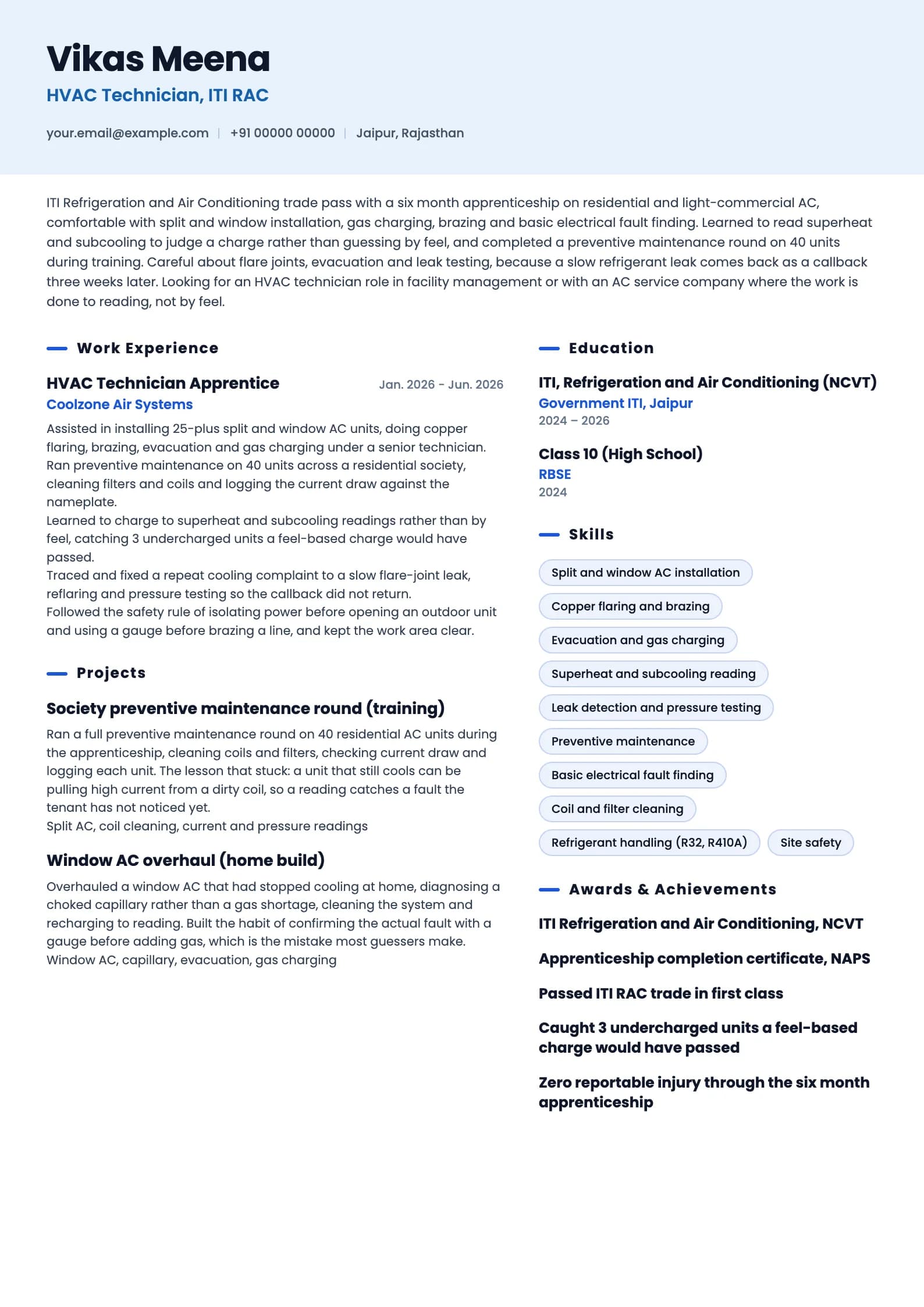
Build my resumeHVAC Technician resume example, Fresher (ITI, 0 years)
ai-era templateIs your resume good enough?
Upload the resume you have now and see what an applicant tracking system reads before a hvac technician recruiter ever does.
Free to run. Sign in with your mobile number to see your score.
HVAC Technician resume example, Mid-level (5 years)
professional template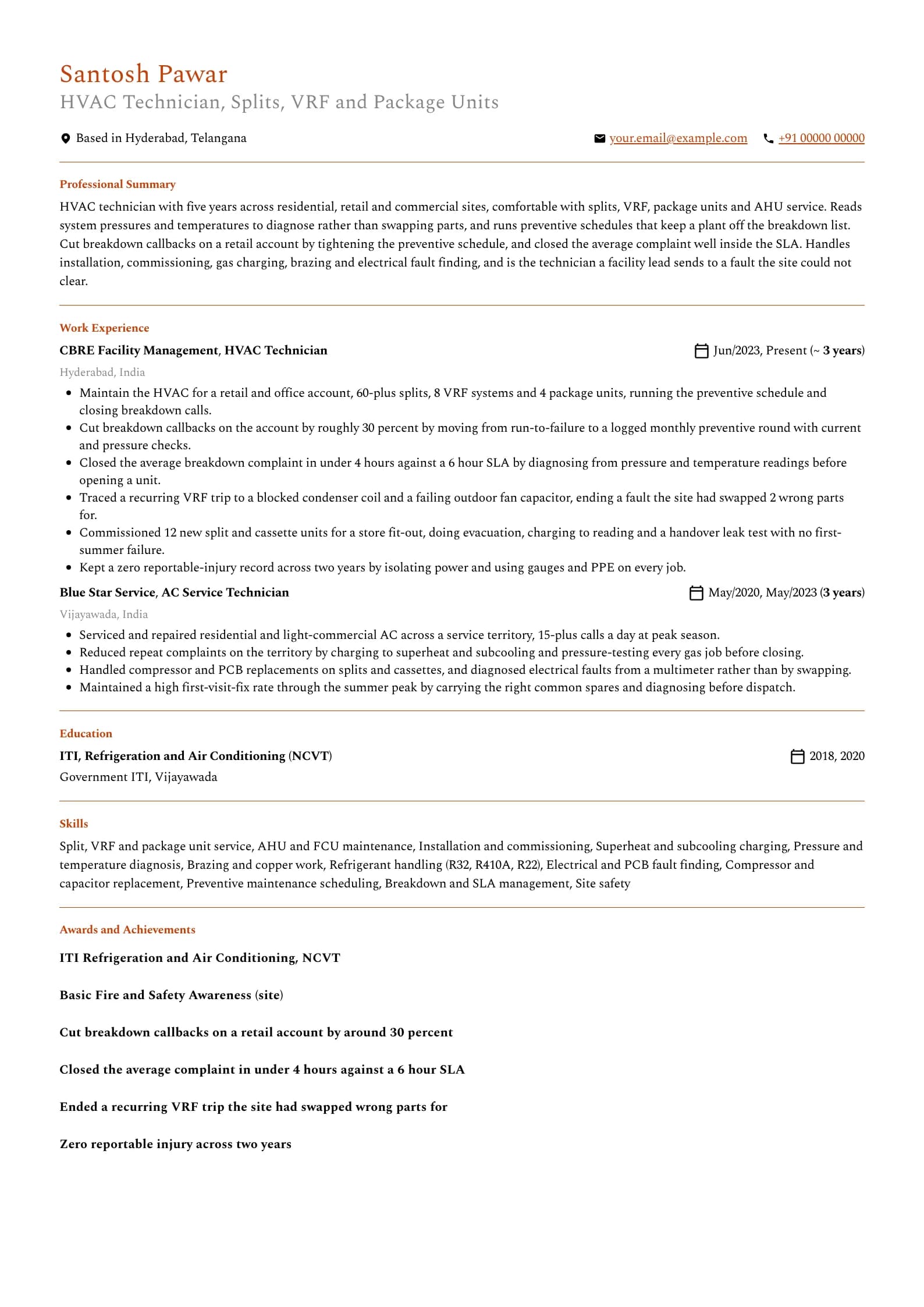
Want this structure with your own details? Build it in the resume builder.
HVAC Technician resume example, Senior (13 years)
header-band template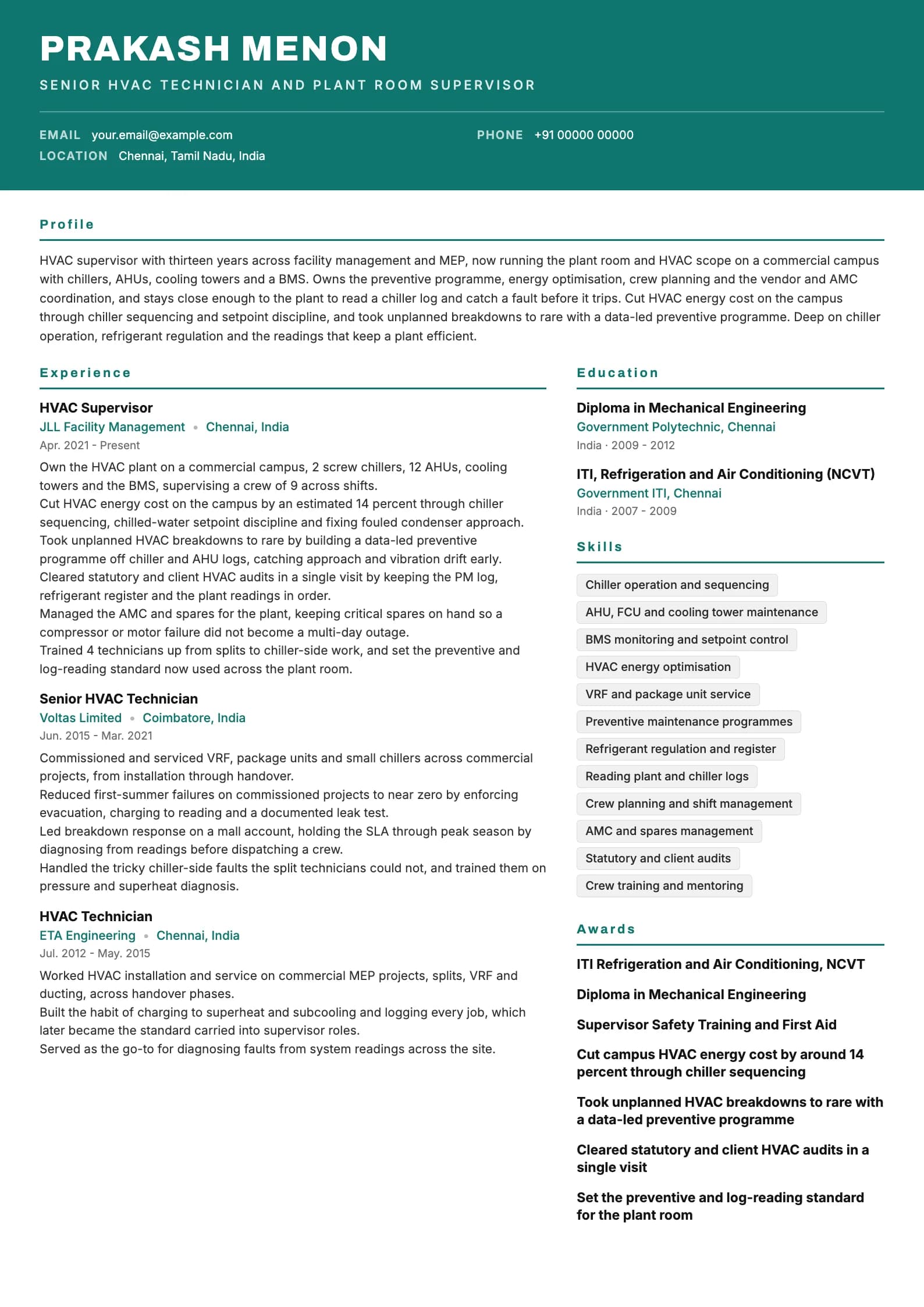
The format that works for HVAC technician resumes in India
Reverse chronological is the layout to use. Put the most recent employer first, work backwards, and keep the dates visible. An HVAC technician's page is read for where you have worked, what systems you have handled and your safety record, so hiding the timeline reads as hiding a gap. If there is a gap, one honest line explains it better than a rearranged page. One page is enough for almost every technician, including a supervisor with over a decade behind them. A facility or MEP employer skims the page in under a minute, so the systems you have worked, splits through chillers, and your uptime and safety record need to sit at a glance, not spread over two pages. Four things belong nowhere on the page: a photograph, date of birth, marital status and father's name. They come from an old campus template and add nothing a facility manager is looking for. Every line they take is a line a system or a result could have used. Lead the header with the role you want, HVAC Technician, and if it fits, the systems, splits and VRF or chillers. Below that, three lines of summary: your trade credential, your years, and the strongest thing you have delivered. Then experience, then skills, then ITI and certifications. The table below sets out the order.
| Section | Where it goes | Why |
|---|---|---|
| Name and headline | Top, above everything | The headline is the role, HVAC Technician. A facility employer matches on it in one glance. |
| Summary | Directly under the header | Three lines. Trade credential, years, and the strongest result. |
| Work experience | Next, for anyone with a job behind them | Most recent employer first, with the systems and the account type. |
| Projects | Above experience for a fresher, below it after that | For an ITI fresher the apprenticeship or a service round is the evidence. |
| Skills | Below experience | Grouped: systems, diagnosis, electrical, safety. Not a 30-item wall. |
| Education and ITI | Near the top for a fresher, lower once you have jobs | ITI RAC trade, board, year. The credential a facility employer scans for. |
| Certifications | After education, or beside skills if only one or two | Refrigerant handling, safety, first aid. Name and issuer. |
Listing skills is not the same as proving them
The most common HVAC-resume failure is a skills line that reads AC, cooling, refrigeration, split, window, VRF, chiller, gas charging, brazing, electrical with no line anywhere that shows any of it on a real site. A facility lead reads that wall and cannot tell a helper who has carried the gauges from a technician who has diagnosed a chiller trip and closed it inside the SLA. The fix is to let the experience prove the skill. If you write superheat and subcooling on the skills line, a bullet should say what charging to reading caught that a feel-based charge would have missed. If you write VRF, a bullet should describe a VRF fault you diagnosed. The mid-level sample lists pressure and temperature diagnosis precisely because a bullet shows a VRF trip traced to a coil and a capacitor after the site had swapped two wrong parts. The skill and the work agree, and that is what makes both believable. Be specific about systems and refrigerants. Writing splits, VRF, package units and AHU service tells a facility lead the range you can hold, which matters because a chiller plant is not the same job as a residential split. Name the refrigerants you have actually handled, R32, R410A, R22, because a shop moving to R32 wants someone who has worked it, not only R22. Do not pad with things that are not HVAC. A list that folds in plumbing, general electrical and civil work reads as a handyman, not a technician. A facility wants someone who owns the HVAC scope, so keep the page to the trade.
For every skill on your line, ask: is there a bullet that shows me doing it on a real system. If not, either add the bullet or cut the skill. A wall of unproven cooling words helps nobody read your page.
Writing a summary a facility manager actually reads
The block under your name is the part most likely to be read, so it should carry three facts: what you maintain, how long you have been on the tools, and the strongest thing you have delivered. Three or four lines, no adjectives a site cannot check. The old objective line, seeking a suitable position in a reputed company to utilise my HVAC skills, tells a facility manager nothing they did not already assume. Replace it with a summary. An objective says what you want, a summary says what you have already delivered, and only one is evidence. Freshers often think they have nothing to summarise. Look at the fresher sample: it names the ITI RAC trade, the apprenticeship length, the units worked, and the one habit that matters, reading superheat and subcooling instead of charging by feel. That is a real summary built from an ITI course and one service stint. What it avoids is hardworking and dedicated, words that appear on every page and carry no information. A practical test: read your summary and ask whether another ITI RAC technician from your batch could paste it onto their page unchanged. If they could, it describes the trade, not you. Add the specific system, the specific reading and the specific result until it only fits you.
Summary, mid-level technician
Weak
Hardworking and dedicated HVAC technician with 5+ years of experience in all types of AC and refrigeration work seeking a good position in a reputed company.
Strong
HVAC technician with five years across residential, retail and commercial sites on splits, VRF and package units. Cut breakdown callbacks on a retail account by tightening the preventive schedule and closed the average complaint well inside the SLA.
The rewrite trades a vague self-description for the systems worked and two things actually delivered.
Experience bullets: verb, system, result
Every strong bullet in the samples follows the same shape. It opens with an action verb, names the specific system or fault you handled, and closes with what measurably changed. The verb says you did it. The system tells a facility lead whether it is relevant. The number does the persuading. Start with the result and work backwards. Technicians usually write the task first, then cannot attach a number, which produces lines like "did AC repair and maintenance work". Instead ask what was different after you closed the job: a callback rate dropped, a complaint closed inside the SLA, a wrong-part swap avoided, energy cost fell, a first-summer failure did not happen. Then write the sentence that ends in that fact. Vary the number. Callbacks cut, SLA hours, units commissioned, energy percentage, first-visit-fix rate, breakdowns avoided. Reaching for different measures across the page reads as range rather than one figure repeated. Where you lack a number, give scope: how many units, how many systems, what account type, how big a crew, what refrigerants. "Maintain 60-plus splits, 8 VRF systems and 4 package units for a retail and office account" carries weight without inventing a percentage. Allocate bullets by recency. Current or last employer gets five or six, the one before four or five, anything older two or three.
| Level | What bullets must prove | Typical number |
|---|---|---|
| Fresher (ITI) | You can install and service a unit to reading under a senior | Units installed, units serviced, faults caught, leaks fixed |
| 1 to 4 years | You diagnose and close a call without close supervision | Calls a day, first-visit-fix, repeat complaints cut |
| 5 to 8 years | You own an account and hold the SLA and the schedule | Callbacks cut, SLA hours, units commissioned, breakdowns avoided |
| 9 years and up | You run a plant and set the preventive and efficiency standard | Energy cost, unplanned breakdowns, audit pass, crew trained |
Experience bullet, service technician
Weak
Responsible for AC installation, servicing and repair work as per the requirement of the customer.
Strong
Cut breakdown callbacks on the account by roughly 30 percent by moving from run-to-failure to a logged monthly preventive round with current and pressure checks.
"Responsible for" describes a job title; the rewrite names the change made and the callbacks it removed.
Experience bullet, diagnosis work
Weak
Handled breakdown complaints of VRF and other systems and resolved the issues on site.
Strong
Traced a recurring VRF trip to a blocked condenser coil and a failing outdoor fan capacitor, ending a fault the site had swapped 2 wrong parts for.
Names the symptom, the two root causes and the wasted swaps it ended, so a facility lead can picture the diagnosis.
If a bullet would read identically on any helper's page, it is describing the trade, not you. Rewrite it until it only fits the system you actually diagnosed.
The skills section: grouped, honest, and short enough to defend
An HVAC technician's skills section has two readers. A facility or MEP employer wants a short, organised list that shows what kind of technician you are. Larger firms also run resumes through a keyword filter that wants literal terms, VRF and chiller and superheat. Grouping satisfies both. Group by function rather than one long line. Systems, diagnosis and charging, electrical, and safety is a grouping that works for almost every HVAC technician. The exact headings matter less than the fact that structure exists. Write the system and refrigerant names the way the industry writes them, VRF not vrf, R410A not 410 gas. Ten to sixteen skills is the working range. Below eight the section looks thin. Above twenty it stops being a signal and starts reading as padding, especially when it folds in plumbing and general electrical that are not the HVAC trade. Every item on the line is something you have agreed to demonstrate if a facility lead hands you a gauge and a faulty unit. Do not include a star rating or a percentage bar. Nobody agrees what four stars in VRF means, and it invites an argument you cannot win. Let the experience prove the depth instead.
| Group | What goes in it | How many |
|---|---|---|
| Systems | Splits, VRF, package units, AHU, FCU, chillers, cooling towers | 3 to 5 |
| Diagnosis and charging | Superheat, subcooling, pressure and temperature, leak testing | 3 to 4 |
| Refrigerant and mechanical | R32, R410A, R22, brazing, evacuation, compressor work | 2 to 4 |
| Electrical | PCB fault finding, capacitor and motor, multimeter diagnosis | 2 to 3 |
| Maintenance and safety | Preventive scheduling, SLA, PPE, refrigerant handling safety | 2 to 3 |
Skills section
Weak
Skills: AC, Cooling, Refrigeration, Split, Window, VRF, Chiller, Gas charging, Brazing, Electrical, Plumbing, Wiring, Civil work, General maintenance, Hard working, Punctual, Team work
Strong
Systems: splits, VRF, package units, AHU, chillers. Diagnosis: superheat and subcooling, pressure and temperature, leak testing. Refrigerant: R32, R410A, R22, brazing, evacuation. Electrical: PCB and capacitor fault finding, multimeter. Maintenance: preventive scheduling, SLA, PPE.
Cuts the non-HVAC labour and the character words, groups the trade so a facility lead reads it in one pass, and keeps only what you can demonstrate.
Projects and sites: what to include and how to describe it
For an ITI fresher, the apprenticeship and any service round are the resume. They sit above experience, they get the most space, and they are where a facility employer decides whether you can actually diagnose and service a unit or only pass the trade test. For an experienced technician the work moves into the experience section and any project entries shrink to a job that showed a system the day job did not. The common failure is naming the task instead of the work. "Did AC servicing" tells an employer nothing, because thousands of pages carry that line. Describe what you serviced, how you diagnosed it, and what was genuinely hard. The society preventive round in the fresher sample is a stronger entry than a bigger site named without detail, because it states the reading habit and the fault a reading catches that a tenant has not noticed. Pick work that shows range rather than the same job three times. One preventive round, one that shows a diagnosis such as a leak or a choked capillary, and one commissioning with a leak test is a stronger set than three identical service calls. Two well-described jobs beat five listed by name only. If a commissioning ran through a summer without a failure, or an account held its SLA, say so plainly. A unit that survived its first summer or an account that held the SLA is a work sample a facility lead trusts, because the heat tested it, not you.
Project line, fresher resume
Weak
Maintenance: did preventive maintenance of AC units in a residential society as part of training.
Strong
Society preventive maintenance round: ran a full round on 40 residential AC units, cleaning coils and filters, checking current draw, and catching units pulling high current from a dirty coil before the tenant noticed a fault.
Swaps a vague task for the scale, the readings taken and the fault a reading catches early.
Where ITI and certifications belong
For an HVAC technician, the ITI Refrigeration and Air Conditioning trade is the credential a facility or MEP employer scans for, so it sits near the top for a fresher and moves lower, but never disappears, once you have jobs behind you. Write the trade, whether it is NCVT or SCVT, the ITI and the year. A diploma in mechanical engineering, if you hold one, sits alongside it and helps for a supervisor track. Keep the ITI percentage while you are a fresher and it is good, because early screening still reads it. Once you have a few years on the tools, the percentage matters far less than the systems and accounts you have handled, so let the experience lead and keep the ITI as a line. Apprenticeship and NAPS completion is worth naming for a fresher, because it proves supervised service time on top of the trade course. Class 10 and Class 12 are worth a single line each and nothing more once you hold the ITI or diploma. Certifications sit just below education. Refrigerant handling and safety training carry real weight, because HVAC work involves pressurised refrigerant, brazing and live electrical, and a facility wants a technician who works to safety. Name the training and who ran it. An expired safety or first-aid card listed as current is an easy thing to catch, so renew it or drop it.
Getting past the filter and the facility manager
Facility management companies and MEP contractors increasingly collect technician resumes through a portal that stores and searches them, so a resume has two readers: a keyword filter and the facility manager or MEP lead who shortlists. Almost every filter problem is a layout problem, not a wording one. The layout rules are short. One column. Standard headings, so use Work Experience rather than My Service Journey, and Skills rather than My Expertise. No text inside an image, because a photo of a plant room with your role written across it reads as empty space. Keep your name, the role and the key facts in the body of the page, not tucked into a header or footer strip some parsers drop. On wording, use the terms a posting uses, where they are honest. If the job says VRF, write VRF. If it says chiller or preventive maintenance, and that is your work, write it. Spell out a credential in full at least once, ITI Refrigeration and Air Conditioning, NCVT, so both the short and long form get found. Stuffing keywords does not work. A hidden block of every system and every refrigerant helps nobody, because the facility manager who reads the page sees straight through it. Write real bullets that naturally contain the right terms, because a bullet about a VRF trip traced to a coil and a capacitor contains VRF, condenser and the fault in a context that survives a human read too. Save and send a PDF unless the posting asks for a Word file, and name it with your own name and HVAC rather than resume final. Open the PDF once and confirm you can select and copy a line of text, because whatever you cannot select, the filter cannot read either.
Section heading
Weak
My HVAC Journey
Strong
Work Experience
A filter looks for standard headings; a creative one can push the whole block into a bucket the facility manager never searches.
Test your own file before you send it. Copy the text out of the PDF into a plain notes app. Whatever reads there is roughly what the filter sees, and anything scrambled is a real risk.
What gets HVAC technician resumes set aside
Most rejections at the resume stage are not close calls. They come from a small set of recurring problems, and all of them are fixable in an evening. The list below covers what facility and MEP employers reviewing Indian HVAC technician resumes see most often, in rough order of how much damage each one does.
- A wall of cooling words with no bullet showing any of it on a real system. Every skill is a claim you have agreed to demonstrate.
- Duties copied off a job description instead of what you closed. "Responsible for AC repair work" is the tell.
- No numbers anywhere. Callbacks cut, SLA hours, units commissioned, energy saved. Pick whatever is honest.
- Folding in plumbing, general electrical and civil work, which reads as a handyman rather than an HVAC technician.
- No ITI RAC trade or safety or refrigerant training shown, when those are the first things a facility employer scans for.
- A photo, date of birth, marital status or father's name, which belong on no trade resume and take a result's space.
- No systems or refrigerants named, so an employer cannot tell chiller and VRF work from a single residential split.
- A generic objective line. Replace it with a summary that states trade, years and one result.
- Nothing about safety or a clean injury record, when refrigerant, brazing and live electrical make safety a first concern.
- Inflated years or employer names that do not match your experience letters. Reference checks are routine and a mismatch ends it.
Read your resume aloud once before sending it. Anything you would not want to say to a facility manager's face is a line to cut or rewrite.
Skills to put on a hvac technician resume
Technical
- Split, VRF and package unit service
- AHU, FCU and cooling tower maintenance
- Chiller operation and sequencing
- Installation and commissioning
- Superheat and subcooling charging
- Pressure and temperature diagnosis
- Leak detection and evacuation
- Brazing and copper work
- Refrigerant handling (R32, R410A, R22)
- PCB and electrical fault finding
- Compressor and capacitor replacement
- Preventive maintenance and SLA
Tools and platforms
- Refrigerant gauge manifold
- Vacuum pump
- Digital thermometer and clamp meter
- Multimeter
- Brazing and flaring kit
- Leak detector
- Recovery machine
- Nitrogen pressure test kit
- BMS console
- Insulation and megger tester
Working skills
- Fault diagnosis
- Crew supervision
- Customer and client handling
- SLA and breakdown response
- Safety discipline
- Preventive planning
- Log and record keeping
- AMC and vendor coordination
- Training helpers
Certifications worth listing as a hvac technician
| Certification | Full name | Worth it for |
|---|---|---|
| ITI RAC (NCVT) | Industrial Training Institute, Refrigeration and Air Conditioning Trade, National Council for Vocational Training | The core trade credential every HVAC technician resume should carry, and the first thing a facility or MEP employer scans for. Essential for a fresher and worth keeping visible even for a supervisor, since it is the recognised proof of the trade. The SCVT variant is the state-council equivalent and reads the same to an employer. |
| Diploma in Mechanical | Diploma in Mechanical Engineering (Polytechnic) | Useful for a technician on the supervisor or plant-room track, since it backs the trade skill with the mechanical fundamentals a chiller plant and a BMS assume. Not required for a service technician, but it widens the door into HVAC supervisor, MEP and building-services roles where a diploma is often listed as a preference. |
| Refrigerant Handling | Refrigerant handling and safe practice training | Worth doing at any level, because HVAC work involves pressurised refrigerant and recovery where safe handling matters, and larger firms increasingly ask for it. Most valuable for technicians who braze, evacuate and recover on commercial systems, and a clean signal to a facility employer that you work to procedure, not by feel. |
| Fire and Safety | Basic Fire and Safety Awareness and First Aid | A practical signal on any facility or MEP resume, since brazing, live electrical and plant-room work make safety a first concern. Worth doing at any level, and often required for a site or plant induction before a large firm lets you near the equipment. First aid pairs naturally for anyone moving into a supervisor role. |
Keywords an ATS scans for in a hvac technician resume
These are the literal terms a parser matches against the job description. Use the ones that are true of you, in the sentences where you did the work, not as a list at the bottom.
- hvac technician
- refrigeration and air conditioning
- iti rac
- vrf
- chiller
- ahu
- split ac
- package unit
- gas charging
- superheat
- brazing
- preventive maintenance
- breakdown maintenance
- refrigerant
- R410A
- compressor
- electrical fault finding
- commissioning
- SLA
- site safety
HVAC Technician resume FAQ
What salary can an HVAC technician expect in India?
An ITI fresher on residential and light-commercial AC typically starts around 12,000 to 20,000 rupees a month, higher in metros and with facility management firms. A technician with five to eight years across splits, VRF and package units usually earns 25,000 to 45,000 a month, and an HVAC supervisor running a chiller plant commonly sits at 50,000 to 85,000 and more. Chiller and BMS skill, a diploma, and Gulf contracts push the top of every band well above the domestic figure.
How long should an HVAC technician resume be?
One page. A facility or MEP employer skims the page in under a minute, so the systems you have worked, splits through chillers, your uptime and SLA record, and your safety record all need to sit at a glance. If you are struggling to fit one page, cut the oldest employer to a single line and drop any skill you would not want to be tested on with a gauge and a faulty unit in front of you.
Do I need an ITI to put on an HVAC resume?
An ITI Refrigeration and Air Conditioning trade is the credential a facility employer scans for first, and it makes shortlisting far easier, so put it near the top if you have it. Many technicians also come through a mechanical diploma, which helps for the supervisor track. If you learned on the job without either, lead with the systems and accounts you have handled and add a refrigerant-handling or safety certificate so the page carries a recognised credential.
Should a fresher put projects above work experience?
Yes. With no full-time role yet, the apprenticeship and any service round are the strongest evidence you can offer, so they sit directly under the summary. State the units, how you diagnosed a fault, and the one habit that matters, such as charging to superheat and subcooling instead of by feel. An apprenticeship still goes in a separate experience section below the projects if it was a paid, dated stint.
What certifications help an HVAC technician the most?
The ITI RAC trade carries the most weight because it is the recognised proof of the trade. After that, a refrigerant-handling certificate and a basic fire and safety card help the most, because pressurised refrigerant, brazing and live electrical make safe practice a first concern for a facility employer. A mechanical diploma helps if you are aiming at the plant-room and supervisor track rather than field service.
How do I write an HVAC resume with no experience?
Lead with your ITI and apprenticeship, then any service round or home repair, then skills. Treat the apprenticeship as a job: the units, how you diagnosed a fault from a reading, and the habit that matters, such as charging to reading rather than by feel. A window-AC overhaul at home counts if you describe the fault you diagnosed and how you confirmed it with a gauge. Verifiable facts carry more weight than adjectives.
Which systems should I mention on my resume?
Name the ones you have actually worked, splits, window units, VRF, package units, AHU, FCU, chillers and cooling towers, because they differ in complexity and a facility lead reads range from the list. Chiller and BMS work is harder than a residential split, so if you have done it, say so, and name the refrigerants you have handled. Do not claim a system you have only watched, because the interview will get to it.
Does an ATS or portal reject HVAC resumes with two columns?
It does not reject them outright, but some parsers read a two-column layout out of order, which mixes your sidebar into your experience and produces nonsense for the person shortlisting. A single-column layout removes the risk, which is why all three samples above use one. Copy the text out of your PDF into a notes app, and if it reads in order there it will most likely be read correctly by a portal too.
Should I put safety on an HVAC technician resume?
Yes, and prominently. HVAC work involves pressurised refrigerant, brazing and live electrical, so a facility manager cares about safe practice before speed. A clean injury record, PPE and lockout discipline, and any refrigerant-handling or safety training are worth a line each, and a supervisor role should show you held the safety standard for the crew. It is one of the few things that reassures an employer about putting you near a plant on day one.
Related resume examples and guides
Build your own in any of these formats
Start from a blank resume or upload the one you have. Goodspace renders it in 24 templates and flags the ITI, refrigeration and facility keywords a facility or MEP employer will look for, and the padding it will not credit.
Build my resume