Refrigeration Technician Resume Format, with 3 Full Samples
A refrigeration technician is hired on proof of units brought back to temperature, leaks found and callbacks that did not happen, not on a line about being a hardworking team player. Yet most RAC resumes list AC repair, gas filling and servicing and leave out the refrigerant they charge, the systems they hold, and the first-time-fix rate that saves a service company a second truck roll. Below are three complete resumes, one for an ITI-qualified fresher out of apprenticeship, one for a service technician with four years across domestic and commercial refrigeration, and one for a senior HVAC-R service engineer owning chillers and cold storage. After the samples come the format rules, the difference between listing gas charging and proving you can commission a system, the terms a service company scans for, and the mistakes that get a technician resume set aside before a call.
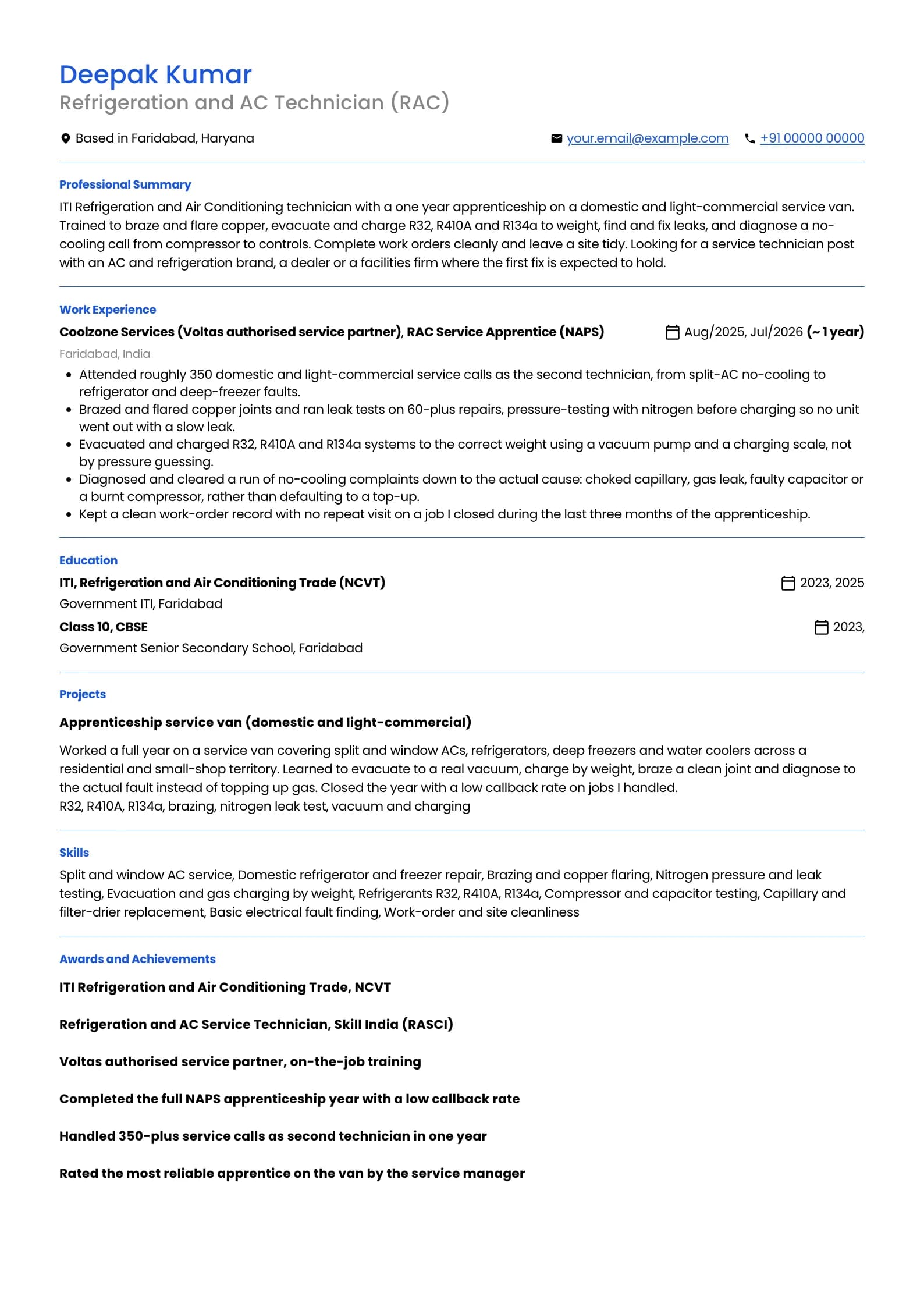
Build my resumeRefrigeration Technician resume example, Fresher / Apprentice (0 to 1 year)
minimalist templateIs your resume good enough?
Upload the resume you have now and see what an applicant tracking system reads before a refrigeration technician recruiter ever does.
Free to run. Sign in with your mobile number to see your score.
Refrigeration Technician resume example, Service Technician (4 years)
ai-era template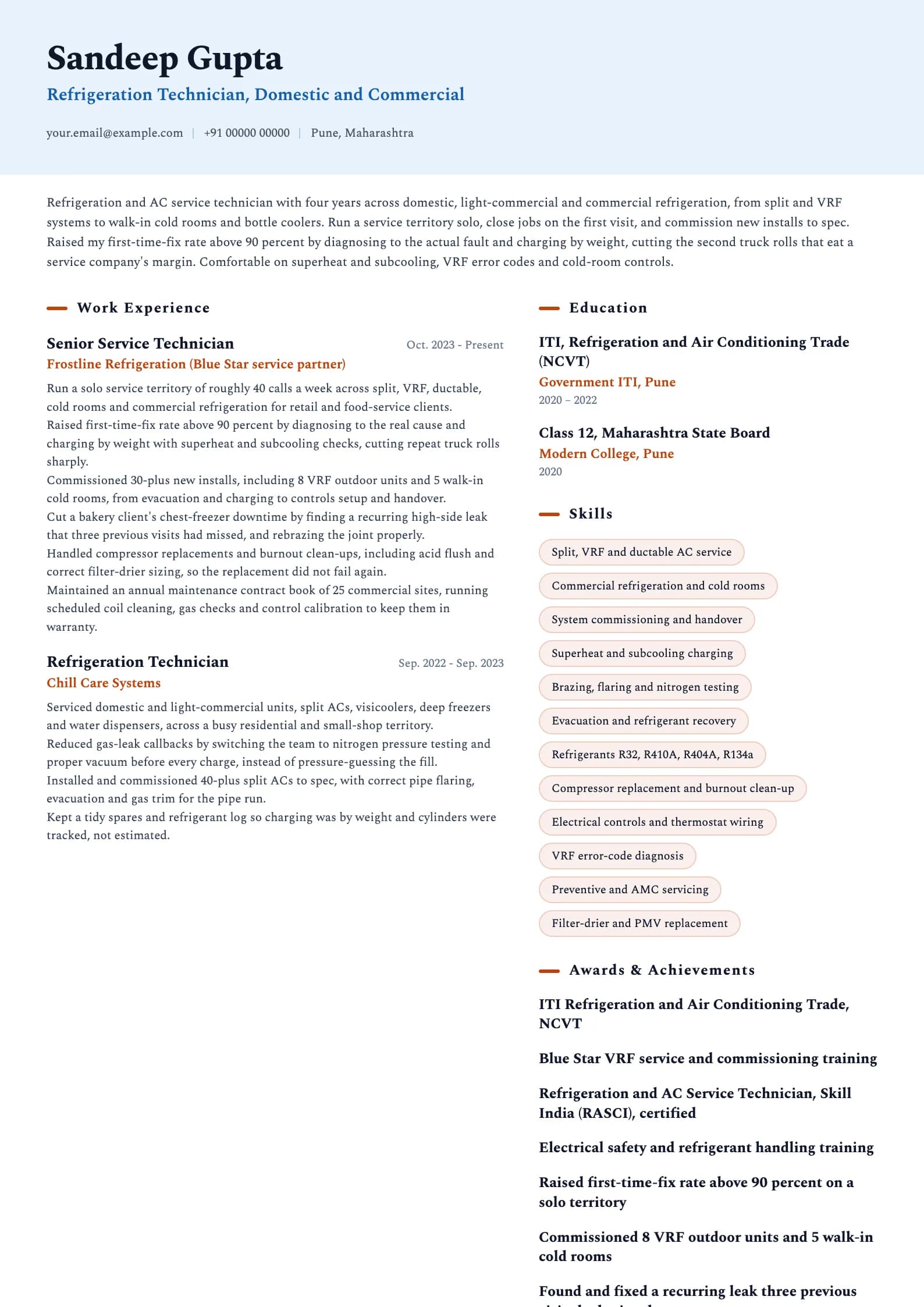
Want this structure with your own details? Build it in the resume builder.
Refrigeration Technician resume example, Senior HVAC-R Service Engineer (11 years)
professional template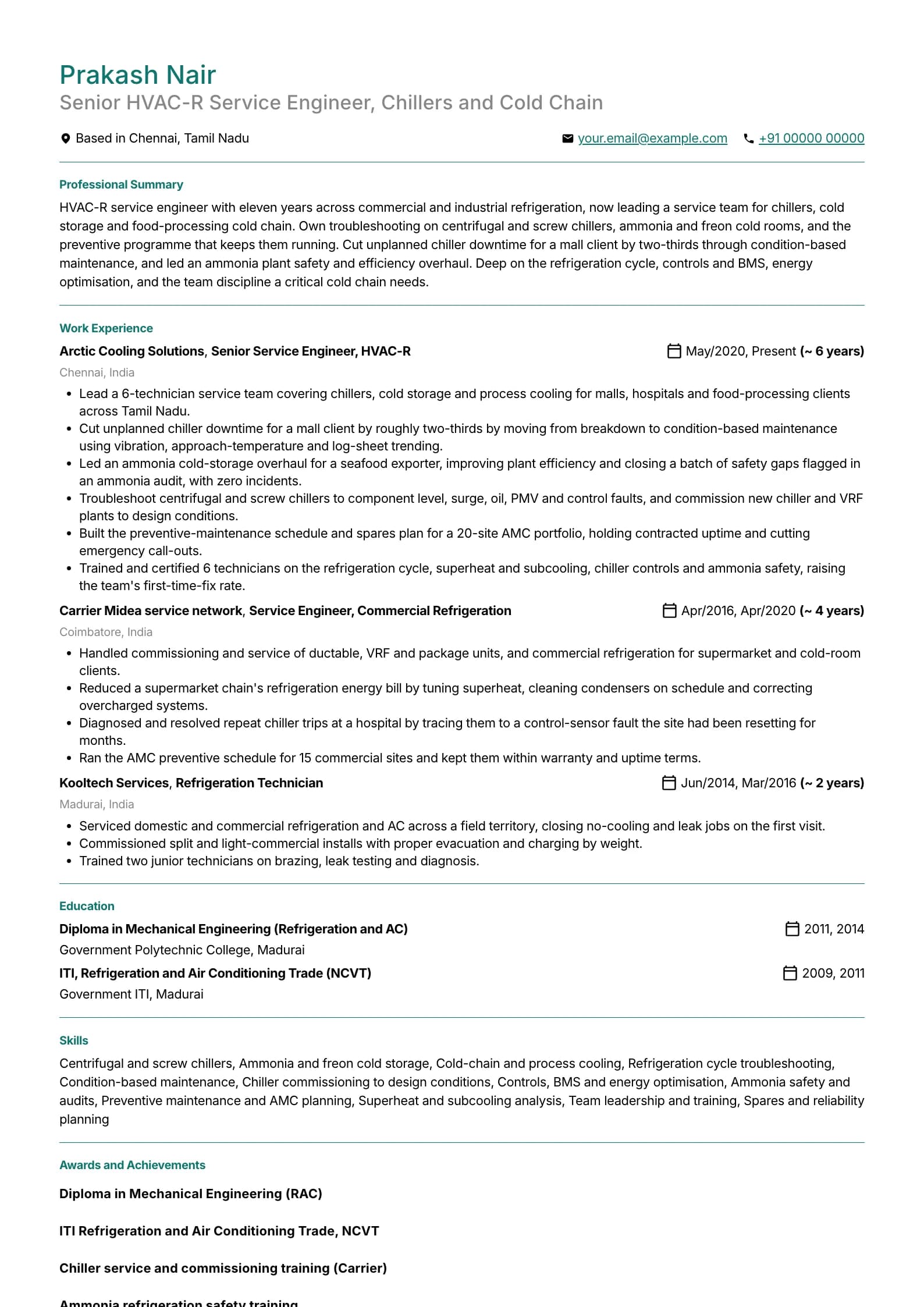
The format that works for refrigeration technician resumes in India
Reverse chronological is the layout to use. Put your current or most recent job first, work backwards, and keep the dates visible. Service companies, OEM dealers, facilities firms and cold-storage operators read a lot of these, and they expect the standard shape. A resume that groups everything under skills and quietly drops the dates reads as if a gap is being hidden, and a gap is better explained in one honest line. Keep it to one page for anyone up to roughly eight years. A refrigeration technician's page needs the trade qualification, the systems and refrigerants worked, the OEM training, and the last two or three jobs, and that fits comfortably. A senior HVAC-R engineer with chiller, ammonia and team-leadership work can run to a second page, but only if it carries real system work rather than a longer tool list. Name the systems and the refrigerants early, because they decide which calls you are sent on. A technician who has only done domestic split ACs is a different hire from one who commissions VRF, runs cold rooms or troubleshoots chillers, and a service manager should not have to guess. The samples name R32, R410A, R404A, R134a and the system types in the summary for exactly this reason. Leave off the photograph, date of birth, marital status and father's name. They come from an old placement template and add nothing to a service screen. Save a PDF, name it with your own name and refrigeration technician, and send that unless a form is asked for. The table below sets the section order.
| Section | Where it goes | Why |
|---|---|---|
| Name and headline | Top, above everything | Headline names the trade and range: Refrigeration Technician, Domestic and Commercial. Service managers match on it. |
| Summary | Directly under the header | Three lines: trade, years, systems and refrigerants, and the first-time-fix or uptime point that matters most. |
| Trade and OEM training | High, near the summary | ITI RAC and any Blue Star, Voltas, Daikin or Carrier training are the fast filters. Do not bury them. |
| Work experience | Next, for anyone with a job | Most recent first. Name the systems, the refrigerants and the fix rate. |
| Skills | Below experience | Grouped: systems, refrigeration work, electrical and controls, tools. Not a 30-item wall. |
| Certifications | Below skills, or beside the trade line | OEM training, Skill India RASCI, ammonia or safety training. These carry weight here. |
| Education | Bottom | ITI, any diploma, Class 10 or 12. Short. |
The line that separates a technician from a gas-filler
The single most valuable thing a refrigeration technician can prove on a resume is that they diagnose to the actual fault instead of topping up gas and leaving. A gas-filler charges a leaking system, it cools for a week, and the customer calls back, which costs the service company a second truck roll and a warranty argument. A technician finds the leak, fixes it, and the job holds. Service managers know the difference and hire for it, so the resume should show it. Say it in the work, not as a claim. "Diagnosed no-cooling down to the actual cause, choked capillary, gas leak, faulty capacitor or burnt compressor, rather than defaulting to a top-up" tells a service manager exactly how you work. Better still, attach a number: a first-time-fix rate, a callback rate, a recurring leak you found that earlier visits missed. The technician sample leads with a first-time-fix rate above 90 percent, which is the metric a service company's margin actually depends on. Charge by weight and say so. Charging to a scale after a proper vacuum, with superheat and subcooling checks, is the mark of someone who commissions a system correctly rather than pressure-guessing a fill. It reads to a service manager as a technician who will not put an overcharged or undercharged unit back on a customer's wall. Avoid the empty version. "Expert in AC and refrigeration repair, hardworking and honest" is on every resume and carries no information. Replace it with the fault types you actually diagnose, the systems you commission and the callback number you hold.
Summary line, service technician
Weak
Expert refrigeration and AC technician, hardworking and honest, expert in all types of AC and fridge repair and gas filling work.
Strong
Service technician with four years across split, VRF and cold rooms, first-time-fix above 90 percent by diagnosing to the real cause and charging by weight with superheat and subcooling checks.
Trades a self-rating and gas filling for the systems worked, the way of charging, and the fix rate a service manager is screening on.
A service manager reads a refrigeration resume asking one thing: will this person fix it on the first visit or send a second truck. Answer it with your first-time-fix or callback rate, not with the word expert.
Listing gas charging is not the same as proving you can commission a system
The most common refrigeration resume names a row of skills, AC repair, gas charging, servicing, installation, with no job anywhere that shows the system, the refrigerant or the result. A service manager reads that row and cannot tell an apprentice who watched from a technician who commissions VRF and troubleshoots chillers, so it assumes the lower. The fix is to let the jobs carry the skills. If you write VRF on your skills line, a bullet should describe a VRF unit you commissioned or an error code you traced. If you write cold rooms, a bullet should name a walk-in you installed or a leak you fixed. If you write chillers, a bullet should show a chiller fault you resolved to component level. The technician sample lists VRF and cold rooms precisely because the bullets show VRF units commissioned and a cold-room leak found. The skills line and the experience agree, which is what makes both believable. Name the numbers a refrigeration job is judged on. First-time-fix rate, callback rate, calls a week, installs commissioned, downtime cut, energy saved, sites held on AMC. These are the exact figures a service manager tracks, so a resume that speaks in them reads as written by someone who has done the work. Do not overstate the system class. Writing chiller or ammonia experience when you have only serviced domestic split ACs is the kind of claim that collapses in the first technical question and, on a refrigerant like ammonia, is a safety concern too, so it costs you more than it gains.
For every system and refrigerant on your skills line, ask: is there a bullet that proves I worked it. If not, add the bullet or cut the claim. An overstated chiller or ammonia line is caught fast and reads as a risk.
Experience bullets: verb, system, result
Every strong bullet in the samples has the same shape. It opens with an action verb, names the specific system or fault, and closes with what changed: a unit back to temperature, a leak fixed, a fix rate raised, downtime cut, energy saved. The verb says you did it. The system tells a service manager whether the work is relevant. The number does the convincing. Start from what was different after your visit and work backwards. Technicians tend to write the task first, then cannot attach a result, which gives lines like "did servicing and gas charging of AC and refrigeration units". Instead ask what changed: a unit that was warm is cooling and stayed cooling, a recurring leak stopped, a compressor replacement did not fail again, a chiller stopped tripping, a bill dropped. Then write the sentence that ends in that fact. Vary what you count. First-time-fix rate on every bullet reads as one trick. Across a real job you can honestly reach for calls a week, installs commissioned, callback rate, downtime cut, energy saved, AMC sites held and technicians trained. The senior sample moves across several of these, which reads as range. Where there is no clean number, give scale: how many calls, how many installs, how many sites, how many systems. "Commissioned 30-plus new installs, including 8 VRF outdoor units and 5 walk-in cold rooms" carries weight without an invented percentage. Give the current job five or six bullets, the previous one four, anything older two or three.
| Level | What bullets must prove | Typical measure |
|---|---|---|
| Fresher / apprentice | You can braze, evacuate, charge and diagnose safely under supervision | Calls attended, leak tests, joints brazed, callback rate |
| 1 to 3 years | You close domestic and light-commercial jobs on your own | Calls a week, installs commissioned, first-time-fix, callbacks cut |
| 4 to 8 years | You run a territory and handle VRF, cold rooms and commercial refrigeration | First-time-fix rate, VRF and cold-room installs, AMC sites, downtime cut |
| 8 years and up | You lead a team and own chiller and cold-chain reliability | Uptime held, downtime and energy cut, plants commissioned, technicians trained |
Experience bullet, service technician
Weak
Responsible for servicing, gas charging and repairing of all types of AC and refrigeration units at customer sites.
Strong
Raised first-time-fix rate above 90 percent by diagnosing to the real cause and charging by weight with superheat and subcooling checks, cutting repeat truck rolls sharply.
"Responsible for" is a duty list; the rewrite names how you work and the fix-rate result a service company's margin depends on.
Experience bullet, commissioning work
Weak
Did installation and commissioning of VRF and cold room systems at various commercial sites.
Strong
Commissioned 30-plus new installs, including 8 VRF outdoor units and 5 walk-in cold rooms, from evacuation and charging to controls setup and handover.
Puts a number on the installs, names the harder systems, and shows the full commissioning sequence rather than the word commissioning.
If a bullet would fit any AC mechanic in the city, it is describing the trade, not you. Add the system, the refrigerant, the fix rate or the number until it only fits the work you actually did.
The skills section: grouped, honest, short enough to defend
A refrigeration technician's skills section has two readers. A service manager scanning many resumes wants to see the systems, the refrigerants and a few core techniques fast. A senior engineer wants a short, organised list that says what kind of technician you are. Grouping serves both. Group by function rather than one long row. Systems, refrigeration work, electrical and controls, and tools is a grouping that fits almost every technician. The headings matter less than the fact that structure exists. Write terms the way the trade writes them: R410A not R 410, VRF not VRV alone unless it is a Daikin site, superheat and subcooling spelled out. If a portal searches your file, it matches the exact string. Ten to sixteen skills is the working range. Below eight the section looks thin. Above twenty it stops signalling anything, and a refrigeration resume is prone to listing every hand tool and every refrigerant as separate items to pad the count. The list is a promise: every item is something an interviewer can ask you to demonstrate or explain. Do not add star ratings or bars against skills. Nobody agrees what four stars in brazing means, and it invites an argument you cannot win. Let the jobs show the depth. Keep the electrical and controls skills as their own group, because a modern refrigeration technician who can read a VRF error code and wire a thermostat is worth more than one who only turns spanners.
| Group | What goes in it | How many |
|---|---|---|
| Systems | Split, VRF, ductable, cold rooms, chillers, commercial refrigeration | 3 to 6 |
| Refrigeration work | Brazing, flaring, evacuation, charging by weight, leak testing, recovery | 3 to 5 |
| Diagnosis | Superheat and subcooling, compressor testing, error-code diagnosis | 2 to 4 |
| Electrical and controls | Thermostat wiring, PCB, capacitor, controls and BMS (senior) | 2 to 3 |
| Tools and refrigerants | Vacuum pump, gauge manifold, charging scale, R32 / R410A / R404A / R134a | 2 to 4 |
Skills section
Weak
Skills: AC repair, Fridge repair, Gas filling, Servicing, Hard working, Spanner, Cutter, Brazing rod, R22, R32, R410, R134, R404, R290, Honest, Punctual, Team player
Strong
Systems: split, VRF, ductable, cold rooms, commercial refrigeration. Work: brazing, flaring, evacuation, charging by weight, nitrogen leak testing. Diagnosis: superheat and subcooling, compressor and PCB testing. Tools: vacuum pump, gauge manifold, charging scale. Refrigerants: R32, R410A, R404A, R134a.
Cuts the hand-tool and personality padding, groups every refrigerant under one heading instead of listing each as a skill, and states the systems a service manager screens for.
Trade, OEM training and certifications: where they belong
For a refrigeration technician, the trade qualification and the OEM training are fast filters, so they sit high, near the summary, not buried with the school details. The ITI Refrigeration and Air Conditioning trade is the base credential most service companies expect, and any manufacturer training, Blue Star, Voltas, Daikin, Carrier, Midea, is a strong signal because it says you have been trained on the exact systems that brand's service network handles. Name the brand, the training and the year. The Skill India RASCI certification for a refrigeration and AC service technician is worth listing, especially for a fresher, because it is a recognised national qualification that verifies the core competencies. For anyone working ammonia or industrial refrigeration, an ammonia refrigeration safety certificate is not optional dressing, it is a credential a serious cold-storage or food-processing employer looks for, so it belongs on the page with the same weight as the trade. A diploma in mechanical engineering with a refrigeration and AC specialisation is worth its own line, because it is the qualification that moves a technician toward a service engineer or supervisor role. The senior sample lists exactly this. Do not hide it among the ITI and school entries. Keep the education entry short: ITI trade, any diploma, Class 10 or 12. Drop the percentage once you have a few years of jobs behind you. An expired OEM training or a lapsed safety certificate listed as current is easy to check and reads as dishonest, so keep them current or mark them clearly.
Getting past the portal and the first filter
Refrigeration jobs come through several channels. OEM service networks, facilities-management firms, cold-chain operators and the larger staffing agencies increasingly take applications through a portal that parses your file, while dealers and small service companies still read a walk-in resume by hand. Write for both: a clean, standard one-page resume that states trade, systems, refrigerants and fix rate works everywhere. Where a portal is involved, keep the layout simple. One column. Standard headings, Work Experience not My Journey, Skills not My Toolbox. No text inside an image, because a brand-logo strip reads as blank space. Nothing important in the header or footer region, which some parsers drop. Save a PDF that holds real text and confirm you can select and copy a sentence, because whatever you cannot select, the parser cannot read. On wording, use the terms the posting uses where they are honest. If it says VRF, write VRF. If it says commercial refrigeration, write commercial refrigeration rather than only AC repair. Spell out an abbreviation once alongside its short form, for example VRF (variable refrigerant flow) and AMC (annual maintenance contract), so a search on either finds you. Do not stuff. Repeating gas charging, AC repair, gas charging across the page fools no human reader and looks worse than a clean list. Write real bullets that carry the right words naturally, because a bullet describing a VRF commissioning contains VRF in a context that survives a human read too.
Section heading
Weak
My Experience in Cooling Field
Strong
Work Experience
A portal looks for standard headings; a creative one can push the whole block into a bucket the recruiter never searches, and a human reader gains nothing from it.
Before you send a file, copy the text out of your PDF into a plain notes app. Whatever reads cleanly there is roughly what a portal sees, and anything scrambled is a real risk. For a walk-in, a neat, correctly spelled one-pager does the same job.
What gets refrigeration technician resumes set aside
Most refrigeration technician resumes are set aside for a small set of recurring reasons, and every one is fixable in an afternoon. The list below covers what service managers, OEM dealers and facilities firms see most often on Indian RAC resumes, in rough order of how much each one hurts.
- No systems or refrigerants named, so a service manager cannot tell whether you have done only domestic split ACs or can commission VRF and cold rooms, and moves on.
- "Gas filling" as the headline skill, which reads as a top-up mechanic rather than a technician who diagnoses to the fault. Show the diagnosis and the fix rate instead.
- No first-time-fix or callback number anywhere, when that is the exact metric a service company's margin depends on.
- The ITI trade and OEM training buried at the bottom or left off, when for many posts they are the fast filter.
- A skills row of hand tools and personality words, spanner, cutter, honest, punctual, instead of real systems, refrigeration work and controls.
- Duties copied from a job description, "responsible for servicing and gas charging", instead of the systems you worked and what changed.
- A photo, date of birth, marital status or father's name, none of which belong on a service resume and all of which take a job's space.
- Overstated chiller or ammonia experience you cannot defend, which is caught fast in the first technical question and, on ammonia, reads as a safety risk.
- Dates and employers that do not match your experience or Provident Fund record, since verification is standard and a mismatch ends the process.
- Spelling errors in the terms of the trade, writing refrigerant as "refrigerent" or condenser as "condensor", which undoes an otherwise solid page.
Read your resume once as if you were the service manager deciding whether to send you to a warranty client alone. Anything that would make you doubt the first fix would hold is a line to fix before you send it.
Skills to put on a refrigeration technician resume
Technical
- Split, window and ductable AC service
- VRF / VRV service and commissioning
- Commercial refrigeration and cold rooms
- Chiller troubleshooting (senior)
- Brazing, flaring and pipe work
- Evacuation and gas charging by weight
- Nitrogen pressure and leak testing
- Refrigerant recovery and recycling
- Superheat and subcooling analysis
- Compressor replacement and burnout clean-up
- Electrical fault finding and controls
- Preventive and AMC servicing
Tools and platforms
- Vacuum pump
- Gauge manifold set
- Digital charging scale
- Brazing torch and nitrogen kit
- Clamp meter and multimeter
- Leak detector
- Recovery machine
- Flaring and swaging tools
Working skills
- Fault diagnosis
- First-time-fix discipline
- Customer handling on site
- Work-order and site cleanliness
- Safety and refrigerant handling
- Reliability and punctuality
- Clear reporting
- Team leadership and training
Certifications worth listing as a refrigeration technician
| Certification | Full name | Worth it for |
|---|---|---|
| ITI RAC (NCVT) | Industrial Training Institute, Refrigeration and Air Conditioning Trade, National Council for Vocational Training | The base trade qualification for a refrigeration technician and the credential most service companies expect. Essential for a fresher, and worth keeping on the page throughout, since it says you were formally trained on the refrigeration cycle rather than only picked it up on site. |
| RASCI Service Technician | Refrigeration and Air Conditioning Service Technician, Skill India (RASCI) | A nationally recognised skill certification that verifies the core competencies of an AC and refrigeration service technician. Most useful for a fresher or a career switcher who needs the qualification on paper, and a fair add-on early in a career. |
| OEM Service Training | Manufacturer service and commissioning training (Blue Star, Voltas, Daikin, Carrier, Midea) | Training from a manufacturer's service network, which says you have been certified on the exact systems that brand handles. A strong signal when applying to that brand's dealers or service partners, and worth naming with the brand and year on the page. |
| Ammonia Refrigeration Safety | Ammonia Refrigeration Safety and Operation Training | A credential that a serious cold-storage or food-processing employer looks for, because ammonia is hazardous and the plant carries strict safety obligations. Important for anyone moving into industrial refrigeration, and worth listing with the same weight as the trade. |
| Diploma in Mechanical (RAC) | Diploma in Mechanical Engineering, Refrigeration and Air Conditioning specialisation | Not a certificate but a qualification worth naming, since it is the credential that moves a technician toward a service engineer or supervisor role. Keep it high on the page if you are aiming for chiller, cold-chain or team-lead work. |
| First Aid and Fire Safety | First Aid, CPR and Basic Fire Safety | A short, cheap certificate that carries weight on plant and cold-storage sites, where electrical, refrigerant and confined-space hazards are real. Worth keeping current at every level and easy to renew. |
Keywords an ATS scans for in a refrigeration technician resume
These are the literal terms a parser matches against the job description. Use the ones that are true of you, in the sentences where you did the work, not as a list at the bottom.
- refrigeration technician
- HVAC technician
- AC technician
- RAC technician
- split AC service
- VRF
- cold room
- commercial refrigeration
- chiller
- brazing
- gas charging
- evacuation
- leak testing
- superheat subcooling
- compressor
- R32 R410A R404A R134a
- preventive maintenance
- AMC
- ITI refrigeration and air conditioning
- first-time fix
Refrigeration Technician resume FAQ
What salary can a refrigeration technician expect in India?
A fresher or apprentice typically earns around 1.5 to 2.6 LPA, roughly 12,000 to 22,000 a month, often on a stipend or per-call basis to start. A service technician with four to eight years across domestic and commercial systems usually sits in the 2.6 to 4.8 LPA band, higher on an OEM roll or with a good AMC-heavy service company. A senior HVAC-R service engineer handling chillers, cold storage and a team commonly earns 5 to 9 LPA and more, and industrial cold-chain and chiller specialists at large facilities or MEP contractors can go higher. Chiller, VRF and ammonia experience, OEM training and a diploma push the top of every band upward.
How long should a refrigeration technician resume be?
One page for anyone up to roughly eight years. It needs your trade, the systems and refrigerants you have worked, your OEM training and your last two or three jobs, and that fits comfortably. A senior HVAC-R engineer with chiller, ammonia and team work can run to a second page, but only if it carries real system work rather than a longer tool list. If you are struggling to fit one page, cut the oldest job to a line and drop the ITI percentage once you have field experience.
Should I list the refrigerants I have worked with?
Yes, and near the top, because they signal which systems you can charge. R32 and R410A cover most modern residential and light-commercial ACs, R134a and R404A cover domestic and commercial refrigeration, and ammonia signals industrial cold storage. Group them under one heading rather than listing each as a separate skill, and back the harder ones with a bullet: a system you charged, a cold room you commissioned, an ammonia plant you serviced. Never claim a refrigerant you have not handled, especially ammonia, where it reads as a safety concern.
How does a fresher refrigeration technician write a resume with no experience?
Lead with your ITI RAC trade and any apprenticeship, then projects or training work, then skills. Treat the apprenticeship like a job: name the systems, the refrigerants, the calls attended, the leak tests, and state your callback rate on jobs you closed. On-site OEM training, a RASCI certification and trade-test marks all count, because a service manager trusts checkable facts over adjectives. Show that you diagnose to the fault and charge by weight, since that is what separates a technician from a gas-filler even at entry level.
What is a first-time-fix rate and why does it matter on the resume?
First-time-fix rate is the share of jobs you close on the first visit without a callback, and it is the metric a service company's margin depends on, because every second truck roll costs fuel, time and a warranty argument. A technician who states a high first-time-fix rate is telling a service manager they diagnose properly and charge correctly the first time. It is one of the strongest numbers you can put on a refrigeration resume, so lead with it if you have it, alongside how you achieve it: diagnosing to the real cause and charging by weight.
Do OEM certifications like Blue Star or Daikin training help?
Yes, especially when applying to that brand's dealers or authorised service partners, because the training certifies you on the exact systems their network handles. It is a fast filter in your favour and worth naming with the brand and year. For industrial and cold-chain roles, an ammonia refrigeration safety certificate matters more, and a diploma in mechanical engineering with an RAC specialisation is what moves you toward a service-engineer or supervisor role. Keep the list short and current, since a lapsed certificate listed as valid is easy to catch.
Should I mention chiller and VRF experience separately?
Yes, because they are the differentiators that separate a domestic AC mechanic from a commercial and industrial technician, and they open the better-paying work. Name VRF, ductable, cold rooms and chillers explicitly in your systems group and back each with a bullet: a VRF unit commissioned, an error code traced, a chiller fault resolved to component level. Do not overstate, though. Claiming chiller experience you do not have collapses in the first technical question, so list only the systems you can actually be interviewed on.
Do I need a photo on a refrigeration technician resume in India?
No. A photograph, date of birth, marital status and father's name come from an old placement template and add nothing to a service screen, while they take space a system, a refrigerant or a certification could use. Leave them off unless a specific posting or a government form explicitly asks for a photograph, in which case follow the form.
Related resume examples and guides
Build your own refrigeration technician resume in any of these formats
Start from a blank resume or upload the one you have. Goodspace renders it in 24 templates and flags the system, refrigerant and OEM-training keywords a service company looks for, and the hand-tool padding it will not credit.
Build my resume