3 Technician Resume Examples, Format and Guide
A technician resume in India is read by a service manager or a plant lead who wants to know your trade, the machines you can service, and whether you turn up and work safely. Below are three complete resumes, one for an ITI passout, one for an experienced service technician and one for a shift lead, followed by the format rules and the details a hirer scans for. Each sample is a full document with a clear trade line, the actual equipment worked on, and honest numbers, not a page of adjectives.
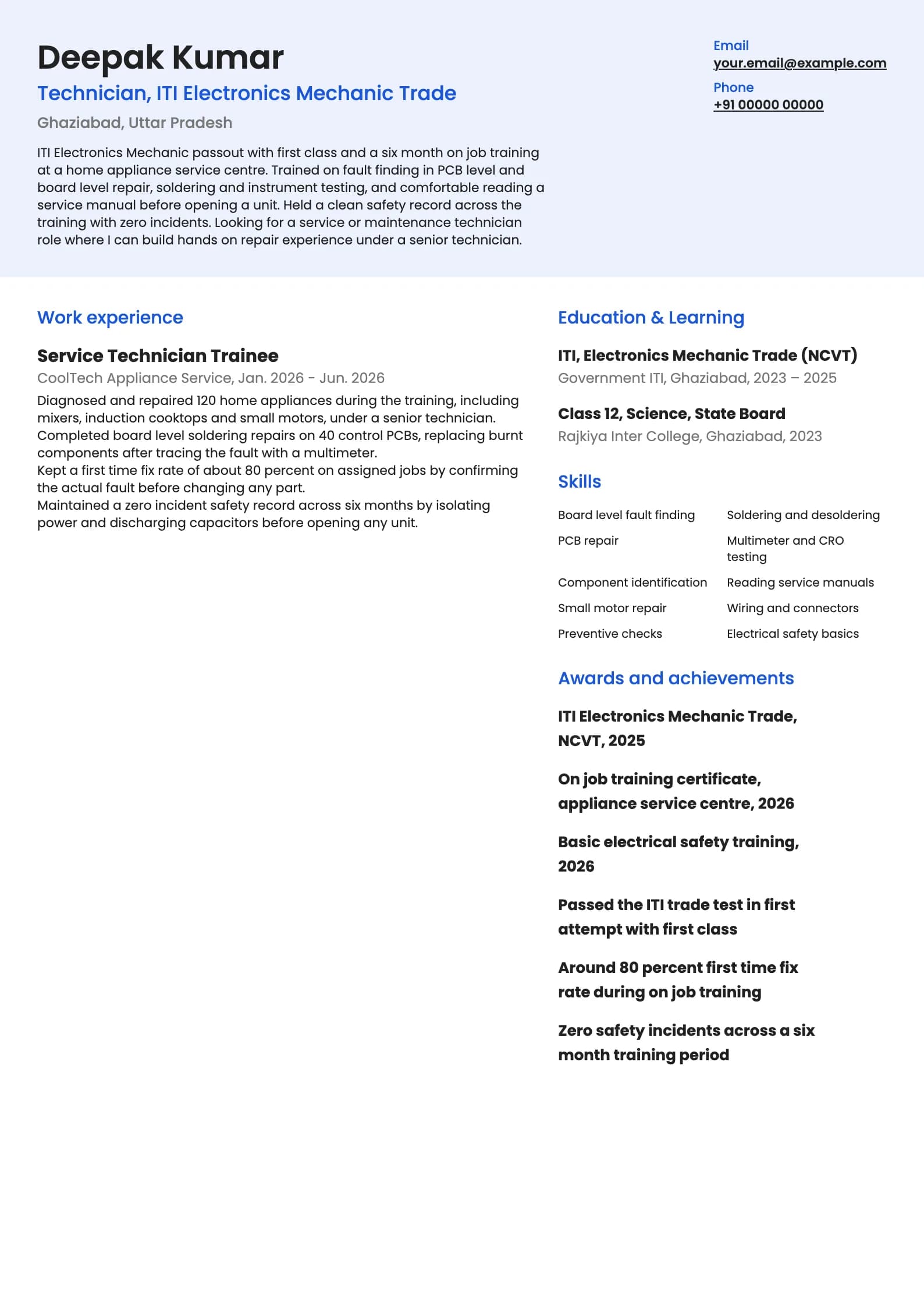
Build my resumeTechnician resume example, ITI Passout (0 to 1 year)
modern templateIs your resume good enough?
Upload the resume you have now and see what an applicant tracking system reads before a technician recruiter ever does.
Free to run. Sign in with your mobile number to see your score.
Technician resume example, Experienced Service Technician (4 years)
header-band template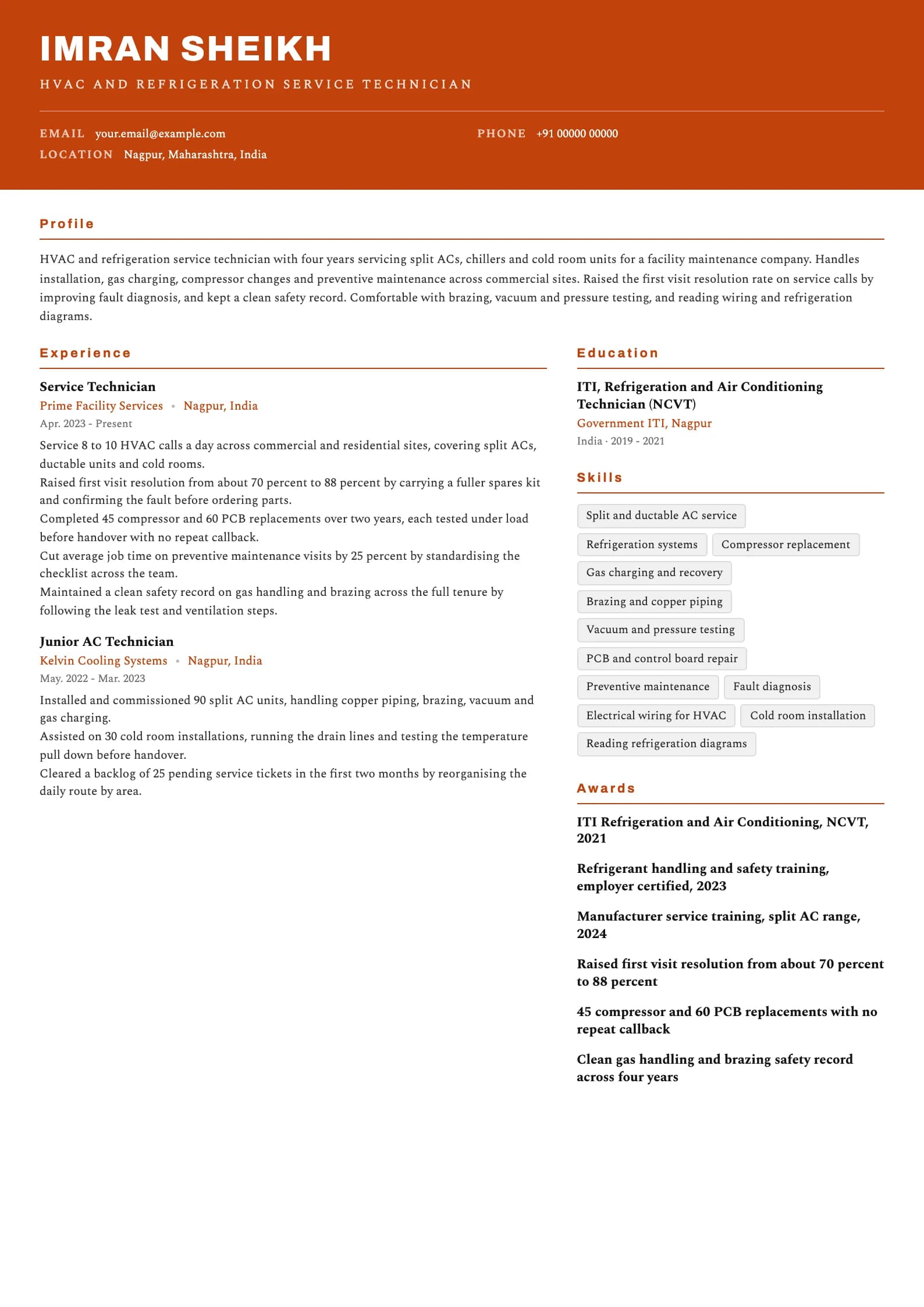
Want this structure with your own details? Build it in the resume builder.
Technician resume example, Shift Lead Technician (9 years)
professional template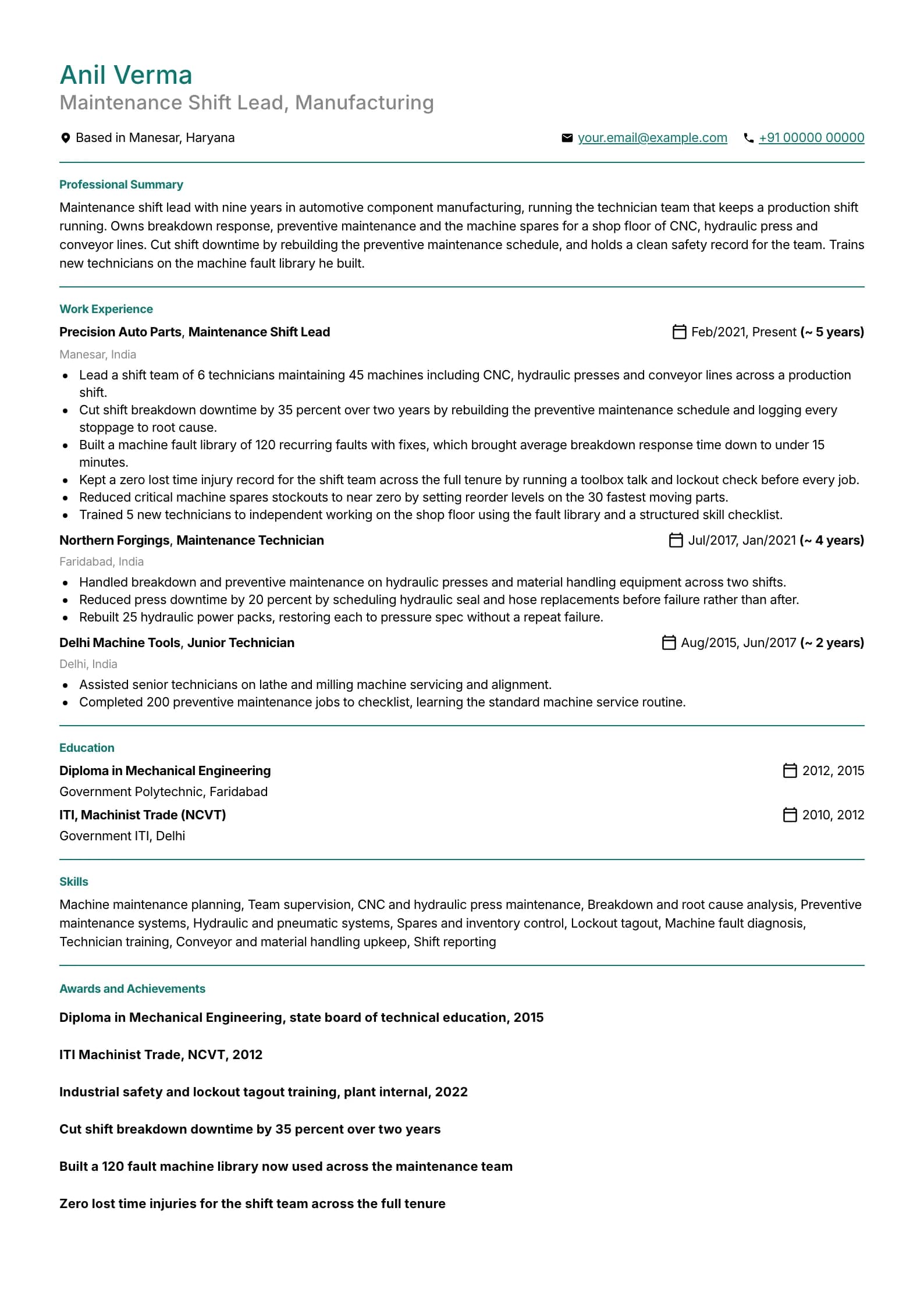
The format that works for a technician resume in India
Technician is a broad word, so the top of the page has to say which technician you are. A service manager or plant lead reads the top third and decides, so put your name, then a headline that names your trade and domain, for example HVAC and Refrigeration Service Technician, then a two or three line summary that states your ITI trade, your years and your strongest result. If a hirer cannot tell in one glance whether you service ACs, electronics or machines, the format has failed. Keep it to one page. A technician resume almost never needs two, and a second page here usually means a long objective and a full address padded the first. Reverse chronological, most recent job first, dates in plain view. One honest line covers a gap better than rearranging the page. Leave off the photograph, date of birth, marital status and father's name. They come from an old campus template and add nothing for a service or plant hirer. The space is better used for the machines you service, your first time fix rate or your safety record. The table below sets the section order that works.
| Section | Where it goes | Why |
|---|---|---|
| Name and headline | Top, above everything | The headline names your trade and domain, so a hirer matches in one glance. |
| Summary | Directly under the header | Two or three lines. Trade, years, the machines you service, and your strongest result. |
| Trade and certifications | High, near the summary | ITI trade and any manufacturer service training are the gate for a technician role. |
| Work experience | Next, for anyone with a job | Most recent first. Name the equipment and the fix rate or downtime result. |
| Skills | Below experience | Grouped by the actual work: diagnosis, repair, testing, safety. |
| Education | Bottom, ITI and any diploma | ITI trade with board and year. Add diploma if you hold one. |
Writing a summary a service manager actually reads
The block under your name is the part most likely to be read, so it should carry the three facts a hirer screens for: your trade and the machines you service, how long you have worked, and the strongest thing that changed because of your work. Two or three lines. No adjectives that cannot be checked. The old objective line, seeking a challenging position in a reputed organisation, tells a service manager nothing. Replace it with a summary that names the equipment and the result. An objective describes what you want, a summary describes what you have already fixed on the job, and only one of those helps a hirer decide. Freshers often think they have nothing to summarise. Look at the ITI passout sample. It names the trade, the training length, the first time fix rate and the safety record. That is a real summary built from an ITI course and one training stint, and it avoids the empty phrase quick learner and hardworking, which appears on nearly every technician resume.
Summary, experienced technician
Weak
A quick learner and hardworking technician seeking a good position in a reputed company to utilise my technical skills and knowledge.
Strong
HVAC and refrigeration service technician with four years on split ACs, chillers and cold rooms, who raised first visit resolution from 70 to 88 percent and kept a clean gas handling safety record.
The rewrite replaces self-description with the domain, the machines, one result and a safety record.
Experience bullets: verb, work, result
Every strong bullet in the samples follows the same shape. It opens with an action verb, names the specific work you did, and closes with what measurably changed. For a technician the numbers that persuade are usually about service quality: first visit resolution, repeat callbacks, jobs a day, downtime, machines serviced. Start from what was different after your work. A call was fixed on the first visit, a machine ran longer between failures, a job took less time, a part stopped failing. Then write the sentence that ends in that fact. Avoid lines like did all repair and maintenance work, which say nothing about scale or quality. Where you genuinely do not have a percentage, give scope: how many machines, how many jobs a day, how many installs. Completed 45 compressor replacements with no repeat callback carries weight without inventing a number.
| Level | What bullets must prove | Typical number |
|---|---|---|
| ITI passout | You can diagnose and repair safely under supervision | Jobs handled, first time fix rate, safety record |
| 2 to 5 years | You resolve calls on your own | First visit resolution, repeat callbacks, jobs a day, installs |
| 6 years and up | You run a team and own uptime | Downtime cut, response time, injuries avoided, technicians trained |
Experience bullet, service technician
Weak
Responsible for repairing and servicing of all AC units and doing installation work as required.
Strong
Raised first visit resolution from about 70 percent to 88 percent by carrying a fuller spares kit and confirming the fault before ordering parts.
Responsible for describes a job posting; the rewrite names the change made and the resolution rate it moved.
Experience bullet, machine work
Weak
Did repairing of many compressors and PCBs during my service job.
Strong
Completed 45 compressor and 60 PCB replacements over two years, each tested under load before handover with no repeat callback.
Names how many, tested under load, and that they held, so a hirer can ask a real follow up question.
For a service technician, first visit resolution and repeat callbacks are the two numbers a hirer trusts most. One says you diagnose right, the other says the fix holds.
The skills section: grouped, honest, defendable
A skills section has two readers. A person wants a short, organised list that signals what kind of technician you are: appliance service, HVAC, machine maintenance. A hirer filtering resumes wants the specific words that match the job, such as compressor, brazing, PCB, hydraulic. Group the list rather than dumping everything in one line. Diagnosis, repair, testing, and safety is a grouping that works for almost every technician. Ten to fourteen skills is the working range. Below eight it looks thin, and above twenty it stops being a signal. Every item on the list is a promise. A hirer can ask you to do any of it on a trial or a live call. If you have never brazed a joint, leave it off. Write the equipment names the way the trade writes them, PCB not pcb, CNC not cnc, so the list stays clean and readable.
Skills section
Weak
Skills: repairing, servicing, hardworking, honest, punctual, team work, computer knowledge, MS Office, technician work, maintenance
Strong
Diagnosis: fault finding, reading service manuals, multimeter and CRO. Repair: compressor change, PCB repair, brazing, gas charging. Testing: vacuum, pressure, under load. Safety: refrigerant handling, lockout tagout.
Cuts the personality words and MS Office, keeps only trade skills, and groups them so a hirer reads it in one pass.
Where the trade, certifications and safety record belong
For a technician the ITI trade and any manufacturer service training are the gate, so state them high on the page, near the summary, not buried at the bottom. Write the ITI trade with the board, NCVT or SCVT, and the year, because government contractors and many employers accept only NCVT. Name the specific trade too, Electronics Mechanic, Refrigeration and Air Conditioning, Machinist, because technician covers many trades and a hirer needs to know which one. Manufacturer or employer service training carries real weight for a service technician, because it says you have been trained on the exact equipment a company sells or runs. List it with the equipment range and the year. If you hold a diploma alongside ITI, list both, because a diploma opens supervisor and shift lead roles that ITI alone may not. The safety record deserves a line for anyone with experience. For gas handling, brazing, electrical or machine work, a stated period with no lost time injury is worth as much to a hirer as the repair skill, because they are buying someone who works safely around real hazards. Keep education itself short: ITI trade, any diploma, board and years. Class 12 is enough school detail, and only for a fresher.
What gets a technician resume rejected
Most rejections at the resume stage come from a small set of recurring problems, and all of them are fixable in an afternoon. The list below covers what hirers of Indian technician resumes see most often.
- A vague headline that just says Technician. Name the trade and domain, for example HVAC service or maintenance technician.
- The ITI trade left off or unnamed. Write the specific trade, the board, NCVT or SCVT, and the year.
- No service numbers. First visit resolution, repeat callbacks, jobs a day. Their absence reads as no track record.
- Job duties copied from a posting instead of what you did. Responsible for all repair work is the tell.
- A photo, date of birth, marital status or father's name taking the space a fix rate or a machine list needs.
- The same resume sent for appliance service, HVAC and machine jobs. The equipment and skills order should change.
- No safety record on hazardous work. For gas, electrical or machine work, a clean injury line is a strong missing signal.
- An ITI year or training claim that does not match the certificate. Site verification is common and a mismatch ends it.
Before you send it, check that a stranger can tell which kind of technician you are, and which machines you service, in the first five seconds.
Skills to put on a technician resume
Technical
- Fault diagnosis
- Board and PCB level repair
- Soldering and desoldering
- Compressor and motor repair
- HVAC and refrigeration service
- Hydraulic and pneumatic systems
- CNC and machine maintenance
- Preventive maintenance
- Gas charging and recovery
- Brazing and copper piping
- Installation and commissioning
- Reading service and wiring manuals
Tools and platforms
- Multimeter
- CRO
- Clamp meter
- Soldering station
- Vacuum pump
- Gas charging manifold
- Torque wrench and hand tools
- Insulation tester
- Pressure gauge set
Working skills
- Safety discipline
- Punctuality and shift reliability
- Customer handling on service calls
- Team coordination
- Clear job reporting
- Working under a supervisor
- Problem solving under time pressure
- Following checklists
Certifications worth listing as a technician
| Certification | Full name | Worth it for |
|---|---|---|
| ITI Trade | Industrial Training Institute trade certificate (NCVT or SCVT) | The base qualification for most technician jobs in India. Name the specific trade, Electronics Mechanic, Refrigeration and Air Conditioning, Machinist and others, plus the board and year. NCVT is accepted more widely than SCVT for government and contractor work. |
| Manufacturer Service Training | Product or brand service training, usually certified by the equipment maker | Strong signal for a service technician, because it proves training on the exact equipment a company sells or runs. List the equipment range and year. Often the deciding factor between two similar technicians. |
| Apprenticeship (NAPS) | Apprenticeship completion certificate under the National Apprenticeship Promotion Scheme | Turns an ITI passout into a candidate with a documented year on the job. Worth stating clearly for a fresher, because it is real supervised experience rather than only coursework. |
| Refrigerant Handling | Refrigerant handling and safety training | Important for HVAC and refrigeration technicians, since gas handling carries safety and environmental rules. Employers increasingly want proof of it before assigning gas charging work. |
| Diploma (Engineering) | Diploma in Mechanical, Electrical or Electronics Engineering | Useful for technicians aiming at shift lead or supervisor roles, where a diploma opens doors ITI alone does not. Not needed for hands on service work, but valuable for the step up to leading a team. |
Keywords an ATS scans for in a technician resume
These are the literal terms a parser matches against the job description. Use the ones that are true of you, in the sentences where you did the work, not as a list at the bottom.
- technician
- service technician
- maintenance technician
- ITI technician
- HVAC technician
- refrigeration technician
- PCB repair
- compressor replacement
- preventive maintenance
- breakdown maintenance
- fault diagnosis
- installation and commissioning
- hydraulic maintenance
- CNC maintenance
- lockout tagout
- first visit resolution
Technician resume FAQ
What salary can a technician expect in India?
An ITI passout technician usually starts around 12,000 to 18,000 rupees a month, more on industrial sites and in metros. An experienced service technician with four to six years commonly earns 20,000 to 35,000 rupees a month, and field roles with an incentive on service calls can go higher. A maintenance shift lead with a team and eight or more years can reach 40,000 to 65,000 rupees a month. Manufacturer training and a strong first visit resolution record both push the number up.
Do I need ITI to become a technician?
For most factory, service centre and contractor roles the ITI trade is the minimum on paper, and it is the fastest route into a technician career. Some workers start as helpers and learn on the job, but without a trade certificate the better paying and permanent roles stay closed. If you have skill but no certificate, an NCVT trade course in your domain is the single highest value thing to add.
Which ITI trade is best for a technician job?
It depends on the field you want. Electronics Mechanic suits appliance and electronics service, Refrigeration and Air Conditioning suits HVAC, Machinist and Fitter suit machine maintenance, and Electrician suits electrical maintenance. Pick the trade that matches the sector hiring near you, and name it clearly on your resume, because a hirer screens on the exact trade, not on the word technician alone.
What format is best for a technician resume?
One page, reverse chronological, with the trade and domain stated in the top third. Lead with a headline that names your trade, then a two or three line summary, then the ITI and any service training, then experience with real service numbers, then grouped skills. Send a PDF unless the employer asks otherwise. A single column parses cleanly and reads fast for a service manager scanning many resumes.
How do I write a technician resume as a fresher?
Lead with your ITI trade and any on job training or apprenticeship. Treat the training as real experience: how many units you diagnosed, your first time fix rate, and your safety record. Add any manufacturer training even if it was short. A fresher resume that names 120 appliances handled and an 80 percent fix rate beats one that only lists skills, because it shows you have actually worked on machines.
Should I list a first visit resolution or fix rate?
Yes, if you have a real figure. For a service technician, first visit resolution and repeat callback rate are the numbers a hirer trusts most, because one shows you diagnose correctly and the other shows the fix holds. State it honestly with a period, for example raised first visit resolution from 70 to 88 percent, so it reads as a track record rather than a claim.
Related resume examples and guides
Build your technician resume in minutes
Start from a blank resume or upload the one you have. Goodspace renders it in a clean format that puts your trade, the machines you service and your fix rate where a hirer looks first.
Build my resume