3 Driver Resume Examples, Format and Guide
A driver resume in India is read by a transport manager, a family or a fleet owner who wants to know three things fast: your licence class, your driving record, and your route or vehicle experience. Below are three complete resumes, one for a new driver, one for an experienced commercial driver and one for a fleet supervisor, followed by the format rules and the details a hirer scans for. Each sample is a full document with a clear licence line, a real safety and challan record, and honest numbers, not a page of adjectives.
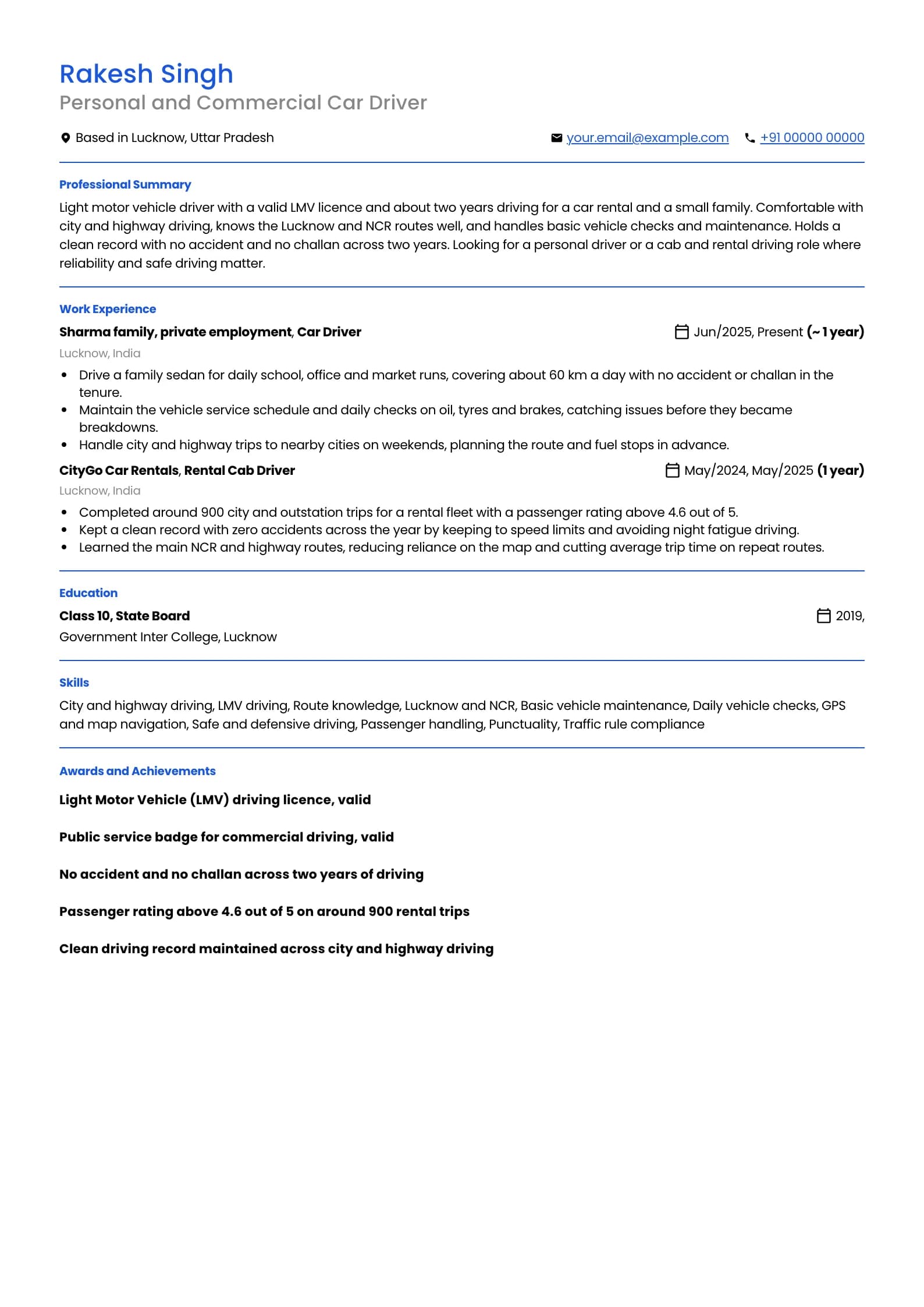
Build my resumeDriver resume example, New Driver (1 to 2 years)
minimalist templateIs your resume good enough?
Upload the resume you have now and see what an applicant tracking system reads before a driver recruiter ever does.
Free to run. Sign in with your mobile number to see your score.
Driver resume example, Experienced Commercial Driver (6 years)
header-band template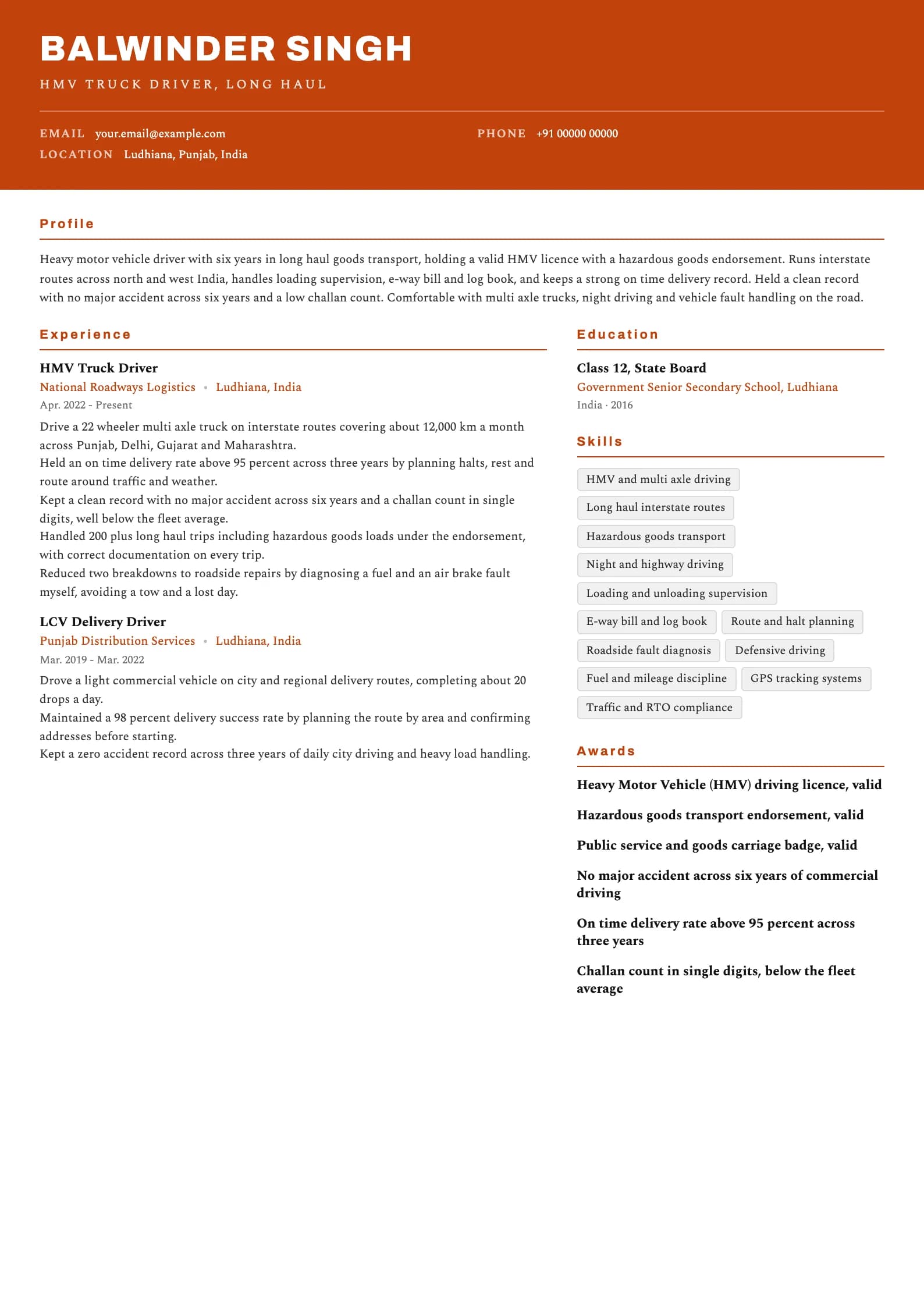
Want this structure with your own details? Build it in the resume builder.
Driver resume example, Fleet Supervisor Driver (12 years)
professional template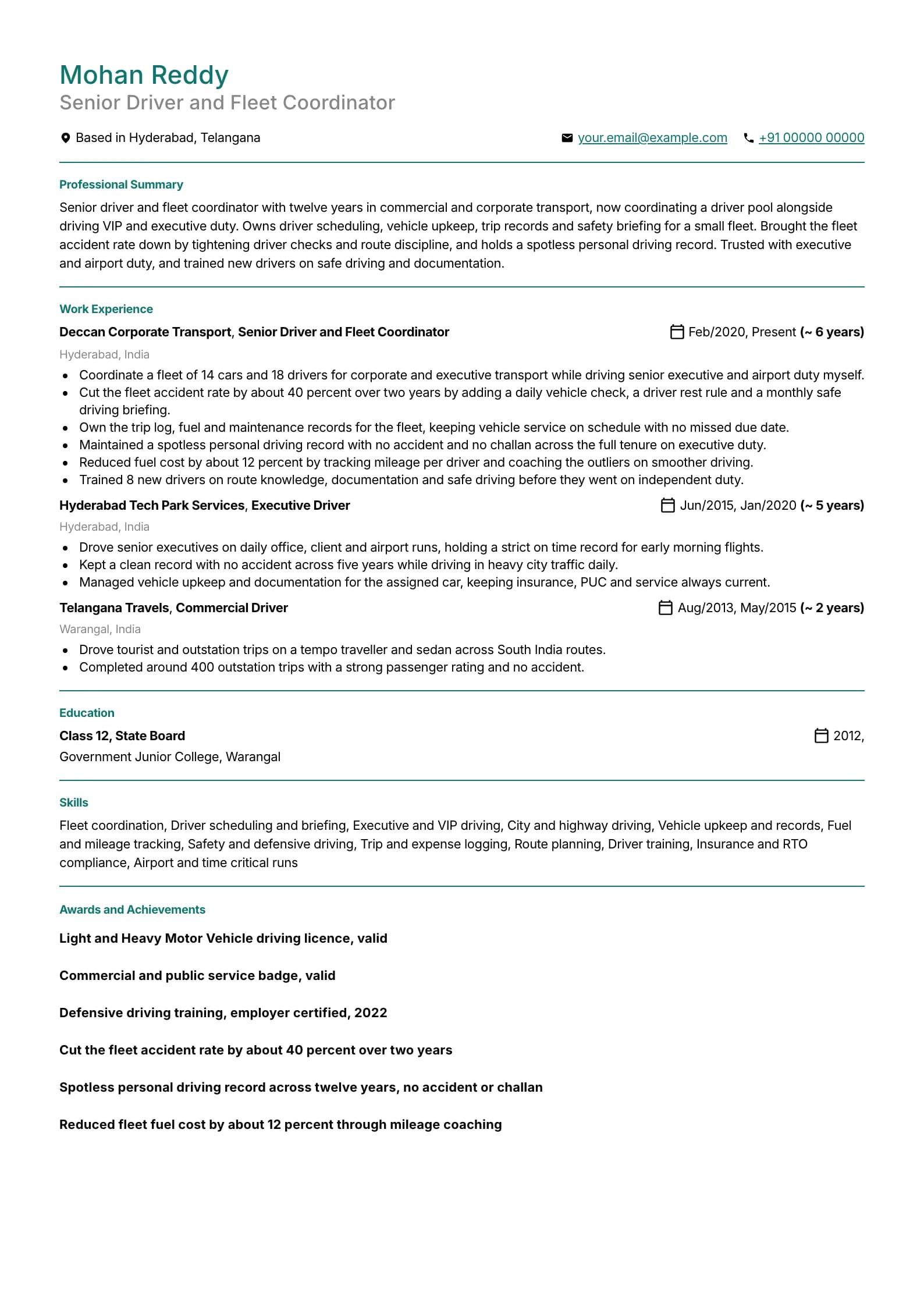
The format that works for a driver resume in India
A transport manager, family or fleet owner reads the top third of the page and decides, so the top third has to carry the licence class, the driving record and the vehicle or route experience. Put your name, then a headline that names the driving you do, for example HMV Truck Driver, Long Haul, then a two or three line summary that states your licence, your years and your safety record. If a hirer cannot tell in one glance whether you hold LMV or HMV, and whether your record is clean, the format has failed. Keep it to one page. A driver resume almost never needs two, and a second page here usually means a long objective and a full address padded the first. Reverse chronological, most recent job first, dates in plain view. One honest line covers a gap better than rearranging the page. Leave off the photograph, date of birth, marital status and father's name. They come from an old template and add nothing for a transport hirer. The space is better used for your licence class, your accident and challan record or your routes. The table below sets the section order that works.
| Section | Where it goes | Why |
|---|---|---|
| Name and headline | Top, above everything | The headline names the driving you do, so a hirer matches in one glance. |
| Summary | Directly under the header | Two or three lines. Licence class, years, routes, and your safety record. |
| Licence and record | High, near the summary | Licence class, endorsements and a clean accident and challan record are the gate. |
| Work experience | Next, for anyone with a job | Most recent first. Name the vehicle, the routes and the delivery or safety result. |
| Skills | Below experience | Grouped: driving, vehicle care, route knowledge, safety. |
| Education | Bottom, keep it short | Class 10 or 12 with board and year. School matters little for driving roles. |
Writing a summary a transport hirer actually reads
The block under your name is the part most likely to be read, so it should carry the three facts a hirer screens for: your licence class and record, how long you have driven, and the routes or vehicles you know. Two or three lines. No adjectives that cannot be checked. The old objective line, seeking a challenging position in a reputed organisation, tells a transport hirer nothing. Replace it with a summary that states the licence, the record and the routes. An objective describes what you want, a summary describes the driving you have already done safely, and only one of those helps a hirer decide. Even a newer driver has a real summary. Look at the new driver sample. It states the LMV licence, the two years, the clean record and the routes known. That is a real summary, and it avoids the empty phrase hardworking and honest driver, which appears on nearly every driver resume and carries no information.
Summary, commercial driver
Weak
Hardworking and honest driver looking for a good driving job in a reputed company where I can use my driving experience.
Strong
HMV driver with six years in long haul goods transport, valid HMV licence with a hazardous goods endorsement, no major accident across six years and a single digit challan count on interstate routes.
The rewrite replaces self-description with the licence class, the endorsement, the record and the route type.
Experience bullets: verb, driving, result
Every strong bullet in the samples follows the same shape. It opens with an action verb, names the specific driving you did, and closes with what measurably held. For a driver the numbers that persuade are about safety and reliability: accidents avoided, challans, on time delivery, trips completed, kilometres, passenger rating, fuel saved. Start from your record. No accident over a stated period, an on time delivery rate, a passenger rating, a fuel figure. Then write the sentence that ends in that fact. Avoid lines like did driving duty as required, which say nothing about scale or safety. Where you genuinely do not have a percentage, give scope: how many trips, how many kilometres a month, how many drops a day, which routes. Completed 200 long haul trips with correct documentation carries weight without inventing a number.
| Level | What bullets must prove | Typical number |
|---|---|---|
| New driver | You drive safely and know the roads | Clean record, trips completed, passenger rating, routes known |
| 3 to 7 years | You run routes and handle the vehicle on your own | On time delivery, kilometres, accidents avoided, challans, fuel |
| 8 years and up | You are trusted with duty or coordinate others | Fleet accident rate, drivers coordinated, fuel cost, trained |
Experience bullet, commercial driver
Weak
Responsible for driving the truck and delivering goods to different locations on time.
Strong
Held an on time delivery rate above 95 percent across three years by planning halts, rest and route around traffic and weather.
Responsible for describes a job posting; the rewrite names the record and how it was achieved.
Experience bullet, safety record
Weak
Always drove safely and never had any major problem on the road during my job.
Strong
Kept a clean record with no major accident across six years and a challan count in single digits, well below the fleet average.
Turns a vague claim into a stated period, an accident record and a challan count a hirer can verify.
For a driver, the accident and challan record is the single most important line on the page. State it as a fact with a period, because a hirer is trusting you with their vehicle and their people.
The skills section: grouped, honest, defendable
A skills section has two readers. A person wants a short, organised list that signals what kind of driver you are: personal car, commercial truck, executive duty. A hirer filtering resumes wants the specific words that match the job, such as HMV, long haul, city driving, route knowledge. Group the list rather than dumping everything in one line. Driving, vehicle care, route knowledge, and safety is a grouping that works for almost every driver. Ten to fourteen skills is the working range. Below eight it looks thin, and above twenty it stops being a signal. Every item is a promise. A hirer can ask you to do any of it on a trial drive. If you have never driven a multi axle truck, leave it off. Write the licence and vehicle terms the way the RTO writes them, LMV and HMV, so the list stays clean and readable.
Skills section
Weak
Skills: driving, hardworking, honest, punctual, good behaviour, no bad habits, city driving, long driving, computer, mobile
Strong
Driving: LMV and HMV, long haul, night and highway. Vehicle care: daily checks, basic maintenance, roadside fault. Routes: north and west India, GPS navigation. Safety: defensive driving, RTO and traffic compliance.
Cuts the character claims, keeps only driving skills, and groups them so a hirer reads it in one pass.
Where the licence, record and documents belong
For a driver the licence and the driving record are not a footnote, they are the gate. State them high on the page, near the summary. Write the licence class clearly, LMV, HMV, or both, and name any endorsement such as hazardous goods or a public service badge, because these decide which jobs you can legally do. State the licence as valid, because an expired licence listed as current is checked and ends the process. The driving record deserves its own line. A stated period with no accident and a low or zero challan count is the strongest thing on a driver's resume, because a hirer is handing over a vehicle and, often, their family or their goods. Say it as a fact with a period attached, no accident and no challan across two years, so it reads as a record rather than a claim. Keep the document status current in your own file even if it is not all on the resume: licence renewal date, badge, and for commercial work the vehicle papers you are used to keeping in order, insurance, PUC, fitness and permit. Mentioning that you keep these current signals a driver who does not create legal trouble for the owner. Education stays short here: Class 10 or 12 with board and year is enough, because school matters little for a driving role and the space is better spent on the record.
What gets a driver resume rejected
Most rejections at the resume stage come from a small set of recurring problems, and all of them are fixable in an afternoon. The list below covers what hirers of Indian driver resumes see most often.
- No licence class stated. A hirer cannot tell whether you can legally drive their vehicle, so LMV or HMV must be clear.
- No driving record. A missing accident and challan line reads as something to hide for a driver.
- Route or vehicle experience left off. A hirer wants to know the roads and the vehicles you actually know.
- Vague duty lines instead of a record. Did driving as required says nothing about safety or scale.
- A photo, date of birth, marital status or father's name taking the space a licence or record line needs.
- The same resume sent for personal car, truck and executive jobs. The vehicle and route focus should change.
- An expired licence or endorsement listed as valid. It is checked at the RTO and a mismatch ends the process.
- No mention of keeping vehicle documents current, which a commercial or fleet hirer specifically looks for.
Before you send it, check that a stranger can read your licence class and your accident record in the first five seconds. For a driver, that is the whole decision.
Skills to put on a driver resume
Technical
- LMV driving
- HMV and multi axle driving
- Long haul and interstate routes
- City and highway driving
- Night driving
- Basic vehicle maintenance
- Daily vehicle checks
- Roadside fault diagnosis
- Loading and unloading supervision
- Fuel and mileage discipline
- GPS and route navigation
- Hazardous goods handling
Tools and platforms
- GPS and navigation apps
- E-way bill and log book
- Vehicle tracking systems
- Basic hand tools
- Tyre and jack tools
- Fuel and trip log
Working skills
- Safety and defensive driving
- Punctuality
- Passenger and client handling
- Traffic rule compliance
- Calm under pressure
- Route and time planning
- Honesty and reliability
- Clear reporting
Certifications worth listing as a driver
| Certification | Full name | Worth it for |
|---|---|---|
| LMV Licence | Light Motor Vehicle driving licence, issued by the RTO | The base licence for cars and light vehicles, required for personal, cab and light delivery driving. State it as valid with the class clear. The minimum a driver hirer looks for, and often enough on its own for personal and rental work. |
| HMV Licence | Heavy Motor Vehicle driving licence, issued by the RTO | Required for trucks, buses and heavy commercial vehicles. It opens the better paid long haul and goods transport work, and a hirer for those roles screens on it first. Usually needs a minimum age and prior LMV experience to obtain. |
| Commercial Badge | Public service or goods carriage driving badge | Required alongside the licence to legally drive for hire, whether passengers or goods. Cab, bus and commercial goods roles ask for it, so state it as valid. Without it a commercial hirer cannot legally put you on the road. |
| Hazardous Goods Endorsement | Hazardous goods transport endorsement on the driving licence | Required to carry chemical, fuel and other hazardous loads. It is a genuine differentiator for a truck driver, because fewer drivers hold it and the loads pay more. State it clearly if you have it. |
| Defensive Driving | Defensive driving training, often employer or agency certified | A useful signal for corporate, executive and fleet roles that care about safety records. Not legally required, but it reassures a hirer who is trusting you with executives or an expensive vehicle. |
Keywords an ATS scans for in a driver resume
These are the literal terms a parser matches against the job description. Use the ones that are true of you, in the sentences where you did the work, not as a list at the bottom.
- driver
- commercial driver
- HMV driver
- LMV driver
- truck driver
- car driver
- executive driver
- long haul driving
- route knowledge
- defensive driving
- vehicle maintenance
- on time delivery
- driving licence
- hazardous goods
- fleet
- RTO compliance
Driver resume FAQ
What salary can a driver expect in India?
A personal or LMV car driver usually earns around 12,000 to 20,000 rupees a month, more in metros and for longer hours. An experienced commercial or HMV driver with a clean record commonly earns 20,000 to 40,000 rupees a month, and long haul work with trip incentives can go higher. A senior or executive driver and a fleet coordinator can reach 30,000 to 55,000 rupees a month. An HMV licence, endorsements and a clean accident record all raise the number.
What is the difference between LMV and HMV licence?
An LMV, Light Motor Vehicle, licence covers cars and light vehicles, and is enough for personal, cab and light delivery driving. An HMV, Heavy Motor Vehicle, licence covers trucks, buses and heavy commercial vehicles, and opens the better paid long haul and goods transport roles. For any commercial work you also need a public service or goods carriage badge alongside the licence. State the class clearly on your resume, because hirers screen on it.
How do I write a driver resume with no formal experience?
Lead with your licence class and your driving record, even if the experience is informal. Private driving for a family, cab or rental work, and delivery driving all count. State how long you have driven, the routes you know, and a clean accident record. If you drove for a family, list it as private employment with the duties and the record. A resume that shows a clean two year record and known routes beats one that only lists the licence.
What format is best for a driver resume?
One page, reverse chronological, with the licence class and record stated in the top third. Lead with a headline that names the driving you do, then a two or three line summary, then the licence and record, then experience with real numbers, then grouped skills. Keep education to one line. Send a PDF unless the employer asks otherwise. A single column reads fast for a transport manager scanning many resumes.
Should I put my accident and challan record on the resume?
Yes, if it is clean. For a driver, a stated period with no accident and a low or zero challan count is the single strongest line on the page, because a hirer is trusting you with a vehicle and often their family or goods. State it as a fact with a period, for example no accident and no challan across two years. If your record is not clean, focus on the years, routes and reliability instead, and be honest in the interview.
Do I need to know English to get a driving job in India?
For most driving jobs, no. Local language and Hindi are usually enough, and route knowledge and a clean record matter far more. Some English helps for executive, corporate and airport duty where you interact with clients, and for reading documents and signs on national highways. List the languages you actually speak, and do not overstate English, because it will be tested quickly on an executive role.
Related resume examples and guides
Build your driver resume in minutes
Start from a blank resume or upload the one you have. Goodspace renders it in a clean format that puts your licence class, driving record and routes where a hirer looks first.
Build my resume