Home Tutor Resume Format, with 3 Full Samples
A home tutor is hired by a parent, not an HR desk, and a parent buys one thing: evidence that a child's marks or confidence moved under someone they can trust in their home. Yet most tutor resumes list subjects and boards and forget the result and the reference. Below are three complete resumes, one for a fresher who tutors alongside a degree, one for an experienced tutor with a steady roster across boards, and one for a full-time private tutor running a small tuition setup with a track record of board and entrance results. After the samples come the format rules, why a parent-ready reference matters more than a fancy layout, the difference between listing a subject and proving a child improved, the terms tuition platforms and school-tutor desks match literally, and the mistakes that lose a parent's trust before the trial class.
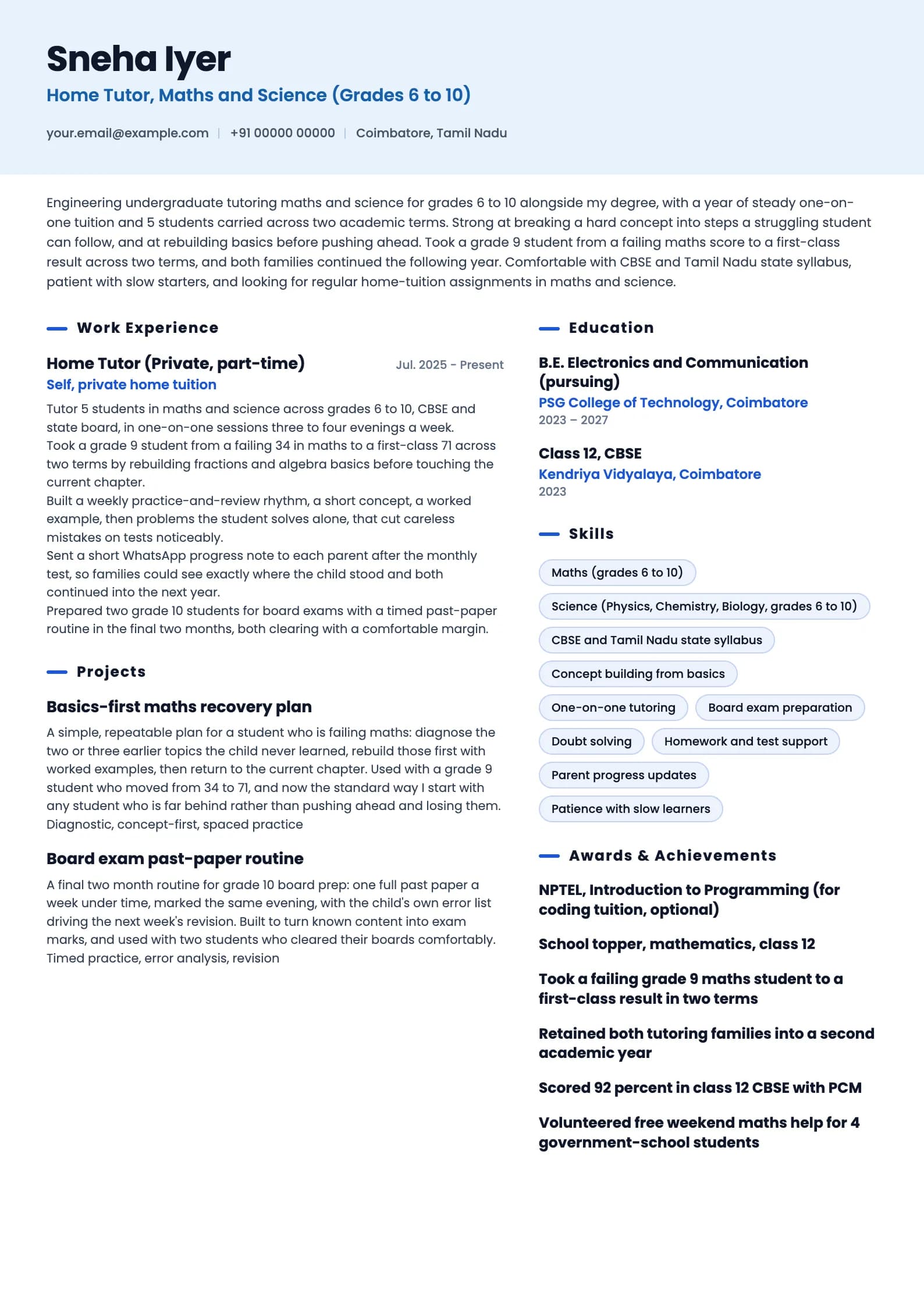
Build my resumeHome Tutor resume example, Fresher / Part-time (1 year)
ai-era templateIs your resume good enough?
Upload the resume you have now and see what an applicant tracking system reads before a home tutor recruiter ever does.
Free to run. Sign in with your mobile number to see your score.
Home Tutor resume example, Experienced (6 years)
professional template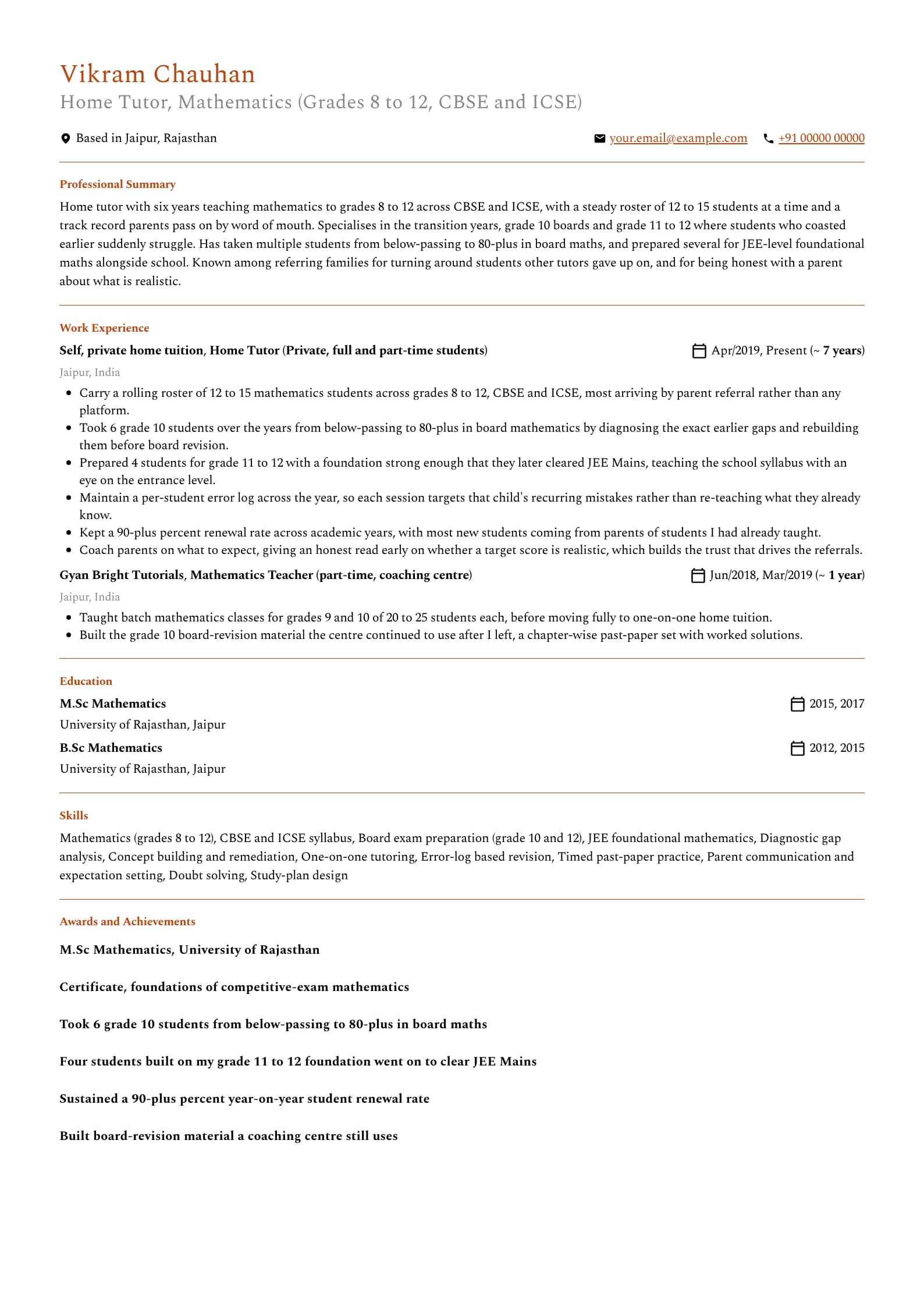
Want this structure with your own details? Build it in the resume builder.
Home Tutor resume example, Full-time / Established (10 years)
minimalist template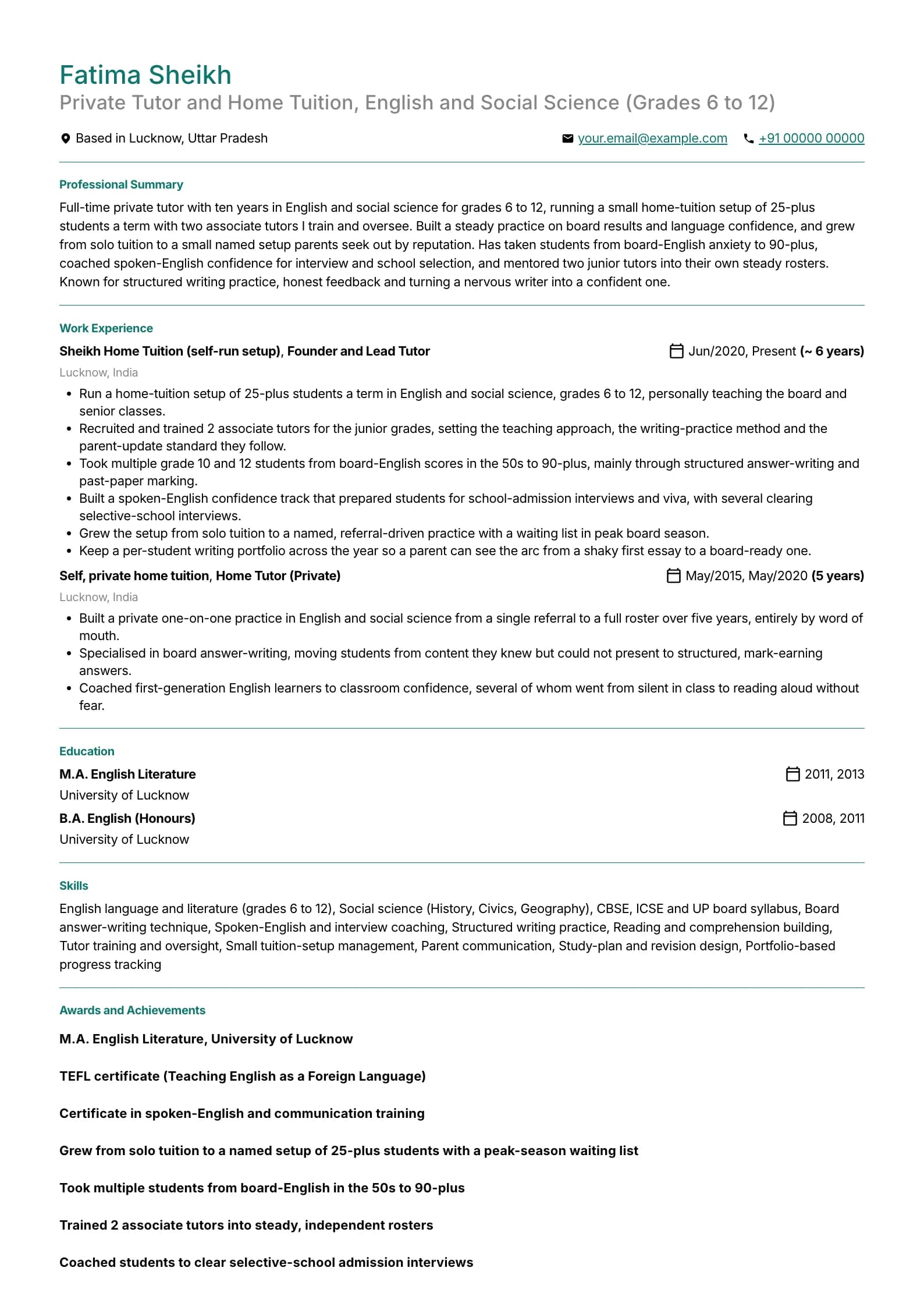
The format that works for home tutor resumes in India
A home tutor's resume has a different reader from most: often a parent, sometimes a tuition-platform desk, occasionally a school looking for an after-hours tutor. All of them want the same thing quickly, which subject and board and class you teach, what results your students have got, and whether you can be trusted in a family's home. Reverse chronological still applies, most recent first, but the summary and the results carry more weight here than the job-title timeline. Keep it to one page. A home tutor almost never needs two, because the job is proven by a handful of concrete results and references, not a long employment history. If you have taught at a coaching centre or school as well as privately, list it, but do not pad. A parent scanning three tutor profiles wants the one that is easiest to trust, and brevity helps. Four things belong nowhere on the page, and this matters doubly for a role that enters a home: leave off a photograph, date of birth, marital status and father's name. They come from an older template and do nothing to earn a parent's trust, which comes from results and references instead. Note that a parent will reasonably want to verify identity separately before a tutor enters the home, but that belongs in the conversation, not printed on a resume. Name your subjects, boards and grade range precisely, and be honest about them. "All subjects, all classes" reads as a generalist and lowers trust, while "mathematics, grades 8 to 12, CBSE and ICSE" reads as someone who knows exactly the parent's problem. Send a PDF, name the file with your name and your main subject, and keep a single column. The table below sets the section order.
| Section | Where it goes | Why |
|---|---|---|
| Name and headline | Top, above everything | Headline names subject, grade range and board, e.g. Home Tutor, Maths, grades 8 to 12, CBSE. |
| Summary | Directly under the header | Three lines. Subject, years, roster and the single strongest student result. |
| Results and experience | Next, and the heart of the page | Most recent first. Lead each with a result a parent can check, not a duty. |
| Subjects, boards and grades | Near the top, in skills or the summary | The exact match a parent hires for. Be specific and honest. |
| Skills and approach | Below experience | Concept building, board technique, doubt solving. How you teach, briefly. |
| Education | Bottom, unless a fresher | Degree and subject. A maths tutor's M.Sc maths is worth naming. |
| References or retention | Wherever it fits honestly | Renewal rate, word-of-mouth intake, a parent willing to be a reference. |
Why a parent-ready reference beats a fancy layout
A parent hiring a home tutor is making a trust decision about someone who will sit with their child, often alone, in their home. That is a bigger ask than most jobs, and no template flourish addresses it. What addresses it is evidence: a specific student who improved, a family who renewed, a parent willing to speak to you. Build the resume around that, not around design. Retention is the closest thing a tutor has to a testimonial. "Both families continued into the next year" or "90-plus percent renewal across academic years" tells a parent that other parents, who watched the child up close, chose to keep paying. That is a stronger signal than any adjective, and it costs nothing but honesty to state. Name a result a parent can check. A mark that moved, a board grade cleared, an interview passed. "Took a grade 9 student from 34 to 71 in two terms" is verifiable in a way that "improved students' performance significantly" is not, and a parent trusts the specific number precisely because it could be checked. Offer references without oversharing. A line such as "references available from tutoring families on request" is enough, and it signals confidence. Do not print other families' names or a child's marks with identifying detail on a document you send to strangers, because a parent judging your discretion is watching how you treat other families' privacy.
A parent is not buying a resume, they are buying trust. Every result, renewal and reference on the page is a reason to trust you; every generic adjective is a wasted line. Lead with the evidence a parent could verify.
Listing a subject is not the same as proving a child improved
The most common home-tutor resume failure is a subject list with no result behind it: maths, science, English, social science, all boards, all classes, with no bullet showing a single student who moved. A platform's search matches the subjects, but a parent reads the list and cannot tell whether you can actually teach, only that you are willing to try anything. The fix is to let the experience prove the teaching. For each subject you lead with, there should be a student and a change: a mark that rose, a board grade cleared, a concept a child finally understood. The samples do this deliberately, the 34-to-71 maths recovery, the board-English 50s to 90-plus, the students who cleared JEE Mains on a foundation you built. The subject line and the results agree, which is what makes both believable. Be honest about range, because overclaiming is the fastest way to lose a parent. A maths tutor who also lists chemistry, biology, English and social science for grades 6 to 12 reads as a generalist, and a parent whose child needs serious maths help trusts the specialist more. It is stronger to own a tight range, mathematics for grades 8 to 12, than to claim everything and prove nothing. Show your teaching method in a line or two, because how you teach is part of what a parent buys. "Diagnose the earlier gaps, rebuild those first, then return to the current chapter" tells a parent you have a real approach, not just subject knowledge. A tutor who can describe their method is easier to trust than one who only lists what they know.
Subjects line, home tutor
Weak
Subjects: All subjects, Maths, Science, English, Social Science, Hindi, Computer, all boards, all classes from 1 to 12.
Strong
Mathematics and science, grades 6 to 10, CBSE and Tamil Nadu state. Strongest in maths recovery for students who are far behind, with a concept-first, basics-rebuilt approach.
Trades an unbelievable everything-for-everyone claim for a tight, honest range and the teaching approach a parent actually hires for.
Writing a summary a parent actually reads
The block under your name is what a parent reads before deciding whether to message you, so it should carry four facts: what you teach and for which board and grades, how long you have tutored, the size or steadiness of your roster, and the single strongest result a student got. Three or four lines, no adjectives a parent could not check. The old objective line, seeking tutoring opportunities to share my knowledge with students, tells a parent nothing. Replace it with a summary. An objective says what you want, a summary says what your students have already achieved, and only one earns a trial class. Freshers often feel they have nothing to summarise. Look at the fresher sample: it names the subjects and boards, states one year and five students, and points at a specific student who went from failing to first-class. That is a genuine summary built from a single year of part-time tutoring. What it avoids is "passionate about teaching", which every tutor writes and no parent believes on its own. A practical test: read your summary and ask whether any tutor with your degree could paste it onto their profile unchanged. If they could, it describes the qualification, not you. Add the specific board, the specific roster and the specific student result until it is unmistakably yours.
Summary, experienced tutor
Weak
Passionate and dedicated tutor with several years of experience teaching maths to school students, seeking to help students achieve their academic goals.
Strong
Home tutor with six years in mathematics for grades 8 to 12 across CBSE and ICSE, carrying a steady roster of 12 to 15 students, most by parent referral. Has taken multiple grade 10 students from below-passing to 80-plus in board maths.
The rewrite trades a warm self-description for a subject, a board, a roster size, an intake channel and a verifiable result.
Experience bullets: student, what you did, result a parent can check
Every strong bullet in the samples follows the same shape. It names the student or group, describes what you actually did, and closes with a result a parent could verify. The student grounds it, the method shows how you teach, and the result does the persuading. Start from the student's outcome and work backwards. Tutors tend to write the activity first, "took regular classes and cleared doubts", then struggle to attach a result. Instead ask what was different for the student after a term: a mark rose, a board grade cleared, a concept clicked, a family renewed. Then write the sentence that ends in that fact. Vary the evidence. Marks gained, board grades, entrance results, renewal rate, students carried, an interview cleared. A page of only one kind of number reads thin, while a mix, a mark turnaround plus a renewal rate plus a board result, shows the full picture of a tutor who both teaches and retains. Where you cannot share an exact mark, give scope or the change without identifying a child: how many students on the roster, how many cleared boards, a renewal rate, a nervous writer turned confident. "Carry a rolling roster of 12 to 15 students, most by referral" carries weight without exposing any family's data. Weight bullets toward what a parent cares about. Results and retention first, teaching method second, everything else after. A hobbies line or a school-topper fact from a decade ago is not what wins a trial class.
| Stage | What bullets must prove | Typical evidence |
|---|---|---|
| Fresher / part-time | You improved at least one student and were kept | A mark turnaround, families who renewed, a board clear |
| A few years | You hold a steady roster and get repeat referrals | Roster size, renewal rate, board and entrance results |
| Experienced | You are a trusted specialist parents seek out | Word-of-mouth intake, multiple result turnarounds, waiting list |
| Established / setup | Your method works beyond you and you train others | Setup size, tutors trained, sustained renewal, reputation |
Experience bullet, private tutor
Weak
Took tuition classes for school students and helped them improve their marks and clear their doubts regularly.
Strong
Took a grade 9 student from a failing 34 in maths to a first-class 71 across two terms by rebuilding fractions and algebra basics before touching the current chapter.
Swaps a generic duty for a specific student, the actual method used, and a checkable before-and-after a parent trusts.
Experience bullet, retention
Weak
Maintained good relationships with parents and students throughout the tutoring engagement.
Strong
Kept a 90-plus percent renewal rate across academic years, with most new students coming from parents of students I had already taught.
Turns a vague relationship claim into a retention number, which is the strongest trust signal a private tutor can offer.
If a bullet would read the same on any tutor's resume, it is describing tutoring, not you. Rewrite it until it names a real student, a real method and a result a parent could check.
The skills section: subjects, method, and no over-claiming
A home tutor's skills section has two jobs. It must carry the literal subject, board and grade terms a platform or parent searches for, and it must signal how you teach. Keep it honest and grouped, because an over-broad list lowers trust rather than raising it. Group by subject and by approach. Subjects and boards, teaching approach, and exam preparation is a grouping that works for almost any tutor. Name subjects and boards the way parents write them, CBSE, ICSE, the state board by name, and the grade range in plain numbers. Precision is the match a parent is scanning for. Eight to fourteen skills is the working range. Below six the section looks thin. Above fifteen, and especially when it lists every subject for every class, it reads as over-claiming, which is the one thing that lowers a parent's trust fastest in this role. The list is a promise, and a parent will test the first subject you name in the trial class. Do not add a proficiency bar or star ratings. A parent does not want a self-assessment, they want a result and a reference. Let the experience and the renewal rate prove the depth instead, and use the skills section only to state clearly what you teach and how.
| Group | What goes in it | How many |
|---|---|---|
| Subjects and boards | Your real subjects, the exact boards and grade range | 3 to 5 |
| Teaching approach | Concept building, diagnostic gap analysis, doubt solving | 2 to 4 |
| Exam preparation | Board technique, timed past papers, entrance foundation | 2 to 3 |
| Working with families | Parent updates, expectation setting, progress tracking | 1 to 2 |
Where education and qualifications belong
For a home tutor, education matters more when it matches the subject you teach. A maths tutor's M.Sc mathematics, an English tutor's M.A. English, a science tutor's engineering or science degree, all carry real weight because they tell a parent you know the subject deeply, not just one class ahead of the child. Name the degree, the subject and the institution. For a fresher who tutors alongside a degree, the education is part of the pitch. A pursuing B.E. with a strong CGPA, a class 12 with 92 percent in the subjects you teach, a school-topper fact, all reassure a parent that the tutor genuinely commands the material. Keep these while you are early, because they are among your strongest signals before you have a long results record. Once you have a steady roster and real turnarounds, marks from your own schooling matter less and student results matter more. A parent choosing between tutors cares that your students improved far more than that you scored 92 percent a decade ago, so let the results lead and keep education as support. Subject-teaching certificates can help where they fit. A TEFL for an English and spoken-English tutor, a competitive-exam foundation certificate for a maths tutor aiming at JEE support, a coding certificate for a computer tutor. Name only what maps to what you teach, because an unrelated certificate is padding a parent skips.
Getting found on tuition platforms and search
Many home tutors are found through tuition platforms and marketplaces, which behave like an applicant tracking system: a parent or the platform searches by subject, board, grade and location, and a matching engine returns profiles. Getting found is a parsing and keyword problem, so the same discipline that helps a corporate resume helps a tutor profile. Use the literal terms a parent searches. Write the board by name, CBSE, ICSE, the state board, the grade range in numbers, and the subject the way it is searched, mathematics and maths, physics and science. Include your city or area, because home tuition is local and a parent filters by distance first. If a platform has a subjects field, fill every relevant one honestly rather than cramming unrelated ones. Keep the layout clean and the headings standard when you send a document. One column, plain headings like Experience and Subjects, no text trapped inside an image, and no critical detail buried in a header or footer that a parser may drop. A tech-heavy or two-column design can scramble in a platform's importer just as it does in a corporate ATS. Do not stuff. Listing every subject and every class to appear in more searches backfires, because a parent who arrives from a maths search and finds a generalist profile trusts it less and moves on. It is better to rank well for the subjects you actually teach than to appear weakly for everything. Write a real profile whose results naturally contain the terms a parent searches, and save any document version as a PDF with selectable text so it imports cleanly.
Subject field on a tuition platform
Weak
Maths, Science, English, Hindi, Social Science, Computer, EVS, all boards, classes 1 to 12, and any other subject as required.
Strong
Mathematics (grades 8 to 12), CBSE and ICSE, Jaipur. Board exam and JEE-foundation maths a specialism.
A precise, honest profile ranks and converts better than an everything claim that a parent reads as a generalist and skips.
On a platform, a parent filters by subject, board, grade and area, then trusts the most specific profile. Fill those fields precisely and honestly, and let your results, not a longer subject list, do the convincing.
What loses a parent's trust in a home tutor resume
A home tutor is rejected less by a filter and more by a parent's gut, and that gut is quick. The problems below are the ones that most often cost a tutor a trial class in the Indian home-tuition market, in rough order of how much damage each does to trust.
- Claiming all subjects for all classes. It reads as a generalist and lowers trust, especially for a parent whose child needs serious help in one subject.
- No result a parent can check. A mark that moved, a board grade, a family that renewed. Without one concrete outcome the page is only a promise.
- A generic objective instead of a summary that states subject, board, roster and one student result.
- No board or grade range, so a parent cannot tell whether you even fit their child's class and exam.
- Overselling a target, or hinting at guaranteed marks. Parents trust an honest read on what is realistic far more than a promise.
- Printing other families' names or a child's marks with identifying detail, which makes a parent question your discretion.
- A photo, date of birth, marital status or father's name, none of which earns trust and all of which wastes space a result could use.
- No mention of your own subject depth, when a parent wants to know you command the material, not just one chapter ahead of the child.
- Ignoring the local angle, when home tuition is chosen by area and a parent filters on distance first.
- Typos in the very subjects you teach, which quietly undoes the trust the rest of the page was building.
Read your resume as the parent, not the tutor. Anything that sounds like a sales pitch rather than a checkable result is a line a wary parent discounts. Trust is built with evidence, not adjectives.
Skills to put on a home tutor resume
Technical
- Subject mastery (name your subjects)
- CBSE, ICSE and state board syllabi
- Board exam preparation (grade 10 and 12)
- Entrance-foundation coaching (JEE, NEET basics where relevant)
- Diagnostic gap analysis
- Concept building from fundamentals
- Structured writing and answer technique
- Timed past-paper practice
- Spoken-English and communication coaching
- Study-plan and revision design
Tools and platforms
- Per-student error logs
- Writing and work portfolios
- Past-paper and worked-solution sets
- Progress-tracking sheets
- WhatsApp parent updates
- Online tutoring tools (Zoom, whiteboard apps)
- NCERT and board reference material
- Practice-worksheet design
Working skills
- Patience with slow learners
- Building a child's confidence
- Honest expectation setting with parents
- Rapport and trust building
- Discretion in a family home
- Reliability and punctuality
- Clear explanation
- Encouragement and motivation
Certifications worth listing as a home tutor
| Certification | Full name | Worth it for |
|---|---|---|
| Subject master's degree | M.Sc, M.A. or equivalent in the subject you tutor | The strongest qualification signal for a subject specialist. A maths tutor's M.Sc maths or an English tutor's M.A. English tells a parent you command the subject deeply, which matters most for senior-grade and board tutoring. |
| TEFL / TESOL | Teaching English as a Foreign Language / to Speakers of Other Languages | Worth it for English and spoken-English tutors, especially those coaching communication, interviews or first-generation English learners. It signals a real method for teaching language, not just knowing it. |
| B.Ed | Bachelor of Education | Useful for tutors who want to teach as a profession and may move between school and tuition, and reassuring to parents who value formal teacher training. Not required for private tuition, where results and references carry more weight. |
| Competitive-exam foundation | Certificate in JEE / NEET foundation or Olympiad mathematics | Relevant for maths and science tutors who prepare grade 11 to 12 students with an eye on entrance exams. It signals you can teach the school syllabus at the depth an entrance aspirant needs. |
| Spoken-English / communication | Certificate in spoken-English or communication training | A differentiator for tutors offering confidence, interview and admission-viva coaching alongside academics. Increasingly asked for by parents preparing children for selective-school interviews. |
Keywords an ATS scans for in a home tutor resume
These are the literal terms a parser matches against the job description. Use the ones that are true of you, in the sentences where you did the work, not as a list at the bottom.
- home tutor
- private tutor
- home tuition
- tuition teacher
- CBSE
- ICSE
- state board
- board exam preparation
- one-on-one tutoring
- concept building
- doubt solving
- mathematics tutor
- science tutor
- english tutor
- grade 10
- grade 12
- JEE foundation
- spoken english
- online tutoring
- revision and practice
Home Tutor resume FAQ
What can a home tutor earn in India?
It varies widely by subject, board, grade and city. A part-time or fresher tutor for lower grades might charge roughly 200 to 500 per hour, or 2,000 to 6,000 a month per student for a few sessions a week. An experienced tutor for senior grades and board or entrance prep commonly charges 500 to 1,500 per hour in metros, more for specialised JEE or NEET foundation. A full-time tutor with a full roster of 15 to 25 students, or a small tuition setup, can earn well into a comfortable monthly income, but it depends on how many students you hold and your reputation. Board-exam and senior-grade specialists in metros earn the most per hour.
How long should a home tutor resume be?
One page, almost always. A home tutor is chosen on a handful of concrete results and references, not a long employment history, so a single well-built page beats a padded two-pager. If you have taught at a coaching centre or school as well as privately, list it briefly, but lead with your private results and your roster. Brevity helps, because a parent comparing tutors picks the one that is easiest to trust quickly.
Should I list every subject I can teach?
No. Claiming all subjects for all classes reads as a generalist and lowers a parent's trust, especially when their child needs serious help in one subject. It is stronger to own a tight, honest range, mathematics for grades 8 to 12 across CBSE and ICSE, than to claim everything and prove nothing. A parent whose child is failing maths trusts the maths specialist over the person who does a bit of everything.
How does a fresher write a home tutor resume with little experience?
Lead with your subject strength and your education, then any tutoring you have done, then your approach. Even one year of part-time tutoring usually has a checkable result, a student whose marks moved, a family who renewed. Use your own strong marks in the subject, a high CGPA or a class 12 topper fact, to reassure a parent you command the material. Add anything verifiable, because in this trust-driven role a specific student result beats any adjective about passion.
What is the single most important thing on a home tutor resume?
A result a parent can check, paired with evidence you are trusted. A mark that moved, a board grade cleared, or a renewal rate that shows other parents kept you. A parent is making a trust decision about someone entering their home, so retention and a verifiable outcome do more than any qualification or design. If you can show one clear turnaround and one sign that families stay with you, the page is working.
Do certifications like B.Ed or TEFL help a home tutor?
They help when they match what you teach. A TEFL matters for an English and spoken-English tutor, a B.Ed reassures parents who value formal teacher training, and a competitive-exam foundation certificate suits a maths or science tutor aiming at entrance prep. A subject master's degree is often the strongest signal of all for senior-grade tutoring. List only what maps to your subjects, because an unrelated certificate is padding a parent skips.
How do I get found on tuition platforms?
Fill the subject, board, grade and location fields precisely and honestly, because parents and the platform search on exactly those. Write the board by name and the grade range in numbers, and include your area, since home tuition is chosen by distance first. Do not cram unrelated subjects to appear in more searches, because a parent who arrives from a maths search and finds a generalist profile moves on. A precise profile that ranks well for what you actually teach converts far better than a broad one.
Should I put references or a photo on the resume?
Add a reference line such as 'references available from tutoring families on request', which signals confidence without exposing anyone's details. Do not print other families' names or a child's marks with identifying information, because a parent judges your discretion by how you treat other families' privacy. Skip the photo, along with date of birth, marital status and father's name, because none of it earns trust and all of it wastes space a result could use. Identity verification is a reasonable conversation to have with a parent separately, not something to print.
Do online tutoring and home tuition need different resumes?
Mostly the same resume works, but adjust the emphasis. For online tutoring, add the tools you use well, a whiteboard app, screen sharing, and note that you can teach students outside your city, which widens your market. For in-home tuition, the local area and reliability matter more, and a parent weighs trust and punctuality heavily. In both cases the results and references stay at the centre, because that is what a parent buys either way.
Related resume examples and guides
Build your home tutor resume in any of these formats
Start from a blank resume or upload the one you have. Goodspace renders it in 24 templates and helps you lead with the subject, board and student results a parent scans for, and drop the everything-for-everyone claims that lower their trust.
Build my resume