Special Educator Resume Format, with 3 Full Samples
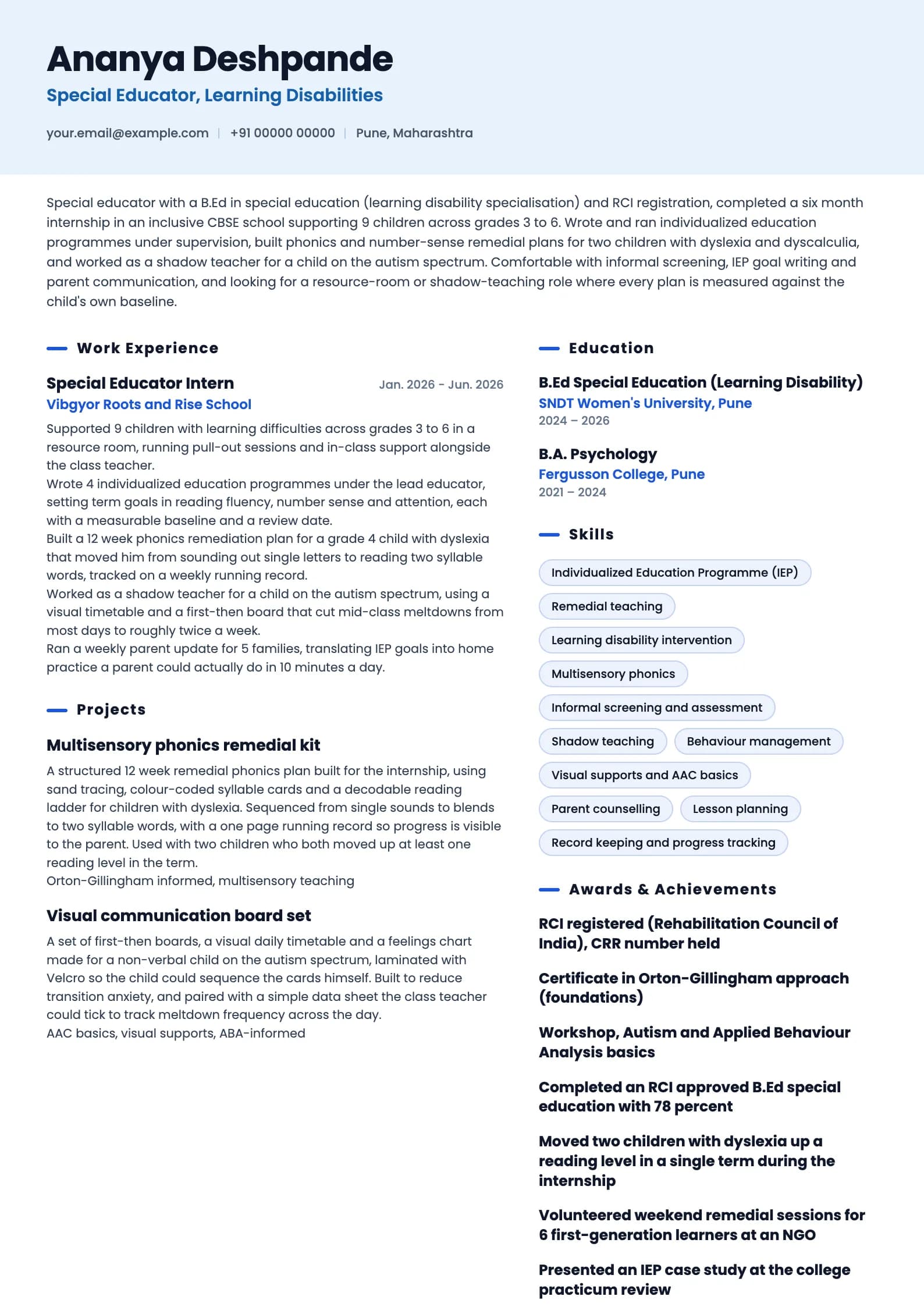
A special educator is hired on evidence that children moved forward under their care, that parents trusted them, and that their registration and safeguarding are in order, yet most resumes read like a list of disabilities and training modules. Below are three complete resumes, one for a fresher with a B.Ed in special education and a school internship, one for a special educator with six years running individualized programmes in an inclusive school, and one for a senior coordinator who builds a resource department and trains other teachers. After the samples come the format rules, why RCI registration must sit near the top, the difference between naming a disability and showing the intervention that worked, the terms a parser matches literally, and the mistakes that get a caring, qualified educator screened out.
Build my resumeSpecial Educator resume example, Fresher (0 years)
ai-era templateIs your resume good enough?
Upload the resume you have now and see what an applicant tracking system reads before a special educator recruiter ever does.
Free to run. Sign in with your mobile number to see your score.
Special Educator resume example, Mid-level (6 years)
professional template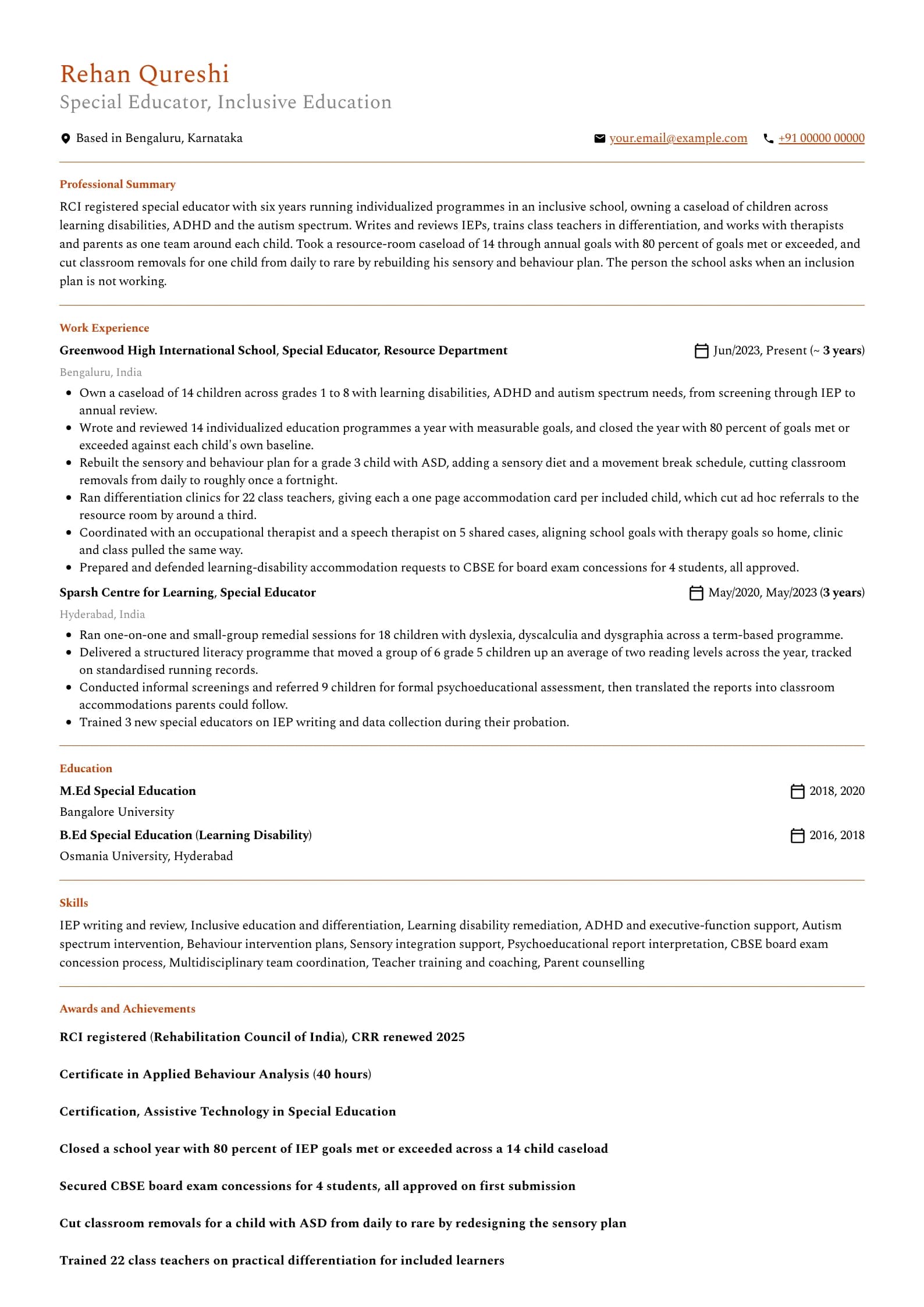
Want this structure with your own details? Build it in the resume builder.
Special Educator resume example, Senior / Coordinator (11 years)
header-band template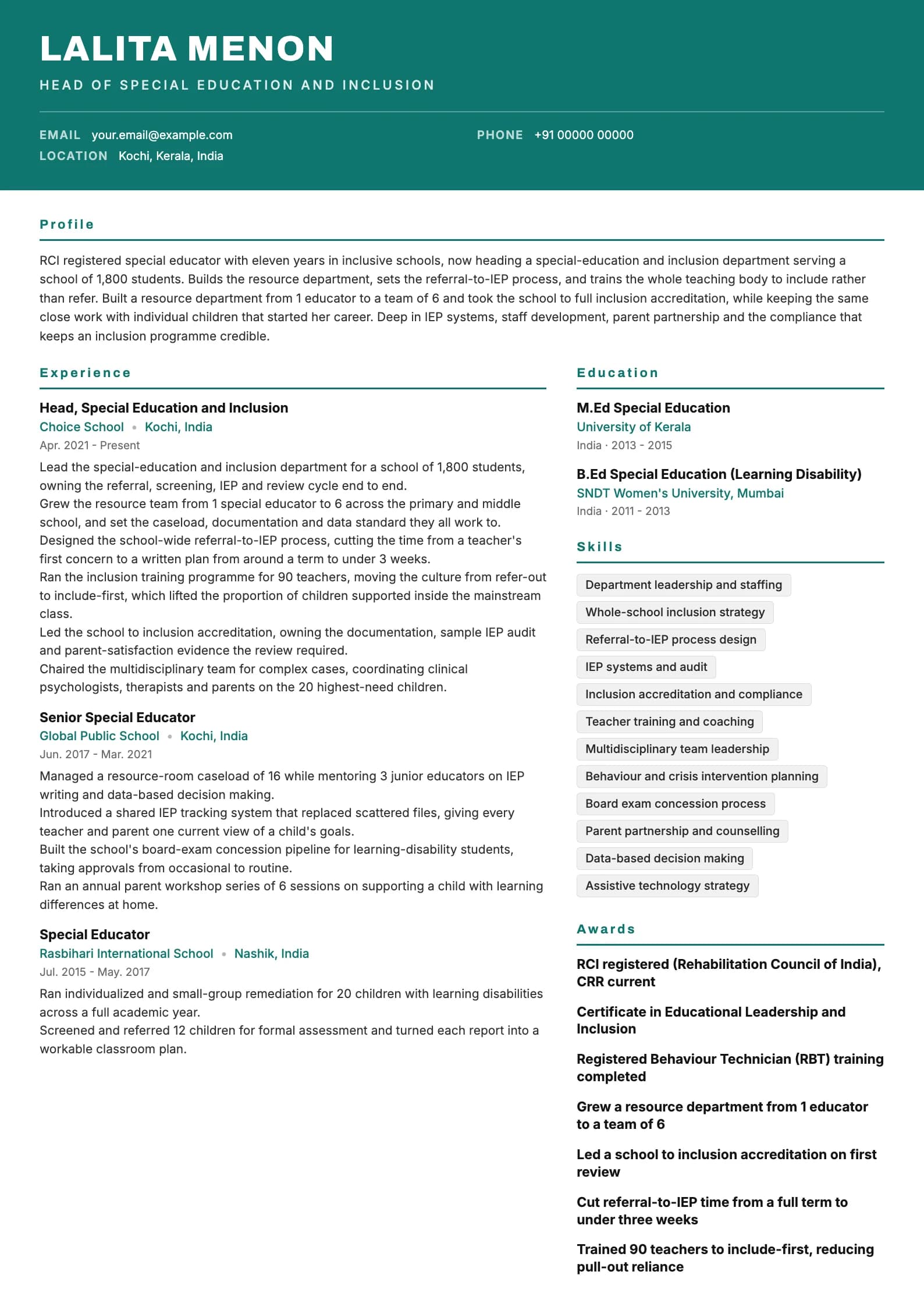
The format that works for special educator resumes in India
Reverse chronological is the layout to use. Most recent role first, working backwards, with dates in plain view. There is one adjustment special educators must make that a general teacher does not: your RCI registration and B.Ed special education belong high on the page, not at the bottom with the rest of education, because a school cannot legally place you without them and a coordinator screens for them first. Length is decided by caseload and years. One page holds everything a fresher and most educators up to roughly six years need. A senior coordinator running a department can use a second page, as long as it carries programme building and staff development rather than a longer list of workshops attended. A page two made of a training-attended list and a declaration paragraph is padding. Four things belong nowhere on this resume: a photograph, date of birth, marital status and father's name. They survive from an older placement-cell template and take space a child's progress story could use. Keep the summary, the caseload, the interventions and the results instead. Send a PDF unless the school asks for DOCX, and name the file with your own name and the role. Use a single column so an applicant tracking system reads your sections in order. The table below sets the section order for a special educator.
| Section | Where it goes | Why |
|---|---|---|
| Name and headline | Top, above everything | Headline names the role and specialism, e.g. special educator, learning disabilities. |
| Professional summary | Directly under the header | Three lines. Registration status, years, caseload and the single strongest result. |
| RCI registration and key qualification | High, near the summary | Non-negotiable for employment in India. A coordinator looks for it before anything else. |
| Work experience | Next, for anyone with a role | Most recent first. Newest role gets the most bullets. Name the caseload. |
| Skills | Below experience | IEP, specific interventions, team coordination. Not a wall of disability labels. |
| Education and certifications | Bottom, unless you are a fresher | B.Ed and M.Ed special education, RCI number, ABA or assistive-tech courses. |
| Projects or case work | Above experience for freshers | For a fresher, remedial kits and case studies are the evidence of practice. |
RCI registration and why it decides the shortlist
The Rehabilitation Council of India regulates who may practise as a special educator in the country. A B.Ed or D.Ed in special education from an RCI approved institution earns you a CRR (Central Rehabilitation Register) number, and that registration must be current. To a hiring coordinator, an unregistered special educator is a compliance risk the school cannot take, so the registration line is the first thing they look for and the fastest reason to reject. Put it where it cannot be missed. All three samples carry an RCI line near the top of certifications, close to the summary, with the CRR held or renewed. Do not write "RCI registration in process" and hope, because a coordinator reads that as not yet employable, so if you are genuinely close, say the expected date honestly. Name your specialisation, because RCI B.Ed programmes are specialised. Learning disability, intellectual disability, autism spectrum disorder, hearing impairment, visual impairment and multiple disabilities are distinct qualifications, and a school hiring for a resource room supporting dyslexia wants the learning-disability specialisation. Writing just "B.Ed special education" hides the one detail that matches you to the vacancy. Keep the registration current on the page and in fact. RCI registration renews on a cycle, and an expired CRR listed as current is the kind of small dishonesty that a school's compliance check catches easily, so renew it or state the real status.
If a special educator resume does not make RCI registration and the B.Ed specialisation obvious in the first third of the page, most Indian schools stop reading. Put the CRR line where a five second scan lands.
Naming a disability is not the same as showing the intervention
The most common special educator resume failure is a page built around conditions rather than practice: a skills line reading dyslexia, dyscalculia, dysgraphia, ADHD, autism, intellectual disability, with no bullet anywhere showing what you actually did for a child with any of them. A parser matches the terms, but a coordinator reads the list and cannot tell whether you can teach, only that you can name a diagnosis. The fix is to let the experience carry the intervention. If you write autism spectrum on the skills line, a bullet should describe the visual schedule, the sensory plan or the communication system you built and what changed for the child. If you write dyslexia, a bullet should name the structured-literacy or multisensory programme you ran and the reading growth it produced. The samples do exactly this: the phonics ladder, the sensory diet, the first-then board each appear as work with a result, not as a label in a list. Measure growth against the child's own baseline, not a class average. That is the honest metric in special education, and coordinators know it. "80 percent of IEP goals met or exceeded", "moved up two reading levels on a running record", "cut classroom removals from daily to rare" all describe a specific child moving from where they started. A percentile against typically developing peers is usually the wrong yardstick and reads as if you do not understand the field. Do not list a condition you have never actually supported just to widen the net. A coordinator's first interview question is a case, and a diagnosis on your skills line with no story behind it becomes the question you cannot answer.
Skills line, special educator
Weak
Dyslexia, dyscalculia, dysgraphia, ADHD, autism, intellectual disability, cerebral palsy, hearing impairment, visual impairment, Down syndrome, learning disability, behaviour issues
Strong
IEP writing, multisensory literacy (Orton-Gillingham informed), ADHD executive-function support, autism spectrum intervention with visual supports and sensory plans, behaviour intervention plans, multidisciplinary team coordination
Trades a wall of diagnoses for the interventions you can actually run, which is what a coordinator hires and interviews on.
Writing a summary a coordinator actually reads
The block under your name is the part you can be sure is read, so it should carry four facts specific to this role: your registration status, your years, your caseload or setting, and the single strongest thing that happened for a child because of your work. Three or four lines, no adjectives a reference could not confirm. The old objective line, seeking a challenging position in a reputed school to utilise my special education skills, tells a coordinator nothing they did not assume from your application. Replace it with a summary. An objective says what you want, a summary says what you have already done for children, and only one is evidence. Freshers often think they have nothing to summarise. Look at the fresher sample: it names the RCI registration, the specialisation, the internship caseload of 9, and points at a specific child who moved from single letters to two syllable words. That is a genuine summary built from one internship and real case work. What it avoids is "passionate about making a difference in children's lives", a phrase so common it now carries no information, because every applicant writes it. A practical test: read your summary and ask whether another special educator with the same degree could paste it unchanged onto their own resume. If they could, it describes the qualification, not you. Add the specific caseload, the specific intervention and the specific result until it stops being transferable.
Professional summary, mid-level special educator
Weak
Dedicated and passionate special educator with 6+ years of experience working with special needs children, seeking a challenging role in a reputed school to make a difference.
Strong
RCI registered special educator with six years running individualized programmes in an inclusive school, owning a caseload of 14 across learning disabilities, ADHD and autism. Closed the year with 80 percent of IEP goals met and cut one child's classroom removals from daily to rare.
The rewrite trades self-description for registration, a caseload, and two results measured the way special education actually measures them.
Experience bullets: child need, intervention, measured change
Every strong bullet in the samples follows the same shape. It opens with an action verb, names the child's need and the intervention you built, and closes with what measurably changed for that child or that caseload. The verb establishes you did it. The need and the intervention tell a coordinator whether the work is relevant. The change does the persuading. Start from the child's outcome and work backwards. Educators tend to write the activity first, "conducted remedial sessions for children with learning difficulties", then struggle to attach a result. Instead ask what was different for the child after a term: a reading level rose, meltdowns fell, an IEP goal was met, a board concession was approved, a child was included in the mainstream class. Then write the sentence that ends in that fact. Vary the evidence. Reading levels, IEP goals met, behaviour frequency, referrals reduced, concessions approved, teachers trained. A page of only reading-level numbers reads as one trick, while a mix shows the real range of the job, which is academic, behavioural and systemic at once. Where you lack a clean number, give scope: how many children on the caseload, how many IEPs written, how many teachers coached, how many therapists coordinated with. "Own a caseload of 14 across grades 1 to 8" carries weight without inventing a percentage. Allocate bullets by recency. Current role gets five or six, the previous role four or five, anything older two or three.
| Level | What bullets must prove | Typical evidence |
|---|---|---|
| Fresher | You can run an intervention and a child moved | Reading level gained, IEP goals written, meltdown frequency, project case work |
| 1 to 3 years | You own a caseload and write IEPs unsupervised | Caseload size, goals met, referrals handled, parent sessions run |
| 4 to 7 years | You coordinate a team around each child | Goals met against baseline, board concessions, teachers trained, therapist coordination |
| 8 years and up | You build the programme and develop other educators | Department growth, process design, accreditation, staff trained |
Experience bullet, resource-room work
Weak
Responsible for teaching special needs children and conducting remedial classes as per the school requirement.
Strong
Rebuilt the sensory and behaviour plan for a grade 3 child with ASD, adding a sensory diet and movement breaks, cutting classroom removals from daily to roughly once a fortnight.
"Responsible for" describes a job description; the rewrite names the child, the intervention built and the behaviour it changed.
Experience bullet, literacy remediation
Weak
Handled reading and writing improvement for students with learning disabilities and saw good progress.
Strong
Delivered a structured literacy programme that moved a group of 6 grade 5 children up an average of two reading levels across the year, tracked on standardised running records.
Names the programme, the group, and the measured reading growth, so a coordinator can ask a real follow-up instead of nodding at 'good progress'.
If a bullet would read identically on any special educator's resume, it is describing the profession, not you. Rewrite it until it only fits a child you actually taught and a plan you actually built.
The skills section: interventions, systems, and a short list you can defend
A special educator's skills section has two audiences. An applicant tracking system wants literal terms, IEP and Orton-Gillingham and behaviour intervention plan. A coordinator wants a short, organised list that signals what kind of educator you are and which children you can actually reach. Grouping satisfies both. Group by function rather than one long line. Programme and assessment, intervention approaches, behaviour and inclusion, and collaboration is a grouping that works for almost every special educator. The exact headings matter less than the fact that structure exists. Write terms the way the field writes them: IEP not "individual educational plan", Orton-Gillingham with the hyphen, RCI in capitals. Ten to sixteen skills is the working range. Below eight the section looks thin. Above twenty it stops being a signal, and special educators are especially prone to two kinds of padding: a wall of disability labels, and a wall of every therapy acronym heard in a workshop. The list is a contract, and every item is a case a coordinator may ask you to talk through in the interview. Do not add a proficiency bar. Nobody agrees what four stars in autism intervention means, and a rating invites an argument you cannot win. Let the experience and the case work prove the depth instead.
| Group | What goes in it | How many |
|---|---|---|
| Programme and assessment | IEP writing, informal screening, goal setting, progress monitoring | 3 to 4 |
| Intervention approaches | Multisensory literacy, remedial maths, executive-function support, AAC | 3 to 5 |
| Behaviour and inclusion | Behaviour intervention plans, sensory support, differentiation, inclusion | 2 to 4 |
| Collaboration | Parent counselling, multidisciplinary teams, teacher training | 2 to 3 |
Where education and certifications belong
For a special educator, education is not a footer. Your B.Ed or D.Ed in special education from an RCI approved institution, and your RCI registration, are the licence to practise, so they sit high for a fresher and remain easy to find even for a senior. Write the degree, the specialisation, the institution and the years, and keep the RCI CRR line current. Specialisation is the detail that matches you to the vacancy. A school hiring for dyslexia support wants the learning-disability specialisation named; one building an autism unit wants that specialisation. "B.Ed special education" alone hides the fit, so always name the stream. Certifications sit just below education. Applied Behaviour Analysis courses, Registered Behaviour Technician training, assistive-technology certificates, Orton-Gillingham or structured-literacy training, and counselling courses all carry weight because they map to real interventions. Write the full name, the body and the hours or year. A 40 hour ABA course is worth stating with its hours, because depth is the question. CGPA or percentage from the B.Ed is worth keeping while you are a fresher and it is strong. Once you have a few years and a caseload with results, drop it, because a child's progress is far more predictive than a mark from training college. An expired certification listed as current is easy to catch, so renew it or remove it.
Getting through the applicant tracking system
Many school groups and ed-tech employers now run resumes through an applicant tracking system before a coordinator sees them. It is a parser and a search index, not a judge. It reads your file, breaks it into name, dates, employers, titles and skills, and stores the result so a recruiter can search. Almost every ATS problem is a parsing problem, and parsing problems come from layout, not wording. The layout rules are short. One column. Standard section headings, so use Work Experience rather than My Journey and Skills rather than My Toolkit. No text inside images, because a certificate image reads as empty space. No critical information in the header or footer region, which some parsers drop. Avoid text boxes and nested tables in the body. On wording, mirror the language of the posting where it is honest. If the vacancy says special educator, write special educator, not just teacher. If it says RCI registered, write RCI registered. Include the expansion alongside an acronym at least once, for example "IEP (individualized education programme)" and "RCI (Rehabilitation Council of India)", so both searches find you. Keyword stuffing does not work. A hidden block of every disability and therapy term in white text is caught quickly and is worse than being filtered. Write real bullets that naturally contain the right terms, because a bullet describing the IEP you wrote contains the word IEP in a context that survives human review too. Save as a PDF with real, selectable text, then open it and confirm you can copy a sentence, because whatever you can select is roughly what the parser sees.
Section heading
Weak
My Journey With Special Children
Strong
Work Experience
Parsers look for standard headings; a creative one can push the whole block into an unclassified bucket the recruiter never searches.
Test your own file before sending it. Copy the text out of the PDF into a plain text editor. Whatever reads there in order is roughly what the parser sees, and if your RCI line or caseload is scrambled, that is a real risk.
What gets special educator resumes rejected
Most rejections at the resume stage are not close calls. They come from a small set of recurring problems, and all of them are fixable in an afternoon. The list below covers what coordinators of Indian special educator resumes see most often, in rough order of how much damage each one does.
- RCI registration missing, buried or vague. Without a clear, current CRR line most schools cannot proceed, so it must be easy to find.
- A wall of disability labels with no bullet showing an intervention. A diagnosis is the child's; the plan you built is yours.
- No specialisation named on the B.Ed, so a coordinator cannot tell whether you match a dyslexia room or an autism unit.
- Progress described only as 'good improvement' with no baseline. Special education measures growth against the child's own starting point.
- A generic objective line instead of a summary that states registration, caseload and one result.
- A photo, date of birth, marital status or father's name, none of which belongs on this resume and each of which takes a child's story's space.
- Every workshop ever attended listed as a certification, which reads as padding and hides the two courses that map to real interventions.
- No mention of parent work or team coordination, when working with families and therapists is half the actual job.
- Inflated titles or dates that do not match your service records, because school background checks and RCI verification are standard.
- Spelling the very conditions you claim to support, dyslexia or dyscalculia, wrong, which undoes an otherwise caring, qualified page.
Read your resume as if you were the child's parent. Anything that sounds like it is about you rather than about the child's progress is a line to rewrite.
Skills to put on a special educator resume
Technical
- Individualized Education Programme (IEP)
- Informal screening and assessment
- Multisensory literacy (Orton-Gillingham informed)
- Remedial mathematics
- Autism spectrum intervention
- ADHD and executive-function support
- Behaviour intervention plans
- Sensory integration support
- Augmentative and alternative communication (AAC)
- Assistive technology
- Psychoeducational report interpretation
- Progress monitoring and data collection
Tools and platforms
- Visual schedules and first-then boards
- Running records and reading assessments
- IEP tracking systems
- Sensory diet planning
- Token and reward systems
- Communication boards
- Accommodation cards
- Learning management systems
- MS Office and Google Workspace
Working skills
- Patience and consistency
- Parent counselling and partnership
- Multidisciplinary team coordination
- Teacher training and coaching
- Empathy and rapport building
- Crisis de-escalation
- Observation and record keeping
- Collaboration
Certifications worth listing as a special educator
| Certification | Full name | Worth it for |
|---|---|---|
| RCI registration (CRR) | Rehabilitation Council of India, Central Rehabilitation Register | Essential for any special educator working in India. It is the licence to practise and the first thing a coordinator checks, so it must be current and easy to find on the page. Not a nice-to-have; without it most schools cannot legally place you. |
| B.Ed Special Education | Bachelor of Education, Special Education (RCI approved), with specialisation | The core qualification, and the one that earns RCI registration. Always name the specialisation, learning disability, intellectual disability, autism, hearing or visual impairment, because it is what matches you to a specific vacancy. |
| ABA / RBT | Applied Behaviour Analysis coursework or Registered Behaviour Technician training | Valuable for educators working with autism-spectrum and significant behaviour needs. State the hours, because a 40 hour course signals real depth. Most useful where a school runs a structured behaviour or autism programme. |
| Orton-Gillingham | Orton-Gillingham or structured-literacy training | Worth it for educators whose caseload is heavy on dyslexia and reading difficulty. It certifies a recognised, evidence-based literacy approach that schools with an LD focus specifically look for. |
| Assistive Technology | Certificate in Assistive Technology in Special Education | Useful for educators supporting children who need text-to-speech, AAC devices or adapted access. Increasingly relevant as schools digitise, and a differentiator for inclusion-focused roles. |
| M.Ed Special Education | Master of Education, Special Education | Strengthens candidacy for senior, coordinator and head-of-inclusion roles, where programme design and staff development matter. Less decisive early on than the B.Ed and RCI registration, which come first. |
Keywords an ATS scans for in a special educator resume
These are the literal terms a parser matches against the job description. Use the ones that are true of you, in the sentences where you did the work, not as a list at the bottom.
- special educator
- special education teacher
- RCI registered
- IEP
- individualized education programme
- learning disability
- remedial teaching
- inclusive education
- autism spectrum disorder
- ADHD
- dyslexia
- behaviour intervention plan
- shadow teacher
- resource room
- multisensory teaching
- assistive technology
- parent counselling
- B.Ed special education
- differentiation
- screening and assessment
Special Educator resume FAQ
What salary can a special educator expect in India?
A fresher special educator typically starts around 2.4 to 4 LPA in schools, with special-education centres and metro international schools at the higher end. A special educator with five to seven years running IEPs and a caseload usually sits in the 4.5 to 9 LPA band. Senior educators, resource-department heads and inclusion coordinators with ten years and above commonly earn 9 to 18 LPA in large international-school groups. Private one-on-one and remedial practice can pay more per hour but is less predictable. RCI registration, a specialisation in demand and a strong caseload of results push every band upward.
How important is RCI registration on a special educator resume?
It is the single most important line. The Rehabilitation Council of India regulates who may practise as a special educator in the country, and most schools cannot legally place an unregistered educator. Put your CRR number and its current status high on the page, near the summary, not buried at the bottom. If registration is genuinely in process, state the honest expected date rather than leaving it vague, because a coordinator screens for it first.
How long should a special educator resume be?
One page up to about six or seven years of experience, two pages after that only if the second page carries real programme building and staff development rather than a longer list of workshops attended. If you are struggling to fit one page, cut the oldest role to a single line, remove training-college coursework, and delete any therapy course you would not want to be interviewed on.
Should I list every disability I have worked with as a skill?
No. A wall of diagnoses, dyslexia, autism, ADHD, intellectual disability and so on, tells a coordinator nothing about what you can do. List the interventions you actually run, multisensory literacy, IEP writing, behaviour intervention plans, sensory support, and let a bullet prove each with a child and a result. A label with no story behind it becomes the interview question you cannot answer.
How does a fresher special educator write a resume with no full-time experience?
Lead with your B.Ed specialisation and RCI registration, then your internship, then case work as projects. Treat each intervention like a job: the child's need, the plan you built, what you owned and what changed. A remedial phonics kit, a communication board, a case study you presented all count. Add anything checkable, an RCI CRR number, a reading level a child gained, volunteer remedial hours, because verifiable facts carry more weight than adjectives about passion.
How should I show progress if children move slowly?
Measure against the child's own baseline, not a class average or a typical-peer percentile. That is the honest and expected metric in special education. "Moved from single letters to two syllable words in a term", "met 80 percent of IEP goals", "cut classroom removals from daily to rare" all show real movement from a starting point. Coordinators understand that a child's progress is measured child by child, and a baseline-referenced result reads as someone who understands the field.
Do certifications like ABA or Orton-Gillingham help?
They help when they map to the children you support. Applied Behaviour Analysis and Registered Behaviour Technician training carry weight for autism and significant behaviour work, and Orton-Gillingham or structured-literacy training matters for a dyslexia-heavy caseload. State the hours for behaviour courses, because depth is the question. Keep the list to the courses that map to real interventions rather than every workshop attended, which reads as padding.
Does an applicant tracking system reject two-column resumes?
It does not reject them outright, but some parsers read multi-column layouts out of order, which can interleave your RCI line and caseload with unrelated text and produce nonsense in the recruiter's view. A single-column layout removes the risk, which is why all three samples use one. Test your own file by copying the text out of the PDF into a plain text editor, and if it reads in order there it will most likely parse correctly.
Do I need a photo on a special educator resume in India?
No. Schools do not expect one, and it takes space a child's progress story should occupy. The same goes for date of birth, marital status, father's name, nationality and a declaration paragraph, all of which come from an older placement-cell template. Use that space for your caseload, your interventions and your results instead. The only exception is a role whose posting explicitly asks for a photograph.
Related resume examples and guides
Build your special educator resume in any of these formats
Start from a blank resume or upload the one you have. Goodspace renders it in 24 templates and flags the RCI, IEP and intervention keywords a school's applicant tracking system will look for, and the wall of diagnoses it will not credit.
Build my resume