Primary Teacher Resume Format, with 3 Full Samples
A primary teacher resume is read by a headmistress or a primary coordinator who is hiring someone to take a class of forty six-year-olds from April, teach them to read and add, and keep forty sets of parents settled while doing it. What they screen for is specific and different from a subject teacher: the class band, whether you hold CTET Paper 1 and a D.El.Ed or B.El.Ed, your work in foundational literacy and numeracy, and whether you can run a classroom of small children as a class teacher, not just deliver a lesson. Most primary resumes lose them on a paragraph about a passion for shaping young minds and a qualification line buried on page two. Below are three complete resumes, one for a D.El.Ed or B.El.Ed fresher, one for a PRT with several years, and one for a primary coordinator, followed by the format rules, the CTET Paper 1 placement that decides eligibility, and the early years vocabulary a primary school reads for.
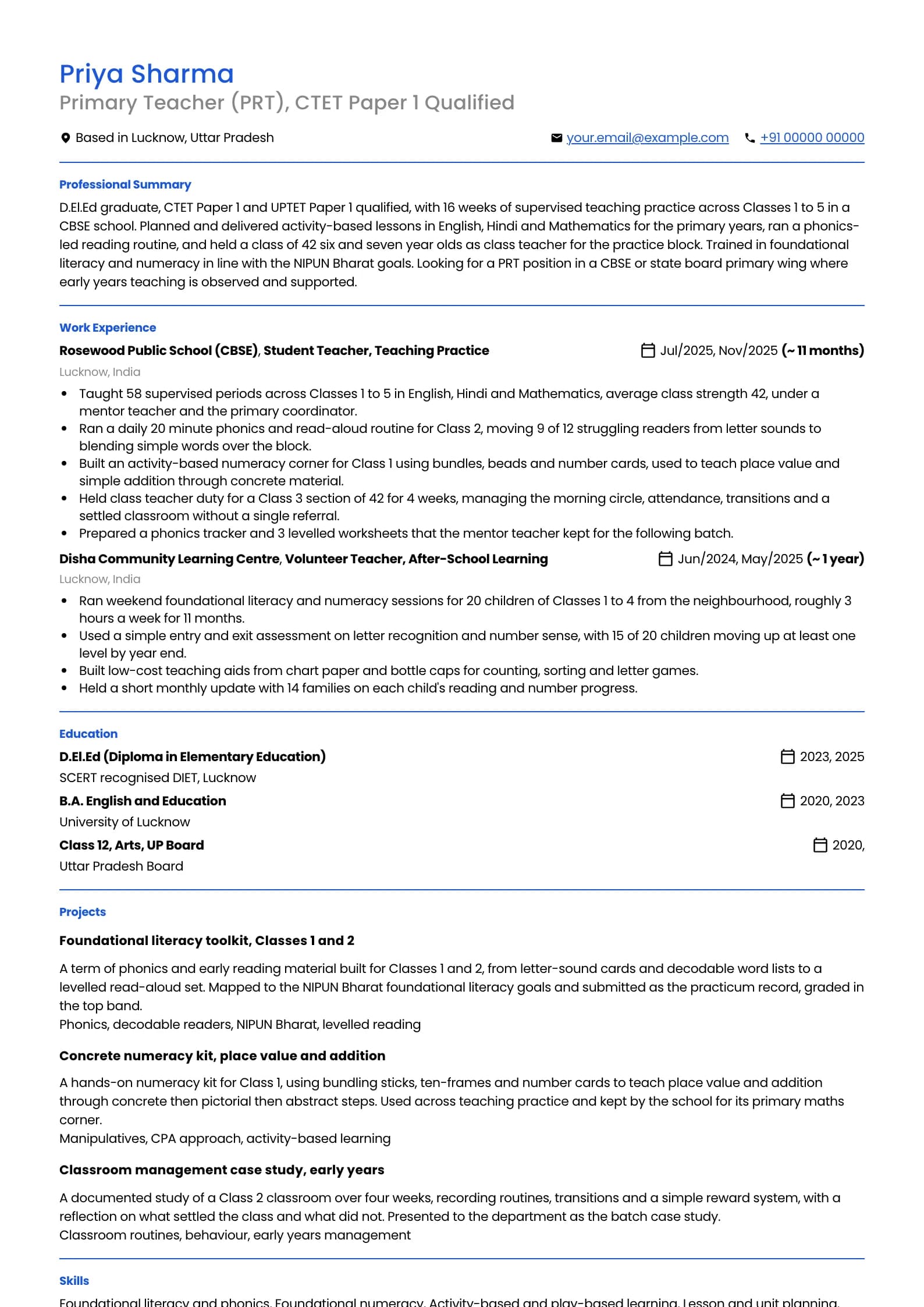
Build my resumePrimary Teacher resume example, Fresher, D.El.Ed graduate (0 years)
minimalist templateIs your resume good enough?
Upload the resume you have now and see what an applicant tracking system reads before a primary teacher recruiter ever does.
Free to run. Sign in with your mobile number to see your score.
Primary Teacher resume example, Primary Teacher, PRT (5 years)
modern template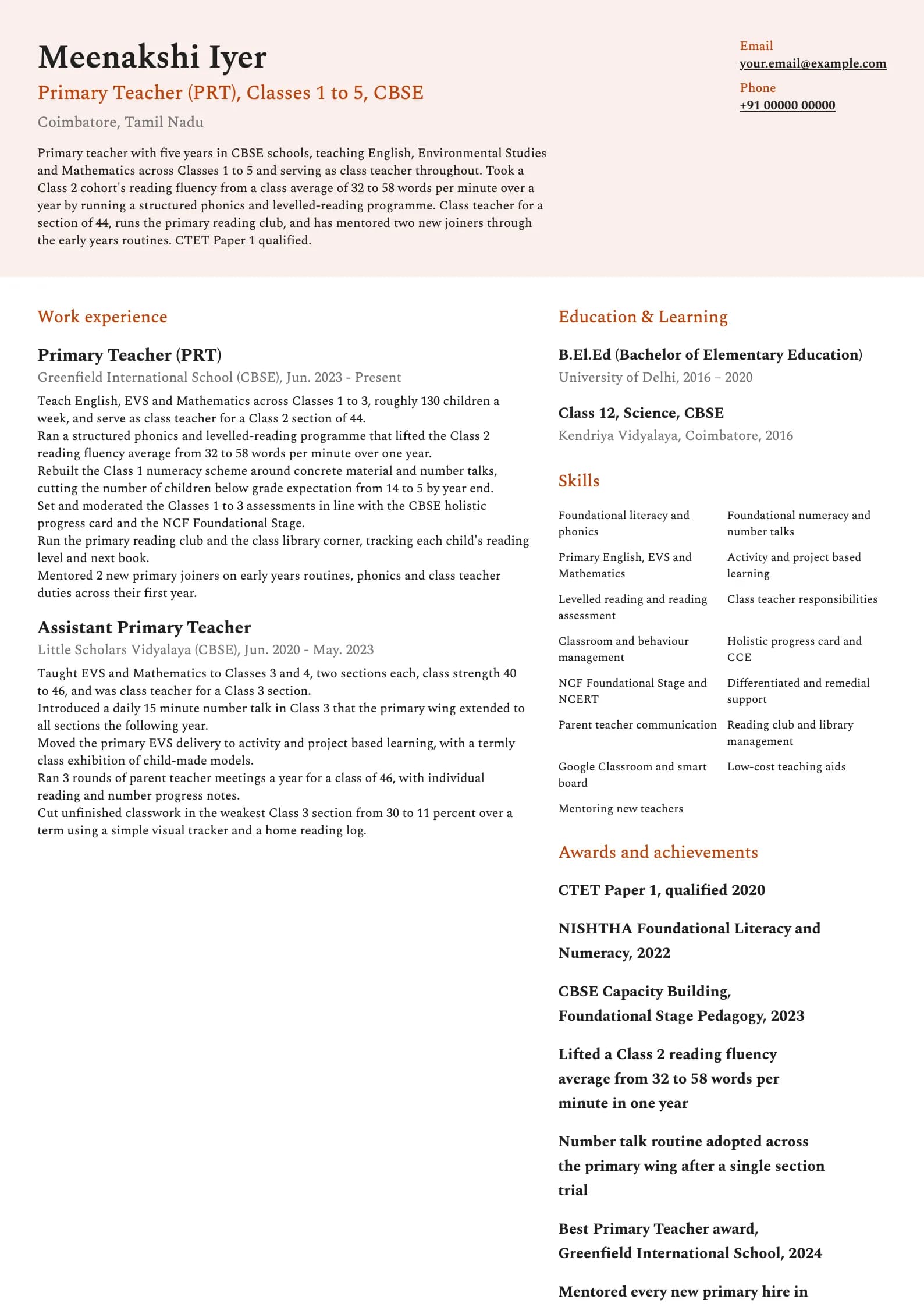
Want this structure with your own details? Build it in the resume builder.
Primary Teacher resume example, Primary Coordinator (10 years)
professional template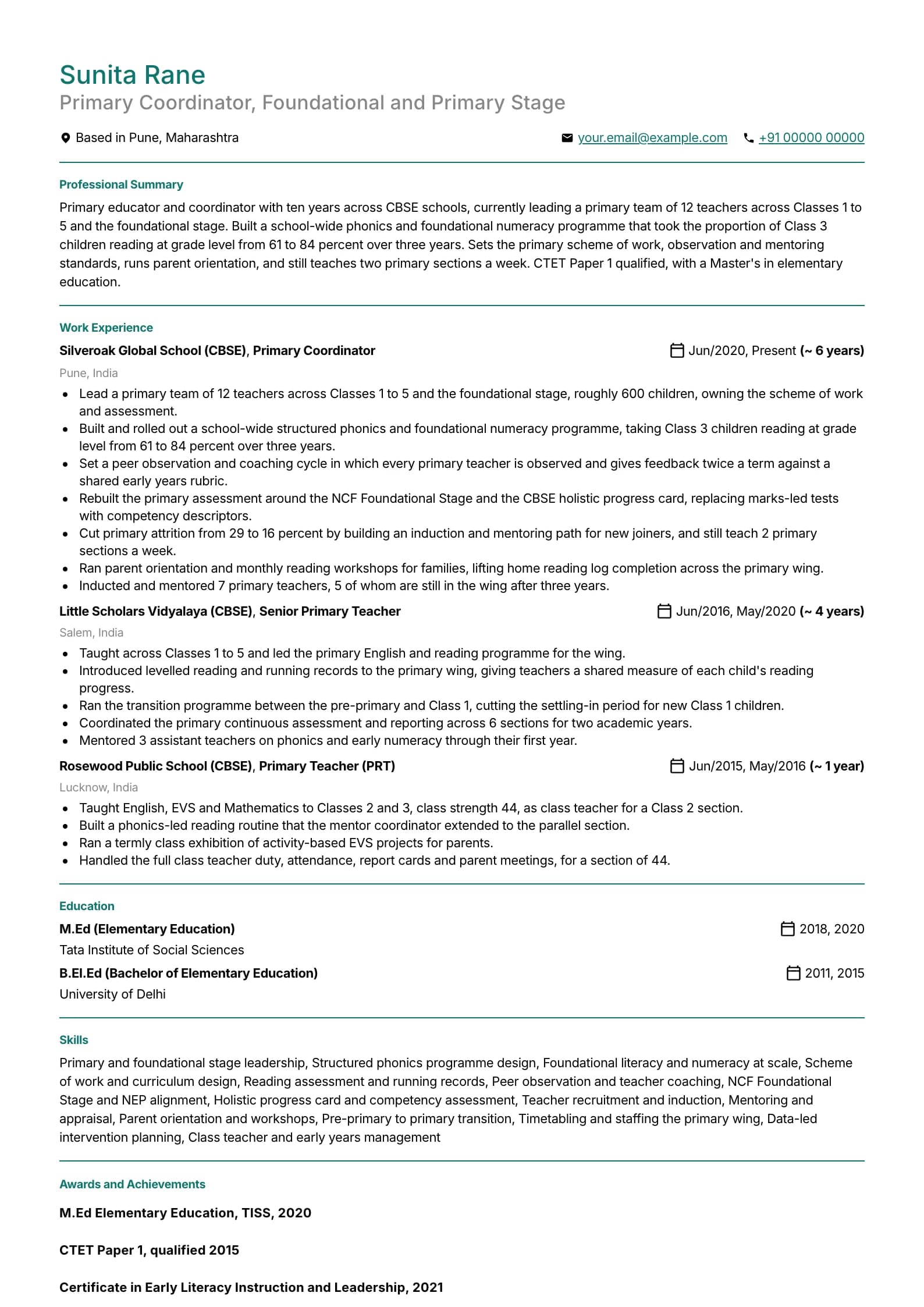
The format that works for primary teacher resumes in India
A primary teacher resume is read by a headmistress or a primary coordinator during an admission rush, against a stack of others for one early years vacancy. It has to answer their questions in the order they ask them, and those questions are different from a subject teacher's. Reverse chronological, one page up to roughly eight years, two pages only for a primary coordinator with a real leadership history. Single column, clean type, plain headings. The reader is checking four things in the first pass: which classes you can take, whether you hold CTET Paper 1 and a D.El.Ed or B.El.Ed, your foundational literacy and numeracy work, and whether you can run a classroom of small children as a class teacher. Resist the coloured two-column layout with a sidebar. Primary offices still print resumes for the interview panel, and a dark sidebar either eats the toner or prints as a grey block with your skills hidden inside it. Keep the file name plain, your name and the post, so a shared inbox during the hiring season can find it again, and send a PDF unless the vacancy asks for Word. Lead with the class band and the early years vocabulary. A resume that says teacher with no class band forces a primary head to work out whether you are applying for their Class 2 vacancy or a middle school one, and a reader with fifty resumes does not do that work in your favour. Name Classes 1 to 5, name PRT, and use the words a primary school thinks in: foundational literacy, phonics, numeracy, class teacher, activity-based learning. Drop the usual clutter: photo, date of birth, marital status, father's name and a signed declaration, unless a government proforma demands them. The section order below is what a primary coordinator expects, arranged so the class band, the eligibility and the early years work surface in the first pass.
| Section | Where it goes | Why |
|---|---|---|
| Name and headline | Top, above everything | Name the post and band: "Primary Teacher (PRT), Classes 1 to 5", plus CTET Paper 1 status. |
| Professional summary | Directly under the header | Three lines. Classes, board, years, and the single strongest foundational result. |
| Qualifications and eligibility | Near the top for freshers, with education otherwise | D.El.Ed or B.El.Ed, and CTET Paper 1 or state TET Paper 1, with the year. Schools screen on this first. |
| Teaching experience | Next, for anyone who has taught | Most recent first. Name the board, the classes, the subjects, and class teacher duty each time. |
| Teaching practice and internship | In place of experience for a fresher | Give it a title, a school, dates and bullets. Supervised primary teaching counts as experience. |
| Skills | Below experience | Grouped: foundational literacy and numeracy, early years pedagogy, working with children and parents. |
| Languages and education | Bottom, unless you are a fresher | Name the medium you can teach in. Keep school marks only while you are a fresher. |
Where the D.El.Ed, B.El.Ed and CTET Paper 1 line belongs
For most primary vacancies in India the first pass is an eligibility check. If a screener cannot confirm your elementary teaching qualification and your CTET Paper 1 status in the first few seconds, the resume is set aside before your classroom results are read. This is the section where the rules are not stylistic. Government schools, aided schools and most CBSE affiliated private schools have a stated qualification for a primary post, and the person doing the first sort is usually working from that list. The paper matters. CTET and the state TETs are split into Paper 1 for Classes 1 to 5 and Paper 2 for Classes 6 to 8, and a primary post needs Paper 1. Writing CTET cleared without the paper leaves the reader to check which one, and many will not. Put Paper 1 in the headline if you hold it, and repeat it under certifications with the year. The elementary qualification matters just as much. A D.El.Ed, a diploma in elementary education from a recognised DIET, and a B.El.Ed, the four year Bachelor of Elementary Education, are the standard routes into primary teaching, and they are not interchangeable with a plain B.Ed in the eyes of every recruiter. Name which one you hold, name the recognising body, and if it is in progress, write the expected completion month rather than leaving a gap. One caution in the other direction. Some private schools, especially in pre-primary and lower primary, do not require a TET at all, and a few weight a Montessori or early childhood qualification instead. Do not pad the certification block with unrelated short courses to fill it. An honest, clearly labelled qualification block, showing exactly the eligibility a primary post needs, does more than a long list that buries it.
- Put CTET Paper 1 or state TET Paper 1 in the headline if you hold it, then repeat it under certifications with the year.
- Name the paper. Paper 1 is for Classes 1 to 5 and is the one a primary post requires, so make it explicit rather than writing CTET alone.
- Name your elementary qualification specifically: D.El.Ed or B.El.Ed, with the recognising DIET or university, not just "teaching qualification".
- State the state for a state TET, because eligibility does not automatically travel when you relocate.
- A fresher should carry Class 12 stream and percentage. Drop school marks once you have a full session of teaching behind you.
- If a qualification is in progress, write the expected completion month and year plainly rather than leaving an open date range.
- Put an M.Ed or a Montessori or NTT diploma in its right place, education or certifications, and name it, because pre-primary heads screen on it.
- Keep the certification block to what changes your eligibility or your early years capability. Everything else is clutter.
Qualifications block
Weak
B.Ed done. CTET cleared. Attended several teaching workshops.
Strong
D.El.Ed, SCERT recognised DIET, Lucknow, 2025. CTET Paper 1 (Classes 1 to 5), qualified 2025. UPTET Paper 1, qualified 2025.
The specific elementary qualification, the paper, the state and the year turn three vague claims into three verifiable primary eligibility facts.
A primary resume that makes the reader hunt for the CTET Paper 1 line is competing against fifty that did not make them hunt.
The summary that replaces the shaping-young-minds line
Almost every primary teaching resume opens with a sentence about a passion for shaping young minds and a nurturing, caring nature. It is warm, it is on every resume in the pile, and it spends your most valuable three lines saying what a primary head already assumes about anyone who chose to teach six year olds. Replace it with a summary that answers what a coordinator is actually screening for: which classes you teach, under which board, for how long, and what happened to the children's reading and number skills. Lead with the noun and the band. "Primary teacher with five years teaching Classes 1 to 5 in CBSE schools" places you instantly; "a passionate and dedicated educator with a love for children" places you nowhere. Put your strongest single result in the second or third line, and make it a foundational one, because reading fluency and number sense are what a primary school is judged on: a reading fluency you lifted, children you moved to grade level, a class you held as class teacher. A fresher has a summary too. The fresher sample names the practice classes, the phonics routine, the class teacher block and the CTET Paper 1 status. That is real evidence from teaching practice, and it never leads with passion, because passion is assumed and the phonics tracker is not. Write the summary last, after the experience section, so you can lift your strongest number to the top. And match it to the post: a school hiring for the foundational stage and one hiring for upper primary want a slightly different first line, and a two minute rewrite to lead with the right band does more than any other edit.
Summary opening line
Weak
A passionate and caring teacher with a deep love for children, seeking a position in a good school where I can shape young minds and grow as an educator.
Strong
Primary teacher with five years in CBSE schools, teaching Classes 1 to 5 and serving as class teacher throughout. Lifted a Class 2 reading fluency average from 32 to 58 words per minute over one year.
The first line says nothing a coordinator can act on; the second gives the band, the board, the years and a foundational reading result before they finish reading it.
Primary teaching bullets a coordinator can act on
Primary teachers write two weak bullets more than most. The first is the duty list, so responsible for teaching primary classes and maintaining discipline, which describes every PRT on the shortlist. The second is the warm generality, so created a happy and engaging learning environment for young learners, which a coordinator cannot verify and quietly discounts. The pattern in all three samples is different: an action verb, the specific early years work, and what changed for the children. The objection is that primary outcomes cannot be measured the way a board result can. They can, in the currency that matters at this stage: reading and number. Reading fluency in words per minute, the number of children reading at grade level, the number below grade expectation you moved up, running record levels, a numeracy routine and its reach. These are the foundational stage numbers, and a school running NIPUN Bharat and the NCF Foundational Stage is measured on exactly them. State the action and the number side by side and the coordinator draws the conclusion. Where a number genuinely does not exist, use scope and the class teacher fact. Class strength, number of sections, subjects across the primary band, a routine that spread to other sections, a class held as class teacher. "Class teacher for a Class 2 section of 44" proves you can run a room full of small children all day, which is half of a primary job and the half a lesson-only resume never shows. Order bullets by strength inside a role, since the first two get read, and allocate by recency across roles. The current role gets five or six, older roles compress, and the oldest survives on the class teacher or foundational fact that still proves the practice behind the years.
- Weak: "Responsible for teaching primary classes as per the school syllabus."
- Strong: "Teach English, EVS and Mathematics across Classes 1 to 3, roughly 130 children a week, and serve as class teacher for a Class 2 section of 44."
- Weak: "Helped weak students improve in reading."
- Strong: "Ran a structured phonics and levelled-reading programme that lifted the Class 2 reading fluency average from 32 to 58 words per minute over one year."
- Weak: "Made maths interesting for young children."
- Strong: "Rebuilt the Class 1 numeracy scheme around concrete material, cutting the children below grade expectation from 14 to 5 by year end."
- Weak: "Involved in various classroom activities."
- Strong: "Number talk routine I introduced in one Class 3 section was adopted across the primary wing the following year."
Experience bullet, class teacher duty
Weak
Handled class teacher duties for a primary section.
Strong
Held class teacher duty for a Class 3 section of 42, managing the morning circle, attendance, transitions and a settled classroom without a single referral.
The first names a duty; the second shows you can actually run a room of small children through a full day, which is what a primary head most needs to know.
Reading fluency, children at grade level, a class held as class teacher, a routine that spread. These are the foundational stage numbers a primary coordinator trusts, so put one in the bullet.
Foundational skills, early years pedagogy and working with children
A primary skills section fails in two directions. Either it lists character, so patient, loving, caring, punctual and hardworking, which every applicant claims and no coordinator can act on, or it runs to a wall of forty generic teaching terms. Group it instead, and use the words a primary school thinks in. Three groups cover almost every primary teacher. Foundational literacy and numeracy covers the core of the job, phonics, decodable reading, levelled reading and running records, number sense, the concrete-pictorial-abstract approach and foundational numeracy routines. Early years pedagogy covers how you teach at this stage, activity and play based learning, lesson and unit planning, the NCF Foundational Stage, the holistic progress card and continuous assessment, differentiated and remedial support. Working with children and parents covers classroom and behaviour management, class teacher duty, transitions and routines, and parent communication. The foundational literacy and numeracy group is the one that marks you as a primary specialist rather than a general teacher, so lead with it. Write the terms the way the system writes them, CTET Paper 1, D.El.Ed, NIPUN Bharat, NCF Foundational Stage, phonics. Schools and portals both match on strings, and a misspelt framework on a teaching resume reads as a standards problem. Keep the list to what you can be asked about, because an interview or a demo lesson will pick two. A primary teacher who lists structured phonics and cannot describe a blending sequence has spent credibility that is hard to rebuild. A useful test: could you be handed that on your first day with a real Class 1? If not, it belongs in a training line or nowhere.
| Group | What belongs here | What does not |
|---|---|---|
| Foundational literacy and numeracy | Phonics, decodable and levelled reading, running records, number sense, concrete-pictorial-abstract, foundational numeracy | Vague umbrellas like "teaching basics", which match nothing a primary head searches for |
| Early years pedagogy | Activity and play based learning, lesson planning, NCF Foundational Stage, holistic progress card, remedial support | "Subject expertise" framing borrowed from secondary teaching, which misreads the stage |
| Working with children and parents | Classroom and behaviour management, class teacher duty, routines and transitions, parent communication | Patient, loving, caring, punctual. Character adjectives every applicant claims and none can prove |
Skills section
Weak
Patient, loving, caring, good with kids, punctual, dedicated, hardworking, creative
Strong
Foundational literacy: phonics, levelled reading, running records. Foundational numeracy: number talks, concrete-pictorial-abstract. Early years: activity-based learning, NCF Foundational Stage, class teacher management.
Character adjectives that match no search become grouped, searchable early years terms that tell a coordinator exactly what you can be handed with a Class 1.
School portals, applicant tracking systems and the plain file
Not every primary vacancy goes through software. A small school still takes a printout, a walk-in and a demo lesson. But the larger school groups, the international and chain schools and most job boards run your file through a parser before a human opens it, and government portals impose rigid form fields. Both reward the same thing: a plain, single column, text based document with conventional headings. Write the headings a parser expects, so use Teaching Experience rather than My Classroom Story, and Education rather than Academic Background. Keep dates in one consistent format on every line, because a mixed format is the most common reason a parser mis-orders a career. Do not put your qualification or your contact details inside a header or footer, because many parsers skip those regions, and the CTET Paper 1 line is the last thing you want dropped. Avoid the layouts primary teachers reach for: a decorative two column sheet, icons standing in for section labels, a table holding your experience. A parser can read a table column by column and scramble a tidy resume into fragments. Keep the layout linear from top to bottom, and if a portal asks you to paste the text into a box, paste it and read it back, because the box strips your formatting and shows you what the school will see. On keywords, the honest approach is the effective one. Use the words a primary post genuinely calls for, PRT, CTET Paper 1, Classes 1 to 5, foundational literacy, phonics, class teacher, and put them inside real bullets rather than a hidden block of white text. Parsers weight terms that appear in context, and a coordinator reading a keyword salad will bin it. Spell an abbreviation out once, for example PRT (Primary Teacher), so both forms match.
- Send a PDF unless the vacancy asks for Word. Never send a scanned image of a printed resume.
- Use conventional headings: Professional Summary, Teaching Experience, Education, Skills, Certifications.
- Keep one date format throughout, for example "Jun 2023 - Present" on every line.
- Keep the CTET Paper 1 and qualification block in the body, not in a header or footer a parser may skip.
- Spell out the post once, "PRT (Primary Teacher)", so both forms are matchable.
- Write CTET, D.El.Ed, B.El.Ed and the board names exactly as the vacancy notice writes them.
- Avoid tables, text boxes, icons and columns in the body. Keep the layout linear from top to bottom.
- Name the file plainly, your name plus the post, so a shared school inbox can find it again.
Name your sections the boring way. "Teaching Experience" is matched by every parser and read instantly by every coordinator; "My Journey with Little Learners" is matched by neither.
What gets primary teacher resumes rejected
Most rejections at the resume stage are not judgements about your teaching. They come from a small set of repeating faults, and almost all are fixable in an afternoon. The list below is ordered roughly by how often it costs a shortlist, starting with the two a coordinator catches in the first few seconds.
- The wrong paper, or no paper named. A primary post needs CTET Paper 1 for Classes 1 to 5, so "CTET cleared" without the paper leaves the eligibility unconfirmed.
- Burying the D.El.Ed, B.El.Ed and CTET on a second page, where an eligibility check will not reach them.
- No class band. "Teacher" with no Classes 1 to 5 forces a primary head to work out whether you even fit the vacancy.
- A duty list lifted from the appointment letter instead of what changed in the children's reading and number skills.
- No foundational vocabulary. A primary resume with no phonics, no foundational literacy or numeracy, no class teacher reads as a subject teacher who wandered in.
- No results anywhere. Reading fluency, children at grade level, a routine that spread. At least one of these is available to almost every primary teacher.
- Photo, date of birth, marital status, father's name and a signed declaration, which cost the space a foundational result needs.
- Character adjectives as skills. Patient, loving and caring match no search and prove nothing a reference check would not.
- Multi-column and table-heavy layouts that a parser reads out of order, scrambling the experience before a human sees it.
- A generic passion line about shaping young minds, in the slot a summary naming band, board and one result should hold.
Print your resume and read it at arm's length for ten seconds. If the class band, CTET Paper 1, the elementary qualification and one foundational result are not all visible, the layout is the problem, not the content.
Skills to put on a primary teacher resume
Technical
- Foundational literacy and phonics
- Foundational numeracy and number sense
- Levelled reading and running records
- Concrete, pictorial, abstract numeracy
- Activity and play based learning
- Lesson and unit planning
- Primary English, EVS and Mathematics
- NCF Foundational Stage and NEP alignment
- NCERT primary curriculum
- Holistic progress card and CCE
- Differentiated and remedial support
- Reading assessment and tracking
- Low-cost teaching aids
- Bilingual early years instruction
Tools and platforms
- Google Classroom
- Smart board and interactive display
- Reading level and running record trackers
- School ERP and attendance systems
- Storytelling and read-aloud sets
- Manipulatives, ten-frames and number cards
- Canva for primary teaching material
- Excel progress and assessment sheets
- Kahoot and simple classroom quiz tools
- Phonics and decodable reader kits
- PicTECH and NISHTHA digital modules
- Home reading logs and communication apps
Working skills
- Classroom and behaviour management
- Class teacher responsibilities
- Managing routines and transitions
- Parent communication and orientation
- Patience with young learners
- Mentoring new primary teachers
- Collaborative planning
- Working with a bilingual classroom
- Empathy and pastoral care
- Time and workload management
Certifications worth listing as a primary teacher
| Certification | Full name | Worth it for |
|---|---|---|
| CTET Paper 1 | Central Teacher Eligibility Test, Paper 1, for Classes 1 to 5 | Effectively mandatory for central government primary schools and widely asked for by CBSE affiliated private schools for PRT posts. Paper 1 is the one that qualifies you for the primary years, so name the paper, not just CTET. Clearing it before you finish training clears a filter most of the cohort has not. |
| State TET Paper 1 | State Teacher Eligibility Test, Paper 1, for example UPTET, REET, MAHA TET, TNTET | Necessary for state government and aided primary recruitment in that state, and often accepted by private schools there. Do it if you intend to teach primary in that state, and note it does not automatically travel if you relocate. If you already hold CTET Paper 1 and are applying only to private CBSE schools, a second state TET adds little. |
| D.El.Ed | Diploma in Elementary Education | The standard two year route into primary teaching in India, offered by DIETs and recognised institutes, and the qualification most government and many private primary posts require. Name the recognising body. It is the qualification to hold if you want a mainstream PRT post and do not have a B.El.Ed. |
| B.El.Ed | Bachelor of Elementary Education, four year integrated degree | A strong dedicated route into elementary teaching, respected across CBSE and reputed private schools for its focus on the primary years. If you hold it, name it specifically rather than letting it read as a generic education degree, because it signals a primary specialist. |
| NTT or Montessori | Nursery Teacher Training or a Montessori or early childhood diploma | Relevant if you are targeting pre-primary and lower primary posts in private schools, especially where the school follows a Montessori or play-based method. It supports a foundational stage application but is not a substitute for a D.El.Ed or B.El.Ed if you want to teach Classes 1 to 5 in a mainstream school. |
| FLN training | Foundational Literacy and Numeracy training, for example the NISHTHA FLN modules | Increasingly valued as schools implement NIPUN Bharat and the NCF Foundational Stage. A genuine signal that you can teach early reading and number the way the current framework expects, and worth naming for any primary or foundational stage role. |
Keywords an ATS scans for in a primary teacher resume
These are the literal terms a parser matches against the job description. Use the ones that are true of you, in the sentences where you did the work, not as a list at the bottom.
- primary teacher
- PRT
- primary school teacher
- D.El.Ed
- B.El.Ed
- CTET Paper 1
- TET qualified
- foundational literacy and numeracy
- phonics
- NIPUN Bharat
- NCF Foundational Stage
- class teacher
- activity-based learning
- classroom management
- Classes 1 to 5
- lesson planning
- CBSE curriculum
- NCERT
- reading assessment
- parent teacher meeting
Primary Teacher resume FAQ
What is the correct resume format for a primary teacher in India?
Reverse chronological, single column, one page up to roughly eight years. Header with name and the post, "Primary Teacher (PRT), Classes 1 to 5", then a three line summary, then qualifications including D.El.Ed or B.El.Ed and CTET Paper 1, then teaching experience with the board and classes named and class teacher duty shown, then skills, languages and education. Send a PDF unless the vacancy asks for Word, and keep the layout linear so both a parser and a printed interview panel copy read it the same way.
Do I need CTET Paper 1 or Paper 2 for a primary teacher job?
Paper 1. CTET and the state TETs split into Paper 1 for Classes 1 to 5 and Paper 2 for Classes 6 to 8, and a primary or PRT post requires Paper 1. Writing "CTET cleared" without the paper leaves the reader to check which one, and many will not, so put Paper 1 in the headline and repeat it under certifications with the year. For a state TET, name the state as well, because eligibility does not automatically travel when you relocate.
How is a primary teacher resume different from a general teacher resume?
The class band, the qualification and the vocabulary change. A primary resume leads with Classes 1 to 5, a D.El.Ed or B.El.Ed and CTET Paper 1, and it is built around foundational literacy and numeracy, phonics, activity-based learning and class teacher duty rather than a subject and board results. A subject teacher resume leads with the subject, TGT or PGT, CTET Paper 2 and Class 10 or 12 results. Match your headline, your qualification line and your evidence to the primary stage, because a coordinator screens on exactly that.
How do I write a primary teacher resume with no experience?
Treat your D.El.Ed or B.El.Ed teaching practice as the experience section. Give it a job title, the school and board, the date range and real bullets: periods taught, classes, class strength, a phonics or numeracy routine you ran, and the class teacher block you held. The fresher sample above is built this way. Add tutoring, community teaching and your practicum toolkit as projects, keep Class 12 stream and percentage while you are a fresher, and put CTET Paper 1 in the headline.
What foundational literacy and numeracy terms should I use?
Use the words the current framework uses, because a coordinator and a parser both read for them: foundational literacy, phonics, decodable and levelled reading, running records, foundational numeracy, number sense, the concrete-pictorial-abstract approach, NIPUN Bharat and the NCF Foundational Stage. Put them in your skills and, more importantly, inside real bullets that show what changed for the children, such as a reading fluency you lifted or the number of children you moved to grade level.
What salary can a primary teacher expect in India?
It varies widely by school type and city, so treat these as broad bands rather than promises. A PRT fresher in a private school often starts around 1.8 to 3.5 LPA, a primary teacher with four to six years commonly sits around 3.5 to 7 LPA, and a primary coordinator or headmistress in a reputed school can reach 8 to 15 LPA and beyond. Government primary posts follow the state pay scale, which is often higher and more secure than an entry private salary. Do not put a figure on the resume; discuss it at the offer stage.
Should I mention class teacher duty and classroom management?
Yes, prominently, because running a class of small children day to day is half of a primary job and the half a lesson-only resume never proves. Name the class teacher sections you held, the class strength, and how you managed routines, transitions and behaviour. A line like "class teacher for a Class 2 section of 44" tells a primary head you can hold a whole room of young children, which is exactly what they are anxious about when hiring for the early years.
Will an applicant tracking system read a primary teacher's resume?
At larger school groups, international and chain schools and most job boards, yes, and a poorly parsed file ranks low enough to be a functional rejection. Four things cause most failures: a two column layout that parses out of order, a scanned or image based PDF, a header that does not name the class band or post, and a qualification line hidden in a header or footer. Fix them by using a single column, a real text PDF, a headline naming PRT and Classes 1 to 5, and keeping the CTET Paper 1 line in the body.
How should I explain a career break on a primary teaching resume?
State it in one plain line where it happened, with the months and a straightforward reason such as a maternity break, family care, a further qualification or a relocation. An explained gap closes the question; an unexplained one invites a worse assumption. If you tutored, ran a playgroup or did substitute teaching during the break, list it as a role with dates and a bullet, because it keeps the classroom thread continuous and shows you stayed close to young learners.
Related resume examples and guides
Build your primary teaching resume in any of these formats
Start from a blank resume or upload the one you have. Goodspace renders it in 24 templates and flags what a school's applicant tracking system will miss, including a CTET Paper 1 or elementary qualification line that has slipped too far down the page.
Build my resume