Teacher Resume Format, with 3 Full Samples
A teaching resume in India is read by a principal or a school HR desk in the middle of an admission cycle, often against a stack of fifty others for one vacancy. What separates the shortlist is specific: subject, board, classes taught, results, and whether the qualification line answers the TET question before it is asked. Schools are not hiring a generic educator. They are hiring someone to take Class 9 Science from April, cover a maternity gap in the primary wing, or lead a department that has slipped two board sessions in a row. A resume that names the post, the board and the classes reads like an answer to that vacancy. A resume that opens with a paragraph about a passion for shaping young minds reads like it was written for nobody in particular. Below are three complete resumes, one for a B.Ed fresher, one for a school teacher with six years, and one for a head of department, followed by the format rules, the qualification placement that decides eligibility, and the terms that matter on a school portal.
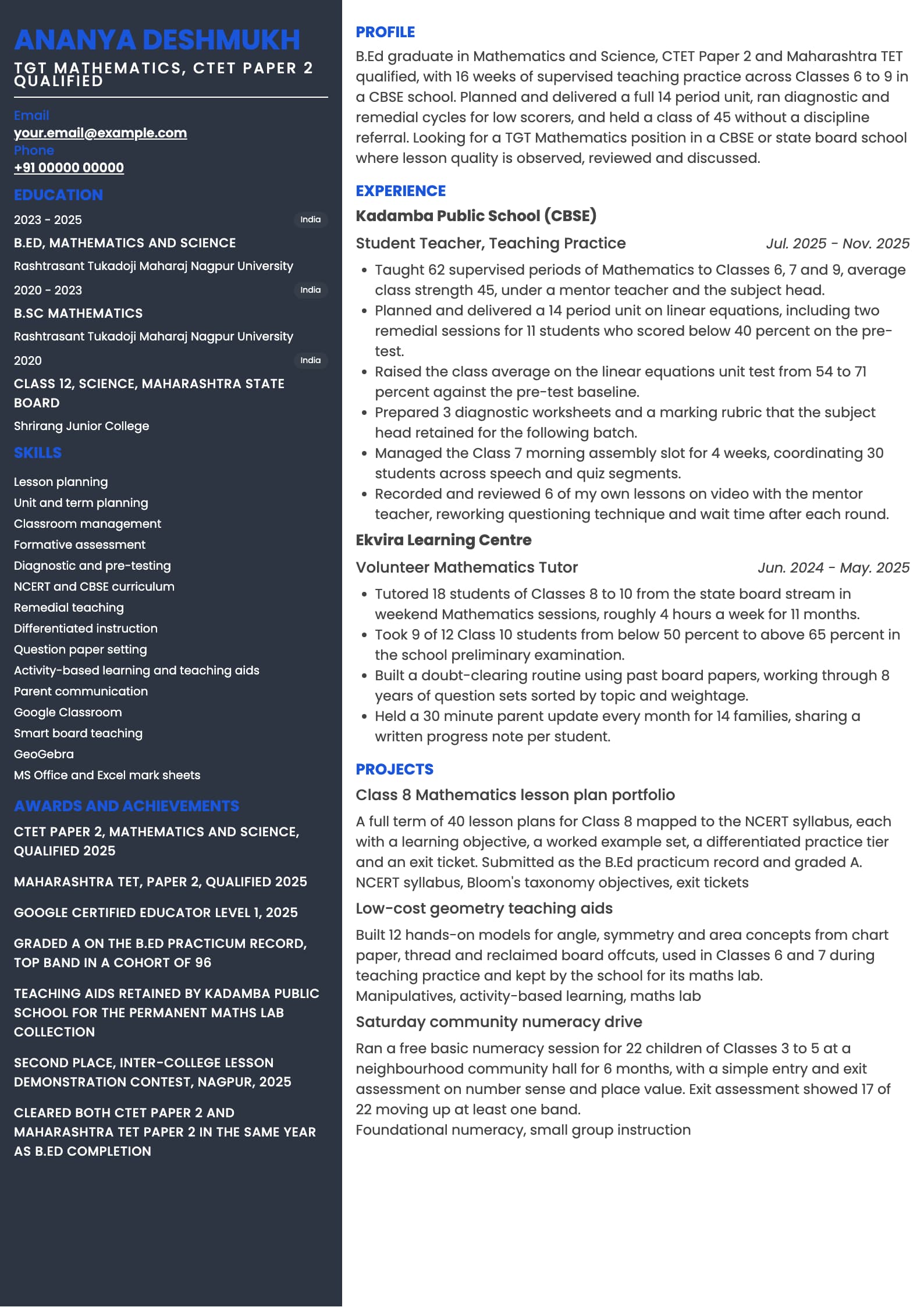
Build my resumeTeacher resume example, Fresher, B.Ed graduate (0 years)
polished templateIs your resume good enough?
Upload the resume you have now and see what an applicant tracking system reads before a teacher recruiter ever does.
Free to run. Sign in with your mobile number to see your score.
Teacher resume example, School teacher (6 years)
banded-header template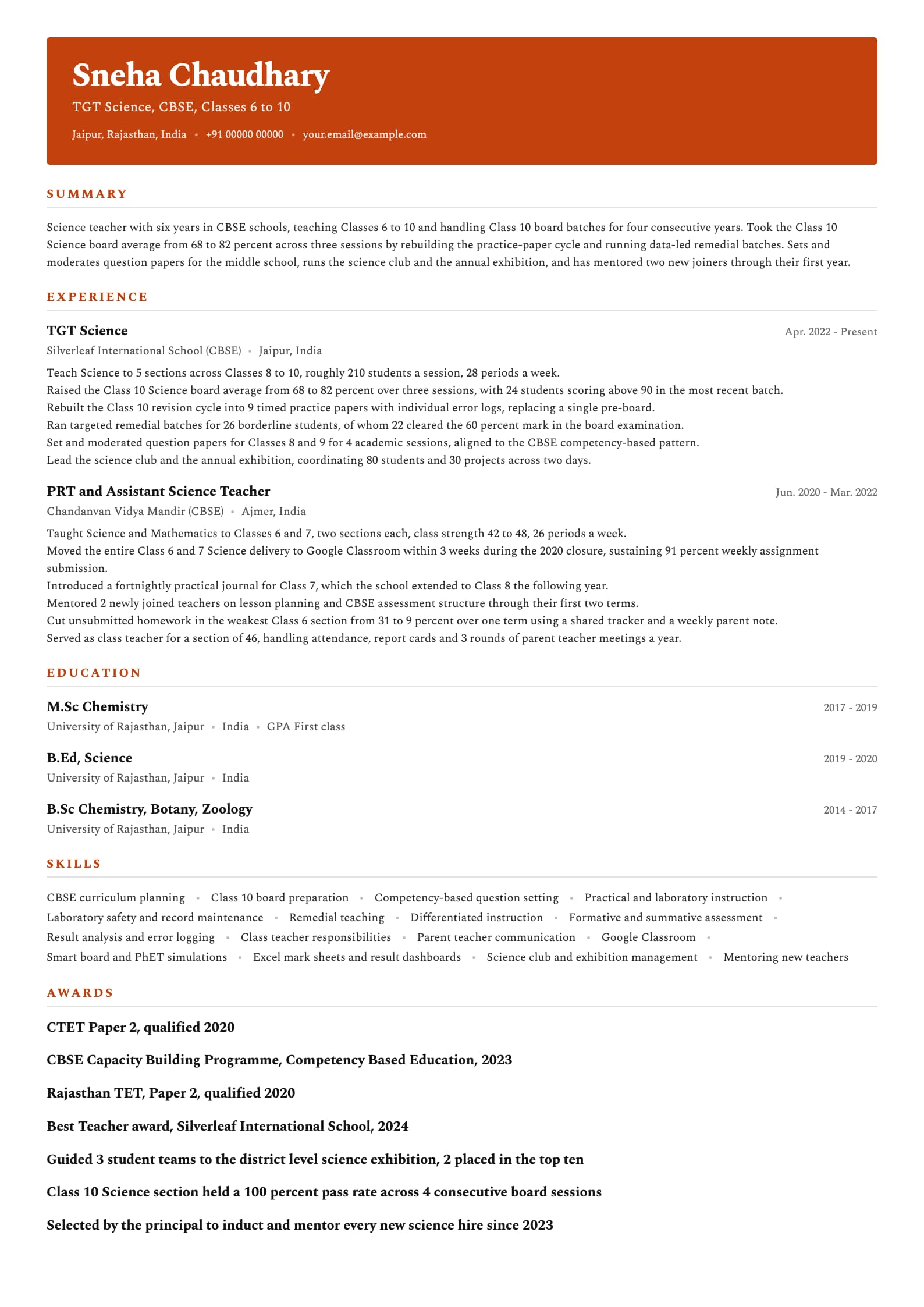
Want this structure with your own details? Build it in the resume builder.
Teacher resume example, Head of Department (12 years)
compact-serif template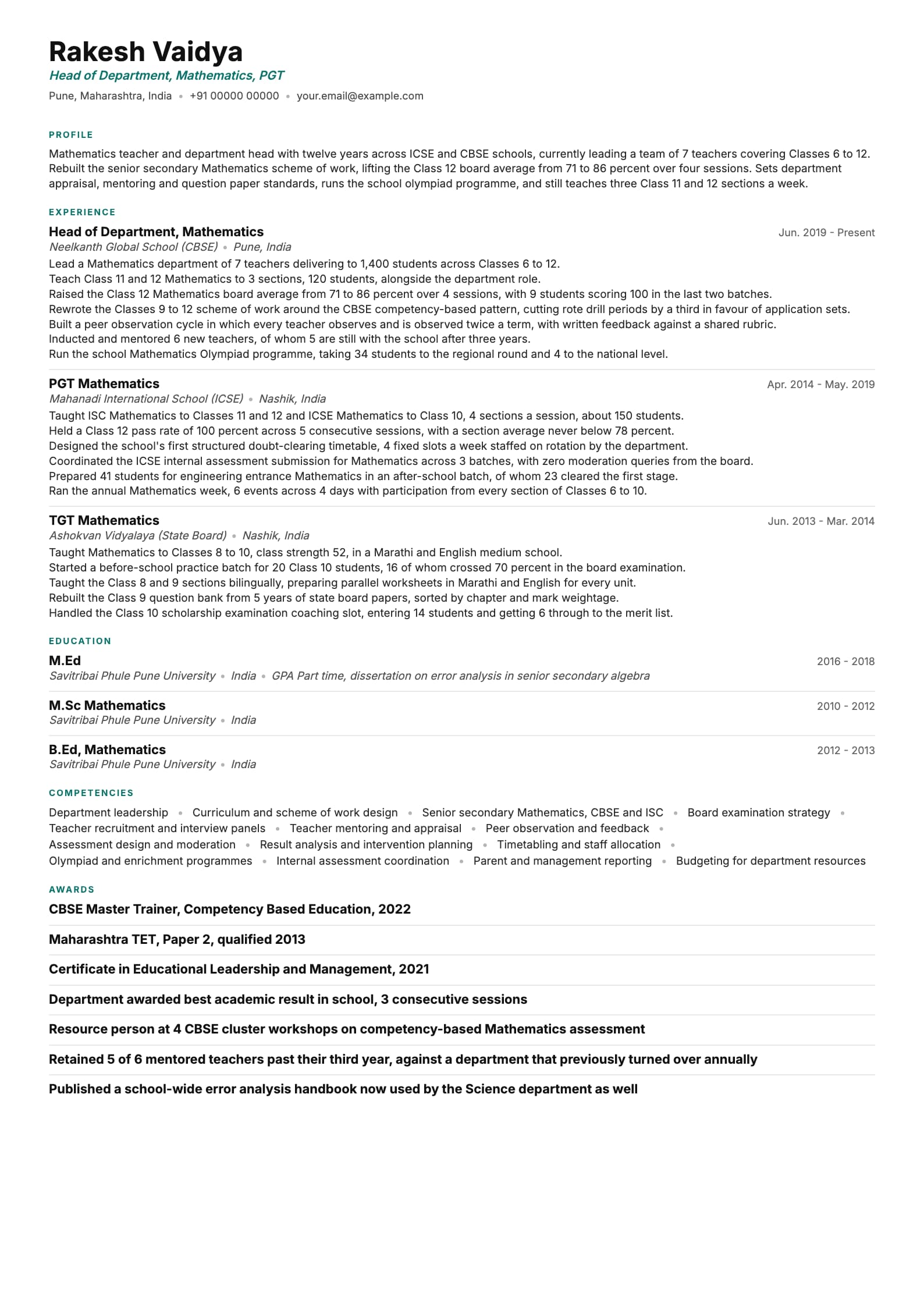
The format that works for teacher resumes in India
Reverse chronological, one page up to roughly eight years of teaching, two pages for a head of department or a coordinator. The order below is what a principal and a school HR desk expect, and keeping to it means nobody has to search for the qualification that decides eligibility. Single column, one clean serif or sans-serif face, and headings that say exactly what the section is. Resist the two-column layout with a coloured sidebar, because school offices still print resumes for the interview panel and a dark sidebar either eats the toner or comes out as a grey block with your skills hidden inside it. Keep the file name plain and human, something like your name followed by the post, so the person managing a shared inbox during an admission cycle can find it again. Send a PDF unless the vacancy notice asks for a Word file. A PDF holds its layout on a school laptop that may still be running an old office suite, and it stops your carefully spaced sections from reflowing into four ragged pages. Leave the photo, the date of birth, the marital status, the father's name and the signed declaration off the page entirely, unless a government recruitment form explicitly demands them in its own prescribed proforma. Every line of that block is space a board result should be occupying.
| Section | Where it goes | Why |
|---|---|---|
| Name and headline | Top, above everything | Name the post and the subject you want: TGT Science, PGT Mathematics, Primary Teacher. Add TET or CTET status if you have it. |
| Professional summary | Directly under the header | Three lines. Subject, board, classes taught, years, and the single strongest result. |
| Qualifications and eligibility | Near the top for freshers, with education otherwise | B.Ed, M.Ed, CTET or state TET, with paper and year. Schools screen on this first. |
| Teaching experience | Next, for anyone who has taught | Most recent first. Name the board, the classes, the sections and the subject each time. |
| Teaching practice and internship | In place of experience for a fresher | Give it a title, a school, dates and bullets. It is supervised classroom work, so it counts. |
| Skills | Below experience | Grouped: curriculum and pedagogy, classroom tools, working with people. Not a forty item wall. |
| Co-curricular responsibility | After skills | Clubs, houses, exhibitions, olympiads, trips. Schools staff these too and it is often the tiebreaker. |
| Languages | Near skills, or beside education | Name the medium you can teach in. A bilingual teacher solves a staffing problem a monolingual one cannot. |
| Education | Bottom, unless you are a fresher | Degree, university, years. Keep Class 10 and 12 marks only while you are a fresher. |
The summary that replaces the objective line
Almost every teaching resume that arrives at a school opens with the same sentence about seeking a challenging position in a reputed institution where one can utilise one's skills. It is the single most skippable line in Indian recruitment, and it costs you the most valuable three lines on the page. Replace it with a summary that answers what a screener is actually holding the resume to find out: what you teach, to which classes, under which board, for how long, and what happened to your students. Three lines, four at the outside. Start with the noun, not with a personality claim. "Science teacher with six years in CBSE schools" places you instantly; "Dedicated and passionate educator" places you nowhere, because everyone applying wrote it. Put your strongest single result in the second or third line, and make it a result about students rather than about you. Board average movement, pass rate, remedial outcomes, olympiad qualifications, a class size you held. If you are a fresher and have no results yet, use the scale of your teaching practice: weeks, periods, classes and the school board. That is still evidence, and it is more than most fresher summaries offer. Finish with the post you want, named the way the vacancy names it, so a screener sorting for a TGT Science opening does not have to infer that you are applying for it. Write the summary last, after the experience section is finished, because by then you will know which number is your strongest and you can lift it straight up to the top.
Summary opening line
Weak
To seek a challenging position in a reputed educational institution where I can utilise my skills and knowledge for the growth of the organisation and myself.
Strong
Science teacher with six years in CBSE schools, teaching Classes 6 to 10 and handling Class 10 board batches for four consecutive years.
The first line says nothing a screener can act on; the second gives subject, board, classes and years before they finish reading it.
Where B.Ed, M.Ed and the TET line actually belong
For most teaching vacancies in India the first pass is an eligibility check, not a quality judgement. If a screener cannot confirm your B.Ed and your TET status in the first few seconds, the resume is set aside before your results are read. This is the one section where the rules are not stylistic. Government schools, aided schools and most CBSE affiliated private schools have a stated qualification requirement for each post, and the person doing the first sort is usually working from that list rather than from an opinion about teaching quality. Give them the answer in the header and again in a clearly labelled block, because the header line gets read in the two second scan and the block gets read when someone is filling in a shortlist sheet. Name the paper you cleared, name the year, and name your subject specialisation. If you hold a TET for one state and are applying in another, say which state, because eligibility rules differ and a screener who has to guess will assume the answer that costs you least of their time. If your B.Ed is still in progress, write the expected completion month and year plainly rather than leaving a date range open, because an unexplained gap in a qualification block reads worse than an honest in-progress line. And if a post genuinely does not require a TET, for example many private school primary or pre-primary roles, do not pad the section. An empty certification block is better than one filled with short online courses that have nothing to do with teaching.
- Put CTET or state TET in the headline if you hold it, then repeat it under certifications with the paper number and the year you qualified.
- Name the paper. CTET Paper 1 is for Classes 1 to 5 and Paper 2 for Classes 6 to 8, and the post you are eligible for depends on which one you cleared.
- State the B.Ed subject specialisation, not just the degree. "B.Ed, Mathematics and Science" answers a question that "B.Ed" leaves open.
- Name the state for a state TET, because eligibility travels differently across states and a screener will not chase the detail.
- A fresher should carry Class 12 stream and percentage. Once you have a full session of teaching behind you, drop school marks and let the classroom results take the space.
- If you are mid-degree, say so plainly with the expected completion month and year rather than leaving a gap the reader has to guess at.
- Put M.Ed with education, not with certifications, and add the dissertation topic if it is relevant to the post you want.
- Keep the certification block to qualifications that change what you are allowed or equipped to teach. Everything else is clutter.
Qualifications block
Weak
B.Ed. CTET cleared. Various teaching workshops attended.
Strong
B.Ed, Mathematics and Science, Rashtrasant Tukadoji Maharaj Nagpur University, 2025. CTET Paper 2, Mathematics and Science, qualified 2025. Maharashtra TET Paper 2, qualified 2025.
Specialisation, paper, state and year turn three vague claims into three verifiable eligibility facts.
A resume that makes the reader hunt for the TET line is competing against fifty that did not make them hunt.
Writing teaching bullets that a principal can act on
The pattern across all three samples is the same: action verb, what you taught or built, what changed for the students. Class strength, result movement, number of students, sections handled. Pick whichever number is honest for that bullet. Teachers usually resist this, and the resistance is understandable, because teaching outcomes are shared with the students, the parents and the previous year's teacher, and claiming them feels like overstating your part. The way through is to state what you did and what moved, side by side, without claiming sole credit for the movement. "Rebuilt the Class 10 revision cycle into 9 timed practice papers with individual error logs" is entirely yours. "Raised the Class 10 Science board average from 68 to 82 percent over three sessions" is the outcome that followed. Putting them in adjacent bullets lets a principal draw the connection themselves, which is more persuasive than asserting it. If you truly have no result numbers because you have only taught non-board classes, the numbers are still there in a different form: class strength, number of sections, periods per week, students in a remedial batch, unit test movement, assignment submission rates, students entered for a competition, teams guided to a district round. Every one of those is countable and every one of them is on your own record. Avoid one trap in particular. Do not round a real number up into a bigger one, and do not describe a two-student intervention as a programme. A principal who has run a department can tell, and the interview is where the invention gets found.
- Weak: "Responsible for teaching Science to secondary classes."
- Strong: "Teach Science to 5 sections across Classes 8 to 10, roughly 210 students a session, 28 periods a week."
- Weak: "Improved student performance in board exams."
- Strong: "Raised the Class 10 Science board average from 68 to 82 percent over three sessions, with 24 students scoring above 90."
- Weak: "Took extra classes for weak students."
- Strong: "Ran targeted remedial batches for 26 borderline students, of whom 22 cleared the 60 percent mark in the board examination."
- Weak: "Participated in school activities."
- Strong: "Lead the science club and the annual exhibition, coordinating 80 students and 30 projects across two days."
- Weak: "Guided and supported junior faculty members."
- Strong: "Inducted and mentored 6 new teachers, of whom 5 are still with the school after three years."
Experience bullet, workload
Weak
Handled multiple classes and sections as per the school timetable.
Strong
Teach Science to 5 sections across Classes 8 to 10, roughly 210 students a session, 28 periods a week.
Schools staff against load, so the numbers a timetable already contains are the ones that make the decision easy.
Experience bullet, co-curricular
Weak
Actively involved in various co-curricular activities of the school.
Strong
Lead the science club and the annual exhibition, coordinating 80 students and 30 projects across two days.
Naming the activity, the scale and the duration turns a filler line into a second reason to hire you.
If a bullet would read identically on every teacher's resume in your staff room, it is describing the job, not you. Rewrite it until it only fits your classes.
Subject, board and class band: say all three, every time
The most common structural weakness in Indian teaching resumes is a subject named without a board and a class band. "Taught Science" could mean Class 3 environmental studies in a state board primary school or Class 12 Physics in an ISC stream, and those are entirely different hires. Every experience heading should carry the school, the board in brackets, and every bullet under it should carry the classes and sections. That single habit does more for a teaching resume than any amount of design. It also matters because post titles are not interchangeable across the system. PRT, TGT and PGT map to class bands and qualification levels, and a principal reading your resume is placing you against a specific vacancy. If your career has crossed boards, say so and treat it as an asset rather than an inconsistency, because a teacher who has taught both CBSE and ICSE knows two assessment patterns and can be placed in either. If you have taught in more than one medium, name it. Bilingual capability is a real staffing constraint in a large part of the country, and a school running parallel English and regional medium sections will read a Marathi or Hindi medium line as a solution rather than as a footnote. The table below is the mapping most Indian schools use, and matching your headline to the right row is the cheapest relevance win on the page.
| Post | Classes it covers | Usual qualification | What the resume must show |
|---|---|---|---|
| PRT, Primary Teacher | Classes 1 to 5 | Graduation plus D.El.Ed or B.Ed, CTET Paper 1 for most CBSE and government posts | Foundational literacy and numeracy work, class teacher duty, activity-based learning, parent handling. |
| TGT, Trained Graduate Teacher | Classes 6 to 10 | Graduation in the subject plus B.Ed, CTET Paper 2 or state TET | Subject named, sections and class strength, unit test movement, board results if you have taught Class 10. |
| PGT, Post Graduate Teacher | Classes 11 and 12 | Post graduation in the subject plus B.Ed | Stream and board, Class 12 averages and top scorers, entrance preparation if you did it. |
| NTT, Pre-Primary Teacher | Nursery to Kindergarten | NTT or a Montessori or early childhood diploma | Age group, ratio you handled, early years framework, parent communication cadence. |
| Special Educator | Across the school, inclusion support | B.Ed Special Education, RCI registration where required | IEP work, number of students supported, disability categories, coordination with class teachers. |
| Head of Department or Coordinator | A subject or a school wing | Post graduation plus B.Ed, usually M.Ed preferred | Team size, department results over multiple sessions, appraisal and mentoring, curriculum ownership. |
Experience heading
Weak
Science Teacher, Silverleaf International School, 2022 to present.
Strong
TGT Science, Silverleaf International School (CBSE), Jaipur, Apr 2022 to Present. Classes 8 to 10, 5 sections.
The post title, the board and the class band let a principal place the candidate against a specific vacancy without a phone call.
The skills section a school actually reads
Teaching skills sections tend to fail in one of two directions. Either they list personal qualities, patience, punctuality, dedication and hard working, which prove nothing and appear on every resume in the pile, or they run to forty items and become a wall nobody reads. Group them instead, and keep the group headings the ones a school thinks in. Curriculum and pedagogy covers lesson planning, unit and scheme of work design, assessment design, competency-based question setting, remedial and differentiated instruction, and the boards and frameworks you have worked to. Classroom technology covers the platforms you have genuinely run a class on, Google Classroom, Microsoft Teams, a smart board, the school ERP you entered marks into, the simulation tools you used for practicals. Working with people covers classroom management, parent communication, student counselling, mentoring and co-curricular coordination, and these should be there because they are real parts of the job, not because they sound pleasant. Fifteen to eighteen items across three groups is enough. The test for each one is whether you could answer a follow-up question about it in an interview, because the interview panel will pick two at random. Do not list a tool you have opened once, and do not list a framework you have only read about. If you have run one term of Google Classroom, that is a real skill and it should be there; if you have watched a webinar on the National Education Policy, that is not a skill and it will not survive a question.
- Group under three headings: curriculum and pedagogy, classroom technology, working with people.
- Put the board and framework knowledge in the first group, because it is the closest thing teaching has to a technical stack.
- Name the tool version of a skill where one exists. "Google Classroom" is checkable, "technology integration" is not.
- Drop the personal virtues. Patience and dedication are assumed and they occupy a line that a real capability could use.
- Mirror the vacancy notice's own wording where it is honest to do so, because that is the phrasing the screener has in mind.
- Keep the total between 15 and 18 items. Anything longer stops being read at about item twelve.
- Every listed skill is a question you have agreed to answer in the interview. Cut the ones you would not want asked.
Skills line
Weak
Hard working, punctual, patient, good communication, team player, quick learner.
Strong
Competency-based question setting, remedial and differentiated instruction, Class 10 board preparation, Google Classroom, Excel result analysis, parent teacher communication.
Six unverifiable adjectives are replaced by six things a panel can ask about and a school can staff against.
School portals, applicant tracking systems and the plain file
Not every teaching vacancy in India goes through software. A small independent school still takes a printout, a walk-in and a demo lesson. But the larger school groups, the international schools, the chains running twenty campuses and most job boards do run your file through a parser before a human opens it, and government portals impose their own rigid form fields. Both cases reward the same thing: a plain, single column, text-based document with conventional section headings. Write the headings a parser expects, so use Work Experience or Teaching Experience rather than My Journey, and Education rather than Academic Milestones. Keep the dates in one consistent format on every line, because inconsistent date formats are the most common reason a parser mis-orders a career. Do not put your qualification, your contact details or anything else important inside a header or footer, because many parsers never read those regions. Avoid text inside images, avoid icons standing in for section labels, and avoid tables holding your experience, because a table can be read column by column and turn a tidy resume into scrambled fragments. Where a portal asks you to paste the resume text into a box, paste it and then read it back, since that box will strip your formatting and you want to see what the school will see. On keywords, the honest approach is also the effective one. Use the words your subject and post genuinely call for, TGT, PGT, CBSE, lesson planning, board examination, classroom management, and use them inside real bullets rather than in a hidden block of white text at the bottom of the page. Parsers weight terms that appear in context, and a school reading a keyword salad will bin it.
- Send a PDF unless the vacancy asks for a Word file. Never send a scanned image of a printed resume.
- Use conventional headings: Professional Summary, Teaching Experience, Education, Skills, Certifications.
- Keep one date format throughout, for example "Apr 2022 - Present" on every line.
- Keep the qualification block in the body, not in a header or footer that a parser may skip.
- Spell out the post abbreviations at least once. Write "TGT (Trained Graduate Teacher)" so both forms are matchable.
- Write CTET, B.Ed and the board names exactly as the vacancy notice writes them.
- Avoid tables, text boxes, icons and columns in the body. Keep the layout linear from top to bottom.
- Name the file plainly, your name plus the post, so a shared school inbox can find it again.
Name your sections the boring way. "Teaching Experience" is matched by every parser and read instantly by every principal; "My Teaching Journey So Far" is matched by neither.
What gets teacher resumes rejected
Most rejections at the resume stage are not close calls. They come from a small set of repeating faults, and almost all of them are fixable in an afternoon. The list below is ordered roughly by how often it costs someone a shortlist, starting with the two that a screener catches in the first few seconds. It is worth understanding why these particular faults are fatal rather than merely untidy. A school shortlisting for one vacancy is not ranking candidates on a scale; it is sorting them into a yes pile and a no pile, and anything that makes the sorting slower pushes you towards no. A missing board name means the screener has to guess which syllabus you know. A buried TET line means they have to read a second page to confirm you are even eligible. A page of duties copied from an appointment letter means they cannot tell you apart from the last eleven applicants, all of whom had the same duties. None of these are judgements about your teaching. They are judgements about how much work your resume is making somebody do. Fix the top four on this list and you have removed most of the reasons a competent teacher gets filtered out before the demo lesson, which is the stage where you actually win the job.
- Listing subjects without the classes or the board. "Taught Science" and "Taught Science to Classes 8 to 10, CBSE" are read very differently.
- Burying B.Ed and TET at the bottom of a second page, where an eligibility check will not reach them.
- A duty list lifted from the appointment letter instead of what actually changed in your classes.
- No results anywhere. Board averages, unit test movement, remedial outcomes, students mentored, exhibition placements. At least one of these is available to almost every teacher.
- Photo, date of birth, marital status, father's name and a signed declaration. None of it belongs on the page, and it costs the space a result should occupy.
- Long paragraphs instead of bullets, which is common in teaching resumes and is the fastest way to lose a reader who has fifty to get through.
- Multi-column and table-heavy layouts that an older applicant tracking system reads out of order, scrambling your experience before a human sees it.
- A generic objective line asking for a challenging position. Replace it with a summary naming subject, board, classes and one outcome.
- Unexplained gaps between sessions. A single honest line covering a career break, a further degree or a relocation closes the question before it is raised.
- The same resume sent to a CBSE senior school, a pre-primary wing and a state board vacancy. Change the headline and the top three bullets each time, at minimum.
- A list of every workshop and webinar attended since 2015. Keep the ones that changed what you can teach and drop the rest.
- Spelling and capitalisation errors in the subject names, the board names or the school names. On a teaching resume this is read as a statement about your standards.
Print your resume once and read it at arm's length for ten seconds. If subject, board, classes and TET status are not all visible in that time, the layout is the problem, not the content.
Skills to put on a teacher resume
Technical
- Lesson planning
- Unit and term planning
- Curriculum mapping, CBSE, ICSE and state board
- Scheme of work design
- Assessment design
- Competency-based question setting
- Formative and summative assessment
- Board examination preparation
- Remedial and differentiated instruction
- Laboratory and practical instruction
- Individualised education plan support
- Continuous and comprehensive evaluation
- Result analysis and error logging
- Question bank and paper moderation
- Foundational literacy and numeracy
Tools and platforms
- Google Classroom
- Google Workspace for Education
- Microsoft Teams for Education
- Microsoft Office and Word lesson templates
- Smart board and interactive display
- Zoom and online class delivery
- Canva for teaching material
- PhET and GeoGebra simulations
- School ERP and attendance systems
- Learning management system administration
- Kahoot and Quizizz
- Excel result analysis and mark sheets
Working skills
- Classroom management
- Parent teacher communication
- Student counselling
- Mentoring junior teachers
- Collaborative planning
- Behaviour management
- Co-curricular coordination
- Time and workload management
- Conflict resolution with students and parents
- Working with a bilingual classroom
Certifications worth listing as a teacher
| Certification | Full name | Worth it for |
|---|---|---|
| CTET | Central Teacher Eligibility Test, Paper 1 or Paper 2 | Effectively mandatory for central government schools and widely asked for by CBSE affiliated private schools. Paper 1 covers Classes 1 to 5 and Paper 2 covers Classes 6 to 8, so clear the one that matches the post you want. Worth doing before you finish B.Ed if the timing allows, because a fresher who already holds it clears a filter that most of the cohort has not. |
| State TET | State Teacher Eligibility Test, for example MAHA TET, UPTET, REET, TNTET | Necessary for state government and aided school recruitment in that state, and often accepted by private schools there as well. Do it if you intend to teach in that state, and note that it does not automatically travel if you relocate. If you already hold CTET and are applying only to private CBSE schools, a second state TET adds little. |
| B.Ed | Bachelor of Education | The baseline qualification for TGT and PGT posts across almost every board. There is no route around it for a mainstream school teaching job in India, so if you are a subject graduate teaching in a coaching setup and want to move into a school, this is the qualification to plan for first. Name your subject specialisation on the resume, not just the degree. |
| M.Ed | Master of Education | Worth it if you are aiming at head of department, academic coordinator, vice principal or teacher training work, where it is frequently preferred and sometimes required. It does very little for a classroom TGT post, so do not take it purely to strengthen a subject teaching application. A part time M.Ed alongside a full teaching load is common and is respected. |
| NTT | Nursery Teacher Training | The standard entry qualification for pre-primary and nursery posts in private schools, alongside a Montessori or early childhood diploma where the school follows that method. Genuinely useful if you want to teach the early years, and it is not a substitute for B.Ed if you later want to move into primary or middle school. Pair it with the age group and ratio you have handled on your resume, because that is what pre-primary heads screen on. A Montessori diploma adds little in a conventional CBSE primary wing, so check what the schools in your city actually recognise before paying for one. |
| B.Ed Special Education | Bachelor of Education in Special Education, with RCI registration | For special educators and inclusion support roles, where RCI registration is usually the hard requirement rather than the diploma alone. Increasingly relevant as schools staff inclusion cells. If you are a mainstream teacher, a shorter foundation course in inclusive practice is enough to signal capability and you do not need the full degree. |
| IB or Cambridge certification | IB Educator Certificate, or Cambridge International Certificate in Teaching and Learning | Worth it only if you are targeting IB or Cambridge schools, where it is often a genuine differentiator and sometimes a requirement for the diploma programme. It carries no weight in a CBSE or state board recruitment, so do not spend on it as a general upgrade. Many international schools sponsor it after you join, which is usually the better route. |
Keywords an ATS scans for in a teacher resume
These are the literal terms a parser matches against the job description. Use the ones that are true of you, in the sentences where you did the work, not as a list at the bottom.
- teacher
- TGT
- PGT
- PRT
- B.Ed
- M.Ed
- CTET
- TET qualified
- CBSE curriculum
- ICSE
- NCERT
- lesson planning
- classroom management
- curriculum development
- student assessment
- board examination
- remedial teaching
- subject specialisation
- Google Classroom
- parent teacher meeting
- co-curricular activities
- class teacher
Teacher resume FAQ
What is the correct resume format for a teacher job in India?
Reverse chronological, single column, one page up to roughly eight years of teaching. Header with name and the post you want, then a three line summary, then qualifications including B.Ed and TET, then teaching experience with the board and classes named, then skills, co-curricular responsibility, languages and education. All three samples above follow that order. Send it as a PDF unless the vacancy notice asks for Word, and keep the layout linear so both a parser and a printed interview panel copy read it the same way.
How do I write a teacher resume with no experience?
Treat your B.Ed teaching practice as the experience section. Give it a job title, the school and board, the date range and real bullets: periods taught, classes, average class strength, and what moved on a unit test. Add tutoring, volunteer teaching, your lesson plan portfolio and any teaching aids you built. The fresher sample above is built exactly this way, and it carries five bullets on the internship alone. Keep Class 12 stream and percentage while you are a fresher, and drop them after your first full session.
Should I mention CTET or state TET on my resume?
Yes, and high up. Put it in the headline and repeat it under certifications with the paper number and the year. Paper 1 covers Classes 1 to 5 and Paper 2 covers Classes 6 to 8, so naming the paper tells the school which posts you are eligible for without a follow-up call. For a state TET, name the state as well, because eligibility does not automatically travel when you relocate. If you hold both, list both, and put the one the vacancy asks for first.
Should a teacher resume include board exam results?
If you have taught a board class, yes. Give the movement rather than a single figure, for example a Class 10 average going from 68 to 82 percent over three sessions, and add how many students crossed 90. Movement over multiple sessions is more convincing than one strong year, because it reads as method rather than luck. If you have not handled a board batch, use unit test movement, remedial outcomes, assignment submission rates or the number of students you mentored instead.
How long should a head of department or senior teacher resume be?
Two pages is acceptable once you are leading a department, and only if the second page carries department results, mentoring and curriculum work rather than more of the same teaching bullets. Compress the older roles hard, the way the twelve year sample above gives seven bullets to the current role, six to the five year ICSE role and five to the single first year. Anything beyond two pages will be skimmed rather than read, whatever your experience.
What is the difference between a PRT, TGT and PGT resume?
The class band and the evidence change. A PRT resume leads with foundational literacy and numeracy, class teacher duty, activity-based learning and parent handling for Classes 1 to 5. A TGT resume leads with the subject, the sections, class strength and unit test or Class 10 board movement for Classes 6 to 10. A PGT resume leads with the stream, Class 12 averages, top scorers and any entrance preparation work. Match your headline to the post title in the vacancy notice, because that is the term the screener is sorting on.
Should I list languages on a teaching resume?
Yes, and name the medium you can teach in rather than just listing the languages you speak. A school running parallel English and regional medium sections reads a line like "Marathi, fluent, can teach in Marathi medium" as a staffing solution. Put it near skills or beside education, keep it to three or four entries, and be honest about the level, because a demo lesson in the second medium is a normal part of the interview for a bilingual post.
Do teacher resumes need a photo in India?
No, and it usually hurts. A photo, date of birth, marital status, father's name and a signed declaration together consume most of a page's most valuable space, and none of it helps a principal decide whether you can take Class 10 Science. The only exception is a government recruitment form with its own prescribed proforma that explicitly asks for them, in which case fill the form as required and keep your own resume clean.
How do I show co-curricular work without it looking like filler?
Name the activity, your role in it, and the scale. "Lead the science club and the annual exhibition, coordinating 80 students and 30 projects across two days" is staffing information; "actively involved in co-curricular activities" is not. Schools have to staff houses, clubs, exhibitions, olympiads and trips, and a candidate who can take one of those off a coordinator's list is easier to hire. Keep it to two or three lines unless the vacancy specifically asks for an activity in-charge.
How should I explain a career gap on a teaching resume?
In one plain line, in the experience section, where the gap sits. A further degree, a relocation, a family break or a period of private tuition all read fine when stated; an unexplained eighteen month hole invites a worse assumption. If you tutored, ran online classes or did substitute work during the gap, list it as a role with dates and a bullet or two. Do not hide a gap by widening date ranges, because school HR desks verify appointment letters.
Related resume examples and guides
Build your teaching resume in any of these formats
Start from a blank resume or upload the one you have. Goodspace renders it in 24 templates and flags what a school's applicant tracking system will miss.
Build my resume