Education Counselor Resume Format, with 3 Full Samples
An education counselor is hired on evidence of students guided, admissions closed and targets hit without leaving a family feeling pushed, yet most resumes describe a warm personality and forget the numbers. Below are three complete resumes, one for a psychology graduate stepping into an admissions desk, one for an admissions counselor with four years at a coaching and study-abroad firm, and one for a senior career counselor who runs a team and owns an enrolment target. After the samples come the format rules, the difference between claiming empathy and proving conversion, the terms an applicant tracking system matches literally, and the mistakes that get a counselor resume filtered before a human reads it.
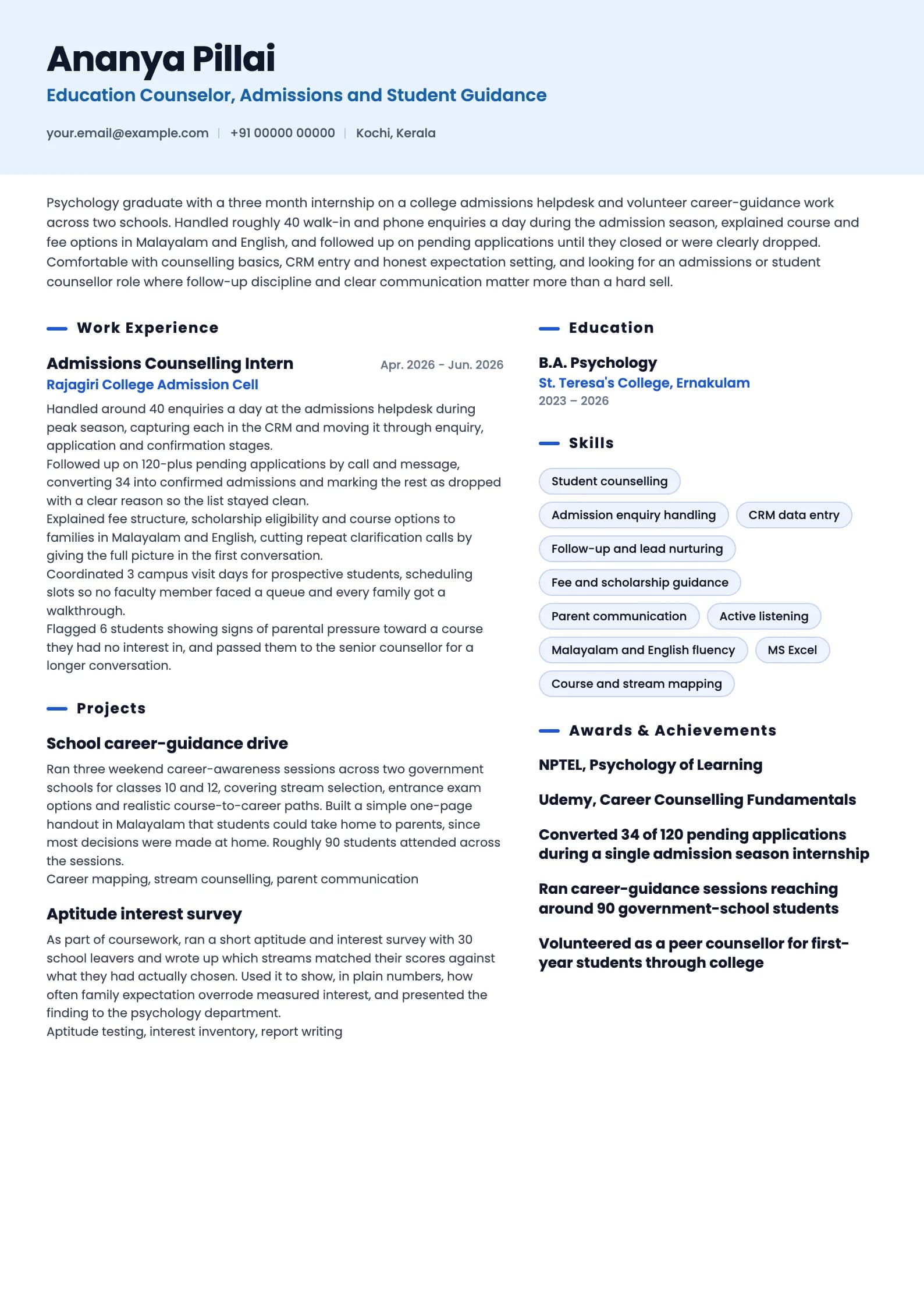
Build my resumeEducation Counselor resume example, Fresher (0 years)
ai-era templateIs your resume good enough?
Upload the resume you have now and see what an applicant tracking system reads before a education counselor recruiter ever does.
Free to run. Sign in with your mobile number to see your score.
Education Counselor resume example, Mid-level (4 years)
professional template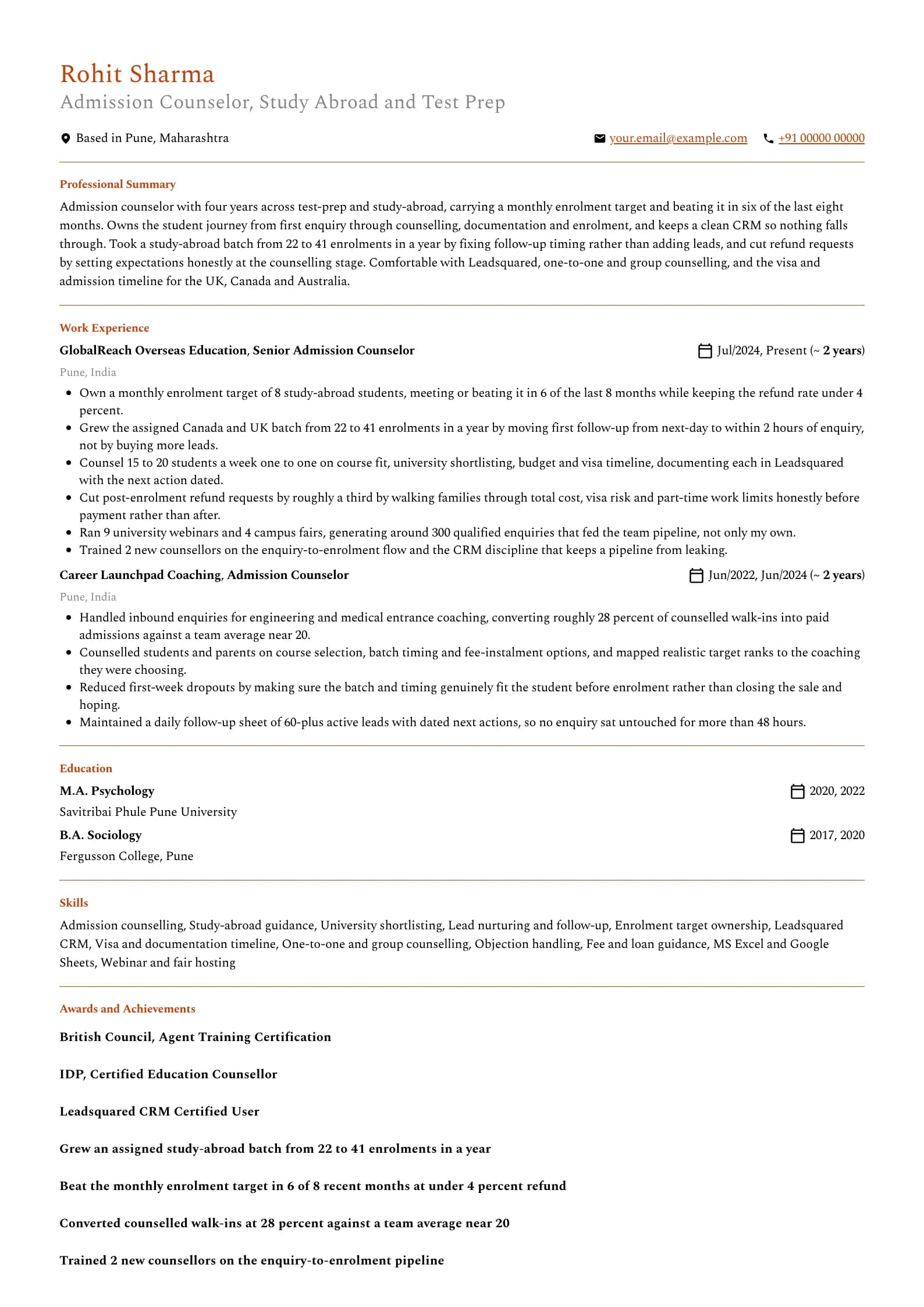
Want this structure with your own details? Build it in the resume builder.
Education Counselor resume example, Senior (10 years)
header-band template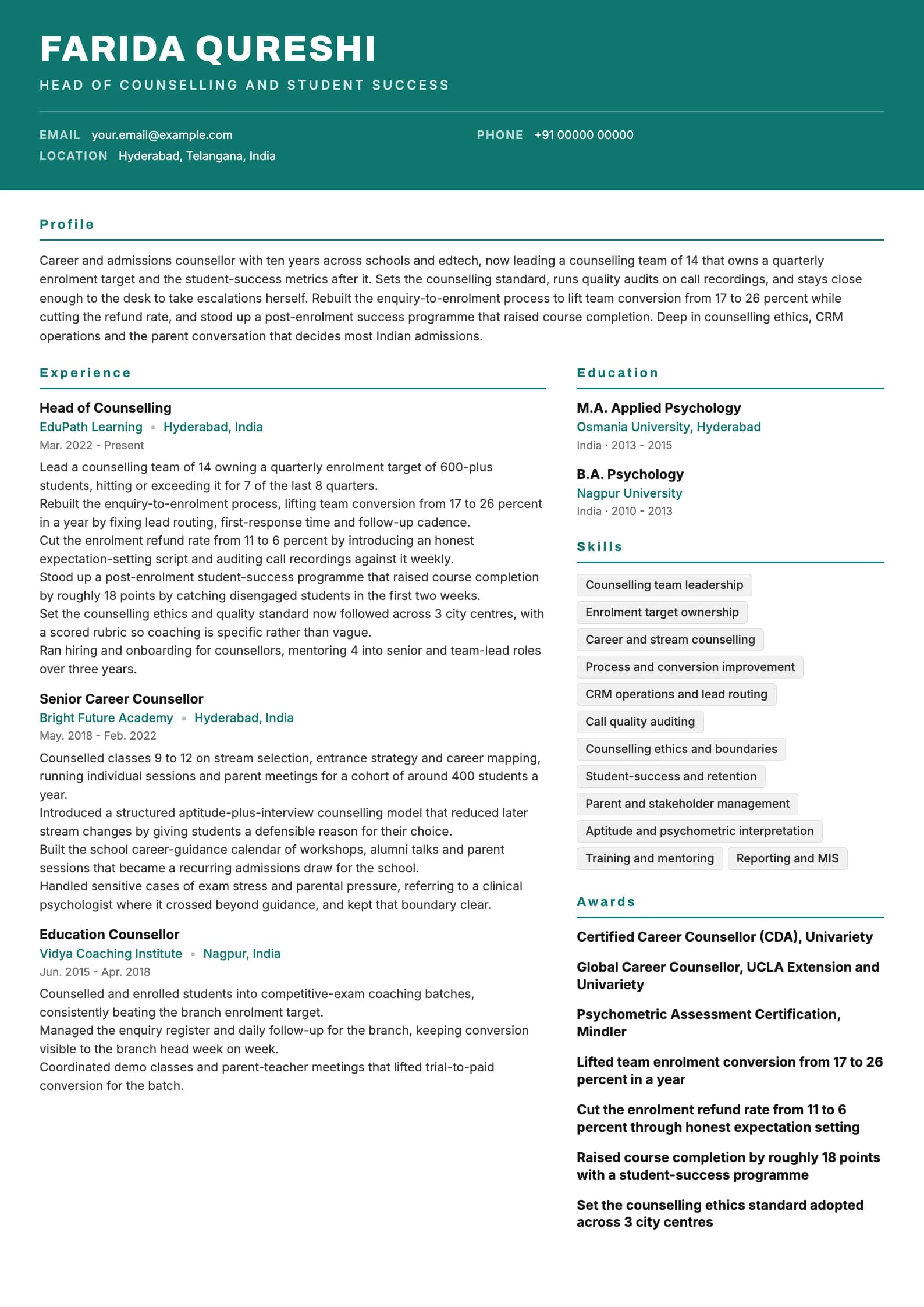
The format that works for education counselor resumes in India
Reverse chronological is the layout to use. Most recent role first, work backwards, dates in plain view. A functional resume that hides dates under a Skills heading reads as an attempt to cover a gap or job-hopping, and in a target-carrying role like counselling that suspicion is expensive. One honest line explaining a gap beats a layout built to disguise one. Length follows evidence. One page holds everything a fresher and most counsellors up to roughly six years need. A senior counsellor running a team can use a second page, but only if it carries real ownership and numbers rather than a longer list of soft skills. A page two made of a hobbies line and a declaration paragraph is a padded one-pager. Four things do not belong on a counselling resume in 2026: a photograph, date of birth, marital status and father's name. They come from an older campus-placement template and add nothing to a hiring decision. Each line they take is a line a conversion number or a counselling result could have used. Send a PDF unless the posting asks for DOCX, and name the file with your own name and the role rather than resume_final. Use a single column top to bottom, because two-column layouts with a sidebar parse unpredictably in an applicant tracking system. The table below sets the section order.
| Section | Where it goes | Why |
|---|---|---|
| Name and headline | Top, above everything | Headline is the role you want: education, admission or career counsellor. Recruiters match on it. |
| Professional summary | Directly under the header | Three lines. Domain, years, and the single strongest conversion or student result. |
| Work experience | Next, for anyone with a job | Most recent first. The current role carries the most bullets and the numbers. |
| Skills | Below experience, grouped | Counselling, CRM and languages grouped, not a 30-item wall of adjectives. |
| Projects or drives | Above experience for freshers only | For a fresher, guidance drives and internships are the evidence. |
| Education | Bottom, near the top for a fresher | Degree, institution, years. A psychology or counselling degree helps, so name it clearly. |
| Certifications and languages | After education | Career-counselling certs and the languages you counsel in both earn their place. |
Claiming empathy is not the same as proving conversion
The most common counselling resume failure is a page full of warmth with nothing measurable on it: excellent communication, passionate about student success, good at building rapport. Every counsellor writes those lines, so they carry no information. The hiring manager already assumes you are friendly. What they cannot tell is whether you close enrolments, keep refunds low and follow up without being chased. The fix is to attach a number to the counselling work. How many enquiries a day, what conversion rate against the team average, what enrolment target and how often you hit it, what the refund or dropout rate looked like. The mid-level sample states an 8-student monthly target beaten six of eight months at under 4 percent refund, which is far stronger than passionate about guiding students, because it can be checked and it answers the real question. Not every number is a sales number, and it should not be. Course completion, first-week retention, repeat-clarification calls avoided, students correctly steered away from a wrong fit. A counsellor who only reports enrolments looks like a salesperson with a nicer title. Varying the metric shows you understand the whole job. Where you genuinely have no number, give scope. How many students in a cohort, how many parent meetings, how many centres, how long a process rebuild took. Scope carries weight without inventing a percentage.
For every soft skill on your resume, ask whether a bullet proves it. "Strong follow-up" means nothing; "followed up on 120 pending applications and closed 34" proves it. Turn each claimed trait into a counted result or cut it.
Writing a counselling summary a hiring manager actually reads
The block under your name is the part most likely to be read, so it should carry three facts: what you counsel and for whom, how long you have done it, and the single strongest result you have produced. Three or four lines, no adjectives that cannot be verified. The old objective line, seeking a challenging position in a reputed institution to utilise my counselling and communication skills, tells the reader nothing they had not already assumed. Replace it with a summary. An objective says what you want; a summary says what you have already delivered, and only one of those is evidence. Freshers often think they have nothing to summarise. Look at the fresher sample: it names the internship, the enquiry volume, the languages counselled in and one honest instance of protecting a student. That is a real summary built from an internship and volunteer work, and it avoids passionate about helping students, which appears on nearly every graduate counselling resume and therefore says nothing. A practical test: read your summary and ask whether a classmate with the same degree could paste it onto their resume unchanged. If they could, it describes the qualification, not you. Add the specific target, the specific conversion number and the specific ownership until it only fits you.
Professional summary, mid-level counsellor
Weak
Passionate and dedicated education counsellor with 4+ years of experience, excellent communication skills and a strong ability to build rapport with students, seeking a challenging role in a reputed institution.
Strong
Admission counselor with four years in study-abroad and test-prep, carrying a monthly enrolment target and beating it in six of eight months at under 4 percent refund. Grew an assigned batch from 22 to 41 enrolments by fixing follow-up timing.
The rewrite trades adjectives and a wish for a target owned, a delivery record and a verifiable growth number.
Experience bullets: action, student or process, result
Every strong bullet in the samples follows the same shape. It opens with an action verb, names the specific counselling activity or process you ran, and closes with what measurably moved. The verb shows you did it. The activity tells a reviewer whether the work maps to their desk. The number does the persuading. Start from the outcome and work backwards. Counsellors usually write the task first, then struggle to attach a result, which produces bullets like handled student enquiries and provided counselling to students and parents. Instead, ask what was different after your work: an enrolment closed, a conversion rate rose, a refund rate fell, a student was correctly steered, a follow-up gap closed. Then write the sentence that ends in that fact. Vary the metric. Six enrolment numbers in a row read as a sales sheet. Across a real counselling role you can honestly reach for enquiries handled, conversion versus team average, target hit rate, refund rate, dropout rate, students counselled, webinars run and juniors trained. The mid and senior samples move across several metric types, which reads as range and as a counsellor who understands more than the sale. Where a number is missing, give scope: cohort size, number of parent meetings, number of centres, length of a process change. Allocate bullets by recency: current role gets five or six, the previous role four, anything older two or three.
| Level | What bullets must prove | Typical metric |
|---|---|---|
| Fresher | You can hold a counselling conversation and follow up | Enquiries a day, applications followed up, conversions from an internship |
| 1 to 3 years | You convert counselled students without hand-holding | Conversion rate, walk-ins closed, follow-up discipline, dropouts avoided |
| 4 to 6 years | You own an enrolment target and keep quality high | Target hit rate, batch growth, refund rate, students counselled a week |
| 7 years and up | You run a team and improve the whole funnel | Team conversion, refund rate, completion or retention, standards set |
Experience bullet, admission counsellor
Weak
Responsible for counselling students and parents about various courses and handling admission enquiries on a daily basis.
Strong
Grew the assigned Canada and UK batch from 22 to 41 enrolments in a year by moving first follow-up from next-day to within 2 hours of enquiry.
"Responsible for" describes a job description; the rewrite names the change made and the enrolment growth it produced.
Experience bullet, quality of enrolment
Weak
Achieved good conversion and helped the institute reach its admission targets every month.
Strong
Cut post-enrolment refund requests by roughly a third by walking families through total cost, visa risk and work limits honestly before payment.
Swaps a vague claim for a specific mechanism and a quality metric, which shows the enrolments were sound rather than pushed.
If a bullet would read identically on any counsellor's resume, it describes the job, not you. Rewrite it until it only fits the target you carried and the student outcome you actually moved.
The skills section: grouped, honest, and counselling-specific
A counselling resume's skills section has two readers with opposite tastes. The applicant tracking system wants literal terms it can match, admission counselling and Leadsquared and career guidance. A human wants a short, organised list that signals what kind of counsellor you are. Grouping serves both. Group by function rather than one long line. Counselling skills, CRM and tools, and languages is a grouping that works for almost every education counsellor. The exact headings matter less than the fact that structure exists. Write names the way the industry writes them: Leadsquared not Lead Square, psychometric not sycometric. The parser matches on strings, and a misspelled tool is a missed match. Ten to fifteen grouped skills is the working range. Below eight it looks thin. Above twenty it stops being a signal, and a counselling resume is especially prone to adjective padding: excellent communication, good listener, team player, hardworking, self-motivated as five separate skills says nothing. Replace them with counselling, CRM and domain terms a reviewer can actually test. List the languages you counsel in as a real skill, not an afterthought. In India, a counsellor who can hold the conversation in the family's home language closes admissions a monolingual counsellor cannot, so name Hindi, Tamil, Marathi or whichever you actually use. Do not include a star-rating bar; nobody agrees what four stars in counselling means, and it invites an argument you cannot win.
| Group | What goes in it | How many |
|---|---|---|
| Counselling | Admission, career or study-abroad counselling, follow-up, objection handling | 4 to 6 |
| Domain | Stream mapping, visa timeline, scholarship guidance, aptitude interpretation | 2 to 4 |
| CRM and tools | Leadsquared, Zoho CRM, MS Excel, Google Sheets | 2 to 3 |
| Process | Enrolment target ownership, lead nurturing, MIS and reporting | 2 to 3 |
| Languages | The languages you actually counsel in | 2 to 4 |
Skills section
Weak
Skills: Excellent communication, Good listener, Hardworking, Team player, Self-motivated, Passionate, Punctual, Multitasking, MS Office, Counselling, Convincing power, Positive attitude
Strong
Counselling: admission counselling, career guidance, follow-up, objection handling. Domain: stream mapping, scholarship guidance. CRM: Leadsquared, Excel. Process: enrolment target ownership, lead nurturing. Languages: Hindi, Marathi, English.
Cuts the interchangeable adjectives, replaces them with counselling and domain terms an ATS and a human can both test, and groups the rest so a reviewer reads it in one pass.
Certifications, degrees and where they belong
Education goes at the bottom for anyone with a full-time role and near the top for a fresher, who has nothing stronger to lead with. Degree, institution, years. A psychology, education or social-work degree is genuinely relevant to counselling, so name it clearly rather than abbreviating it into invisibility. Percentage or CGPA is worth keeping while you are a fresher and it is decent, because early-career screening still filters on it. Once you have your first counselling role with real numbers, drop it. A mark from three years ago competes for space with conversion results that are far more predictive of the job. Certifications sit just below education, or beside skills if you hold only one or two. Write the full name, the issuing body and the year. For counselling in India, credentials from Univariety, Mindler, the British Council for study-abroad, IDP for overseas education, and psychometric-assessment certifications carry real weight, especially early in a career and for edtech and study-abroad roles. Do not list a lapsed or half-finished course as if complete, because it is easy to check. A counselling certificate proves you learned a framework, not that you can hold a room. It helps most when your experience is thin and least once you have a conversion record to point at. Keep the list short and let the numbers carry the depth.
Getting through the applicant tracking system
Edtech firms, coaching chains and study-abroad companies increasingly screen counselling resumes through an applicant tracking system, which is a parser and a search index, not a judge. It reads your file, tries to split it into name, dates, employers, titles and skills, and stores the result so a recruiter can search across candidates. Almost every ATS problem is a parsing problem, and parsing problems come from layout, not wording. The layout rules are short. One column. Standard section headings, so Work Experience rather than My Journey and Skills rather than My Strengths. No text inside images, because a logo strip reads as empty space. No critical information in the header or footer band, which some parsers drop. Avoid text boxes and nested tables in the body. On wording, mirror the language of the job description where it is honest. If the posting says admission counselling, write admission counselling, not just counselling. If it names a CRM like Leadsquared or Zoho, and you have used it, write it exactly. Spell out an acronym once alongside its short form so both searches find you. Keyword stuffing does not work. A hidden block of counselling, counsellor, admission, enrolment, career repeated in white text is found quickly, and the outcome is worse than being filtered. Write real bullets that naturally carry the right terms, because a bullet describing a Leadsquared pipeline contains the word Leadsquared in a context that survives human review too. Save as PDF from a tool that embeds real text, then open the file and confirm you can select and copy a sentence. If you cannot select the text, neither can the parser.
Section heading
Weak
My Counselling Journey
Strong
Work Experience
Parsers look for standard headings; a creative one can push the whole block into an unclassified bucket the recruiter never searches.
Test your own file before sending it. Copy the text out of the PDF into a plain text editor. Whatever reads cleanly there is roughly what the parser sees, and anything scrambled is a real risk.
What gets education counselor resumes rejected
Most rejections at the resume stage are not close calls. They come from a small set of recurring problems, and all are fixable in an afternoon. The list below covers what recruiters of Indian counselling resumes see most often, in rough order of how much damage each does.
- A page of adjectives with no number: passionate, excellent communication, good rapport, and not a single conversion or enrolment figure to back them.
- Job duties copied from the posting instead of what you achieved. "Responsible for counselling students" is the tell.
- Only enrolment numbers, no quality metric, which reads as a salesperson rather than a counsellor. Add refund rate, retention or correct-fit decisions.
- No CRM named. If you have used Leadsquared, Zoho or even a structured sheet, say so; a counsellor who cannot run a pipeline is a gap.
- Languages left off, when the job is spoken and the family's home language often decides the admission. Name the languages you counsel in.
- A photo, date of birth, marital status or father's name. None belongs on a counselling resume and each takes a result's space.
- A generic objective line. Replace it with a summary that states domain, years and one counselling result.
- Inflated targets or dates that will not match offer letters. Background checks are standard in edtech, and a mismatch ends the process.
- Overstating certifications: listing a half-finished or lapsed counselling course as complete, which is easy to catch.
- Typos in the tools or exams you claim to know, such as writing Leadsquared as Lead Square or IELTS as IELETS, which undoes an otherwise strong page.
Read your resume aloud once before sending it. Any line you would be embarrassed to defend to a hiring manager's face is a line to cut or rewrite into a countable result.
Skills to put on a education counselor resume
Technical
- Admission counselling
- Career and stream counselling
- Study-abroad guidance
- University shortlisting
- Lead nurturing and follow-up
- Enrolment target ownership
- Objection handling
- Aptitude and psychometric interpretation
- Scholarship and fee guidance
- Student-success and retention
- MIS and reporting
- Counselling ethics and boundaries
Tools and platforms
- Leadsquared
- Zoho CRM
- MS Excel
- Google Sheets
- Google Meet and Zoom
- Mindler assessments
- WhatsApp Business
- Calendly
Working skills
- Active listening
- Empathy
- Parent communication
- Patience under pressure
- Clear expectation setting
- Rapport building
- Conflict de-escalation
- Multilingual communication
- Time and pipeline management
Certifications worth listing as a education counselor
| Certification | Full name | Worth it for |
|---|---|---|
| Certified Career Counsellor | Certified Career Counsellor (CDA), Univariety | One of the most recognised career-counselling credentials in India, worth it for school and college counsellors and anyone moving into career guidance. Most valuable early to mid career; once you have a strong conversion and student-success record, the work outranks the badge. |
| Global Career Counsellor | Global Career Counsellor Program, UCLA Extension and Univariety | A stronger, internationally framed version of the career-counselling credential, worth it for counsellors targeting premium schools, international curricula or study-abroad roles. Overkill for a pure inside-sales admissions desk, useful where genuine guidance is the job. |
| Psychometric Certification | Psychometric Assessment Certification, Mindler | Worth it for counsellors who interpret aptitude and interest assessments as part of stream and career guidance. Signals you can read a test rather than only sell a course, which matters for school and genuine career-counselling roles more than for enrolment desks. |
| British Council Agent Training | British Council Agent Training Certification | The standard credential for study-abroad counsellors handling UK admissions, and a clear signal for overseas-education firms. Pairs naturally with IDP and university-specific training. Not relevant for domestic admissions or school counselling roles. |
| IDP Certified Counsellor | IDP Certified Education Counsellor | A study-abroad counselling credential recognised across overseas-education firms, worth it for anyone advising on Australia, Canada and UK admissions and visa timelines. Like the British Council certification, it belongs on a study-abroad resume, not a domestic one. |
Keywords an ATS scans for in a education counselor resume
These are the literal terms a parser matches against the job description. Use the ones that are true of you, in the sentences where you did the work, not as a list at the bottom.
- education counselor
- admission counselor
- career counsellor
- student counselling
- study abroad counselling
- enrolment target
- lead nurturing
- follow-up
- conversion
- Leadsquared
- CRM
- stream counselling
- scholarship guidance
- visa documentation
- parent counselling
- aptitude assessment
- psychometric
- student success
- retention
- edtech
Education Counselor resume FAQ
What salary can an education counselor expect in India?
A fresher typically starts around 2.4 to 4 LPA at coaching and edtech firms, often with an incentive component tied to enrolments. An admission or career counsellor with four to six years and a solid conversion record usually sits in the 4.5 to 9 LPA band, more in study-abroad where ticket sizes and incentives are larger. Senior counsellors and heads of counselling running a team commonly earn 12 to 22 LPA and above. A strong, provable conversion rate and low refund rate push the top of every band upward, because they translate directly into revenue.
How long should an education counselor resume be?
One page up to about six years of experience, two pages only for a senior counsellor running a team whose second page carries real ownership and numbers. Nobody has been rejected for a resume that was easy to read. If you are struggling to fit one page, cut the oldest role to a line, remove coursework, and delete adjective skills that carry no information.
How does a fresher write an education counselor resume with no experience?
Lead with any internship or guidance drive, then education, then skills. Treat each as real work: how many students, what you did, what changed. A college admission-cell internship, school career-awareness sessions, or peer counselling all count. Add checkable facts such as a counselling certification, the languages you counsel in, and any conversion number from an internship, since verifiable facts beat adjectives like passionate and dedicated.
Should I put my conversion rate and enrolment numbers on the resume?
Yes, and they should lead. Counselling is a target-carrying role, so a hiring manager wants to know whether you close enrolments and keep them. State your enquiries handled, conversion rate against the team average, target hit rate and, importantly, a quality metric like refund or dropout rate. A counsellor who reports only enrolments looks like a salesperson; pairing volume with quality shows you understand the whole job.
Do counselling certifications like Univariety or Mindler help?
They help most when your experience is thin or you are switching into counselling, and least once you have a conversion and student-success record to point at. Univariety and Mindler credentials carry weight in school and edtech hiring, and British Council or IDP training matters specifically for study-abroad roles. Keep the list short, name the issuing body and year, and never list a lapsed or unfinished course as complete.
Which skills matter most on an education counselor resume?
Real counselling and pipeline skills, not adjectives. Admission or career counselling, follow-up discipline, objection handling, a named CRM such as Leadsquared or Zoho, enrolment target ownership, and the languages you actually counsel in. Group them so a reviewer reads them in one pass, and make sure a bullet in your experience proves each one rather than leaving them as a claim.
Should I list the languages I speak on a counselling resume?
Yes, as a real skill rather than an afterthought. In India a family often makes the admission decision at home in their own language, so a counsellor who can hold the conversation in Hindi, Tamil, Marathi or Telugu closes admissions a monolingual counsellor cannot. Name the languages you can genuinely counsel in, and be honest about which are conversational versus fluent.
Does an applicant tracking system reject counselling resumes with two columns?
It does not reject them outright, but some parsers read a two-column layout out of order, interleaving your sidebar with your experience so the recruiter sees nonsense. A single-column layout removes the risk, which is why all three samples above use one. Test your own file by copying the text out of the PDF into a plain text editor; if it reads in order there, it will most likely parse correctly.
Is a photo needed on an education counselor resume in India?
No. Recruiters do not expect one, and it takes space a conversion result or a student outcome should occupy. The same goes for date of birth, marital status, father's name and a declaration paragraph, which come from an older template that spread through placement cells. The only exception is a role whose posting explicitly asks for a photograph.
Related resume examples and guides
Build your own in any of these formats
Start from a blank resume or upload the one you have. Goodspace renders it in 24 templates and flags the counselling, CRM and enrolment keywords an applicant tracking system will look for, and the adjective padding it will not credit.
Build my resume