Counselor Resume Format, with 3 Full Samples
A counselor is hired on evidence of clients helped safely, cases held without burning out, and referrals made at the right moment, yet most resumes read like a personality description instead. Below are three complete resumes, one for a psychology postgraduate starting out in a school, one for a clinical counselor with five years across an EAP and a private practice, and one for a counseling lead running a team and a service. After the samples come the format rules, the difference between saying you are empathetic and showing a case outcome, the RCI question every Indian counselor faces, the terms an applicant tracking system matches, and the mistakes that end an application before an interview.
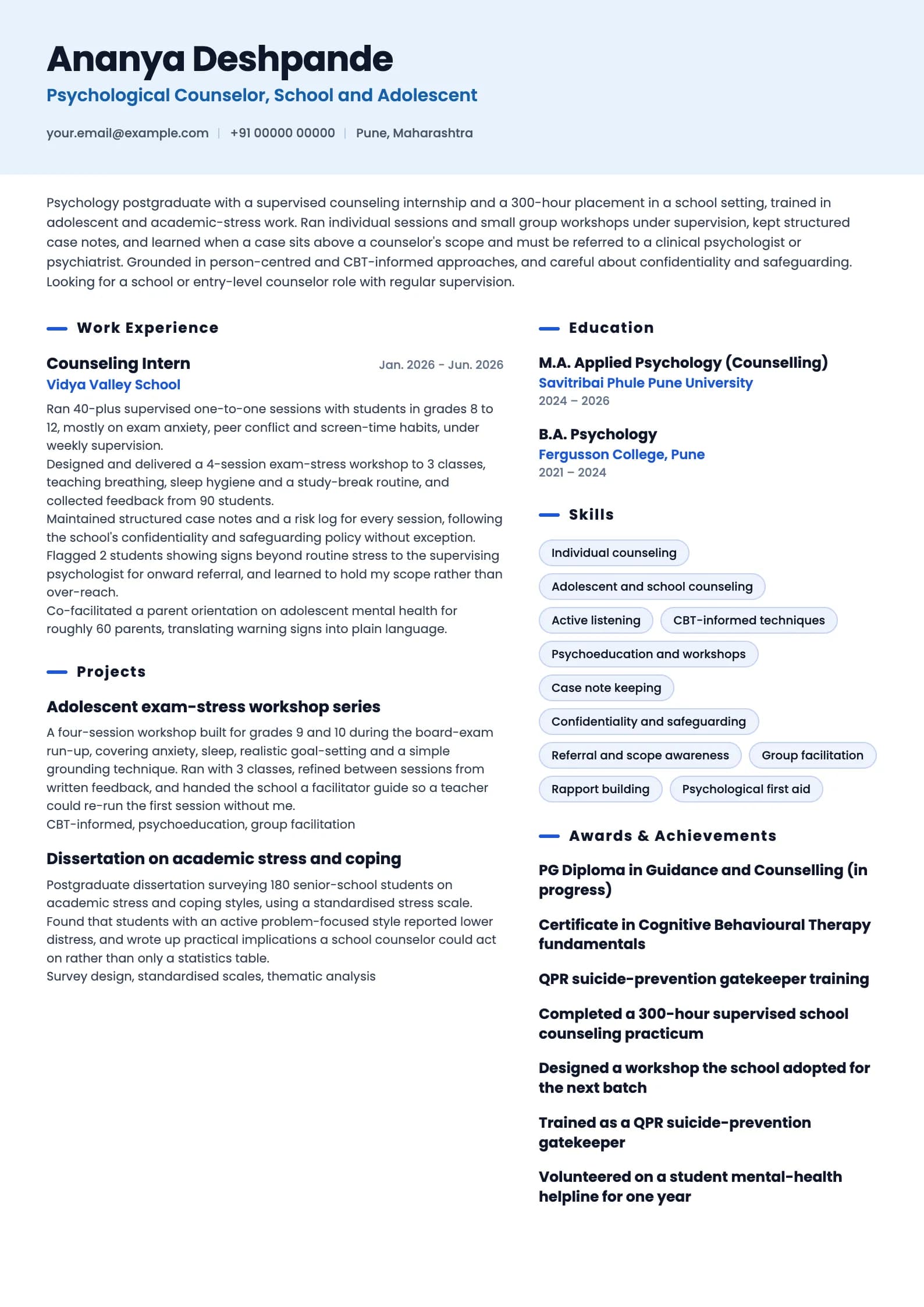
Build my resumeCounselor resume example, Fresher (0 to 1 year)
ai-era templateIs your resume good enough?
Upload the resume you have now and see what an applicant tracking system reads before a counselor recruiter ever does.
Free to run. Sign in with your mobile number to see your score.
Counselor resume example, Clinical / EAP counselor (5 years)
professional template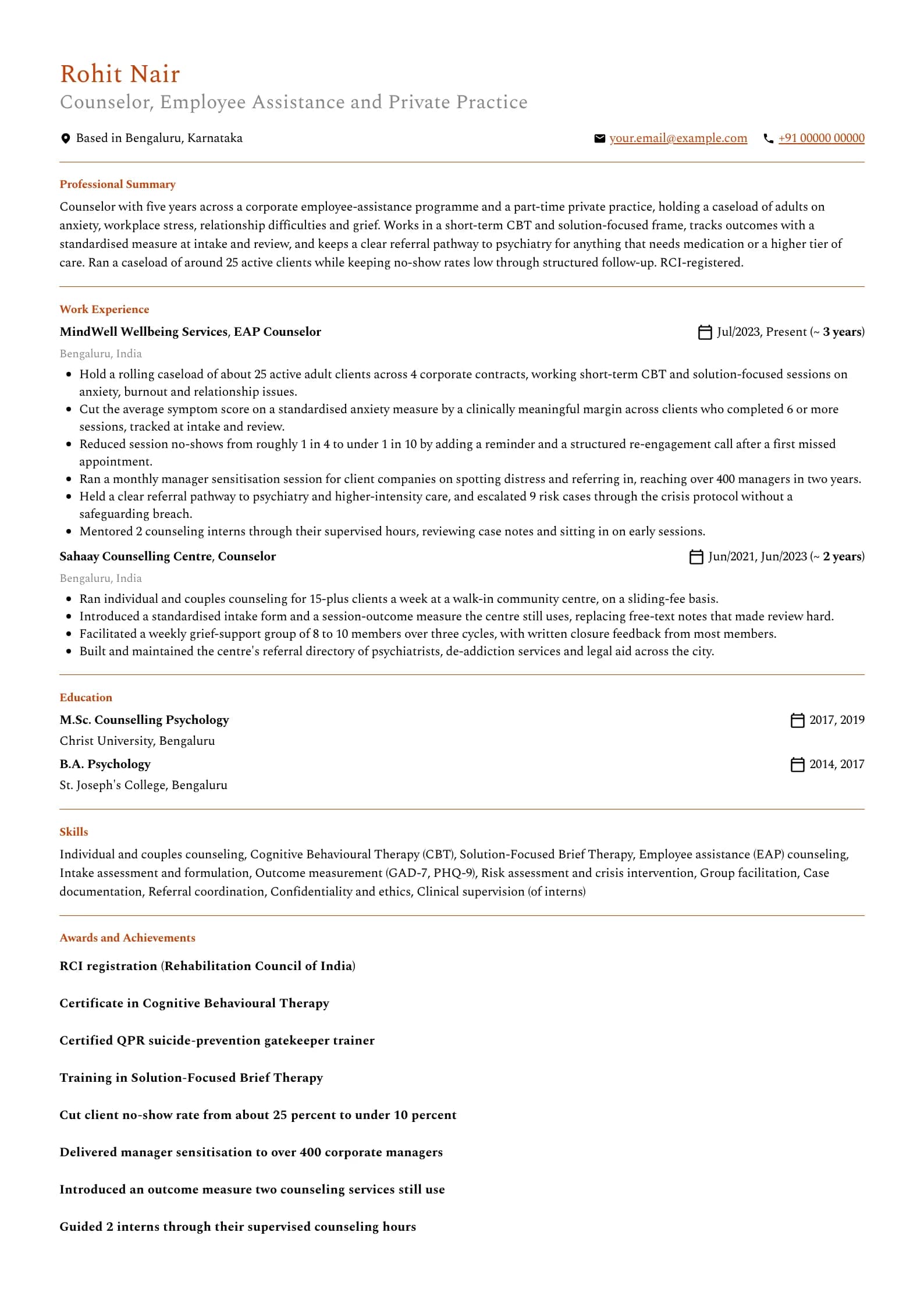
Want this structure with your own details? Build it in the resume builder.
Counselor resume example, Counseling lead (12 years)
header-band template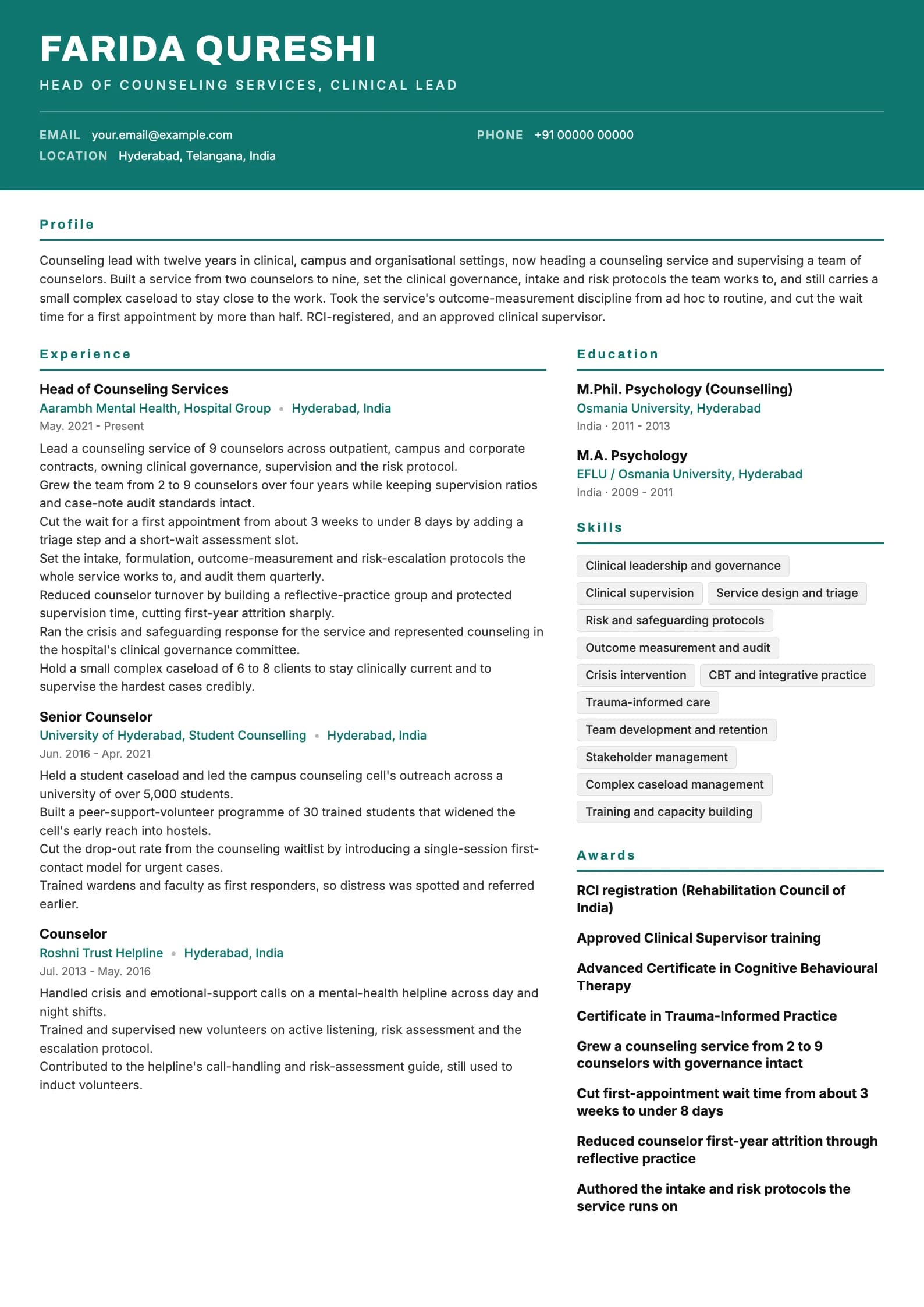
The format that works for counselor resumes in India
Reverse chronological is the layout to use. Most recent role first, work backwards, dates in plain view. A functional resume that groups everything under Skills and Approaches while hiding the dates reads as an attempt to cover a gap, and hiring supervisors in mental health, who are trained to notice avoidance, treat it exactly that way. A career break for your own health or caregiving is better named in one honest line than obscured. Length follows evidence. One page holds everything a fresher and most counselors up to roughly six years need. A clinical lead or a counselor with a decade of varied settings can run to a second page when it carries real service and supervision work rather than a longer list of workshops attended. Continuing-education courses are a supporting list, not a page of content. Four things do not belong on a counselor's resume: a photograph, date of birth, marital status and father's name. They come from an older template that spread through college placement cells, they add nothing to a clinical screen, and each line they take is a line a case outcome or a supervised-hours figure could have used. The exception is nothing: even client-facing counseling roles do not screen on a photo. One detail is specific to this field. State your registration status where it applies. In India, counseling sits in a grey zone: clinical psychologists are licensed through the Rehabilitation Council of India, while the title counselor itself is not tightly regulated, so employers rely on your training, supervised hours and any RCI registration to judge safety. Make that legible. Send a PDF unless the posting asks otherwise, name the file with your own name and the role, and keep to a single column so the parser reads it in order.
| Section | Where it goes | Why |
|---|---|---|
| Name and headline | Top, above everything | The headline is the role: school counselor, clinical counselor, EAP counselor. Recruiters match on it. |
| Professional summary | Directly under the header | Three lines: setting and client group, years, and the strongest outcome or scope figure. |
| Registration and credentials | High, near the summary | RCI status, core qualification and supervised hours. This is the safety question, so answer it early. |
| Work and placement experience | Next, for anyone with hours | Most recent first. Supervised placements count and are named as such. |
| Skills and modalities | Below experience | Grouped: clinical, assessment, population, ethics. Not a 30-item wall. |
| Education | Bottom, near the top for a fresher | Degree, institution, years, and practicum hours while you are new. |
| Certifications and CPD | After education | CBT, REBT, trauma training, gatekeeper training. Name, body, year. |
Showing you help clients, not saying you are empathetic
The single most common counselor resume failure is a page built from character traits. Empathetic, compassionate, a good listener, passionate about mental health. Every applicant writes the same words, none of them can be checked, and a supervisor reading the tenth identical resume of the morning learns nothing about whether you can actually hold a caseload safely. The fix is to describe the work and, where you have it honestly, the outcome. You cannot and should not publish client details, so the unit of evidence is the caseload, the setting, the modality and the change you can measure without breaching confidentiality. A drop on a standardised measure across clients who completed a course of sessions. A no-show rate you brought down with a follow-up process. A referral pathway you built. A crisis handled through protocol without a safeguarding breach. These prove the same qualities the adjectives claim, and a supervisor can ask a real question about each. Be careful and honest with numbers in this field. Outcomes in counseling are noisy and hard-won, so do not invent a recovery rate. What you can state cleanly is caseload size, session counts, workshop reach, wait-time and no-show figures, and whether you measured outcomes at all, which many counselors do not. Measuring at intake and review is itself a signal of a disciplined practitioner. Above all, show scope awareness. A line that says you referred a case beyond your competence to a clinical psychologist or psychiatrist is one of the strongest things on an early-career counseling resume, because the fastest way to be a risk to a client is to work outside your training and not know it.
Professional summary, clinical counselor
Weak
Compassionate and empathetic counselor with a passion for helping people and excellent communication skills seeking a role in a reputed mental health organisation.
Strong
Counselor with five years across an EAP and private practice, holding a rolling caseload of around 25 adults on anxiety, burnout and relationship issues in a short-term CBT frame, with outcomes tracked at intake and review. RCI-registered.
The rewrite trades four uncheckable adjectives for a setting, a client group, a caseload figure, a modality and a registration fact a supervisor can probe.
Read each line and ask: could a supervisor ask me a real question about this in an interview. "Empathetic" invites nothing. "Cut no-shows from 1 in 4 to under 1 in 10 with a re-engagement call" invites a good conversation you can win.
Writing a summary a clinical supervisor actually reads
The block under your name is the part you can be reasonably sure gets read, so it must carry the facts a supervisor screens on: the setting and client group you work with, how long you have worked in it, your modality or approach, and your registration status. Three or four lines, no adjectives that cannot be checked. The old objective line, seeking a challenging position to utilise my counseling skills and grow professionally, tells the reader nothing they did not already assume. Replace it with a summary. An objective describes what you want; a summary describes the clients you have already helped and how, and only one is evidence. Freshers often feel they have nothing to summarise. Look at the fresher sample: it names the setting (school and adolescent), the supervised hours, the approaches (person-centred and CBT-informed), and it states scope awareness and confidentiality discipline. That is a genuine summary built from one postgraduate placement, not a padded one. What it avoids is "passionate about mental health", a phrase so universal on psychology resumes that it now carries no information at all. A practical test: read your summary and ask whether a classmate with the same degree could paste it onto their own resume unchanged. If they could, it describes the course, not you. Add the specific setting, the specific client group, the specific approach and, where you have it, the specific outcome, until it stops being transferable.
Professional summary, school counselor fresher
Weak
A motivated and dedicated psychology graduate looking to start a career in counseling and make a positive difference in people's lives.
Strong
Psychology postgraduate with a 300-hour supervised school placement in adolescent and academic-stress work, CBT-informed and person-centred, careful about confidentiality and clear about when a case must be referred on.
Swaps a motivation statement any graduate could write for supervised hours, a client group, an approach and a safety signal a school can actually screen on.
Experience and placement bullets: action, setting, consequence
Every strong bullet in the samples follows the same shape. It opens with an action verb, names the setting and the client group or the change you made, and closes with what measurably moved or the scope you held. The verb establishes that you did it. The setting tells a supervisor whether the work transfers to their service. The number, where honest, does the persuading, and where a number would be invented, a scope figure does the same job. Start with what changed and work backwards. Counselors usually write the task first ("conducted counseling sessions with clients") and then cannot attach anything to it. Instead ask what was different because you were there: a wait time shorter, a no-show rate lower, a group that ran to closure, a workshop a school re-used, a risk case escalated safely, an outcome measure introduced. Then write the sentence that ends in that fact. Count supervised placement hours as experience, because early in this field they are the experience. Name the placement, the hours, the setting and what you actually did under supervision, rather than listing the course module. A 300-hour school placement described in specifics beats a paragraph about your degree. Vary what you prove. A page of "conducted sessions on X" reads as one line repeated. Across a real role you can honestly show caseload size, session counts, workshop reach, outcome measurement, group work, crisis handling, referral-network building and supervision of juniors. Allocate bullets by recency: current role gets five or six, the previous role four or five, older roles two or three.
| Level | What bullets must prove | Typical evidence |
|---|---|---|
| Fresher / placement | You can hold a session safely and know your scope | Supervised hours, sessions run, workshops, referrals made, safeguarding discipline |
| 1 to 4 years | You carry a caseload with light supervision | Caseload size, modality, outcome measures, no-show and wait figures, group work |
| 5 to 8 years | You run a caseload and improve the service around it | Outcome data, crisis handling, process introduced, intern supervision, manager training reach |
| 9 years and up | You set clinical governance and lead a team | Team size, wait-time and turnover figures, protocols authored, audit, supervision ratios |
Experience bullet, EAP counselor
Weak
Responsible for conducting counseling sessions with employees and providing emotional support as required.
Strong
Reduced session no-shows from roughly 1 in 4 to under 1 in 10 by adding a reminder and a structured re-engagement call after a first missed appointment.
"Responsible for" describes the job title; the rewrite names a process you introduced and the engagement problem it fixed.
If a bullet would read identically on any counselor's resume, it is describing the profession, not you. Rewrite it until it only fits the caseload, setting or service you actually held.
The skills section: modalities, assessment and ethics, grouped
A counselor's skills section has two readers with different needs. An applicant tracking system wants literal terms it can match, CBT and GAD-7 and crisis intervention. A clinical supervisor wants a short, organised list that signals what kind of practitioner you are and what you can and cannot do. Grouping serves both. Group by function rather than one long line. Clinical approaches, assessment, client populations, and professional practice is a grouping that fits almost every counselor. The exact headings matter less than the fact that structure exists and that you have not listed every therapy you once read about as though you practise all of them. Name modalities the way the field names them: Cognitive Behavioural Therapy or CBT, Solution-Focused Brief Therapy, not vague phrases like "talking therapy". Twelve to sixteen items is the working range. Below eight the section looks thin. Above twenty it stops being a signal and starts reading as a training-course inventory, which invites the interview question you least want: "you have listed psychodynamic, CBT, DBT, ACT, EMDR and family therapy, which of these do you actually practise unsupervised." Every modality on the line is a competence you are agreeing to defend. Do not include a proficiency bar or a percentage next to a therapy. Rating yourself four stars in CBT invites an argument you cannot win and, worse, reads as clinically naive. Let the experience and your supervised hours prove the depth instead. And be scrupulously honest: listing a modality you attended one workshop on but have never used with a client is the kind of overstatement this profession treats as a safety issue, not a resume flourish.
| Group | What goes in it | How many |
|---|---|---|
| Clinical approaches | CBT, Solution-Focused, person-centred, REBT, the ones you actually use | 3 to 5 |
| Assessment | Intake, formulation, GAD-7, PHQ-9, risk assessment | 2 to 4 |
| Populations / settings | Adolescents, adults, couples, EAP, campus, grief | 2 to 4 |
| Professional practice | Confidentiality, safeguarding, case notes, referral, supervision | 3 to 5 |
Registration, RCI and the credential question in India
This is the section a counselor resume in India cannot skip, because the field is only partly regulated and employers manage that ambiguity by scrutinising your credentials closely. Clinical psychologists are licensed and registered through the Rehabilitation Council of India after an RCI-recognised M.Phil in Clinical Psychology. The title counselor itself is not tightly regulated, which means anyone can use it, which in turn means a careful employer looks hard at your actual training, your supervised hours and any registration you hold to judge whether you are safe. So make your credentials legible and precise. State your core qualification (M.A. or M.Sc. in Counselling Psychology, or M.Phil Clinical Psychology if you hold it), whether you are RCI-registered, your supervised clinical hours, and your named therapy training with the issuing body and year. Do not imply a clinical-psychologist scope you do not have. If you are a counselor, not a clinical psychologist, the honest framing is a strength, because a supervisor trusts a practitioner who is clear about their lane. Certifications sit just below education, or beside skills if you hold only one or two. For counselors in India the ones that carry weight are structured therapy trainings (a certified CBT or REBT course, DBT-informed training, trauma-informed practice), suicide-prevention gatekeeper training such as QPR, and clinical-supervisor training for senior roles. A weekend webinar with a certificate of attendance is not the same as a supervised, assessed training, and experienced supervisors know the difference, so name the depth honestly. One more discipline: do not list a lapsed registration or an in-progress qualification as though it is complete. Write "PG Diploma in Guidance and Counselling (in progress)" rather than implying you hold it. In a field built on trust, a credential overstatement caught in the interview costs you more than the credential ever would have earned.
Getting through the applicant tracking system
Hospitals, edtech companies, EAP providers and large schools increasingly screen counselor applications through an applicant tracking system before a human reads them. The system is a parser and a search index, not a judge. It breaks your file into name, dates, employers, titles and skills, and stores the result so a recruiter can search across candidates. Almost every ATS problem is a parsing problem, and parsing problems come from layout, not wording. The layout rules are short. One column. Standard section headings, so use Work Experience rather than My Journey and Skills rather than My Toolkit. No text inside images, because a badge graphic reads as empty space. Keep nothing load-bearing in the header or footer region, which some parsers drop. Avoid text boxes and nested tables in the body. On wording, mirror the language of the job description where it is honest. If the posting says school counselor, write school counselor. If it says CBT, write Cognitive Behavioural Therapy (CBT) so both the acronym and the expansion are searchable. If it says psychological first aid or crisis intervention and you have done it, use those exact terms rather than a paraphrase. Do not keyword-stuff, and never list therapies you do not practise to catch a search, because in this field the interview is designed to expose exactly that. Write real bullets that naturally contain the right terms, because a line describing a CBT-based programme you ran contains the word CBT in a context that survives clinical review too. Finally, save as a PDF that embeds real text, then open the file and confirm you can select and copy a sentence. If you cannot select the text, neither can the parser, and a scanned or image-based resume is invisible to the search the recruiter runs.
Section heading
Weak
My Healing Journey
Strong
Work Experience
A parser looks for standard headings; a poetic one can push the whole block into an unclassified bucket the recruiter never searches.
Test your own file before sending it. Copy the text out of the PDF into a plain text editor. Whatever reads cleanly there is roughly what the parser sees, and anything scrambled is a real risk to your application.
What gets counselor resumes rejected
Most rejections at the resume stage are not close calls. They come from a small set of recurring problems, and all of them are fixable in an afternoon. The list below covers what supervisors and HR teams reviewing Indian counselor resumes see most often, in rough order of how much damage each one does.
- A page built from traits: empathetic, compassionate, passionate, a good listener. None of it can be checked, and every applicant writes the same words.
- No registration or supervised-hours detail, which forces the supervisor to guess whether you are safe and clinically trained.
- Overstated modalities: listing CBT, DBT, ACT, EMDR and psychodynamic when you practise one, an overstatement this field treats as a safety concern.
- No sense of scope: nothing that shows you know what you do not treat and when you refer on.
- Duties copied from the job description instead of what you did. "Responsible for conducting sessions" is the tell.
- Client confidentiality handled carelessly, for example a case described in identifying detail. It reads as an ethics red flag, not a strong example.
- A photo, date of birth, marital status or father's name, none of which belongs on a clinical resume and all of which take a case example's space.
- A generic objective line. Replace it with a summary that states setting, client group, approach and registration.
- Lapsed or in-progress credentials written as though complete, which background checks and interviews expose quickly.
- Typos in the modalities or measures you claim, such as writing PHQ-9 wrong or misspelling a therapy, which undoes an otherwise careful page.
Read your resume as if you were the supervisor who has to defend hiring you after a client complaint. Every line should be something you could stand behind under that scrutiny.
Skills to put on a counselor resume
Technical
- Individual counseling
- Cognitive Behavioural Therapy (CBT)
- Solution-Focused Brief Therapy
- Person-centred counseling
- Intake assessment and formulation
- Risk assessment and crisis intervention
- Outcome measurement (GAD-7, PHQ-9)
- Group facilitation
- Couples and family counseling
- Trauma-informed practice
- Psychoeducation and workshops
- Case documentation
Tools and platforms
- GAD-7 and PHQ-9 measures
- Standardised intake forms
- Case-note and EHR systems
- Referral directories
- Session scheduling tools
- Outcome-tracking spreadsheets
- Telehealth platforms
- Psychoeducation resources
Working skills
- Active listening
- Empathy and rapport
- Confidentiality and ethics
- Scope and referral judgement
- Boundaries and self-care
- Non-judgemental stance
- Cultural sensitivity
- Reflective practice
- Composure under distress
Certifications worth listing as a counselor
| Certification | Full name | Worth it for |
|---|---|---|
| RCI registration | Rehabilitation Council of India registration | The registration that matters most for clinical mental-health roles in India, held by clinical psychologists trained through an RCI-recognised M.Phil. Essential for a clinical-psychologist post and a strong differentiator for a counselor whose training route qualifies. State it plainly, and do not imply RCI scope you do not hold. |
| CBT certificate | Certificate in Cognitive Behavioural Therapy | A structured, assessed CBT training is the single most useful credential for a working counselor in India, because CBT is the modality most services and EAPs run on. Worth it across the whole career. Make sure it is an assessed course with supervised practice, not a one-day webinar of attendance. |
| QPR gatekeeper | Question, Persuade, Refer suicide-prevention training | A short, credible suicide-prevention gatekeeper training, valuable for school, campus and helpline counselors who are often the first to spot risk. The trainer-level version is worth it for anyone building capacity in a team. |
| SFBT training | Solution-Focused Brief Therapy training | A practical fit for EAP and short-term counseling work, where you have a small number of sessions per client. Pairs naturally with CBT and signals you can work within a session-limited contract, which corporate wellbeing providers care about. |
| PG Diploma Counselling | Post Graduate Diploma in Guidance and Counselling | A recognised route into school and guidance counseling, useful for career-switchers and teachers moving into counseling. Less weight than an M.A. or M.Sc. in Counselling Psychology, so pair it with supervised hours to show real practice. |
| Clinical Supervisor training | Approved Clinical Supervisor / supervision training | The credential for senior counselors who supervise others. Worth it when you lead a team or take on interns, because it certifies that you can hold others' cases and their risk safely, not just your own. |
Keywords an ATS scans for in a counselor resume
These are the literal terms a parser matches against the job description. Use the ones that are true of you, in the sentences where you did the work, not as a list at the bottom.
- counselor
- counsellor
- psychological counselor
- mental health counselor
- school counselor
- CBT
- cognitive behavioural therapy
- crisis intervention
- risk assessment
- case management
- intake assessment
- GAD-7
- PHQ-9
- group facilitation
- confidentiality
- safeguarding
- referral
- RCI
- counselling psychology
- EAP
Counselor resume FAQ
What salary can a counselor expect in India?
A fresher counselor typically starts around 2.5 to 4.5 LPA in schools, NGOs and edtech, with clinical settings and corporate EAP providers paying a little more. A counselor with four to six years and a steady caseload usually sits in the 5 to 9 LPA band, higher in corporate wellbeing and private practice. Counseling leads and heads of service with a decade and up commonly earn 10 to 18 LPA, and experienced private practitioners can earn more per session outside a salary structure. RCI registration, a recognised therapy certification and demonstrable outcome-measurement discipline push the top of every band upward.
How long should a counselor resume be?
One page up to about six years of experience, two pages after that only if the second page carries real service, supervision and outcome work rather than a longer list of courses attended. Nobody has been rejected for a resume that was easy to read. If you are struggling to fit one page, cut the oldest role to a single line, remove course-module lists, and keep continuing-education as a short named list rather than a paragraph each.
Do I need RCI registration to work as a counselor in India?
It depends on the title and the setting. The RCI licenses clinical psychologists, who complete an RCI-recognised M.Phil in Clinical Psychology, and clinical-psychologist roles in hospitals require it. The title counselor itself is not tightly regulated, so many school, campus, NGO and EAP counselors practise without RCI registration on the strength of a counselling-psychology degree and supervised hours. Whatever your status, state it plainly on the resume and never imply a clinical-psychologist scope you do not hold, because employers scrutinise this closely.
How do I write a counselor resume as a fresher?
Lead with your supervised placement hours, then education, then skills and modalities. Treat the placement as a job: the setting, the client group, the hours, what you did under supervision, and any workshop or group you ran. Course projects and a dissertation with practical implications count. Above all, include a line that shows scope awareness, such as flagging a case beyond your competence for referral, because a supervisor reads that as safety, which is the thing they are actually screening for.
How do I show outcomes without breaking client confidentiality?
You never publish client details. The unit of evidence is the caseload, the setting, the modality and changes you can measure at an aggregate level: a drop on a standardised measure across clients who completed a course of sessions, a no-show rate you reduced, a wait time you cut, a referral pathway you built, a crisis handled through protocol without a safeguarding breach. These prove your effectiveness without naming anyone. Simply measuring outcomes at intake and review is itself a signal, because many counselors do not.
Which certifications help a counselor most in India?
An assessed Cognitive Behavioural Therapy certificate helps most, because CBT is the modality most services and EAPs run on. Solution-Focused Brief Therapy pairs well for short-term and corporate work. Suicide-prevention gatekeeper training such as QPR is valuable for school, campus and helpline roles. Trauma-informed practice matters where your caseload needs it. For senior roles, clinical-supervisor training is the differentiator. Choose assessed trainings with supervised practice over one-day webinars, which experienced supervisors discount.
Should I list every therapy approach I have studied?
No. Listing CBT, DBT, ACT, EMDR, psychodynamic and family therapy when you actually practise one or two is an overstatement this field treats as a safety concern, not a resume flourish. List the three to five modalities you use with clients and can defend unsupervised, and let a bullet prove each. The interview is specifically designed to test whether the therapies on your page match what you can do in the room, so honesty here protects you.
Do school placement or internship hours count as experience?
Yes, and early in this field they are the experience. Name the placement, the setting, the supervised hours and what you actually did, rather than describing the degree module. A 300-hour school placement written in specifics, with sessions run, a workshop built and a referral made, is stronger evidence than a paragraph about your course. Keep it in a clearly labelled experience or placement section so a reviewer sees it as real practice, not classroom work.
Do I need a photo on a counselor resume in India?
No. Clinical and school employers do not screen on a photo, and it takes space a case example or a supervised-hours figure should occupy. The same goes for date of birth, marital status, father's name, nationality and a declaration paragraph. These come from an older template that spread through college placement cells and add nothing to a clinical screen. There is no counseling exception, because even client-facing roles hire on training and safety, not appearance.
Related resume examples and guides
Build your own in any of these formats
Start from a blank resume or upload the one you have. Goodspace renders it in 24 templates and flags the CBT, crisis-intervention and safeguarding keywords an applicant tracking system looks for, and the empty adjectives it will not credit.
Build my resume