Psychologist Resume Format, with 3 Full Samples
A psychologist is hired on evidence of clients assessed and treated, therapy that measurably reduced distress, and programmes that reached people who needed them, yet most resumes list theories and forget the clinical work. Below are three complete resumes, one for a counselling-psychology fresher out of her internship, one for an RCI-registered clinical psychologist with five years across a hospital and private practice, and one for a senior psychologist leading a mental-health service. After the samples come the format rules, the difference between naming CBT and proving you deliver it, the terms a parser matches literally, and the mistakes that quietly end a screening.
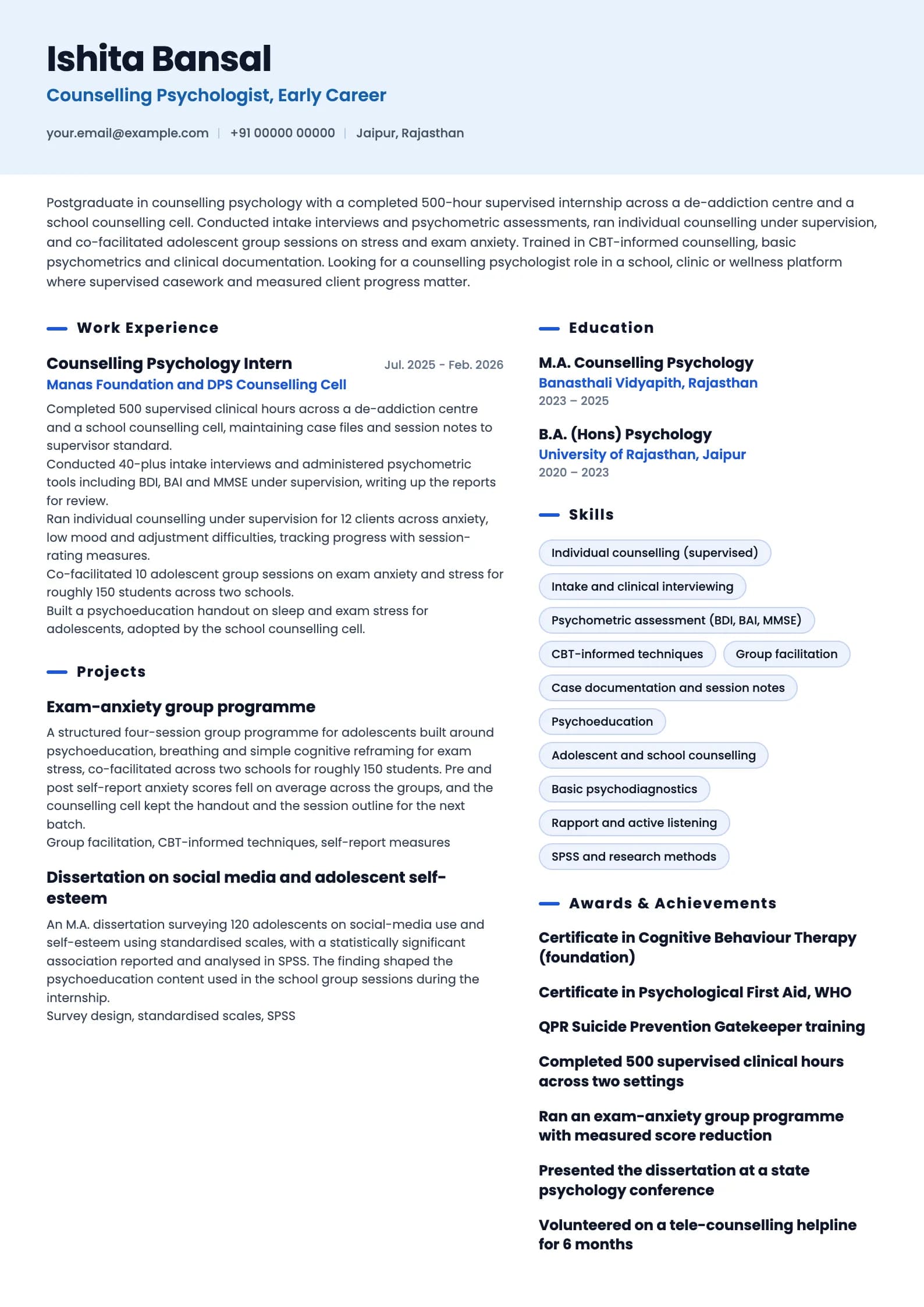
Build my resumePsychologist resume example, Fresher (0 years)
ai-era templateIs your resume good enough?
Upload the resume you have now and see what an applicant tracking system reads before a psychologist recruiter ever does.
Free to run. Sign in with your mobile number to see your score.
Psychologist resume example, Clinical psychologist (5 years)
professional template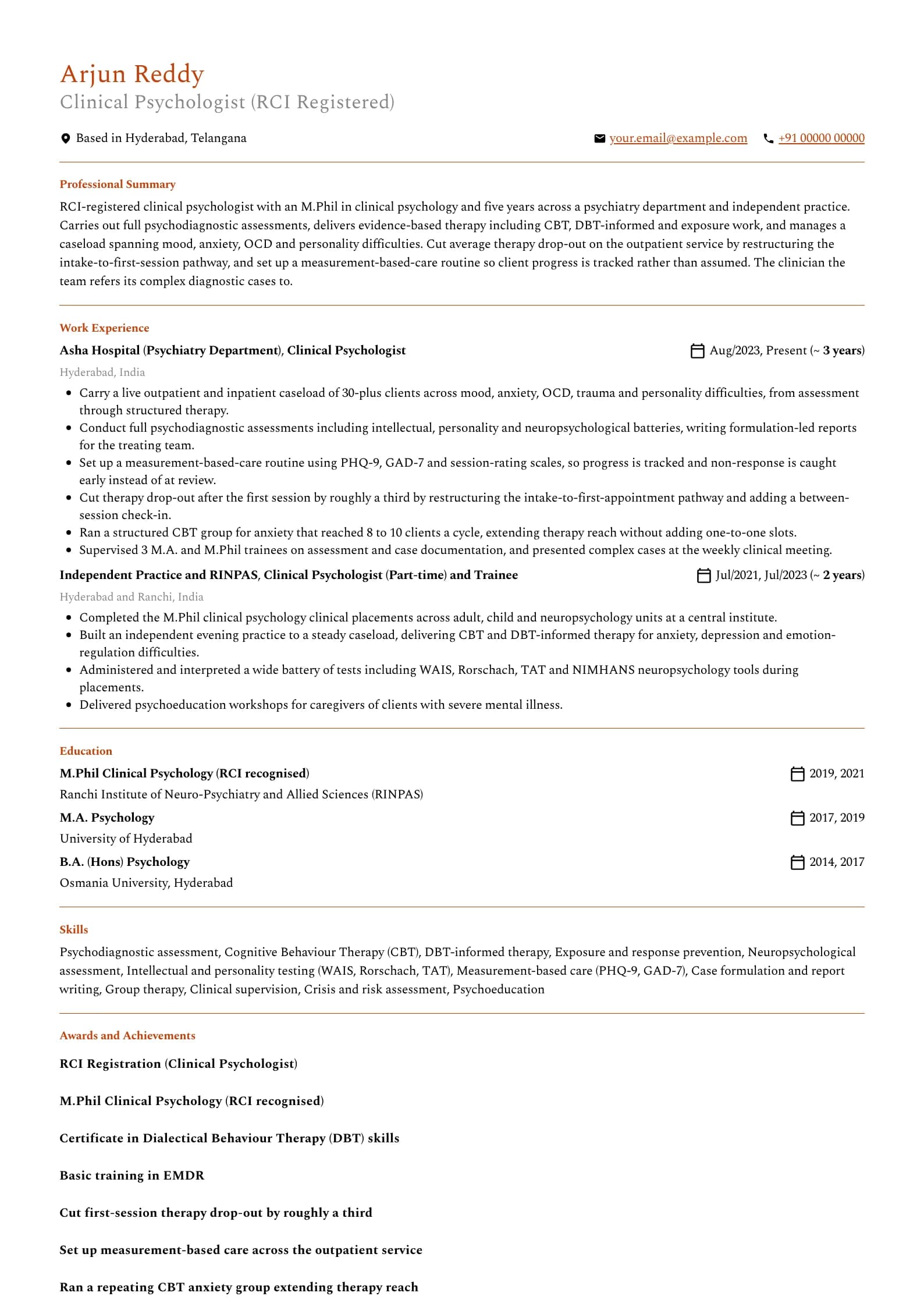
Want this structure with your own details? Build it in the resume builder.
Psychologist resume example, Senior psychologist (12 years)
header-band template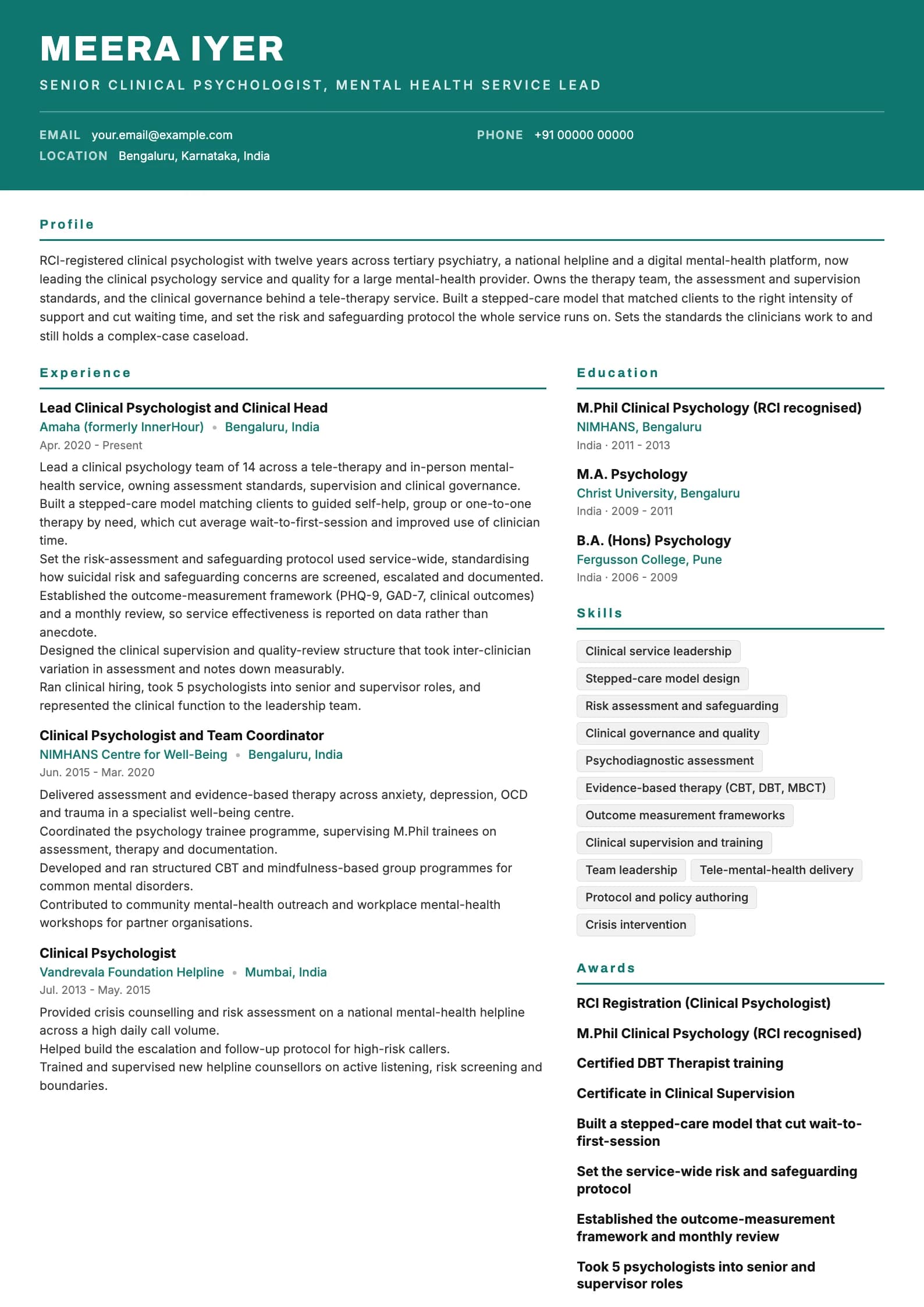
The format that works for psychologist resumes in India
Reverse chronological is the layout to use. Put the most recent role first, work backwards, and keep the dates in plain view. Functional resumes that group everything under Areas of Expertise and drop the dates read as an attempt to hide a gap, and clinical HR treats them that way. A gap is better explained in one honest line than buried. Two things must be unambiguous near the top: your registration status and your track. In India the clinical-psychologist title and independent clinical practice are governed by the Rehabilitation Council of India, and an RCI licence earned through an M.Phil in clinical psychology is a genuine gate for clinical roles. If you are RCI registered, say so in the headline and again under certifications. If you are a counselling psychologist without RCI licensure, describe yourself accurately as a counselling psychologist rather than claiming the clinical title, because the mismatch is easy to catch and ends the process. Length is decided by evidence. One page holds everything a fresher and most psychologists up to roughly six years have to say. Past that, a second page is fine when it carries real clinical, supervision and service work rather than a longer theory list. A page two built from a declaration paragraph and a hobbies line is a padded one-page resume. Four things belong nowhere on a clinical resume: a photograph, date of birth, marital status and father's name. They survive from an older template that circulated through colleges. Nobody screening a psychologist is looking for them, and every line they occupy is a line a clinical outcome could have used. Send a PDF unless the posting asks for DOCX, use a single column all the way down, and name the file with your own name and the target role. The table below sets out the section order.
| Section | Where it goes | Why |
|---|---|---|
| Name and headline | Top, above everything | Headline names the track: clinical (RCI) or counselling psychologist. Recruiters match on it. |
| Professional summary | Directly under the header | Three lines. Registration, years, setting, and the strongest clinical or service outcome. |
| Registration and licence | In the header or top of certifications | RCI registration for clinical work. A gate, so make it visible. |
| Work experience | Next, for anyone with a job | Most recent first. Supervised internship counts and gets real space for a fresher. |
| Clinical skills | Below experience | Grouped: assessment, therapy modalities, tools. Not a 40-item wall. |
| Education | Bottom, unless you are a fresher | M.Phil, M.A., B.A. with institution and years. Note the RCI recognition of the M.Phil. |
| Certifications and training | After education, or beside skills if only one or two | RCI, therapy trainings (CBT, DBT, EMDR). Name, body, year. |
Naming CBT is not the same as proving you deliver it
The single most common psychologist resume failure is a skills line that reads CBT, DBT, REBT, psychoanalysis, humanistic, mindfulness, family therapy, art therapy with no bullet anywhere that shows any of it in real casework. A parser matches those terms, but a clinical interviewer reads the wall and assumes it is coursework recall, then asks you to describe one CBT case you actually formulated and delivered. The fix is to let the experience prove the modality. If you write CBT, a bullet should describe a caseload or a group you delivered it to and how you tracked progress. If you write neuropsychological assessment, a bullet should name the batteries you administered and interpreted. The clinical sample lists CBT, DBT and named tests precisely because the bullets show a caseload, a CBT group and a battery including WAIS and Rorschach. The skills line and the experience agree, which is what makes both believable. Be accurate about your track and your registration. Clinical psychologist, counselling psychologist, school psychologist, organisational psychologist and psychometrician are different roles with different gates. Do not claim the clinical-psychologist title or independent clinical practice without RCI licensure, because it is both an ethical problem and an easily verified one. If your training is counselling psychology, present strong counselling-psychology evidence rather than borrowing a title you do not hold. Do not overclaim assessment. Writing that you administer projective and neuropsychological batteries you only read about in a textbook falls apart in the first case discussion. List the tests you have genuinely administered and interpreted, and mark supervised work as supervised.
For every modality on your skills line, ask: can I describe a real case where I delivered this and tracked the result. If not, either move it to training-in-progress or cut it. A wall of therapy schools helps the parser and sinks the interview.
Writing a summary a hiring manager actually reads
The block under your name is the part you can be reasonably sure gets read, so it should carry four facts: your track and registration, how long you have practised, the setting you practised in, and the strongest thing that happened because of your work. Three or four lines, no adjectives that cannot be checked, and nothing that identifies a client. The old objective line, seeking a challenging position to apply my knowledge of human behaviour and help people, tells the reader nothing they did not assume from the application. Replace it with a summary. An objective describes what you want, a summary describes what you have already done, and only one is evidence. Freshers often believe they have nothing to summarise. Look at the fresher sample: it names the counselling-psychology track, states the supervised internship and its settings, and points at real work, intakes conducted, assessments administered, a group programme run. That is a genuine summary built from an M.A. and a supervised internship. What it avoids is "passionate about mental health and helping people", a phrase so common on psychology resumes it now carries no information. A practical test: read your summary and ask whether a classmate with the same degree could paste it onto their resume unchanged. If they could, it describes the qualification, not you. Add the specific setting, the specific number and the specific track until it stops being transferable.
Professional summary, clinical psychologist
Weak
Passionate and compassionate psychologist with 5+ years of experience in counselling, therapy and human behaviour, seeking a challenging role to help people improve their mental health.
Strong
RCI-registered clinical psychologist with an M.Phil and five years across a psychiatry department and private practice. Deliver CBT and DBT-informed therapy across a 30-plus caseload, and cut first-session therapy drop-out by about a third by restructuring the intake pathway.
The rewrite trades a warmth adjective and a keyword list for the registration, the caseload scope and a verifiable service outcome.
Experience bullets: verb, clinical work, consequence
Every strong bullet in the samples follows the same shape. It opens with an action verb, names the specific clinical work, assessment or programme you did, and closes with what measurably moved. The verb establishes that you did it. The clinical detail tells a reviewer whether the work is relevant. The number does the persuading, without ever identifying a client. Start with the outcome and work backwards. Psychologists usually write the task first, then struggle to attach a number, which produces bullets like "provided counselling and therapy to clients with various issues". Instead ask what was different after your work: drop-out fell, wait time shortened, an outcome measure moved across a caseload, a group extended reach, a protocol standardised how risk is handled. Then write the sentence that ends in that fact. Confidentiality is not a reason to have no numbers. You quantify at the level of the service and the process, not the individual: caseload size, number of assessments, drop-out rate, wait-to-first-session, outcome-measure completion, trainees supervised, group reach. None of that puts an identifiable person on the page. The clinical sample does exactly this. Vary the metric. Five vague improved-well-being lines in a row read as one claim repeated. Where you genuinely lack a number, give scope: caseload size, assessment volume, hours supervised, settings covered. "Carry a live caseload of 30-plus across mood, anxiety, OCD and trauma" carries weight without inventing a percentage. Allocate bullets by recency: current role gets five or six, the previous role four, anything older two or three.
| Level | What bullets must prove | Typical metric |
|---|---|---|
| Fresher / intern | You can assess and counsel under supervision | Supervised hours, intakes, tests administered, groups run |
| 1 to 3 years | You hold a caseload and deliver therapy | Caseload size, assessments, modalities delivered, outcomes tracked |
| 4 to 7 years | You own assessment and improve the service | Drop-out, wait time, outcome measures, group reach, trainees |
| 8 years and up | You lead a service and set standards | Stepped-care, risk protocol, outcome framework, team size |
Experience bullet, outpatient service
Weak
Responsible for providing counselling and therapy to clients with anxiety, depression and other issues.
Strong
Cut first-session therapy drop-out by roughly a third by restructuring the intake-to-first-appointment pathway and adding a between-session check-in.
"Responsible for" describes a job description; the rewrite names a process change and the service outcome it produced, with no client identified.
Experience bullet, assessment
Weak
Conducted various psychological tests and assessments on patients as required.
Strong
Administered and interpreted full psychodiagnostic batteries including WAIS, Rorschach and NIMHANS neuropsychology tools, writing formulation-led reports for the treating team.
Names the actual instruments and the deliverable, so a clinical interviewer can ask a real follow-up instead of nodding at a vague claim.
Quantify the service, never the person. Caseload, drop-out, wait time and outcome-measure completion are all confidentiality-safe. If a line would identify a client, it does not belong on a resume at all.
The skills section: grouped, honest, and short enough to defend
A psychologist resume's skills section has two audiences with opposite preferences. The parser wants literal terms it can match, CBT and psychodiagnostic assessment and risk assessment. A human wants a short, organised list that signals what kind of psychologist you are. Grouping satisfies both. Group by function rather than one long line. Assessment, therapy modalities, clinical process, and specialisation is a grouping that works for almost every psychologist. The exact headings matter less than the fact that structure exists. Write names the way the field writes them: CBT not cbt, PHQ-9 not phq9, WAIS spelled correctly. A parser matches on strings. Ten to sixteen skills is the working range. Below eight the section looks thin. Above twenty it stops being a signal, and a psychology resume is especially prone to listing every therapy school ever studied: CBT, DBT, REBT, ACT, psychoanalysis, Jungian, humanistic, Gestalt, art therapy, hypnotherapy as ten items when you have delivered two. The list is a contract: every item is a question you have agreed to answer, so a modality you only read about does not belong on the page. Do not include a proficiency bar. Star ratings invite an argument you cannot win, and nobody agrees what four stars in psychodynamic therapy means. Let the experience prove the depth instead.
| Group | What goes in it | How many |
|---|---|---|
| Assessment | Psychodiagnostics, WAIS, personality and projective tests, neuropsych | 3 to 5 |
| Therapy modalities | CBT, DBT-informed, exposure, MBCT, that you actually deliver | 2 to 4 |
| Clinical process | Case formulation, report writing, risk assessment, measurement-based care | 3 to 4 |
| Specialisation | Adult, child, adolescent, de-addiction, neuropsychology | 1 to 3 |
| Other | Group facilitation, supervision, psychoeducation, tele-therapy | 2 to 3 |
Skills section
Weak
Skills: CBT, DBT, REBT, ACT, psychoanalysis, Jungian therapy, humanistic, Gestalt, art therapy, hypnotherapy, counselling, human behaviour, empathy, good listener, MS Office
Strong
Assessment: psychodiagnostics, WAIS, Rorschach, neuropsych batteries. Therapy: CBT, DBT-informed, exposure. Process: case formulation, risk assessment, measurement-based care. Specialisation: adult and OCD. Other: group therapy, supervision.
Cuts the modalities you have not delivered and the soft filler, keeps what a clinical role actually tests, and groups the rest so a human reads it in one pass.
Internship, dissertation and supervised work: what to include
For a fresher, the supervised internship, the dissertation and any helpline or group work are the resume. They sit high, they get real space, and they are where a reviewer decides whether you can actually assess and counsel or only pass exams about it. For an experienced psychologist they shrink to a line, kept only where a project shows something the day job does not. The common failure is describing the topic instead of the work and its result. "Did a project on depression" tells a reviewer nothing, because hundreds of resumes carry that line. Describe what you actually did, in what setting, under whose supervision, and what changed. The exam-anxiety group in the fresher sample is a stronger entry than a fancier-sounding dissertation title, because it names a real population, a real technique and a measured drop in self-report anxiety. Treat the supervised internship as clinical work, because it is. Name the settings, the assessments you administered under supervision, the number of intakes and counselling cases, and the supervised hours. Mark it clearly as supervised. A vague "completed internship at XYZ" wastes the strongest thing a fresher has, and dropping the word supervised on assessment work reads as overclaiming. Helpline volunteering, tele-counselling and psychoeducation drives count and are often undersold. Name the setting, your role and the scale, and be honest about the level of supervision and responsibility. Verifiable, accurately-framed experience carries more weight than a claim of passion for mental health.
Internship description, fresher resume
Weak
Completed internship at a mental health centre and gained experience in counselling and psychological testing.
Strong
Completed 500 supervised clinical hours across a de-addiction centre and a school cell, conducting 40-plus intakes, administering BDI, BAI and MMSE under supervision, and running 12 counselling cases with progress tracked.
Swaps "gained experience in" for the settings, the supervised hours, the assessments and the casework, honestly marked as supervised.
Where education, registration and certifications belong
Education goes at the bottom for anyone with a full-time job, and near the top for a fresher, who has nothing stronger to lead with. For clinical psychology, name the M.Phil in clinical psychology and note its RCI recognition, along with the M.A. and B.A. in psychology, each with institution and years. For counselling psychology, name the relevant M.A. or M.Sc. and any supervised diploma. Registration is not just another certificate. RCI registration for a clinical psychologist is closer to a licence, so it earns a visible place near the top and again under certifications, with the registration current. Listing an RCI-recognised M.Phil is a meaningful signal because it distinguishes a genuinely licensable clinical qualification from a general master's, and recruiters for clinical roles look for exactly that. Marks are worth keeping while you are a fresher and they are good, roughly first class and above, because campus and early-career screening still filters on them. Once you have your first clinical role, drop the percentage. A number from your degree competes for space with clinical outcomes that are far more predictive. Therapy trainings sit just below education. Write the full name, the body and the year, and be honest about level: a foundation CBT course is not the same as an accredited CBT diploma, and a two-day workshop is a workshop. An overstated training is easy to unpick in a case discussion, so present each at the level you actually completed.
Getting through the applicant tracking system
Hospitals, mental-health platforms and larger clinics increasingly screen resumes through an applicant tracking system before a human reads them. An ATS is a parser and a search index, not a judge. It reads your file, tries to break it into name, dates, employers, titles and skills, and stores the result so a recruiter can search across candidates. Almost every ATS problem is a parsing problem, and parsing problems come from layout, not wording. The layout rules are short. One column. Standard section headings, so use Work Experience rather than My Journey, and Clinical Skills rather than My Toolkit. No text inside images, because a certificate scan reads as empty space. No critical information in the header or footer region, which some parsers drop, so keep your RCI registration in the body too. Avoid text boxes and nested tables in the resume body. On wording, mirror the language of the job posting where it is honest. If the posting says clinical psychologist, and you are RCI registered, write clinical psychologist and RCI registered. If it says psychometric assessment, write psychometric assessment. Include the expansion alongside an acronym at least once, for example "CBT (cognitive behaviour therapy)" and "RCI (Rehabilitation Council of India)", so both searches find you. Keyword stuffing does not work, and claiming modalities you cannot deliver is worse in this field than in most, because the interview is a case discussion that exposes it. Write real bullets that naturally contain the right terms, because a bullet describing a CBT group contains the word CBT in a context that survives clinical scrutiny too. Save as PDF from a tool that embeds real text, then open the file and confirm you can select and copy a sentence. If you cannot select the text, neither can the parser.
Section heading
Weak
My Healing Journey
Strong
Work Experience
Parsers look for standard headings; a creative one can push the entire block into an unclassified bucket the recruiter never searches.
Test your own file before you send it. Copy the text out of the PDF into a plain text editor. Whatever you can read there is roughly what the parser sees, and anything scrambled is a real risk.
What gets psychologist resumes rejected
Most rejections at the resume stage are not close calls. They come from a small set of recurring problems, and all of them are fixable in an afternoon. The list below covers what recruiters and clinical supervisors of Indian psychologist resumes see most often, in rough order of how much damage each one does.
- Claiming the clinical-psychologist title or independent practice without RCI licensure. It is an ethical and legal problem and is verified quickly.
- RCI registration missing or buried on page two when the role is clinical. It is a gate, so put it in the header and under certifications.
- A wall of therapy modalities with no bullet proving you deliver any of them. In this field the case-discussion interview exposes it fast.
- No numbers because of confidentiality, when you could safely quantify caseload, drop-out, wait time and outcome-measure completion.
- Job duties copied from the job description instead of what you did. "Responsible for providing counselling" is the tell.
- Overstated assessment claims, listing projective and neuropsych batteries you have not actually administered and interpreted.
- A supervised internship written as one vague line, or with the word supervised dropped, which reads as overclaiming.
- A photo, date of birth, marital status or father's name. None of it belongs on a clinical resume, and it takes a clinical outcome's space.
- A generic objective line. Replace it with a summary that states track, registration, years and one result.
- Anything that could identify a client. Even a disguised case detail is a confidentiality red flag to a clinical reviewer.
Read your resume aloud once before sending it. Anything you would be uncomfortable defending in a case discussion, or that names a client, is a line to cut or rewrite.
Skills to put on a psychologist resume
Technical
- Psychodiagnostic assessment
- Cognitive Behaviour Therapy (CBT)
- DBT-informed therapy
- Exposure and response prevention
- Neuropsychological assessment
- Intellectual and personality testing
- Clinical interviewing and case formulation
- Risk and crisis assessment
- Measurement-based care (PHQ-9, GAD-7)
- Group therapy
- Psychoeducation
- Clinical report writing
Tools and platforms
- WAIS and WISC
- Rorschach and TAT
- BDI, BAI, PHQ-9, GAD-7
- MMSE and NIMHANS neuropsych battery
- SPSS
- Tele-therapy platforms
- Electronic case records
- Session-rating and outcome measures
Working skills
- Therapeutic rapport
- Active and reflective listening
- Empathy and non-judgement
- Ethical practice and boundaries
- Confidentiality discipline
- Multidisciplinary collaboration
- Clinical supervision
- Reflective practice
- Composure under crisis
Certifications worth listing as a psychologist
| Certification | Full name | Worth it for |
|---|---|---|
| RCI Registration | Rehabilitation Council of India Registration (Clinical Psychologist) | The core licence for a clinical psychologist in India, earned through an RCI-recognised M.Phil in clinical psychology. Effectively a gate for clinical roles and independent practice, so it must be visible on the page and kept current. Counselling psychologists without it should describe themselves accurately as counselling psychologists rather than claiming the clinical title. |
| M.Phil Clinical Psychology | M.Phil in Clinical Psychology (RCI recognised) | The qualifying degree behind RCI clinical registration, and the credential that distinguishes a licensable clinical psychologist from a general psychology master's. Essential for clinical-psychologist roles in hospitals and mental-health services. Note its RCI recognition explicitly, because recruiters for clinical posts look for exactly that. |
| CBT Certification | Certificate or Diploma in Cognitive Behaviour Therapy | Valuable for any psychologist delivering CBT, which is the most-requested modality in Indian mental-health roles. Be honest about level: a foundation course is not an accredited diploma. Strong across clinical and counselling tracks, and worth doing early since so many services expect CBT competence. |
| DBT Training | Dialectical Behaviour Therapy skills or therapist training | Worth it for psychologists working with emotion-regulation difficulties, self-harm, borderline presentations and de-addiction. It signals a specialisation beyond general therapy and pairs well with adult clinical roles. Less central for school or purely assessment-focused counselling posts. |
| EMDR | Eye Movement Desensitisation and Reprocessing training | A recognised trauma-focused modality worth naming for psychologists who work with PTSD and trauma. Note whether you completed basic training or full accreditation, and only list it if you actually use it. Off-target for a resume aimed at organisational or child-development assessment work. |
| PFA / Gatekeeper | Psychological First Aid (WHO) and Suicide Prevention Gatekeeper training | Short, practical trainings that suit early-career psychologists, helpline and community roles, and anyone doing crisis-facing work. Quick to obtain and a reasonable signal for a fresher or a counselling psychologist. Modest weight for a senior clinical role where the M.Phil and RCI registration carry the page. |
Keywords an ATS scans for in a psychologist resume
These are the literal terms a parser matches against the job description. Use the ones that are true of you, in the sentences where you did the work, not as a list at the bottom.
- psychologist
- clinical psychologist
- counselling psychologist
- RCI registered
- psychodiagnostic assessment
- CBT
- cognitive behaviour therapy
- DBT
- psychometric assessment
- case formulation
- risk assessment
- psychotherapy
- neuropsychological assessment
- PHQ-9
- group therapy
- clinical supervision
- mental health
- M.Phil clinical psychology
- psychoeducation
- measurement-based care
Psychologist resume FAQ
What salary can a psychologist expect in India?
A counselling-psychology fresher typically starts around 2.5 to 4.5 LPA at schools, clinics and wellness platforms. An RCI-registered clinical psychologist with an M.Phil and four to seven years usually sits in the 6 to 14 LPA band, higher in metros and specialist hospitals, and independent practice can exceed that. A senior clinical psychologist or service lead with ten years and above commonly earns 14 to 28 LPA and more at large mental-health providers. RCI registration, an M.Phil and a clear specialisation push the top of every band upward.
How long should a psychologist resume be?
One page up to about six years of experience, two pages after that only if the second page carries real clinical, supervision and service work rather than a longer theory list. Nobody has been rejected for a resume that was too easy to read. If you are struggling to fit one page, cut the oldest role to a single line, remove coursework, and delete any therapy modality you could not defend in a case discussion.
Do I need RCI registration to work as a psychologist in India?
For the clinical-psychologist title and independent clinical practice, effectively yes. Registration with the Rehabilitation Council of India, earned through an RCI-recognised M.Phil in clinical psychology, is the standard gate, and hospitals and clinical services expect it. Counselling psychologists, school psychologists and organisational psychologists work in many roles without it, which is legitimate, but they should describe themselves accurately by their actual track rather than claiming the clinical title, because the mismatch is easy to verify.
What is the difference between a clinical and a counselling psychologist resume?
A clinical psychologist resume foregrounds RCI registration, an M.Phil in clinical psychology, psychodiagnostic assessment, work with clinical populations and hospital or specialist settings. A counselling psychologist resume foregrounds counselling training, work with adjustment, stress, relationship and school or workplace concerns, and often community or wellness settings. Lead with the track you actually hold, present the matching evidence, and do not borrow the clinical title if you are not RCI registered, because a case-discussion interview exposes the gap quickly.
How does a fresher psychologist write a resume with no job experience?
Lead with your supervised internship and your dissertation, then education, then skills. Treat the internship as clinical work: name the settings, the assessments you administered under supervision, the number of intakes and counselling cases, and the supervised hours, marked clearly as supervised. Add helpline volunteering, group programmes and psychoeducation you delivered. Verifiable, accurately-framed experience, plus short practical trainings like Psychological First Aid, carries more weight than a claim of passion for mental health.
How do I show outcomes on a psychologist resume without breaking confidentiality?
Quantify at the level of the service and the process, never the individual. Caseload size, number of assessments, therapy drop-out rate, wait-to-first-session, outcome-measure completion, group reach and trainees supervised are all confidentiality-safe and genuinely persuasive. Never put an identifiable client, or even a disguised case detail, on a resume, because a clinical reviewer reads that as a red flag. The samples above show how to state real impact using service and process metrics alone.
Which certifications and trainings help a psychologist most in India?
For clinical work the M.Phil and RCI registration carry the page, and beyond them a CBT certification helps almost everywhere since CBT is the most-requested modality. DBT training helps for emotion-regulation and de-addiction work, EMDR for trauma, and short trainings like Psychological First Aid and suicide-prevention gatekeeper suit early-career and crisis-facing roles. Be honest about the level of each training, list only modalities you actually deliver, and match the list to the target job.
Does an ATS reject psychologist resumes with two columns?
It does not reject them outright, but some parsers read multi-column layouts out of order, which interleaves your sidebar with your experience and produces nonsense in the recruiter's view. A single-column layout removes the risk, which is why all three samples above use one. Test your own file by copying the text out of the PDF into a plain text editor, and if it reads in order there, including your RCI registration, it will most likely parse correctly.
Do I need a photo on a psychologist resume in India?
No. Clinical and platform recruiters do not expect one, and it takes space a clinical outcome should occupy. The same goes for date of birth, marital status, father's name, nationality and a declaration paragraph. These come from an older template that spread through colleges and add nothing to a clinical screen. The only exception is a client-facing role that explicitly asks for a photograph in the posting.
Related resume examples and guides
Build your own in any of these formats
Start from a blank resume or upload the one you have. Goodspace renders it in 24 templates and flags the RCI, assessment and therapy keywords a mental-health employer's applicant tracking system will look for, and the modality padding it will not credit.
Build my resume