Nutritionist Resume Format, with 3 Full Samples
A nutritionist is hired on evidence of clients who changed what they ate and kept it, wellness programmes that a company actually ran, and communities whose numbers moved, yet most resumes list diet knowledge and forget the results. Below are three complete resumes, one for a community-nutrition fresher, one for a corporate and sports nutritionist with four years of client work, and one for a senior nutrition consultant running programmes across brands and clinics. After the samples come the format rules, the difference between claiming client results and proving them, the terms a parser matches literally, and the mistakes that quietly end a screening.
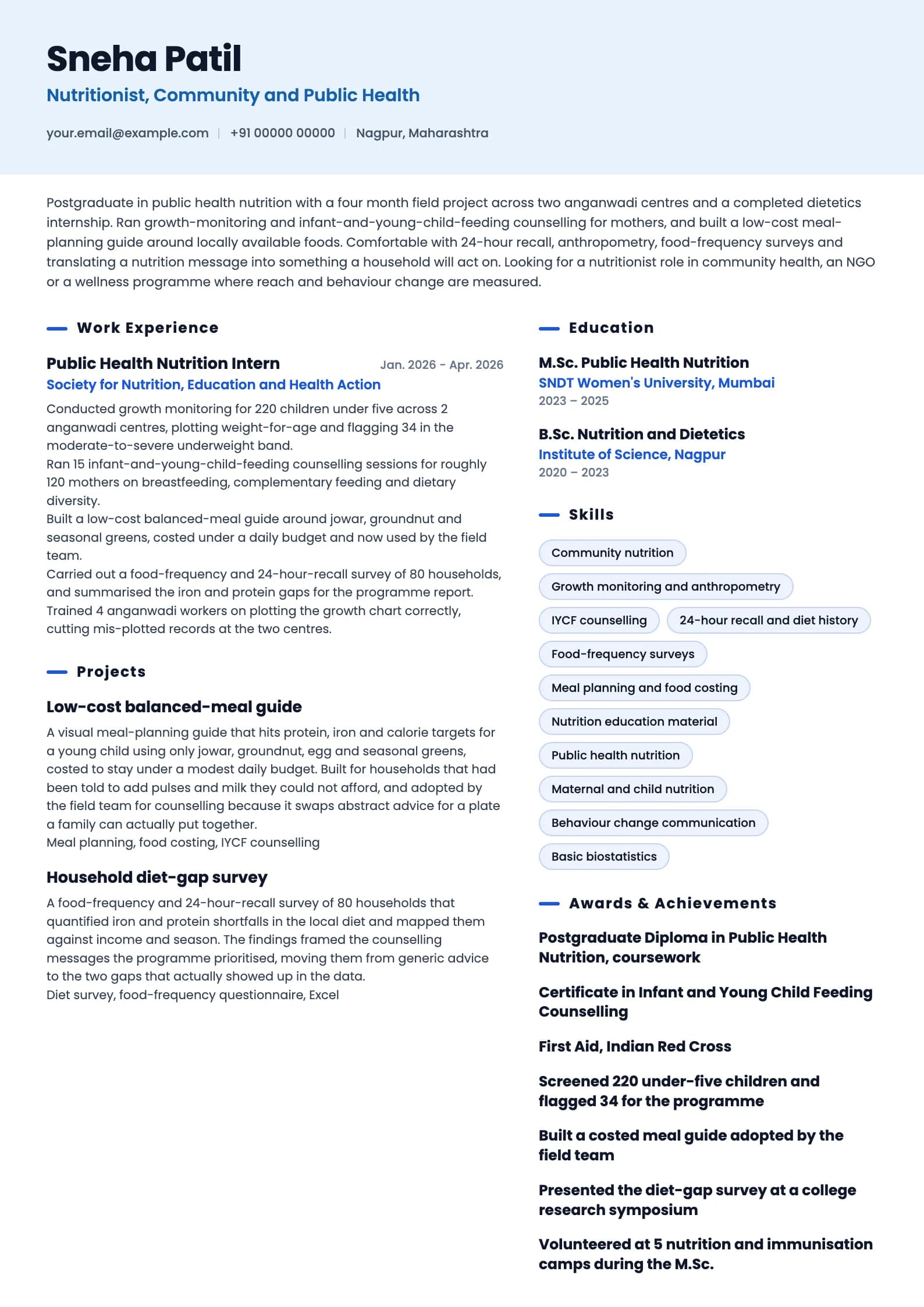
Build my resumeNutritionist resume example, Fresher (0 years)
ai-era templateIs your resume good enough?
Upload the resume you have now and see what an applicant tracking system reads before a nutritionist recruiter ever does.
Free to run. Sign in with your mobile number to see your score.
Nutritionist resume example, Corporate and sports (4 years)
modern template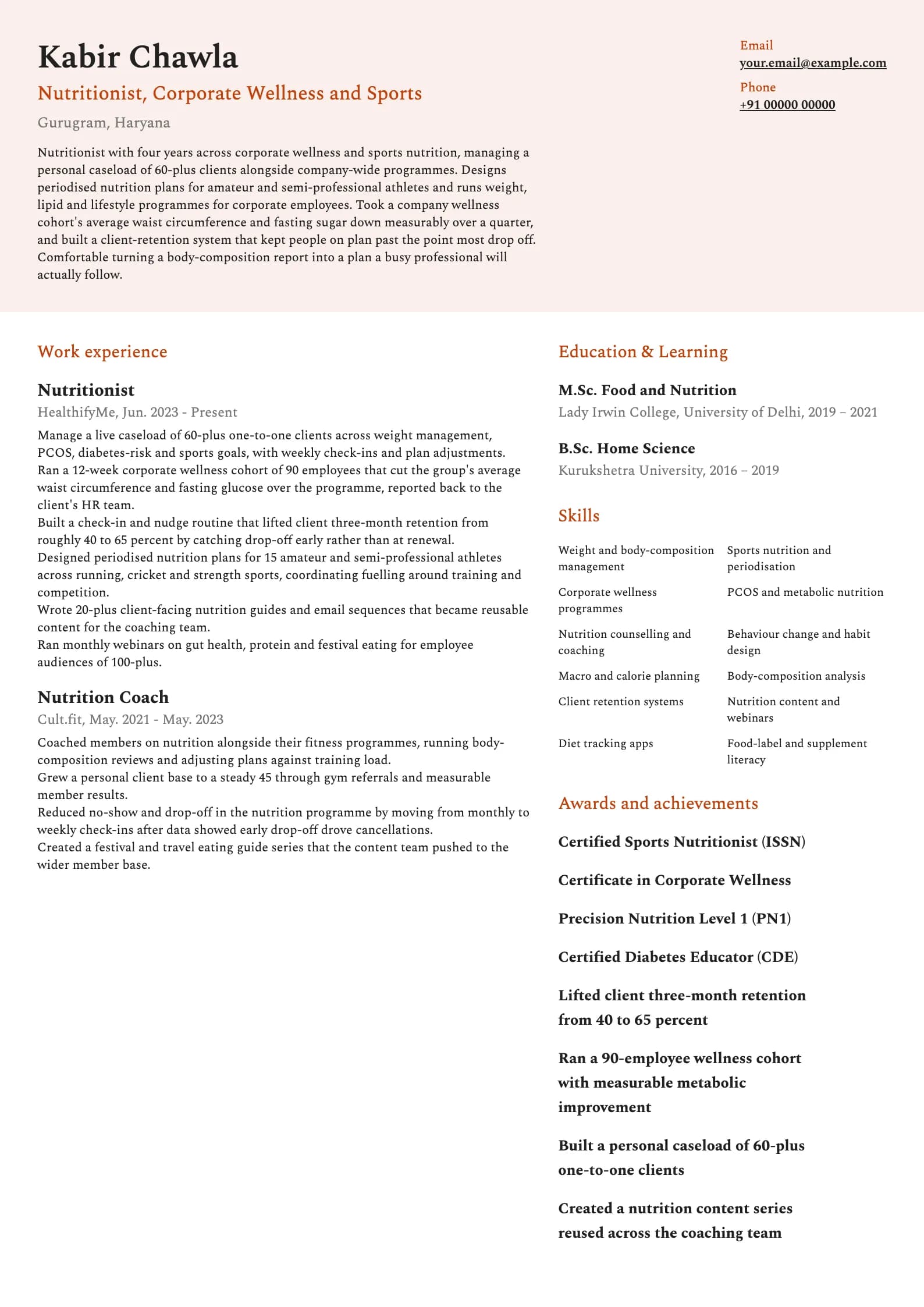
Want this structure with your own details? Build it in the resume builder.
Nutritionist resume example, Senior consultant (10 years)
minimalist template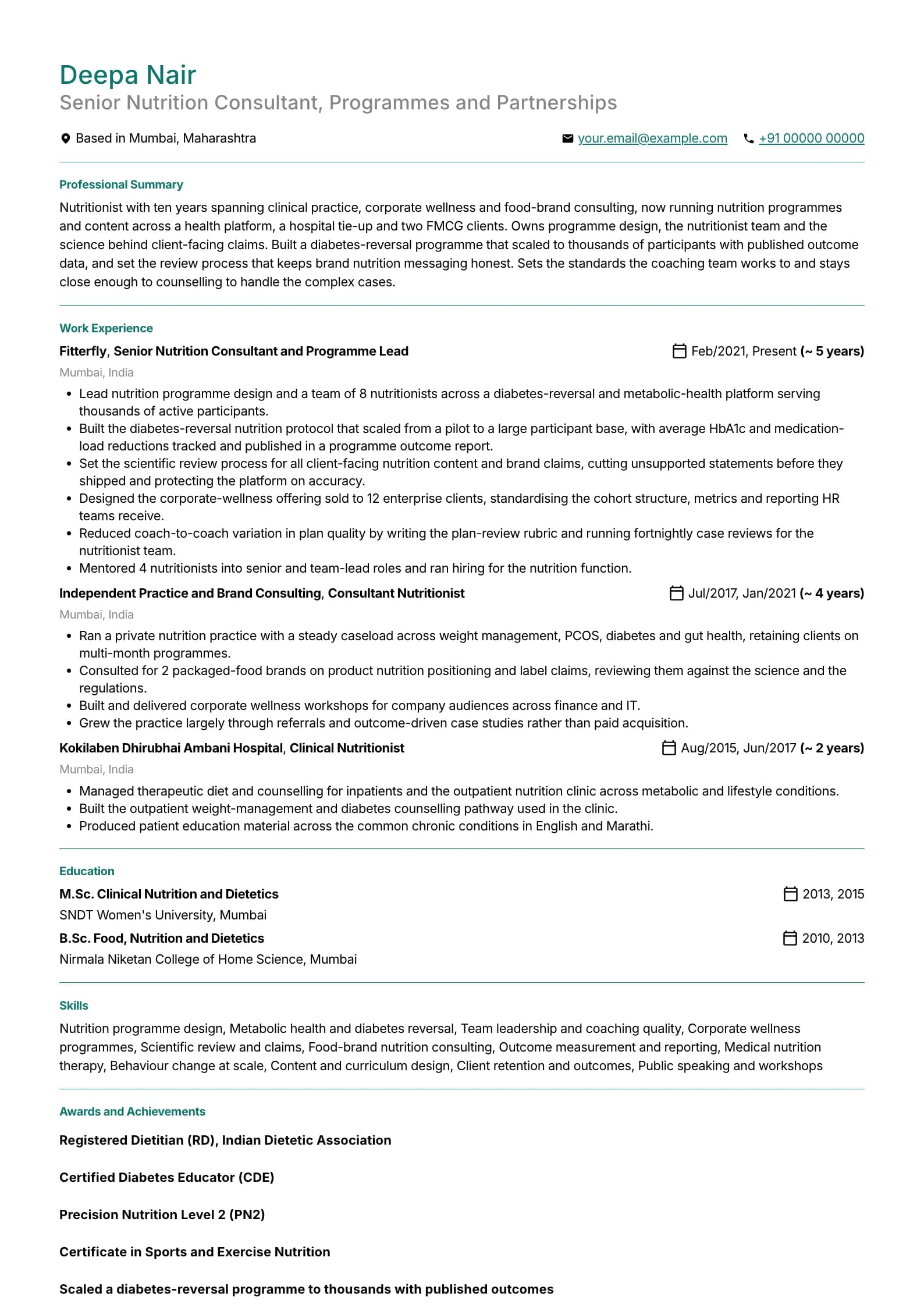
The format that works for nutritionist resumes in India
Reverse chronological is the layout to use. Put the most recent role first, work backwards, and keep the dates in plain view. Functional resumes that group everything under Areas of Expertise and drop the dates read as an attempt to hide a gap, and recruiters treat them that way. A gap is better explained in one honest line than buried. One thing must be obvious near the top: which nutrition world you work in. Nutritionist covers community and public health, corporate wellness, sports, clinical and food-brand consulting, and these are genuinely different jobs. A recruiter hiring a sports nutritionist wants to see athletes and periodisation, not anganwadi growth charts, and vice versa. Say it in the headline and shape the summary to the target role. Length is decided by evidence. One page holds everything a fresher and most nutritionists up to roughly six years have to say. Past that, a second page is fine when it carries real programme and client work rather than a longer skills list. A page two built from a declaration paragraph and a hobbies line is a padded one-page resume. Four things belong nowhere on a professional resume: a photograph, date of birth, marital status and father's name. They survive from an older template that circulated through colleges. Nobody screening a nutritionist is looking for them, and every line they occupy is a line a client outcome could have used. Send a PDF unless the posting asks for DOCX, use a single column all the way down, and name the file with your own name and the target role. The table below sets out the section order.
| Section | Where it goes | Why |
|---|---|---|
| Name and headline | Top, above everything | Headline names the niche: sports, corporate or community nutritionist. Recruiters match on it. |
| Professional summary | Directly under the header | Three lines. Niche, years, and the single strongest client or programme outcome. |
| Work experience | Next, for anyone with a job | Most recent first. Newest role and internship or field work get the most bullets. |
| Programmes and clients | Woven into experience, or its own block | Named cohorts, athlete groups or campaigns with numbers. |
| Skills | Below experience | Grouped: specialisation, counselling, assessment, tools. Not a 40-item wall. |
| Education | Bottom, unless you are a fresher | Degree, institution, years. M.Sc. and B.Sc. Drop marks after your first job. |
| Certifications | After education, or beside skills if only one or two | Sports nutrition, PN, CDE, RD if you hold it. Name, body, year. |
Claiming client results is not the same as proving them
The single most common nutritionist resume failure is a skills line that reads weight management, healthy eating, wellness, lifestyle coaching, balanced nutrition, transformation with no bullet anywhere that shows a real client result. A parser matches those terms, but an interviewer reads the wall and assumes it is generic, then asks for the one case, cohort or athlete you can actually describe with a number. The fix is to let the experience prove the specialisation. If you write sports nutrition, a bullet should describe the athletes, the sport and the periodisation you actually did. If you write corporate wellness, a bullet should carry a cohort size and a metric the HR team saw. The corporate-and-sports sample lists retention, waist circumference and periodisation precisely because the bullets show a 90-person cohort, a retention figure and 15 named athletes. The skills line and the experience agree, which is what makes both believable. Be specific about the niche and keep the resume pointed at the target role. A community-nutrition CV heavy on anganwadi work and a sports-nutrition CV heavy on periodisation are aimed at different hirers. If you have worked across worlds, lead with the slice that matches the job and keep the rest as supporting depth. Do not lean on transformation language and before-and-after promises without the numbers behind them. "Helped hundreds transform their lives" is the kind of claim that reads as marketing rather than evidence. One cohort with a measured change beats a paragraph of adjectives, and it is the kind of thing an interviewer can actually ask you to walk through.
For every specialisation on your skills line, ask: is there a bullet that names the clients or cohort and the number that moved. If not, either add the bullet or cut the claim. A wall of wellness buzzwords helps the parser and hurts the interview.
Writing a summary a hiring manager actually reads
The block under your name is the part you can be reasonably sure gets read, so it should carry four facts: your niche, how long you have practised in it, the scale you work at, and the strongest thing that happened because of your work. Three or four lines, no adjectives that cannot be checked. The old objective line, seeking a challenging position where I can use my passion for health and nutrition, tells the reader nothing they did not assume from the application. Replace it with a summary. An objective describes what you want, a summary describes what you have already done, and only one is evidence. Freshers often believe they have nothing to summarise. Look at the fresher sample: it names the public-health-nutrition focus, states the field posting, and points at real supervised work, children screened and a costed meal guide the team adopted. That is a genuine summary built from an M.Sc. and a field project. What it avoids is "passionate about healthy living and helping people", a phrase so common on nutrition resumes it now carries no information. A practical test: read your summary and ask whether a classmate with the same degree could paste it onto their resume unchanged. If they could, it describes the qualification, not you. Add the specific cohort, the specific number and the specific niche until it stops being transferable.
Professional summary, corporate and sports nutritionist
Weak
Passionate nutritionist with 4+ years of experience in weight management, wellness and healthy lifestyle coaching, dedicated to transforming lives and helping people reach their goals.
Strong
Nutritionist with four years across corporate wellness and sports, managing 60-plus clients and company cohorts. Ran a 90-employee programme that cut average waist circumference and fasting glucose, and lifted client three-month retention from 40 to 65 percent.
The rewrite trades a buzzword list and self-description for a niche, a caseload size and two verifiable outcomes.
Experience bullets: verb, client or programme, consequence
Every strong bullet in the samples follows the same shape. It opens with an action verb, names the specific client group, cohort or campaign you worked on, and closes with what measurably moved. The verb establishes that you did it. The setting tells a reviewer whether the work is relevant. The number does the persuading. Start with the outcome and work backwards. Nutritionists usually write the task first, then struggle to attach a number, which produces bullets like "provided nutrition counselling and prepared diet plans for clients". Instead ask what was different after you did the work: a cohort's numbers moved, retention rose, an athlete performed on a fuelling plan, a community's screening improved, a piece of content got reused. Then write the sentence that ends in that fact. Vary the metric. Five kilos-lost numbers in a row read as one trick repeated. Across a real role you can honestly reach for retention, cohort size, waist circumference, fasting glucose, athletes coached, workshops delivered, content reused and screening reach. The corporate-and-sports sample uses several metric types across its bullets, which reads as range. Where you lack a number, give scope: how many clients, how large a cohort, how many athletes, how long a programme ran. "Manage a live caseload of 60-plus one-to-one clients" carries weight without inventing a percentage. Allocate bullets by recency: current role gets five or six, the previous role four, anything older two or three.
| Level | What bullets must prove | Typical metric |
|---|---|---|
| Fresher / field | You can screen, counsel and educate under supervision | People screened, sessions run, households surveyed, material built |
| 1 to 3 years | You hold a client caseload and get results | Caseload size, client outcomes, retention, content produced |
| 4 to 7 years | You run programmes and cohorts, not just one-to-ones | Cohort size and metrics, retention, athletes, workshops |
| 8 years and up | You design programmes and lead a team | Programme scale, published outcomes, team size, clients won |
Experience bullet, corporate wellness
Weak
Responsible for conducting wellness sessions and giving diet advice to company employees.
Strong
Ran a 12-week corporate wellness cohort of 90 employees that cut the group's average waist circumference and fasting glucose, reported back to the client's HR team.
"Responsible for" describes a job description; the rewrite names the cohort, the duration and the metrics the client actually saw.
Experience bullet, client retention
Weak
Helped many clients stay motivated and follow their diet plans consistently.
Strong
Built a check-in and nudge routine that lifted client three-month retention from roughly 40 to 65 percent by catching drop-off early.
Names the before and after and the mechanism, so an interviewer can ask a real follow-up instead of nodding at a vague claim.
If a bullet would read identically on a classmate's resume, it is describing the qualification, not you. Rewrite it until it only fits the cohort or client group you actually ran.
The skills section: grouped, honest, and short enough to defend
A nutritionist resume's skills section has two audiences with opposite preferences. The parser wants literal terms it can match, sports nutrition and behaviour change and body-composition analysis. A human wants a short, organised list that signals what kind of nutritionist you are. Grouping satisfies both. Group by function rather than one long line. Specialisation, counselling and behaviour change, assessment, and tools is a grouping that works for almost every nutritionist. The exact headings matter less than the fact that structure exists. Write names the way the field writes them: PCOS not pcos, HbA1c not hba1c, body composition spelled out. A parser matches on strings. Ten to sixteen skills is the working range. Below eight the section looks thin. Above twenty it stops being a signal, and a nutrition resume is especially prone to buzzword padding: listing wellness, healthy eating, balanced diet, lifestyle, immunity, detox as six items that all mean roughly the same thing. The list is a contract: every item is a question you have agreed to answer, so a trend you would not want to defend does not belong on a professional resume. Do not include a proficiency bar. Star ratings invite an argument you cannot win, and nobody agrees what four stars in sports nutrition means. Let the experience prove the depth instead.
| Group | What goes in it | How many |
|---|---|---|
| Specialisation | Sports, corporate wellness, PCOS, metabolic, community nutrition | 2 to 4 |
| Counselling | Nutrition counselling, behaviour change, habit design, coaching | 2 to 3 |
| Planning | Macro and calorie planning, meal planning, periodisation | 2 to 3 |
| Assessment | Body composition, anthropometry, diet history, 24-hour recall | 2 to 4 |
| Tools | Diet-tracking apps, body-composition analyser, Excel, content tools | 2 to 4 |
Skills section
Weak
Skills: nutrition, wellness, healthy eating, balanced diet, weight loss, immunity, detox, lifestyle, motivation, good communication, teamwork, social media, MS Office
Strong
Specialisation: sports nutrition, corporate wellness, PCOS. Counselling: behaviour change, habit design. Planning: macro and periodised plans. Assessment: body composition, 24-hour recall. Tools: diet-tracking apps, Excel.
Cuts the trend and filler items, collapses the wellness-buzzword wall to what a role tests, and groups the rest so a human reads it in one pass.
Field work, dissertation and portfolio: what to include
For a fresher, the field project, the dissertation and any community or camp work are the resume. They sit high, they get real space, and they are where a reviewer decides whether you can actually do nutrition work or only pass exams about it. For an experienced nutritionist they shrink to a line or move into a portfolio of programmes, kept only where they show something the day job does not. The common failure is describing the topic instead of the work and its result. "Did a project on nutrition awareness" tells a reviewer nothing, because hundreds of resumes carry that line. Describe what you actually did, who it involved, and what changed. The costed meal guide in the fresher sample is a stronger entry than a fancier-sounding dissertation title, because it names real households and one real problem: advice to add pulses and milk a family cannot afford does not change what a child eats. Treat a field posting or internship as a job, because in this profession it is one. Name the organisation, the setting, the population you worked with, and quantify it: people screened, sessions run, households surveyed. A vague "did community work during my M.Sc." wastes the strongest thing a fresher has. An experienced nutritionist's equivalent of projects is a portfolio: named programmes, cohorts and content. If you built a corporate cohort or a diabetes programme, describe its scale and its outcome the way the samples do, because for this profession the programme is the proof.
Field project description, fresher resume
Weak
Completed a field project on child nutrition at anganwadi centres and gained experience in community work.
Strong
Conducted growth monitoring for 220 under-five children across 2 anganwadi centres, flagged 34 in the underweight band, and ran 15 IYCF counselling sessions for roughly 120 mothers.
Swaps "gained experience in" for the setting, the population and the counselling actually delivered.
Where education and certifications belong
Education goes at the bottom for anyone with a full-time job, and near the top for a fresher, who has nothing stronger to lead with. Most nutritionist roles want a graduate or postgraduate degree in nutrition, dietetics, food science or public health nutrition. Name the M.Sc. and the B.Sc. with institution and years. Registered Dietitian status, if you hold it, is worth showing prominently even for a non-clinical nutritionist role, because it is a recognised professional credential and a clean differentiator. Many nutritionists work without it in corporate, sports and community settings, which is fine, but if you have it, put it in the header or under certifications. Marks are worth keeping while you are a fresher and they are good, roughly first class and above, because campus and early-career screening still filters on them. Once you have your first role, drop the percentage. A number from your degree competes for space with client and programme outcomes that are far more predictive. Certifications sit just below education, or beside skills if you hold only one or two. Write the full name, the issuing body and the year. A sports-nutrition certification, a Precision Nutrition credential or a Certified Diabetes Educator qualification carry real weight for the matching niche, and less outside it, so match the list to the target job rather than listing everything you ever attended.
Getting through the applicant tracking system
Health platforms, corporate-wellness firms and larger clinics increasingly screen resumes through an applicant tracking system before a human reads them. An ATS is a parser and a search index, not a judge. It reads your file, tries to break it into name, dates, employers, titles and skills, and stores the result so a recruiter can search across candidates. Almost every ATS problem is a parsing problem, and parsing problems come from layout, not wording. The layout rules are short. One column. Standard section headings, so use Work Experience rather than My Journey, and Skills rather than My Toolbox. No text inside images, because a certificate scan reads as empty space. No critical information in the header or footer region, which some parsers drop. Avoid text boxes and nested tables in the resume body. On wording, mirror the language of the job posting where it is honest. If the posting says sports nutrition, write sports nutrition. If it says behaviour change, write behaviour change rather than motivation. Include the expansion alongside an acronym at least once, for example "PCOS (polycystic ovary syndrome)", so both searches find you. Keyword stuffing does not work. A hidden white-text block of every wellness term will be caught, and the outcome is worse than being filtered. Write real bullets that naturally contain the right terms, because a bullet describing an athlete's periodised plan contains the word periodisation in a context that survives human review too. Save as PDF from a tool that embeds real text, then open the file and confirm you can select and copy a sentence. If you cannot select the text, neither can the parser.
Section heading
Weak
My Transformation Stories
Strong
Work Experience
Parsers look for standard headings; a creative one can push the entire block into an unclassified bucket the recruiter never searches.
Test your own file before you send it. Copy the text out of the PDF into a plain text editor. Whatever you can read there is roughly what the parser sees, and anything scrambled is a real risk.
What gets nutritionist resumes rejected
Most rejections at the resume stage are not close calls. They come from a small set of recurring problems, and all of them are fixable in an afternoon. The list below covers what recruiters of Indian nutritionist resumes see most often, in rough order of how much damage each one does.
- Niche left unclear, so a reviewer cannot tell a sports nutritionist from a community one. Name it in the headline and shape the resume to the target role.
- A wall of wellness buzzwords, transformation, lifestyle, immunity, detox, with no bullet proving a real client result. Every item is a question you have agreed to answer.
- Marketing language instead of evidence. "Transformed hundreds of lives" reads as a brochure; one cohort with a measured change reads as a professional.
- Job duties copied from the job description instead of what you achieved. "Responsible for giving diet advice" is the tell.
- No numbers anywhere. Retention, cohort size, waist circumference, athletes coached, reach. Pick whichever is honest for the work.
- A field posting or internship written as one vague line. It is your strongest evidence as a fresher, so quantify the population and the work.
- A photo, date of birth, marital status or father's name. None of it belongs on a professional resume, and it takes a client outcome's space.
- A generic objective line. Replace it with a summary that states niche, years, scale and one result.
- Fad and unregulated claims that read as risky, like promising to cure conditions through diet. It undermines credibility with a serious employer.
- Inflated titles or dates that do not match your experience certificates. Background verification is standard and a mismatch ends the process.
Read your resume aloud once before sending it. Anything you would be embarrassed to say to an interviewer's face is a line to cut or rewrite.
Skills to put on a nutritionist resume
Technical
- Sports nutrition and periodisation
- Weight and body-composition management
- Corporate wellness programmes
- Community and public health nutrition
- PCOS and metabolic nutrition
- Nutrition counselling and coaching
- Behaviour change and habit design
- Macro and calorie planning
- Anthropometry and body composition
- Meal planning and food costing
- Programme design and outcomes
- Maternal and child nutrition
Tools and platforms
- HealthifyMe coach dashboard
- Body-composition analyser (BIA)
- Diet-tracking apps
- 24-hour recall and FFQ forms
- MS Excel outcome tracking
- Canva content design
- Webinar and workshop tools
- Food-composition databases
Working skills
- Client rapport and coaching
- Motivational interviewing
- Public speaking
- Content and storytelling
- Empathy
- Cross-functional collaboration
- Programme reporting
- Cultural sensitivity
- Retention and follow-up discipline
Certifications worth listing as a nutritionist
| Certification | Full name | Worth it for |
|---|---|---|
| Sports Nutrition | Certified Sports Nutritionist (ISSN) or equivalent | The credential to hold if your target is athletes, gyms, academies or a fitness platform. It signals structured competence in fuelling, periodisation and body composition that a general nutrition degree does not. Central for a sports-nutrition resume, and off-target on a community-health application, so match it to the role. |
| PN1 / PN2 | Precision Nutrition Level 1 and Level 2 | Widely recognised coaching credentials for nutritionists working one-to-one in weight management and lifestyle change, especially at health apps and coaching companies. Strong for the coaching and behaviour-change niche. Less relevant for clinical hospital work, where the RD and condition-specific certificates matter more. |
| CDE | Certified Diabetes Educator | Worth it for nutritionists whose caseload is heavy on diabetes and metabolic health, which is a large share of Indian nutrition work. It signals structured competence in the condition and pairs well with corporate-wellness and metabolic-programme roles. Less relevant for a pure sports or community focus. |
| RD | Registered Dietitian, Indian Dietetic Association | Not required for most non-clinical nutritionist roles, but a clean differentiator if you hold it, since it is the recognised clinical credential in India. Show it prominently even for corporate or sports roles. If you are aiming at hospital clinical nutrition specifically, it moves from a bonus to close to a requirement. |
| Public Health Nutrition | PG Diploma or Certificate in Public Health Nutrition | The credential to foreground for NGO, government-programme and community roles, where maternal and child nutrition, growth monitoring and behaviour-change communication are the work. It signals a genuinely different track from clinical or sports nutrition, so it belongs on a resume aimed at that world. |
| Corporate Wellness | Certificate in Corporate Wellness or Workplace Health | A useful signal for nutritionists targeting employee-wellness programmes at companies and platforms, where cohort design, metrics and HR reporting matter as much as the nutrition. Pairs with coaching credentials for the corporate niche. Optional for one-to-one clinical or sports practice. |
Keywords an ATS scans for in a nutritionist resume
These are the literal terms a parser matches against the job description. Use the ones that are true of you, in the sentences where you did the work, not as a list at the bottom.
- nutritionist
- sports nutritionist
- clinical nutritionist
- corporate wellness
- weight management
- nutrition counselling
- behaviour change
- body composition
- meal planning
- PCOS
- diabetes
- public health nutrition
- community nutrition
- diet plan
- macro planning
- anthropometry
- client retention
- IYCF
- wellness programme
- nutrition assessment
Nutritionist resume FAQ
What salary can a nutritionist expect in India?
A fresher nutritionist typically starts around 2.5 to 4.5 LPA at clinics, gyms and health platforms, with corporate roles and metros paying more. A nutritionist with four to seven years across corporate, sports or clinical work usually sits in the 4.5 to 10 LPA band. A senior consultant or programme lead with ten years and above commonly earns 10 to 22 LPA, and a well-run private practice or a strong social following can exceed that. A clear niche, a recognised certification and measurable client or programme outcomes push the top of every band upward.
How long should a nutritionist resume be?
One page up to about six years of experience, two pages after that only if the second page carries real programme and client work rather than a longer skills list. Nobody has been rejected for a resume that was too easy to read. If you are struggling to fit one page, cut the oldest role to a single line, remove coursework, and delete any generic wellness skill you would not want to be interviewed on.
What is the difference between a nutritionist and a dietitian resume?
A dietitian resume foregrounds clinical practice: RD registration, hospital settings, therapeutic diets, screening, enteral and parenteral nutrition and patient outcomes. A nutritionist resume more often foregrounds community, corporate, sports or wellness work, and may not carry RD registration. If you are applying for a hospital clinical role, lead with clinical evidence and the RD. If you are applying for a corporate, sports or community role, lead with cohorts, clients and programme outcomes, and keep the clinical detail as supporting depth.
Do I need to be a Registered Dietitian to work as a nutritionist?
For most non-clinical nutritionist roles, no. Corporate wellness, sports, community and health-platform work is open to graduates and postgraduates in nutrition, food science or public health, often without RD registration. That said, the RD is a recognised clinical credential and a clean differentiator, so if you hold it, show it prominently. If you specifically want to do medical nutrition therapy in hospitals, the RD moves from a bonus to close to a requirement.
How does a fresher nutritionist write a resume with no job experience?
Lead with your field project, dissertation and any camp or community work, then education, then skills. Treat a field posting or internship as a job: name the organisation, the setting, the population, and quantify it, people screened, sessions run, households surveyed, material built. Add anything checkable, such as a public-health-nutrition credential or a costed guide a team adopted. Verifiable facts carry more weight than adjectives, and a clear niche tells a recruiter which nutrition world you are aiming at.
Which certifications help a nutritionist most in India?
Match the certification to the niche. A sports-nutrition credential helps for athlete and gym roles, Precision Nutrition helps for coaching and health-platform work, a Certified Diabetes Educator qualification helps for metabolic and corporate wellness, and a public-health-nutrition diploma helps for NGO and community roles. The RD is a strong differentiator anywhere and close to required for clinical work. Keep the list short and pointed at the target job rather than listing everything you ever attended.
Should I put client transformation photos or testimonials on my resume?
No. A resume is a text document read by parsers and busy recruiters, so images of clients and testimonial screenshots either fail to parse or read as marketing. Keep those for your portfolio, website or social channels. On the resume, translate the same success into a measured line: a cohort size, a retention figure, a metric that moved. One quantified outcome does more for a serious employer than a wall of before-and-after images.
Does an ATS reject nutritionist resumes with two columns?
It does not reject them outright, but some parsers read multi-column layouts out of order, which interleaves your sidebar with your experience and produces nonsense in the recruiter's view. A single-column layout removes the risk, which is why all three samples above use one. Test your own file by copying the text out of the PDF into a plain text editor, and if it reads in order there it will most likely parse correctly.
Do I need a photo on a nutritionist resume in India?
No. Recruiters at health companies and clinics do not expect one, and it takes space a client or programme outcome should occupy. The same goes for date of birth, marital status, father's name, nationality and a declaration paragraph. These come from an older template that spread through colleges and add nothing to a professional screen. The only exception is a client-facing role that explicitly asks for a photograph in the posting.
Related resume examples and guides
Build your own in any of these formats
Start from a blank resume or upload the one you have. Goodspace renders it in 24 templates and flags the niche, client-outcome and programme keywords a health-company applicant tracking system will look for, and the wellness buzzwords it will not credit.
Build my resume