Engineering Fresher Resume Format, with 3 Full Samples
An engineering degree is a strong start, but a campus recruiter reads a hundred resumes that all list the same degree, the same labs and the same tools, and shortlists the few that show something real got built. The winning page proves you can apply the branch, through a project that worked, an internship, or a design or analysis you actually did. Below are three complete engineering fresher resumes, one for a computer-science graduate targeting software, one for a mechanical graduate going for a graduate engineer trainee role, and one for an electrical graduate aiming at core and power. After the samples come the format rules, why projects carry the page, the terms an applicant tracking system matches, and the mistakes that get a fresher filtered before a person reads it.
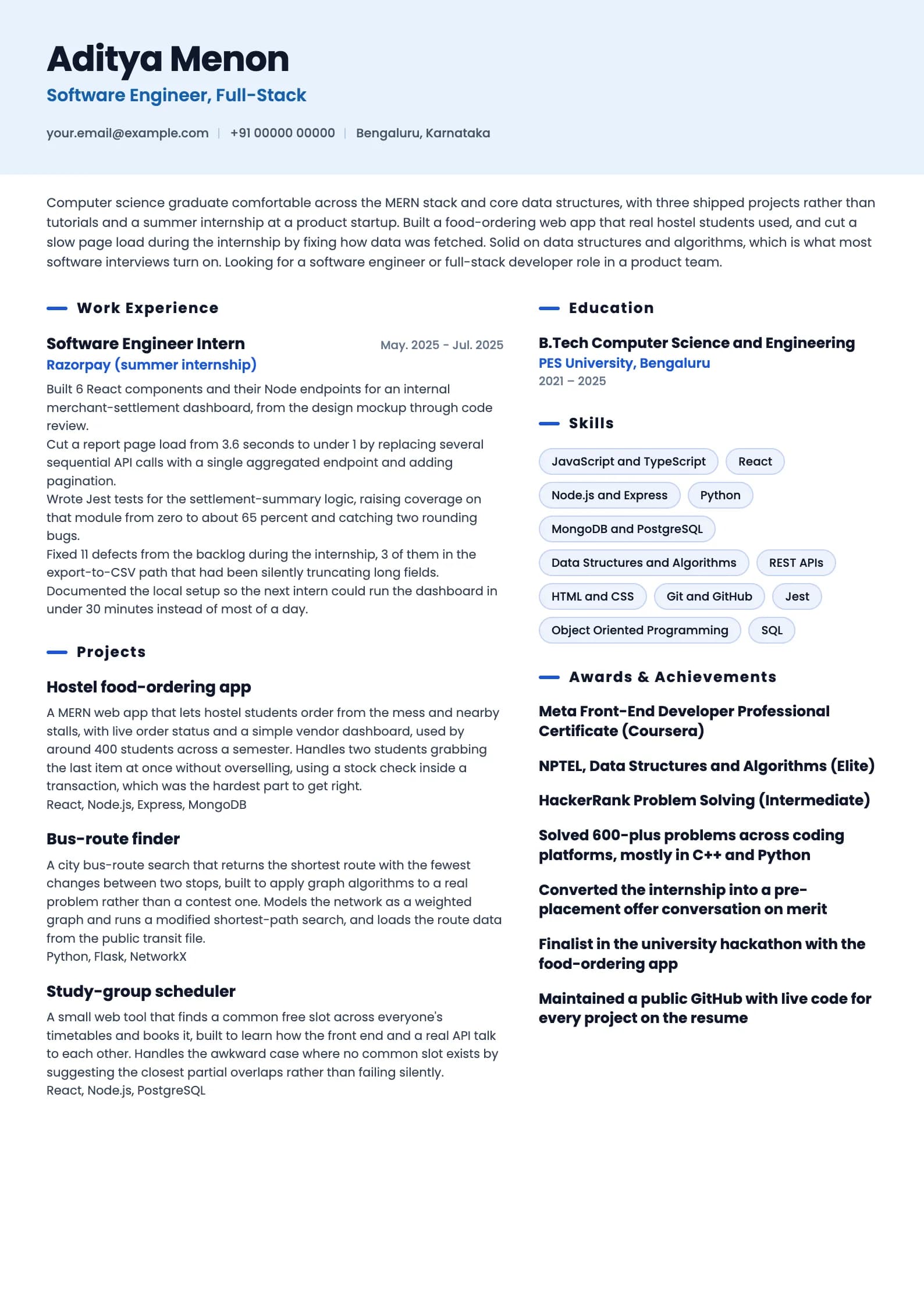
Build my resumeEngineering Fresher resume example, CSE fresher, software track (0 years)
ai-era templateIs your resume good enough?
Upload the resume you have now and see what an applicant tracking system reads before a engineering fresher recruiter ever does.
Free to run. Sign in with your mobile number to see your score.
Engineering Fresher resume example, Mechanical fresher, GET track (0 years)
professional template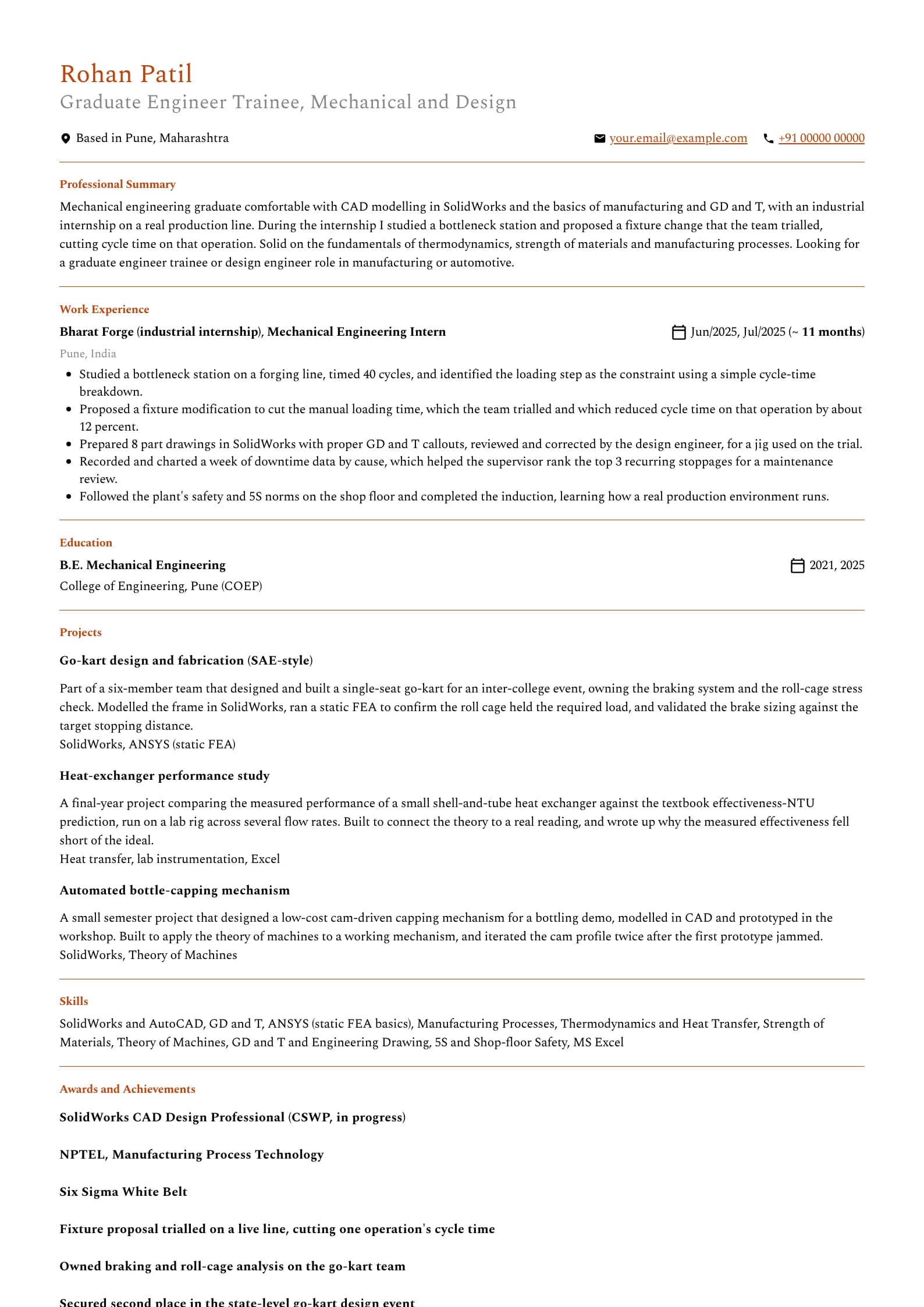
Want this structure with your own details? Build it in the resume builder.
Engineering Fresher resume example, Electrical fresher, core and power (0 years)
header-band template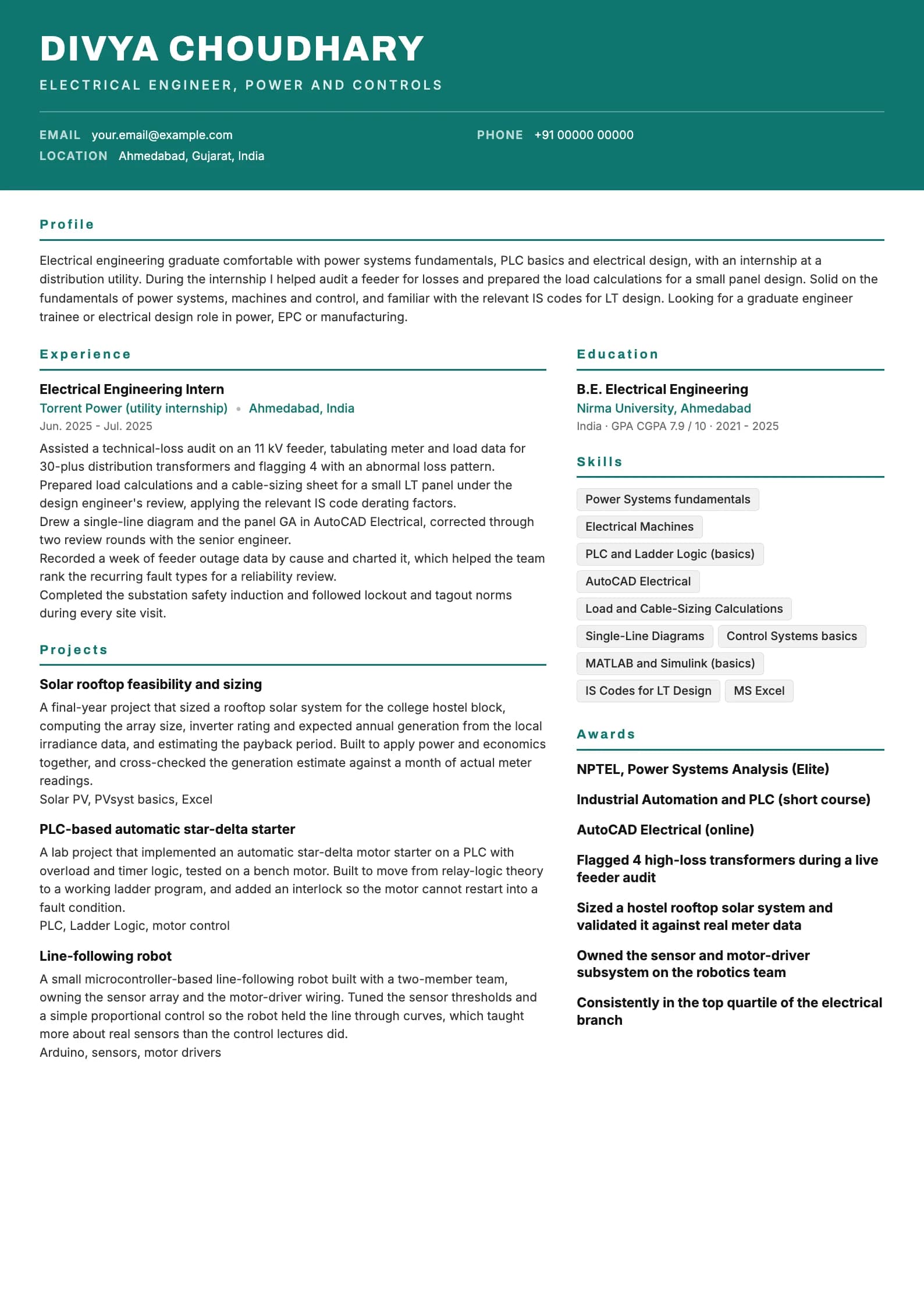
The format that works for an engineering fresher resume in India
Use a single-column, reverse-chronological layout. For a fresher across any branch, that means the strongest evidence comes first: an internship if you have one, then projects and skills. The old campus format that opens with a photograph, date of birth, father's name, marital status and a declaration wastes the top of the page on facts no recruiter needs, whatever the branch. Every one of those lines is a line a project or a real result could have used. One page is right for almost every engineering fresher, regardless of branch. You have a four-year degree, some projects, maybe an internship and a set of tools, and it all fits on one page once the filler is gone. A two-page fresher resume is nearly always a padded one, stretched with hobbies, a soft-skills paragraph and a declaration line. Order is decided by what you have. With an internship, that goes first, because real industry work outranks anything academic. Without one, lead with a tight skills section and projects that show you can apply the branch, whether that is a working software project, a design and analysis, or a hardware build. Match the resume to the target: a software role wants data structures and projects, a core role wants CAD, analysis and manufacturing or power fundamentals. Send a PDF unless the posting asks for DOCX, and name the file with your name and the target role rather than resume_final. Keep it one column all the way down, because two-column layouts confuse the parser that reads you first. The table below sets out the section order.
| Section | Where it goes | Why |
|---|---|---|
| Name and headline | Top, above everything | The headline is the role you want, software engineer, GET or design engineer. Recruiters match on it. |
| Professional summary | Directly under the header | Three lines. Your branch strengths, any internship, and one concrete result. |
| Internship | Next, only if you have any | Real industry work outranks projects, whatever the branch. Carry numbers where honest. |
| Projects | High for every fresher | The evidence you can apply the branch. Two well-described beat five named. |
| Skills | Below projects or the internship | Branch tools first: DSA and a stack for software, CAD and analysis for core. |
| Education | Near the bottom, still visible | Degree, branch, institution, years. Keep CGPA while it is fresh and good. |
| Certifications and achievements | After education, or beside skills | Name, issuing body, year. Coding record, CSWP, NPTEL Elite earn their place. |
Why projects carry an engineering fresher resume, whatever the branch
For an engineering fresher with no full-time job, projects are where a recruiter decides whether the degree turned into the ability to build, analyse or design something real. They sit high on the page and get the most space, and this is true whether the target is software, mechanical, electrical, civil or electronics. The common failure is describing the topic instead of the work. A software resume writes a web application using React and Node with CRUD operations, a mechanical resume writes a study of a heat exchanger, an electrical resume writes a project on solar energy. All three tell a reviewer nothing, because thousands of resumes carry the same line. Describe what you built or found, what you personally did, and the one part that was genuinely hard. The food-ordering app is stronger for naming real users and an overselling problem; the go-kart project is stronger for naming the subsystem the candidate owned and the load the roll cage had to hold. On team projects, and most core-branch projects are team projects, name what you personally owned rather than claiming the whole thing. Owned the braking system and the roll-cage stress check is credible from one fresher; designed and built a go-kart on your own is not, and an interviewer will find the seam. Pick projects that show range and match the target. For software, one with live users, one that applies a real algorithm, one with tricky logic. For a core branch, one design or CAD project, one analysis or FEA project, one hardware build. Two well-described projects with visible evidence, a public GitHub, a drawing set, a test reading, beat five listed by title.
Project description, engineering fresher
Weak
Final Year Project: designed and fabricated a go-kart using SolidWorks and ANSYS as part of a team, gaining hands-on experience in mechanical design.
Strong
Go-kart (6-member team): owned the braking system and the roll-cage stress check, ran a static FEA confirming the cage held the required load, and validated brake sizing against the target stopping distance.
Swaps a vague whole-vehicle claim and gaining experience for the specific subsystem the candidate owned and the two analyses they actually did.
For each project ask: what got built or found, what did I personally do, and what was hard. If your line does not answer all three, it is describing the topic, not your work. Rewrite until it only fits your project.
Match the resume to the branch and the target role
Engineering fresher is a broad category, and the single biggest mistake is sending the same generic resume to a software role and a core role. A recruiter for each is scanning for different keywords, different tools and different projects, so the resume has to point clearly at one target. For a software or IT target, whatever your branch, the currency is data structures and algorithms and shipped code. Most fresher software interviews are decided on a coding round, so the resume should name DSA, a language, a stack your projects actually use, and a public GitHub. A mechanical or electrical graduate targeting software is common and fine, but the resume then has to look like a software resume, led by projects and DSA, not by heat transfer. For a core mechanical target, the scan is for CAD, GD and T, FEA or CFD, manufacturing processes and the design or analysis you have done. For a core electrical target, it is power systems, machines, PLC, load and cable calculations and AutoCAD Electrical. For civil, it is AutoCAD, STAAD or ETABS, estimation and site or survey exposure. Lead with the branch tools the target actually uses, and let the fundamentals sit as supporting context. Graduate engineer trainee programmes at large firms often screen on branch fundamentals and CGPA first, so keep a strong aggregate visible and name the core subjects the role leans on. If you are genuinely open to both software and core, keep two versions of the resume rather than one blurred page that convinces neither recruiter.
| Target | Lead the resume with | Keywords that matter |
|---|---|---|
| Software or IT | DSA, a stack, shipped projects, GitHub | Data structures, DSA, a language, React or Spring, REST, SQL |
| Core mechanical | CAD, analysis and manufacturing projects | SolidWorks, GD and T, ANSYS or FEA, manufacturing, GET |
| Core electrical | Power, machines, PLC, design calculations | Power systems, PLC, AutoCAD Electrical, load calculation, IS codes |
| Civil | Design software, estimation, site exposure | AutoCAD, STAAD Pro, ETABS, estimation, surveying |
| Electronics | Embedded, PCB, VLSI or firmware projects | Embedded C, microcontroller, PCB design, Verilog, IoT |
Writing an engineering fresher summary that is not the same as everyone else's
The block under your name is the part a reviewer is most likely to read, so it must carry three things: your branch strengths, any real experience, and one concrete piece of evidence. Three or four lines, no adjectives that cannot be checked. Most engineering freshers write an objective, and it is nearly always the same sentence: a motivated engineering graduate seeking a challenging position in a reputed organisation to utilise my skills. It tells the reader nothing they had not assumed from the application, and it works for any branch, which is exactly the problem. Replace it with a summary. An objective describes what you want; a summary describes what you can already do, and only one is evidence. The honest worry is that a fresher has nothing to summarise. Look at the samples. The software summary names the MERN stack, an internship result and DSA. The mechanical summary names SolidWorks, GD and T and a fixture change trialled on a live line. The electrical summary names power systems, a feeder audit and IS-code design. All three are built from an internship, projects and a clear target, and none uses the phrase quick learner and team player, which is so common on graduate resumes it now carries no information. A practical test: read your summary and ask whether a classmate in the same branch with the same CGPA could paste it onto their resume unchanged. If they could, it describes the degree, not you. Add the specific tool, the specific number and the specific project until it stops being transferable.
Professional summary, engineering fresher
Weak
A motivated and hardworking engineering graduate and quick learner seeking a challenging position in a reputed organisation to utilise my technical skills and contribute to its growth.
Strong
Mechanical graduate comfortable in SolidWorks, GD and T and static FEA, with an industrial internship where a fixture change I proposed cut one operation's cycle time by about 12 percent. Looking for a graduate engineer trainee role in manufacturing.
Trades a branch-agnostic objective and self-praise for specific tools, a real internship result and a clear target a recruiter can act on.
Turning an internship into experience bullets that count
If you have an internship, an industrial training stint or even a two-week plant visit that produced real work, it is among the most valuable sections on the page, so treat it like real work rather than a line that names the company and the dates. Every bullet should follow the same shape: an action verb, the specific thing you did or studied, and the number or scope attached to it. Start with what you actually did and attach a number. Freshers tend to write observed the manufacturing process and gained exposure to the industry, which tells a reviewer nothing. Ask instead: what did you measure, model, calculate, build or find. Timed 40 cycles and identified the constraint, prepared load calculations for a panel, flagged 4 high-loss transformers, cut a page load from 3.6 seconds to under 1: these are honest, specific and exactly what a recruiter reads as real experience. Be honest about what you did versus what the engineer or team did. You proposed a fixture change that the team trialled; you did not redesign the line. You prepared calculations under the design engineer's review; you did not sign the design. You assisted an audit; you did not lead it. An interviewer will ask, and claiming an engineer's responsibility is the fastest way to lose credibility on an otherwise strong page. Where you genuinely have no number, give scope: how many drawings, how many transformers, how many cycles timed, how many defects fixed. A count of what you touched carries weight even when a percentage is not honest.
| What you did in the internship | Weak bullet | Strong bullet |
|---|---|---|
| Studied a process | Observed the manufacturing process on the line | Timed 40 cycles on a forging station and identified the loading step as the constraint |
| Did some drawings | Was involved in design and drawing work | Prepared 8 SolidWorks part drawings with GD and T, reviewed by the design engineer |
| Helped on an audit | Assisted the team with technical work | Tabulated data for 30-plus transformers on a feeder audit and flagged 4 high-loss units |
| Made something faster | Helped improve the performance of a page | Cut a report page load from 3.6s to under 1 by collapsing several calls into one |
Where education, CGPA and certifications belong
For an engineering fresher, education sits near the bottom but still clearly visible, because unlike an experienced hire you do not yet have shipped work or delivered designs to lead with. List the degree with the branch, the institution and the years. That is the whole entry for most people, whatever the branch. Keep your CGPA or percentage while you are a fresher and it is reasonable, roughly 7 out of 10 and above, because campus and GET screening still filters hard on it, and many large firms and PSUs set an explicit cutoff, often 60 percent or a 6.5 to 7 CGPA with no active backlogs. Show the aggregate, and if a large recruiter asks for the tenth and twelfth marks, keep them for a fresher because some programmes screen on all three. Once you have your first job, the school numbers can go. Name the core subjects the target role leans on, but only the relevant ones. For a software target, data structures, DBMS and operating systems; for mechanical, machine design, manufacturing and thermodynamics; for electrical, power systems, machines and control. Skip generic first-year subjects and engineering mathematics, which say nothing about your fit. Certifications and achievements sit just below education, or beside skills if you hold only one or two. Write the full name, the issuing body and the year. For freshers, a coding-platform record, an NPTEL Elite grade, a CAD certification like CSWP, or a relevant automation course earn their place. An in-progress certification is fine to list if you mark it clearly as in progress rather than complete.
Getting an engineering fresher resume through the applicant tracking system
An applicant tracking system is a parser and a search index, not a judge. It reads your file, breaks it into name, dates, education, employers and skills, and stores the result so a recruiter can search across candidates. For a fresher applying to high-volume campus and off-campus drives, the ATS is often the first thing that touches your resume, so it has to parse cleanly. Almost every ATS problem is a layout problem, not a wording one. The layout rules are short. One column. Standard section headings, so use Work Experience or Internship, Projects, Skills and Education rather than clever alternatives. No text inside images, because a logo strip, a rating graphic or a skills wheel reads as blank space. Keep your name, degree, branch and target role in the body of the page, not only in a header region some parsers drop. On wording, mirror the posting where it is honest, and match the branch. If a software role says data structures, write data structures; if a core role says GD and T or PLC, write those exact terms. Spell out an acronym alongside its short form at least once, for example FEA (finite element analysis) or GET (graduate engineer trainee), so both searches find you. These are the literal terms the recruiter for that specific role searches on. Keyword stuffing does not work, and a hidden block of white-text keywords is caught quickly and is worse than being filtered. Write real project and internship bullets that naturally contain the right terms, because a bullet describing a fixture you designed in SolidWorks contains the word SolidWorks in a context that survives human review too. Then save as a PDF with real text and confirm you can select and copy a sentence. If you cannot select the text, neither can the parser.
Test your own file before you send it. Copy the text out of your PDF into a plain text editor. Whatever reads cleanly there is roughly what the parser sees, and any scrambled or missing branch keyword is a real risk in a drive that shortlists by keyword.
What gets an engineering fresher resume rejected
Most rejections at the resume stage are not close calls. They come from a small set of recurring problems, and every one of them is fixable in an afternoon. The list below covers what campus and off-campus recruiters see most often on engineering fresher resumes across branches, in rough order of how much damage each one does.
- One generic resume sent to both software and core roles, matching the keywords of neither. Match the resume to the target and keep two versions if you apply to both.
- Projects described as topics, a study of, a project on, instead of what got built or found, what you did, and what was hard.
- Claiming a whole team project, designed and built a go-kart, when you owned one subsystem. Name what you personally did.
- A generic objective that works for any branch. Replace it with a summary that states your branch strengths, any internship and one result.
- An internship reduced to observed the process and gained exposure, with no measurement, calculation, drawing or defect to point at.
- A photo, date of birth, marital status, father's name and a declaration at the top, taking the space projects and an internship should have.
- A software-track resume with no data structures and no public code, when most fresher software interviews turn on the coding round.
- A core-track resume that lists software tools it never used, or buries CAD and analysis under generic soft skills, confusing the core recruiter.
- No CGPA anywhere for a GET or PSU target that screens on a hard cutoff, so the resume cannot clear the first automated filter.
- Two pages of padding, with hobbies, a long soft-skills paragraph and a references-available line stretched to fill a second page that says nothing.
Read your resume aloud once before sending it. Any project or claim you would be uncomfortable defending to an interviewer's face is a line to rewrite to the truth or cut before it goes out.
Skills to put on a engineering fresher resume
Technical
- Data Structures and Algorithms
- Java, Python or C++
- SolidWorks and AutoCAD
- ANSYS and FEA basics
- GD and T
- Power Systems and Machines
- PLC and Automation basics
- MATLAB and Simulink
- Manufacturing Processes
- Thermodynamics and Heat Transfer
- Circuit and Control fundamentals
- SQL and Databases
Tools and platforms
- Git and GitHub
- SolidWorks
- AutoCAD and AutoCAD Electrical
- ANSYS
- MATLAB
- VS Code
- MS Excel
- Postman
- STAAD Pro or ETABS
- PLC programming software
- Arduino and microcontrollers
- MS Project (basics)
Working skills
- Problem solving
- Applying fundamentals to real problems
- Teamwork on projects
- Clear technical writing
- Time management
- Willingness to learn
- Attention to detail
- Safety and discipline
Certifications worth listing as a engineering fresher
| Certification | Full name | Worth it for |
|---|---|---|
| NPTEL Elite | NPTEL Certification (Elite or Elite plus Gold) | A credible academic signal for any engineering fresher, worth listing when the grade is Elite or above and the course matches the target role, data structures for a software track, manufacturing or power systems for a core track. A plain completion certificate is weaker, so lead with the Elite grade and the subject that fits the job. |
| CSWP | Certified SolidWorks Professional | A strong, verifiable CAD credential for a mechanical or design fresher, since it proves modelling skill rather than just naming the tool. Worth doing for design, product and GET applications, and best paired with a project whose drawings show the same skill. Even the associate-level CSWA helps early on. |
| AWS CCP | AWS Certified Cloud Practitioner | An entry cloud certification worth it for an engineering fresher on a software or IT track who wants the AWS keyword and is applying where deployment matters. It is broad rather than deep, so treat it as a foundation and let data structures and shipped projects carry the technical weight of the resume. |
| PLC Automation | Industrial Automation and PLC Programming Certificate | A practical credential for an electrical, instrumentation or mechatronics fresher targeting automation, controls or plant roles, because PLC and SCADA skills are in real demand and thin on most fresher resumes. Most valuable when backed by a small PLC project, such as a starter or a process-control ladder program. |
| STAAD or ETABS | Structural Design with STAAD Pro or ETABS (course) | A targeted signal for a civil fresher aiming at structural design or a consultancy role, since these tools are what design offices actually use and are rarely taught deeply in the degree. Worth pairing with a design project so the certificate and a worked structure reinforce each other rather than standing alone. |
Keywords an ATS scans for in a engineering fresher resume
These are the literal terms a parser matches against the job description. Use the ones that are true of you, in the sentences where you did the work, not as a list at the bottom.
- engineering fresher
- graduate engineer trainee
- GET
- b.tech fresher
- software engineer
- data structures
- solidworks
- autocad
- ansys
- fea
- gd and t
- power systems
- plc
- manufacturing
- design engineer
- matlab
- python
- internship
- cgpa
- project
Engineering Fresher resume FAQ
What salary can an engineering fresher expect in India?
It varies widely by branch and target. Core mechanical, electrical and civil GET roles at large firms typically start around 3 to 5 LPA, while mass-recruiter IT service roles anchor near 3.5 to 4.5 LPA. Software roles at product companies and strong startups pay 6 to 12 LPA and above for a fresher who clears the coding rounds, which is the widest band by far. A strong data-structures record and a genuine skill the role needs, in any branch, is what pushes a fresher into the higher band.
How long should an engineering fresher resume be?
One page, for every branch. An engineering fresher has a four-year degree, some projects, maybe an internship and a set of tools, and all of it fits on a single page once the filler is cut. A two-page fresher resume is almost always a one-page resume padded with hobbies, a soft-skills paragraph and a declaration. If you are struggling to fit one page, tighten each project to three lines and drop generic first-year coursework.
Should an engineering fresher put projects above education?
Yes, put projects high on the page, second only to an internship if you have one. With no full-time roles, projects are the strongest evidence that your degree became the ability to build, design or analyse something real. Describe each as what got built or found, what you personally did, and what was hard, and on team projects name your own subsystem. Education still stays on the page, just lower, though a GET or PSU target that screens on CGPA needs the number kept visible.
Can a mechanical or electrical fresher apply for software roles?
Yes, and it is very common. A core-branch graduate can move into software, but the resume then has to look like a software resume: led by data structures, a language, a stack your projects actually use, and a public GitHub, rather than by heat transfer or power systems. Most fresher software interviews are decided on a coding round, so a strong problem-solving record matters more than the branch on your degree. Keep a separate software version rather than sending one blurred page.
Do I need an internship to get placed as an engineering fresher?
It helps a great deal, because real industry work is strong evidence, but many freshers are placed without one. If you have no internship, strong projects that show you can apply the branch carry the page: a working software project with live users, a design with an FEA to back it, a power calculation or a PLC build. Add any checkable signal, a coding record, an NPTEL Elite grade, a CAD certification. Job-like evidence matters more than the label of an internship you did nothing in.
Which certifications help an engineering fresher most?
The ones that match your target and are backed by a project. For software, a data-structures record and a stack certificate; for mechanical, a SolidWorks CSWP or CSWA; for electrical or instrumentation, a PLC and automation course; for civil, a STAAD Pro or ETABS course. A certificate helps most when a project shows you applying it, so the two reinforce each other. Avoid a long list of unrelated online courses, which reads as collecting certificates rather than depth in the branch.
Does my CGPA matter, and should I put it on the resume?
For a fresher it matters, so keep it on the resume while it is reasonable, roughly 7 out of 10 and above. Campus placements, graduate engineer trainee programmes and PSUs screen hard on it, and many set an explicit cutoff around 60 percent or a 6.5 to 7 CGPA with no active backlogs, which is an automated filter your resume must clear. Show the aggregate, and for a fresher keep the tenth and twelfth marks too, since some large recruiters screen on all three. Once you have your first job, the numbers can go.
Should I send the same resume for core and software roles?
No. A core recruiter scans for CAD, analysis, manufacturing or power tools and the projects that use them, while a software recruiter scans for data structures, a stack and shipped code. One blurred resume that tries to serve both convinces neither and reads as unfocused. Keep two versions, each led by the keywords and projects that target expects, and send the one that matches the specific role. It is the same underlying you, just pointed clearly at one door.
Does an ATS reject two-column engineering resumes?
It does not reject them outright, but some parsers read multi-column layouts out of order, which interleaves your sidebar with your projects and produces nonsense in the recruiter's search view. Since engineering freshers apply to high-volume campus and off-campus drives that shortlist by keyword, a clean single-column layout is the safer choice, which is why all three samples above use one. Test your file by copying the text out of the PDF into a plain editor and checking that your branch keywords read in order.
Related resume examples and guides
Build your engineering fresher resume in any of these formats
Start from a blank resume or upload the one you have. Goodspace renders it in 24 templates, keeps it to one clean page, and flags the branch and role keywords an applicant tracking system will look for, whether you are targeting software, a graduate engineer trainee programme or a core design role.
Build my resume