B.Tech Fresher Resume Format, with 3 Full Samples
A B.Tech fresher is hired on projects that work, one internship, and a technical skill set the interviewer can probe, not on a CGPA line and a list of every subject in the syllabus. Most campus resumes get the order backwards and lead with objectives and hobbies. Below are three complete one-page resumes, one for a computer-science graduate targeting software roles, one for a mechanical engineer targeting core and design, and one for an electronics engineer targeting embedded and VLSI. After the samples come the format rules a placement cell expects, how to describe a project so it survives an interview, the terms an applicant tracking system matches, and the mistakes that filter a fresher before a human reads the page.
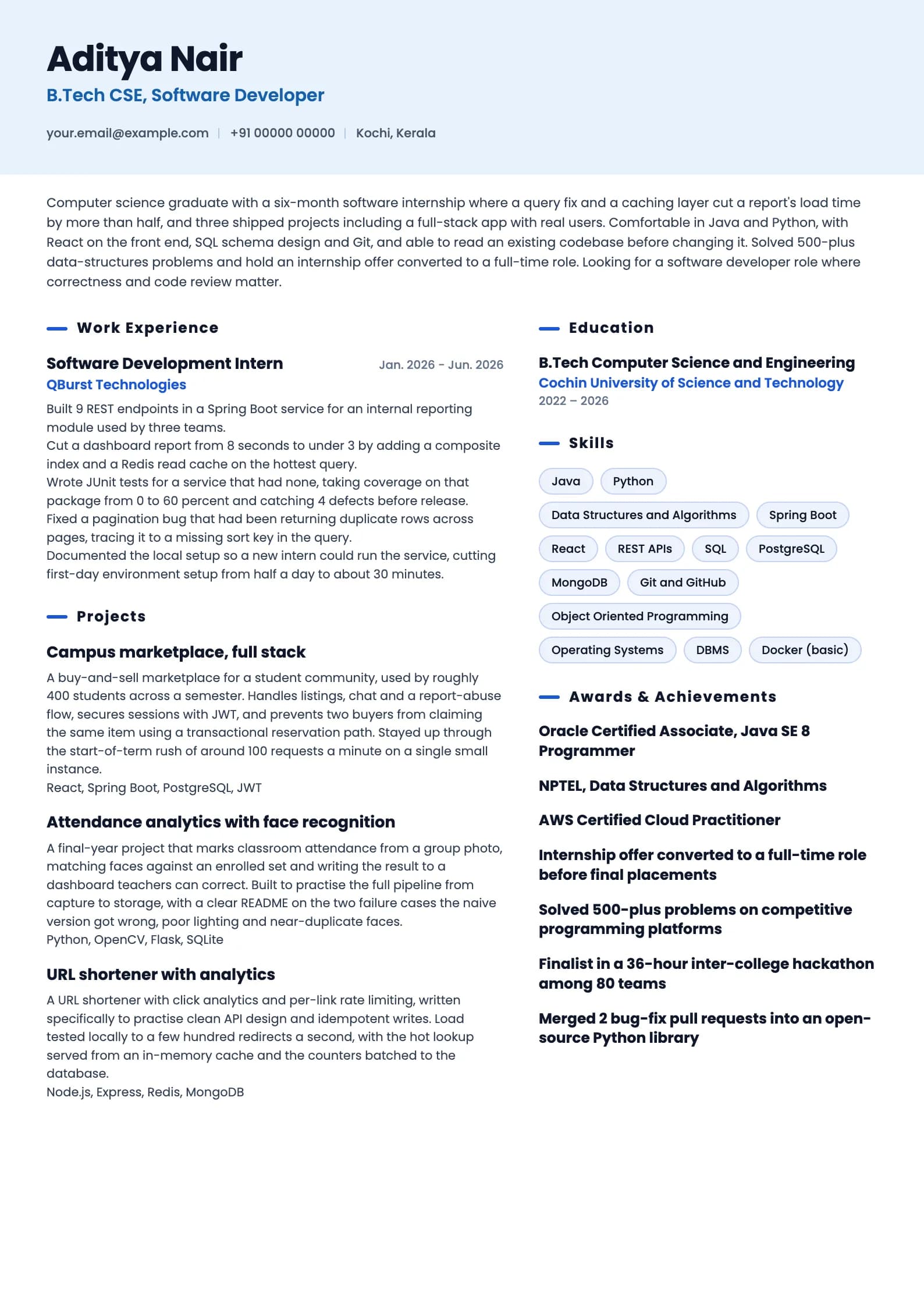
Build my resumeB.Tech Fresher resume example, Computer Science branch
ai-era templateIs your resume good enough?
Upload the resume you have now and see what an applicant tracking system reads before a btech fresher recruiter ever does.
Free to run. Sign in with your mobile number to see your score.
B.Tech Fresher resume example, Mechanical branch
professional template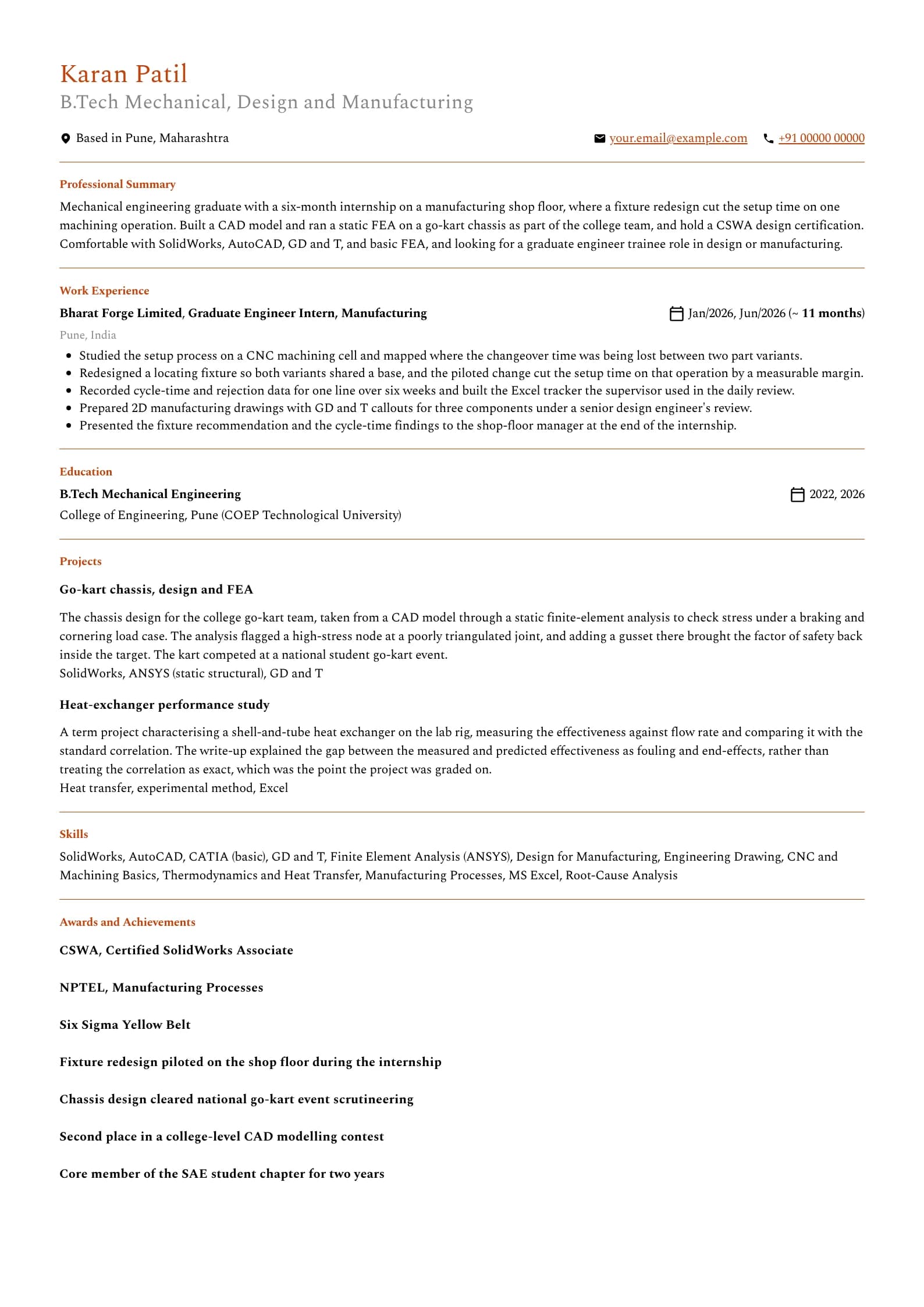
Want this structure with your own details? Build it in the resume builder.
B.Tech Fresher resume example, Electronics branch
modern template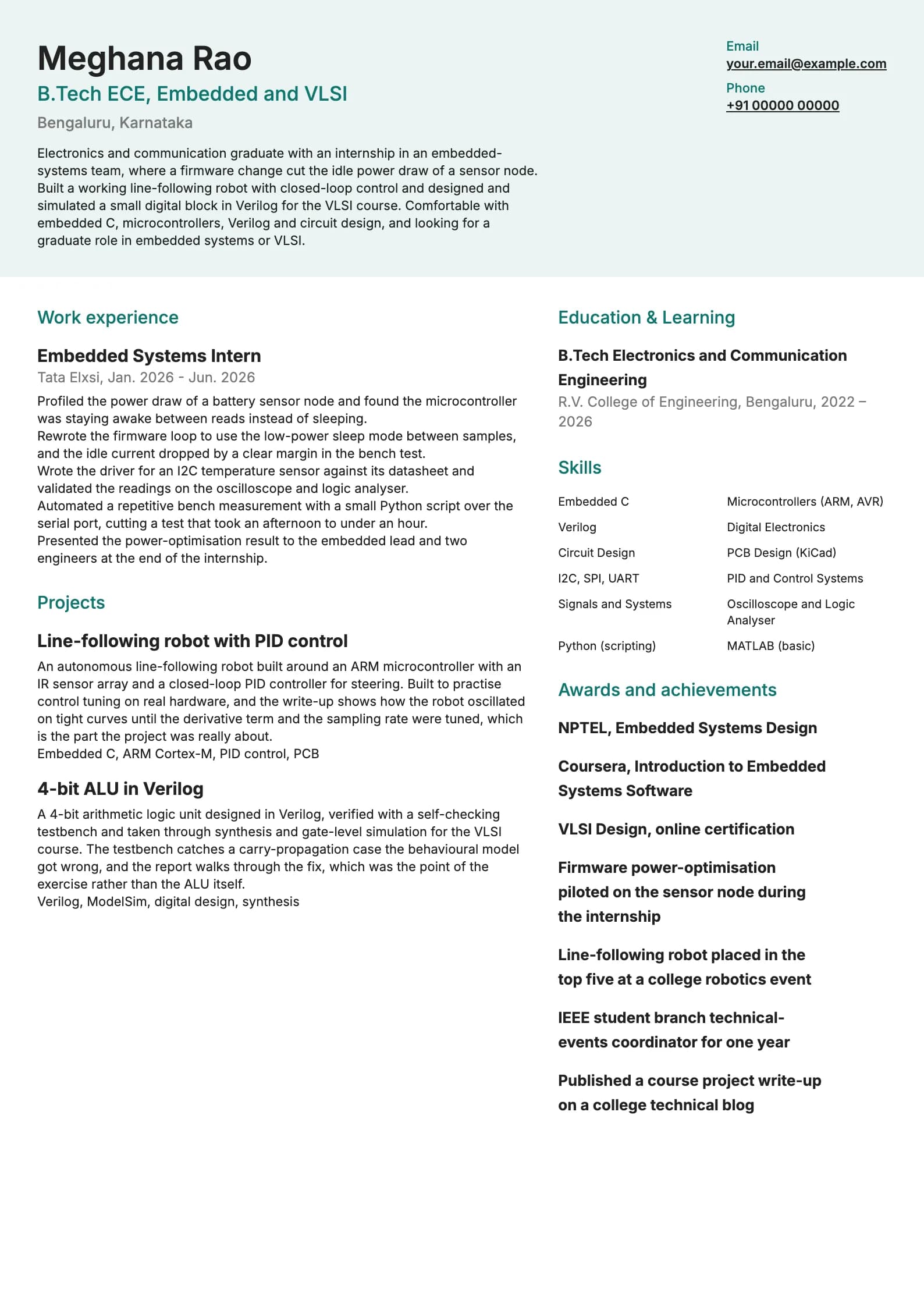
The format a placement cell expects for a B.Tech fresher
A B.Tech fresher resume is one page, reverse chronological, and single column. Where your college issues a placement-cell format, use it, because campus recruiters are used to reading it and a deviation stands out for the wrong reason. Where you have a free hand, the order below is the one that works across branches. One page is the rule for a fresher, not a target. You have projects, one internship, a degree and some positions of responsibility, and all of it fits on a page once the objective and the hobbies come off. A second page on a fresher resume signals you cannot tell your strong evidence from your weak. Four things belong nowhere on the page: a photograph, date of birth, marital status and father's name. They survive from an old campus template and add nothing an engineering recruiter wants. Every line they take is a line a project could have used. State the branch and the target role in the headline, because a recruiter shortlists by track. A CSE recruiter should not have to infer software from your project list, and a core recruiter should not have to guess whether a mechanical candidate wants design or manufacturing. Send a PDF named with your own name and the role. The table below sets the section order.
| Section | Where it goes | Why |
|---|---|---|
| Name and headline | Top, above everything | Branch plus target role, so a recruiter places you in seconds. |
| Professional summary | Directly under the header | Three lines. Branch, the internship, and the one strongest project or result. |
| Projects | Above the internship for most freshers | For an engineering fresher this is the portfolio. It carries the most weight. |
| Internship | Below or above projects, as a work block | The one place you did real work. Frame it as a result, not tasks. |
| Technical skills | Below projects and internship | Grouped by branch: languages, tools, domains. Not the full syllabus. |
| Education | Near the bottom, with the B.Tech first | Degree, institution, years, CGPA while it is strong. |
| Achievements and positions | Bottom | Hackathons, contests, club roles, coding counts. Verifiable signals. |
Describing a project so it survives the interview
For a B.Tech fresher, projects are the resume. They are where an interviewer decides whether you can actually build in your field or only pass the exam about it, so they sit near the top and get the most space. The single most common failure is describing the stack instead of the software, and the fix is the same across every branch. "A web application built using Java and MySQL" or "a robot built using Arduino" tells a reviewer nothing, because thousands of resumes carry the same line. Describe what the thing does, who or what uses it, and the one part that was genuinely hard. The strongest project entries in the samples all name a specific difficulty: two buyers cannot claim the same item, the robot oscillated until the PID was tuned, the FEA flagged a joint that needed a gusset. Naming the hard part is what proves you did the work. Pick projects that show range rather than three variations of one tutorial. One with real users or real hardware, one that demonstrates a core concept from your branch, and one with a genuinely tricky piece of logic is a stronger set than five listed by title. Two well-described projects beat five named ones. Assume the interviewer will open your code or ask you to draw your circuit. If a software project's repository has one commit called "initial commit", fix that before you link it, because the commit history reads as a work sample. If you claim an FEA, be ready to explain the load case and the boundary conditions. The project is a promise to answer questions about it, so only list what you can defend.
| Branch | A project should prove | Name the hard part |
|---|---|---|
| CSE / IT | You can ship working software | Concurrency, caching, auth, a real user load |
| Mechanical | You can take a design from CAD to a decision | The load case, the FEA finding, the design change it forced |
| Electronics / ECE | You can make hardware and firmware work together | The control tuning, the timing bug, the power optimisation |
| Electrical | You can analyse and build a real circuit or system | The fault case, the protection logic, the efficiency measurement |
Project description, CSE fresher
Weak
Campus Marketplace: a full-stack web application built using React, Spring Boot and PostgreSQL with login and CRUD operations.
Strong
Campus marketplace used by 400 students that prevents two buyers claiming the same item with a transactional reservation path, secured with JWT, holding up through a 100-requests-a-minute start-of-term rush.
Swaps a stack list and "CRUD operations" for real users, the one concurrency problem the project solves, and the load it survived.
Making one internship count
Most B.Tech freshers have exactly one internship, and it is the only place on the page where you did real work for a real organisation, so it is worth framing carefully. The mistake is describing what you were assigned rather than what changed because of you. "Worked with the development team on various tasks" or "assisted the production department" is a task list, and every intern can write it. Frame the internship as a result. What problem were you pointed at, what did you find, what did you build or recommend, and did it move a number. The samples follow this shape across branches: a caching layer that cut a report's load time, a fixture redesign that cut setup time, a firmware change that cut idle current. The verb, the change and the consequence are the bullet. A fresher's numbers are smaller, and that is fine. You are not claiming you transformed the business in six months. "Cut a report from 8 seconds to under 3" and "took coverage from 0 to 60 percent" are honest intern-scale results, and they are more credible than a grand percentage an interviewer would immediately doubt. Where you cannot claim a clean number, claim scope: nine endpoints, three components drawn, one line tracked for six weeks. If your internship was mostly shadowing, say what you learned to do rather than inflating it. "Wrote the driver for an I2C sensor against its datasheet and validated it on the logic analyser" is a real, checkable skill gained, and it beats claiming ownership of work you only watched.
Internship bullet, mechanical fresher
Weak
Assisted the production team with various manufacturing and quality tasks and helped prepare reports during the internship.
Strong
Redesigned a locating fixture so two part variants shared a base, and the piloted change cut the setup time on that machining operation by a measurable margin.
Replaces "assisted" and "various tasks" with the specific change made and the setup-time result it produced on the line.
Ask of your internship bullet: what was different after I left. If the honest answer is a fixture, a driver, a caching layer or a report, name it. That beats "assisted the team" every time.
A summary, not an objective
The block under your name is the part a campus recruiter is most likely to read, so it should carry three facts: your branch and target role, your internship in a clause, and the strongest project or result you have. Three or four lines, no adjectives a recruiter cannot check. The career objective, seeking a challenging position in a reputed organisation to utilise my engineering skills and grow with the company, is the default on thousands of B.Tech resumes and tells a recruiter nothing new. Replace it with a summary. An objective describes what you want, a summary describes what you have already built, and only the second is evidence. Freshers often think they have nothing to summarise. Look at the samples: each names the branch, the internship in a phrase, and a concrete project or result. That is a real summary built from coursework, one internship and projects. What each avoids is "passionate about technology", a phrase so common on engineering resumes that it now carries no information at all. The test is transferability. If a batchmate in your branch could paste your summary onto their resume unchanged, it describes the degree, not you. Add the specific project, the specific number, the specific tool until it stops fitting anyone else.
Professional summary, ECE fresher
Weak
A passionate and hardworking electronics engineering graduate seeking a challenging role in a reputed organisation to apply my technical skills and grow with the company.
Strong
Electronics graduate with an embedded internship where a sleep-mode firmware change cut a sensor node's idle current, plus a PID line-following robot and a synthesised 4-bit ALU in Verilog.
Trades self-description and a wish for the branch, a concrete internship result, and two named projects a recruiter can probe.
Technical skills: grouped by branch, and defendable
A B.Tech fresher skills section has two readers with opposite tastes. An applicant tracking system wants literal terms it can match, Java and SolidWorks and Verilog. A human interviewer wants a short, grouped list that signals what kind of engineer you are. Grouping by function serves both, and it looks different in each branch. Group rather than dumping one long line. For CSE: languages, frameworks, data, tools, core CS. For mechanical: CAD, analysis, manufacturing, domains. For electronics: embedded, hardware description, hardware, tools. The exact headings matter less than the fact that structure exists and a recruiter reads the section in one pass. Twelve to sixteen skills is the working range. Below eight it looks thin, above twenty it stops being a signal and starts reading as the syllabus copied onto the page. Do not list every subject you studied. "Engineering Mathematics" and "Environmental Science" are not skills, they are courses, and listing them tells a recruiter you could not distinguish a skill from a semester. Every item on the line is a question you have agreed to answer. Writing Verilog means you can be asked to sketch a testbench, writing FEA means you can be asked about boundary conditions, writing Spring Boot means you can be asked what a bean is. List what you can defend in a short conversation, and skip the star ratings, because nobody agrees what four stars in SolidWorks means and they only invite an argument.
For every tool on your skills line, ask: can I answer three follow-up questions on it right now. If not, either learn enough to defend it or cut it. The syllabus copied onto the page fools no interviewer.
Where education and certifications belong
For a B.Tech fresher, education sits near the bottom of the page but stays substantial, because the degree, the branch and the CGPA are current screening signals in a way they will stop being once you have a couple of years of work behind you. List the B.Tech first with the institution, the years and the CGPA. Keep the CGPA while it is strong, roughly 7.5 out of 10 and above, because many campus and mass recruiters apply an academic cut-off and a good number clears it for you. Add the tenth and twelfth marks as a compact line if they are strong, since some cut-offs look across the full record. Once you have a job, drop the school marks and eventually the CGPA, but as a fresher they still count. Coursework lines are for freshers and only where relevant. Operating systems, DBMS and computer networks are worth naming for a software role, thermodynamics and machine design for a mechanical one, digital electronics and signals for an ECE one. Do not list every subject, and do not list engineering mathematics, which everyone took. Certifications sit just below education or beside skills if you hold one or two. Name the certification, the body and the year. For engineering freshers the ones that carry weight are branch-specific and checkable: OCA and a cloud practitioner badge for software, CSWA for mechanical design, NPTEL courses across branches. An expired or vaguely-named certificate is worse than none, so keep the list to two or three that map to your target role.
Getting a B.Tech fresher resume through the ATS
Mass recruiters who hire engineering freshers in volume, the service companies especially, run every resume through an applicant tracking system before a human sees it. The system is a parser and a search index, not a judge: it breaks your file into name, education, employers, titles and skills, then lets a recruiter search across thousands of candidates. Almost every ATS problem is a parsing problem, and parsing problems come from layout, not wording. The layout rules are short. One column, because a two-column campus template with a sidebar is read out of order by some parsers and interleaves your skills with your projects. Standard headings, so Projects and Work Experience rather than My Creations and My Journey. No text inside images, because a tech-logo strip reads as blank space. Nothing critical in the header or footer region, which some parsers drop. On wording, mirror the job description where it is honest. If the posting says data structures, write data structures. If it says embedded C, write embedded C rather than only "microcontroller programming". Include an acronym with its expansion once, for example "FEA (finite element analysis)", so both searches find you. Keyword stuffing does not work and is easy to catch. A hidden white-text block of every programming language is worse than being filtered, because a recruiter who finds it stops trusting the page. Write real project and internship bullets that naturally contain the right terms, then test the file: copy the text out of your PDF into a plain editor, and if it reads in order there, the parser sees roughly the same.
Before you upload, copy the text out of your PDF into a plain text editor. Whatever reads in order there is roughly what the ATS sees. If your projects and skills are scrambled together, your two-column template is the cause.
What gets B.Tech fresher resumes rejected
Most rejections at the resume stage are not close calls, and for B.Tech freshers they cluster around a small set of recurring problems, all fixable in an afternoon. The list below is what campus recruiters and mass screeners see most often, in rough order of how much damage each does.
- A generic career objective instead of a summary. "Seeking a challenging position in a reputed organisation" is on thousands of resumes and says nothing.
- Projects described by stack, not by what they do. "A web app using Java and MySQL" is a line a thousand candidates share.
- The full syllabus dumped into skills, engineering mathematics and environmental science listed as if they were tools.
- The internship written as "assisted the team with various tasks" instead of the one result you produced.
- No branch or target role in the headline, forcing a recruiter to infer software or core from your project list.
- A photo, date of birth, marital status or father's name from an old campus template, taking space a project should occupy.
- Two columns and a decorative sidebar that parses out of order in an ATS, scrambling skills into projects.
- Listing a tool you cannot defend, so an interviewer asks one question about Verilog or Spring and the page unravels.
- Spilling onto a second page. A fresher with one internship on two pages cannot tell strong evidence from weak.
- Typos in the technologies you claim, writing "SolidWorks" or "Verilog" wrong, which undoes an otherwise careful resume.
Read your resume aloud once before sending it. If a line would embarrass you in front of an interviewer, a stack-list project or an empty objective, it is a line to cut or rewrite.
Skills to put on a btech fresher resume
Technical
- Java
- Python
- C and C++
- Data Structures and Algorithms
- SQL and DBMS
- Operating Systems
- Embedded C
- Verilog
- SolidWorks and AutoCAD
- Finite Element Analysis
- Object Oriented Programming
- Computer Networks
Tools and platforms
- Git and GitHub
- VS Code
- MATLAB
- ANSYS
- KiCad
- ModelSim
- Docker (basic)
- MySQL and PostgreSQL
- Oscilloscope and Logic Analyser
- MS Excel
Working skills
- Problem solving
- Team collaboration
- Technical communication
- Debugging and root-cause analysis
- Time management
- Documentation
- Willingness to learn
- Attention to detail
- Presentation
Certifications worth listing as a btech fresher
| Certification | Full name | Worth it for |
|---|---|---|
| OCA Java | Oracle Certified Associate, Java SE Programmer | The entry-level Oracle Java certification, a clean paper signal for a CSE or IT fresher targeting Java or backend roles with no work history yet. Worth doing before placements at service companies, which read it as proof of fundamentals. Redundant once you have shipped production Java. |
| AWS CCP | AWS Certified Cloud Practitioner | A foundational cloud certification, worth it for a software fresher who wants the cloud keyword on the page and a basic grounding recruiters recognise. Quick to earn and ATS-friendly. Skip the associate-level certs as a fresher unless you have actually deployed something to AWS. |
| CSWA | Certified SolidWorks Associate | The standard design credential for a mechanical fresher, a checkable proof of CAD ability that campus and core recruiters recognise. Worth it if you are targeting design or product roles. Pair it with a project that shows a real CAD-to-analysis loop, or the badge stands alone with nothing behind it. |
| NPTEL | NPTEL Online Certification (branch-specific course) | Government-backed online course certifications across every engineering branch, worth listing when the course maps directly to your target role, data structures for software, manufacturing for mechanical, embedded systems for ECE. Recognised and free. List one or two relevant ones, not a wall of them. |
| Six Sigma YB | Six Sigma Yellow Belt | An entry quality-and-process certification, useful for a mechanical or production fresher targeting manufacturing, quality or operations roles where process improvement is the job. A supporting credential that pairs with a shop-floor internship, not a headline qualification on its own. |
| GATE | Graduate Aptitude Test in Engineering (qualified score) | Not a certification but a qualifying score worth stating if it is strong, because a good GATE rank is a recognised signal of core engineering depth and opens PSU and higher-study routes. List the score and year if it helps your target, and leave it off if you are aiming purely at software product roles that do not read it. |
Keywords an ATS scans for in a btech fresher resume
These are the literal terms a parser matches against the job description. Use the ones that are true of you, in the sentences where you did the work, not as a list at the bottom.
- btech fresher
- engineering fresher
- graduate engineer trainee
- software developer
- data structures
- java
- python
- embedded c
- verilog
- solidworks
- autocad
- finite element analysis
- sql
- internship
- project
- git
- microcontroller
- manufacturing
- design
- problem solving
B.Tech Fresher resume FAQ
What salary can a B.Tech fresher expect in India?
It depends heavily on the branch, the college tier and whether the role is a mass IT services offer or a product one. Mass recruiters at service companies commonly offer 3.5 to 5 LPA to fresh graduates across branches. Core mechanical, electrical and civil roles at manufacturing firms often sit in the 3 to 6 LPA range. Software product companies and strong startups pay far more, 8 to 20 LPA and higher for a strong CSE graduate who clears a coding bar, with the top product firms going well beyond that. A strong project portfolio and a coding record push you toward the higher band within any branch.
How long should a B.Tech fresher resume be?
One page, without exception. You have projects, one internship, a degree and some positions of responsibility, and all of it fits on a page once the objective and hobbies come off. A recruiter reading hundreds of campus resumes treats a two-page fresher resume as an inability to prioritise. If you are struggling to fit one page, describe two projects well instead of five badly, cut the syllabus out of skills, and remove the objective.
Should a fresher put projects above the internship?
For most engineering freshers, yes, because the projects are your portfolio and you usually have more of them than internship work. Projects sit near the top and get the most space, with the internship as a work block just below or above them. The exception is when your internship was substantial and directly on the role you want, in which case it can lead. Either way, describe each as what it does and the hard part it solves, not a stack list.
How do I describe a project so it survives the interview?
Name what it does, who or what uses it, and the one part that was genuinely hard, then be ready to defend that hard part. Assume the interviewer will open your code or ask you to draw your circuit. "Prevents two buyers claiming the same item with a transactional path" or "the robot oscillated until the PID and sampling rate were tuned" shows you did the work, because you can only write it if you understand it. A stack list cannot be interviewed, so it proves nothing.
Should I list my CGPA and my tenth and twelfth marks?
Yes if they are strong, roughly 7.5 out of 10 and above for CGPA, because many campus and mass recruiters apply an academic cut-off and a good number clears it for you. Add the tenth and twelfth marks as a compact line, since some cut-offs look across the full academic record. If a number is weak, you can leave that one out while keeping the strong ones. Once you have a couple of years of work experience, drop the school marks.
Which certifications actually help a B.Tech fresher?
Branch-specific, checkable ones. For software, an OCA Java or an AWS Cloud Practitioner and relevant NPTEL courses. For mechanical, a CSWA SolidWorks associate. For electronics, NPTEL embedded-systems courses. Name the certification, the body and the year, and keep the list to two or three that map to your target role. A wall of ten generic online certificates reads as badge-collecting and crowds out the projects that actually carry you.
I have only one internship. Is that enough?
Yes, one relevant internship framed well is plenty for a fresher. What matters is how you describe it: as a result you produced, not tasks you were assigned. State the problem, what you built or found, and what changed, a caching layer that cut load time, a fixture that cut setup time, a firmware change that cut power draw. If the internship was mostly shadowing, say what concrete skill you learned to do rather than inflating your role, because an interviewer will test any claim of ownership.
Does an ATS reject two-column campus resume templates?
It does not reject them outright, but some parsers read a two-column layout out of order and interleave your sidebar with your main content, so your skills land in the middle of your projects in the recruiter's view. A single-column layout removes the risk, which is why all three samples use one. Test your own file by copying the text out of the PDF into a plain text editor: if it reads in order there, it will most likely parse correctly.
Do I need a photo on a B.Tech fresher resume in India?
No. Engineering recruiters do not expect one, and it takes space a project or an internship result should occupy. The same goes for date of birth, marital status, father's name, nationality and a declaration paragraph, all of which come from an older campus template and add nothing to a technical screen. The only exception is where a specific posting or the placement cell explicitly asks for a photograph.
Related resume examples and guides
Build your B.Tech fresher resume in any of these formats
Start from a blank resume or upload the draft you have. Goodspace renders it in 24 one-page templates and flags the branch and project keywords a campus recruiter's applicant tracking system will look for, and the syllabus padding it will not credit.
Build my resume