Software Engineer Resume for Freshers: 2 Samples and a Format That Works
A fresher software engineer resume has to win on projects, internships and education, because there is no work history to lean on. The mistake is treating that as a weakness and padding with adjectives. Below are two complete fresher resumes at different starting points, one from a tier-one campus with an internship and one from a tier-three college who self-taught and shipped real projects, followed by the format rules that put your evidence where a reviewer will actually see it. Both lead with projects, and both replace the old objective line with a summary that states something you have already done.
Build my fresher resume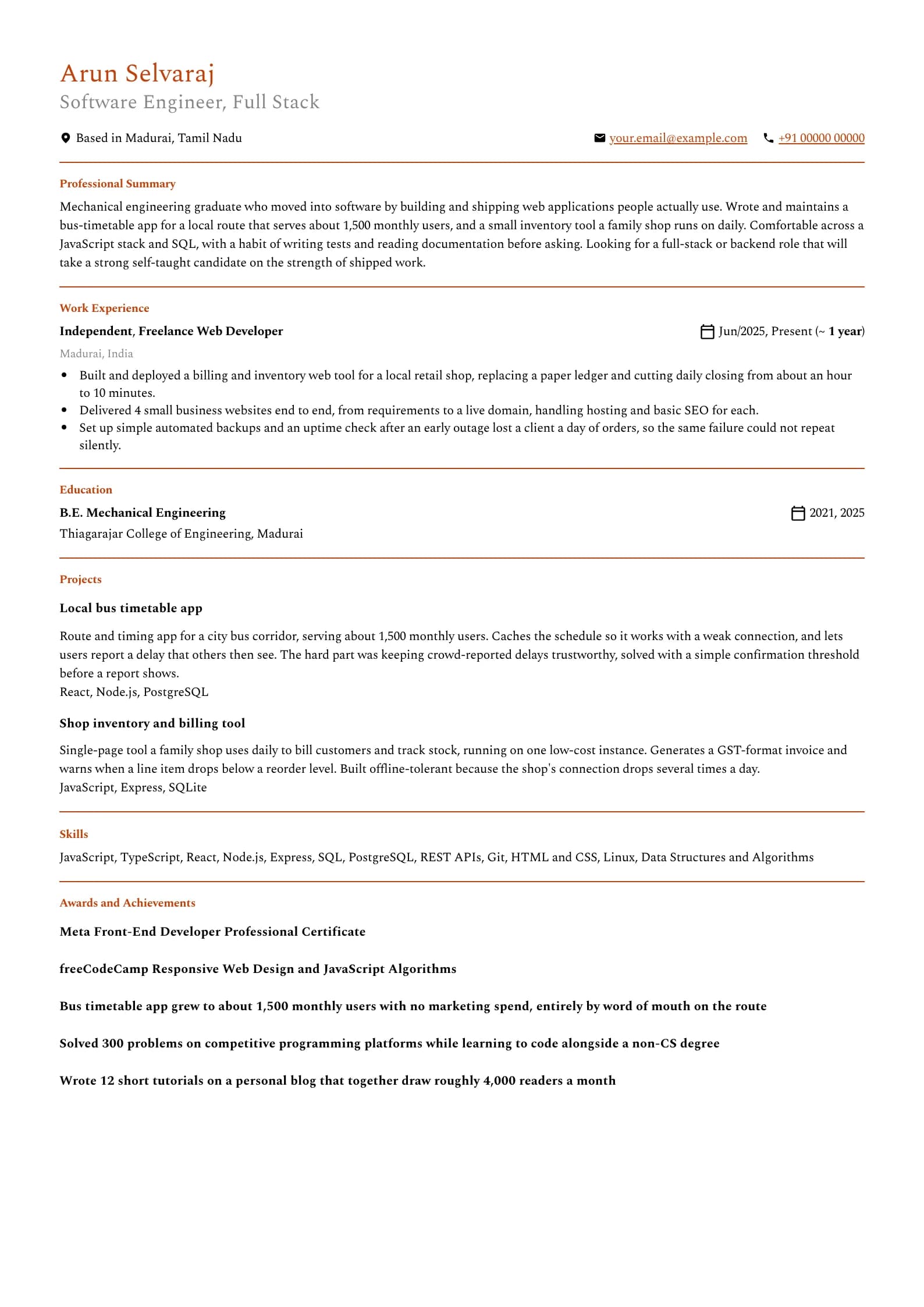
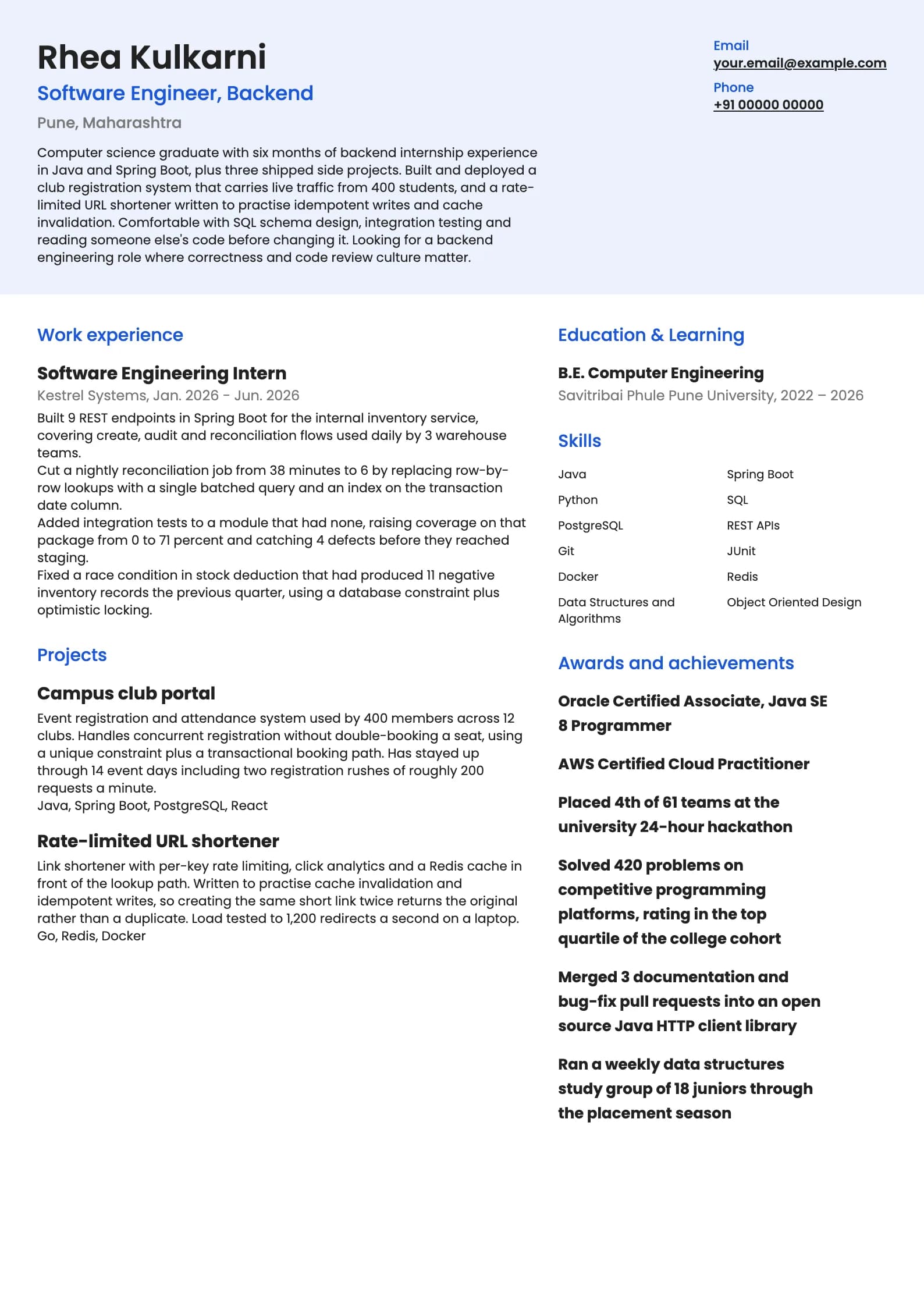
Software Engineer resume example, Campus placement, with internship (0 years)
modern templateIs your resume good enough?
Upload the resume you have now and see what an applicant tracking system reads before a software engineer recruiter ever does.
Free to run. Sign in with your mobile number to see your score.
Software Engineer resume example, Self-taught, no internship (0 years)
minimalist templateThe order for a fresher: summary, projects, then everything else
A fresher resume inverts the usual order in one specific way: projects sit above experience, directly under the summary, because for someone with no full-time job the projects are the evidence and the experience section is thin or empty. Everything else keeps the standard sequence. Name and headline at the top, then the summary, then projects, then any internship or freelance experience, then skills, then education and certifications. Keep it to a single page. A fresher has genuinely less to say than an engineer with five years, and a two-page fresher resume almost always got there by padding: a declaration paragraph, a hobbies line, a full postal address, a photo and a wall of coursework. Cut all of that. The reviewer wants to reach your best project in the first few seconds, and every line of filler pushes it further down. Use a single column of plain text and standard section headings, the same parsing rules that apply to any resume, because fresher applications go through the same applicant tracking systems as everyone else's. The two samples above both use one column top to bottom. Education moves higher for a fresher than for an experienced engineer, sitting near the projects rather than at the bottom, because it is one of the few credentials you have. Keep your CGPA or percentage on the page while it is good, roughly 7.5 out of 10 and above, since campus and early-career screening still filters on it.
| Section | Order for a fresher | What it must show |
|---|---|---|
| Summary | First, under the header | Stack, and one thing you have already built or shipped |
| Projects | Second, the top of the body | What it does, who uses it, what was hard |
| Experience | Third, if you have an internship or freelance work | That someone employed you, and what changed |
| Skills | Fourth | Grouped, only technologies you can be interviewed on |
| Education | Near the top area for a fresher | Degree, institution, years, CGPA if good |
Objective or summary: write the summary
The single most common line on a fresher resume in India is the objective: a sentence about seeking a challenging position in a reputed organisation to utilise your skills and grow with the company. It says nothing the reviewer did not already assume from the fact that you applied, and it wastes the one block you can be reasonably sure gets read. Replace it with a summary. The difference is direction. An objective describes what you want; a summary describes what you have already done. Only one of those is evidence, and a reviewer screening a hundred graduate resumes is looking for evidence. Freshers resist this because they believe they have nothing to summarise, but look at the two samples. One summary names an internship stack and a project with 400 live users. The other names a mechanical degree, a deliberate switch, and an app with 1,500 monthly users. Both are built entirely from coursework, one internship or freelance work, and side projects. The test for a fresher summary is whether a classmate applying to the same company could paste it onto their own resume unchanged. If they could, it describes the degree, not you. Add the specific project, the specific number, the specific thing you owned until it stops being transferable. And delete the phrase passionate about technology, which appears on so many graduate resumes that it now carries no information at all.
Top block, fresher resume
Weak
Objective: To secure a challenging position in a reputed organisation where I can utilise my technical skills and knowledge for the growth of the organisation and myself.
Strong
Computer science graduate with a six-month backend internship in Java and Spring Boot and three shipped projects, including a club portal serving 400 live users. Looking for a backend role where code review culture matters.
The objective is transferable to any graduate and states only a want. The summary names a stack, an internship and a project with real users, which is evidence.
If your top line would fit any fresher from your batch, it is describing the degree. Rewrite it around one specific thing you built until it only fits you.
Projects are the resume, so describe the software not the stack
For a fresher, projects are where a reviewer decides whether you can actually build software or only pass exams about it. That makes how you describe them the highest-value writing on the page. The common failure is describing the stack instead of the software: a full-stack web application built using React, Node.js and MongoDB tells a reviewer nothing, because thousands of fresher resumes carry that exact line. Describe what the thing does, who uses it, and what was genuinely hard about building it. The campus club portal in the first sample is a stronger entry than a more sophisticated project would be, because it names real users and one real engineering problem: two people cannot book the same seat. The bus timetable app in the second sample names 1,500 users and the trust problem in crowd-reported delays. Neither leads with the framework, because the framework is the least distinctive thing about either project. Pick projects that show range rather than three variations of the same tutorial. One with live users, one that demonstrates a systems concept such as caching or concurrency, and one that solved an actual annoyance for a real group of people is a stronger set than three CRUD apps. Two well-described projects beat five listed by name. If the code is public, say so in plain text on the line. But clean it up first: an empty repository, one commit called initial commit, or a default README actively hurts, because an interviewer who opens it reads the commit history as a work sample. Spend an hour on two repositories before you link anything.
Project description, fresher resume
Weak
Bus App: A full-stack web application built using React, Node.js and PostgreSQL with real-time features and a clean user interface.
Strong
Local bus timetable app: route and timing for a city corridor, about 1,500 monthly users. Caches the schedule so it works on a weak connection, and keeps crowd-reported delays trustworthy with a confirmation threshold before a report shows.
Swaps a stack list and vague adjectives for real users and the one genuine engineering problem the project actually solves.
What counts as experience when you have no job
Freshers routinely undersell themselves by deciding that only a formal job counts as experience. Plenty of other things count, and a reviewer treats them as real as long as they produced something checkable. An internship is the obvious one and goes in its own experience section with dates and results. Freelance or client work counts and is often stronger than an internship, because someone paid for the output. A serious open source contribution counts: name the project, describe what you changed and its effect, and be specific about size, since three merged pull requests is honest and useful where contributor to a well-known project on the strength of a typo fix is the first thing an interviewer will question. Beyond that, a reviewer values verifiable facts over adjectives. Competitive programming rank, problem counts on judging platforms, a hackathon placement, a teaching or club leadership role, a technical blog with real readers: each is a fact someone can check, and checkable facts carry more weight than any self-assessment. The second sample above leans entirely on this kind of evidence, freelance work and shipped projects, because there was no internship, and it stands up. What does not help is inventing seniority. Do not describe a college assignment as production work, do not list a technology you touched once in a tutorial, and do not claim a team-lead title for a group project of four. Background verification is standard in Indian tech hiring even at entry level, and a claim that does not survive a single follow-up question does more damage than the gap it was meant to fill.
- An internship: its own experience section, with dates and two or three quantified bullets.
- Freelance or client work: also an experience section, because someone paid for the result.
- Open source: name the project, the contribution and its effect, and the number of merged pull requests.
- Competitive programming: rank or problem count on a named platform, both checkable.
- A hackathon placement, a teaching or club role, or a technical blog with real readers.
- Course and personal projects, treated as the evidence they are and described by what they do.
Skills and education for a fresher
Keep the skills section grouped and honest. Twelve to sixteen technologies is the working range even for a fresher: below eight it looks thin, above twenty it stops being a signal. Group by function, languages, frameworks, data, tools, so a human can read it in one pass and a parser still finds every term. And remember that every skill on the page is a question you have agreed to answer in the interview, so a fresher who lists a technology from a single tutorial is inviting a bad twenty minutes to save one keyword. Write the names the way the industry writes them, because parsers match on strings: PostgreSQL not Postgresql, JavaScript not Java Script, Data Structures and Algorithms spelled out at least once. Drop the padding that survives from campus templates: MS Office, Windows, typing speed and internet browsing are not software engineering skills and every one of them makes the list look weaker. Education sits near the top for a fresher, since it is one of the few credentials you have. Degree, institution, years, and your CGPA or percentage while it is good. A coursework line is worth adding only when the courses are directly relevant to the target role, operating systems, databases, computer networks for a backend job, not engineering mathematics. Skip your class 12 and class 10 board percentages entirely: no one in software hiring is reading them, and they take space a project needs.
Skills section, fresher resume
Weak
Skills: C, C++, Java, Python, HTML, CSS, MS Office, Windows, Typing, Internet, Data Structures, DBMS, OS, CN, Photoshop
Strong
Languages: Java, Python, SQL. Frameworks: Spring Boot, React. Data: PostgreSQL, Redis. Tools: Git, Docker, Linux. Practices: REST API design, unit testing, data structures and algorithms.
Removes MS Office, Windows and typing, cuts the technologies you cannot be interviewed on, and groups the rest so a human reads it in one pass.
Skills to put on a software engineer resume
Technical
- Java
- Python
- JavaScript
- TypeScript
- C++
- SQL
- Data Structures and Algorithms
- Object Oriented Design
- REST APIs
- Unit Testing
- HTML and CSS
Tools and platforms
- Git
- GitHub
- Docker
- PostgreSQL
- MySQL
- MongoDB
- Redis
- Linux
- VS Code
- Postman
Working skills
- Problem solving
- Reading documentation
- Code review basics
- Collaboration on group projects
- Written communication
- Time management
Certifications worth listing as a software engineer
| Certification | Full name | Worth it for |
|---|---|---|
| OCA Java 8 | Oracle Certified Associate, Java SE 8 Programmer | A clean entry-level signal for a fresher targeting Java roles at service companies, where a certification helps most precisely because there is no work history yet. Product companies weigh it less, so treat it as a foot in the door rather than a career credential. |
| AWS CCP | AWS Certified Cloud Practitioner | The easiest cloud certification and a reasonable first badge for a fresher who wants the AWS keyword on the page without claiming infrastructure depth. Fine as a starter; move to an associate certification once you have deployed something real. |
| Meta Front-End | Meta Front-End Developer Professional Certificate | Useful for a self-taught or non-CS fresher targeting front-end roles, because it is project-based and gives a structured portfolio to point at. Weaker on its own than a shipped app with real users, so pair it with projects rather than leaning on it alone. |
Keywords an ATS scans for in a software engineer resume
These are the literal terms a parser matches against the job description. Use the ones that are true of you, in the sentences where you did the work, not as a list at the bottom.
- software engineer fresher
- software developer
- backend development
- full stack development
- REST API
- data structures and algorithms
- object oriented programming
- SQL
- Git
- unit testing
- internship
- projects
- Java
- Python
- React
Software Engineer resume FAQ
What should a fresher software engineer resume include with no experience?
Lead with a summary, then projects, then any internship or freelance work, then skills and education. With no full-time job, projects are your evidence, so put two or three well-described ones directly under the summary. Describe what each project does, who uses it and what was hard, not just the technology stack. Add anything checkable, an internship, a competitive programming rank, a hackathon placement or merged open source pull requests, because verifiable facts carry more weight than adjectives.
Should a fresher write an objective or a summary?
Write a summary. An objective states what you want, which the reviewer already assumed when you applied, and it wastes the one block that reliably gets read. A summary states what you have already done: your stack, and one project or internship result. Even a fresher has this, a course project with real users or a six-month internship, so name it. Skip the phrase passionate about technology, which is on so many graduate resumes that it now carries no information.
How long should a fresher software engineer resume be?
One page. A fresher genuinely has less to say than an experienced engineer, and a two-page fresher resume almost always got there through padding: a declaration paragraph, hobbies, a full address, a photo and a wall of coursework. Cut all of that. Keep two or three strong projects, one internship or freelance section if you have it, a grouped skills list and your education, and the page fills honestly.
Do I put projects above experience on a fresher resume?
Yes. With no full-time roles, projects are the strongest evidence you can offer, so they sit directly under the summary where a reviewer will see them. An internship or freelance work still goes in a separate experience section below the projects, because a reviewer wants to see that someone employed you and what you did there. This order flips once you have your first full-time job, when experience moves above projects.
Should I include my CGPA or percentage on a fresher resume?
Yes, while it is good, roughly 7.5 out of 10 and above, because campus and early-career screening in India still filters on it. Put it on the education line. Drop it once you have your first full-time role, since a college number then competes for space with shipped work that predicts your performance far better. Leave off your class 12 and class 10 board percentages entirely, as no one in software hiring reads them.
Can I get a software job as a fresher from a non-CS or tier-three college?
Yes, and the resume is where you make the case. Handle the background honestly in the summary, then let shipped projects and any freelance work do the arguing, as the second sample above does with a mechanical degree and apps that have real users. Companies that hire on evidence care more about software that runs in the world than about the college name. Clean up two public repositories, describe your projects by what they do, and lead with the work.
How many skills should a fresher list?
Twelve to sixteen, grouped by type, and only technologies you could take an interview in. Below eight the section looks thin; above twenty it stops distinguishing you. Every skill is a question you have agreed to answer, so listing a language from a single tutorial costs you more in the interview room than it gains in the search index. Drop campus-template padding like MS Office, Windows and typing speed, which are not software engineering skills.
Related resume examples and guides
Build a fresher resume that leads with your projects
Start from a blank resume in Goodspace or upload a draft. The builder renders it in 24 templates, puts projects where a reviewer will see them, and flags what an applicant tracking system will miss.
Build my fresher resume