Data Analyst Resume for Freshers: 2 Samples Built on Real Projects
A fresher data analyst resume in India lives or dies on whether it shows you can turn data into a decision, not on whether you list enough tools. Everyone applying can write SQL, Excel and Python in a skills line, so the tools do not separate you. Below are two complete fresher resumes at different starting points, one from a statistics graduate and one from a commerce graduate who taught themselves, each built around projects that name the question, the data and the decision it changed, followed by the format rules that put that evidence first.
Build my analyst resume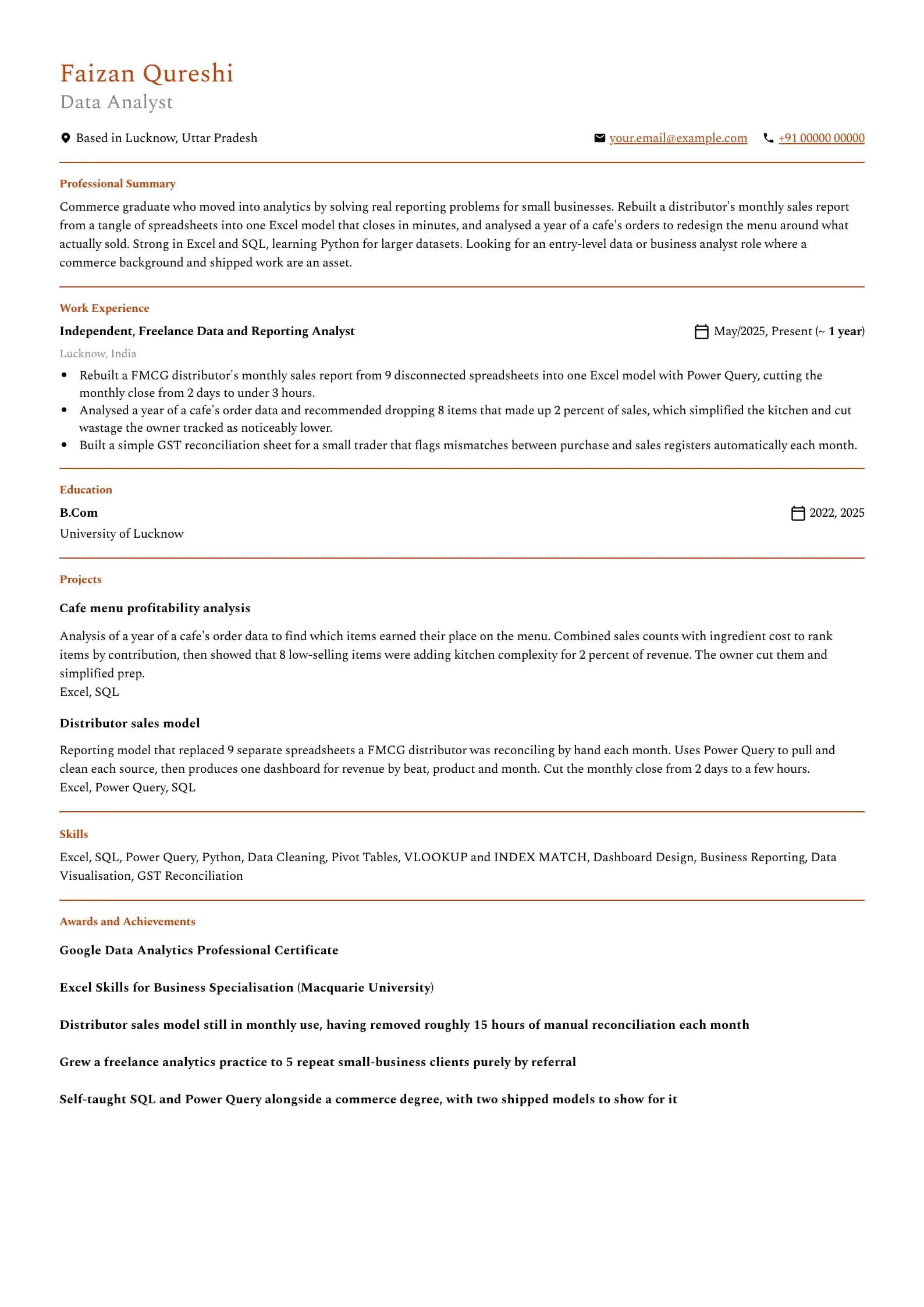
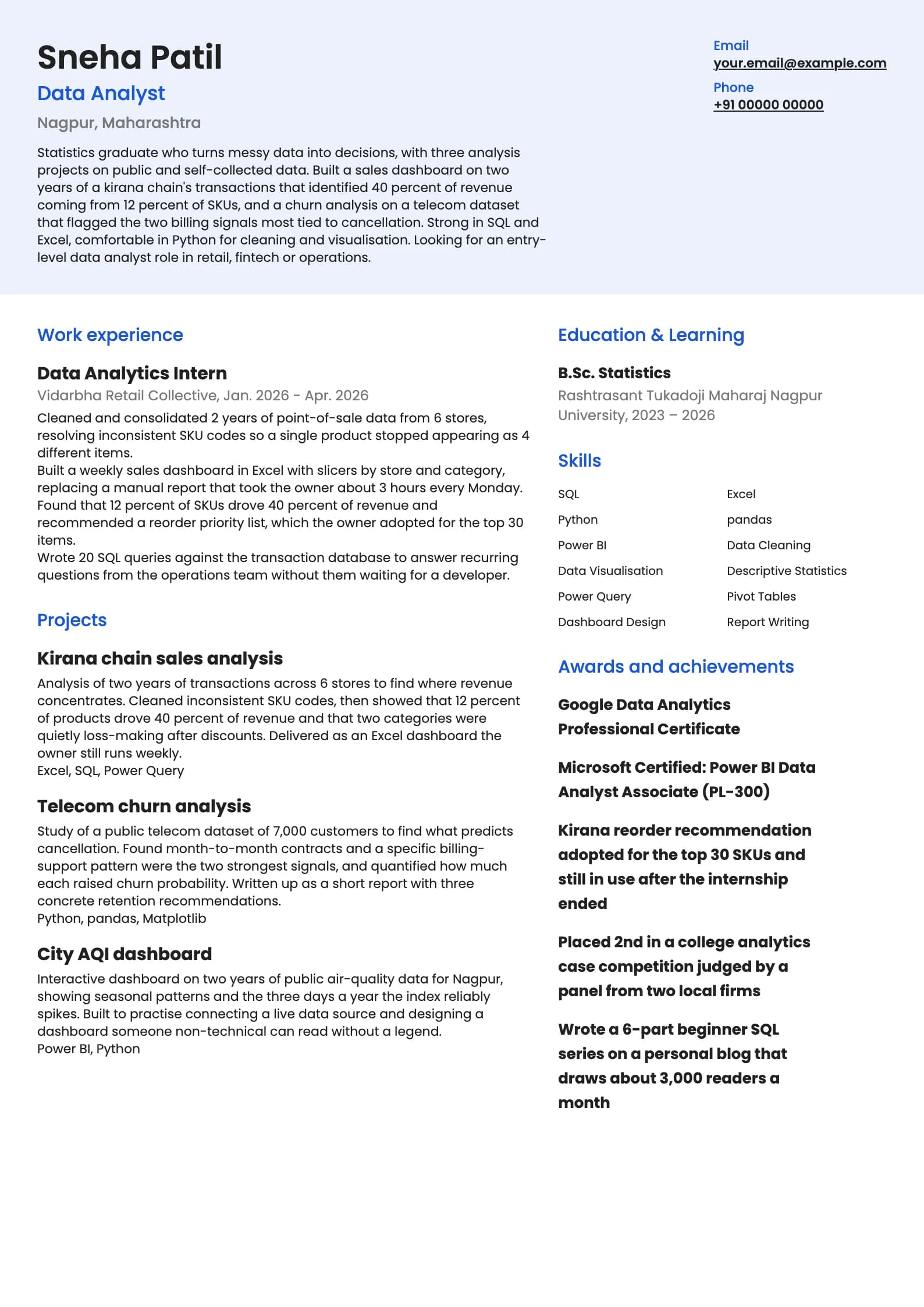
Data Analyst resume example, Statistics graduate (0 years)
modern templateIs your resume good enough?
Upload the resume you have now and see what an applicant tracking system reads before a data analyst recruiter ever does.
Free to run. Sign in with your mobile number to see your score.
Data Analyst resume example, Commerce graduate, self-taught (0 years)
minimalist templateThe order for a fresher data analyst resume
A fresher data analyst resume follows the same inversion as any fresher resume: projects sit above experience, directly under the summary, because with no full-time job the projects are the evidence. Name and headline, then a summary, then projects, then any internship or freelance work, then skills, then education and certifications. Keep it to one page. A fresher genuinely has less to say, and a second page almost always fills with a declaration paragraph, a hobbies line, a photo and a wall of coursework. The reviewer wants to reach your strongest analysis in the first few seconds, so cut everything that pushes it down. There is one temptation specific to this role: pasting a screenshot of your best dashboard into the resume. Do not. It parses as nothing to an applicant tracking system, it inflates the file size, and the interesting part of that dashboard was the decision it drove, which is a sentence, not an image. Describe the dashboard in text and link a live version or a portfolio if you have one, but keep the resume itself a single column of readable text. Education sits higher for a fresher than for an experienced analyst, near the projects, since it is one of the few credentials you have. Keep your CGPA or percentage while it is good, roughly 7.5 out of 10 and above, because early-career screening still filters on it.
| Section | Order for a fresher | What it must show |
|---|---|---|
| Summary | First, under the header | The kind of analyst you are, and one decision your work changed |
| Projects | Second, the top of the body | The question, the data, the decision it drove |
| Experience | Third, if you have an internship or freelance work | That someone used your analysis, and what changed |
| Skills | Fourth | SQL, Excel, Python and visualisation, grouped and honest |
| Education | Near the top area for a fresher | Degree, institution, years, CGPA if good |
Projects that name the question, the data and the decision
For a fresher analyst, the project section is where a reviewer decides whether you can actually analyse data or only make charts. The strongest project entries share a shape: they name the question they asked, the data they used, and the decision the analysis changed. The weakest ones name a dataset and a tool and stop, which describes an exercise, not an analysis. Compare the two. Analysed the Titanic dataset using Python and pandas to find survival patterns tells a reviewer you followed a tutorial thousands of others followed. Analysed a year of a cafe's order data, found 8 items were adding kitchen complexity for 2 percent of revenue, and the owner cut them tells a reviewer you asked a real question and something happened because of your answer. The second is a weaker dataset and a stronger project, because analysis is judged by the decision, not the size of the data. Prefer data you collected or a real problem you were handed over the famous public datasets everyone uses. If you must use a public dataset, at least ask a question of it that the tutorial did not, and end on a recommendation rather than a description. Both samples above lean on real business data precisely because it lets the projects end in a decision. Describe the dashboard, do not embed it. If you have a live Power BI or Tableau Public link or a portfolio, put it in plain text on the line. But write the insight in words, because the resume is parsed as text and the recruiter is skimming for what your analysis changed, not admiring your colour palette.
Project description, fresher analyst resume
Weak
Sales Analysis: Analysed a retail sales dataset using SQL, Excel and Python to generate insights and visualisations with charts and graphs.
Strong
Kirana chain sales analysis: analysed 2 years of transactions across 6 stores and found 12 percent of SKUs drove 40 percent of revenue. Recommended a reorder priority list the owner adopted for the top 30 items.
Replaces a tool list and the empty word insights with the actual finding and the decision the owner made because of it.
A project that ends in a chart is an exercise. A project that ends in a decision someone made is analysis. Rewrite every entry so it closes on the decision.
Summary, not objective, and no passionate about data
The block under your name is the one part of the resume you can be reasonably sure gets read, so it should not be an objective. The line about seeking a challenging position in a reputed organisation to utilise your analytical skills says nothing the reviewer did not assume when you applied. Replace it with a summary of what you have already done. An objective describes what you want; a summary describes what you have done, and only one is evidence. For a fresher analyst the summary should name the kind of analyst you are and point at one decision your work changed. Both samples above do this: one names a reorder recommendation the owner adopted, the other a reporting model still in monthly use. Neither uses the phrase passionate about data, which appears on so many analyst resumes that it now signals nothing. The test is the same as for any fresher: could a classmate applying to the same company paste your summary onto their resume unchanged? If so, it describes the degree, not you. Add the specific project and the specific decision until it only fits you. And rewrite these three lines for a meaningfully different role, a retail analyst posting and a fintech one want different framing of the same work, which takes two minutes and is the highest-leverage editing you can do.
Top block, fresher analyst resume
Weak
Objective: Seeking a challenging position as a data analyst in a reputed organisation where I can utilise my analytical and technical skills to grow with the company.
Strong
Statistics graduate who turns messy data into decisions, with three analysis projects on real data. Built a sales analysis that identified 40 percent of revenue in 12 percent of SKUs and drove a reorder priority the owner adopted.
The objective is transferable to any fresher and states only a want. The summary names the analyst you are and a decision your analysis actually changed.
Framing analysis you have already done as experience
Fresher analysts undersell themselves by deciding only a formal analytics job counts. Several other things count, as long as they produced a decision or an artefact someone used. An internship goes in its own experience section with dates and quantified results. Freelance or small-business reporting work counts and is often stronger, because someone relied on the output to run their business, as the second sample shows. Beyond that, a reviewer values checkable evidence. A case-competition placement, a Kaggle notebook that asked a real question, a live dashboard on Power BI service or Tableau Public, a technical blog with real readers: each is a fact someone can verify. Course projects count too, provided you describe them by the question and the decision rather than the dataset and the tool. Even coursework in a statistics or commerce degree, a survey you designed, a live project you did for a local business, is real analysis if you frame it that way. What does not help is inflating what you did. Do not describe a Kaggle tutorial as a client project, do not list a tool you used once, and do not claim to know a machine learning technique you ran once from a copied notebook. Background checks are standard in Indian hiring, and analyst interviews probe your projects hard: the interviewer will open your dashboard and ask why you chose that chart, so every claim needs to survive a follow-up question.
- An internship: its own experience section, with dates and two or three quantified bullets.
- Freelance or small-business reporting: also an experience section, because someone ran their business on it.
- A case competition placement or a Kaggle notebook that asked a real, non-tutorial question.
- A live dashboard on Power BI service or Tableau Public, linked in plain text.
- Course projects, described by the question and the decision rather than the dataset and the tool.
- A technical blog or SQL and Excel tutorials with real readers, which show you can explain analysis.
Skills: SQL, Excel and Python are the floor
Every fresher analyst applying can list SQL, Excel and Python, so those three are the entry ticket, not the differentiator. List them, and list them the way the industry writes them, because parsers match on strings. But understand that the skills section gets you past the filter, and the projects are what actually win the screen. Group the section so it reads in one pass. A working grouping for a data analyst is: databases and querying, spreadsheets, programming, and visualisation, with statistics as a fifth group if it is a strength. Twelve to sixteen items is the range. Below eight it looks thin; above twenty it stops signalling, and a fresher who lists R, SAS, Tableau, Power BI, Python, SQL, Excel, Spark and a dozen libraries reads as someone who touched all of them once and knows none of them well. Be honest about proficiency. Every tool on the page is a question in the interview, and analyst interviews probe hard: if you list Python, expect to be asked to clean a messy column; if you list SQL, expect a join and a window function. List Learning Python rather than claiming it if that is the truth, as the second sample does, because a stated gap is safer than a claimed skill you cannot defend. Drop the campus-template padding, MS Office as a whole, typing speed, internet browsing, none of which is a data skill.
| Group | What goes in it | How many |
|---|---|---|
| Databases and querying | SQL, MySQL, PostgreSQL, joins, window functions | 2 to 4 |
| Spreadsheets | Excel, pivot tables, Power Query, INDEX MATCH | 2 to 4 |
| Programming | Python, pandas, NumPy. R only if it is real. | 2 to 3 |
| Visualisation | Power BI, Tableau, dashboard design | 1 to 3 |
| Statistics | Descriptive stats, hypothesis testing, correlation | 1 to 3 |
Skills section, fresher analyst resume
Weak
Skills: SQL, Excel, Python, R, SAS, Tableau, Power BI, Spark, Hadoop, Machine Learning, MS Office, Typing, Data Science, AI
Strong
Querying: SQL, MySQL. Spreadsheets: Excel, Power Query, pivot tables. Programming: Python, pandas. Visualisation: Power BI. Statistics: descriptive statistics, correlation.
Cuts the buzzwords and tools a fresher cannot defend, removes MS Office and typing, and groups the honest core so a reviewer reads it in one pass.
Skills to put on a data analyst resume
Technical
- SQL
- Excel
- Python
- pandas
- NumPy
- Descriptive Statistics
- Data Cleaning
- Data Visualisation
- Hypothesis Testing
- Power Query
Tools and platforms
- MySQL
- PostgreSQL
- Power BI
- Tableau
- Google Sheets
- Jupyter Notebook
- Pivot Tables
- Looker Studio
Working skills
- Turning data into recommendations
- Business questioning
- Report writing
- Presenting to non-technical stakeholders
- Attention to detail
- Structured problem solving
Certifications worth listing as a data analyst
| Certification | Full name | Worth it for |
|---|---|---|
| Google Data Analytics | Google Data Analytics Professional Certificate | The most useful first credential for a fresher analyst with no work history, because it is project-based and structures a portfolio you can point at. It gets you past a filter, not through the screen, so pair it with real projects rather than leaning on it alone. |
| PL-300 | Microsoft Certified: Power BI Data Analyst Associate | A genuine differentiator for a fresher targeting reporting and BI roles, since it is tool-specific and hands-on. Worth it if your target postings name Power BI, which many Indian analyst roles do; less useful if the roles are SQL and Python heavy. |
| Excel Skills for Business | Excel Skills for Business Specialisation (Macquarie University) | A solid signal for a fresher, especially from a commerce background, because Excel is still the daily tool in most Indian analyst roles and the certificate shows depth beyond basic formulas. A reasonable pairing with the Google certificate. |
Keywords an ATS scans for in a data analyst resume
These are the literal terms a parser matches against the job description. Use the ones that are true of you, in the sentences where you did the work, not as a list at the bottom.
- data analyst fresher
- entry level data analyst
- SQL
- Excel
- Python
- data visualisation
- Power BI
- Tableau
- data cleaning
- dashboard
- pivot tables
- descriptive statistics
- business analysis
- reporting
- pandas
Data Analyst resume FAQ
What should a fresher data analyst resume include with no experience?
Lead with a summary, then projects, then any internship or freelance work, then skills and education. With no job, projects are your evidence, so put two or three under the summary and describe each by the question it asked, the data it used and the decision it changed, not by the tool. Add anything checkable, an internship, a case-competition placement, a live dashboard or a Kaggle notebook that asked a real question, because verifiable analysis carries far more weight than a longer tool list.
Which tools do I need on a fresher data analyst resume in India?
SQL, Excel and Python are the core almost every posting expects, so list all three. Add a visualisation tool, Power BI or Tableau, since most Indian analyst roles report through one of them. Those tools are the entry ticket, not the pitch: every fresher applying lists the same set, so they get you past the filter and your projects are what win the screen. List only tools you could be interviewed on, because analyst interviews probe each one hard.
Do I need Python for an entry-level data analyst role?
It helps and is increasingly expected, but many entry-level Indian analyst roles still run mainly on SQL and Excel, so a strong SQL-and-Excel candidate with real projects can compete. If you are still learning Python, say Learning Python rather than claiming fluency, as one sample above does, because a stated gap is safer than a claim you cannot defend when the interviewer asks you to clean a messy column live.
Can I become a data analyst from a non-technical or commerce background?
Yes, and a commerce or business background is often an asset because you understand the questions behind the numbers. Own the degree in your summary and let shipped work argue for you, as the second sample does with a B.Com and reporting models real businesses use. Learn SQL and Excel to a defensible level, build two projects that end in a decision, and frame freelance or small-business reporting as the real experience it is.
Should I put a dashboard screenshot on my resume?
No. A screenshot parses as nothing to an applicant tracking system, inflates the file size, and hides the point, which was the decision the dashboard drove, not its appearance. Describe the dashboard in text, state what it revealed and what changed because of it, and link a live Power BI service or Tableau Public version in plain text if you have one. Keep the resume itself a single column of readable text.
How long should a fresher data analyst resume be?
One page. A fresher has less to say than an experienced analyst, and a second page almost always fills with padding: a declaration paragraph, hobbies, a photo, a full address and a wall of coursework. Keep two or three strong projects described by their decisions, an internship or freelance section if you have one, a grouped and honest skills list, and your education. That fills a page well without filler.
Related resume examples and guides
Build a fresher analyst resume that leads with decisions
Start from a blank resume in Goodspace or upload a draft. The builder renders it in 24 templates, puts your projects where a reviewer will see them, and flags what an applicant tracking system will miss.
Build my analyst resume