Civil Engineer Resume for Freshers: Projects, Training and Format
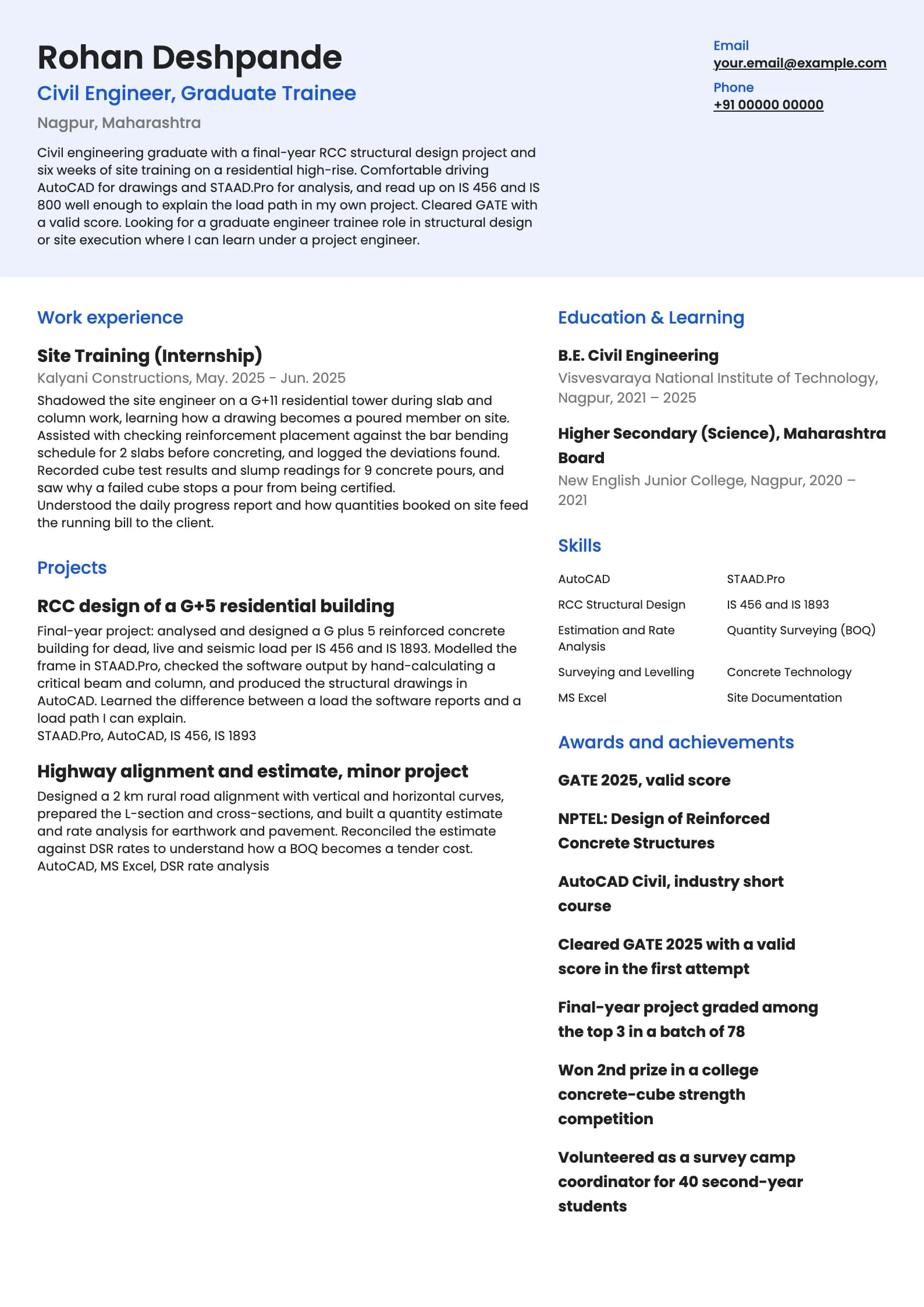
A fresher civil engineer has no site experience to lead with, so the resume has to make the evidence out of what it does have: the final year project, the site or industrial training, the software you can actually drive, and the checkable achievements from four years of college. Done well, that is enough to get shortlisted for a graduate engineer trainee role. This page gives you one complete fresher civil engineer resume, the format that puts projects where a reviewer will see them, and the exact skills and keywords a construction or consultancy recruiter scans for.
Build my civil resumeCivil Engineer resume example, Fresher (0 years)
modern templateIs your resume good enough?
Upload the resume you have now and see what an applicant tracking system reads before a civil engineer recruiter ever does.
Free to run. Sign in with your mobile number to see your score.
How to build the resume when you have no site experience
A fresher resume has to answer one worry in the reviewer's mind: can this person be useful on a site or in a design office within a few months, without supervision becoming a full-time job. You answer it with evidence, and for a civil engineering fresher the evidence is four things: your academic projects, your site or industrial training, the software and codes you can actually work with, and the checkable achievements from your degree. Put those front and centre and the absence of a job stops being the headline. Projects go above experience for a fresher, because they are the strongest thing you have. The final-year project especially: it is the closest thing to real engineering on your resume, so describe what you analysed, which IS codes you applied, and what you understood that a slide deck would not teach. Training goes in an experience block, honestly labelled, because a reviewer wants to see that a company let you onto a live site and what you did there, even if what you did was mostly watch and check. The temptation to inflate is strong and it backfires. A six-week internship where you shadowed a site engineer is a six-week internship where you shadowed a site engineer, and writing it as "managed slab casting for a G+11 tower" ends badly in the first technical question. Write what you honestly did, and let the project carry the depth.
| Section | Where it goes for a fresher | Why |
|---|---|---|
| Header and summary | Top | Name, target role, City and State, and three lines naming your project, software and GATE if cleared. |
| Projects | Above experience | Your strongest evidence. Final-year project first, described by what you analysed. |
| Training and internship | Below projects | Proof a company let you on a live site. Honest about what you did. |
| Technical skills | Below training | AutoCAD, STAAD, IS codes, estimation. Grouped, only what you can drive. |
| Education | Near the top for a fresher | Degree, college, CGPA. Keep the percentage while it is your strongest signal. |
| Achievements | Bottom | GATE, rank, competitions. Only checkable facts. |
Academic projects: describe the engineering, not the software
For a fresher civil engineer, projects are the resume, and the single most common mistake is describing the software instead of the engineering. "Designed a building using STAAD.Pro and AutoCAD" tells a reviewer nothing, because it is on hundreds of resumes and it shows only that you opened the software. Describe what you analysed, which codes governed the design, what the critical case was, and what you understood by doing it. The RCC project in the sample is stronger than a flashier one would be, because it says the student hand-checked the software's output on a critical member, which is exactly the judgement a design office is hiring for. Pick projects that show range rather than three versions of the same building. A structural design project, an estimation and quantity project, and a surveying or transportation project together show that you can move across the domains a graduate trainee gets rotated through. Two projects described well beat five listed by name. If a project involved real fieldwork, a survey camp, a soil test, a site visit that fed the design, say so, because fieldwork is scarce on fresher resumes and construction recruiters value it. Name the IS codes you actually used and can talk about, IS 456 for concrete, IS 800 for steel, IS 1893 for seismic, IS 875 for loads. A code you list is a code an interviewer may open, so list the ones you genuinely applied in the project, not the whole syllabus.
Final-year project description, fresher resume
Weak
Final Year Project: Designed a multi-storey building using STAAD.Pro and AutoCAD software with all modern features and analysis.
Strong
RCC design of a G+5 residential building: analysed the frame for dead, live and seismic load per IS 456 and IS 1893 in STAAD.Pro, then hand-calculated a critical beam and column to verify the software output.
The rewrite swaps a software list for the actual engineering, the codes applied, and the hand-check that shows real understanding.
If your project description would fit any building any student designed, it describes the assignment, not you. Add the specific code, the specific critical case, and the specific thing you checked by hand.
Software and site skills: list only what you can drive
The skills section is where a construction or consultancy recruiter searches for the tools a graduate trainee needs from day one. Group them so both the parser and the human can read them: design and analysis software, drafting, estimation and quantities, surveying, and the IS codes you work with. Twelve to sixteen items is plenty, and every one is a question you have agreed to answer, so list only the software you can actually open and use, not everything the syllabus mentioned. AutoCAD is close to mandatory, because almost every civil role touches drawings. STAAD.Pro or ETABS matters for structural roles, MS Excel and estimation software for quantity and billing roles, and total station or auto level familiarity for survey-heavy site work. If you have used Revit or a BIM workflow even in a course, name it, because BIM is a genuine differentiator on a fresher resume and still uncommon. Write the tool names the way the industry writes them, AutoCAD not Auto Cad, STAAD.Pro not Staad, because a parser and a recruiter both match on the exact string. Do not pad the list with things that are not skills. "MS Office", "internet", "good in maths" and "quick learner" are not civil engineering competencies and they dilute the ones that are. The strongest skills line is short, specific to the roles you are targeting, and free of anything you could not demonstrate if the interviewer opened the software and asked you to draw a section.
| Group | What goes in it | Matters most for |
|---|---|---|
| Design and analysis | STAAD.Pro, ETABS, SAP2000 | Structural design roles |
| Drafting | AutoCAD, Revit, Civil 3D | Almost every civil role |
| Estimation and quantities | MS Excel, rate analysis, BOQ, DSR | Billing and quantity surveying roles |
| Surveying | Total station, auto level, contouring | Site execution and survey roles |
| Codes and materials | IS 456, IS 800, IS 1893, concrete technology | Design and site quality roles |
Getting a fresher civil resume through the ATS
Large construction firms, EPC contractors and consultancies run campus and off-campus applications through an applicant tracking system that parses your file and stores it so a recruiter can search across hundreds of graduate applicants for AutoCAD, STAAD or a valid GATE score. It fails on layout, not on wording. Use a single column, standard headings such as Projects, Work Experience and Education, and real selectable text rather than a designed image, because a two-column template exported flat parses out of order and hides your strongest evidence. Mirror the language of the posting where it is honest. If the trainee role asks for STAAD.Pro, write STAAD.Pro, not "structural analysis software". If it names quantity surveying, write quantity surveying alongside BOQ and estimation. Put your GATE score on the page as a clean line, because many core companies filter graduate applications on it, and spell out an acronym once so both the acronym search and the phrase search find you. Then test the file by copying a sentence out of the PDF: if it does not highlight, the parser cannot read it, and a strong fresher resume disappears for a reason you never see.
Skills line on a fresher civil resume
Weak
Skills: MS Office, Internet, Good communication, Hardworking, Quick learner, AutoCAD, Civil Engineering, Maths.
Strong
Design: STAAD.Pro, ETABS. Drafting: AutoCAD. Estimation: MS Excel, rate analysis, BOQ. Codes: IS 456, IS 1893. Surveying: total station, levelling.
Cuts the non-skills and adjectives, groups the real tools, and uses the exact strings a construction recruiter searches on.
Put your GATE score, if valid, as its own clean line near the top. Many core civil companies filter graduate applications on it before a human opens the file.
Skills to put on a civil engineer resume
Technical
- RCC Structural Design
- Steel Structure Design
- STAAD.Pro Analysis
- ETABS
- Estimation and Costing
- Quantity Surveying (BOQ)
- Rate Analysis (DSR)
- Surveying and Levelling
- Concrete Technology
- Soil Mechanics
- Highway and Transportation Engineering
- IS 456, IS 800, IS 1893
Tools and platforms
- AutoCAD
- STAAD.Pro
- ETABS
- Revit
- Civil 3D
- MS Excel
- Total Station
- Auto Level
- MS Project
Working skills
- Site Coordination
- Attention to Detail on Drawings
- Teamwork on a Project
- Willingness to Work on Site
- Clear Documentation
- Learning Under Supervision
- Time Management
- Basic Client and Vendor Communication
Certifications worth listing as a civil engineer
| Certification | Full name | Worth it for |
|---|---|---|
| GATE | Graduate Aptitude Test in Engineering, Civil | A valid GATE score is the single strongest line on a fresher civil resume for core companies and PSUs, many of which filter graduate applications on it before a human reads the file. Put it near the top. Also the gate to M.Tech admission if you want the design specialisation route. |
| AutoCAD | AutoCAD certification or industry short course | Worth it for a fresher because it turns a claimed skill into a verified one, and AutoCAD is close to universal in civil roles. Most useful when your college curriculum did not cover drafting deeply. |
| STAAD / ETABS course | STAAD.Pro or ETABS structural analysis course | Genuinely useful for a fresher targeting structural design roles, where hands-on software fluency is what a consultancy is hiring a trainee for. Less relevant if you are aiming at site execution or quantity surveying. |
| NPTEL | NPTEL online course, e.g. Design of RC Structures | A credible, free way to show depth in a specific subject and back up a project. Name the specific course rather than listing NPTEL generically, and pick one that matches the roles you are applying for. |
Keywords an ATS scans for in a civil engineer resume
These are the literal terms a parser matches against the job description. Use the ones that are true of you, in the sentences where you did the work, not as a list at the bottom.
- civil engineer
- graduate engineer trainee
- site engineer
- AutoCAD
- STAAD.Pro
- ETABS
- RCC design
- structural design
- estimation
- quantity surveying
- BOQ
- rate analysis
- surveying
- concrete technology
- IS 456
- IS 1893
- GATE
- site execution
- BIM
- B.E. Civil
Civil Engineer resume FAQ
How do I make a civil engineer resume with no experience?
Lead with your academic projects, then training, then software skills and education. Treat the final-year project as the centrepiece: describe what you analysed, which IS codes you applied and what you verified by hand, not just the software you used. Put site or industrial training in an experience block, honestly stated. Add checkable achievements like a valid GATE score, a project rank or a competition. For a fresher, verifiable evidence and a strong project matter far more than the absence of a job.
Should projects go above experience on a fresher civil resume?
Yes. With no full-time role, your projects are the strongest evidence you can offer, so they sit directly under the summary where a reviewer will actually see them. Site or industrial training still goes in a separate experience block below projects, because a reviewer wants to see that a company let you onto a live site and what you did there. Describe each project by the engineering, the codes and the critical case, not by a list of software names.
What software should a fresher civil engineer know?
AutoCAD is close to mandatory because almost every civil role touches drawings. Add STAAD.Pro or ETABS for structural design roles, MS Excel and estimation software for quantity and billing roles, and total station or auto level familiarity for site and survey work. Revit or a BIM workflow is a genuine differentiator and still uncommon on fresher resumes, so name it if you have used it. List only software you can actually open and drive, because each one is a question you have agreed to answer.
Should I put my GATE score on a fresher civil resume?
Yes, if it is valid, and put it as its own clean line near the top. Many core civil companies and PSUs filter graduate applications on the GATE score before a human opens the file, so it is one of the highest-value lines you can carry. If you have not cleared GATE, do not manufacture a substitute, just lead harder with your project, training and software instead.
How long should a fresher civil engineer resume be?
One page. A graduate with projects, training, skills and achievements has exactly one page of real content, and stretching it to two with a full postal address, a declaration paragraph and a hobbies list weakens it. If you are struggling to fit one page, cut coursework that is not directly relevant and describe two projects well rather than five briefly. Nobody screening graduate trainees was ever put off by a resume that was easy to read.
Do I need a photo or personal details on a civil resume?
No. A photo, date of birth, marital status and father's name come from an older template and add nothing to an engineering screen, while taking space a project or a skill should occupy. Indian construction and consultancy recruiters are reading for your projects, your software and your GATE score. Keep the header to your name, target role, city and state, and leave the personal details off unless a specific posting asks for them.
How do I describe site training if I mostly observed?
Write honestly what you did: shadowed a site engineer, checked reinforcement against the bar bending schedule, recorded cube test and slump readings, understood how quantities feed the running bill. Framing observation as ownership, such as claiming you managed a slab casting, collapses in the first technical question. A reviewer values a fresher who understood what they saw over one who inflated a shadowing role, so let the training show learning and let your project carry the engineering depth.
Related resume examples and guides
Build a fresher civil engineer resume that gets shortlisted
Start from a blank resume or upload the one you have. Goodspace puts your projects and training where a recruiter will see them, renders 24 templates, and flags the ATS keywords a construction firm scans for.
Build my civil resume