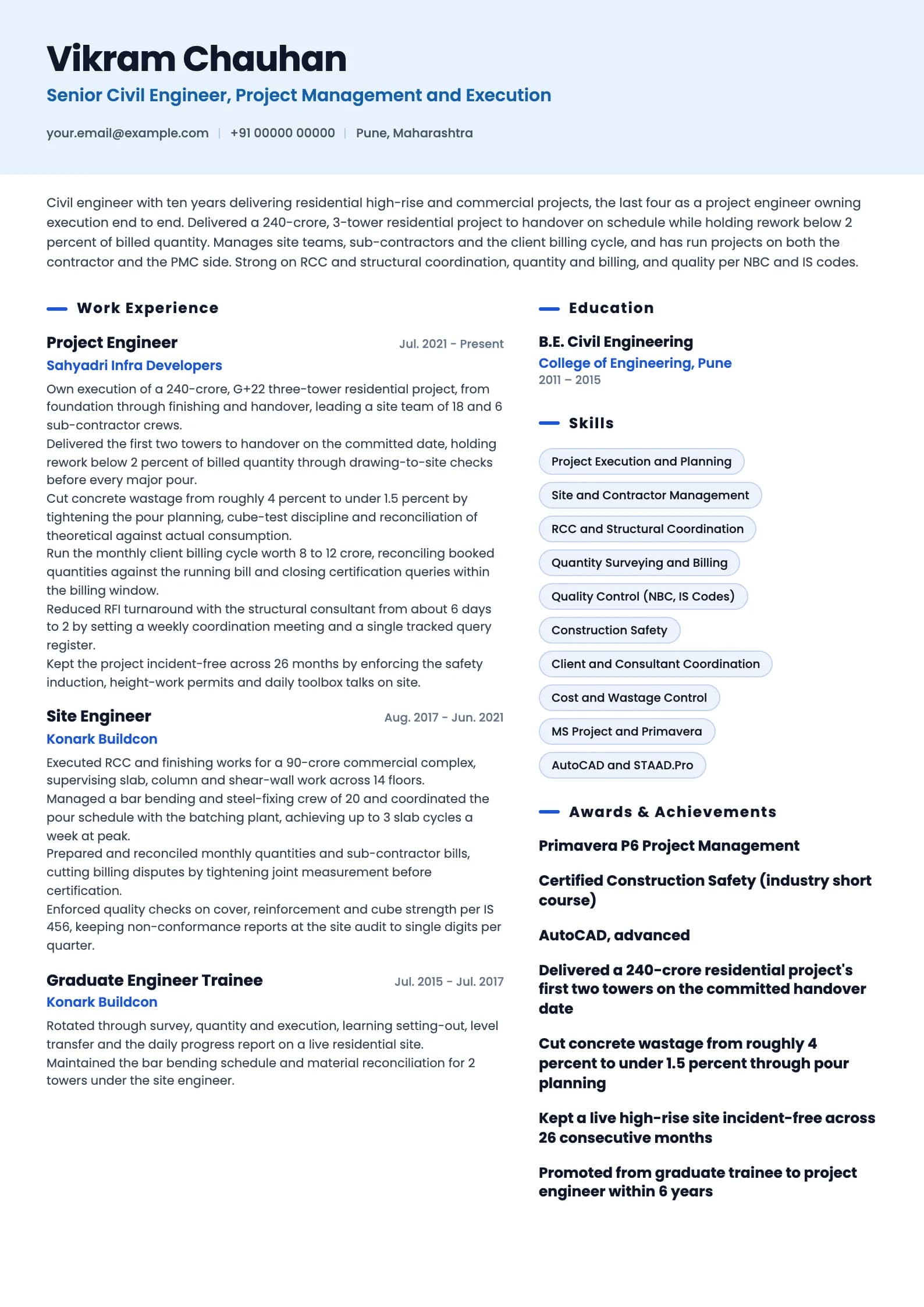
Experienced Civil Engineer Resume: Scale, Delivery and Management
An experienced civil engineer is not hired on software or codes, those are assumed. You are hired on what you have delivered: the scale of the projects in crores, the site or PMC role you owned, the teams and contractors you managed, and the handovers you closed on time and on budget. A resume that reads like a fresher's, heavy on tools and light on delivery, undersells eight years badly. This page gives you one complete senior civil engineer resume, the format that leads with project scale and ownership, and the keywords a construction or infrastructure recruiter searches for at this level.
Build my civil resumeCivil Engineer resume example, Senior Civil Engineer (10 years)
ai-era templateIs your resume good enough?
Upload the resume you have now and see what an applicant tracking system reads before a civil engineer recruiter ever does.
Free to run. Sign in with your mobile number to see your score.
What changes on the resume after eight years
The experienced civil engineer's resume inverts the fresher's. Software and IS codes, which the fresher leads with, are now assumed, so they compress into a single skills line and stop being the story. What replaces them is delivery: the scale of the projects you ran in crores, the role you owned on them, the size of the team and the contractors you managed, and the outcomes you can attach a number to. A recruiter for a project engineer or a construction manager role is not asking whether you know AutoCAD, they are asking whether you can be handed a 200-crore site and trusted to deliver it. Lead every role with scope. "Own execution of a 240-crore, G+22 residential project, leading a site team of 18" is one line that answers the recruiter's core question. Then the bullets prove it with results: handover met, rework held down, wastage cut, billing closed within the window, RFI turnaround reduced. Allocate detail by recency, the current role gets the most bullets, the graduate trainee stint at the bottom collapses to two lines, because nobody hiring a ten-year engineer is reading closely about a rotation from a decade ago. Drop everything a fresher needs and you have outgrown. The college percentage goes, coursework goes, the objective line goes. Your degree stays as a single line at the bottom, and your delivery fills the space they vacate.
| On the resume | Fresher | Experienced (8y+) |
|---|---|---|
| Leads with | Academic projects and software | Project scale, role and delivery |
| Software and codes | Front and centre, the evidence | One compressed skills line, assumed |
| Experience bullets prove | You can finish a project | You can own a site and hit handover |
| Education | Near the top, with CGPA | One line at the bottom, no percentage |
| Typical metric | Project rank, GATE score | Crores delivered, rework, wastage, team size |
Leading with project scale and ownership
At this level, the first line of every role should state the scale and your ownership of it, because that is the fact a recruiter is scanning for and the one that decides whether they read further. Scale is the project value in crores, the built-up area or the configuration, G+22, three towers, a 90-crore commercial complex. Ownership is your actual role on it: did you own execution end to end, run a package, manage a discipline, or coordinate as PMC. State it plainly and let the bullets carry the results. The distinction that matters most at senior level is between participation and accountability. "Worked on a residential project" is participation and tells a recruiter nothing about what you were trusted to hold. "Owned execution of the structure package for two towers, leading a team of 18" is accountability, and it is the difference between a site engineer and a project engineer on paper. Use the verbs that carry it: delivered, owned, managed, led, reconciled, closed. Avoid "responsible for" and "involved in", which are the language of a job description rather than a track record. Be specific about the money, because construction is a business measured in cost and time. Billing value run, wastage reduced, cost saved, penalty avoided by hitting a handover date, these are the metrics a construction employer weighs, and they are honest numbers you actually know from the sites you ran. A resume that describes a decade of civil work with no rupee figure and no schedule outcome is leaving its strongest evidence on the table.
Experience bullet, senior civil engineer
Weak
Responsible for site work and involved in execution of residential project including coordination with various teams and contractors.
Strong
Owned execution of a 240-crore G+22 residential project from foundation to handover, leading a site team of 18 and 6 sub-contractor crews, and delivered the first two towers on the committed date.
The rewrite replaces vague participation with the project value, the configuration, the team size and a delivered outcome a recruiter can weigh.
Experience bullet, cost and quality
Weak
Worked on reducing wastage and maintaining quality standards at the construction site as per requirements.
Strong
Cut concrete wastage from roughly 4 percent to under 1.5 percent through pour planning and theoretical-to-actual reconciliation, while holding rework below 2 percent of billed quantity.
Names the before and after, the technique and a second quality metric, so a construction manager can ask a real follow-up question.
If a bullet does not name a scale, a number or a delivered outcome, it is describing your presence on a site, not your contribution to it. Rewrite it until it names what you were accountable for.
Showing site management, PMC and the commercial side
By eight to ten years, an experienced civil engineer is managing more than concrete. The resume needs to show the three dimensions a senior role is really about: people and contractors, the commercial and billing cycle, and quality and safety governance. An engineer who can run the structure but cannot close a client bill, manage a difficult sub-contractor, or keep a site incident-free is only doing part of a project engineer's job, and the resume should prove all three. Show people management with real numbers: the size of the site team you led, the number of contractor crews you coordinated, the trades you managed at peak. Show the commercial side with the billing value you ran, the reconciliation you owned, the disputes you closed, because a project engineer is trusted with crores of monthly certification and a recruiter wants to see you have handled that money responsibly. Show governance with quality and safety outcomes: non-conformance kept low per IS 456 and NBC, an incident-free run measured in months, RFI turnaround with the consultant. If you have worked on the PMC or client side as well as the contractor side, say so, because the ability to see a project from both sides is genuinely valued and distinguishes a senior engineer from one who has only executed. Name whether a role was contractor execution, PMC supervision, or client-side project management, since they are different jobs and a recruiter is often hiring specifically for one of them.
| Dimension | What to show | Honest metric |
|---|---|---|
| People and contractors | Team led, crews and trades coordinated | Team of 18, 6 sub-contractor crews, 3 slab cycles a week |
| Commercial and billing | Billing value run, reconciliation, disputes closed | 8 to 12 crore monthly billing, disputes cut |
| Quality | NCR levels, IS 456 and NBC compliance | Single-digit NCRs per quarter, rework under 2 percent |
| Safety | Incident record, permits and inductions enforced | 26 months incident-free on a live high-rise |
| Schedule | Handover met, RFI and cycle times | First two towers on committed date, RFI 6 days to 2 |
ATS and format at senior level
Large contractors, developers and infrastructure firms run experienced applications through an applicant tracking system too, and it searches on role and delivery keywords: project engineer, site engineer, execution, billing, Primavera, RCC, handover. The format rules are the same as at any level, single column, standard headings, real selectable text, no two-column template exported as an image, because a parser that scrambles your experience hides exactly the delivery record you are hired on. A senior resume earns a second page if it needs one, and after eight to ten years it usually does. The test is whether the second page carries real project delivery or padding: a third project run, a genuine list of quantified outcomes, and the older roles compressed, all earn their place, while a hobbies line, a declaration paragraph and a full postal address do not. Mirror the posting's language: if it asks for a project engineer with high-rise experience, make sure high-rise and project engineer appear in your bullets, not just in your head. Put the tools you are expected to know, Primavera or MS Project for planning roles, on the page as clean keywords, and let the delivery record carry the rest.
Summary line, experienced civil engineer
Weak
Experienced civil engineer with 10+ years seeking a challenging role in a reputed construction organisation to utilise my skills and grow.
Strong
Civil engineer with ten years delivering residential high-rise, the last four as project engineer, having delivered a 240-crore project to handover on schedule with rework below 2 percent.
Replaces a generic objective with the domain, the seniority, and a delivered outcome a recruiter can act on in one line.
A second page is fine after ten years, but only if it carries a third project and real numbers. If page two is a declaration and a hobbies list, you have a one-page resume with padding.
Skills to put on a civil engineer resume
Technical
- Project Execution and Planning
- Site and Contractor Management
- RCC and Structural Coordination
- Quantity Surveying and Billing
- Rate Analysis and Reconciliation
- Quality Control (NBC, IS Codes)
- Construction Safety Management
- Cost and Wastage Control
- Tendering and BOQ
- PMC and Client Coordination
Tools and platforms
- Primavera P6
- MS Project
- AutoCAD
- STAAD.Pro
- ETABS
- MS Excel
- Total Station
- ERP Billing Systems
Working skills
- Team Leadership on Site
- Contractor Negotiation
- Client and Consultant Communication
- Decision-Making Under Schedule Pressure
- Problem-Solving on Site
- Stakeholder Coordination
- Planning and Prioritisation
- Mentoring Junior Engineers
Certifications worth listing as a civil engineer
| Certification | Full name | Worth it for |
|---|---|---|
| Primavera P6 | Primavera P6 Project Management Professional | Strongly worth it for an experienced engineer moving into planning, scheduling or project management, where Primavera is the industry standard on large projects. A clean keyword that many senior postings filter on. Less critical if you stay purely on execution. |
| PMP | Project Management Professional, PMI | A genuine differentiator for a civil engineer targeting project manager and construction manager roles, particularly with large EPC firms and multinationals. Worth the effort at eight years and up when you are moving from executing projects to managing them. |
| Construction Safety | Diploma or certificate in Construction Safety | Valuable for engineers taking on site-in-charge or safety-accountable roles, where a documented safety credential backs up an incident-free record. Increasingly expected on large infrastructure and high-rise projects. |
| LEED or Green Building | LEED Green Associate or IGBC accreditation | A differentiator for engineers on commercial and institutional projects where green certification is a client requirement. Niche, but it opens a specific set of premium projects and marks you as current. |
Keywords an ATS scans for in a civil engineer resume
These are the literal terms a parser matches against the job description. Use the ones that are true of you, in the sentences where you did the work, not as a list at the bottom.
- civil engineer
- project engineer
- site engineer
- construction manager
- project execution
- site management
- RCC
- quantity surveying
- billing
- rate analysis
- quality control
- construction safety
- Primavera
- MS Project
- PMC
- high-rise
- handover
- contractor management
- IS 456
- NBC
Civil Engineer resume FAQ
How is an experienced civil engineer resume different from a fresher's?
It inverts the priorities. A fresher leads with academic projects and software; an experienced engineer leads with delivery, the scale of projects in crores, the role owned, the team managed and the outcomes achieved. Software and IS codes are assumed at this level, so they compress into a single skills line. The college percentage, coursework and objective all go. A recruiter for a project engineer role is asking whether you can be trusted with a 200-crore site, and the resume should answer that in its first few lines.
What should a senior civil engineer put at the top of the resume?
A three-line summary that names your years, your project type, your current role and one delivered outcome, followed immediately by your current role led with scope. For example, ten years delivering residential high-rise, four as project engineer, having delivered a 240-crore project to handover on schedule. Do not open with a generic objective about seeking a challenging role, which says nothing a recruiter did not already assume. Lead with what you have delivered, not what you want.
How do I show project scale on a civil engineer resume?
State the project value in crores, the configuration such as G+22 or three towers, and the built-up area, then your ownership of it. Attach honest numbers to the outcomes: billing value run, rework and wastage reduced, handover dates met, team size led, contractor crews coordinated. Construction is measured in cost and time, so a resume with no rupee figure and no schedule outcome is leaving its strongest evidence out. Use the numbers you actually know from the sites you ran.
Should I mention PMC and contractor-side experience separately?
Yes, because they are different jobs and recruiters often hire specifically for one. Name whether a role was contractor execution, PMC supervision or client-side project management. If you have worked on more than one side, say so, because seeing a project from both the contractor and the client perspective is genuinely valued and distinguishes a senior engineer from one who has only executed. Make the role type clear in each job heading or its first line.
Can an experienced civil engineer resume be two pages?
Yes, and after eight to ten years it usually should be, provided the second page carries real project delivery. A third project run, a genuine list of quantified outcomes and compressed older roles all earn a second page. What does not is a hobbies line, a declaration paragraph and a full postal address. The test is simple: if page two is padding rather than delivery, cut it back to a strong single page.
Do I still need to list AutoCAD and STAAD as an experienced engineer?
List them, but compress them into a single skills line near the bottom rather than leading with them. At eight years and up they are assumed, and giving them the prominence a fresher does makes you look junior. What earns the top of the page is your delivery record. Do keep planning tools like Primavera or MS Project visible if you are targeting planning and project management roles, since those are often filtered on and are less universally assumed.
What certifications help an experienced civil engineer?
Primavera P6 for planning and scheduling roles, PMP for those moving into project and construction management, a construction safety credential for site-in-charge roles, and a green building accreditation such as LEED or IGBC for commercial projects where it is a client requirement. At this level certifications support a delivery record rather than replace it, so a short, relevant list beside strong project outcomes is far stronger than a long list of courses.
Related resume examples and guides
Put your delivery record at the top
Start from a blank resume or upload the one you have. Goodspace leads with your project scale and outcomes, renders 24 templates, and flags the ATS keywords a construction or infrastructure recruiter scans for.
Build my civil resume