Civil Engineer Resume Format, with 3 Full Samples
A civil engineer is hired on evidence of projects delivered, yet most resumes describe the site instead of the engineer. The building gets a name, the city gets a mention, and the person who ran the slab cycle disappears. Below are three complete resumes, one for a B.E. Civil fresher, one for a site engineer with five years of execution, and one for a project engineer running packages worth crores. After the samples come the format rules, the project portfolio structure that separates a site engineer from a site, the split between execution, design and billing careers, the codes and software that get matched literally, and the mistakes that end a screening before a human is involved.
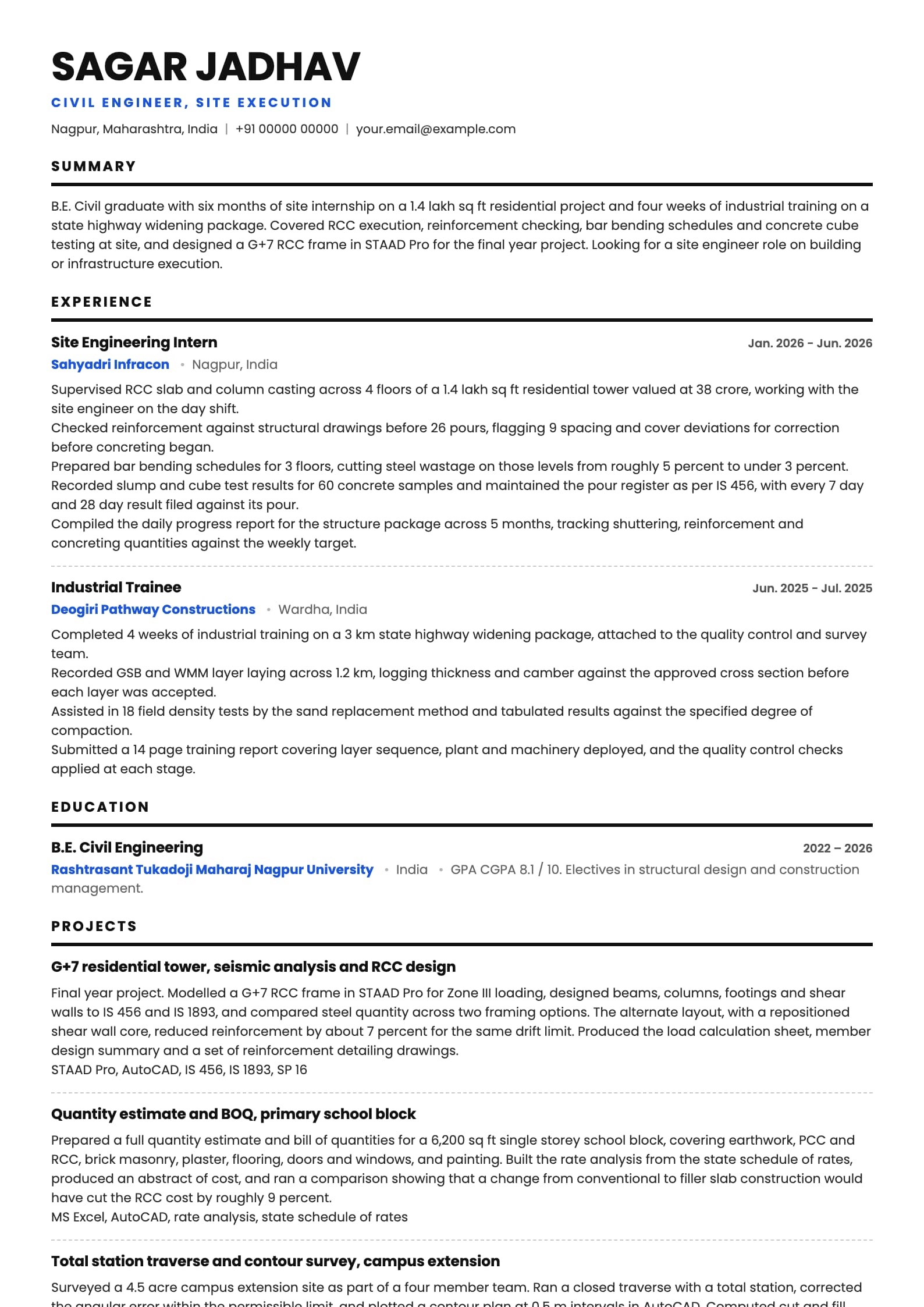
Build my resumeCivil Engineer resume example, Fresher (0 years)
bold-rule templateIs your resume good enough?
Upload the resume you have now and see what an applicant tracking system reads before a civil engineer recruiter ever does.
Free to run. Sign in with your mobile number to see your score.
Civil Engineer resume example, Site Engineer (5 years)
accent-compact template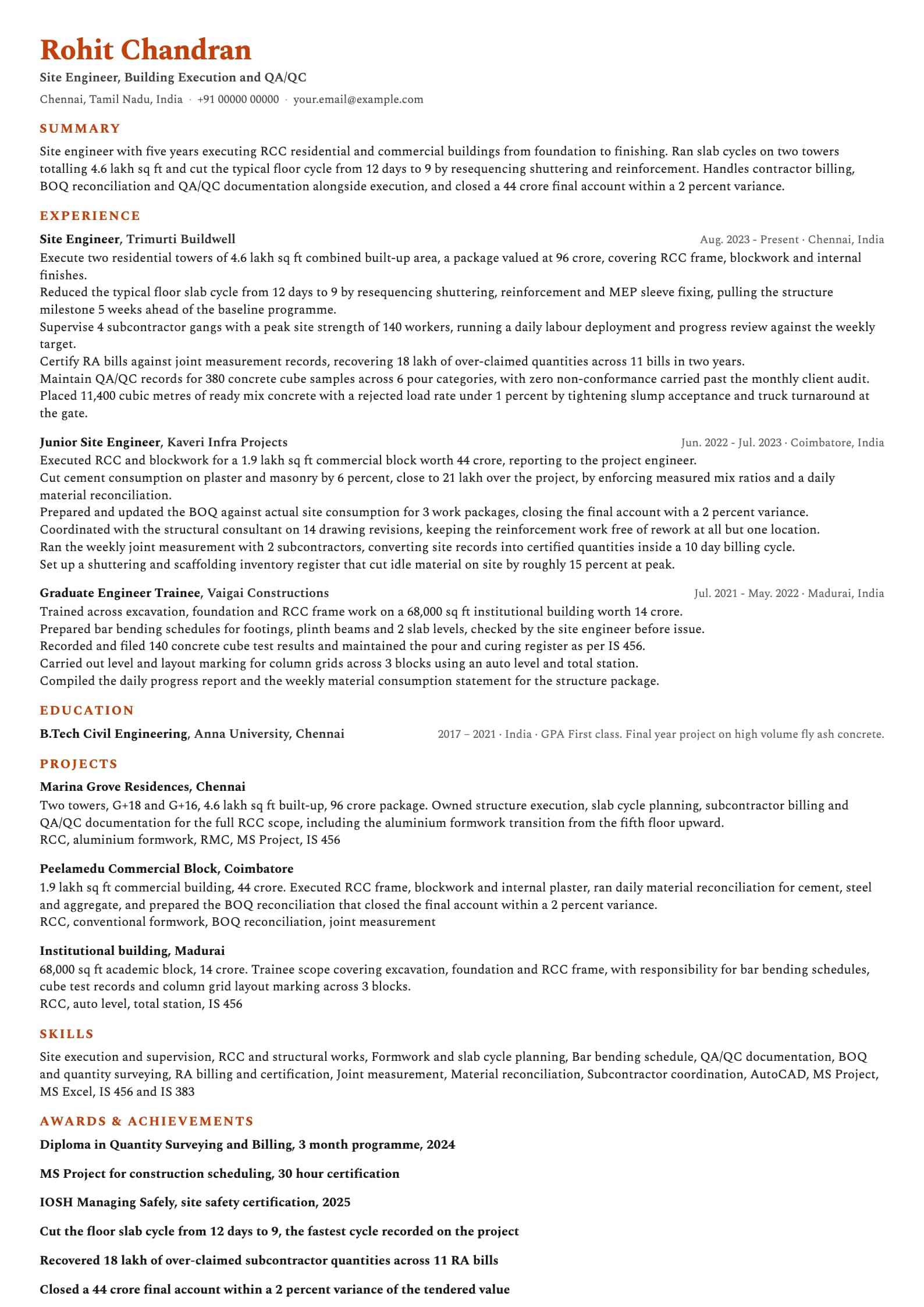
Want this structure with your own details? Build it in the resume builder.
Civil Engineer resume example, Project Engineer (9 years)
wide-margin template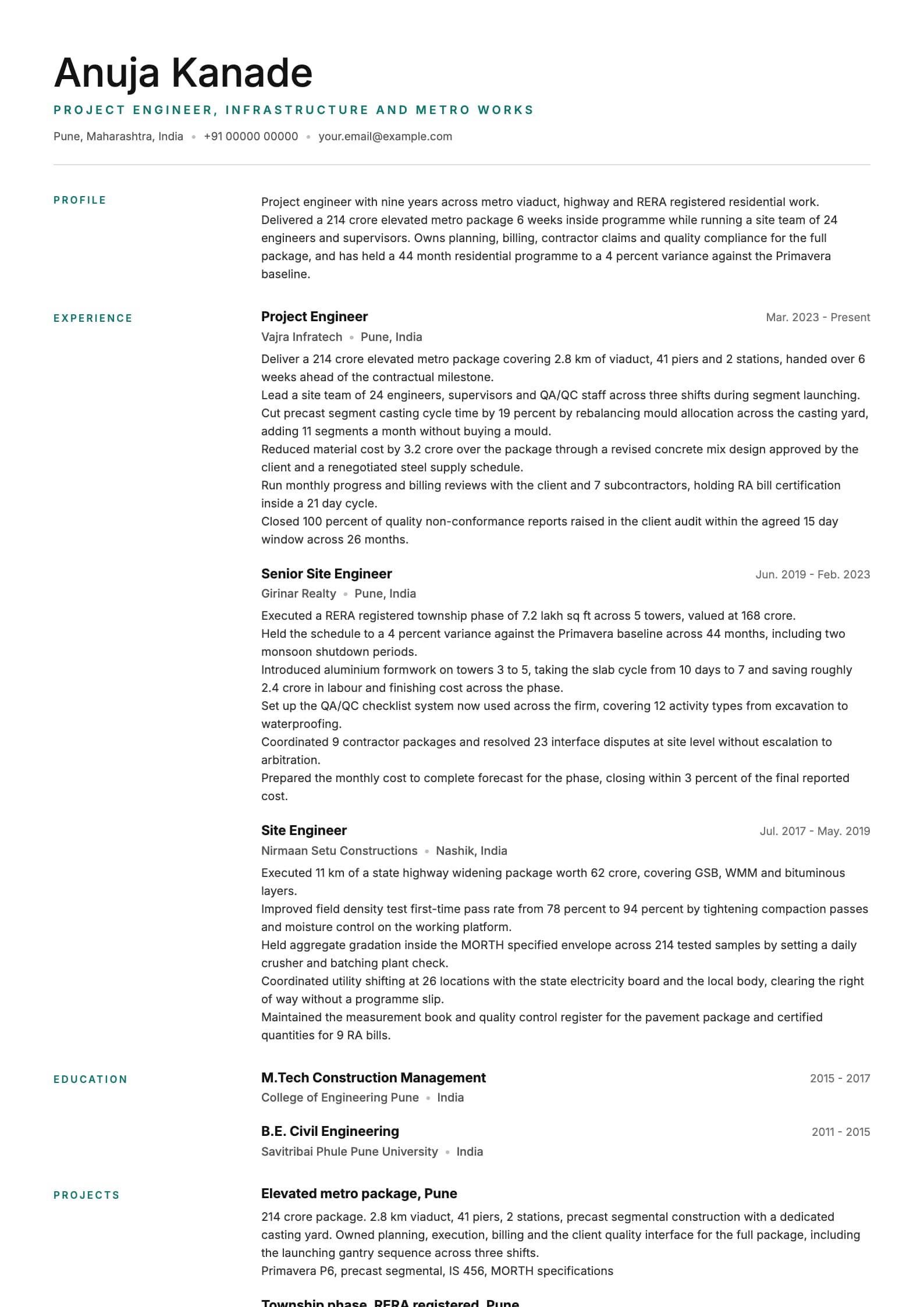
The format that works for civil engineer resumes in India
Reverse chronological, single column, one page until roughly six years of site experience and two pages after that once the project list genuinely justifies a second sheet. No photograph, no declaration line, no father's name, no full postal address. City and state is enough, and for a site role the city matters, because posting location and willingness to relocate are real screening questions in construction hiring. The order in the table below is doing work. A construction hiring manager reads a civil resume looking for scale first, discipline second and skills third, because the question they are actually answering is whether you have run something the size of what they are about to hand you. If your summary and your first role open with the package value and the built-up area, that question is settled in the first ten seconds. If they open with "responsible for day to day site activities", the reader has to hunt for the scale, and on a stack of two hundred applications they generally do not. Two structural decisions cause most of the damage. The first is leaving education at the top after you already have site experience, which pushes a 96 crore package below a CGPA. The second is a two column layout with skills running down a sidebar, which looks tidy in a PDF viewer and can be read out of order by older parsing software, splicing your Chennai project into your Coimbatore dates. Freshers invert exactly one thing. Projects and industrial training move above skills, education stays near the top because it is the most recent thing that happened, and the CGPA stays until a full time role replaces it.
- Fresher: portfolio and industrial training above skills, CGPA on the page, software certifications easy to find, one page always.
- Fresher: treat a six month internship as a real role with real bullets. Pours supervised, drawings checked, tests recorded, quantities estimated.
- Two to five years: experience first, portfolio directly under it, CGPA removed, still one page.
- Six years and above: two pages is acceptable, but the second page must carry projects and results, not a longer skills list.
- Every level: single column, no photograph, no declaration line, city and state only, consistent date format throughout.
| Section | Where it goes | Why |
|---|---|---|
| Name and headline | Top, above everything | Write the role you want with the discipline attached, for example "Site Engineer, Building Execution" rather than just "Civil Engineer". |
| Professional summary | Directly under the header | Three lines. Years, project types, total value or built-up area handled, and the single strongest result. |
| Work experience | Next, for anyone with site time | Most recent first. Open each role with the project value and scale, then the results. |
| Project portfolio | Above experience for freshers, directly below it after that | The section civil resumes get wrong most often. Name, value, built-up area or length, your scope. Not a list of site names. |
| Skills | Below the portfolio | Split execution skills, software and codes. A wall of 30 items reads as noise to both the software and the human. |
| Certifications | Below skills | AutoCAD, STAAD Pro, Primavera, quantity surveying, safety training. These are screened for by name. |
| Achievements | Below certifications, from about four years on | Three or four lines that restate your strongest numbers, so a skim reader hits them without reading every bullet. |
| Education | Bottom, unless you are a fresher | Degree, institution, years. Keep CGPA only until your first job is on the page. |
| Languages and mobility | Last line | Useful on site roles across states and for Gulf applications. One line, no proficiency bar graphics. |
The professional summary, three lines that decide whether the rest is read
A civil engineer's summary has one job, which is to state the scale you have operated at before the reader forms an opinion from your job title. Job titles in Indian construction are unreliable. A site engineer at a small builder and a site engineer on a metro package are doing work separated by an order of magnitude, and the title alone cannot tell them apart. The number can. Four things belong in it: years of experience, the type of work you have done (residential, commercial, industrial, highways, metro, water infrastructure), the total value or built-up area you have handled, and the single strongest result you can defend under questioning. That is three lines. Anything longer stops functioning as a summary and becomes a paragraph nobody finishes. Look at what the site engineer sample does. Five years, RCC residential and commercial, 4.6 lakh sq ft across two towers, floor cycle taken from twelve days to nine. A reader now knows the level, the discipline and the strongest evidence before reaching the first bullet. The project engineer sample does the same thing at a different altitude: nine years, metro viaduct and highway and RERA registered residential, a 214 crore package delivered six weeks inside programme. Freshers have the hardest version of this, because there is no delivered scale to quote. Quote the internship instead. Six months of site internship on a 1.4 lakh sq ft residential project covering RCC execution, reinforcement checking and cube testing is a real sentence with real content. It is not a claim of seniority, and it is not the objective line about seeking a challenging position in a reputed organisation where you can utilise your skills. That sentence appears on a very large number of civil resumes and it has never persuaded anybody of anything.
Professional summary, site engineer
Weak
Hardworking and dedicated civil engineer seeking a challenging position in a reputed organisation to utilise my technical skills and grow along with the company.
Strong
Site engineer with five years executing RCC residential and commercial buildings, including two towers totalling 4.6 lakh sq ft on a 96 crore package. Cut the typical floor slab cycle from 12 days to 9 by resequencing shuttering and reinforcement.
The first version describes a personality and asks for something. The second states discipline, scale and one defensible result, which is exactly what the reader is screening for.
How to list your project portfolio, the section most civil resumes get wrong
The usual mistake is a line that reads "Worked on Marina Grove Residences, Chennai" and stops. That tells a hiring manager the name of a building and nothing about you, and it is the most common reason a competent site engineer reads as junior on paper. Everybody who was on that site, from the project manager to the storekeeper, could have written the same line. A project entry has to answer four questions in this order: what the project was physically, how big it was in value and in area or length, what you personally owned on it, and what changed because you were the one holding that scope. Miss the third and the entry describes a building. Miss the fourth and it describes a job. Scale has two units in Indian construction and you want both. Value in crore tells the reader the commercial level you have operated at, and it is the number a hiring manager compares against the package they are recruiting for. Physical scale tells them what kind of work it was: 4.6 lakh sq ft of built-up area, 2.8 km of viaduct with 41 piers, 11 km of highway widening, a 6,200 sq ft school block. Value without physical scale is vague. Physical scale without value hides your level. Scope has to be specific enough to be unfair to a colleague. "Owned structure execution, slab cycle planning, subcontractor billing and QA/QC documentation for the full RCC scope" excludes the finishing engineer, the MEP coordinator and the planning engineer who were all standing on the same site. That exclusion is the entire point of the line. Three or four projects is the whole section. A fresher lists academic design work, an estimate or BOQ exercise, and industrial training. An experienced engineer keeps only the projects that add a scope the others do not, which usually means dropping the second near-identical residential tower and keeping the highway package, because it is the only pavement work on the page.
- State the project type and physical scale. G+18 residential, 4.6 lakh sq ft built-up. 2.8 km viaduct, 41 piers. 11 km highway widening.
- State the value in crore. It is the fastest signal of the level you have operated at, and every construction hiring manager reads it first.
- State your actual scope. Structure execution only, or execution plus billing, or full package including contractor coordination. Vague ownership reads as no ownership.
- Name the delivery method and codes where they differentiate you. Aluminium formwork, precast segmental, RMC, IS 456, MORTH specifications, RERA registered.
- Add the one result that only came from your scope. Slab cycle, final account variance, non-conformance closure, material saved, first-time pass rate.
- Keep it to three or four projects. A fresher lists academic and training projects, an experienced engineer lists only the ones that add a scope the others do not.
Project portfolio entry
Weak
Marina Grove Residences, Chennai. Residential project. Worked as site engineer.
Strong
Marina Grove Residences, Chennai. Two towers, G+18 and G+16, 4.6 lakh sq ft built-up, 96 crore package. Owned structure execution, slab cycle planning, subcontractor billing and QA/QC documentation for the full RCC scope, including the aluminium formwork transition from the fifth floor upward.
Adds value, physical scale, personal scope and delivery method, so the entry now describes an engineer rather than a building.
If your project list would be identical for every engineer who was on that site, it is describing the project, not you. Add the scope line and the result line until it only fits you.
Writing experience bullets that survive a first scan
The pattern across all three samples is identical: an action verb, the thing you executed with its scale attached, and what changed because of it. Civil engineering is unusually generous here, because the number almost always already exists somewhere. It is sitting in a daily progress report, a joint measurement sheet, a cube test register or a monthly billing summary that nobody ever transferred onto the resume. The metrics worth hunting for are the ones your own site reviews every week. Slab cycle in days. Built-up area and package value. Schedule variance against the baseline programme. Material saved through reconciliation or a revised mix. Manpower supervised at peak. RCC volume placed. Cube test or field density first-time pass rate. Non-conformance reports raised and closed, and how long closure took. Amount recovered or disallowed at billing stage. Number of drawing revisions absorbed without rework. Order matters inside a bullet. Put the result first when the result is the strongest part, and the scale first when the scale is. "Reduced the typical floor slab cycle from 12 days to 9" leads with the result because the result is genuinely uncommon. "Execute two residential towers of 4.6 lakh sq ft, a package valued at 96 crore" leads with the scale, because scale is what the reader is measuring you against. Avoid the passive construction Indian resumes drift into. "Was responsible for supervision of RCC works" has nobody doing anything in it. "Supervised RCC slab and column casting across four floors" does. Verb first, every time: executed, supervised, certified, reconciled, resequenced, reduced, recovered, coordinated, commissioned, closed. One caution that costs people offers. Do not invent the number. A civil interview is a technical conversation, and a claimed 19 percent casting cycle reduction is followed by a question about how the moulds were reallocated. If you cannot answer that question in detail, the number is losing you the interview rather than winning it.
- Weak: "Responsible for RCC work at site."
- Strong: "Reduced the typical floor slab cycle from 12 days to 9 by resequencing shuttering, reinforcement and MEP sleeve fixing."
- Weak: "Handled billing and BOQ."
- Strong: "Certified RA bills against joint measurement records, recovering 18 lakh of over-claimed quantities across 11 bills."
- Weak: "Coordinated with contractors and consultants."
- Strong: "Coordinated 9 contractor packages and resolved 23 interface disputes at site level without escalation to arbitration."
- Weak: "Ensured quality of concrete work."
- Strong: "Maintained QA/QC records for 380 concrete cube samples with zero non-conformance carried past the monthly client audit."
- Weak: "Managed labour and manpower at site."
- Strong: "Supervised 4 subcontractor gangs with a peak site strength of 140 workers, running a daily labour deployment and progress review."
- Weak: "Involved in material management."
- Strong: "Cut cement consumption on plaster and masonry by 6 percent, close to 21 lakh over the project, by enforcing measured mix ratios and daily reconciliation."
Experience bullet, execution
Weak
Responsible for RCC work at site as per drawings and specifications.
Strong
Supervised RCC execution across 4.6 lakh sq ft in two towers, reducing the typical floor slab cycle from 12 days to 9 by resequencing shuttering, reinforcement and MEP sleeve fixing.
Adds the scale, the specific action taken and the measured outcome, so the line stops reading like a copy of the appointment letter.
Experience bullet, billing
Weak
Handled RA billing and BOQ work as per company procedure.
Strong
Certified RA bills against joint measurement records, recovering 18 lakh of over-claimed quantities across 11 bills in two years.
Names the control that was applied and the money it protected, which is the only part of billing work a hiring manager can actually evaluate.
Pull the numbers off your daily progress report, the joint measurement sheet, the cube test register and the monthly billing summary. You already recorded them, you just never put them on the resume.
Site, design and billing are three different resumes
Civil engineering job titles collapse several genuinely different careers into one word, and a resume that tries to claim all of them usually convinces a reader of none. Decide which one you are applying for and let the top half of the page commit to it. The others can survive lower down as supporting evidence. Execution is the largest of them by hiring volume. It is judged on scale delivered, schedule held and quality documented, so the page leads with package value, built-up area, slab cycle, manpower and non-conformance closure. Software matters less here than most candidates assume: AutoCAD for reading and marking up drawings, Excel for reconciliation, and MS Project or Primavera if you genuinely touched the programme. Design and structural work is judged on what you analysed and what you were responsible for signing off, so the evidence is completely different. Software depth in STAAD Pro, ETABS or SAFE. The codes you designed to. The structural systems and seismic zones you have handled. The drawings you produced and any proof checking you did. Package value in crore is weak evidence here, and "designed the RCC frame for a G+11 residential tower in seismic Zone IV to IS 456 and IS 1893" is strong. Quantity surveying and billing is judged on commercial control, so the page leads with BOQ preparation, rate analysis, joint measurement, RA bill certification, variation and claim handling, and final account closure, with money recovered and variance percentage attached. Planning is judged on programme size and baseline discipline, and QA/QC on tests, checklists and audit outcomes. The mistake to avoid is a headline that says "Civil Engineer" over a page that gestures vaguely at all of them. If you have genuinely done two, lead with the one the advertisement is for and give the second its own clearly separated block. A hybrid page reads as unfocused rather than versatile.
| Specialisation | Lead the page with | Evidence that convinces |
|---|---|---|
| Site execution | Package value, built-up area, schedule held | Slab cycle days, peak manpower, schedule variance, non-conformance closure, material reconciliation |
| Structural design | Structures analysed and codes applied | STAAD Pro or ETABS depth, seismic zone, framing systems, quantity optimisation, drawings issued and checked |
| Quantity surveying and billing | Contract value under your certification | BOQ and rate analysis, joint measurement, RA bill cycle time, amount recovered, final account variance |
| Planning and scheduling | Programme size and baseline held | Primavera P6 or MS Project, activity count, variance against baseline, recovery plans, progress reporting |
| QA/QC | Activities and tests under your sign off | Cube and field density pass rates, checklist systems built, audit outcomes, non-conformance volume and closure time |
Headline under the name
Weak
Civil Engineer
Strong
Site Engineer, RCC Building Execution and QA/QC
Names the discipline as well as the degree, so a recruiter filtering for execution rather than design stops on the page instead of scrolling past it.
The software section, and why omitting it costs interviews
Software is the part of a civil resume most likely to be matched literally. A recruiter filtering a pile of applications for a planning role types Primavera into the search box, and an engineer who has run a P6 baseline for four years but wrote "planning software" instead of the product name simply does not appear in the results. The rule is blunt: write the product name, spelled the way the industry spells it. What to list depends on the specialisation you committed to in the previous section. AutoCAD is the one item expected on effectively every civil resume, execution and design alike, because reading and marking up drawings is universal. Beyond that, STAAD Pro and ETABS belong on design and analysis pages, Primavera P6 and MS Project on planning and project engineering pages, Revit and Navisworks only where the project genuinely ran on BIM, AutoCAD Civil 3D for roads, corridors, grading and earthwork, and Excel everywhere quantities or billing are involved. Total station, auto level and DGPS are instruments rather than software, but they belong in the same neighbourhood of the page because surveying capability gets screened the same way. Two rules keep the section honest. First, list only what you can be questioned on. Revit on a resume invites a question about worksets and families, and a candidate who once opened the software to look at a model will be found out inside ninety seconds. Second, indicate depth where depth is the point. "STAAD Pro, modelled and designed G+7 RCC frames including seismic load cases" carries far more than the bare word and costs you one line. Where a fresher has a certification but no project use, keep both and let them sit next to each other. A sixty hour AutoCAD certification alongside a final year project that used AutoCAD is a coherent story. A certification with no project behind it reads as a course completed, not a skill held.
- AutoCAD: expected on every civil resume, execution and design alike. Omitting it reads as an oversight, not as modesty.
- STAAD Pro, ETABS, SAFE: design and analysis pages. Name the structural system, the seismic zone and the codes alongside them.
- Primavera P6, MS Project: planning, project engineering and any role that owns a programme. Say what you did with it, not just that you have it.
- Revit, Navisworks: only where the project genuinely ran on BIM. Claiming BIM on a conventionally executed project makes for a short interview.
- AutoCAD Civil 3D: roads, corridors, grading and earthwork. Different enough from plain AutoCAD that it deserves its own line.
- MS Excel: quantity estimation, rate analysis, material reconciliation and billing. Say what you built in it rather than that you know it.
- Total station, auto level, DGPS: instruments, listed in the same block because recruiters screen for them exactly the same way.
Skills line, software
Weak
Software known: AutoCAD, STAAD, Primavera, MS Office and other engineering software.
Strong
AutoCAD (drawings and site markups), STAAD Pro (G+7 RCC frames, IS 456 and IS 1893 load cases), Primavera P6 (44 month baseline, 1,200 activity programme), MS Excel (BOQ, rate analysis, material reconciliation).
Names each product exactly as it is searched for and attaches the depth, so the line survives both a keyword filter and a technical interviewer.
IS codes, compliance and what an applicant tracking system actually matches
Codes are the most under-used keyword class on civil resumes. IS 456 for plain and reinforced concrete, IS 1893 for seismic design, IS 800 for steel structures, IS 383 for aggregates, IS 2911 for piling, SP 16 for design aids, MORTH specifications for highway work, IRC codes for roads and bridges, and the National Building Code for building compliance. Job advertisements name them, recruiters search for them, and a resume that has genuinely worked to them but never writes them down is invisible to both. Compliance terms behave identically. RERA registration, environmental clearance, fire NOC, occupancy certificate, third party quality audit, ISO 9001 documentation, safety induction and permit to work systems. If your project ran under any of them and you handled part of that work, name the system rather than describing it in a sentence a search box will never find. The mechanical point about applicant tracking systems is far simpler than the folklore surrounding them. These systems parse a document into fields and then match text. They have no opinion about your career. What breaks them is structure, not content: multi-column layouts read out of order, text baked into an image or a header block, tables used to lay out the whole page rather than one small comparison, unusual fonts that fail to extract cleanly, and files saved as a scan rather than as text. Send a text based PDF unless the advertisement specifically asks for Word. What passes is unremarkable. Single column, standard section headings that say Experience and Education rather than My Journey, dates in one consistent format, the job title written the way the industry writes it, and the codes, software and compliance terms spelled the way the advertisement spells them. If the posting says quantity surveying and your resume says quantity survey, that is a genuine miss on some systems, and matching the phrasing costs you nothing.
- Name the codes you have genuinely worked to: IS 456, IS 1893, IS 800, IS 383, IS 2911, SP 16, MORTH, IRC, National Building Code.
- Name the compliance regimes: RERA registration, fire NOC, occupancy certificate, environmental clearance, ISO 9001 documentation, permit to work.
- Match the advertisement's phrasing. Quantity surveying and quantity survey are not the same string to every parser.
- Write the job title the way the industry writes it. Site Engineer and Project Engineer are searched far more often than internal grade names like Engineer Grade II.
- Send a text based PDF, never a scan or a photograph of a printout. If the text cannot be selected, most of your resume does not exist to the system.
- Keep section headings standard: Experience, Projects, Skills, Certifications, Education. Creative headings parse into nothing useful.
The fastest self check: open your PDF, select all, and paste into a plain text file. If the order scrambles or half of it fails to paste, the parser is seeing exactly what you just saw.
What gets civil engineer resumes rejected
Most rejections at the screening stage are not close calls. They come from a small and repetitive set of errors, and almost every one of them is fixable in an afternoon without changing a single fact about your career. The list below is ordered roughly by how often the mistake appears on civil resumes in India rather than by how much damage each one does, because the common ones also happen to be the cheapest to fix. Work down it once with your current resume open, and expect to find at least four of them. Two patterns sit underneath most of the list. The first is describing the project instead of the engineer, which produces the nameless project entry, the duty copied from the appointment letter and the company name with no indication of what was built. The fix is always the same: add your scope and add the number that came from your scope. The second is treating the resume as a form to be completed rather than an argument to be made, which produces the photograph, the declaration line, the objective paragraph and the forty item skills wall. Those are conventions inherited from a different era of Indian hiring, and every one of them consumes space that a project result would use better. Nothing on the list requires you to have done more impressive work. It only requires you to describe the work you already did in the terms the person screening you is reading for.
- A project list with names and cities only, no value, no area, no scope. It is the single most common reason a good site engineer reads as junior.
- Job duties lifted from the appointment letter. "Responsible for day to day site activities" is on thousands of resumes and separates you from none of them.
- No mention of software. AutoCAD, STAAD Pro, Primavera, MS Project and Excel are screened for by name, and an engineer who omits them is filtered out before a human reads the page.
- Confusing design and execution experience. If you have run sites, say execution. If you have designed, say design. A page that claims both without evidence convinces nobody of either.
- Certifications and codes buried inside paragraphs instead of listed. IS 456, IS 1893, MORTH, RERA and safety training are literal match terms.
- An objective line asking for a challenging position in a reputed organisation. It spends your best space asking rather than proving.
- Every role written at the same length, including one from eight years ago. Detail should decay as work ages, unless the old role carries a scope nothing newer repeats.
- Company names with no indication of what the company builds. "Site Engineer, Kaveri Infra Projects" says nothing until the next line says a 44 crore commercial block.
- A photo, date of birth, marital status or father's name, plus a declaration line at the bottom. It costs you the space a project entry needs.
- Multi-column layouts and full-page tables. Some older applicant tracking systems read them out of order and scramble your experience, which is why all three samples above are single column.
- A resume sent as a scanned image or a photograph of a printout. It defeats the parser and irritates the reader at the same time.
Skills to put on a civil engineer resume
Technical
- Site execution and supervision
- RCC and structural works
- Quantity surveying and estimation
- BOQ preparation and reconciliation
- Rate analysis
- Bar bending schedule
- QA/QC and quality documentation
- RA billing and joint measurement
- Concrete mix design and cube testing
- Structural analysis and design
- Project planning and scheduling
- Surveying and levelling
- Formwork and slab cycle planning
- Contract and claims management
- Flexible and rigid pavement execution
- Material reconciliation and wastage control
Tools and platforms
- AutoCAD
- AutoCAD Civil 3D
- STAAD Pro
- ETABS
- SAFE
- Primavera P6
- MS Project
- Revit
- Navisworks
- MS Excel
- Total station
- Auto level and DGPS
Working skills
- Contractor and subcontractor coordination
- Client and consultant liaison
- Site team leadership
- Daily progress reporting
- Safety and toolbox talk compliance
- Problem solving under schedule pressure
- Negotiation at measurement and billing stage
- Interface and dispute resolution at site level
- Documentation discipline
Certifications worth listing as a civil engineer
| Certification | Full name | Worth it for |
|---|---|---|
| Primavera P6 | Oracle Primavera P6 Professional Project Management | Worth it for planning engineers and project engineers on infrastructure, metro and large EPC work, where the client contract mandates a P6 programme and someone has to own it. On small residential builds it will sit unused on your page, and MS Project is the more honest claim. |
| MS Project | Microsoft Project, construction scheduling and programme control | Worth it for site and project engineers at builders and mid sized contractors, where the programme genuinely lives in MS Project rather than P6. Cheaper and faster than P6 and sufficient for most building work. Weak as a differentiator on its own, so pair it with a schedule variance number. |
| Autodesk Certified, AutoCAD | Autodesk Certified User or Certified Professional, AutoCAD | Genuinely useful for freshers and diploma holders who need a credential attached to a skill everybody claims on paper. For an engineer with three years of drawings behind them it adds very little, because the project list already proves the same thing more convincingly. |
| STAAD Pro | Structural analysis and design with Bentley STAAD.Pro | Worth it if you are aiming at design consultancies or the design cell inside a contractor. Close to pointless for a pure execution career, where nobody will ask you to model a frame. Only credible when paired with a project you actually analysed rather than the certificate alone. |
| IGBC AP | Indian Green Building Council Accredited Professional | Worth it for engineers on commercial, IT park and institutional projects chasing a green rating, and for anyone moving toward sustainability or MEP coordination. On a residential execution resume it is decoration. LEED Green Associate is the international equivalent and matters mainly for Gulf and overseas roles. |
| NEBOSH IGC | NEBOSH International General Certificate in Occupational Health and Safety | Worth it if you are moving into an EHS or safety engineer role, or targeting Gulf projects where it functions as close to a hard filter. For a site engineer staying in execution, IOSH Managing Safely is the cheaper and more proportionate option and reads as sensible rather than over-invested. |
| Quantity surveying diploma | Diploma or certificate in quantity surveying, estimation and billing | Worth it for site engineers who want to move into billing, contracts or QS roles, and for freshers targeting a contractor's billing department. Choose a programme that makes you build a real BOQ and rate analysis, because the interview will be a spreadsheet rather than a viva. |
Keywords an ATS scans for in a civil engineer resume
These are the literal terms a parser matches against the job description. Use the ones that are true of you, in the sentences where you did the work, not as a list at the bottom.
- civil engineer
- site engineer
- project engineer
- site execution
- RCC
- QA/QC
- BOQ
- quantity surveying
- bar bending schedule
- AutoCAD
- STAAD Pro
- Primavera P6
- MS Project
- project planning and scheduling
- RA billing
- joint measurement
- contractor coordination
- IS 456
- MORTH specifications
- RERA compliance
Civil Engineer resume FAQ
What is the correct resume format for a civil engineer in India?
Reverse chronological, single column, one page up to about six years of site experience. Header with the role you want and the discipline attached, then a three line summary carrying years, project type and value, then experience, project portfolio, skills, certifications, achievements and education. Skip the photograph, the declaration line, the date of birth and the postal address. City and state is the only location detail worth the space, and it earns its place because posting location is a real screening question on site roles.
How do I write a civil engineer resume as a fresher with no experience?
Lead with the project portfolio. Your final year design project, your quantity estimate work and your industrial training are the evidence you have, so state the scope, the codes you designed to and what the outcome was. If you did a site internship, treat it as a real role with dates and bullets: pours supervised, drawings checked, tests recorded, schedules prepared. Keep the CGPA on the page and put AutoCAD or STAAD Pro certifications somewhere easy to find. One page, always.
How should I list projects on a civil engineering resume?
Four elements per project: type and physical scale, value in crore, your personal scope, and the result that came from your scope. "Marina Grove Residences, Chennai" is a building name. "Two towers, G+18 and G+16, 4.6 lakh sq ft, 96 crore package, owned structure execution and subcontractor billing, cut the floor cycle from 12 days to 9" is a project entry. Three or four projects is the whole section, and each one should add a scope the others do not already cover.
Which software should a civil engineer list on a resume?
Only what you can be questioned on. AutoCAD is expected across the board. Add STAAD Pro or ETABS for design and analysis work, Primavera P6 or MS Project for planning and project engineering roles, Revit for genuine BIM projects, AutoCAD Civil 3D for roads and earthwork, and Excel for quantity and billing work. These are matched literally by name, so an engineer who runs Primavera daily but writes "planning software" gets filtered out before anybody reads the page.
Should a site engineer put billing and BOQ work on the resume?
Yes, and prominently. An engineer who can prepare a BOQ, run a joint measurement and defend an RA bill is doing commercial work as well as execution, and that combination is considerably scarcer than pure supervision. Put the number on the page: amount recovered from over-claimed quantities, final account variance percentage, billing cycle time. It is also the cleanest route out of pure site work later, because it is the experience a quantity surveying or contracts role screens for.
How long should a civil engineer resume be?
One page up to roughly six years of site experience, two pages after that only when the second page carries projects and results rather than a longer skills list. A project engineer with three packages worth naming, a planning history and a QA/QC system to describe has earned the second sheet. A site engineer with four years has not, and a fresher never does. Nobody has ever been rejected for a resume that was easy to read quickly.
Should I mention IS codes on a civil engineer resume?
Yes, if you have genuinely worked to them. IS 456, IS 1893, IS 800, IS 383, IS 2911, SP 16, MORTH specifications and IRC codes are named in job advertisements and searched for by recruiters, so a resume that worked to them silently is invisible to both. Put them in the skills block and attach them to the project entries where they applied. Do not list codes you have only heard of, because the interview will go there first.
What is the difference between a site engineer and a project engineer resume?
Scope and altitude. A site engineer resume proves execution: slab cycle, built-up area, manpower supervised, quality records, contractor coordination on a package. A project engineer resume proves ownership of the whole package: total value in crore, schedule variance against a baseline, cost forecasting, claims and contract handling, and the size of the team reporting to them. The site engineer is showing they can build it. The project engineer is showing they can be handed it.
Do I need a photo, date of birth or declaration on a civil engineer resume?
No to all three, plus marital status, father's name and full postal address. None of it affects a hiring decision in Indian construction, and together they consume the space a project entry needs. The declaration line at the bottom certifying that the above information is true is a leftover convention that adds nothing. Use the space for a fourth bullet on your current role or a project result you left off.
Which certifications actually help a civil engineer get shortlisted?
It depends entirely on the direction you are heading. Primavera P6 for planning and infrastructure roles, a quantity surveying diploma for billing and contracts, STAAD Pro for design consultancies, an AutoCAD certification mainly for freshers who need a credential behind a common skill, IGBC AP for green rated commercial work, and NEBOSH or IOSH for safety focused or Gulf roles. A certification that does not match the roles you are applying for adds a line and nothing else.
Related resume examples and guides
Build your own in any of these formats
Start from a blank resume or upload the one you have. Goodspace renders it in 24 templates and flags what an applicant tracking system will miss.
Build my resume