Architect Resume Format, with 3 Full Samples
An architect is hired on evidence of buildings designed, drawings that got built and approvals that came through, yet most resumes describe the studio instead of the architect. The project gets named, the software gets listed, and the person who ran the working drawings disappears. Below are three complete resumes, one for a B.Arch fresher, one for a project architect with five years across residential and commercial work, and one for a senior architect running whole projects from concept to completion. After the samples come the format rules, the portfolio link that a resume alone cannot replace, the software and codes a parser matches, and the mistakes that end a screening early.
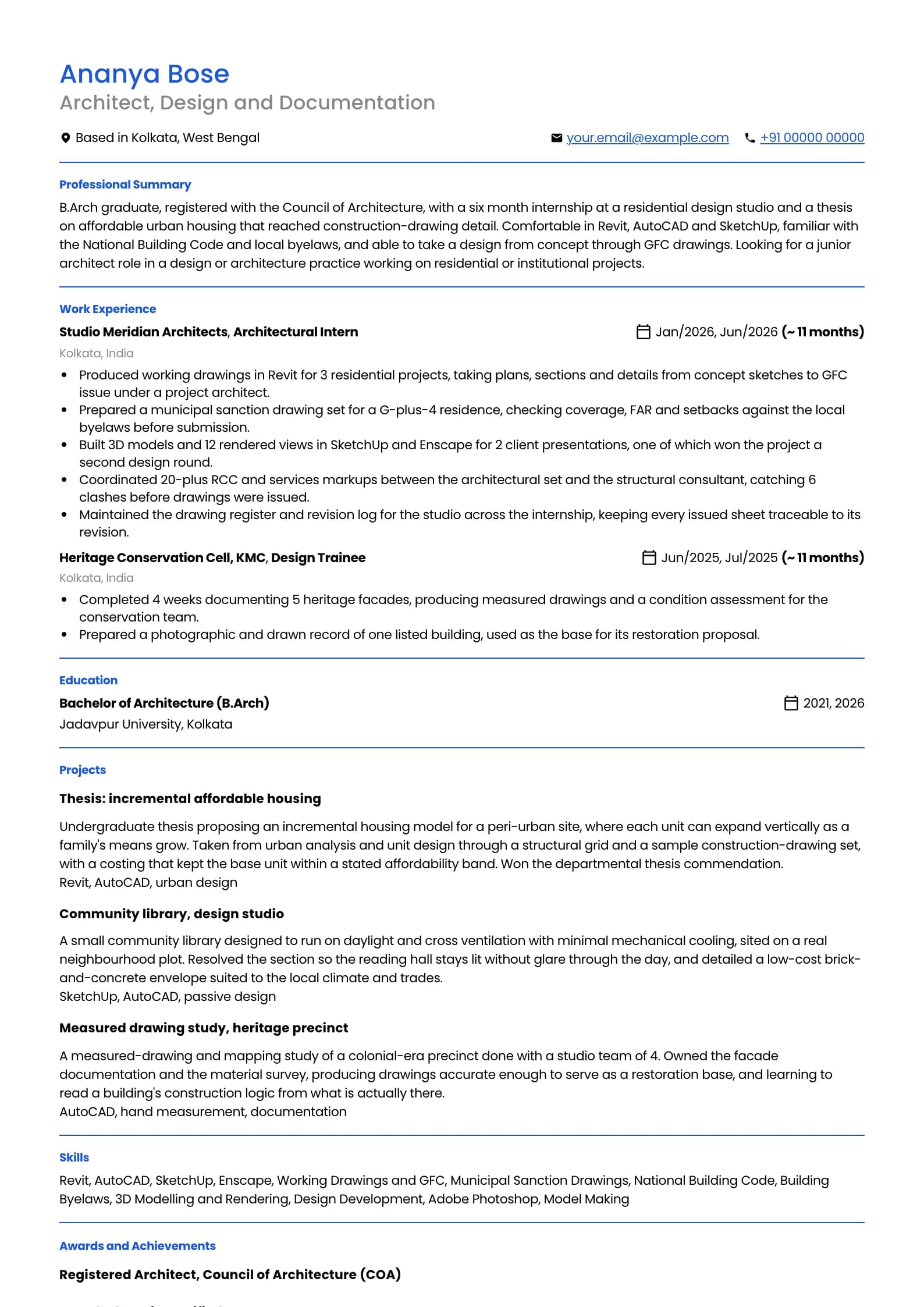
Build my resumeArchitect resume example, Fresher (0 years)
professional templateIs your resume good enough?
Upload the resume you have now and see what an applicant tracking system reads before a architect recruiter ever does.
Free to run. Sign in with your mobile number to see your score.
Architect resume example, Mid-level (5 years)
header-band template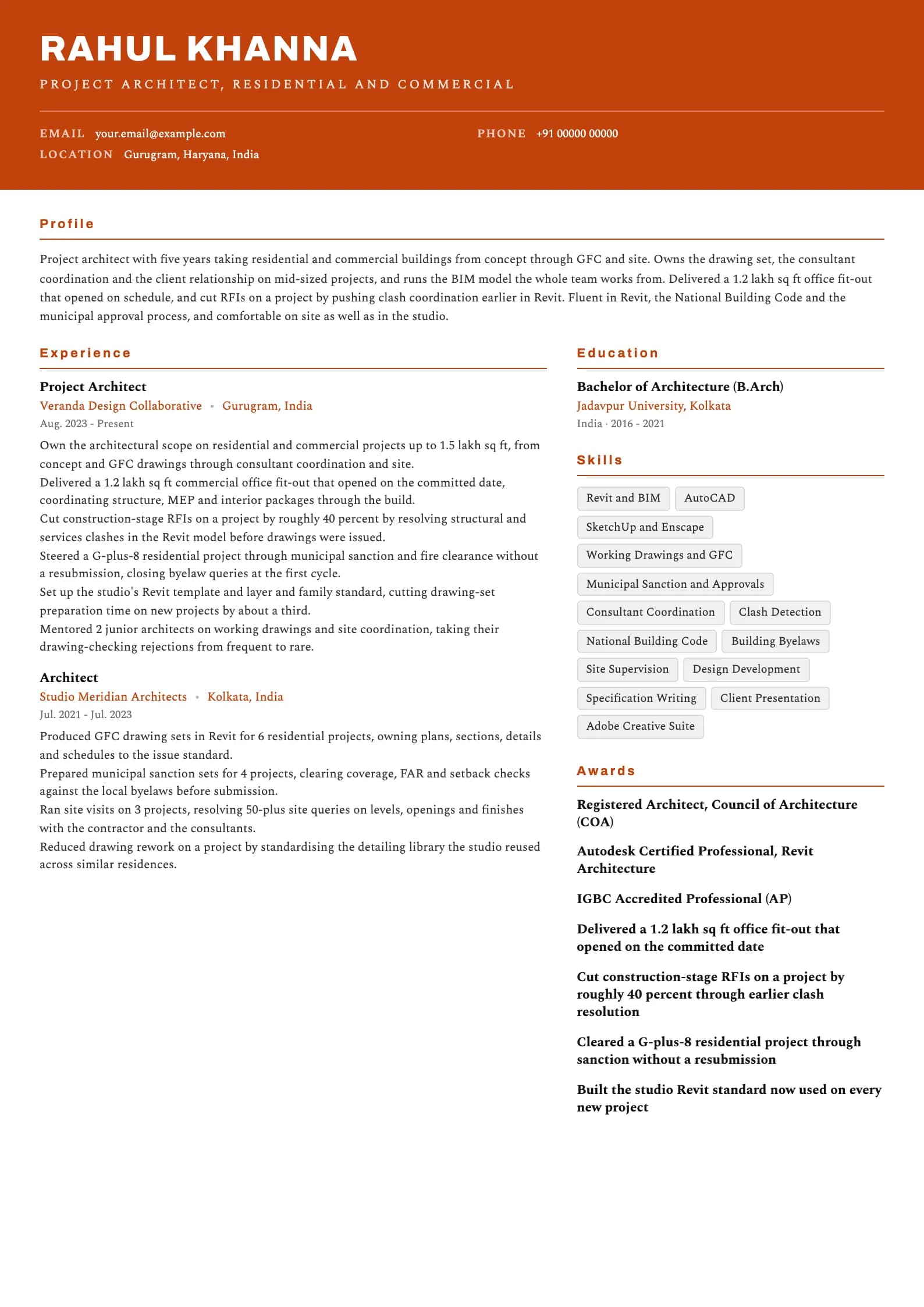
Want this structure with your own details? Build it in the resume builder.
Architect resume example, Senior (9 years)
minimalist template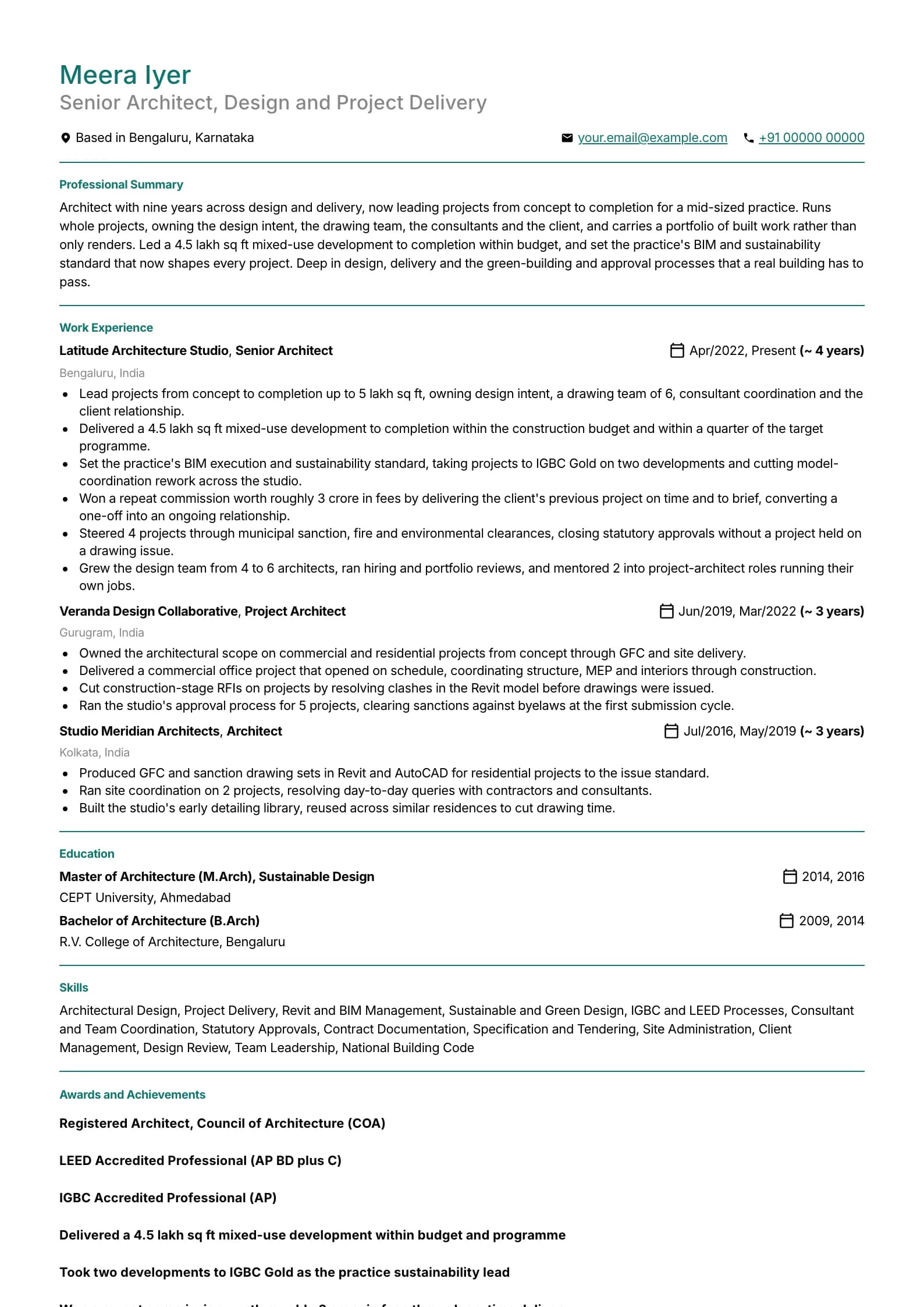
The format that works for architect resumes in India
Reverse chronological is the layout to use. Put the most recent role first, work backwards, and let the dates sit in plain view. Functional resumes that group everything under Areas of Expertise and quietly drop the dates read as an attempt to hide a gap, and reviewers treat them that way. A gap is better explained in one honest line than buried. An architect's resume is not the portfolio, and confusing the two is the most common mistake in this field. The resume is a one or two page text document that gets you shortlisted; the portfolio is where the design work is judged. Keep the resume clean and text-first, and link the portfolio in plain text. Do not try to cram thumbnails into the resume, because they bloat the file, break the parser and still do the portfolio no justice. Length is decided by evidence. One page holds everything a fresher and most architects up to roughly six years have to say. Past that, a second page is fine when it carries real project delivery rather than a longer software list. Four things belong nowhere here: a photograph, date of birth, marital status and father's name. They survive from an older template that circulated through campus placement cells. Send a PDF unless the posting asks otherwise, name the file with your own name and the role, and use a single column so the parser reads it cleanly. The table below sets out the section order.
| Section | Where it goes | Why |
|---|---|---|
| Name, title and portfolio link | Top, above everything | Title as Architect only if COA registered. The portfolio link goes here, in plain text. |
| Professional summary | Directly under the header | Three lines. Design and delivery focus, years, and the strongest built result. |
| Work experience | Next, for anyone with a job | Most recent first. Newest role gets the most bullets. |
| Key projects | Above experience for freshers, below it after that | For a fresher, thesis and studio work is the evidence. |
| Software and skills | Below experience | Grouped: BIM, drafting, visualisation, codes. Not a 30-item wall. |
| Education and registration | Bottom, unless you are a fresher | B.Arch and M.Arch, plus the COA registration line. |
| Certifications | After education, or beside skills if only one or two | COA, IGBC or LEED, Revit. Name and year. |
The portfolio link a resume cannot replace
No architect is hired on the resume alone. Design ability is judged from the portfolio, so the resume's job is to earn the click through to it and to prove the parts a portfolio does not show: delivery, coordination, approvals and the ability to get a drawing built. Treat the two as a pair. The resume is the argument for a shortlist; the portfolio is the evidence of taste and skill. Put the portfolio link in plain text near the top, on Behance, Issuu or your own site, and make sure it opens. A dead link or a request-access page is worse than no link, because it reads as carelessness on the one document meant to show your attention to detail. Keep the portfolio itself tight: ten to fifteen strong pages beat forty that dilute the good work. What the resume adds, and the portfolio cannot, is scope and delivery. A gorgeous render says nothing about whether the building was ever built, on time, within budget, and through its approvals. The bullets in the samples deliberately carry that: opened on the committed date, cleared sanction without a resubmission, cut RFIs by resolving clashes early. A practice hiring a project architect wants exactly this, because they already assume you can make a pretty image. Never paste low-resolution thumbnails into the resume PDF to double as a portfolio. They inflate the file past email limits, confuse the applicant tracking system, and represent your work at a size that flatters nothing. Link, do not embed.
Click your own portfolio link from a private browser window before you send the resume. If it asks for access or 404s, you have just failed the one test an architect's resume must pass.
Writing a summary a hiring manager actually reads
The block under your name is the part you can be reasonably sure gets read, so it should carry three facts: what you design and deliver, how long you have been doing it, and the strongest thing you have built or led. Three or four lines, no adjectives that cannot be checked. The old objective line, seeking a challenging position in a reputed firm to utilise your design skills, tells the reader nothing they did not assume from the application. Replace it with a summary. An objective describes what you want, a summary describes what you have already delivered, and only one is evidence. Freshers often believe they have nothing to summarise. Look at the fresher sample: it names the software, states the internship length, cites COA registration, and points at a thesis that reached construction detail. That is a genuine summary built from coursework, one internship and a thesis. What it avoids is "creative and passionate architect", a phrase so common it now carries no information. A practical test: read your summary and ask whether a classmate with the same B.Arch could paste it onto their resume unchanged. If they could, it describes the degree, not you. Add the specific project, the specific scale and the specific ownership until it stops being transferable.
Professional summary, mid-level project architect
Weak
Creative and passionate architect with 5+ years of experience seeking a challenging position in a reputed design firm to apply my design and technical skills.
Strong
Project architect with five years taking residential and commercial buildings from concept through GFC and site. Delivered a 1.2 lakh sq ft office fit-out that opened on schedule and cut construction-stage RFIs by resolving clashes early in Revit.
The rewrite trades self-description for a scope of ownership, a built result and one delivery number a practice actually values.
Experience bullets: verb, project, consequence
Every strong bullet in the samples follows the same shape. It opens with an action verb, names the specific project or drawing scope you owned, and closes with what measurably moved. The verb establishes that you did it. The project tells a reviewer the scale and type. The number, or the delivery outcome, does the persuading. Start with the outcome and work backwards. Architects usually write the task first, then leave it vague, which produces bullets like "worked on design and drawings for various projects". Instead ask what actually happened: a building opened on date, a sanction cleared without resubmission, RFIs fell because clashes were caught early, an area was delivered within budget. Then write the sentence that ends in that fact. Architecture rewards a specific kind of metric: built-up area, project value, programme and budget adherence, RFI and clash counts, approval cycles. "Delivered a 4.5 lakh sq ft development within budget and programme" carries the scale and the delivery in one line. Vary the metric so the resume does not read as one number repeated. Where you genuinely lack a number, give scope: how many projects, how many drawing sets, how many site queries closed, how many approvals cleared. "Cleared a G-plus-8 project through sanction without a resubmission" is a real, checkable claim. Allocate bullets by recency. Current role gets five or six, the previous role four or five, anything older two or three.
| Level | What bullets must prove | Typical metric |
|---|---|---|
| Fresher | You can draw and document, not just render | Drawing sets produced, sanctions prepared, clashes caught |
| 1 to 4 years | You own a drawing set and coordinate consultants | GFC sets, RFIs, site queries closed, approvals cleared |
| 5 to 7 years | You run a project from concept to site | Built-up area, opened on schedule, RFIs cut, budget held |
| 8 years and up | You deliver whole projects and set standards | Project value, budget and programme, IGBC rating, team |
Experience bullet, project architect
Weak
Responsible for preparing drawings and coordinating with consultants for residential and commercial projects.
Strong
Cut construction-stage RFIs on a project by roughly 40 percent by resolving structural and services clashes in the Revit model before drawings were issued.
"Responsible for" describes a job description; the rewrite names the coordination action and the RFI reduction it produced.
Experience bullet, delivery
Weak
Handled a large commercial project from design to completion with good coordination and client satisfaction.
Strong
Delivered a 1.2 lakh sq ft commercial office fit-out that opened on the committed date, coordinating structure, MEP and interior packages through the build.
Names the area, the delivery outcome and the packages coordinated, so a reviewer can gauge the real scale of the work.
If a bullet would read identically on a classmate's resume, it is describing the studio, not you. Rewrite it until it only fits the project you actually ran.
The software and skills section: grouped, honest, defendable
An architect's skills section has two audiences with opposite preferences. The parser wants literal terms it can match, Revit and AutoCAD and IGBC. A human wants a short, organised list that signals what kind of architect you are. Grouping satisfies both. Group by function rather than one long line. BIM and drafting, visualisation, documentation and codes is a grouping that works for most architects. The exact headings matter less than the fact that structure exists. Write software the way the vendor writes it: Revit not Rivit, SketchUp not Sketchup, AutoCAD not Autocad. A parser matches on strings. Name the software you actually work in daily and can be tested on. Revit is now the expectation for most practices doing serious documentation, so if you have it, lead with it. Rendering skill, Enscape, Lumion or V-Ray, matters for design-facing roles and less for documentation-heavy ones. Match the emphasis to the job. Twelve to sixteen skills is the working range. Below eight the section looks thin. Above twenty it stops being a signal. The list is a contract: every item is a question you have agreed to answer. Do not include a proficiency bar. Let the portfolio and the project bullets prove the depth instead.
| Group | What goes in it | How many |
|---|---|---|
| BIM and drafting | Revit, AutoCAD, ArchiCAD, BIM coordination | 2 to 4 |
| Visualisation | SketchUp, Enscape, Lumion, V-Ray, 3ds Max | 2 to 3 |
| Documentation | Working drawings, GFC, specifications, tender sets | 2 to 4 |
| Codes and approvals | National Building Code, byelaws, IGBC or LEED, fire norms | 2 to 3 |
| Graphics | Photoshop, InDesign, Illustrator for portfolios and sheets | 1 to 3 |
Software and skills section
Weak
Skills: AutoCAD, Revit, SketchUp, 3ds Max, Lumion, V-Ray, Enscape, ArchiCAD, Rhino, Grasshopper, Photoshop, InDesign, Illustrator, MS Office, model making, hand sketching, creativity, teamwork, leadership, communication
Strong
BIM: Revit, AutoCAD. Visualisation: SketchUp, Enscape. Documentation: working drawings, GFC, specifications. Codes: National Building Code, byelaws, IGBC. Graphics: Photoshop, InDesign.
Cuts the software you cannot be tested on and the soft skills masquerading as tools, then groups the rest so a human reads it in one pass.
Projects and thesis: what to include and how to describe it
For a fresher, projects and the thesis are the resume alongside the portfolio link. They sit above experience, they get real space, and they are where a reviewer decides whether you can take an idea to a buildable proposal. For an experienced architect, key projects move below experience and become the built work you led, described by scale, type and your role. The common failure is describing the software or the style instead of the architecture. "Designed a residential project using Revit and SketchUp with a modern aesthetic" tells a reviewer nothing. Describe the site, the design problem, and what your resolution achieved. The thesis in the fresher sample is a strong entry because it names a real constraint, incremental affordability, and shows the idea was taken to construction detail and costing, not left at the pretty stage. Pick projects that show range: one design-led studio project, one thesis or research project taken to depth, and one documentation or measured-drawing exercise that proves technical ability. A studio that hires a junior wants to see both the idea and the drawing behind it. For experienced architects, name your role on each project explicitly. "Project architect" versus "part of the design team" tells a reviewer whether you ran the drawing set or contributed to it, and inflating that is the fastest way to lose credibility in an interview where the project is discussed in detail.
Project description, fresher resume
Weak
Thesis: designed an affordable housing project using Revit and AutoCAD with a focus on sustainability and modern design.
Strong
Thesis: incremental affordable housing where each unit expands vertically as a family's means grow, taken from urban analysis through a structural grid and a sample construction set, with costing held within an affordability band.
Swaps a software list and vague adjectives for the real design idea, the depth it reached and the constraint it had to satisfy.
Where education, registration and certifications belong
Education goes at the bottom for anyone with a job, and near the top for a fresher. B.Arch, institution, years, and the M.Arch above it if you have one. That is the core entry. The Council of Architecture registration is not an ordinary certification: in India, only a COA-registered person may legally use the title Architect and offer architectural services. So the registration line matters more than any software certificate, and for a fresher it belongs high, near education or the header. If you are registered, say so. If you are not yet, do not call yourself an Architect on the resume; use a title like Architectural Designer until you are. CGPA or percentage is worth keeping while you are a fresher and it is good. Once you have your first job, drop it. Coursework lines are rarely needed in architecture, where the portfolio carries the evidence. Green-building accreditation, IGBC AP or LEED AP, is genuinely useful and increasingly expected on sustainability-conscious projects, so it earns a place near your certifications. Autodesk Revit certification is a reasonable signal early on, less so once your project bullets show heavy Revit use. Write the full name and the year, and never list a lapsed registration or accreditation as current.
Getting through the applicant tracking system
Larger practices and firms that recruit through job portals run an applicant tracking system, so the same parsing rules apply to architects as to any other field. The system reads your file, tries to break it into name, dates, employers, titles and skills, and stores the result for search. Almost every ATS problem is a parsing problem, and parsing problems come from layout, not wording. The layout rules are short. One column. Standard section headings, so use Work Experience rather than My Design Journey, and Software rather than My Creative Tools. Crucially for architects, no embedded images or thumbnails in the resume, because they break the parser and bloat the file. Keep the visuals in the linked portfolio. No critical information in the header or footer region, which some parsers drop. On wording, mirror the language of the job description where it is honest. If the posting says BIM, write BIM and Revit. If it says working drawings, write working drawings rather than only GFC. Include the expansion alongside an acronym at least once, for example "GFC (good for construction)", so both searches find you. Keyword stuffing does not work. A hidden block of software names helps nothing, because an architect is judged on the portfolio a stuffed resume never reaches. Write real bullets that naturally contain the right terms. Save as PDF from a tool that embeds real text, then open the file and confirm you can select and copy a sentence. If you cannot select the text, neither can the parser.
Section heading
Weak
My Creative Toolkit
Strong
Software
Parsers look for standard headings; a decorative one can push the whole block into an unclassified bucket the recruiter never searches.
Keep every image in the linked portfolio, not the resume PDF. Embedded thumbnails break the parser, blow past email size limits, and show your work at a size that flatters nothing.
What gets architect resumes rejected
Most rejections at the resume stage are not close calls. They come from a small set of recurring problems, and all of them are fixable in an afternoon. The list below covers what reviewers of Indian architect resumes see most often, in rough order of how much damage each one does.
- A dead or access-restricted portfolio link. For an architect this is the single most damaging error, because the resume exists to earn that click.
- Embedded thumbnails that bloat the file and break the parser, in place of a clean link to a proper portfolio.
- Using the title Architect without COA registration, which is a legal and credibility problem in India.
- Renders described as achievements with no word on whether anything was built, on time or through its approvals.
- Job duties copied from the brief instead of what you delivered. "Responsible for design and drawings" is the tell.
- A software wall of twenty tools, half of them opened once, plus soft skills listed as software.
- A photo, date of birth, marital status or father's name. None of it belongs on a professional resume here.
- A generic objective line. Replace it with a summary that states focus, years and one built result.
- Inflating your role from team member to project architect on a specific building, which collapses the moment that project is discussed.
- Typos in the software or codes you claim. Writing "Revit" as "Rivet" or "IGBC" as "IGBS" undoes an otherwise strong page.
Read your resume aloud once before sending it, and open your portfolio link. Anything you would be embarrassed to defend in an interview, on the page or in the portfolio, is a line to cut or fix.
Skills to put on a architect resume
Technical
- Architectural Design
- Revit and BIM
- AutoCAD
- Working Drawings and GFC
- Municipal Sanction Drawings
- Consultant Coordination
- Clash Detection
- Sustainable and Green Design
- Specification Writing
- Contract Documentation
- Site Supervision
- National Building Code
- Building Byelaws
- Space Planning
Tools and platforms
- Revit
- AutoCAD
- SketchUp
- Enscape
- Lumion
- V-Ray
- ArchiCAD
- Rhino
- Adobe Photoshop
- Adobe InDesign
- Adobe Illustrator
- Navisworks
Working skills
- Client management
- Consultant coordination
- Design communication
- Team leadership
- Presentation and storytelling
- Site problem solving
- Mentoring
- Stakeholder liaison
- Time and programme management
Certifications worth listing as a architect
| Certification | Full name | Worth it for |
|---|---|---|
| COA Registration | Registration with the Council of Architecture, India | Not a bonus but the legal basis for calling yourself an Architect in India. Every practising architect needs it, and only registered persons may use the title and offer architectural services. It belongs high on the page for freshers. If you are not yet registered, use a title like Architectural Designer instead. |
| IGBC AP | Indian Green Building Council Accredited Professional | Genuinely useful and increasingly expected as clients and codes push green building. Worth it for architects working on commercial and institutional projects chasing an IGBC rating. The India-focused counterpart to LEED, and often the more relevant one for domestic work. |
| LEED AP | LEED Accredited Professional (BD plus C) | The internationally recognised green-building credential, worth it for architects on projects targeting LEED certification or working with global clients and developers. Carries weight for sustainability-focused and larger commercial practices. Pair it with real green-rated project work rather than listing it alone. |
| Revit Professional | Autodesk Certified Professional, Revit Architecture | A reasonable early-career signal that you can actually drive Revit rather than just list it, useful for documentation-heavy roles. Its value fades once your project bullets clearly show heavy Revit use, since the work then speaks louder than the certificate. |
| GATE | Graduate Aptitude Test in Engineering, Architecture and Planning | Relevant mainly for freshers pursuing an M.Arch or M.Plan at the IITs and NITs, or targeting public-sector planning and PWD roles that consider it. Of little value on a private-practice design resume once you are working, where the portfolio and built work matter far more. |
| M.Arch | Master of Architecture, specialisation such as sustainable or urban design | Not a certification but worth naming clearly when you have one, since it signals depth in a specialism like sustainability, conservation or urban design. Most valuable when the specialism matches the practice you are targeting. Firms hiring generalist project architects weigh built experience above it. |
Keywords an ATS scans for in a architect resume
These are the literal terms a parser matches against the job description. Use the ones that are true of you, in the sentences where you did the work, not as a list at the bottom.
- architect
- project architect
- b.arch
- COA registered
- Revit
- BIM
- AutoCAD
- working drawings
- GFC
- sanction drawings
- municipal approvals
- consultant coordination
- clash detection
- National Building Code
- green building
- IGBC
- LEED
- site supervision
- space planning
- design development
Architect resume FAQ
What salary can an architect expect in India?
A B.Arch fresher typically starts around 2.5 to 4.5 LPA, which is modest for the length of the degree and a common frustration in the field. A project architect with five to seven years usually sits in the 6 to 12 LPA band, higher in large corporate and commercial practices. Senior architects and project leads with nine years and above commonly earn 15 to 30 LPA and more, especially in delivery-focused firms and with an M.Arch or green-building specialism. Design-build, corporate and international-client practices tend to pay above independent studios.
Do I put my portfolio on the resume or link it?
Link it, always, in plain text near the top. The resume is a text document that earns the shortlist; the portfolio is where design ability is judged. Never embed thumbnails into the resume PDF, because they bloat the file, break the applicant tracking system and show your work too small to do it justice. Check the link opens from a private browser window before sending, since a dead or access-restricted link is the most damaging error an architect can make.
Can I call myself an architect without COA registration?
No. In India the title Architect is legally protected under the Architects Act, and only a person registered with the Council of Architecture may use it or offer architectural services. On your resume, use Architect only once you are registered, and put the registration line high on the page. Before registration, a title such as Architectural Designer or B.Arch Graduate is honest and avoids a credibility problem.
How long should an architect resume be?
One page up to about six years of experience, two pages after that only if the second page carries real project delivery rather than a longer software list. The resume stays short precisely because the portfolio carries the visual weight. If you are struggling to fit one page, cut the oldest role to a line, remove coursework, and delete any software you would not want to be tested on.
Should a fresher lead with the thesis and studio projects?
Yes. With no full-time roles, your thesis, studio projects and portfolio are the strongest evidence, so they sit directly under the summary. Describe the site, the design problem and what your resolution achieved, and show depth by naming a project taken to construction detail rather than left at the render. An internship still goes in a separate experience section below projects, because it shows you can document and coordinate, not just design.
Which software should be on an architect resume in India?
Lead with Revit if you have it, since BIM is now the expectation for serious documentation, then AutoCAD, a visualisation tool such as SketchUp with Enscape or Lumion, and the graphics tools for portfolios. List only what you can be tested on, grouped by type. Match the emphasis to the role: rendering skill for design-facing jobs, documentation and coordination tools for delivery-heavy ones.
Do green-building certifications like IGBC or LEED help?
Yes, increasingly, as clients and building codes push sustainability. An IGBC AP is often the more relevant one for domestic projects, while LEED AP carries weight on international and large commercial work. They help most when paired with real project experience on a rated building, so list the accreditation alongside the green project you worked on rather than on its own.
Do I need a photo on an architect resume in India?
No. Architecture practices do not expect one, and it takes space a project or a result should occupy. The same goes for date of birth, marital status, father's name, nationality and a declaration paragraph. These come from an older template that spread through campus placement cells and add nothing to a design hire. The only exception is a client-facing role that explicitly asks for a photograph in the posting.
Related resume examples and guides
Build your own in any of these formats
Start from a blank resume or upload the one you have. Goodspace renders it in 24 templates, keeps your portfolio link clean and clickable, and flags what an applicant tracking system will miss.
Build my resume