Safety Officer Resume Format, with 3 Full Samples
A safety officer is hired on evidence that the site got safer while the job still got done, yet most resumes list toolbox talks and inspections without ever naming an outcome. The certificates get listed, the responsibilities get copied from the appointment letter, and the drop in incidents that the person actually delivered goes missing. Below are three complete resumes, one for a Diploma in Industrial Safety fresher, one for an HSE officer with four years across construction and manufacturing, and one for a senior safety manager running the function across multiple sites. After the samples come the format rules, the certifications that decide who gets shortlisted, the numbers a safety resume has to carry, and the mistakes that end a screening early.
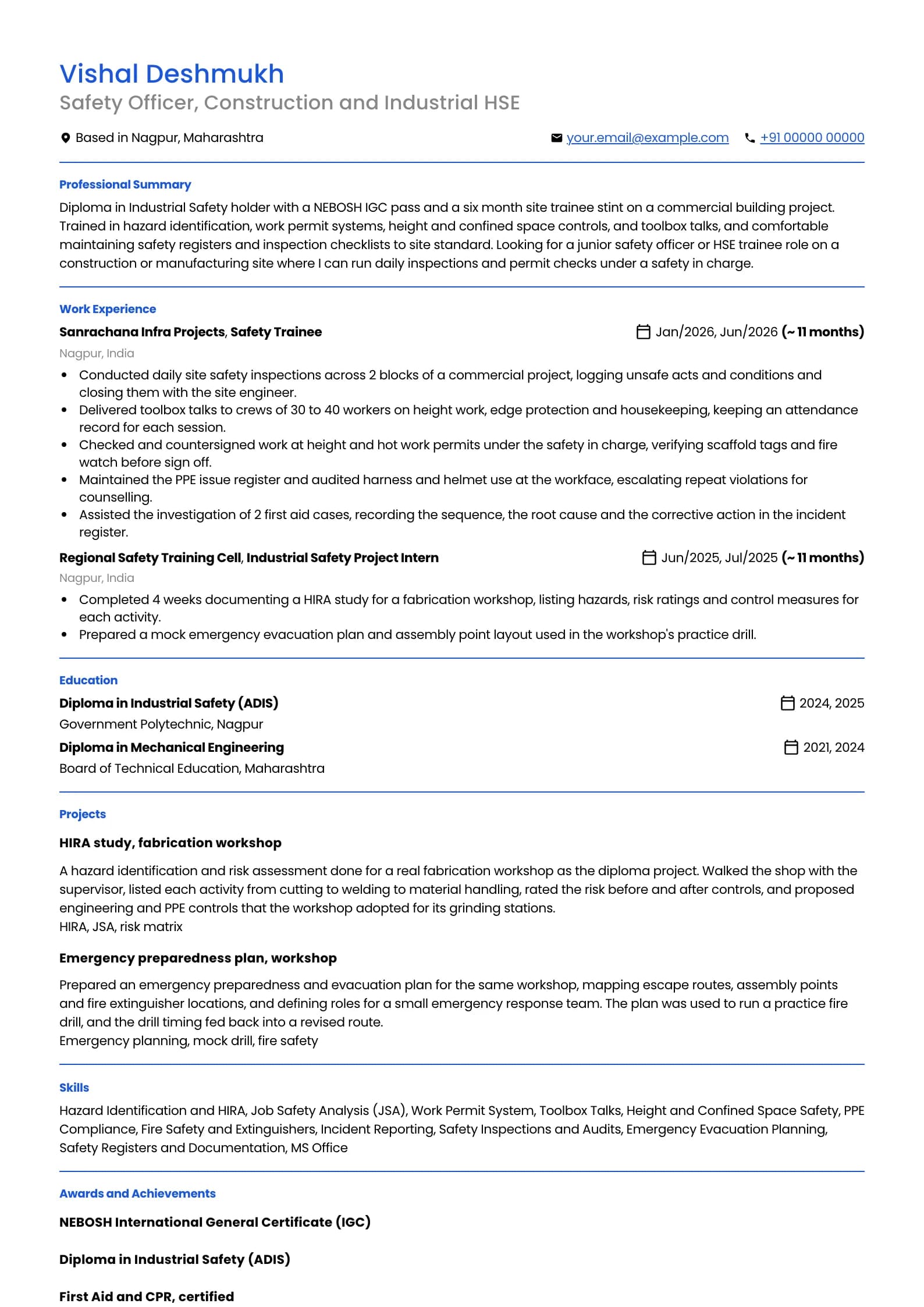
Build my resumeSafety Officer resume example, Fresher (0 years)
professional templateIs your resume good enough?
Upload the resume you have now and see what an applicant tracking system reads before a safety officer recruiter ever does.
Free to run. Sign in with your mobile number to see your score.
Safety Officer resume example, Mid-level (4 years)
header-band template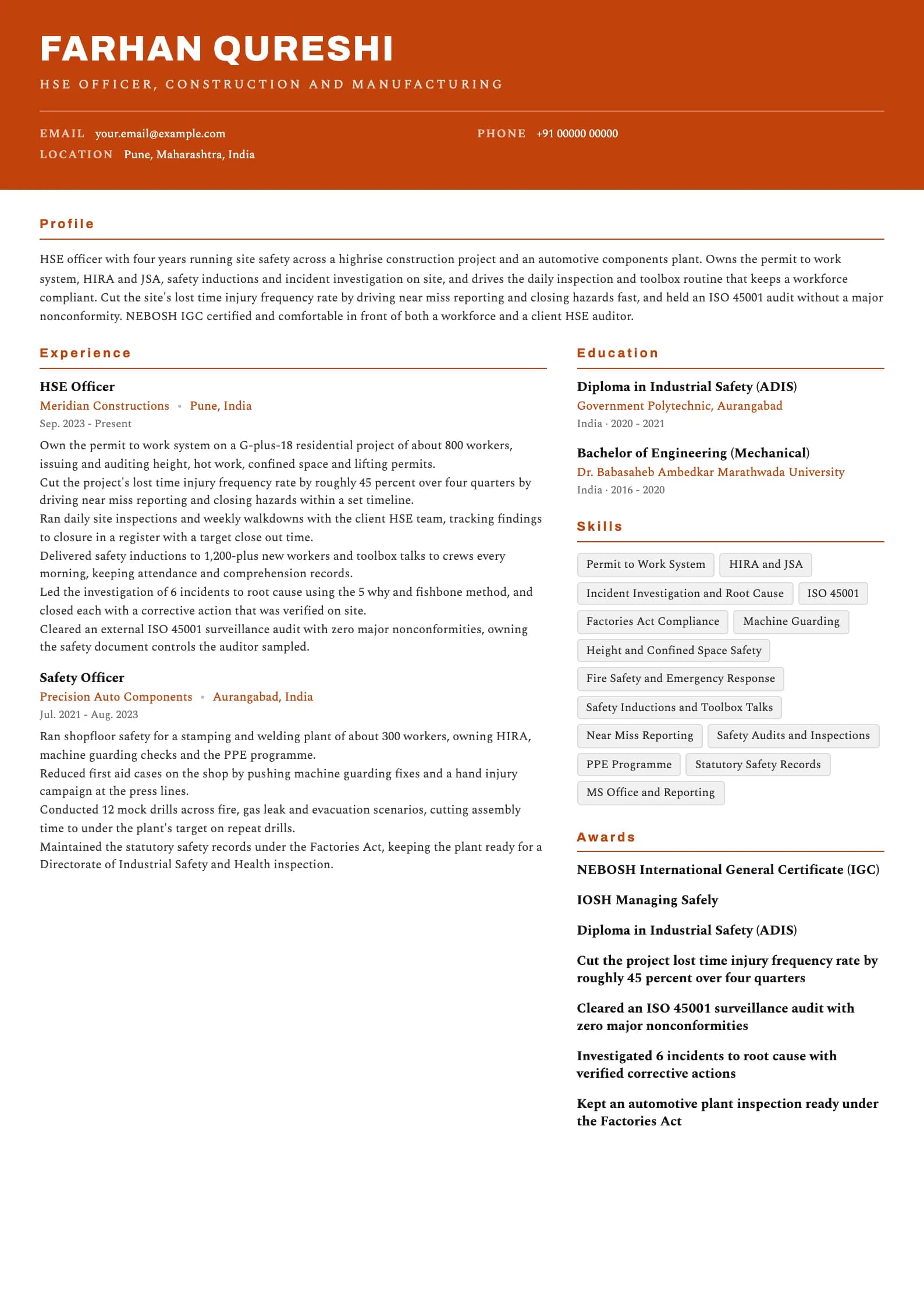
Want this structure with your own details? Build it in the resume builder.
Safety Officer resume example, Senior (10 years)
minimalist template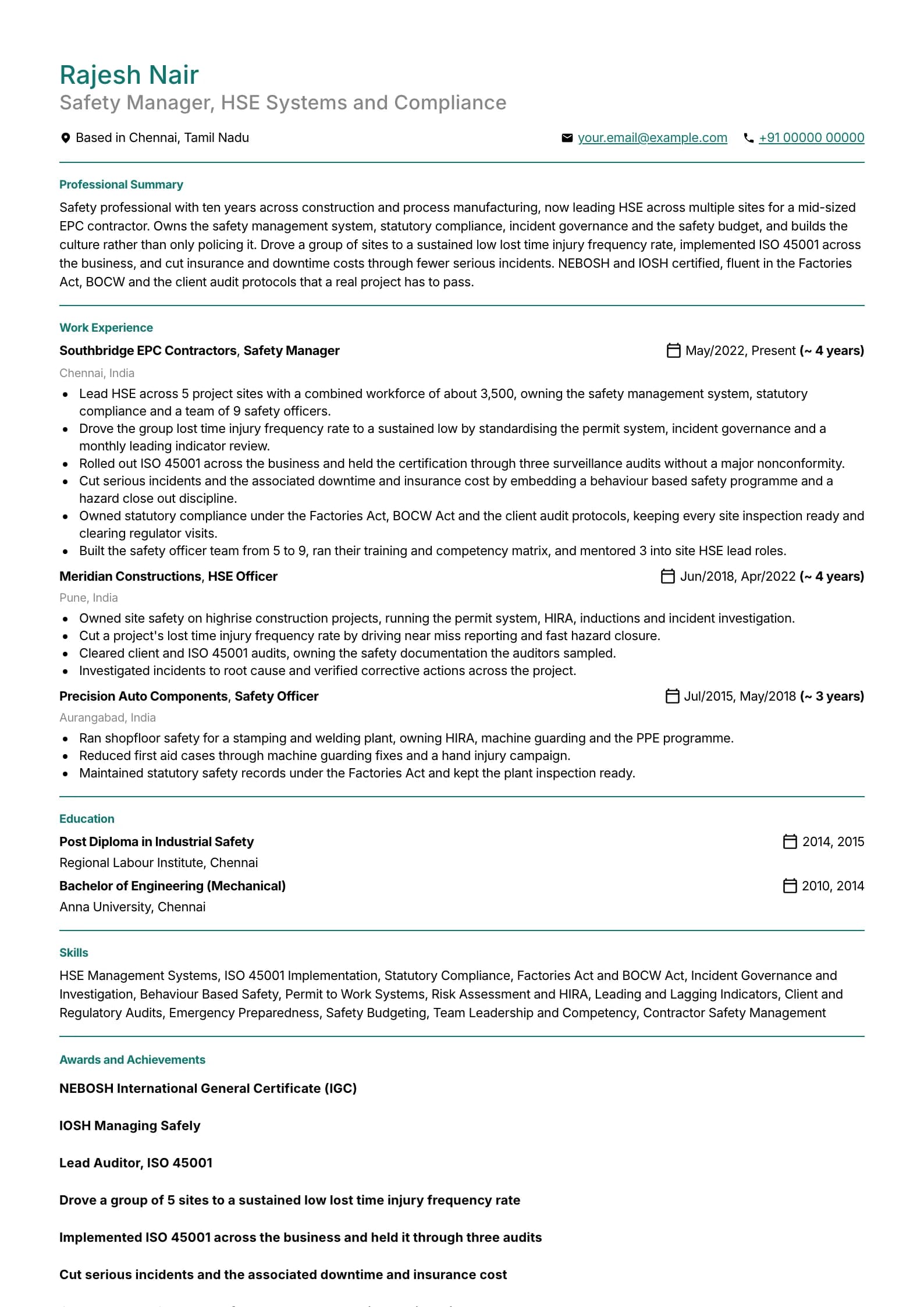
The format that works for safety officer resumes in India
Reverse chronological is the layout to use. Put the most recent role first, work backwards, and let the dates sit in plain view. Functional resumes that group everything under Areas of Expertise and quietly drop the dates read as an attempt to hide a gap, and reviewers treat them that way. A gap on site is better explained in one honest line than buried. A safety officer's resume is screened on two things before anyone reads a bullet: the certifications and the incident record. So the format has to surface both fast. Put your NEBOSH, IOSH and Diploma in Industrial Safety where a scan catches them, and let the summary carry the strongest safety result you own. The person reading is often an HSE manager or a client safety lead who has seen a thousand resumes that list toolbox talks and none that name an outcome. Length is decided by evidence. One page holds everything a fresher and most officers up to roughly six years have to say. Past that, a second page is fine when it carries real system ownership and incident governance rather than a longer list of trainings attended. Four things belong nowhere here: a photograph, date of birth, marital status and father's name. They survive from an older template that circulated through ITI and polytechnic placement cells. Send a PDF unless the posting asks otherwise, name the file with your own name and the role, and use a single column so the parser reads it cleanly. The table below sets out the section order.
| Section | Where it goes | Why |
|---|---|---|
| Name and title | Top, above everything | Safety Officer or HSE Officer, plus the location you can work in. |
| Professional summary | Directly under the header | Three lines. Years, industry, and the strongest incident or audit result. |
| Certifications | High, near the summary | NEBOSH, IOSH, Diploma in Industrial Safety. This is the shortlist filter. |
| Work experience | Next, for anyone with a job | Most recent first. Newest role gets the most bullets. |
| Key projects or HIRA work | Above experience for freshers | For a fresher, the diploma HIRA and drill work is the evidence. |
| Skills | Below experience | Grouped: risk, permits, compliance, response. Not a 30-item wall. |
| Education | Bottom, unless you are a fresher | Diploma and degree, with the ADIS and any engineering base. |
Why certifications decide the safety shortlist
In most other fields the certification is a bonus. In safety it is often the filter. Many postings state NEBOSH IGC required or ADIS mandatory, and a resume without the named credential is dropped before a single bullet is read. So the certifications cannot sit in a footnote at the bottom of page two. Put them high, right under the summary, named exactly as the body writes them. Name them the way the awarding body does. NEBOSH International General Certificate, not NEBOSH course. IOSH Managing Safely, not IOSH training. Diploma in Industrial Safety, often written ADIS, is the credential many state factory and construction roles require by law for the person to be recognised as a safety officer. Fire and Safety diploma holders should write the full name and the awarding institute. A parser and a screener both match on the exact string. Do not inflate. Writing NEBOSH when you hold only a local fire and safety certificate is the fastest way to lose an interview, because the difference is obvious the moment the syllabus comes up. If you are mid way through NEBOSH, write it honestly as pursuing NEBOSH IGC with the expected date, rather than claiming a pass. Match the certification to the sector. Construction and infrastructure roles weight NEBOSH and the client HSE protocols. Factory and manufacturing roles weight the Diploma in Industrial Safety recognised under the state Factories Act rules. Oil, gas and process roles often add specialised tickets. List the ones the sector you are targeting actually asks for, near the top, and leave the rest lower.
If a posting names a certificate as required, put that exact certificate in your summary line or immediately under it. A screener filtering on NEBOSH will never scroll to page two to find it.
Writing a summary a safety manager actually reads
The block under your name is the part you can be reasonably sure gets read, so it should carry three facts: how long you have run safety and in what industry, the certification the role screens on, and the strongest safety result you own. Three or four lines, no adjectives that cannot be checked. The old objective line, seeking a challenging position in a reputed organisation to ensure a safe working environment, tells the reader nothing they did not assume from the application. Replace it with a summary. An objective describes what you want, a summary describes what you have already delivered, and only one is evidence on a safety resume. Freshers often believe they have nothing to summarise. Look at the fresher sample: it names the NEBOSH IGC and the ADIS, states the six month site stint, and points at a clean lost time record and a HIRA project the workshop adopted. That is a genuine summary built from a diploma, one traineeship and a project. What it avoids is "dedicated and hardworking safety professional", a phrase so common it now carries no information. A practical test: read your summary and ask whether a batchmate with the same diploma could paste it onto their resume unchanged. If they could, it describes the course, not you. Add the specific site, the specific number and the specific system you owned until it stops being transferable.
Professional summary, mid-level HSE officer
Weak
Dedicated and hardworking safety professional with 4+ years of experience seeking a challenging position to ensure a safe and healthy working environment in a reputed organisation.
Strong
HSE officer with four years across construction and manufacturing, NEBOSH IGC certified, owning the permit to work system on an 800-worker site. Cut the project's lost time injury frequency rate by roughly 45 percent and cleared an ISO 45001 audit with zero major nonconformities.
The rewrite trades self-description for the certification the role screens on, the scope owned, and two safety results a manager actually values.
Experience bullets: verb, hazard controlled, consequence
Every strong bullet in the samples follows the same shape. It opens with an action verb, names the specific safety activity or hazard you controlled, and closes with what measurably moved. The verb establishes that you did it. The activity tells a reviewer the scale and risk. The number, the rate cut or the audit cleared, does the persuading. Start with the outcome and work backwards. Safety officers usually write the task first, then leave it vague, which produces bullets like "responsible for ensuring safety on site as per norms". Instead ask what actually happened: a lost time injury frequency rate fell, an audit cleared without a nonconformity, near miss reporting rose, a drill time dropped, first aid cases fell after a guarding fix. Then write the sentence that ends in that fact. Safety rewards a specific kind of metric: lost time injury frequency rate, near miss and first aid counts, audit results, permit and inspection volumes, manhours without a lost time injury, drill and induction numbers. "Cut the lost time injury frequency rate by 45 percent over four quarters" carries the scale and the result in one line. Vary the metric so the resume does not read as one number repeated. Where you genuinely lack a headline rate, give scope: how many workers on the site, how many permits audited, how many incidents investigated to root cause, how many inductions delivered. "Investigated 6 incidents to root cause with verified corrective actions" is a real, checkable claim. Allocate bullets by recency. Current role gets five or six, the previous role four or five, anything older two or three.
| Level | What bullets must prove | Typical metric |
|---|---|---|
| Fresher | You can run inspections, permits and paperwork | Inspections logged, toolbox talks, permits checked, HIRA done |
| 1 to 4 years | You own the permit system and investigate incidents | LTIFR cut, near misses raised, audits cleared, workers inducted |
| 5 to 8 years | You run site HSE and statutory compliance | LTIFR, incidents to root cause, audits held, workforce size |
| 9 years and up | You lead the system across sites and set standards | Group LTIFR, ISO 45001, cost of incidents, team size |
Experience bullet, HSE officer
Weak
Responsible for ensuring safety on site and conducting toolbox talks and inspections as per company norms and standards.
Strong
Cut the project's lost time injury frequency rate by roughly 45 percent over four quarters by driving near miss reporting and closing hazards within a set timeline.
"Responsible for" describes an appointment letter; the rewrite names the mechanism and the rate reduction it produced.
Experience bullet, incident investigation
Weak
Handled various incidents and accidents on site and took necessary corrective and preventive actions as required.
Strong
Led the investigation of 6 incidents to root cause using the 5 why and fishbone method, and closed each with a corrective action that was verified on site.
Names the count, the method and the verification, so a reviewer can judge the rigour rather than take the word for it.
If a bullet would read identically on a batchmate's resume, it is describing the appointment letter, not you. Rewrite it until it only fits the site you actually ran.
The skills section: grouped, honest, defendable
A safety officer's skills section has two audiences with opposite preferences. The parser wants literal terms it can match, HIRA and permit to work and ISO 45001. A human wants a short, organised list that signals what kind of safety officer you are. Grouping satisfies both. Group by function rather than one long line. Risk assessment, permit and controls, compliance and standards, emergency response is a grouping that works for most safety officers. The exact headings matter less than the fact that structure exists. Write standards the way they are written: ISO 45001 not ISO45001, HIRA not Hira, JSA and its expansion at least once. A parser matches on strings. Name the systems you actually run and can be tested on. Permit to work, HIRA and JSA, incident investigation methods, the specific acts you work under. If you have run ISO 45001, say so plainly, because it is a common posting keyword. Match the emphasis to the sector: machine guarding and Factories Act for manufacturing, height and confined space and BOCW for construction. Twelve to sixteen skills is the working range. Below eight the section looks thin. Above twenty it stops being a signal. The list is a contract: every item is a question you have agreed to answer in an interview. Do not include a proficiency bar. Let the incident results and the audit record prove the depth instead.
| Group | What goes in it | How many |
|---|---|---|
| Risk assessment | HIRA, JSA, hazard identification, risk matrix | 2 to 4 |
| Permits and controls | Permit to work, height, confined space, hot work, LOTO | 2 to 4 |
| Compliance and standards | ISO 45001, Factories Act, BOCW, statutory records | 2 to 4 |
| Emergency response | Fire safety, mock drills, evacuation, first aid | 2 to 3 |
| Investigation | Root cause, 5 why, fishbone, incident reporting | 1 to 3 |
Skills section
Weak
Skills: safety, HIRA, JSA, permit, fire, first aid, PPE, toolbox, inspection, audit, ISO, drill, LOTO, guarding, hard working, punctual, sincere, team player, leadership, communication
Strong
Risk: HIRA, JSA, hazard identification. Permits: permit to work, height, confined space, LOTO. Compliance: ISO 45001, Factories Act, BOCW. Response: fire safety, mock drills, first aid. Investigation: root cause, 5 why.
Cuts the single-word fragments and the soft skills masquerading as safety terms, then groups the rest so a human reads it in one pass.
The numbers a safety resume has to carry
Safety is one of the few fields where the headline number is not about output but about harm avoided, and reviewers know exactly which numbers are real. A resume that only lists activities, so many toolbox talks and inspections, reads as someone who did tasks. A resume that carries a lost time injury frequency rate that fell reads as someone who changed an outcome. The lost time injury frequency rate, the LTIFR, is the anchor number for a working safety officer. If you have driven it down, that is your headline. Express it honestly, as a percentage change over a stated period, and never invent a precise figure you cannot defend. Alongside it, leading indicators carry weight now: near miss reports raised, hazards closed within the target time, safety observations logged. A rising near miss count is a good sign, not a bad one, because it means the reporting culture is working. Audit results are checkable and valued. An ISO 45001 audit or a client HSE audit cleared without a major nonconformity is a clean, defensible line. So is a manhours without a lost time injury milestone, which many sites track on a board at the gate. Where you genuinely have no rate, use volume and scope: the size of the workforce you covered, the number of permits you audited, the number of incidents investigated to root cause, the drills you ran and the time they cut. The point is to move from "ensured safety" to a fact a reviewer can picture.
Achievement line, safety result
Weak
Successfully maintained a safe working environment and conducted regular safety activities throughout my tenure.
Strong
Drove the project lost time injury frequency rate down by roughly 45 percent over four quarters while near miss reporting rose, and cleared the ISO 45001 audit with zero major nonconformities.
Swaps a vague claim of safety for a rate change, a leading indicator moving the right way and an audit result, all of which a reviewer can probe.
Where education, certifications and licences belong
For a safety officer the certifications punch above education, so they sit near the top, not the bottom. Education still goes at the foot of the page for anyone with a job: the diploma or degree, the institution and the years. For a fresher, education and the diploma project move higher because they are the evidence. Name each certification the way the awarding body writes it, with the year. NEBOSH International General Certificate. IOSH Managing Safely. Diploma in Industrial Safety, often ADIS, from the named institute. A Fire and Safety diploma should carry its full title. Never list a lapsed certificate as current, and never round a fire and safety certificate up to a NEBOSH. Some roles need statutory recognition. In several states the person designated as a safety officer under the Factories Act must hold a recognised Diploma in Industrial Safety, so that credential is not optional for a factory safety officer role, it is the qualification the law names. Make it unmissable when you are targeting manufacturing. An engineering diploma or degree underneath the safety qualification is a genuine plus, because it signals you understand the processes you are keeping safe. Keep it, but let the safety credential lead. First aid and firefighting certificates are worth a line each, especially early on, since they are practical tickets a site values.
Getting through the applicant tracking system
Larger contractors, EPC firms and factories that recruit through job portals run an applicant tracking system, so the same parsing rules apply to safety officers as to any other field. The system reads your file, tries to break it into name, dates, employers, titles and skills, and stores the result for search. Almost every ATS problem is a parsing problem, and parsing problems come from layout, not wording. The layout rules are short. One column. Standard section headings, so use Work Experience rather than My Safety Journey, and Certifications rather than My Achievements. No tables or text boxes for your core content, because some parsers scramble them. No critical information in the header or footer region, which some parsers drop. On wording, mirror the language of the job description where it is honest. If the posting says NEBOSH, write NEBOSH IGC. If it says HIRA, write HIRA rather than only risk assessment. If it says ISO 45001, write ISO 45001. Include the expansion alongside an acronym at least once, for example "JSA (job safety analysis)", so both searches find you. Keyword stuffing does not work. A hidden block of safety acronyms helps nothing, because a safety officer is judged in an interview a stuffed resume rarely reaches. Write real bullets that naturally contain the right terms. Save as PDF from a tool that embeds real text, then open the file and confirm you can select and copy a sentence. If you cannot select the text, neither can the parser.
Section heading
Weak
My Safety Achievements Journey
Strong
Certifications
Parsers look for standard headings; a decorative one can push the whole block, including your NEBOSH line, into an unclassified bucket the recruiter never searches.
Put the exact certificate names a posting asks for in plain text, high on the page. The single most common reason a qualified safety officer is filtered out is a NEBOSH or ADIS that sits too low for the screen to catch.
What gets safety officer resumes rejected
Most rejections at the resume stage are not close calls. They come from a small set of recurring problems, and all of them are fixable in an afternoon. The list below covers what reviewers of Indian safety officer resumes see most often, in rough order of how much damage each one does.
- Certifications buried at the bottom, so a screener filtering on NEBOSH or ADIS never sees them and drops the file.
- Inflating a fire and safety certificate to a NEBOSH, which collapses the moment the syllabus comes up in the interview.
- Activities listed with no outcome. "Conducted toolbox talks and inspections" without a rate, an audit or a count is the tell.
- No safety numbers at all: no LTIFR, no near miss count, no audit result, no workforce size, just responsibilities copied from the appointment letter.
- Job duties lifted from the JD instead of what you delivered. "Responsible for ensuring a safe environment" says nothing.
- A wall of twenty safety acronyms with no grouping, plus soft skills like punctual and sincere listed as safety skills.
- Missing the statutory qualification for the sector, such as a recognised Diploma in Industrial Safety for a Factories Act role.
- A photo, date of birth, marital status or father's name. None of it belongs on a professional resume here.
- A generic objective line. Replace it with a summary that states years, industry, the screened certificate and one safety result.
- Typos in the standards and acronyms you claim. Writing "NEBOSH" wrong or "ISO 45001" as "ISO 5001" undoes an otherwise strong page.
Read your resume once as if you were the HSE manager who has to defend this hire to a client auditor. Any line you could not stand behind in an incident review is a line to fix or cut.
Skills to put on a safety officer resume
Technical
- Hazard Identification and HIRA
- Job Safety Analysis (JSA)
- Permit to Work System
- Incident Investigation and Root Cause
- ISO 45001
- Factories Act and BOCW Compliance
- Machine Guarding and LOTO
- Height and Confined Space Safety
- Fire Safety and Emergency Response
- Behaviour Based Safety
- Safety Audits and Inspections
- Near Miss and Leading Indicators
- PPE Programme
- Statutory Safety Records
Tools and platforms
- MS Office and Excel
- Safety Management Software
- Incident Reporting Systems
- Permit to Work Software
- Audit and Checklist Apps
- Gas Detection Equipment
- Fire Extinguishers and Hydrants
- PPE and Fall Protection Gear
- First Aid Equipment
Working skills
- Workforce communication
- Toolbox talk delivery
- Firm but fair enforcement
- Stakeholder and client liaison
- Incident investigation discipline
- Team leadership
- Training and mentoring
- Calm emergency response
- Report writing
Certifications worth listing as a safety officer
| Certification | Full name | Worth it for |
|---|---|---|
| NEBOSH IGC | NEBOSH International General Certificate in Occupational Health and Safety | The credential many construction, EPC and multinational roles name as required, so for those sectors it is closer to a filter than a bonus. Worth the investment for any safety officer targeting large contractors and client-driven projects, and best written exactly as NEBOSH IGC, high on the page. |
| IOSH Managing Safely | Institution of Occupational Safety and Health, Managing Safely | A widely recognised shorter certificate useful for supervisors and early to mid career safety officers, and often paired with NEBOSH rather than replacing it. Signals a working grasp of managing risk day to day, and reads well alongside a diploma. |
| ADIS | Advanced Diploma in Industrial Safety, or Diploma in Industrial Safety | In several states the recognised diploma the Factories Act names for a designated safety officer, so for manufacturing roles it is the statutory qualification, not optional. Make it unmissable when you are targeting factory and process work, and cite the awarding institute. |
| Fire and Safety Diploma | Diploma in Fire and Safety Engineering or Fire and Safety Management | A practical credential for site and industrial fire safety roles, worth naming with its full title and institute. Useful early on, but do not let it stand in for a NEBOSH or an ADIS where the posting names those specifically, since the difference shows quickly. |
| ISO 45001 Lead Auditor | ISO 45001 Occupational Health and Safety Management Systems Lead Auditor | Valuable for senior safety officers and managers who own the management system and face surveillance audits. It signals you can build and defend the system, not only work within it, and it pairs well with real audit-cleared project bullets. |
| First Aid and CPR | Certified First Aid and Cardiopulmonary Resuscitation | A small but genuinely useful practical ticket, especially for a fresher or a site officer who is a designated first aider. Cheap to hold, quick to earn, and a sensible line on any safety resume alongside a firefighting certificate. |
Keywords an ATS scans for in a safety officer resume
These are the literal terms a parser matches against the job description. Use the ones that are true of you, in the sentences where you did the work, not as a list at the bottom.
- safety officer
- hse officer
- NEBOSH IGC
- IOSH
- diploma in industrial safety
- ADIS
- HIRA
- JSA
- permit to work
- ISO 45001
- incident investigation
- root cause analysis
- lost time injury frequency rate
- LTIFR
- Factories Act
- BOCW
- fire safety
- toolbox talk
- safety audit
- PPE
Safety Officer resume FAQ
What salary can a safety officer expect in India?
A fresher with a Diploma in Industrial Safety and a NEBOSH IGC typically starts around 2.4 to 4 LPA, often quoted as a monthly figure of roughly 20,000 to 33,000 on site. An HSE officer with four to seven years usually sits in the 4.5 to 9 LPA band, higher on EPC and multinational projects. Senior safety managers with ten years and above commonly earn 12 to 25 LPA and more, especially in oil and gas, large construction and process manufacturing. NEBOSH and an ISO 45001 lead auditor credential push offers toward the top of each band.
Which certification matters most on a safety officer resume?
It depends on the sector, but NEBOSH IGC is the one most large construction, EPC and multinational postings name as required, so it is the strongest single credential for those roles. For factory and manufacturing roles, the recognised Diploma in Industrial Safety, the ADIS, is the qualification the Factories Act names for a designated safety officer, which makes it non-negotiable there. Put whichever your target sector asks for high on the page, in the summary or right under it.
How does a fresher write a safety officer resume with no experience?
Lead with the certifications, the NEBOSH IGC and the Diploma in Industrial Safety, since those are the shortlist filter. Then use the diploma project, a HIRA study or an emergency plan, and any site traineeship or plant internship as the evidence that you can run inspections, permits and the safety paperwork. Look at the fresher sample: it carries a clean lost time record, a HIRA project the workshop adopted and a drill it ran. That is a real resume built from a diploma, one stint and a project.
How long should a safety officer resume be?
One page up to about six years of experience, two pages after that only if the second page carries real system ownership and incident governance rather than a longer list of trainings attended. Keep the certifications and the strongest safety result on page one where a screen catches them. If you are struggling to fit one page, cut the oldest role to a line, remove course lists, and drop any skill you would not want to be tested on in an interview.
Do I need a photo on a safety officer resume in India?
No. Contractors and factories do not expect one, and it takes space a certification or a safety result should occupy. The same goes for date of birth, marital status, father's name, nationality and a declaration paragraph. These come from an older template that spread through polytechnic and ITI placement cells and add nothing to a safety hire. The only exception is a role that explicitly asks for a photograph in the posting.
What numbers should I put on a safety resume?
The lost time injury frequency rate is the anchor if you have moved it, expressed as an honest percentage change over a stated period. Around it, use leading indicators like near miss reports raised and hazards closed on time, audit results such as an ISO 45001 audit cleared without a major nonconformity, and scope figures like the workforce size, permits audited and incidents investigated to root cause. Never invent a precise figure you could not defend in an interview.
Is NEBOSH necessary to get a safety officer job in India?
Not for every job, but it opens the largest and best paid ones. Many construction, EPC, oil and gas and multinational postings name NEBOSH IGC as required and filter without it. For factory and manufacturing roles the recognised Diploma in Industrial Safety often matters more, because it is the statutory qualification. The practical answer is to hold the credential your target sector screens on, and to write it exactly, high on the page.
Should I list every training and mock drill I have attended?
No. List the named certifications that carry weight, NEBOSH, IOSH, the Diploma in Industrial Safety, first aid and firefighting, and let the drills and toolbox work appear as results inside your experience bullets instead. A long list of one-day trainings dilutes the credentials that matter and reads as padding. Show the drill you ran and the time it cut, not the certificate of attendance for a session.
Related resume examples and guides
Build your own in any of these formats
Start from a blank resume or upload the one you have. Goodspace renders it in 24 templates, surfaces your NEBOSH and Diploma in Industrial Safety where a screen catches them, and flags what an applicant tracking system will miss.
Build my resume