Electrical Engineer Resume Format, with 3 Full Samples
An electrical engineer is hired on evidence of panels designed, loads sized right and plants energised on time, yet most resumes list the standards and forget the outcome. Below are three complete resumes, one for a B.E. Electrical fresher, one for a design engineer with four years across panels and protection, and one for a senior engineer running electrical packages on projects worth crores. After the samples come the format rules, the split between design, testing and project careers, the software and codes that a parser matches literally, and the mistakes that end a screening before a human sees the page.
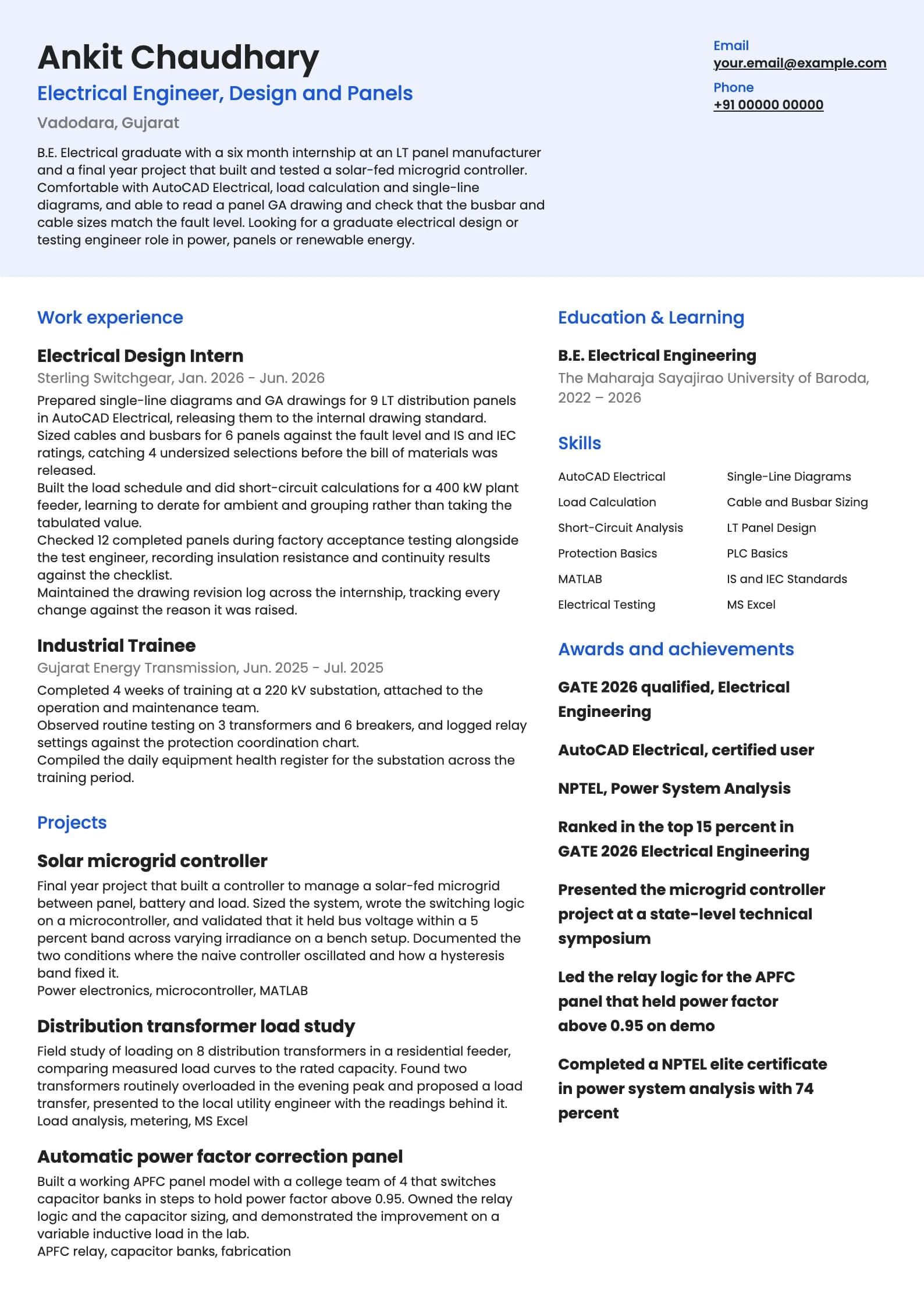
Build my resumeElectrical Engineer resume example, Fresher (0 years)
modern templateIs your resume good enough?
Upload the resume you have now and see what an applicant tracking system reads before a electrical engineer recruiter ever does.
Free to run. Sign in with your mobile number to see your score.
Electrical Engineer resume example, Mid-level (4 years)
ai-era template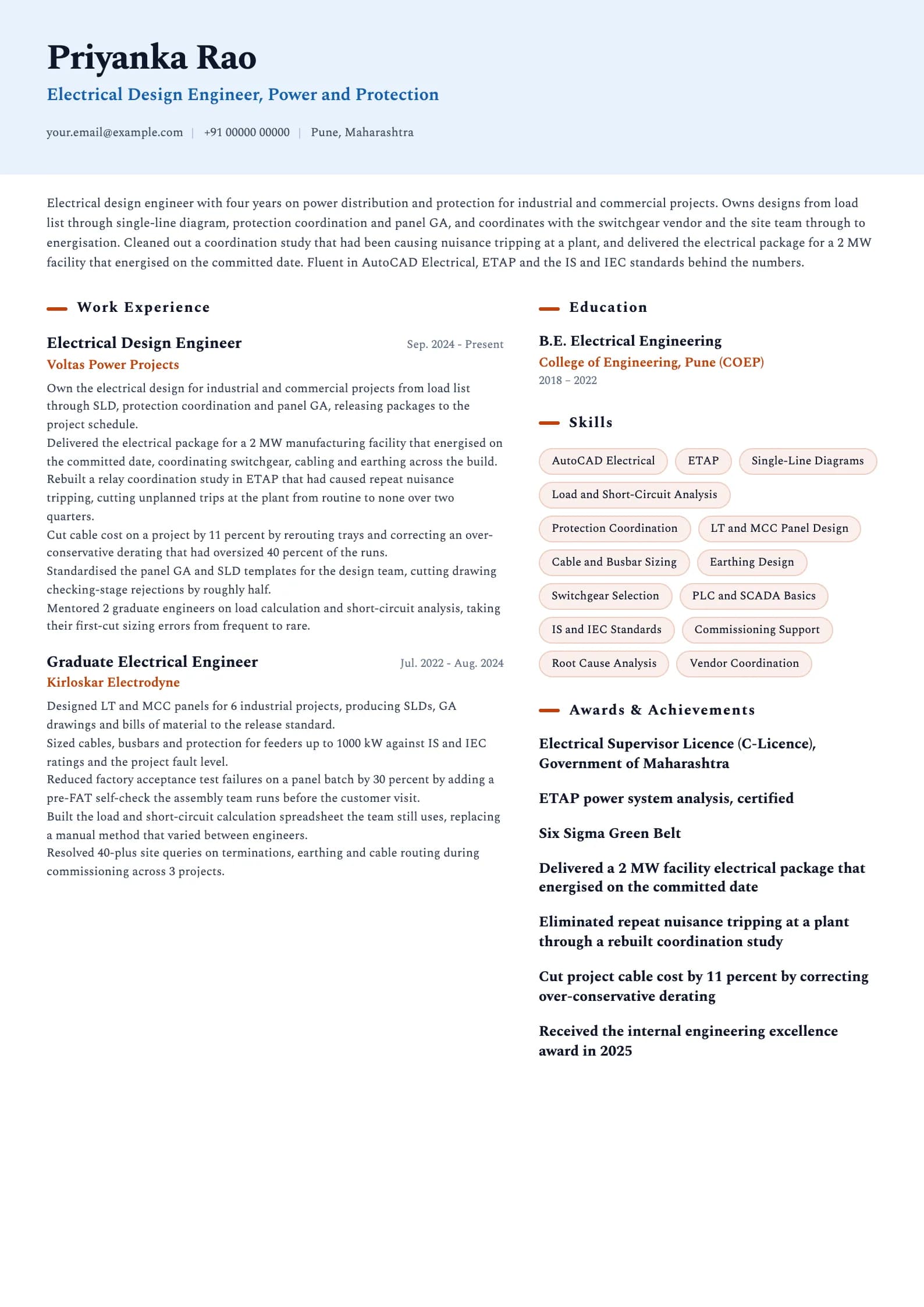
Want this structure with your own details? Build it in the resume builder.
Electrical Engineer resume example, Senior (9 years)
professional template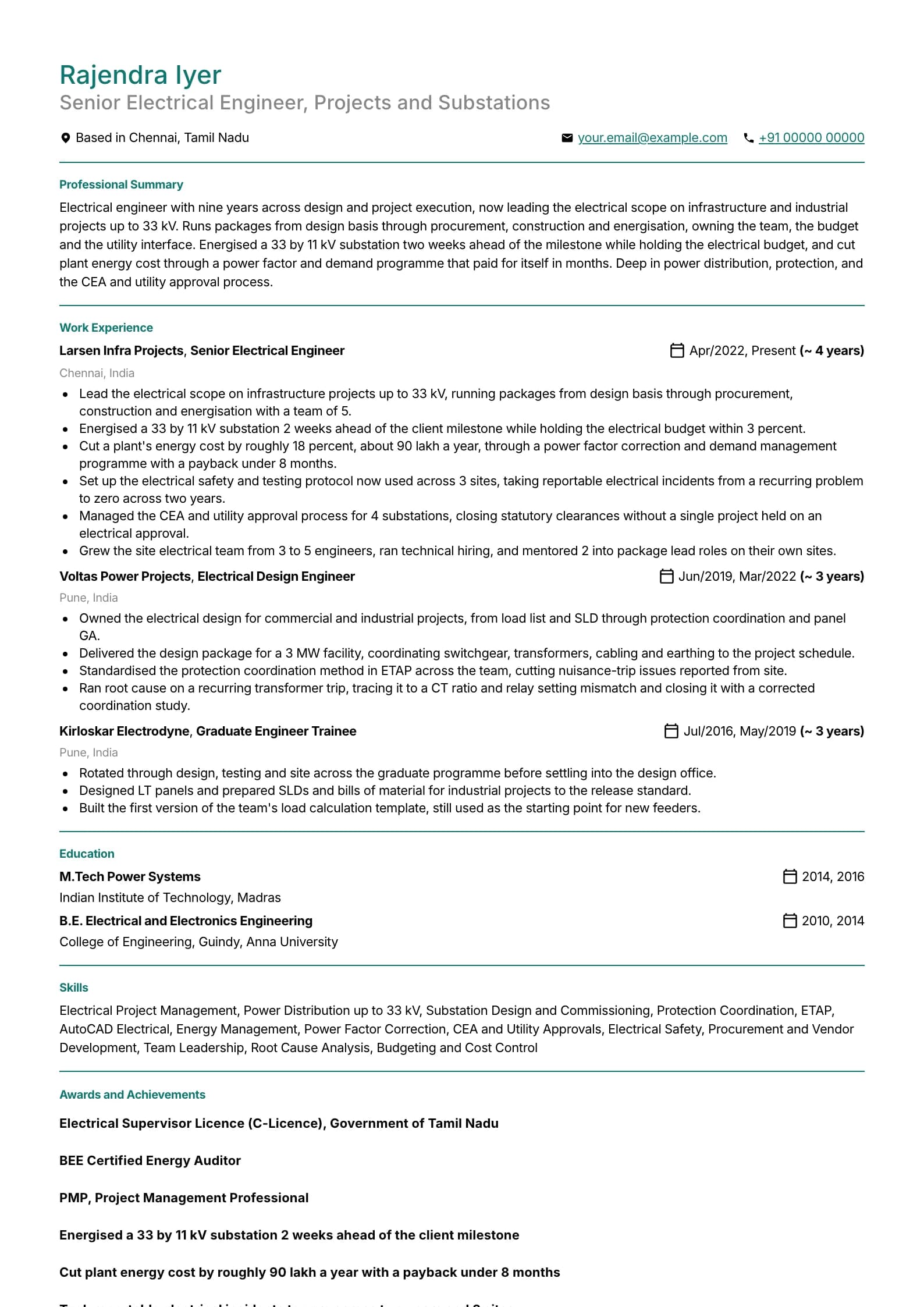
The format that works for electrical engineer resumes in India
Reverse chronological is the layout to use. Put the most recent role first, work backwards, and let the dates sit in plain view. Functional resumes that group everything under Technical Skills and quietly drop the dates read as an attempt to hide a gap, and reviewers treat them that way. A gap is better explained in one honest line than buried under a restructured document. Length is decided by evidence. One page holds everything a fresher and most engineers up to roughly six years have to say. Past that, a second page is fine when it carries real project work rather than a longer standards list. A page two built from a declaration paragraph, a full address and a hobbies line is a padded one-page resume. Four things belong nowhere on a technical resume here: a photograph, date of birth, marital status and father's name. They survive from an older template that circulated through campus placement cells, and they persist for that reason alone. Nobody screening a design engineer is looking for them, and every line they occupy is a line a project or a result could have used. Send a PDF unless the posting asks for DOCX, and name the file with your own name and the target role. Use a single column all the way down, because two-column layouts parse unpredictably when a sidebar sits beside the experience. The table below sets out the section order.
| Section | Where it goes | Why |
|---|---|---|
| Name and headline | Top, above everything | The headline is the role you want, design or testing or projects. Recruiters match on it. |
| Professional summary | Directly under the header | Three lines. Domain, years, and the single strongest result. |
| Work experience | Next, for anyone with a job | Most recent first. Newest role gets the most bullets. |
| Projects | Above experience for freshers, below it after that | For a fresher this is the evidence. For an experienced engineer it is supporting material. |
| Skills and software | Below experience | Grouped: design, analysis, software, standards. Not a 30-item wall. |
| Education and licence | Bottom, unless you are a fresher | Degree, institution, years. Put the C-Licence where it is easy to find. |
| Certifications | After education, or beside skills if only one or two | Name, issuing body, year. ETAP and BEE auditor earn their place. |
Design, testing or projects: name your track
Electrical engineering splits into distinct careers, and a resume that tries to look equally strong at design, testing and project execution ends up looking weak at all three. Decide which track the posting is for and let the headline, the summary and the bullet order say so. A recruiter filling a design opening wants SLDs, load and short-circuit calculation, protection coordination and AutoCAD Electrical. One filling a testing and commissioning role wants relay testing, insulation resistance, factory acceptance testing and site energisation. One filling a project role wants schedule, budget, procurement and the utility interface. The fresher sample leans design with real testing exposure, which is honest for someone who did a panel design internship and a substation training stint. The mid-level sample is a design engineer who follows the package to site. The senior sample has moved into project leadership, where the track is the energisation and the budget. Each is legible in the first three lines. Where you span two tracks, say design and commissioning, name both and prove both with bullets. A summary that claims design, testing, projects, sales and maintenance in one sentence reads as someone who has not decided what they are, not as someone versatile.
Read your own headline and summary and ask which track they point at. If the answer is all of them, the resume has not chosen, and the recruiter will choose for you by moving on.
Writing a summary a hiring manager actually reads
The block under your name is the part you can be reasonably sure gets read, so it should carry three facts: what you design or run, how long you have been doing it, and the strongest thing that happened because of your work. Three or four lines, no adjectives that cannot be checked. The old objective line, seeking a challenging position in a reputed organisation to utilise your skills, tells the reader nothing they did not assume from the application. Replace it with a summary. An objective describes what you want, a summary describes what you have already delivered, and only one is evidence. Freshers often believe they have nothing to summarise. Look at the fresher sample: it names the software, states the internship length, and points at a project with a real control problem behind it. That is a genuine summary built from coursework, one internship and projects. What it avoids is "passionate about power systems", a phrase so common it now carries no information. A practical test: read your summary and ask whether a classmate applying to the same company could paste it onto their resume unchanged. If they could, it describes the degree, not you. Add the specific project, the specific number and the specific ownership until it stops being transferable.
Professional summary, mid-level design engineer
Weak
Dedicated and hardworking electrical engineer with 4+ years of experience looking for a challenging role in a reputed organisation to apply my knowledge and grow my career.
Strong
Electrical design engineer with four years on power distribution and protection, owning designs from load list through coordination and panel GA. Delivered the electrical package for a 2 MW facility that energised on the committed date.
The rewrite trades self-description for a domain, an ownership scope and one verifiable result a reviewer can ask about.
Experience bullets: verb, system, consequence
Every strong bullet in the samples follows the same shape. It opens with an action verb, names the specific design, panel or project you owned, and closes with what measurably moved. The verb establishes that you did it. The system tells a technical reviewer whether the work is relevant. The number does the persuading. Start with the outcome and work backwards. Engineers usually write the task first, then struggle to attach a number, which produces bullets like "handled electrical design activities as per requirement". Instead ask what was different after you shipped: a plant energised on date, a nuisance trip stopped, a cable cost dropped, an FAT failure rate fell, an energy bill came down. Then write the sentence that ends in that fact. Vary the metric. A resume that only ever cites cost saved reads as narrow. Across a real role you can honestly reach for schedule, cable and equipment cost, trip and fault counts, FAT failure rate, energy saved and drawing volume. The mid-level sample uses several different metric types, which reads as range rather than one trick repeated. Where you lack a number, give scope: how many panels, how many feeders, how many projects, how many site queries closed. "Resolved 40-plus site queries on terminations and earthing across 3 projects" carries weight without inventing a percentage. Allocate bullets by recency. Current role gets five or six, the previous role four or five, anything older two or three.
| Level | What bullets must prove | Typical metric |
|---|---|---|
| Fresher | You can size and draw a real design | Panels drawn, undersized selections caught, project outcome |
| 1 to 3 years | You own a design through release without supervision | SLDs released, cable cost, FAT failures, site queries closed |
| 4 to 6 years | You own a package to energisation | Energisation date, trip count, cable cost, coordination fixes |
| 7 years and up | You run projects and set the standard | Milestone and budget, energy cost, incidents, approvals, team |
Experience bullet, design role
Weak
Responsible for preparation of electrical drawings, load calculations and coordination with vendors as per project requirements.
Strong
Rebuilt a relay coordination study in ETAP that had caused repeat nuisance tripping, cutting unplanned trips at the plant from routine to none over two quarters.
"Responsible for" describes a job description; the rewrite names the change made and the trip count it removed.
Experience bullet, project role
Weak
Worked on energy saving initiatives at the plant which resulted in reduced electricity consumption and cost.
Strong
Cut plant energy cost by roughly 18 percent, about 90 lakh a year, through a power factor correction and demand programme with a payback under 8 months.
Names the percentage, the rupee figure and the payback, so a reviewer can ask a real follow-up instead of nodding at a vague claim.
If a bullet would read identically on a classmate's resume, it is describing the degree, not you. Rewrite it until it only fits the design or project you actually owned.
The skills and software section: grouped, honest, defendable
An electrical resume's skills section has two audiences with opposite preferences. The parser wants literal terms it can match, ETAP and AutoCAD Electrical and protection coordination. A human wants a short, organised list that signals what kind of engineer you are. Grouping satisfies both. Group by function rather than one long line. Design, analysis and software, standards, and site or testing is a grouping that works for most electrical engineers. The exact headings matter less than the fact that structure exists. Write software the way the vendor writes it: ETAP not Etap, AutoCAD Electrical not Autocad. A parser matches on strings. Twelve to sixteen skills is the working range. Below eight the section looks thin. Above twenty it stops being a signal, because a list that includes everything distinguishes nothing. The list is a contract: every item is a question you have agreed to answer. If you touched DIgSILENT once in a lab, taking it off costs a keyword and saves a bad twenty minutes on the panel. Do not include a proficiency bar. Star ratings invite an argument you cannot win, and nobody agrees on what four stars in ETAP means. Let the bullets prove the depth.
| Group | What goes in it | How many |
|---|---|---|
| Design | SLDs, panel GA, load calculation, cable and busbar sizing, earthing | 2 to 4 |
| Analysis and software | ETAP, short-circuit and load flow, AutoCAD Electrical, MATLAB | 2 to 4 |
| Protection and control | Protection coordination, relay settings, PLC and SCADA | 2 to 3 |
| Standards | IS and IEC standards, CEA regulations, NEC where relevant | 1 to 3 |
| Site and testing | FAT, commissioning, insulation resistance, energisation | 2 to 3 |
Skills section
Weak
Skills: AutoCAD, ETAP, MATLAB, DIgSILENT, PLC, SCADA, C, Python, MS Office, Photoshop, Windows, transformers, motors, transmission, distribution, protection, power electronics, control systems, machines, drives
Strong
Design: SLDs, load calculation, cable and busbar sizing, earthing. Software: ETAP, AutoCAD Electrical. Protection: coordination, relay settings. Standards: IS and IEC. Site: FAT, commissioning, insulation resistance testing.
Cuts the tools you cannot be interviewed on and the subjects that are coursework, then groups the rest so a human reads it in one pass.
Projects and academic work: what to include and how to describe it
For a fresher, projects are the resume. They sit above experience, they get the most space, and they are where a reviewer decides whether you can actually design and test or only pass exams about it. For an experienced engineer they move below experience and shrink to one entry, kept only if it shows something the day job does not. The common failure is describing the hardware instead of the engineering. "Built a project using a microcontroller and power electronics" tells a reviewer nothing, because thousands of resumes carry that line. Describe what the system does, the constraint, and what was genuinely hard. The microgrid controller in the fresher sample is a strong entry because it names a real problem: the naive controller oscillated, and a hysteresis band fixed it. Pick projects that show range rather than three variants of the same idea. One design and control project, one field study that measured something real, and one hands-on build such as an APFC panel is a stronger set than three simulations nobody validated. Two well-described projects beat five listed by name. If you worked on a real utility or field study, name the finding and who you presented it to. "Found two transformers routinely overloaded in the evening peak and proposed a load transfer to the utility engineer" is worth more than "did a project on distribution transformers".
Project description, fresher resume
Weak
Solar Microgrid: designed a microgrid controller using power electronics and a microcontroller with satisfactory performance in testing.
Strong
Solar microgrid controller: held bus voltage within a 5 percent band across varying irradiance, and documented the two conditions where the naive controller oscillated and how a hysteresis band fixed it.
Swaps a hardware list and "satisfactory performance" for the real number and the control problem the project actually solved.
Where education, GATE, licence and certifications belong
Education goes at the bottom for anyone with a full-time job, and near the top for a fresher, who has nothing stronger to lead with. Degree, institution, years. That is the whole entry for most people. CGPA or percentage is worth keeping while you are a fresher and it is good, roughly 7.5 out of 10 and above, because campus and early-career screening still filters on it. Once you have your first full-time role, drop it. A GATE score is different: for a fresher it is a strong, verifiable signal that PSU and campus recruiters filter on directly, so a good rank earns a line. The electrical supervisor licence, the C-Licence, is not optional for many roles: where it gates the job, it belongs where a recruiter can find it in two seconds, near education or the header. Coursework lines are for freshers only, and only when directly relevant. Power systems, machines and protection are worth naming for a power role. Engineering mathematics is not. Skip school details once you have a degree. Certifications sit just below education, or beside skills if you hold only one or two. Write the full name, the issuing body and the year, because an unexplained acronym is a wasted line. An expired certification listed as current is a small dishonesty that is easy to catch and expensive to explain.
Getting through the applicant tracking system
An applicant tracking system is a parser and a search index, not a judge. It reads your file, tries to break it into name, dates, employers, titles and skills, and stores the result so a recruiter can search across candidates. Almost every ATS problem is a parsing problem, and parsing problems come from layout, not wording. The layout rules are short. One column. Standard section headings, so use Work Experience rather than My Journey, and Skills rather than My Toolbox. No text inside images, because an SLD thumbnail or a skills graphic reads as empty space. No critical information in the header or footer region, which some parsers drop. Avoid text boxes and nested tables in the resume body. On wording, mirror the language of the job description where it is honest. If the posting says protection coordination, write protection coordination rather than relay grading. If it says ETAP, write ETAP. Include the expansion alongside an acronym at least once, for example "SLD (single-line diagram)", so both searches find you. Keyword stuffing does not work. White text, a hidden block of terms, or a paragraph listing thirty topics are all things recruiters find quickly, and the outcome is worse than being filtered. Write real bullets that naturally contain the right terms, because a bullet describing what you did in ETAP contains the word ETAP in a context that survives human review too. Save as PDF from a tool that embeds real text, then open the file and confirm you can select and copy a sentence. If you cannot select the text, neither can the parser.
Section heading
Weak
Technical Arsenal and Key Strengths
Strong
Skills
Parsers look for standard headings; a decorative one can push the whole block into an unclassified bucket the recruiter never searches.
Test your own file before you send it. Copy the text out of the PDF into a plain text editor. Whatever you can read there is roughly what the parser sees, and anything scrambled is a real risk.
What gets electrical engineer resumes rejected
Most rejections at the resume stage are not close calls. They come from a small set of recurring problems, and all of them are fixable in an afternoon. The list below covers what reviewers of Indian electrical engineering resumes see most often, in rough order of how much damage each one does.
- A skills wall listing twenty topics and every software, half of them touched once in a lab. Every item is a question you have agreed to answer.
- Job duties copied from the job description instead of what you designed or energised. "Responsible for" is the tell.
- No numbers anywhere. Schedule, cost, trip count, energy saved, panels drawn. Pick whichever is honest for the work.
- A photo, date of birth, marital status or father's name. None of it belongs on a technical resume, and it takes a project's space.
- Hiding the C-Licence, or omitting it, when the role requires an electrical supervisor licence to be shortlisted at all.
- A resume that claims design, testing, projects and maintenance equally, so a recruiter cannot tell which track you want.
- A generic objective line. Replace it with a summary that states track, years and one result.
- Listing coursework subjects like a syllabus years after graduating. Power systems as a bullet is not an achievement.
- Inflated titles or dates that do not match your payslips and offer letters. Background verification is standard and a mismatch ends the process.
- Typos in the software or standards you claim to know. Writing "ETAP" as "ETABS" or "IEC" as "IES" undoes an otherwise strong page.
Read your resume aloud once before sending it. Anything you would be embarrassed to say to a panel's face is a line to cut or rewrite.
Skills to put on a electrical engineer resume
Technical
- Single-Line Diagrams
- Load and Short-Circuit Analysis
- Cable and Busbar Sizing
- Protection Coordination
- LT and MCC Panel Design
- Earthing and Lightning Protection
- Substation Design
- Power Factor Correction
- Energy Auditing
- Switchgear Selection
- PLC and SCADA
- Relay Testing
- Commissioning
- IS and IEC Standards
Tools and platforms
- AutoCAD Electrical
- ETAP
- DIgSILENT PowerFactory
- MATLAB and Simulink
- SKM PowerTools
- MS Excel
- Dialux
- EPLAN
- Primavera P6
- MS Project
Working skills
- Root cause analysis
- Vendor coordination
- Site coordination
- Cross-functional collaboration
- Mentoring
- Project management
- Technical documentation
- Statutory liaison
- Estimation and planning
Certifications worth listing as a electrical engineer
| Certification | Full name | Worth it for |
|---|---|---|
| GATE | Graduate Aptitude Test in Engineering, Electrical Engineering | The strongest early-career credential for an electrical engineer in India. A good score drives PSU recruitment at NTPC, PGCIL, BHEL and the state boards, and M.Tech admissions at the IITs and NITs. Highest value for freshers, fades once you have real design or project work to show. |
| C-Licence | Electrical Supervisor Licence, issued by the state electrical authority | Not a resume bonus but a gate. Many contracting, project and maintenance roles require a valid electrical supervisor licence before they can even shortlist you, and it is mandatory for signing off certain electrical works. If you hold it, it belongs near the top. If you are in contracting or projects, get it. |
| ETAP | ETAP power system analysis, vendor certification | A clean signal for a power system design engineer that you can actually run load flow, short-circuit and coordination studies rather than just list the tool. Worth it for design engineers early in their career. The real proof remains a coordination study you can defend in an interview. |
| BEE Energy Auditor | Bureau of Energy Efficiency Certified Energy Auditor | The credential for engineers moving into energy management, audits and efficiency work, which is a growing field as industry chases power cost. Worth it if your track is energy or facilities. It also carries statutory weight, since designated consumers need certified auditors. |
| PMP | Project Management Professional | Worth it once you move from owning designs to owning project schedules and budgets, typically past six or seven years. It signals to EPC and project roles that you can run electrical execution, not just design it. Of limited value for a fresher or a pure design contributor. |
| PLC and SCADA | Industrial automation, PLC and SCADA programming certification | Useful for engineers targeting automation, control and instrumentation roles rather than power distribution. A practical, hands-on course is worth more than a name on a certificate. Choose it if your interest is control systems, not if your track is power design. |
Keywords an ATS scans for in a electrical engineer resume
These are the literal terms a parser matches against the job description. Use the ones that are true of you, in the sentences where you did the work, not as a list at the bottom.
- electrical engineer
- electrical design engineer
- power systems
- single-line diagram
- load calculation
- short-circuit analysis
- protection coordination
- ETAP
- AutoCAD Electrical
- panel design
- cable sizing
- earthing
- substation
- switchgear
- commissioning
- PLC
- SCADA
- energy audit
- IS and IEC standards
- electrical supervisor licence
Electrical Engineer resume FAQ
What salary can an electrical engineer expect in India?
A fresher typically starts around 3 to 5 LPA in EPC and manufacturing, higher in top product firms and in PSUs entered through GATE, where the pay and job security are strong. A design or project engineer with four to six years usually sits in the 7 to 14 LPA band. Senior engineers and electrical project leads with nine years and above commonly earn 18 to 32 LPA and more on large infrastructure and industrial projects. Roles that combine electrical with automation or energy management often pay above the core-electrical average.
How long should an electrical engineer resume be?
One page up to about six years of experience, two pages after that only if the second page carries real project work rather than a longer standards list. Nobody has been rejected for a resume that was too easy to read. If you are struggling to fit one page, cut the oldest role to a single line, remove coursework, and delete any software you would not want to be interviewed on.
Should a fresher put projects above work experience?
Yes. With no full-time roles, projects and field studies are the strongest evidence you can offer, so they sit directly under the summary where a reviewer will see them. State what the project does, the constraint, and what was hard, not just the hardware. An internship still goes in a separate experience section below projects, because a reviewer wants to see that someone employed you.
Do I need the electrical supervisor licence on my resume?
If you have it, yes, and put it where a recruiter can find it fast. The C-Licence is mandatory for many contracting, project and maintenance roles and for signing off certain electrical works, so for those postings it is a shortlisting gate rather than a nice-to-have. If you are targeting design or R and D roles it matters less, but it never hurts to list a valid one.
Should I list every power system software I have used?
No. List the ones you would take an interview in, grouped by type, and leave off the packages you opened once. Twelve to sixteen skills across design, software, protection and standards is the working range. Every software on the page is a question you have agreed to answer, so a tool you cannot defend costs you more in the room than it gains you in the search index.
Does an ATS reject resumes with two columns?
It does not reject them outright, but some parsers read multi-column layouts out of order, which interleaves your sidebar with your experience and produces nonsense in the recruiter's view. A single-column layout removes the risk, which is why all three samples above use one. Test your own file by copying the text out of the PDF into a plain text editor, and if it reads in the right order there it will most likely parse correctly.
How do I write an electrical resume with no work experience?
Lead with projects, then education and GATE, then skills. Treat each project as a job: what it does, the constraint, what you owned and what changed because it exists. Final year projects count, field studies count, and a working panel or controller you built counts. Add anything checkable, such as a GATE rank, a symposium presentation or a real utility finding, since verifiable facts carry more weight than adjectives.
Should I tailor my resume for design versus project roles?
Yes, at least the top third. Rewrite the summary and reorder the skills so the matching track leads: SLDs, calculations and protection for a design opening, schedule, budget and energisation for a project one, relay testing and commissioning for a testing role. It takes about two minutes and is the highest-leverage editing you can do, because a recruiter decides in the first three lines which track you fit.
Do I need a photo on an electrical engineer resume in India?
No. EPC, manufacturing and utility recruiters do not expect one, and it takes space a project or a result should occupy. The same goes for date of birth, marital status, father's name, nationality and a declaration paragraph. These come from an older template that spread through placement cells and add nothing to a technical screen. The only exception is a client-facing role that explicitly asks for a photograph.
Related resume examples and guides
Build your own in any of these formats
Start from a blank resume or upload the one you have. Goodspace renders it in 24 templates and flags what an applicant tracking system will miss, including the software, standards and licence lines a power recruiter searches for.
Build my resume