Creative Director Resume Format, with 3 Full Samples
A creative director is not hired on craft alone, they are hired on judgement, on the work their teams produced, and increasingly on the business those campaigns moved. There is no fresher creative director, so the samples below start where the role actually begins. One for an associate creative director stepping up from art direction, one for a creative director owning the creative product across a set of accounts, and one for an executive creative director shaping a whole department and its business results. After the samples come the format rules, why this resume leads with leadership and outcomes rather than tools, how to prove creative judgement on paper, and the mistakes that stall a strong career at the resume stage.
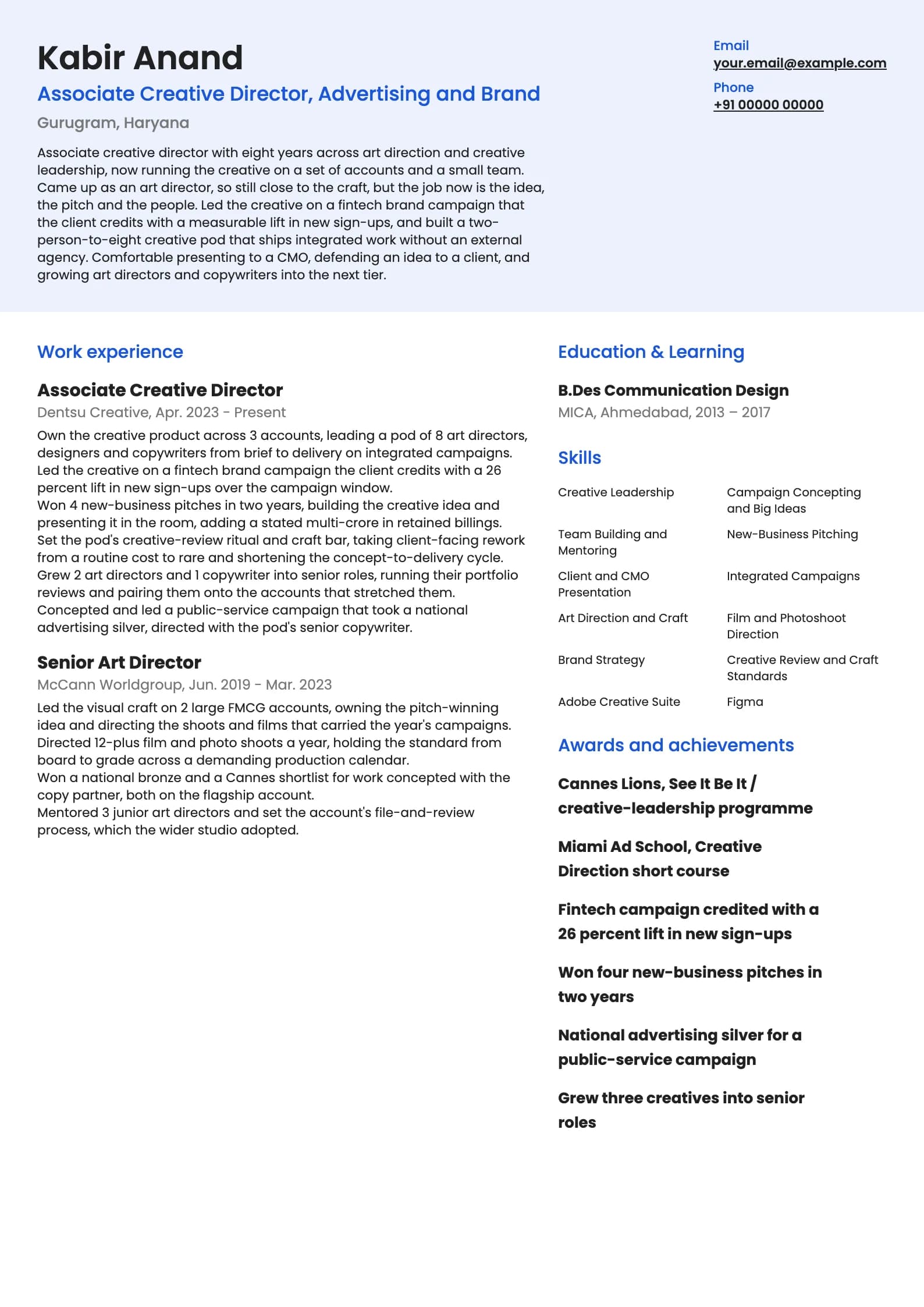
Build my resumeCreative Director resume example, Associate Creative Director (8 years)
modern templateIs your resume good enough?
Upload the resume you have now and see what an applicant tracking system reads before a creative director recruiter ever does.
Free to run. Sign in with your mobile number to see your score.
Creative Director resume example, Creative Director (13 years)
header-band template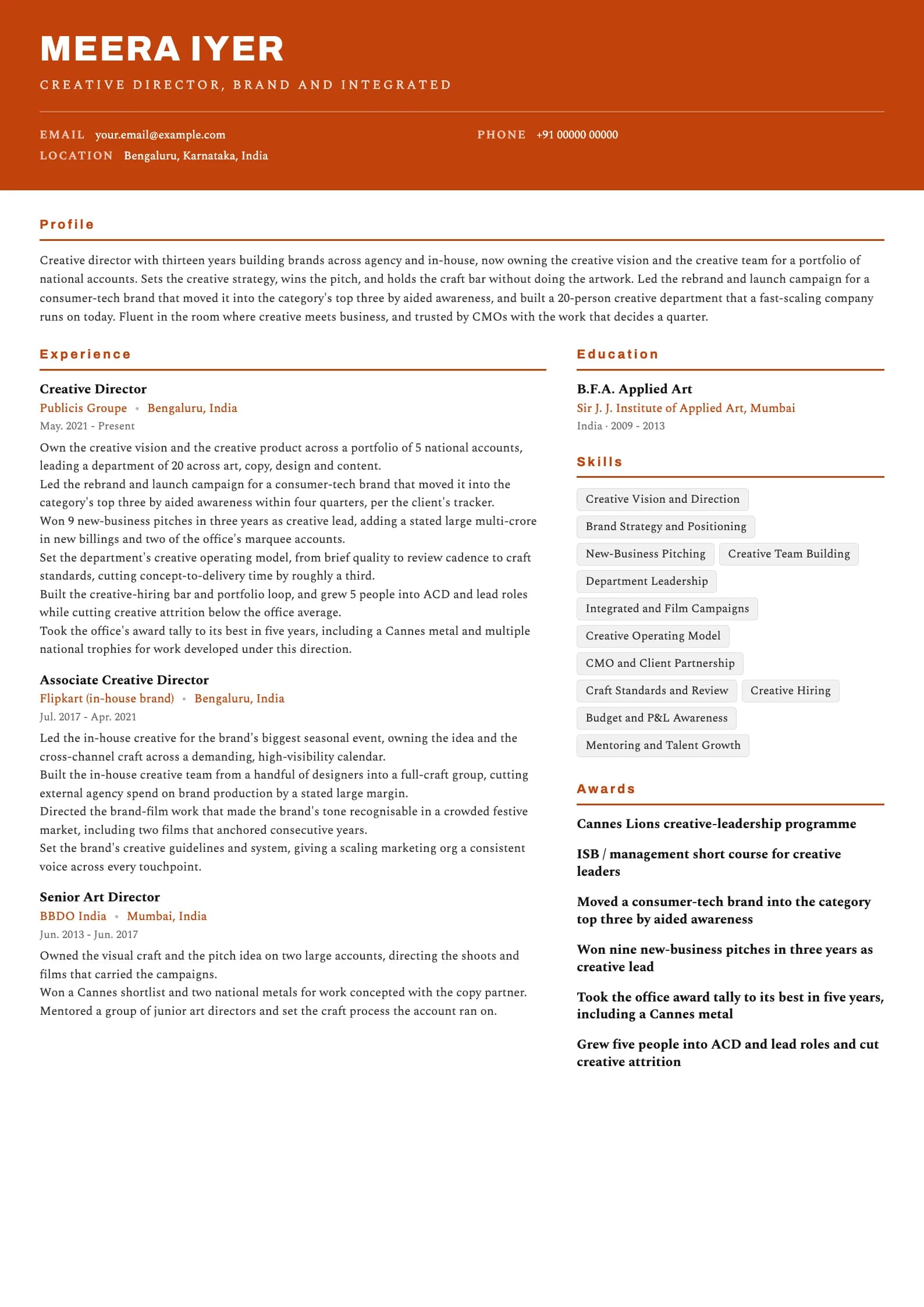
Want this structure with your own details? Build it in the resume builder.
Creative Director resume example, Executive Creative Director (18 years)
professional template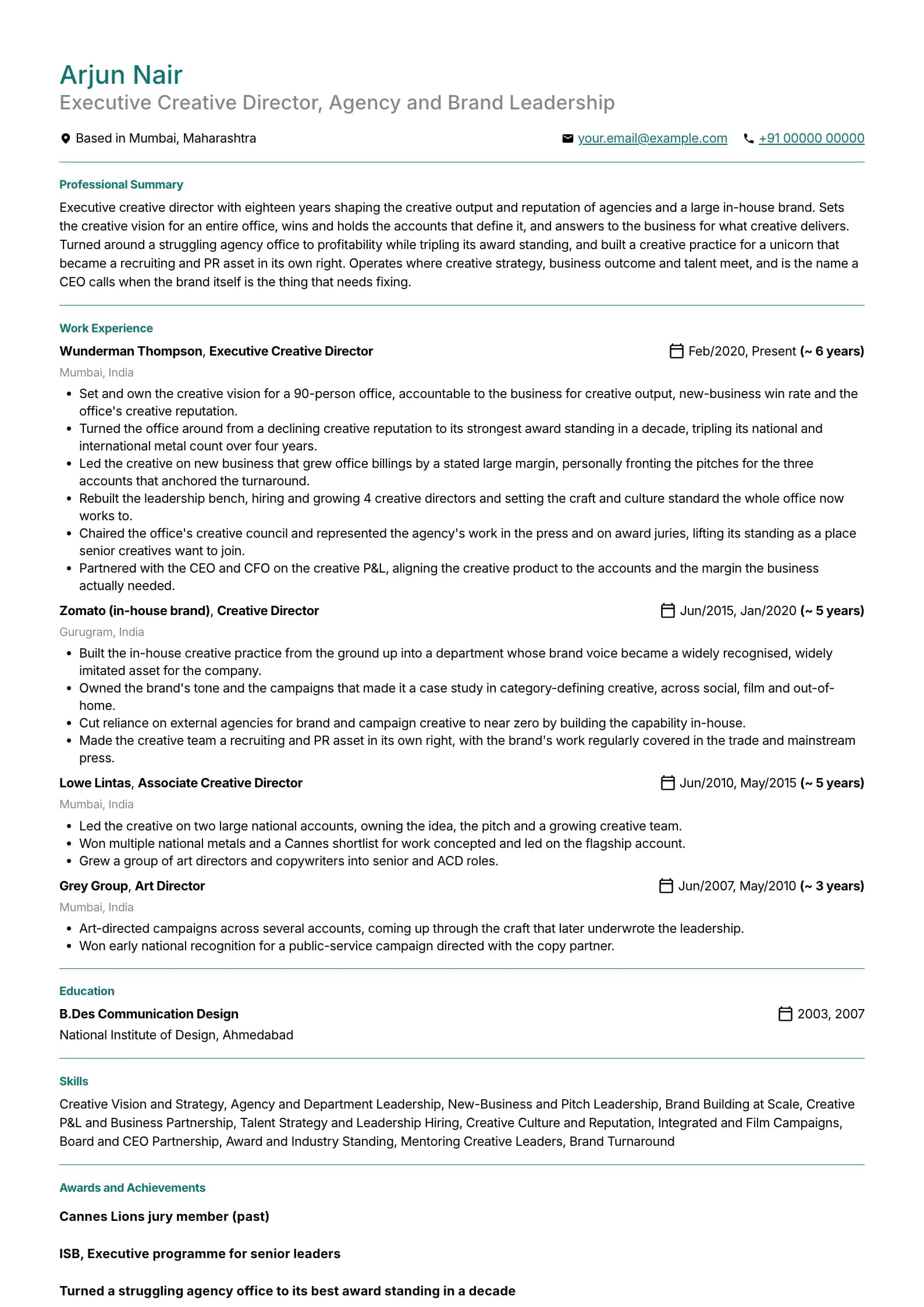
The format that works for creative director resumes in India
Reverse chronological, most recent role first, and at this level the career arc itself is part of the argument: art director to senior to ACD to CD is a story a reader should be able to trace at a glance. Keep the dates honest and visible, because a creative leader hiding a timeline reads far worse than one explaining a deliberate move. The portfolio still matters, but its role shifts. For a creative director the book is a team body of work and a set of case studies, not a personal craft reel, and the resume increasingly carries the weight because the reader, a CMO, a founder, a CEO, a head of talent, is judging leadership and business impact as much as taste. Link the book, but write the resume as if it will be read carefully, because at this level it will be. Two pages is normal and expected for a creative director with a decade or more, because the leadership, the accounts, the pitches won and the people grown do not compress onto one page honestly. What does not belong on page two is a software list or a decade-old junior project. Every line should earn its place with scope, outcome or leadership. Send a PDF, name it with your own name and the level, and keep the document clean and confident rather than heavily designed. A creative director's judgement is on trial from the first impression, and a restrained, well-set resume signals it better than a gradient-heavy showpiece. The table below sets out the section order.
| Section | Where it goes | Why |
|---|---|---|
| Name, headline and links | Top, above everything | Level in the headline (CD, ECD). A link to a team-work portfolio or case studies, plus LinkedIn. |
| Executive summary | Directly under the header | Three to four lines. What you lead, the scale, and the strongest business-and-creative result. |
| Leadership experience | Next, the core of the page | Most recent first. Lead each role with the creative product owned, the team, and the outcome. |
| Selected campaigns or case studies | A short block, or folded into experience | Two or three flagship stories: the challenge, the idea, the business result. |
| Awards and industry standing | Its own block | Cannes, Effie, Abby, Kyoorius. Metals, juries, speaking. This is currency at this level. |
| Skills and expertise | Below experience | Leadership, strategy, craft. Not a software wall. Kept short. |
| Education | Bottom | Design or fine-art degree, plus any leadership or management programme. |
This resume leads with judgement and business, not craft
The single biggest mistake a rising creative writes is a creative director resume that still reads like an art director's: a list of campaigns designed and tools used. By the time you are a CD, nobody doubts you can make things. They are asking a different question. Can you decide what the work should be, get a team to produce it, win the account that funds it, and answer to the business for the result. The resume has to answer that question, not the old one. That means leading each role with the creative product you owned and the scale of it, not the artwork you personally touched. Own the creative across five accounts, lead a department of 20, set the creative vision for a 90-person office. These lines locate you in the hierarchy in one read. The craft that got you here supports the story, it no longer is the story. Business outcomes belong at the front. A creative director is hired to move something the company cares about: awareness, sign-ups, sales, a successful launch, a turnaround, new billings won in a pitch. A resume full of beautiful work and empty of business results reads as a strong art director who has not yet made the leap, and it will be read against candidates who have. State the number the client or the company actually counted. And the people are a deliverable. At this level your output is partly the creatives you built and the culture you set. Grew five people into leadership, cut creative attrition, set the craft bar the office works to. These are not soft extras, they are core evidence that you can run a creative organisation and not just be its most talented individual.
Read each of your bullets and ask: does this show me making the work, or leading it. A creative director resume needs mostly the second kind. If your page is still mostly the first, you have written an art director resume with a bigger title on top.
Writing an executive summary a CMO or founder reads
The block under your name is read carefully at this level, often by a non-creative decision-maker, so it should carry four things: what you lead and at what scale, how long you have led, the single strongest business-and-creative result, and the shape of leader you are. Three or four lines, and every one should survive a skeptical CFO reading it. Drop the craft-era adjectives entirely. Visionary, passionate, award-winning creative leader is the summary equivalent of a blank page, because every CD claims it. Replace it with the specific: the creative director who moved a consumer-tech brand into the category top three and built the department that scaled it. The proof is the adjective. Say what kind of creative leader you are, because the title covers several jobs. An agency CD who wins new business is not the same hire as an in-house CD who builds a brand voice, who is not the same as an ECD who turns around an office. The summary should signal which, so a founder hiring their first brand leader and a network agency filling a group role can both tell in three lines whether to keep reading. A useful test: could another creative director at your level, in a different city, sign their name to your summary. If yes, it describes the title, not you. Add the specific account, the specific business number and the specific organisation you built until it could only be about your career.
Executive summary, creative director
Weak
Visionary and award-winning creative director with 13+ years of experience delivering innovative, out-of-the-box campaigns for leading brands, passionate about building great creative teams.
Strong
Creative director with thirteen years across agency and in-house, owning the creative vision and team for a portfolio of national accounts. Moved a consumer-tech brand into the category top three by aided awareness and built the 20-person department that scaled it.
The rewrite trades four unprovable adjectives for the scale led, a business outcome the client tracked, and the organisation built, which is what a decision-maker is actually screening for.
Experience bullets: what you led, at what scale, to what end
A creative director bullet has a different shape from an art director's. It opens with what you led or owned, states the scale, the team, the accounts, the office, and closes with the outcome, a business result, an award standing, a pitch won, a person grown. The leadership verb replaces the craft verb. You are no longer the one who designed it, you are the one who decided it and got it made. Lead with outcomes the business counted, then attach the creative and the leadership behind them. Rising creatives instinctively write the work first and the result as an afterthought, which produces led the creative on a fintech campaign, when the reader wants led the creative on a fintech campaign the client credits with a 26 percent lift in sign-ups. Start from the number the company cared about and work back to the creative that produced it. Mix your proof types, because creative leadership is judged on several axes at once. Business results, awareness, sales, sign-ups, launches. New business, pitches won, billings added. Awards, metals and juries. Team, people grown, attrition, hiring bar. Operations, review cadence, delivery time, operating model. A resume that is all awards reads as a portfolio, and one that is all business reads as a suit. The best CD resumes carry all five. Where a hard number is genuinely confidential, give scale and direction honestly: a stated large multi-crore in new billings, moved into the category top three, tripled the award count. Vague is a real risk here, because senior readers are skeptical, so anchor every claim to something a reference call could confirm.
| Level | What bullets must prove | Typical proof |
|---|---|---|
| Associate creative director | You own the creative product and lead a team | Accounts owned, pod led, a business result, pitches won, people grown |
| Creative director | You set the vision and run a creative department | Department size, brand outcome, pitch record, operating model, leaders grown |
| Executive / group CD | You own the office's creative product and its business | Office scale, turnaround, win rate, P&L partnership, leadership bench built |
| Chief creative / brand leader | You are accountable for the brand and the creative org | Company-level brand impact, reputation, talent strategy, board partnership |
Experience bullet, creative leadership
Weak
Led a team of creatives and worked on multiple award-winning campaigns for various clients across different categories.
Strong
Won nine new-business pitches in three years as creative lead, adding a stated large multi-crore in new billings and two of the office's marquee accounts.
"Led a team" and "various clients" describe a title; the rewrite names the pitch record, the billings added and the accounts won, which is the business a CD is hired to move.
Experience bullet, in-house creative leadership
Weak
Managed the in-house creative team and was responsible for maintaining brand consistency across all marketing channels.
Strong
Built the in-house creative team from a handful of designers into a full-craft department, cutting external agency spend on brand production by a stated large margin.
Swaps "managed" and "brand consistency" for the organisation you built and the cost you took out, which shows leadership and a business result rather than a maintenance role.
Every senior claim on this page should be one a reference call could confirm. Senior readers are skeptical by default, so a vague superlative hurts you, while a specific, checkable number, even a directional one, builds the trust the whole hire runs on.
Proving new business and creative judgement on paper
The two things a creative director is really being bought for, judgement and the ability to win and hold business, are the two hardest to show on a resume, because neither is a deliverable you can screenshot. The resume proves them indirectly, through pattern and outcome, and the candidates who do it well stand out precisely because most CD resumes forget to. Judgement shows through the arc and the choices. The accounts you were trusted with, the turnarounds you were handed, the standard you set that others adopted, the people who got promoted under you. A reader infers judgement from a career where responsibility compounded, so make the compounding visible: bigger accounts, bigger teams, harder briefs, higher stakes, in that order down the page. New business is more concrete, so state it plainly. Pitches led, pitches won, win rate, billings added, accounts retained and grown. In Indian agency hiring, a creative director's new-business record is a primary hiring criterion, and a resume that omits it entirely reads as someone who has never carried that pressure. If your wins are under NDA, give the shape: won the majority of pitches led over three years, added the two accounts that anchored the office. Case studies are where judgement becomes legible. A short block or two of challenge, idea, result, the brief nobody could crack and the idea that did, the brand in decline and the campaign that turned it, does more to prove creative judgement than any adjective. Pick two or three that show range, one business turnaround, one brand-defining piece of craft, one team or capability you built, and tell each as a three-beat story, not a paragraph of praise.
New-business claim on a CD resume
Weak
Played a key role in several successful pitches and helped the agency win new clients.
Strong
Won nine of the twelve new-business pitches I led as creative director over three years, including the two accounts that anchored the office's growth.
"Played a key role" and "several" hide the record behind hedged language; the rewrite states the win rate and the accounts, which is the number an agency actually hires a CD on.
The skills and expertise section at leadership level
By creative director, the skills section is the least important block on the page and the easiest to get wrong. Nobody hires a CD off a skills list, and a CD resume that leans on one, especially a software list, actively signals someone who has not made the leap from craft to leadership. Keep it short, keep it senior, and let the experience carry the weight. Weight it toward leadership and strategy, not tools. Creative vision, brand strategy, new-business pitching, team building, creative operating model, P&L awareness. These are the capabilities the role is actually bought for, and a reader scanning a CD resume wants them named. Craft skills can appear, but as background, the foundation you lead from, not the headline. Drop the Adobe wall entirely at this level, or reduce it to a single line noting you remain hands-on if that is true and relevant, for instance at a startup where a CD still makes things. Listing ten design apps on a creative director resume reads as clinging to the old job, and a founder reading it wonders whether you can actually operate at the level of the title. Skip proficiency bars and buzzword clouds. A creative leader claiming five stars in leadership on a graphic is a contradiction a skeptical reader will enjoy at your expense. The strongest signal of your expertise is not a list at all, it is a set of experience bullets where the scale and the outcomes make the capabilities self-evident.
Skills section, creative director
Weak
Skills: Photoshop, Illustrator, InDesign, After Effects, Premiere, Figma, Sketch, XD, Leadership, Creativity, Team Management, Communication, Time Management, Branding, Advertising
Strong
Expertise: creative vision and direction, brand strategy, new-business pitching, creative team building and hiring, creative operating model and P&L awareness. Foundation in art direction and film craft.
Replaces a design-app wall and generic soft skills with the leadership and business capabilities the role is bought for, keeping craft as a one-line foundation rather than the headline.
Where education, awards and industry standing belong
Education goes at the bottom for a creative director, because eighteen years of leadership vastly outweighs where you studied. A design or fine-art degree is worth naming, and a strong pedigree, NID, MICA, JJ, still registers, but it is a footnote to the career, not a headline. What is newly worth adding at this level is any leadership or management programme, an ISB or IIM executive course, a Cannes creative-leadership programme, because it signals to a business-side reader that you take the management half of the job seriously. Awards and industry standing deserve a proper block of their own, high on the page, because at leadership level they are hard currency and a proxy for the creative culture you build. Name the metals, the shows and the years, and add the things that only accrue to senior creatives: juries you have sat on, talks you have given, trade coverage of your teams' work. A CD who has judged at Cannes or spoken at Goafest carries a standing that a business reader recognises even without knowing the craft. Be scrupulously honest about credit, because the industry is small and the room is connected. A metal your team won under your direction is fairly claimed as work developed under you; a metal you personally art-directed is a different, more specific claim; a shortlist is not a win. Blur these and someone on a jury or a former colleague will notice, and at this level a single inflated credit can end a candidacy that the work would otherwise have carried. Certifications in the technical sense barely feature here. Nobody appoints a creative director on a badge. The one adjacent credential worth naming is a business or leadership programme, precisely because it addresses the part of the job the craft years did not teach, and it reassures the CFO in the room that the creative leader can also read a P&L.
The resume still has to pass a filter, even at this level
It is tempting to assume a creative director role is filled entirely through network and reputation, and often the introduction is, but the resume still lands in an applicant tracking system or in front of an HR or talent partner who screens against a brief before the CMO or founder sees it. Senior candidates lose here in a distinctive way: they over-design the document or write it entirely in industry language a non-creative screener does not match. The layout rules do not change with seniority. One column, standard headings, real selectable text, no critical information trapped in a header graphic, no resume-as-flat-image. A creative leader's resume built as a designed showpiece is the most common self-inflicted wound at this level, because it both signals the wrong priority and fails to parse, and the parse failure is invisible to you until the callback does not come. Use the business language the brief uses, alongside your craft language. A talent partner searching for creative director, new business, brand strategy and team leadership will not match a page written only in visionary storyteller and craft. You can have both: lead with the plain title and the business terms so the filter and the non-creative screener catch you, and let the case studies carry the craft voice for the creative reader who follows. Keep the real title on the page. If your card said chief imagination officer, put creative director or executive creative director as the functional title too, because that is what everyone downstream, the ATS, the recruiter, the search firm, is actually looking for. The whimsical title is a fine flourish once the functional one has done its job of getting you found.
Two readers screen a CD resume before the decision-maker: a parser and a non-creative talent partner. Write for both. Plain title, business keywords and clean formatting get you through the gate; the case studies and the book win the room on the other side of it.
What stalls creative director resumes
A creative director career rarely stalls on talent at the resume stage, it stalls on a resume that fails to translate that talent into the language a senior hire is decided in. The problems below are what CMOs, founders, agency leadership and executive search partners see most often on Indian creative-leadership resumes, in rough order of damage.
- An art director resume with a bigger title on top: campaigns designed and tools listed, when the reader needs vision, scale, business impact and team led.
- No business outcomes anywhere. Beautiful work with no awareness, sales, sign-up, launch or new-business number reads as craft that has not made the leap to leadership.
- No new-business record. In agency hiring this is a primary criterion, and omitting it reads as someone who has never carried the pitch pressure.
- A software wall on a leadership resume, which signals clinging to the old job and makes a founder doubt you operate at the level of the title.
- Vague superlatives to skeptical senior readers: several successful campaigns, key role, various clients. At this level, unspecific equals unbelievable.
- Inflated or blurred award credit in a small, connected industry, where a shortlist written as a win or a team metal claimed as personal is a single-line candidacy-ender.
- The resume over-designed into a showpiece, which signals the wrong priority and quietly fails to parse in the ATS a talent partner runs it through.
- A whimsical title, chief imagination officer, with no functional creative director on the page, so search firms and parsers never find you.
- The people you built left off entirely, missing the core leadership proof that you can run a creative organisation and not just be its best individual.
- One dense page cramming eighteen years, or a bloated three pages of every project since college. Two focused pages of leadership and outcomes is the level.
Give your resume to a business-side friend, a founder, a marketing head, a finance person, and ask them what you would be hired to do and what you have moved. If they cannot answer from the page, you have written for the creative department, not for the person who signs off the hire.
Skills to put on a creative director resume
Technical
- Creative Vision and Direction
- Brand Strategy and Positioning
- Campaign Concepting and Big Ideas
- Integrated and Film Campaigns
- New-Business Pitching
- Creative Operating Model
- Art Direction and Craft Standards
- Copy and Content Direction
- Creative Team Building
- Design Systems and Brand Guidelines
- Storytelling
- Creative P&L Awareness
Tools and platforms
- Adobe Creative Suite
- Figma
- Keynote and pitch decks
- Miro
- Behance
- Frame.io
- Notion
- Google Workspace
Working skills
- Creative leadership
- CMO and client partnership
- Pitch presentation
- Talent development and mentoring
- Creative hiring
- Culture building
- Stakeholder management
- Decision-making under pressure
- Cross-functional collaboration
Certifications worth listing as a creative director
| Certification | Full name | Worth it for |
|---|---|---|
| Cannes Lions leadership | Cannes Lions creative-leadership programme (e.g. See It Be It, Creative Leaders) | Worth naming for a rising or established creative director, both for the network and as a signal that you invest in the leadership half of the job. Most valuable when you are stepping from craft into running teams and want a recognisable marker of creative-leadership intent on the page. |
| ISB / IIM executive | ISB or IIM short executive programme for leaders | Genuinely useful for a creative director moving into P&L, agency management or a brand-leadership role, because it addresses the business side the craft years did not teach and reassures a CFO in the room. Signals you can read a balance sheet as well as a storyboard. Skip it if your path stays purely creative and craft-led. |
| Effie / brand-effectiveness | Effie College or a brand-effectiveness programme | Relevant for creative leaders who want to prove creative tied to business outcomes, which is exactly the axis on which modern CD hiring turns. Pairs well with a resume that already leads on results. Less important if your standing rests on craft awards, though effectiveness credentials are rising in weight. |
| Design leadership | A recognised design or creative-leadership course (e.g. IDEO U, RGD, D&AD Masters) | Worth it for in-house and product-adjacent creative directors who lead across brand and product design and want a leadership credential beyond advertising awards. Signals range to a tech or consumer employer. For a pure advertising CD it is optional, since the award record and the accounts speak louder. |
Keywords an ATS scans for in a creative director resume
These are the literal terms a parser matches against the job description. Use the ones that are true of you, in the sentences where you did the work, not as a list at the bottom.
- creative director
- executive creative director
- creative leadership
- brand strategy
- advertising
- campaign
- new business
- pitching
- integrated campaigns
- creative vision
- team leadership
- art direction
- brand building
- creative team
- concept development
- mentoring
- cmo
- creative strategy
- film
- portfolio
Creative Director resume FAQ
What salary can a creative director expect in India?
An associate creative director typically earns around 18 to 32 LPA, a creative director with a decade or more commonly sits in the 30 to 60 LPA band, and an executive or group creative director frequently earns 55 LPA to a crore and beyond, more at leading agencies, unicorns and large in-house brand teams. A strong new-business record, a turnaround on the CV and award standing all push the top of every band upward, and in-house creative-leadership roles at large tech and consumer companies often pay above agency scale.
How long should a creative director resume be?
Two pages is normal and expected for a creative director with a decade or more, because the leadership, accounts, pitches won and people grown do not compress onto one page honestly. What does not belong is a software list or a decade-old junior project padding out page two. Every line should earn its place with scope, business outcome or leadership, and two focused pages beat one crammed page or three bloated ones.
Is there such a thing as a fresher creative director?
No. Creative director is a leadership role you reach after years of craft and rising responsibility, typically art director to senior art director to associate creative director to creative director. If you are early in your career and aiming this way, build the art director or graphic designer resume instead and let the responsibility compound. The samples above start at associate creative director, which is where the CD track actually begins.
Does a creative director still need a portfolio?
Yes, but its role shifts. Instead of a personal craft reel it becomes a set of case studies and a team body of work, the campaigns produced under your direction told as challenge, idea and result. Link it, but write the resume to be read carefully, because the decision-maker, often a CMO or founder, is judging leadership and business impact as much as taste, and at this level the resume itself carries real weight alongside the book.
What matters most on a creative director resume?
Judgement, business impact and the ability to win and hold business, in that combination. Lead each role with the creative product you owned and its scale, attach the outcome the company counted, awareness, sales, sign-ups, a launch, a turnaround, and name your new-business record and the people you grew. A resume of beautiful work with no business results reads as a strong art director who has not yet made the leap, so make the leadership and the outcomes the headline.
How do I show new business and pitch wins on my resume?
State them plainly, because in Indian agency hiring a creative director's new-business record is a primary criterion. Name pitches led, pitches won, your win rate, billings added and accounts retained and grown. If wins are under NDA, give the shape honestly, for example won the majority of pitches led over three years and added the two accounts that anchored the office. A resume that omits new business entirely reads as someone who has never carried that pressure.
Do awards still matter for a creative director?
Yes, they are hard currency and a proxy for the creative culture you build, so give them a proper block high on the page: name the metals, the shows and the years, plus juries you have sat on and talks you have given. Be scrupulous about credit, though, because the industry is small and connected. A team metal is fairly claimed as work developed under your direction, a shortlist is not a win, and a single inflated credit can end a candidacy the work would otherwise have carried.
Should my creative director resume list design software?
Mostly no. By this level tool fluency is assumed, and a wall of Adobe apps on a leadership resume signals someone clinging to the old craft job. Weight the skills block toward creative vision, brand strategy, new-business pitching, team building and P&L awareness, and reduce software to a single line, or drop it, unless you are a hands-on CD at a startup where it is genuinely relevant. Let the experience and the outcomes prove your capability, not a list.
Does a creative director resume need to pass an ATS?
Often yes, because even senior roles route through an applicant tracking system or a talent partner who screens against a brief before the decision-maker sees it. Use one column, standard headings and real selectable text, avoid the designed-showpiece resume that fails to parse, and keep the plain functional title, creative director or executive creative director, plus business keywords on the page alongside your craft language, so the filter and the non-creative screener catch you before the CMO ever does.
Related resume examples and guides
Build your own in any of these formats
Start from a blank resume or upload the one you have. Goodspace renders it in 24 clean, parser-safe templates and flags the leadership, new-business and business-outcome language a CMO, founder or search partner is scanning for, so your resume proves the leap from craft to creative leadership.
Build my resume