Brand Manager Resume Format, with 3 Full Samples
A brand manager owns a brand's P&L, its share of a category and the launches that grow it, so the resume is judged on numbers that read like a business, market share gained, volume grown, a launch landed, a margin protected. Yet most brand manager resumes in India describe activities, ran campaigns, coordinated agencies, managed packaging, without the share, the volume or the P&L line behind them. Below are three complete resumes, one for an assistant brand manager fresh out of an MBA, one for a brand manager owning a category, and one for a senior brand manager running a portfolio. After the samples come the format rules, the difference between running brand activity and owning a brand, the terms a parser matches literally, and the mistakes that end a screening before a human reads the page.
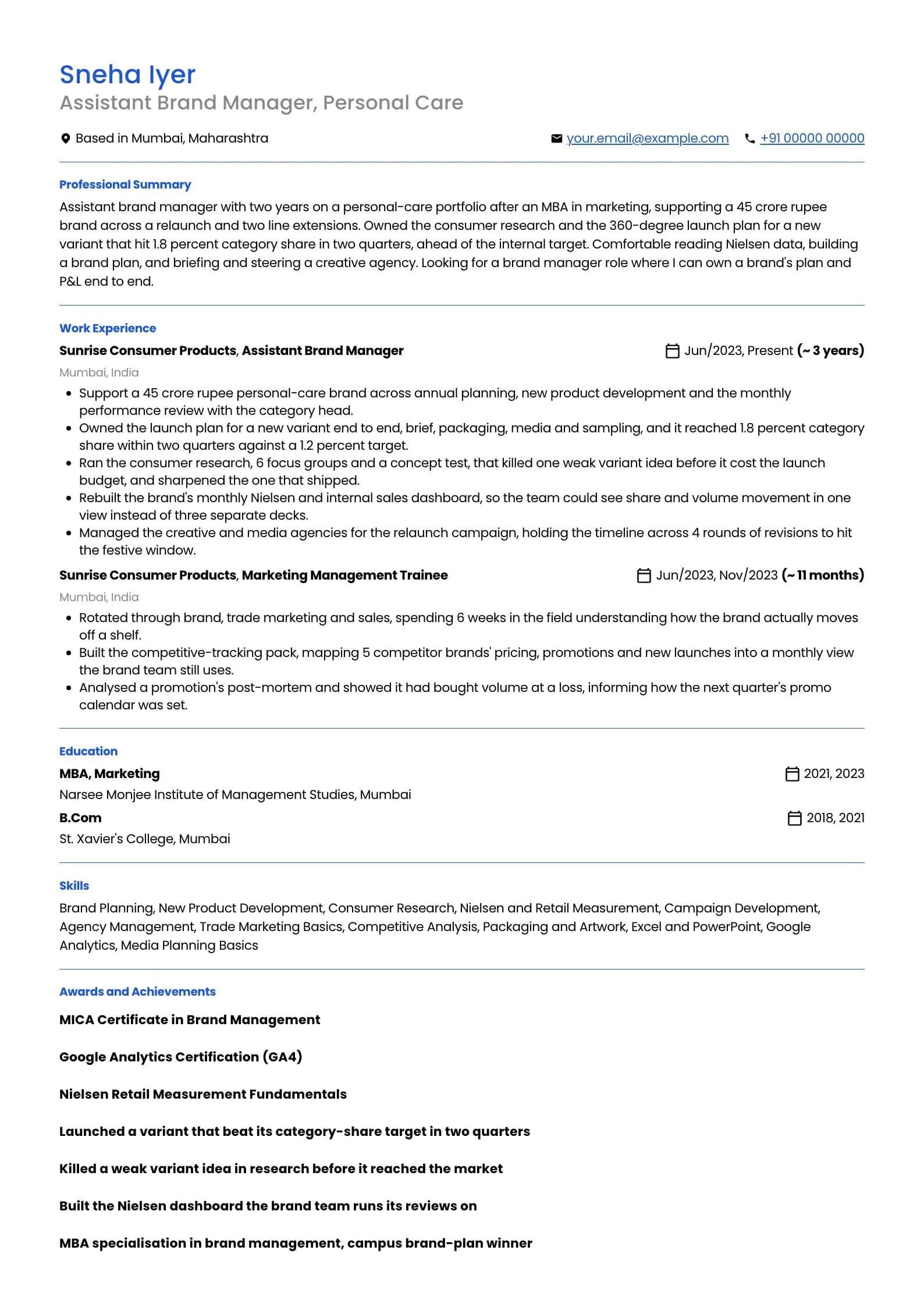
Build my resumeBrand Manager resume example, Assistant Brand Manager (2 years)
minimalist templateIs your resume good enough?
Upload the resume you have now and see what an applicant tracking system reads before a brand manager recruiter ever does.
Free to run. Sign in with your mobile number to see your score.
Brand Manager resume example, Brand Manager (6 years)
modern template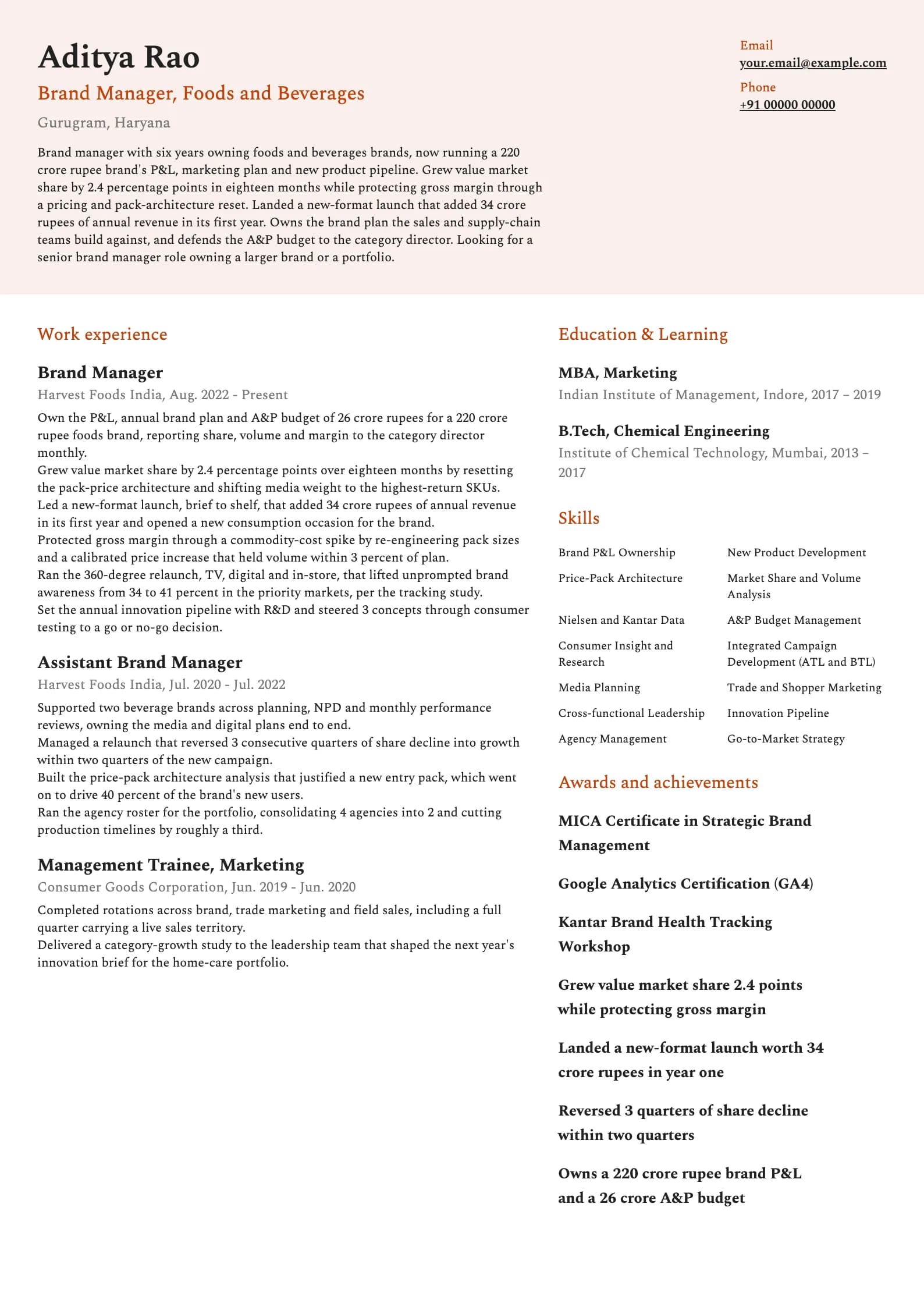
Want this structure with your own details? Build it in the resume builder.
Brand Manager resume example, Senior Brand Manager (11 years)
professional template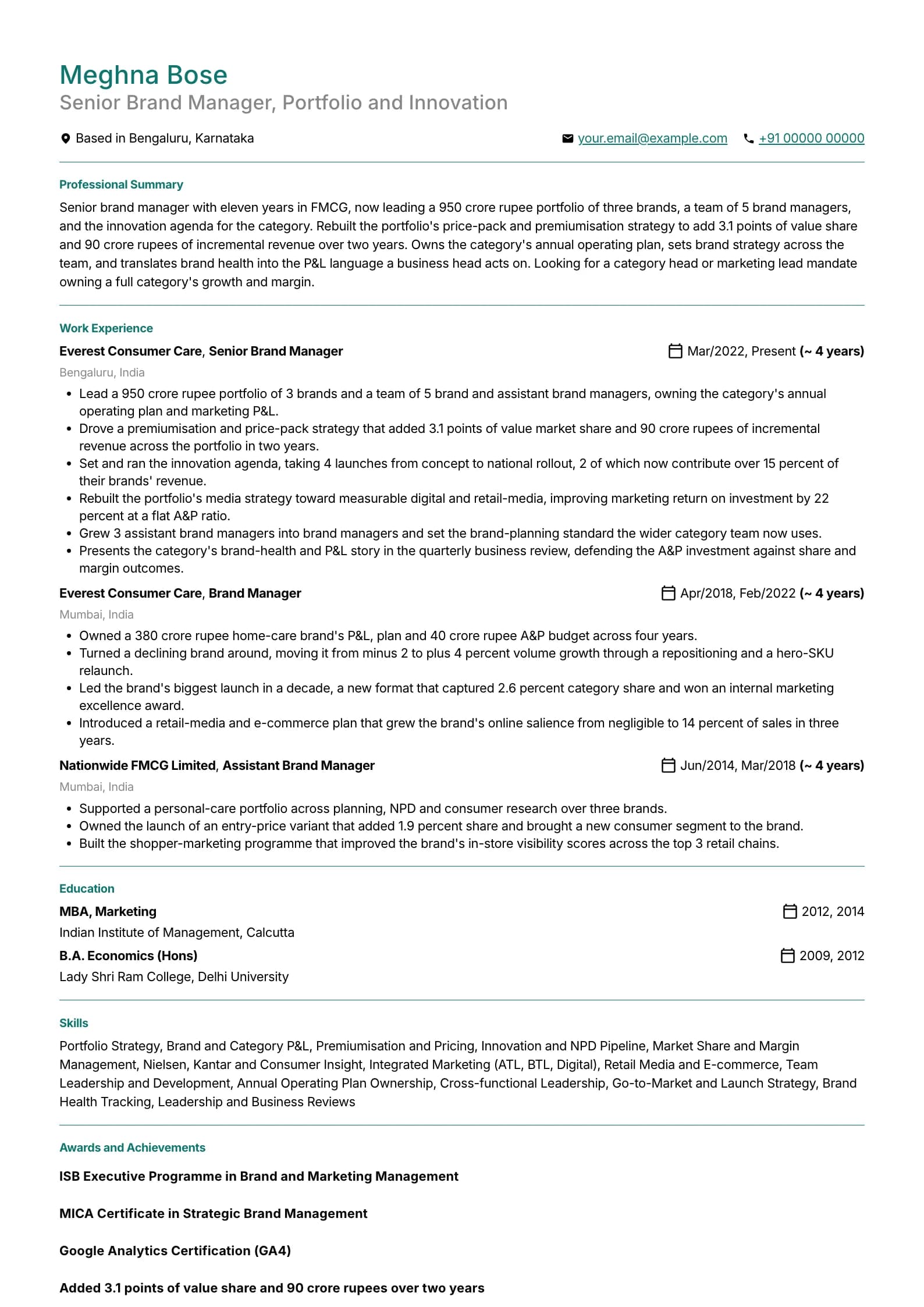
The format that works for brand manager resumes in India
Reverse chronological is the layout to use. Most recent role first, work backwards, dates in plain view. Functional resumes that group everything under Key Achievements and quietly drop the dates read as an attempt to hide a gap or a sideways move, and reviewers treat them that way. A career move is better explained in one honest line than buried. Length is decided by seniority. One page holds an assistant brand manager and most brand managers up to roughly seven years. A senior brand manager running a portfolio earns a second page, but only if page two carries real scope, brands owned, P&Ls run, launches landed, and not a hobbies line and a declaration paragraph. Four things belong nowhere on a brand manager resume: a photograph, date of birth, marital status and father's name. They survive from an older template that circulated through campus placement cells. Nobody hiring someone to run a brand P&L is looking for them, and every line they occupy is a line a launch or a share number could have used. Send a PDF unless the posting asks for DOCX, and name the file with your own name and the target role rather than resume_final_v4. Use a single column all the way down, because two-column layouts parse unpredictably when a skills sidebar sits beside the experience. The table below sets out the section order.
| Section | Where it goes | Why |
|---|---|---|
| Name and headline | Top, above everything | The headline is the role and category, brand manager, foods or personal care. Recruiters match on it. |
| Professional summary | Directly under the header | Three lines. Brand and P&L owned, and the single strongest share or launch result. |
| Work experience | Next, always | Most recent first. Newest role gets the most bullets, each ending in a business number. |
| Skills | Below experience | Grouped: brand strategy, insight and data, campaign, leadership. Not a 30-item wall. |
| Education | Bottom, unless it is a recent brand-management MBA worth leading with | Degree, institution, years. Drop the percentage after your first role. |
| Certifications | After education, or beside skills if only one or two | MICA, Nielsen, GA4. Name, body, year. |
| Achievements | Optional, if they do not repeat the bullets | A short strip for the two or three share, launch or margin numbers that define you. |
Running brand activity is not the same as owning a brand
The single most common brand manager resume failure is a page of activities: coordinated with the agency, managed packaging artwork, ran the digital campaign, organised the sampling drive. Every line describes a task, and not one names the share it moved, the P&L it sat inside or the launch it added up to. A parser matches the marketing terms, but a category director reads the wall and cannot tell whether you owned the brand or merely executed its calendar. The fix is to move from activity to ownership and to attach the business number a brand manager actually carries. "Ran the campaign" is an assistant's line. "Grew value market share by 2.4 points in eighteen months while protecting gross margin" is a brand manager's line: it names the outcome, the timeframe and the trade-off managed. Brand management is judged on share, volume, revenue, margin and successful launches, so those are the numbers that belong at the front of a bullet. Name the P&L and the budget. A brand manager who does not state the size of the brand they run and the A&P budget they control has left out the two facts that fix the level. "Own the P&L and 26 crore rupee A&P budget of a 220 crore rupee brand" answers in one line the question every interviewer is going to ask. Show the trade-offs, because that is where brand craft lives. Anyone can buy share by cutting price; growing share while protecting margin, or holding volume through a cost-driven price increase, is the skill a good brand manager is hired for. A resume that shows both sides of that ledger reads as someone who has actually run a P&L, not just spent an A&P line.
For every brand line on your resume, ask: does it name the share, the P&L, the launch or the margin I moved. If it names only the activity, it is an executor's line. Rewrite it until the ownership and the business number show.
Writing a summary a category director actually reads
The block under your name is the part you can be reasonably sure gets read, so it should carry three facts: the brand and P&L you own, the scope of it, and the strongest business result you drove. Three or four lines, no adjectives that cannot be checked. The old objective line, seeking a challenging brand management role in a reputed FMCG company to leverage my marketing skills, tells the reader nothing they did not assume from the application. Replace it with a summary. An objective describes what you want, a summary describes the brand you have already grown, and only one is evidence. Brand managers often understate their scope. Do the opposite. If you run a 220 crore brand and a 26 crore A&P budget, lead with it, because the next role is deciding whether you can handle a bigger P&L, and your current numbers are the only proof it has. A summary that says "dynamic brand professional" and omits the P&L has thrown away its strongest card. A practical test: read your summary and ask whether the brand manager on the next brand in your company could paste it onto their resume unchanged. If they could, it describes the company, not you. Add the specific brand size, the specific share number and the specific launch until it stops being transferable.
Professional summary, brand manager
Weak
Dynamic and result-oriented brand manager with 6+ years of FMCG experience in branding, marketing and product management, seeking a challenging role in a reputed organisation.
Strong
Brand manager with six years in foods and beverages, now owning a 220 crore rupee brand's P&L and a 26 crore A&P budget. Grew value share by 2.4 points while protecting margin, and landed a new-format launch worth 34 crore rupees in year one.
The rewrite trades self-description for the brand and P&L owned, the share moved and a launch with a revenue number, all of which a director can probe.
Experience bullets: verb, brand initiative, business result
Every strong bullet in the samples follows the same shape. It opens with an ownership verb, names the specific brand initiative you drove, a relaunch, a launch, a price-pack reset, and closes with the business number that moved. The verb establishes accountability. The initiative tells a reviewer what kind of brand work you do. The number does the persuading. Start with the outcome and work backwards. Brand managers usually write the activity first, then struggle to attach a result, which produces lines like "handled the relaunch of the brand across all touchpoints". Instead ask what was different in the business after your year: a share point gained, a volume trend reversed, a launch that hit its number, a margin protected through a cost spike. Then write the sentence that ends in that fact. Vary the metric. Five share numbers in a row read as one trick repeated. Across a real role you can honestly reach for value and volume share, revenue, gross margin, brand awareness and recall, A&P efficiency, launch revenue and distribution or salience. The brand-manager sample uses several across its bullets, which reads as someone who understands the whole P&L, not just the media plan. Where you lack a clean number, give scope: how large a brand, how big an A&P budget, how many SKUs or markets, how long a turnaround took. "Owned the P&L and 40 crore rupee A&P budget of a 380 crore rupee brand across four years" carries weight without inventing a percentage. Allocate bullets by recency. Current role gets five or six, the previous role four or five, anything older two or three.
| Level | What bullets must prove | Typical metric |
|---|---|---|
| Assistant BM (0 to 2 yrs) | You can own a slice, a launch or a plan, and read the data | Launch share, research that changed a call, dashboard built |
| Brand Manager (3 to 7 yrs) | You own a brand's P&L, plan and A&P | Value or volume share, revenue, margin, launch revenue |
| Senior BM (8 to 11 yrs) | You own a portfolio and set strategy across it | Portfolio share, premiumisation, marketing ROI, managers grown |
| Category head (11 yrs and up) | You own a category's growth, margin and team | Category P&L, incremental revenue, innovation contribution |
Experience bullet, brand growth
Weak
Responsible for the relaunch of the brand across all touchpoints to improve brand image and market presence.
Strong
Grew value market share by 2.4 percentage points over eighteen months by resetting the pack-price architecture and shifting media weight to the highest-return SKUs.
"Responsible for" describes a brief; the rewrite names the share moved, the timeframe and the two levers that did it.
Experience bullet, product launch
Weak
Successfully launched a new product in the market which was well received by consumers and performed well.
Strong
Led a new-format launch, brief to shelf, that added 34 crore rupees of annual revenue in its first year and opened a new consumption occasion for the brand.
"Performed well" is unfalsifiable; the rewrite gives a revenue number and the strategic reason the launch mattered.
If a bullet would read identically on the next brand manager's resume, it is describing the company, not you. Rewrite it until it only fits the brand and P&L you actually owned.
The skills section: grouped, honest and short enough to defend
A brand manager's skills section has two audiences with opposite preferences. The parser wants literal terms it can match, brand P&L and Nielsen and NPD. A human wants a short, organised list that signals what kind of brand marketer you are. Grouping satisfies both. Group by function rather than one long line. Brand strategy, insight and data, campaign and go-to-market, and leadership is a grouping that works for almost every brand manager. The exact headings matter less than the fact that structure exists. Write names the way the industry writes them: Nielsen and Kantar, A&P not adspend if the company uses A&P, price-pack architecture spelled out. A parser matches on strings. Twelve to sixteen skills is the working range. Below eight the section looks thin. Above twenty it stops being a signal. Keep the strategic skills, P&L ownership, price-pack architecture, premiumisation, innovation pipeline, ahead of the tactical ones, because at brand-manager level those are what the role is actually testing. The list is a contract: every item is a question you have agreed to answer, so do not list a discipline you cannot talk through a real brand on. Do not include a proficiency bar. Star ratings invite an argument you cannot win, and nobody agrees on what four stars in consumer insight means. Let the experience prove the depth instead.
| Group | What goes in it | How many |
|---|---|---|
| Brand strategy | Brand P&L, price-pack architecture, premiumisation, GTM, NPD | 3 to 5 |
| Insight and data | Nielsen, Kantar, consumer research, market-share analysis | 2 to 4 |
| Campaign and go-to-market | Integrated campaigns (ATL, BTL, digital), media planning, shopper marketing | 3 to 4 |
| Leadership | Cross-functional leadership, team development, agency management | 2 to 4 |
Skills section
Weak
Skills: Marketing, Branding, Advertising, Communication, Leadership, MS Office, Creativity, Team Player, Product Launch, Digital Marketing, Social Media, Photoshop, Hardworking
Strong
Brand strategy: brand P&L, price-pack architecture, premiumisation, NPD. Insight: Nielsen and Kantar, consumer research, market-share analysis. Campaign: integrated campaigns (ATL, BTL, digital), media planning. Leadership: cross-functional leadership, agency management.
Cuts the adjectives and generic tools, keeps the FMCG terms a parser scans, and groups the rest so a director reads the seniority in one pass.
The numbers a brand manager resume must carry
Brand management is a P&L job, so a brand manager resume with no business numbers reads as someone who supported a brand rather than ran one. The fix is not to invent figures, it is to know which numbers a brand P&L is judged on and to report them honestly. Share is the headline. Value market share and volume market share, and which way they moved on your watch, are the first thing a category director looks for, because share is how a brand's health is scored inside an FMCG business. State the points gained or the decline reversed, and name the period, because share moves slowly and eighteen months of gain is a real story. Money and margin sit alongside share. Brand revenue, the size of the P&L you own, the A&P budget you control, launch revenue and gross margin protected are the numbers that fix your level and show you understand the whole ledger, not just the media plan. A brand manager who reports awareness but never margin looks like an advertiser, not a P&L owner. Where a result is a launch, give it a revenue number and, if you can, a share number. "Launched a new format" is a project; "a new format that added 34 crore rupees and 2.6 percent category share" is a business result. And where a number is influenced by trade or pricing beyond your control, be honest about your contribution, because an FMCG interviewer will test exactly that.
- Value and volume market share, points gained or decline reversed, with the period.
- Brand revenue and the size of the P&L you own, in rupees.
- A&P budget owned, which fixes your level as clearly as the P&L size does.
- Launch revenue and launch share, for every new product you led to market.
- Gross margin protected or improved, especially through a cost or pricing move.
- Brand awareness, recall or consideration, ideally from a tracking study, not a guess.
- Marketing return on investment or A&P efficiency, for senior and portfolio roles.
Pick the two numbers that define your brand and put them in the summary. A share gain and a launch revenue figure at the top do more than a page of campaign activity below.
Getting through the applicant tracking system
An applicant tracking system is a parser and a search index, not a judge. It reads your file, tries to break it into name, dates, employers, titles and skills, and stores the result so a recruiter can search across candidates. Almost every ATS problem is a parsing problem, and parsing problems come from layout, not wording. The layout rules are short. One column. Standard section headings, so use Work Experience rather than My Journey, and Skills rather than My Toolkit. No text inside images, because a strip of brand logos reads as empty space. No critical information in the header or footer region, which some parsers drop. Avoid text boxes and nested tables in the resume body. On wording, mirror the language of the job description where it is honest. If the posting says new product development, write new product development, not just launches. If it says A&P, write A&P. Include the expansion alongside an acronym at least once, for example "NPD (new product development)", so both searches find you. Keyword stuffing does not work. A hidden block of every FMCG term in white text is found quickly, and the outcome is worse than being filtered. Write real bullets that naturally contain the right terms, because a bullet describing the launch you led contains the phrase new product development in a context that survives human review too. Save as PDF from a tool that embeds real text, then open the file and confirm you can select and copy a sentence. If you cannot select the text, neither can the parser.
Section heading
Weak
My Brand-Building Story
Strong
Work Experience
Parsers look for standard headings; a creative one can push the entire block into an unclassified bucket the recruiter never searches.
Test your own file before you send it. Copy the text out of the PDF into a plain text editor. Whatever you can read there is roughly what the parser sees, and anything scrambled is a real risk.
What gets brand manager resumes rejected
Most rejections at the resume stage are not close calls. They come from a small set of recurring problems, and all of them are fixable in an afternoon. The list below covers what reviewers of Indian brand manager resumes see most often, in rough order of how much damage each one does.
- An activity list, ran campaigns, managed packaging, coordinated agencies, with no share, P&L or launch result attached.
- No P&L size or A&P budget anywhere, so a director cannot tell what scale of brand you actually ran.
- No share number, the single metric a brand's health is scored on inside an FMCG business.
- Awareness and campaign metrics standing in for share, revenue and margin, which reads as an advertiser, not a P&L owner.
- A launch described as "well received" with no revenue or share number to make it a business result.
- A generic objective line. Replace it with a summary that states the brand owned, its P&L and one result.
- A wall of adjectives and generic tools as the skills section, creative, hardworking, MS Office, team player.
- A photo, date of birth, marital status or father's name, none of which belongs on a management resume.
- Inflated brand sizes or titles that do not match the company or your payslips, since FMCG background checks are thorough.
- Claiming credit for a share gain that pricing or trade drove, which an FMCG interviewer will probe in the first ten minutes.
Read your resume aloud once before sending it. Anything you would be embarrassed to defend in a category business review is a line to cut or rewrite.
Skills to put on a brand manager resume
Technical
- Brand P&L Ownership
- New Product Development (NPD)
- Price-Pack Architecture
- Premiumisation and Pricing Strategy
- Market Share and Volume Analysis
- Consumer Insight and Research
- Integrated Marketing (ATL, BTL, Digital)
- Media Planning
- Trade and Shopper Marketing
- Go-to-Market and Launch Strategy
- Innovation Pipeline Management
- Annual Brand Planning
Tools and platforms
- Nielsen Retail Measurement
- Kantar and Brand Health Tracking
- Google Analytics 4
- Excel and Advanced Excel
- PowerPoint and Keynote
- Meta Ads Manager
- Google Ads
- Media planning tools (BARC, comScore)
- E-commerce and retail-media dashboards
- Consumer research platforms
- Power BI or Looker Studio
- Design and artwork tools (Canva, basic Photoshop)
Working skills
- Cross-functional leadership
- Team development and mentoring
- Agency and partner management
- Consumer empathy
- Commercial and P&L thinking
- Storytelling and presentation
- Stakeholder and leadership management
- Negotiation
- Decision-making under ambiguity
Certifications worth listing as a brand manager
| Certification | Full name | Worth it for |
|---|---|---|
| MICA Brand Mgmt | MICA Certificate in Strategic Brand Management | A recognised brand-marketing signal in India, worth it for assistant and early brand managers, and for those without a top-tier MBA who want brand-specific credibility. Reads best alongside real brand ownership rather than as a substitute for it. |
| Nielsen | Nielsen Retail Measurement Fundamentals | Useful for early-career brand managers who want to prove they can read share and category data, the daily language of the job. Most valuable at the assistant and first brand-manager level; once you have run a P&L, the reviews you have presented carry it. |
| Kantar | Kantar Brand Health Tracking Workshop | A practical signal for brand managers who work with tracking studies and consumer panels. Worth listing if your brand runs a brand-health tracker and you own the read of it, otherwise skip it. |
| GA4 | Google Analytics Certification (GA4) | Worth it for brand managers whose brands sell through e-commerce and retail media, where digital salience and online sales are now part of the P&L. A cheap way to show you are not purely an ATL marketer. |
| ISB / IIM Exec | Executive Programme in Brand and Marketing Management (ISB or IIM) | A credibility and network signal for brand managers moving toward senior brand and category-head roles, especially useful mid-career. Strongest when paired with a track record of P&L ownership and successful launches. |
Keywords an ATS scans for in a brand manager resume
These are the literal terms a parser matches against the job description. Use the ones that are true of you, in the sentences where you did the work, not as a list at the bottom.
- brand manager
- brand management
- FMCG
- market share
- P&L
- new product development
- NPD
- consumer insights
- Nielsen
- A&P budget
- price-pack architecture
- product launch
- go-to-market
- media planning
- ATL and BTL
- trade marketing
- brand strategy
- gross margin
- premiumisation
- cross-functional
Brand Manager resume FAQ
What salary can a brand manager expect in India?
An assistant brand manager, typically an MBA one to three years in, usually sits in the 12 to 22 LPA band at established FMCG companies, higher at premium multinationals. A brand manager with four to seven years owning a brand P&L commonly earns 22 to 40 LPA. Senior brand managers and category leads with a decade and above running a portfolio often earn 45 to 80 LPA and more. The size of the P&L you own, the share you have moved and the launches you have landed push the top of every band far more than years alone.
How long should a brand manager resume be?
One page up to about seven years, two pages after that only if the second page carries real scope, brands owned, P&Ls run, launches landed, rather than a longer skills list. Nobody has been rejected for a resume that was too easy to read. If you are struggling to fit one page, cut the oldest role to a single line, remove the coursework, and delete any activity that does not carry a share, revenue or margin number.
What is the difference between an assistant brand manager and a brand manager resume?
An assistant brand manager resume proves you can own a slice, a launch, a plan, a piece of research, and read the data behind it. A brand manager resume proves you own a brand's full P&L, its A&P budget and its share. The upgrade when you move up is to stop listing what you supported and start naming the brand size, the P&L, the budget and the share you were accountable for. If your brand manager resume still reads like an assistant's task list, that is the first gap a category director sees.
Which numbers matter most on a brand manager resume?
Share first, value and volume market share and which way they moved on your watch, because that is how a brand's health is scored inside an FMCG business. Then the money and margin: the size of the P&L you own, the A&P budget you control, launch revenue and gross margin protected. State the brand size and A&P budget explicitly, since those fix your level. Where a number was influenced by pricing or trade beyond your control, be honest about your contribution, because an FMCG interviewer will test it.
Do I need an MBA to be a brand manager in India?
For classic FMCG brand management, an MBA is close to a default entry requirement, and most brand managers at large consumer companies come through the management-trainee route after one. That said, in digital-first and D2C brands the door is wider, and a track record of owning a brand's growth can outweigh the degree. If you do not have a top-tier MBA, a MICA or ISB brand-management programme plus real P&L ownership is a credible path, and the resume should lead with the brands you have grown, not the qualification.
How do I show launches and NPD on a brand manager resume?
Treat each launch as a business result, not a project. Name what you launched, the revenue it added in its first year, the category share it captured, and the strategic reason it mattered, a new occasion, a new segment, a premium tier. "Launched a new format that added 34 crore rupees and 2.6 percent category share, opening a new consumption occasion" is far stronger than "successfully launched a new product." If a concept was killed in research before launch, that is worth a line too, because deciding what not to make is part of the brand-manager job.
Should I list ATL, BTL and digital separately?
List them as a single integrated-marketing skill rather than as three padded items, because at brand-manager level the value is orchestrating them together, not knowing each in isolation. Write "integrated campaigns across ATL, BTL and digital" and then let a bullet prove it with a real relaunch and its awareness or share result. If a target role is clearly digital-led, weight your bullets toward the e-commerce and retail-media work, since that is increasingly where the P&L is fought.
Does an ATS reject brand manager resumes with two columns?
It does not reject them outright, but some parsers read multi-column layouts out of order, which interleaves your skills sidebar with your experience and produces nonsense in the recruiter's view. A single-column layout removes the risk, which is why all three samples above use one. Test your own file by copying the text out of the PDF into a plain text editor, and if it reads in order there it will most likely parse correctly.
Do I need a photo on a brand manager resume in India?
No. Recruiters do not expect one, and it takes space a share number or a launch result should occupy. The same goes for date of birth, marital status, father's name, nationality and a declaration paragraph. These come from an older template that spread through campus placement cells and add nothing to a marketing screen. The only exception is a role that explicitly asks for a photograph in the posting.
Related resume examples and guides
Build your own in any of these formats
Start from a blank resume or upload the one you have. Goodspace renders it in 24 templates and flags the share, P&L and launch keywords a hiring manager will look for, and the activity lines it will not credit.
Build my resume