3 Product Manager Resume Examples, Format and Guide
A product manager resume in India is read for one thing: evidence that you moved a number that the business cares about, not that you attended standups. Below are three complete resumes, one for someone breaking into product from an adjacent role, one for a mid-level PM with a few years of shipping behind them, and one for a senior PM who owns a portfolio. Each is a full document, summary through education, followed by the format rules and the exact keywords that survive both a recruiter skim and an applicant tracking system.
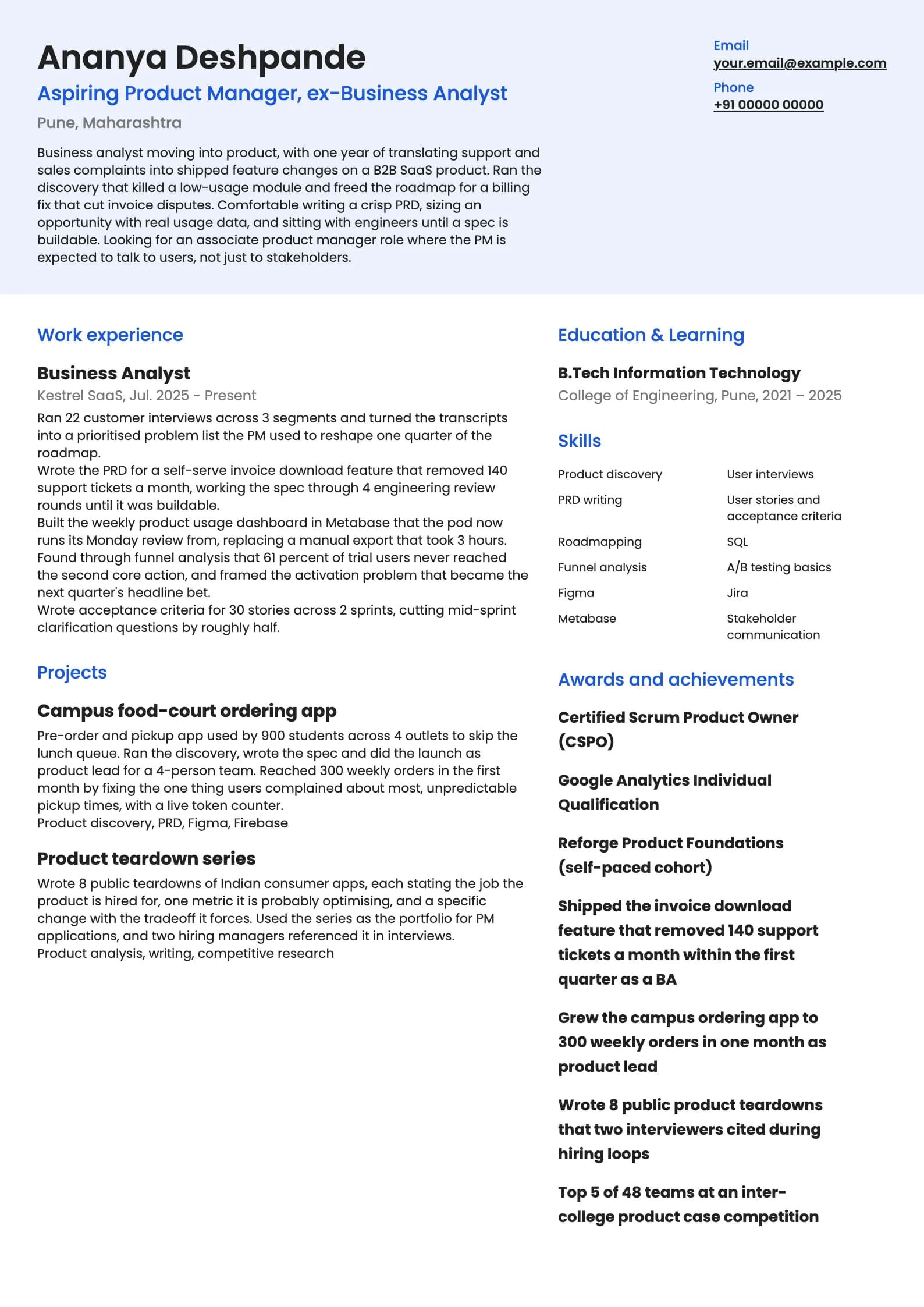
Build my resumeProduct Manager resume example, Aspiring PM (0 to 1 year)
modern templateIs your resume good enough?
Upload the resume you have now and see what an applicant tracking system reads before a product manager recruiter ever does.
Free to run. Sign in with your mobile number to see your score.
Product Manager resume example, Mid-level PM (4 years)
ai-era template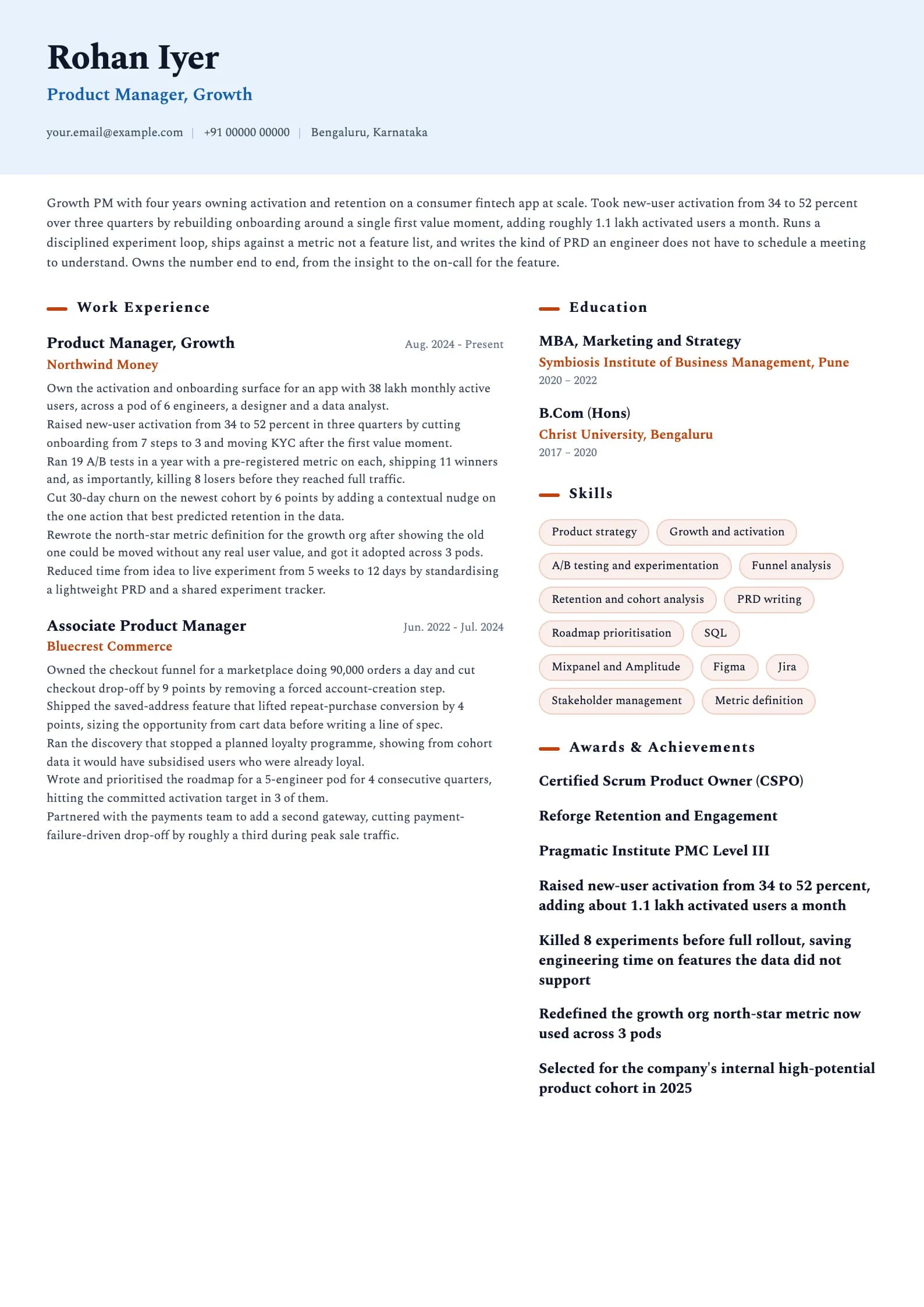
Want this structure with your own details? Build it in the resume builder.
Product Manager resume example, Senior PM (9 years)
header-band template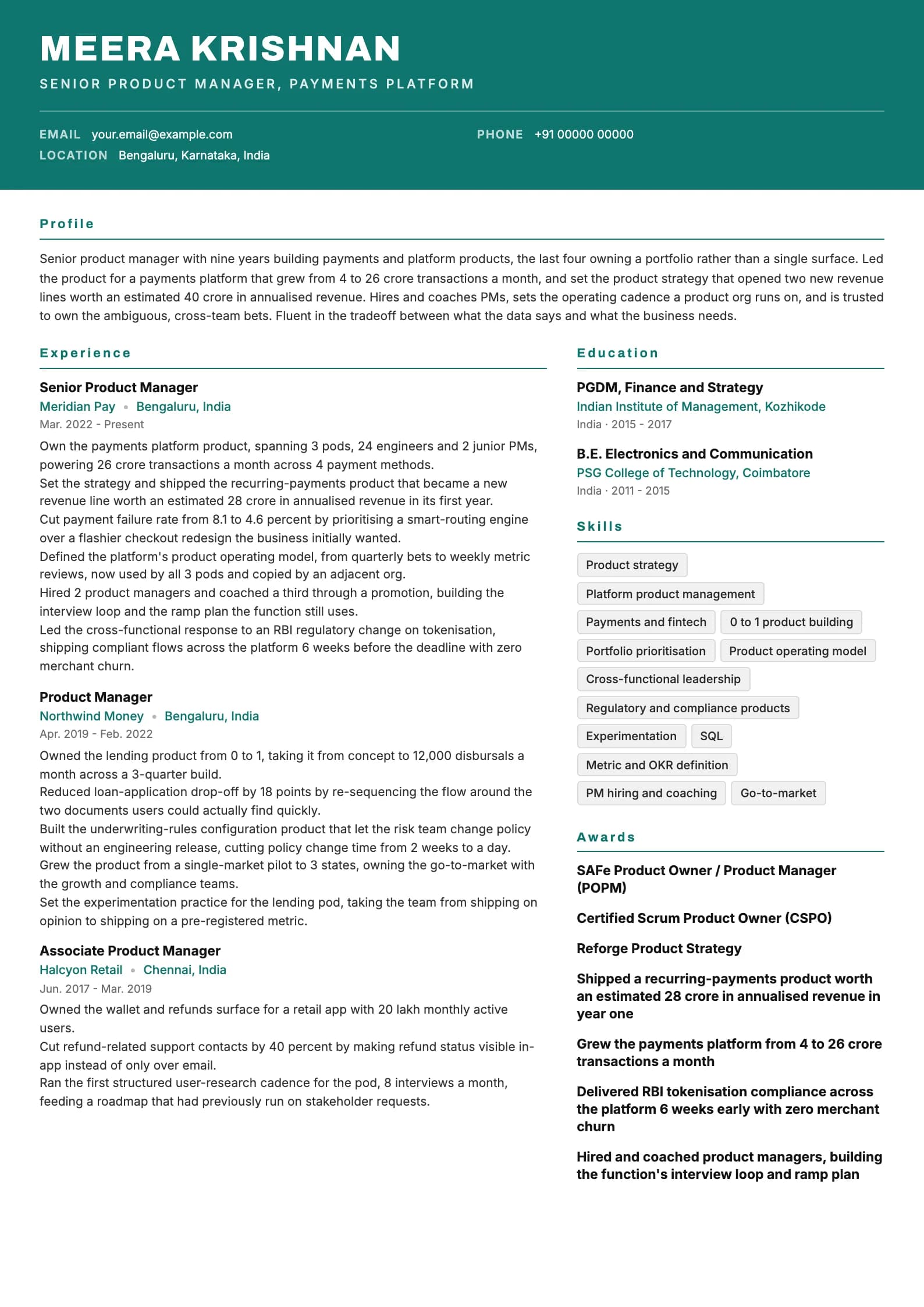
The format that works for product manager resumes in India
Reverse chronological is the only sensible layout for a PM resume in India. A product manager is judged on a track record of outcomes over time, and a functional resume that hides the dates removes exactly the thing a hiring manager is trying to read. Most recent role first, work backwards, dates in plain view. If you are transitioning into product from engineering, analytics or consulting, keep the format identical and let the summary and the bullets carry the reframe, rather than inventing a title you did not hold. Length is set by evidence. One page holds everything an aspiring PM and most product managers up to about six years have to say. A senior PM with a genuine portfolio can run to a second page, but only if it carries decisions and outcomes rather than a longer tools list. A PM resume that reaches two pages on the strength of a skills wall and a hobbies line is a one-page resume with padding, and padding is the last signal a product hire wants to send. Four things belong nowhere on a PM resume here: a photograph, date of birth, marital status and father's name. They are residue from an older campus template and they occupy space a shipped outcome should own. The reviewer screening product candidates is looking for the metric you moved, not your age. Send a PDF unless the posting asks for DOCX, and name the file with your own name and the target role. Use a single column throughout. Two-column layouts read cleanly on screen but parse unpredictably, and the section a PM cannot afford to have scrambled is the experience section, because that is the whole argument. The table below sets out the section order.
| Section | Where it goes | Why |
|---|---|---|
| Name and headline | Top, above everything | The headline is the product role you want, with your specialism: Growth, Platform, B2B. Recruiters match on it. |
| Professional summary | Directly under the header | Three lines. Domain, years, and the single strongest metric you moved. |
| Work experience | Next, for anyone with a role | Most recent first. Newest role gets the most bullets and the biggest outcomes. |
| Projects or portfolio | Above experience for an aspiring PM, below it after that | For someone breaking in, this is the evidence. For a working PM it is supporting material. |
| Skills | Below experience | Grouped: product craft, analytics, tools. Not a 30-item wall. |
| Education | Bottom, unless you are a fresher | Degree, institution, years. The MBA or PGDM sits here once you have shipped. |
| Certifications | After education, or beside skills if only one or two | CSPO, SAFe POPM and the like. Name and issuing body, no bare acronyms. |
Writing a PM summary a hiring manager actually reads
The block under your name is the one part of a PM resume you can be reasonably sure gets read, so it must carry the three facts a hiring manager screens for: what kind of product you build, how long you have been doing it, and the single strongest number you moved. Three or four lines. No adjective a follow-up question could puncture. The old objective line, seeking a challenging product role in a reputed organisation to leverage my skills, tells the reader nothing beyond the fact that you applied. Replace it with a summary. An objective describes what you want; a summary describes the metric you already moved, and only one of those survives a screen where forty other product people also want a challenging role. Aspiring PMs often believe they have nothing to summarise. Look again at the first sample. It names the adjacent role, the length of it, and one shipped outcome with a number attached. That is a real summary built from a business-analyst year and one campus product. What it avoids is passionate about building products that delight users, a phrase so common on PM resumes that it now signals only that the writer had nothing specific to say. A practical test: read your summary and ask whether another PM applying to the same company could paste it onto their resume unchanged. If they could, it describes the job title rather than you. Add the specific product, the specific number, the specific decision until it stops being transferable. Rewrite the summary for each meaningfully different role. A growth PM posting and a platform PM posting want different lead metrics, and moving the right one to the front takes two minutes for the highest-leverage edit on the page.
Professional summary, mid-level PM
Weak
Passionate and results-driven product manager with 4+ years of experience seeking a challenging role in a reputed organisation to build products that delight users.
Strong
Growth PM with four years owning activation on a consumer fintech app. Took new-user activation from 34 to 52 percent in three quarters by rebuilding onboarding around a single first value moment.
The rewrite replaces self-description with a specialism, a scope of ownership and one verifiable outcome a hiring manager can probe.
Experience bullets: decision, product, metric moved
Every strong bullet in the three samples has the same spine. It opens with a decision or an action you owned, names the product or surface you changed, and closes with the metric that moved because of it. The verb establishes ownership rather than participation. The product tells the reader whether the work is relevant. The number does the persuading, because product management is one of the few functions where nearly everything worth doing can be measured. Start with the metric and work backwards to the bullet. PMs often write the feature first, then struggle to attach an outcome, which produces lines like worked with engineering to launch the new dashboard, resulting in a better user experience. Instead, ask what was different in the numbers after you shipped: activation rose, churn fell, a funnel step converted better, revenue opened, a cost dropped, a support queue shrank. Then write the sentence that ends in that fact. Vary the metric. A resume with six activation numbers in a row reads as one trick repeated and hides your range. Across a career a PM can honestly reach for activation, retention, conversion, revenue, transaction volume, failure rate, cycle time, support contacts and adoption across teams. The mid-level sample uses seven different outcome types, which reads as a product mind rather than a growth-hacking specialist. Include the decisions where you said no. Killed an experiment, stopped a planned feature, chose the less glamorous bet because the data pointed there. These are often stronger than launches, because saying no with evidence is the harder and more senior skill, and very few resumes show it. Allocate bullets by recency and seniority. Current role gets five or six and the biggest outcomes; the previous role four or five; anything older two or three. Roles beyond about eight years back collapse to a line each.
| Level | What bullets must prove | Typical metric |
|---|---|---|
| Aspiring PM | You can run product work and move something | Tickets removed, activation of a small product, discovery that changed a plan |
| APM / 1 to 3 years | You own a surface and ship against a metric | Funnel conversion, drop-off, feature adoption, experiment win rate |
| PM / 4 to 6 years | You own a number end to end and set direction | Activation, retention, revenue line, north-star redefinition |
| Senior PM / 7 years and up | You own a portfolio and shape the function | Revenue, transaction scale, operating model, PMs hired and coached |
Experience bullet, growth PM
Weak
Worked with the engineering and design team to revamp the onboarding flow, resulting in improved user experience and engagement.
Strong
Raised new-user activation from 34 to 52 percent in three quarters by cutting onboarding from 7 steps to 3 and moving KYC after the first value moment.
Names the decision, the specific change and the metric with a before and after, so a reviewer can ask a real follow-up.
Experience bullet, showing judgement
Weak
Was responsible for the product roadmap and prioritising features based on business requirements and stakeholder inputs.
Strong
Ran the discovery that stopped a planned loyalty programme, showing from cohort data it would have subsidised users who were already loyal.
Responsible for the roadmap describes a job title; the rewrite shows a specific call made on evidence, which is the actual PM skill.
If a bullet would read identically on another PM's resume, it is describing the role, not you. Add the product, the number and the decision until it only fits you.
The skills section: craft, analytics and tools, grouped
A PM skills section has two readers with opposite tastes. The parser wants literal terms it can match to the job description. A hiring manager wants a short, organised list that signals what kind of product person you are. Grouping serves both: the terms are present for the machine, the structure is legible for the human. Group by function rather than piling everything into a line. Product craft, analytics and data, and tools is a grouping that fits almost every PM. Product craft covers discovery, PRD writing, roadmapping, experimentation and stakeholder management. Analytics covers SQL, funnel and cohort analysis, and A/B testing. Tools covers the named products, Jira, Figma, Mixpanel, Amplitude. The exact headings matter far less than the fact that structure exists. Twelve to sixteen skills is the working range. Below eight it looks thin even behind strong experience. Above about twenty it stops signalling, because a list that claims everything distinguishes nothing. The list is also a contract: every item is a question you have agreed to answer, and a PM who lists machine learning on the strength of one project will regret it in the room. Be careful to list product skills, not engineering skills you no longer use. A PM who leads with a decade-old Java line invites doubt about whether they moved into product at all. SQL belongs, because a PM genuinely uses it; a full backend stack does not, unless you are applying for a technical PM role that explicitly asks for it. Write tool names the way the industry writes them, Amplitude not amplitude, and skip proficiency bars. Nobody has agreed what four stars out of five in product strategy means, and the claim invites an argument you cannot win.
| Group | What goes in it | How many |
|---|---|---|
| Product craft | Discovery, PRD writing, roadmapping, experimentation, stakeholder management | 4 to 6 |
| Analytics and data | SQL, funnel analysis, cohort and retention analysis, A/B testing | 3 to 5 |
| Domain | Growth, payments, B2B SaaS, marketplace, platform. Whatever you actually own. | 1 to 3 |
| Tools | Jira, Figma, Mixpanel, Amplitude, Metabase, Notion | 3 to 5 |
Skills section
Weak
Skills: Product Management, Leadership, Communication, Teamwork, Java, Python, MS Excel, MS PowerPoint, Agile, Scrum, Problem Solving, Time Management, Hardworking, Jira, SQL
Strong
Product craft: discovery, PRD writing, roadmapping, experimentation, stakeholder management. Analytics: SQL, funnel and cohort analysis, A/B testing. Domain: growth, payments. Tools: Jira, Figma, Amplitude.
Cuts the personality traits and stale engineering lines, keeps SQL because a PM uses it, and groups the rest so a human reads it in one pass.
Portfolio and side projects: what to include and how to describe it
For an aspiring PM, a portfolio does the work experience cannot. Case studies, teardowns and one product you actually shipped, even a campus one, are the evidence that you can do the job, not just describe it. They sit above experience and get real space. For a working PM they move below experience and shrink to one or two entries, kept only when they show something the day job does not. The common failure is describing the feature instead of the thinking. A food ordering app built with React and Firebase tells a reviewer nothing, because thousands of resumes carry that line. Describe the problem you found, the decision you made, and the outcome. The campus ordering app in the first sample works because it names the real user complaint, unpredictable pickup times, and the specific product response, a live token counter, with a number attached. For teardowns and case studies, show product judgement, not enthusiasm. A good teardown states the job the product is hired to do, one metric it is probably optimising, and a specific change with the tradeoff it forces. That structure is what a hiring manager is scanning for, and it is what two interviewers in the first sample actually referenced. If your portfolio is a public link, make sure it survives being opened. A case study that is three screenshots and a paragraph of praise for the product hurts you. One well-argued case study beats five thin ones. For a working PM, keep one side project only if it demonstrates a muscle your role does not, a consumer instinct if you work on B2B, or a technical build if your product work is non-technical. Otherwise the space is better spent on the job.
Portfolio entry, aspiring PM
Weak
Food Ordering App: Built a food ordering application using React and Firebase with real-time order tracking and a clean user interface.
Strong
Campus food-court ordering app: pre-order and pickup for 900 students. Fixed the top complaint, unpredictable pickup times, with a live token counter, and reached 300 weekly orders in the first month.
Swaps a stack list for the problem found, the specific decision and the outcome, which is the actual product story.
Where education, the MBA and certifications belong
Education goes at the bottom for any working PM, and near the top for an aspiring one who has nothing stronger to lead with. Degree, institution, years. The MBA or PGDM sits in the same block, and it matters most in the year you graduate and less every year after, because a hiring manager weighing a mid-level PM is reading shipped outcomes, not your business school. The MBA is genuinely useful on a PM resume in India, more so than on an engineering one, because a large share of product hiring runs through campus and lateral MBA channels. List it plainly, name the institution, and let it sit below your work once you have work. What does not help is dressing the MBA up as experience, or leading a resume with five years of shipping behind it with the business school at the top. CGPA or percentage is worth keeping while you are a fresher and it is good, roughly 7.5 out of 10 and above. Once you have your first product role, drop the undergraduate number. Nobody evaluating a PM against a revenue line is weighing a four-year-old college percentage. Certifications sit just below education, or beside skills if you hold only one or two. Write the full name and the issuing body, because CSPO and SAFe POPM mean nothing to a non-technical recruiter on the first pass. Product certifications help most when you are breaking in or changing track, and least once you have a portfolio to point at. A senior PM's certification list should be short. The shipped products are the credential. If a certification has expired, renew it or remove it. An expired credential listed as current is a small dishonesty that is easy to catch and expensive to explain in a function built on trust.
Getting a PM resume through the applicant tracking system
An applicant tracking system is a parser and a search index, not a judge. It reads your file, breaks it into name, dates, employers, titles and skills, and stores the result so a recruiter can search across candidates. Almost every ATS problem is a parsing problem, and parsing problems come from layout, not from wording. The layout rules are short. One column. Standard section headings, Work Experience rather than My Product Journey, Skills rather than My Toolkit. No text inside images, since a skills graphic or a logo strip reads as empty space. No critical information in the header or footer region, which some parsers drop entirely. Avoid text boxes and nested tables in the resume body. A simple skills grid usually survives, but the safe default is not to gamble your experience section on it. On wording, mirror the job description where it is honest. If the posting says product-led growth, write product-led growth, not organic acquisition strategy. If it says A/B testing, write A/B testing even if you prefer experimentation. Include the expansion alongside an acronym at least once, for example PRD (product requirements document), so both searches find you. Product postings vary a lot in vocabulary, so tailoring the terms is worth more here than in most functions. What does not work is keyword stuffing. A hidden block of terms, white text on white, or a paragraph listing thirty tools is found quickly by recruiters, and the outcome is worse than being filtered. Write real bullets that naturally contain the right terms, because a bullet describing what you did with an experiment contains the word experiment in a context that survives human review too. Save as PDF from a tool that embeds real text, then open the file and confirm you can select and copy a sentence. If you cannot select the text, neither can the parser.
Section heading
Weak
My Product Journey
Strong
Work Experience
Parsers look for standard headings; a creative one can push the whole block into an unclassified bucket the recruiter never searches.
Test your own file before you send it. Copy the text out of the PDF into a plain text editor. Whatever reads there is roughly what the parser sees, and anything scrambled is a real risk.
What gets product manager resumes rejected
Most PM rejections at the resume stage are not close calls. They come from a small set of recurring problems, all fixable in an afternoon. The list below covers what reviewers of Indian PM resumes see most often, in rough order of how much damage each one does.
- No metrics anywhere. A PM resume without numbers reads as a project coordinator, because moving numbers is the definition of the job.
- Feature lists instead of outcomes. Launched X, shipped Y, built Z, with no statement of what changed for the user or the business.
- Taking credit for team outcomes with no sign of your specific decision. Reviewers probe this hard in the interview, so claim only what you owned.
- A skills section full of personality traits, hardworking, team player, dynamic, that describe every applicant and distinguish none.
- Leading with an engineering or consulting past instead of reframing it as product work, when you are transitioning in.
- A generic objective line. Replace it with a summary that states specialism, years and one number moved.
- The same resume sent to a growth role, a platform role and a B2B role, when the lead metric and skills order should change each time.
- Inflated titles or dates that do not match your offer letters. Background verification is standard in Indian hiring and a mismatch ends the process.
- A wall of text with no whitespace. If a reviewer cannot find your headline outcome in two seconds, the formatting has failed.
- No sign of judgement. Only launches, never a bet you killed or a tradeoff you chose, which is the clearest tell of a junior product mind.
For every bullet, ask what a follow-up question would be. If you cannot answer it with a real story, the bullet is claiming more than you owned.
Skills to put on a product manager resume
Technical
- Product strategy
- Product discovery
- PRD writing
- Roadmap prioritisation
- A/B testing and experimentation
- Funnel analysis
- Retention and cohort analysis
- SQL
- Metric and OKR definition
- Go-to-market
- Competitive analysis
- User research
Tools and platforms
- Jira
- Figma
- Mixpanel
- Amplitude
- Metabase
- Notion
- Confluence
- Google Analytics
- Excel and Google Sheets
- Miro
- Productboard
Working skills
- Stakeholder management
- Cross-functional leadership
- Prioritisation and saying no
- Written communication
- Influencing without authority
- Customer empathy
- Data-driven decision making
- Coaching and mentoring
Certifications worth listing as a product manager
| Certification | Full name | Worth it for |
|---|---|---|
| CSPO | Certified Scrum Product Owner (Scrum Alliance) | The most widely recognised entry product certification in Indian postings, and a clean signal for an aspiring PM or someone moving from a delivery role. Product companies stop weighing it once you have shipped, so treat it as a door-opener rather than a career credential. |
| CSM | Certified ScrumMaster (Scrum Alliance) | Worth naming if you are transitioning from a scrum master or delivery role into product, because it explains the adjacency. Not a product credential on its own, so pair it with real product outcomes rather than leaning on it. |
| SAFe POPM | SAFe Product Owner / Product Manager | Genuinely useful if you are targeting large enterprises, banks and service organisations that run the Scaled Agile Framework, which many Indian delivery centres do. Of limited value at product startups, which rarely run SAFe and may read it as enterprise baggage. |
| Pragmatic PMC | Pragmatic Institute Product Management Certification | A structured framework certification that helps most for PMs moving into more strategy-heavy or B2B roles. Useful as evidence of formal training if your product experience is thin, less so once your portfolio speaks for itself. |
| Reforge | Reforge programs (Growth, Retention, Product Strategy) | Not a certificate that a recruiter filters on, but a strong signal to product hiring managers because the programs are well regarded and cohort-based. Name the specific program, and only if you actually applied it to your work, since interviewers will ask. |
| GAIQ | Google Analytics Individual Qualification | A quick, free credential that is worth it mainly for aspiring and growth PMs who want to show analytics literacy. It carries little weight once you have SQL and real experimentation experience on the page. |
Keywords an ATS scans for in a product manager resume
These are the literal terms a parser matches against the job description. Use the ones that are true of you, in the sentences where you did the work, not as a list at the bottom.
- product manager
- product management
- product strategy
- product roadmap
- product discovery
- PRD
- user research
- A/B testing
- experimentation
- funnel analysis
- retention
- activation
- go-to-market
- OKR
- SQL
- stakeholder management
- agile
- scrum
- growth
- product-led growth
Product Manager resume FAQ
How long should a product manager resume be?
One page up to about six years of experience, and only two pages for a senior PM whose second page carries real decisions and outcomes rather than a longer tools list. Product hiring managers read for the metric you moved, so a tight, well-argued single page almost always beats a padded two-pager. If you are struggling to fit one page, cut the oldest role to a line, drop coursework, and remove any tool you would not want to be interviewed on.
What is a good salary to expect as a product manager in India?
It varies widely by company type and city, but as a rough guide in 2026, an associate product manager at a funded startup often sits around 12 to 20 LPA, a mid-level PM with three to five years around 25 to 45 LPA, and a senior PM at a well-funded product company can cross 50 to 80 LPA and beyond with equity. Service companies and non-tech firms pay less for the same title. Your resume's job is to show the outcomes that justify the top of your band, not to state a number.
How do I move into product management from engineering or business analysis?
Do not invent a PM title you never held. Keep your real role and reframe the work: the discovery you ran, the specs you wrote, the metric a feature you influenced moved. The first sample on this page is exactly this transition, a business analyst leading with product activities and one shipped outcome. Add a small portfolio of teardowns or case studies, because for a transitioning candidate that is often the strongest evidence a hiring manager will see.
Do I need an MBA to be a product manager in India?
No, but it helps more here than in most markets, because a large share of PM hiring runs through campus and lateral MBA channels. Plenty of strong PMs come from engineering, analytics or founding a company instead. If you have an MBA, list it plainly and let it sit below your work once you have shipped. If you do not, lead with outcomes and a portfolio, and the absence rarely matters at companies that hire on evidence.
How do I show impact if I cannot share exact numbers due to confidentiality?
Use ranges, percentages and relative changes instead of absolute figures. Raised activation by roughly 18 points or cut churn by about a third carries the argument without disclosing a company secret. You can also describe scale in orders of magnitude, an app with tens of lakhs of monthly active users, rather than the exact count. What you must not do is drop numbers entirely, because a PM resume without them reads as a coordinator.
Should my product manager resume include failed experiments or killed features?
Yes, selectively, and it is often the strongest thing on the page. A bullet that shows you killed an experiment or stopped a planned feature on the basis of data demonstrates judgement, which is harder to prove than a launch and more senior. Frame it as a decision made on evidence, not as a failure, and only include the ones where the call was clearly yours and clearly right.
How many product management tools should I list?
Enough to cover the job description honestly and no more, usually three to five each of analytics tools and delivery or design tools. A PM is not hired for tool knowledge, so a wall of twenty logos signals insecurity rather than competence. List the ones you actually use, group them, and spend the saved space on outcomes. Every tool on the page is a question you have agreed to answer.
Do I need a photo on a product manager resume in India?
No. Indian product recruiters do not expect one, and it takes space a headline outcome should occupy. The same goes for date of birth, marital status, father's name, nationality and a declaration paragraph. These come from an older campus template and add nothing to a product screen. The only exception is a role that explicitly asks for a photograph in the posting, which is rare for PM positions.
Should I tailor my product resume for every application?
Tailor the summary and the skills order, not the whole document. Move the lead metric and specialism that match the posting to the front, growth for a growth role, platform for a platform role, and reorder your skill groups so the most relevant one appears first. That takes about two minutes and does most of the work. Rewriting every bullet for every application is not sustainable and rarely changes the outcome.
Do product management certifications actually help you get hired?
They help most when you are breaking into product or changing track, where a CSPO or a SAFe POPM shows formal grounding and intent. They help least once you have shipped products to point at, because the portfolio is the stronger credential. Reforge programs signal well to hiring managers even though they are not filtered on, but name the specific program and only if you applied it. A senior PM's certification list should be short.
Related resume examples and guides
Build your own in any of these formats
Start from a blank resume or upload the one you have. The Goodspace builder renders it in 24 templates and flags what an applicant tracking system will miss.
Build my resume