3 Marketing Executive Resume Examples, Format and Guide
A marketing executive resume is judged on whether the campaigns you ran actually moved a number: leads, cost per acquisition, reach, revenue influenced. Most resumes in India list tools and channels, ran social media, handled campaigns, managed SEO, without ever saying what changed. Below are three complete resumes, one each for a fresher, a mid-level executive and a senior marketing manager, followed by the format rules and the exact keywords an applicant tracking system scans for. Each sample is a full document, not a fragment: summary, experience with campaign results, skills, certifications and education, in the order a marketing hiring manager expects.
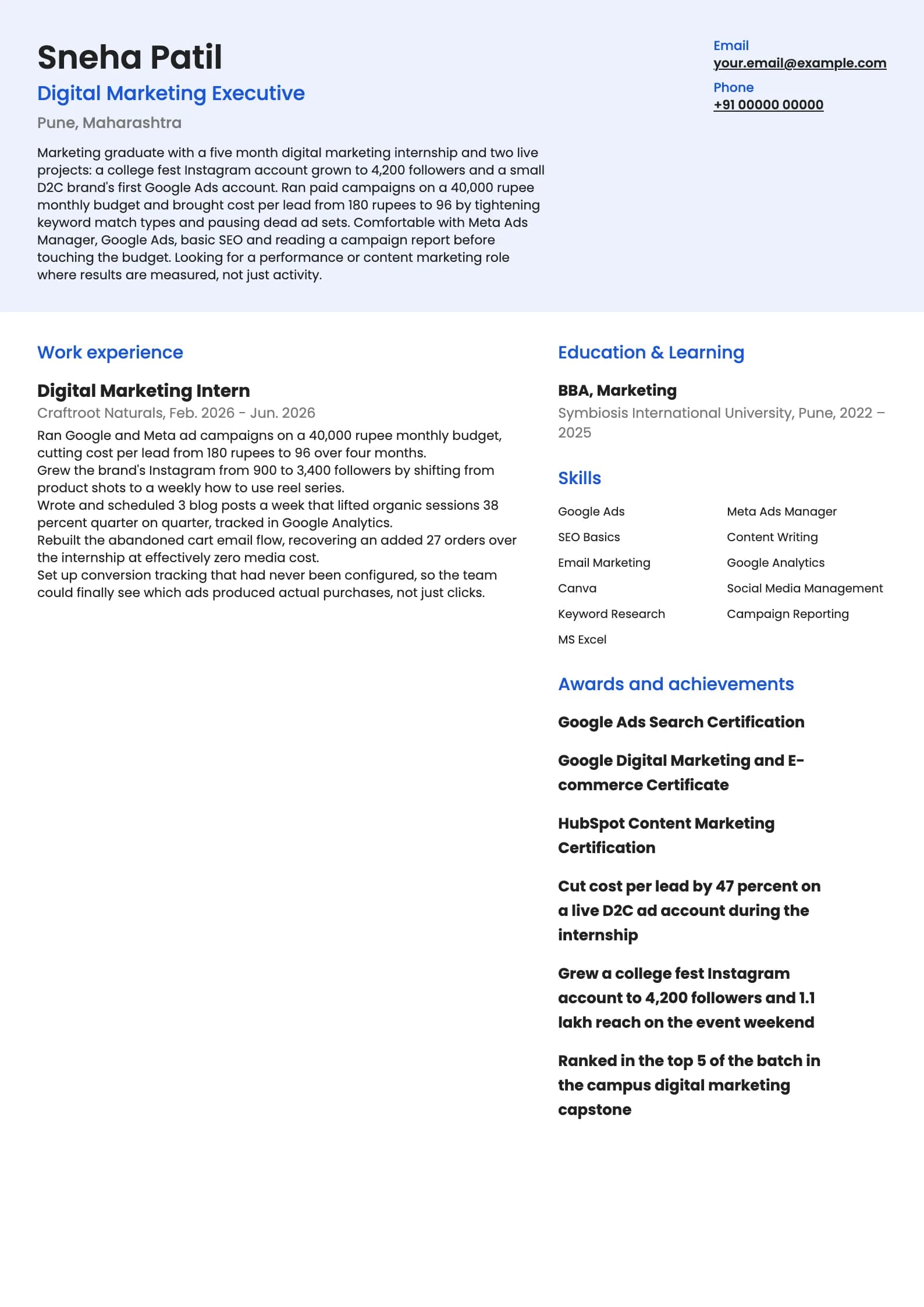
Build my resumeMarketing Executive resume example, Fresher (0 years)
modern templateIs your resume good enough?
Upload the resume you have now and see what an applicant tracking system reads before a marketing executive recruiter ever does.
Free to run. Sign in with your mobile number to see your score.
Marketing Executive resume example, Mid-level (5 years)
ai-era template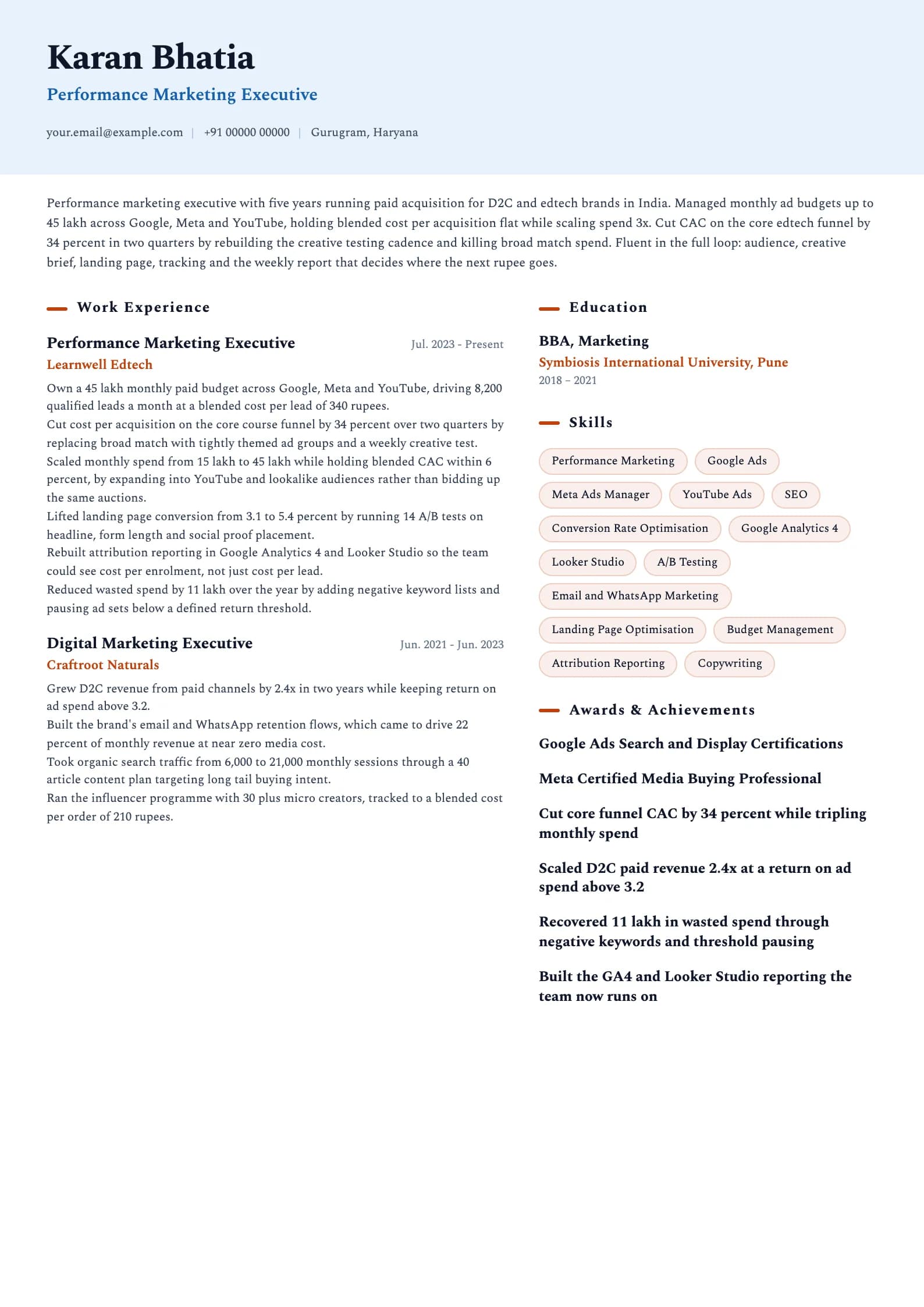
Want this structure with your own details? Build it in the resume builder.
Marketing Executive resume example, Senior (9 years)
header-band template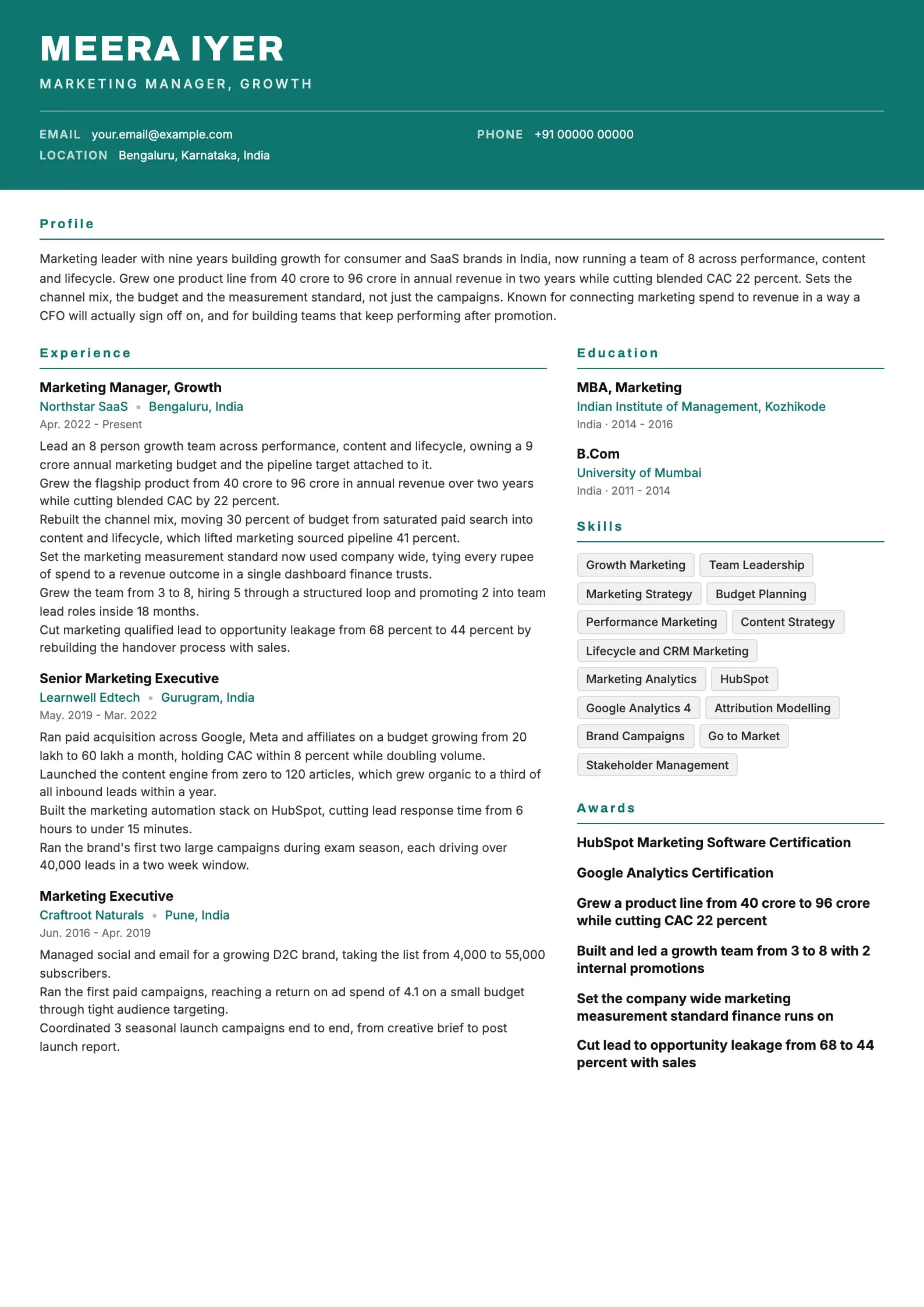
The format that works for marketing executive resumes in India
Reverse chronological is the only layout worth using. Most recent role first, work backwards, dates in plain view. Functional resumes that hide dates under skill clusters read as concealment, and marketing is a field where measurement is the job, so a resume that avoids stating results starts on the back foot. What a marketing resume must do that others need not is attach a number to every campaign. Ran social media is a duty. Grew Instagram from 900 to 3,400 followers is a result. Managed Google Ads is a duty. Cut cost per lead from 180 to 96 rupees is a result. The number is what a marketing manager screens for, because marketing without measurement is decoration. One page holds everything a fresher and most executives up to roughly six years need. A senior marketing manager can run to two, if the second page carries revenue and team numbers rather than a longer tool list. Send a PDF unless the posting asks for DOCX, name the file with your name and target role, and use a single column so an applicant tracking system reads it in order. Four things belong nowhere on the resume: a photograph, date of birth, marital status and father's name. They add nothing to a marketing screen. The table below sets the section order.
| Section | Where it goes | Why |
|---|---|---|
| Name and headline | Top, above everything | The headline names your specialism: performance, content, brand or growth. |
| Professional summary | Directly under the header | Three lines. Years, channels, and your strongest measured result. |
| Work experience | Next, for anyone with a job | Most recent first, each campaign tied to a metric that moved. |
| Skills | Below experience | Channels, tools and analytics platforms, named exactly. |
| Projects or campaigns | Above experience for freshers, below it after | For a fresher these are the evidence: a real account, a real budget, a real result. |
| Education | Bottom, unless you are a fresher | Degree, institution, years. BBA, B.Com and MBA are all common. |
| Certifications | After education, or beside skills | Google Ads, Meta and Analytics certificates carry real weight here. |
Writing a summary a marketing manager actually reads
The block under your name is the only part a hiring manager is guaranteed to read, so it must carry three facts: what you market and on which channels, how long you have done it, and your strongest measured result. Three or four lines, no adjectives that cannot be checked. The old objective line, a creative and passionate marketer seeking a challenging role to grow the brand, is exactly the kind of unmeasured language a marketing resume must avoid. Replace it with a summary that contains a channel, a budget and a number. A marketing summary with no metric in it signals a candidate who has never been held to one. Freshers often think they have nothing to summarise. Look at the fresher sample: it names the channels, the internship length, the budget managed and the cost per lead it cut. That is a real summary from one internship and two projects. What it avoids is passionate about brands and creative thinker, phrases that now carry no information. Rewrite the summary for each meaningfully different role. A performance marketing role and a content marketing role want different channels and metrics in those three lines. Two minutes of editing, and it is the highest leverage change you can make.
Professional summary, mid-level marketing executive
Weak
Passionate and creative marketing professional with 5 years of experience seeking a challenging role in a reputed organisation to build brands and drive growth.
Strong
Performance marketing executive with five years running paid acquisition for D2C and edtech, managing budgets up to 45 lakh a month and cutting core funnel CAC 34 percent while tripling spend.
The rewrite replaces self description with the specialism, the budget scale and a measured efficiency result, which is what a marketing manager screens on.
Experience bullets: what you ran, and the number it moved
Every strong bullet in the samples follows one shape. It opens with an action verb, names the campaign or channel, and ends in a metric that changed. Grew, cut, scaled, launched, rebuilt. The number does the persuading, and in marketing it is nearly always available: leads, cost per lead, cost per acquisition, return on ad spend, conversion rate, organic sessions, revenue influenced, followers, open rate. The common failure is the channel duty. Handled social media and ran email campaigns describes the job posting, not what you achieved. Ask instead: what was the metric before, what did you do, and what was it after. Then write the sentence that ends in the after. Vary the metric. Five ROAS numbers in a row read as one campaign described five ways, and they suggest a marketer who only buys ads. Across a role you can honestly reach for CAC, ROAS, conversion rate, organic traffic, list growth, revenue share of a channel, wasted spend cut and lead volume. The mid-level sample uses six metric types, which reads as range. Where you genuinely lack a number, give scope: budget managed, number of campaigns, size of the list, articles published. Never invent a figure. Marketing numbers are often verifiable through the platforms in an interview, and an inflated ROAS collapses fast under a single follow up question.
| Level | What bullets must prove | Typical metric |
|---|---|---|
| Fresher | You can run a real campaign and read the result | Cost per lead, follower growth, sessions, a live budget managed |
| 1 to 3 years | You own a channel and improve its efficiency | CAC, ROAS, conversion rate, list growth, organic traffic |
| 4 to 6 years | You own a budget and the funnel around it | Blended CAC at scale, revenue influenced, pipeline, spend efficiency |
| 7 years and up | You set strategy and lead a team | Revenue grown, team size, channel mix shifts, measurement standards |
Experience bullet, paid marketing role
Weak
Handled Google and Facebook ad campaigns and worked on improving the overall performance of the marketing funnel.
Strong
Cut cost per acquisition on the core course funnel by 34 percent over two quarters by replacing broad match with tightly themed ad groups and a weekly creative test.
The duty version fits any marketer; the rewrite names the metric, the improvement and the two specific techniques behind it.
Experience bullet, content work
Weak
Created blog content and worked on SEO which helped increase the website traffic over time.
Strong
Took organic search traffic from 6,000 to 21,000 monthly sessions through a 40 article content plan targeting long tail buying intent.
States the before and after, the volume of work, and the intent strategy, so an interviewer can ask a real follow up.
If a bullet names a channel but no result, it describes your job title, not your work. Add the number the campaign moved until it only fits you.
The skills section: channels, tools and analytics
A marketing skills section serves two audiences. The applicant tracking system wants literal platform names it can match, so Google Ads, Meta Ads Manager, Google Analytics 4 and SEO must appear as written. A human wants to see what kind of marketer you are: performance, content, brand, lifecycle. Group the list so both are served. Group by channel, tools and analytics rather than dumping thirty words into one line. Channels covers paid search, paid social, SEO, email, content and influencer. Tools covers the exact platforms, written the industry way, Meta Ads Manager not Facebook Ads Manager, Google Analytics 4 not GA, because parsers match on strings. Analytics covers A/B testing, attribution and reporting, which separate a marketer who measures from one who guesses. Twelve to sixteen skills is the working range. Below eight it looks thin, above twenty it stops distinguishing you. Every skill is a claim an interviewer can test, so if you have never built an attribution report, do not list attribution modelling. Put your strongest channel first, since readers skim the start of a line. Skip star ratings, nobody agrees what four stars in SEO means.
| Group | What goes in it | How many |
|---|---|---|
| Channels | Paid search, paid social, SEO, email, content, influencer | 3 to 5 |
| Ad platforms | Google Ads, Meta Ads Manager, YouTube Ads, LinkedIn Ads | 2 to 4 |
| Analytics | Google Analytics 4, Looker Studio, A/B testing, attribution | 2 to 4 |
| Martech | HubSpot, Mailchimp, WebEngage, Canva, WordPress | 2 to 4 |
Skills section
Weak
Skills: Digital Marketing, Social Media, Communication, Creativity, MS Office, Team Player, Marketing, Branding, Hard Working, SEO
Strong
Channels: paid search, paid social, SEO, email. Ad platforms: Google Ads, Meta Ads Manager, YouTube Ads. Analytics: Google Analytics 4, Looker Studio, A/B testing. Martech: HubSpot.
Cuts unprovable traits like creativity, adds the exact platform names an ATS searches, and groups the rest so a manager reads it in one pass.
Getting through the applicant tracking system
An applicant tracking system is a parser and a search index, not a judge. It reads your file, breaks it into name, dates, employers, titles and skills, and stores the result so a recruiter can search across candidates. Almost every ATS problem is a layout problem, not a wording one. The layout rules are short. One column. Standard section headings, so Work Experience and Skills rather than My Campaigns and My Toolkit. No text inside images, since a channel icon strip reads as empty space. Keep nothing critical in the header or footer region, which some parsers drop. Avoid text boxes and nested tables for the body. On wording, mirror the posting where honest. If it says performance marketing, write performance marketing. If it names Meta Ads Manager, name it too, not Facebook Ads. Spell out an acronym once alongside the short form, for example CAC (cost per acquisition), so both searches find you. Your metrics double as keywords: a bullet stating return on ad spend naturally contains the term a recruiter searches. Keyword stuffing does not work. A hidden block listing every platform you have heard of is caught quickly and read worse than an honest gap. Write real bullets that contain the right terms because you ran the campaign. Finally, export a real text PDF, open it, and confirm you can select and copy a sentence. If you cannot select the text, neither can the parser.
Section heading
Weak
Where the Magic Happened
Strong
Work Experience
Parsers look for standard headings; a creative one can drop the whole block into an unclassified bucket.
Test your own file before sending it. Copy the text out of the PDF into a plain text editor. Whatever you can read there is roughly what the parser sees.
What gets marketing executive resumes rejected
Most rejections at the resume stage are not close calls. They come from a small set of recurring problems, all fixable in an afternoon. The list below covers what recruiters of Indian marketing resumes see most often, in rough order of how much damage each one does.
- Channels listed with no results. Ran social media and handled campaigns tell a manager nothing about what moved.
- No metrics anywhere. Leads, CAC, ROAS, conversion rate, traffic, revenue. Pick whichever is honest for the work.
- Vanity numbers with no business link. Ten lakh impressions means little without a cost, a conversion or a revenue figure attached.
- A tool dump as skills. Fifteen platforms listed, half touched once, when a manager wants the three you can be interviewed on.
- Creativity, passion and out of the box thinking as skills. Unprovable traits waste the line a platform name should hold.
- A generic objective instead of a summary that leads with a measured result.
- The same resume sent for a performance role and a content role. The channels and metrics in the top three lines should change.
- A photo, date of birth, marital status or father's name. None of it belongs on a marketing resume.
- Design heavy multi column layouts that an applicant tracking system reads out of order.
- Claiming platforms you cannot demonstrate. An interviewer will open Ads Manager and ask you to walk through a real campaign.
Read each bullet and ask: what number moved. If a line names a channel but no result, it is describing your job title, not your work.
Skills to put on a marketing executive resume
Technical
- Performance Marketing
- Search Engine Optimisation
- Paid Search
- Paid Social
- Content Marketing
- Email Marketing
- Conversion Rate Optimisation
- A/B Testing
- Marketing Automation
- Attribution Reporting
- Keyword Research
- Copywriting
- Landing Page Optimisation
- Budget Management
Tools and platforms
- Google Ads
- Meta Ads Manager
- YouTube Ads
- LinkedIn Ads
- Google Analytics 4
- Looker Studio
- HubSpot
- Mailchimp
- Canva
- WordPress
- SEMrush
- WebEngage
Working skills
- Campaign Planning
- Cross-functional Collaboration
- Stakeholder Communication
- Data-driven Decision Making
- Creative Briefing
- Project Management
- Storytelling
- Team Coordination
Certifications worth listing as a marketing executive
| Certification | Full name | Worth it for |
|---|---|---|
| Google Ads | Google Ads Search and Display Certifications | The baseline credential for any performance or paid marketing role, free and expected on early career resumes. Strong for freshers and up to mid-level; a senior marketer running teams does not need it on the page, though the knowledge is assumed. |
| Meta Media Buying | Meta Certified Media Buying Professional | Worth it for executives who run serious paid social budgets, and a genuine differentiator versus the free Blueprint badges. Best for performance marketers; less relevant for content or brand focused roles. |
| Google Analytics | Google Analytics Certification | A clean signal that you can actually read and configure GA4, which many marketers claim and few can do. Useful across all levels, especially for anyone whose resume leans on traffic and conversion numbers. |
| HubSpot Content | HubSpot Content Marketing Certification | A reasonable, free signal for content and inbound roles, and a fit for freshers building an early resume. Carries little weight once you have real content results to point at, so treat it as an entry credential. |
| Google Career Cert | Google Digital Marketing and E-commerce Certificate | A broad entry level programme worth it for career changers and freshers with no marketing degree, since it covers the whole funnel. Product companies mostly stop caring once you have live campaign results, so use it to get the first role, not the fifth. |
Keywords an ATS scans for in a marketing executive resume
These are the literal terms a parser matches against the job description. Use the ones that are true of you, in the sentences where you did the work, not as a list at the bottom.
- marketing executive
- digital marketing
- performance marketing
- SEO
- SEM
- Google Ads
- Meta Ads
- social media marketing
- content marketing
- email marketing
- cost per acquisition
- return on ad spend
- conversion rate optimisation
- Google Analytics
- lead generation
- campaign management
- marketing automation
- brand marketing
- A/B testing
- budget management
Marketing Executive resume FAQ
How much do marketing executives earn in India, and should CTC go on the resume?
Entry level marketing executive roles commonly pay 3 to 5 LPA, mid-level performance and digital marketers 7 to 14 LPA, and marketing managers leading teams 18 LPA and above, with high demand specialisms like performance marketing at the top of each band. Do not put your current or expected CTC on the resume. It anchors the negotiation before you have shown your results and belongs in the recruiter conversation, not the document.
How long should a marketing executive resume be?
One page up to about six years, two pages for a senior marketing manager only if the second page carries revenue and team numbers rather than a longer tool list. A marketing resume is judged on how fast a manager can find a measured result, so clear whitespace and metric led bullets matter more than length. If you cannot fit one page, compress the oldest role to a single line and drop coursework.
What is the most important thing on a marketing resume?
A measured result on every campaign you name. Marketing without measurement is decoration, so a bullet like cut cost per acquisition 34 percent while tripling spend does more work than a paragraph describing the channels you touched. Attach a number, whether leads, CAC, ROAS, conversion rate or revenue, to each claim, because a manager screens for the metric before anything else.
How does a fresher write a marketing resume with no experience?
Lead with any internship or live project, then education, then skills. Treat each project as evidence you can run a real campaign and read the result: a college fest Instagram grown to a follower count, a small brand's ad account you managed on a stated budget, a cost per lead you cut. Managing your own reselling page, an NGO's social handle or a fest sponsorship drive all count, because each involved a real audience and a measurable outcome.
Do certifications help a marketing executive get hired?
They help most for freshers and career changers, where a Google Ads or Google Analytics certificate signals you know the tooling before you have campaign results to show. They help least once you have live numbers to point at, because the results are the stronger credential. A Meta media buying or analytics certificate adds value for performance roles specifically, but no certificate substitutes for a campaign that moved a metric.
Should I put creative work or a portfolio on the resume?
Name it and link it, do not paste it. For content, brand and social roles a portfolio or a link to real published work is strong evidence, so add one line with a working URL. Keep the resume itself text based and single column so an applicant tracking system can read it, and let the portfolio carry the visuals. A resume built as a graphic is unreadable to a parser and often to a busy manager too.
Does an applicant tracking system reject marketing resumes with two columns?
It does not reject them outright, but marketing resumes are often the most design heavy, and some parsers read a two column layout out of order, scrambling your campaign results into your skills sidebar. A single column removes the risk, which is why all three samples above use one. Copy the text out of your PDF into a plain text editor; if your metrics read in the right order there, the parser will most likely get them too.
Related resume examples and guides
Build your own in any of these formats
Start from a blank resume or upload the one you have. The builder renders it in 24 templates and flags what an applicant tracking system will miss.
Build my resume