Digital Marketing Executive Resume Format, with 3 Full Samples
A digital marketing executive is hired on evidence of traffic grown, leads generated and rupees returned on ad spend, yet most resumes list every channel and tool and never say what any of it produced. Below are three complete resumes, one for a fresher with a certification and two live projects, one for an executive with three years across SEO, paid and social, and one for a performance-marketing specialist owning a paid budget at scale. After the samples come the format rules, the difference between listing Google Ads and proving a ROAS, the terms an applicant tracking system matches, and the mistakes that end a screening before a human reads the page.
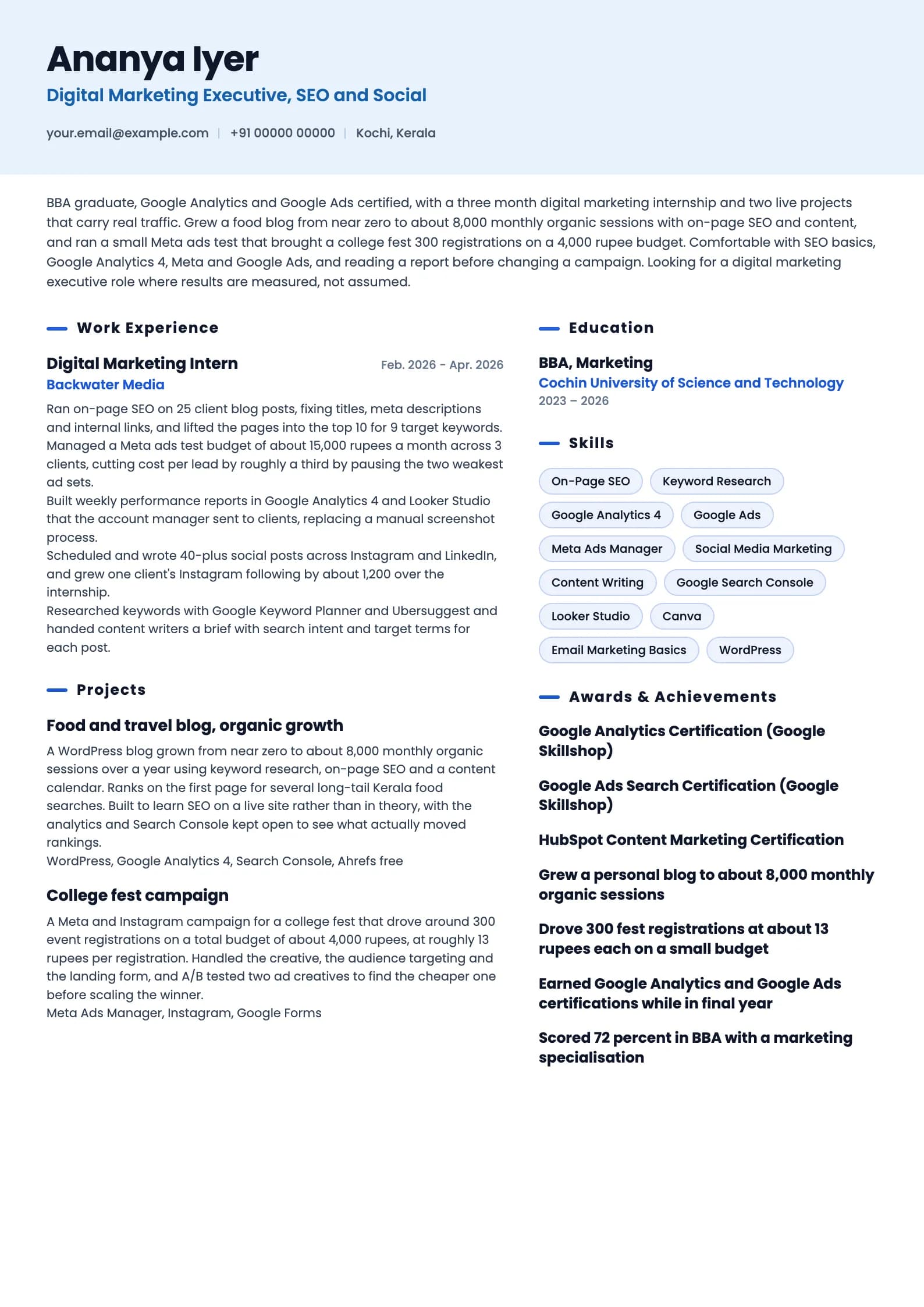
Build my resumeDigital Marketing Executive resume example, Fresher (0 years)
ai-era templateIs your resume good enough?
Upload the resume you have now and see what an applicant tracking system reads before a digital marketing executive recruiter ever does.
Free to run. Sign in with your mobile number to see your score.
Digital Marketing Executive resume example, Executive (3 years)
modern template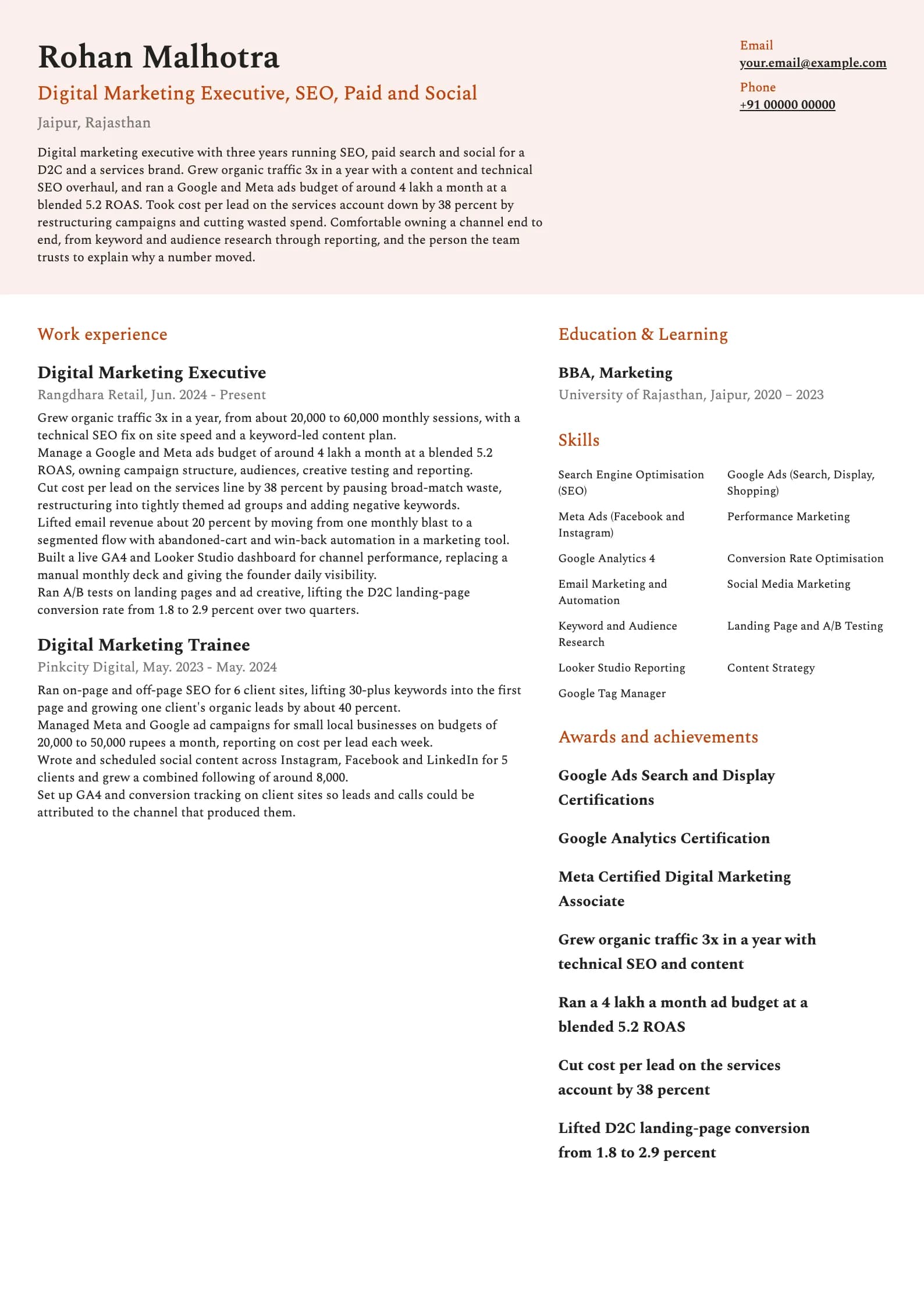
Want this structure with your own details? Build it in the resume builder.
Digital Marketing Executive resume example, Specialist (6 years)
header-band template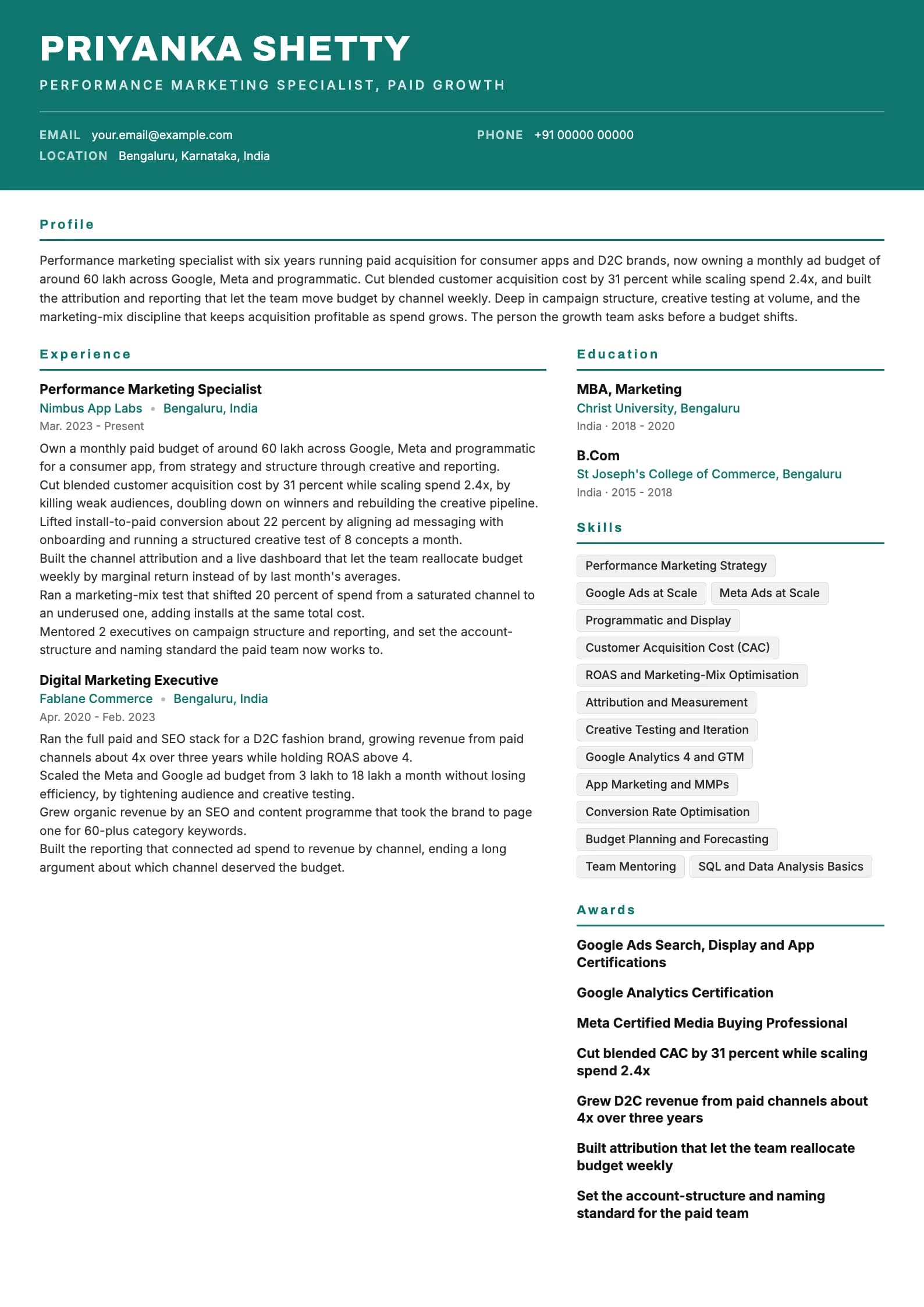
The format that works for digital marketing resumes in India
Reverse chronological is the layout to use. Put the most recent role first, work backwards, and keep the dates in plain view. A functional resume that groups everything under Channels and Tools and quietly drops the dates reads as an attempt to hide a gap or a short stint, and reviewers treat it that way. A gap is better explained in one honest line than buried. Length is decided by evidence. One page holds everything a fresher and most executives up to roughly five years have to say. A specialist or manager with six years and campaigns at scale can justify a second page, but only if it carries real results rather than a longer tool list. Four things belong nowhere on a marketing resume here: a photograph, date of birth, marital status and father's name. They survive from an older template that circulated through campus placement cells. Nobody screening a digital marketer is looking for them, and every line they occupy is a line a ROAS or a traffic result could have used. The one exception is a personal-brand or creator role where a headshot is genuinely part of the pitch. Send a PDF unless the posting asks for DOCX, name the file with your own name and the target role, and use a single column all the way down, because two-column layouts parse unpredictably when a sidebar sits beside the experience. The table below sets out the section order.
| Section | Where it goes | Why |
|---|---|---|
| Name and headline | Top, above everything | The headline is the role you want and your strongest channels, SEO, paid or performance. Recruiters match on it. |
| Professional summary | Directly under the header | Three lines. Years, channels owned, and the single strongest result, usually a ROAS or growth number. |
| Work experience | Next, for anyone with a job | Most recent first. Newest role gets the most bullets. |
| Projects and campaigns | Above experience for freshers, below it after that | For a fresher, a grown blog or a live campaign is the evidence. |
| Skills and tools | Below experience | Grouped: channels, analytics, tools. Not a 40-item logo wall. |
| Education | Bottom, unless you are a fresher | Degree, institution, years. Keep the percentage only while a fresher. |
| Certifications | After education, or beside skills if only one or two | Google, Meta, HubSpot. Name, issuer, year. |
Listing Google Ads is not the same as proving a ROAS
The single most common digital marketing resume failure is a skills line that reads SEO, SEM, Google Ads, Meta Ads, PPC, social media, email marketing, content marketing, analytics, GA4, GTM with no bullet anywhere that shows any of it producing a result. A parser matches those terms, but a hiring manager reads the wall and assumes it is padded, then goes looking for the one channel you can actually defend with a number. The fix is to let the experience prove the channel. If you write Google Ads, at least one bullet should carry a budget and a ROAS or a cost per lead. If you write SEO, a bullet should show the traffic or ranking it moved. The executive sample lists SEO, paid and email precisely because the bullets show 3x organic growth, a 5.2 ROAS and a 20 percent email revenue lift. The skills line and the experience agree, which is what makes both believable. Be specific about the number that matters for each channel. Paid work is judged on ROAS, CAC, cost per lead and spend managed. SEO is judged on organic traffic, rankings and organic leads or revenue. Email is judged on open rate, revenue and list growth. A marketer who names the right metric for the channel signals they understand the job, not just the tool. Do not list a channel you touched once. Writing programmatic, influencer, affiliate, ASO and CRO when you ran one small Meta campaign is transparent padding, and it invites a question you cannot answer. Own two or three channels with real numbers rather than ten with none.
For every channel on your skills line, ask: is there a bullet with a number that proves I ran it. If not, either add the bullet or cut the channel. A wall of channels helps the parser and hurts the interview.
Writing a summary a marketing manager actually reads
The block under your name is the part you can be reasonably sure gets read, so it should carry three facts: how long you have marketed, the channels you own and their scale, from budget to traffic, and the strongest thing that happened because of your work. Three or four lines, no adjectives that cannot be checked. The old objective line, seeking a challenging position in a reputed organisation to grow my digital marketing skills, tells the reader nothing they did not assume from the application. Replace it with a summary. An objective describes what you want, a summary describes what you have already done, and only one is evidence. Freshers often believe they have nothing to summarise. Look at the fresher sample: it names the certifications, states the internship length, and points at a blog grown to 8,000 sessions and a campaign at 13 rupees a registration. That is a genuine summary built from a certification, one internship and two live projects. What it avoids is "passionate about digital marketing", a phrase so common on graduate resumes it now carries no information. A practical test: read your summary and ask whether a classmate with the same Google certification could paste it onto their resume unchanged. If they could, it describes the course, not you. Add the specific channel, the specific budget and the specific result until it stops being transferable.
Professional summary, executive
Weak
Passionate and creative digital marketer with 3+ years of experience in SEO, SEM, social media and email marketing seeking a challenging role in a growth-oriented organisation.
Strong
Digital marketing executive with three years running SEO, paid and social for a D2C and a services brand. Grew organic traffic 3x in a year and ran a 4 lakh a month ad budget at a blended 5.2 ROAS.
The rewrite trades a channel list and self-description for scope, a budget and two verifiable results.
Experience bullets: verb, channel, result
Every strong bullet in the samples follows the same shape. It opens with an action verb, names the specific channel or campaign you ran, and closes with what measurably moved. The verb establishes that you did it. The channel tells a marketing reviewer whether the work is relevant. The number does the persuading. Start with the outcome and work backwards. Marketers usually write the activity first, then struggle to attach a number, which produces bullets like "handled SEO and social media for various clients". Instead ask what was different after you ran it: traffic rose, a ROAS held while spend scaled, cost per lead fell, a conversion rate improved, email revenue grew. Then write the sentence that ends in that fact. Vary the metric. Five traffic numbers in a row read as one trick repeated. Across a real marketing role you can honestly reach for organic traffic, keyword rankings, ROAS, cost per lead, CAC, conversion rate, email revenue, follower growth and budget managed. The executive sample uses several of these, which reads as range. Where you lack a number, give scope: how large a budget, how many clients or accounts, how many campaigns, how big a channel. "Manage a Google and Meta ads budget of around 4 lakh a month" carries weight without inventing a percentage. Allocate bullets by recency. Current role gets five or six, the previous role four or five, anything older two or three.
| Level | What bullets must prove | Typical metric |
|---|---|---|
| Fresher | You can run a channel and read the result | Traffic grown, cost per registration, keywords ranked, followers gained |
| 1 to 2 years | You own a channel for real clients | Cost per lead, ROAS on small budgets, rankings, list growth |
| 3 to 5 years | You own multiple channels and their numbers | ROAS, CPL, organic growth, conversion rate, budget managed |
| 6 years and up | You set strategy and improve how the team measures | CAC at scale, spend scaled, attribution built, standards set |
Experience bullet, paid role
Weak
Responsible for handling Google and Facebook ad campaigns for the company and improving the performance.
Strong
Cut cost per lead on the services line by 38 percent by pausing broad-match waste, restructuring into tightly themed ad groups and adding negative keywords.
"Responsible for" describes a job description; the rewrite names the change made and the cost it moved.
Experience bullet, SEO work
Weak
Worked on SEO of the website which resulted in significant increase in the organic traffic over time.
Strong
Grew organic traffic 3x in a year, from about 20,000 to 60,000 monthly sessions, with a technical SEO fix on site speed and a keyword-led content plan.
Names the before and after and the two levers used, so a reviewer can ask a real follow-up instead of nodding at a vague claim.
If a bullet would read identically on a teammate's resume, it is describing the agency, not you. Rewrite it until it only fits the channel and budget you actually owned.
The skills section: grouped, honest, and short enough to defend
A digital marketing resume's skills section has two audiences with opposite preferences. The parser wants literal terms it can match, Google Ads and GA4 and SEO. A human wants a short, organised list that signals what kind of marketer you are. Grouping satisfies both. Group by function rather than one long line. Channels, analytics and measurement, and tools is a grouping that works for almost every digital marketer. The exact headings matter less than the fact that structure exists. Write names the way the industry writes them: Google Ads not Adwords, GA4 or Google Analytics 4 not Google Analytic, Meta Ads not FB Ads. A parser matches on strings, and Adwords is a dead term. Twelve to sixteen skills is the working range. Below eight the section looks thin. Above twenty it stops being a signal, and a marketing resume is especially prone to a logo wall of twenty tools touched once. The list is a contract: every item is a question you have agreed to answer, so a manager can and will ask you to explain how you structure a Google Ads account if you list it. Do not include a proficiency bar. Star ratings invite an argument you cannot win, and nobody agrees on what four stars in SEO means. Let the experience prove the depth instead.
| Group | What goes in it | How many |
|---|---|---|
| Channels | SEO, Google Ads, Meta Ads, email, social, content | 3 to 5 |
| Analytics | Google Analytics 4, Google Tag Manager, Search Console, Looker Studio | 2 to 4 |
| Optimisation | CRO, A/B testing, keyword and audience research, attribution | 2 to 4 |
| Tools | Ahrefs or SEMrush, Meta Ads Manager, Mailchimp, Canva, WordPress | 3 to 5 |
| Practices | Performance marketing, content strategy, reporting | 1 to 3 |
Skills section
Weak
Skills: SEO, SEM, PPC, Google Ads, Adwords, Bing Ads, Facebook Ads, Instagram Ads, LinkedIn Ads, Twitter Ads, YouTube Ads, Email Marketing, SMS Marketing, Affiliate, Influencer, Programmatic, ASO, CRO, GA, GA4, GTM, SEMrush, Ahrefs, Moz, Ubersuggest, Canva, Photoshop, WordPress, HTML, MS Office
Strong
Channels: SEO, Google Ads, Meta Ads, email marketing. Analytics: GA4, Google Tag Manager, Looker Studio. Optimisation: CRO, A/B testing, keyword research. Tools: Ahrefs, Meta Ads Manager, Mailchimp, WordPress.
Cuts the dead term Adwords and the channels touched once, collapses the tool wall to what you can defend, and groups the rest so a human reads it in one pass.
Projects and campaigns: what to include and how to describe it
For a fresher, projects are the resume. A grown blog, a real campaign or a managed social account sits above experience, gets the most space, and is where a reviewer decides whether you can actually market or only pass a certification exam. For an experienced marketer these move below experience and shrink to one or two entries, kept only if they show something the day job does not. The common failure is describing the activity instead of the result. "Ran social media and SEO for a project" tells a reviewer nothing, because thousands of resumes carry that line. Describe what you did, what it produced and the one thing that made it work. The blog in the fresher sample is a stronger entry than a fancier project would be, because it names a real number, 8,000 monthly sessions, and states it was grown on a live site to learn SEO in practice. Pick work that shows range rather than three of the same thing. One organic-growth project, one paid campaign with a cost per result, and one that shows measurement or A/B testing is a stronger set than three social accounts. Two well-described campaigns beat five listed by name. If a result is public or checkable, say so plainly: a blog with a URL, a Search Console screenshot in a portfolio, a campaign the college can confirm. A live number you can show beats a big claim you cannot, and a specific small win, 300 registrations at 13 rupees each, reads as real where a vague large one reads as invented.
Project description, fresher resume
Weak
Social Media Project: managed social media and ran ads for a college event and increased engagement and reach.
Strong
College fest campaign: drove around 300 event registrations on a budget of about 4,000 rupees, at roughly 13 rupees per registration, after A/B testing two creatives and scaling the cheaper one.
Swaps vague reach and engagement for a cost per result and the one decision, testing then scaling, that produced it.
Where education and certifications belong
Education goes at the bottom for anyone with a full-time job, and near the top for a fresher, who has nothing stronger to lead with. Degree, institution, years. That is the whole entry for most people. A BBA, B.Com, MBA or any graduate degree is a fine base for digital marketing, which values a track record over a specific degree. Percentage is worth keeping while you are a fresher and it is decent, roughly 60 percent and above, because early-career screening still filters on it. Once you have your first full-time role, drop it. A number from three years ago competes for space with a ROAS or a traffic result that is far more predictive of how you will do the job. Certifications matter more in digital marketing than in most fields, because the platform certifications are free, current and directly relevant. The Google Ads and Google Analytics certifications are the baseline, a Meta Blueprint certification signals paid-social depth, and a HubSpot inbound or content certification helps for content and email roles. List the full name, the issuer and the year, and keep them current, because an expired Google Ads certification listed as active is easy to check. For a fresher especially, certifications plus one or two live projects are the whole case. They are the cheapest, fastest way to show a marketing team you have gone past the theory, so earn the free ones before you apply.
Getting through the applicant tracking system
An applicant tracking system is a parser and a search index, not a judge. It reads your file, tries to break it into name, dates, employers, titles and skills, and stores the result so a recruiter can search across candidates. Almost every ATS problem is a parsing problem, and parsing problems come from layout, not wording. The layout rules are short. One column. Standard section headings, so use Work Experience rather than My Journey, and Skills rather than My Toolbox. No text inside images, because a tool-logo strip, which marketers love, reads as empty space to a parser. No critical information in the header or footer region, which some parsers drop. Avoid text boxes and nested tables in the resume body. On wording, mirror the language of the job description where it is honest. If the posting says performance marketing, write performance marketing. If it says SEM, write SEM as well as Google Ads so either search finds you. Include the expansion alongside an acronym at least once, for example "ROAS (return on ad spend)" and "CRO (conversion rate optimisation)". Keyword stuffing does not work, and marketing resumes are a common offender, ironically, with a hidden block of every channel and tool in white text. Recruiters find it quickly, and the outcome is worse than being filtered. Write real bullets that naturally contain the right terms, because a bullet describing a ROAS you hit contains the word ROAS in a context that survives human review too. Save as PDF from a tool that embeds real text, then open the file and confirm you can select and copy a sentence. If you cannot select the text, neither can the parser. Design-heavy marketing resumes built as a single image are the classic own-goal here.
Section heading
Weak
My Marketing Playbook
Strong
Work Experience
Parsers look for standard headings; a creative one can push the entire block into an unclassified bucket the recruiter never searches.
Test your own file before you send it. Copy the text out of the PDF into a plain text editor. Whatever you can read there is roughly what the parser sees, and a resume built as one designed image reads as blank.
What gets digital marketing resumes rejected
Most rejections at the resume stage are not close calls. They come from a small set of recurring problems, and all of them are fixable in an afternoon. The list below covers what reviewers of Indian digital marketing resumes see most often, in rough order of how much damage each one does.
- A channel and tool wall with no bullet proving a result on any of it. Every item is a question you have agreed to answer.
- No numbers anywhere. Traffic, ROAS, cost per lead, conversion rate, revenue. A marketing resume with no metric is the fastest rejection.
- Activity copied from the JD instead of results. "Responsible for handling social media and SEO" is the tell.
- Listing ten channels when you ran two. Programmatic, ASO, affiliate and influencer on a two-year resume invites a question you cannot answer.
- A design-heavy resume built as a single image or a Canva graphic that a parser reads as blank and a recruiter cannot copy from.
- The dead term Adwords instead of Google Ads, which signals a mental model that stopped updating years ago.
- A photo, date of birth, marital status or father's name, unless it is a creator role. It takes space a ROAS or a traffic result should use.
- A generic objective line. Replace it with a summary that states years, channels and one result.
- Vanity metrics with no business tie. Impressions and reach without a cost, a lead or a sale behind them read as filler.
- Inflated titles or budgets that do not match reality. A quick interview question about how you structured that budget exposes it.
Read your resume aloud once before sending it. Anything you would be embarrassed to defend to a marketing manager's face is a line to cut or rewrite.
Skills to put on a digital marketing executive resume
Technical
- Search Engine Optimisation (SEO)
- Google Ads (Search, Display, Shopping)
- Meta Ads (Facebook and Instagram)
- Performance Marketing
- Conversion Rate Optimisation
- Email Marketing and Automation
- Social Media Marketing
- Content Strategy
- Keyword and Audience Research
- Landing Page and A/B Testing
- Attribution and Measurement
- Google Analytics 4
- Google Tag Manager
- Marketing Funnel Analysis
Tools and platforms
- Google Analytics 4
- Google Ads
- Meta Ads Manager
- Ahrefs
- SEMrush
- Google Search Console
- Looker Studio
- Mailchimp
- HubSpot
- Canva
- WordPress
- Google Tag Manager
Working skills
- Data-led decision making
- Copy and messaging
- Client and stakeholder reporting
- Creative collaboration
- Budget management
- Testing and iteration
- Cross-channel planning
- Working to targets
- Clear communication
Certifications worth listing as a digital marketing executive
| Certification | Full name | Worth it for |
|---|---|---|
| Google Ads | Google Ads Certifications (Search, Display, Shopping, App, Video) | The baseline paid-search credential, free through Google Skillshop, and expected on almost every digital marketing resume. Worth it for everyone from fresher to specialist, since it is current and directly maps to the work. Take the Search certification first, then the ones matching the channels you actually run. |
| Google Analytics | Google Analytics Certification (GA4) | Free and essential, since GA4 is the default analytics layer under almost every campaign. Worth it for every level, because a marketer who cannot read a GA4 report cannot prove any result. Make sure it is the GA4 version, as the old Universal Analytics certification is now obsolete. |
| Meta Blueprint | Meta Certified Digital Marketing Associate or Media Buying Professional | The paid-social credential, worth it for anyone who runs Facebook and Instagram ads as a core channel. The associate level suits freshers and executives; the media-buying professional level signals depth for a performance role. Less relevant if your work is purely SEO or organic. |
| HubSpot | HubSpot Inbound, Content or Email Marketing Certifications | Free credentials that help most for content, email and inbound roles rather than paid performance. Worth it for a fresher building a content-side case or an executive whose work is CRM and lifecycle marketing. Treat it as a content signal, not a substitute for the Google and Meta certifications on a paid resume. |
| SEMrush or Ahrefs | SEMrush Academy or Ahrefs Certification | Tool-specific SEO credentials, worth it for a fresher or SEO-focused executive who wants to show hands-on familiarity with the industry-standard research tools. They are a nice-to-have rather than a differentiator; a real project that grew traffic outweighs the badge for anyone with experience. |
Keywords an ATS scans for in a digital marketing executive resume
These are the literal terms a parser matches against the job description. Use the ones that are true of you, in the sentences where you did the work, not as a list at the bottom.
- digital marketing executive
- digital marketing
- SEO
- SEM
- google ads
- meta ads
- performance marketing
- PPC
- ROAS
- cost per lead
- google analytics
- GA4
- conversion rate optimisation
- email marketing
- social media marketing
- content marketing
- keyword research
- google tag manager
- looker studio
- campaign management
Digital Marketing Executive resume FAQ
What salary can a digital marketing executive expect in India?
A fresher typically starts around 2.5 to 4.5 LPA, higher at a good agency or in-house team. A digital marketing executive with three to five years across SEO, paid and social usually sits in the 5 to 11 LPA band, more with a strong ROAS and performance record. Performance specialists and managers with six years and above commonly earn 12 to 25 LPA and more at well-funded startups. Paid-media ownership at scale, clear attribution skill and demonstrated CAC or ROAS wins push the top of every band upward.
How long should a digital marketing resume be?
One page up to about five years of experience, two pages only for a specialist or manager whose second page carries real campaign results rather than a longer tool list. If you are struggling to fit one page, cut the oldest role to a single line, remove coursework, and delete any channel you would not want to be interviewed on.
How does a fresher write a digital marketing resume with no experience?
Lead with projects and certifications. Grow a blog, run a small campaign, or manage a real social account, and describe each as a job: what you did, what it produced and the one thing that made it work. Earn the free Google Ads and Google Analytics certifications, which are expected. A live blog at 8,000 sessions or a campaign at 13 rupees a registration is worth far more than "passionate about digital marketing", which every fresher resume already says.
Which certifications matter most for digital marketing in India?
The Google Ads and Google Analytics certifications are the baseline and are free, so there is no excuse not to hold them. A Meta Blueprint certification signals paid-social depth, and a HubSpot content or inbound certification helps for content and email roles. They matter most for freshers and career switchers who need to show they have gone past theory; for experienced marketers, a real ROAS or growth result outweighs any badge.
Should I focus on SEO, paid or social on my resume?
Lead with the channel you can prove with numbers, and be honest about the rest. A resume that claims deep expertise in every channel reads as thin, because few people run SEO, paid, social, email and content all at an expert level. It is stronger to own two or three channels with real results, ROAS on paid, traffic on SEO, and mention the others as familiarity. Match the emphasis to the job: a performance role wants paid and analytics, a content role wants SEO and content.
What metrics should a digital marketing resume include?
Match the metric to the channel. Paid work is judged on ROAS, CAC, cost per lead and budget managed. SEO is judged on organic traffic, keyword rankings and organic leads or revenue. Email is judged on open rate, revenue and list growth. Social is judged on follower and engagement growth tied to a business result. Avoid vanity metrics like raw impressions with no cost or conversion behind them, because a manager reads them as filler.
Do I need to know Google Analytics 4 specifically?
Yes. GA4 is now the default and the older Universal Analytics is retired, so a resume that mentions only Google Analytics or lists the old certification signals a mental model that stopped updating. Write GA4 or Google Analytics 4 explicitly, and make sure any analytics certification you list is the GA4 version. A marketer who can read a GA4 report and set up conversion tracking in Google Tag Manager stands out from one who only ran ads.
Should a digital marketing resume be visually designed?
Keep it clean and readable, not a design showcase. Marketers are tempted to build a heavily designed resume or a single Canva image, but an applicant tracking system reads an image as blank and a recruiter cannot copy text from it, so it is a common own-goal. Use a simple single-column layout that parses cleanly, and put your design and creative skill into a portfolio link instead. The resume's job is to pass the parser and read fast, not to win a design award.
Related resume examples and guides
Build your own in any of these formats
Start from a blank resume or upload the one you have. Goodspace renders it in 24 templates and flags the SEO, paid and analytics keywords an applicant tracking system will look for, and the channel wall it will not credit.
Build my resume