Content Writer Resume Format, with 3 Full Samples
A content writer is hired on evidence of pieces published, traffic earned and readers who stayed, yet most resumes claim excellent writing skills and a passion for words without a single link or number to back it. Below are three complete resumes, one for a fresher with a blog and a handful of published clips, one for a content writer with three years on SEO and long-form for a SaaS brand, and one for a senior writer owning content strategy and an editorial calendar. After the samples come the format rules, why a portfolio beats an adjective, the terms a parser matches literally, and the mistakes that get a writing resume rejected before an editor reads a sentence you wrote.
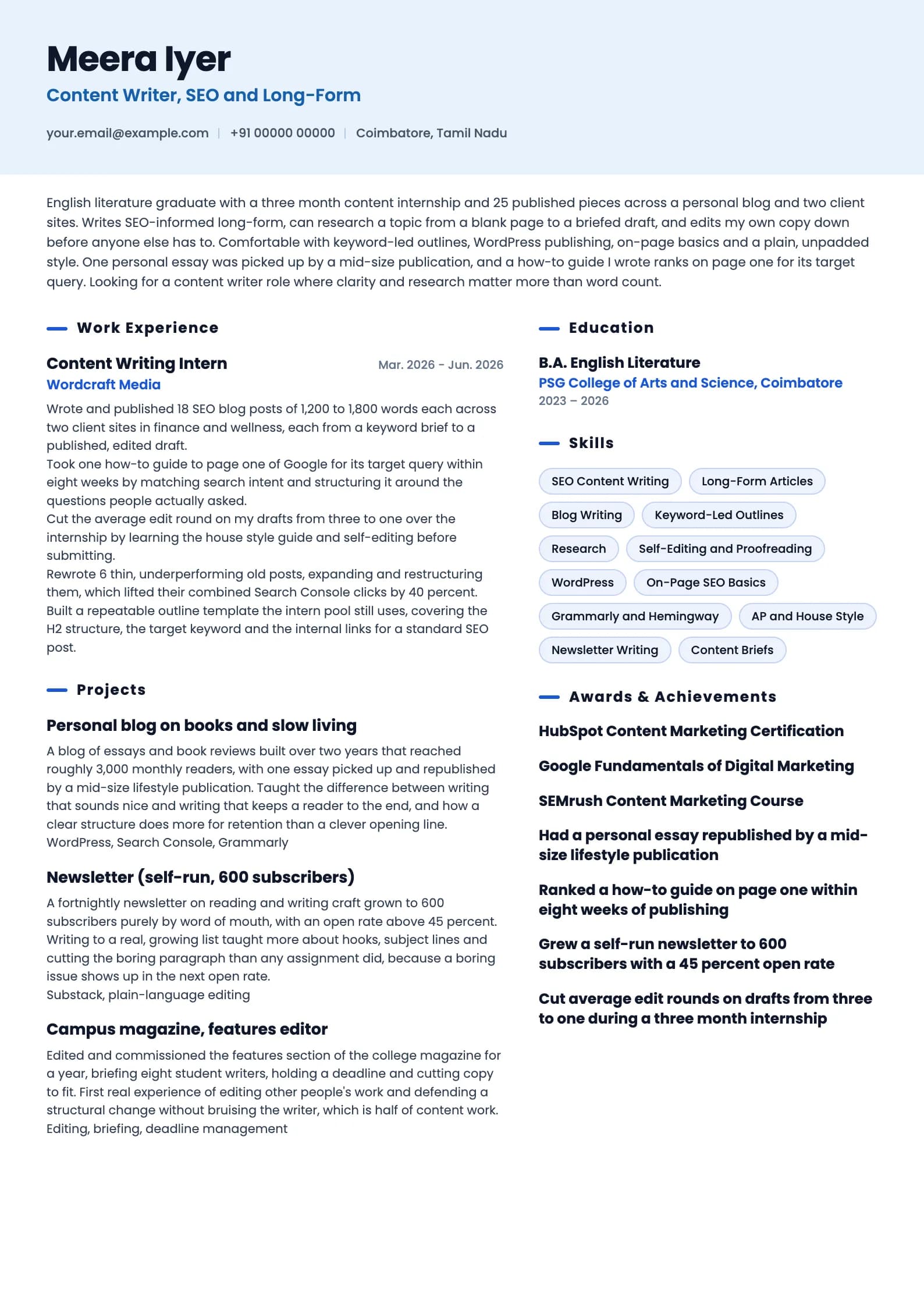
Build my resumeContent Writer resume example, Fresher (0 to 1 year)
ai-era templateIs your resume good enough?
Upload the resume you have now and see what an applicant tracking system reads before a content writer recruiter ever does.
Free to run. Sign in with your mobile number to see your score.
Content Writer resume example, Mid-level (3 years)
professional template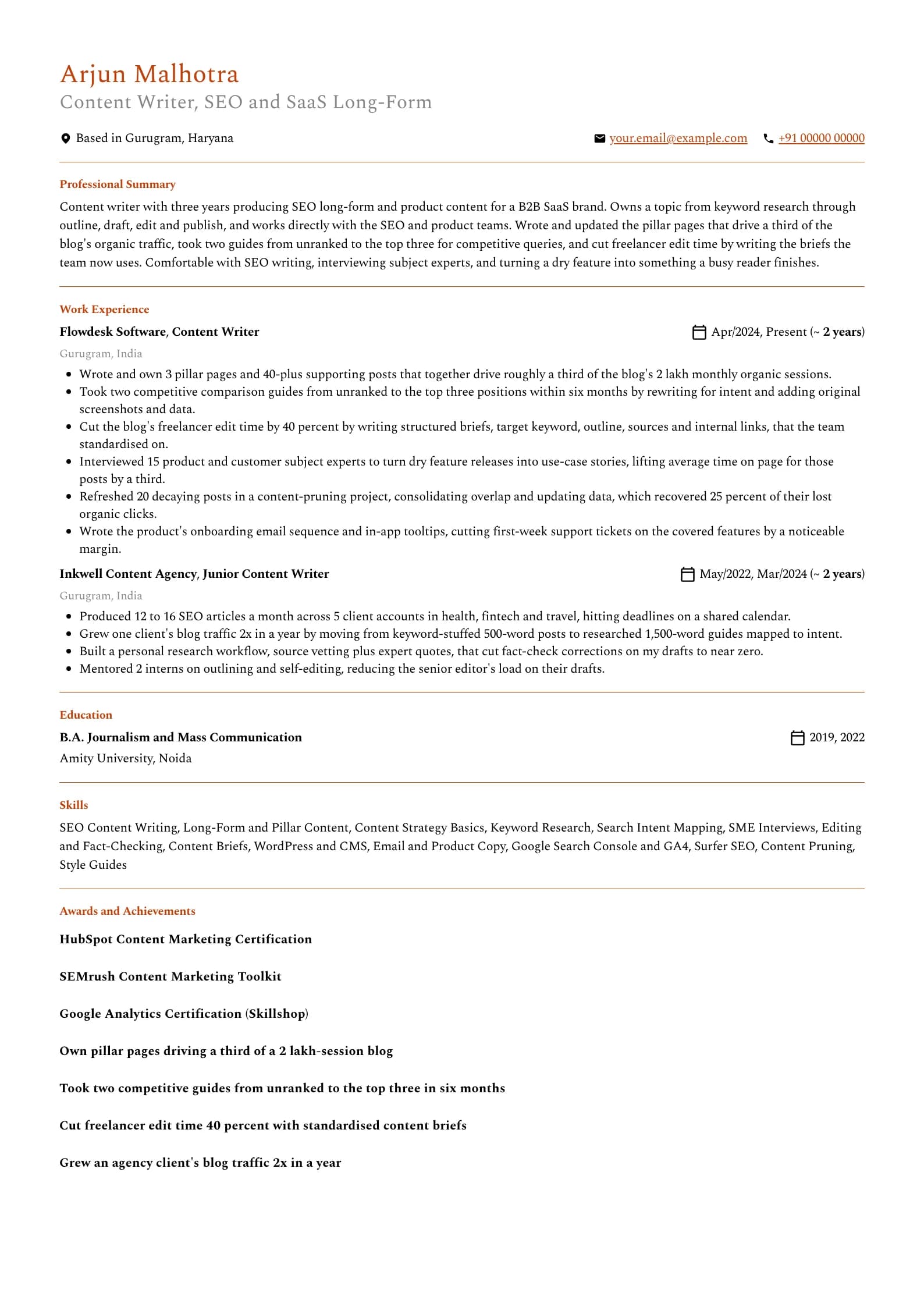
Want this structure with your own details? Build it in the resume builder.
Content Writer resume example, Lead (8 years)
header-band template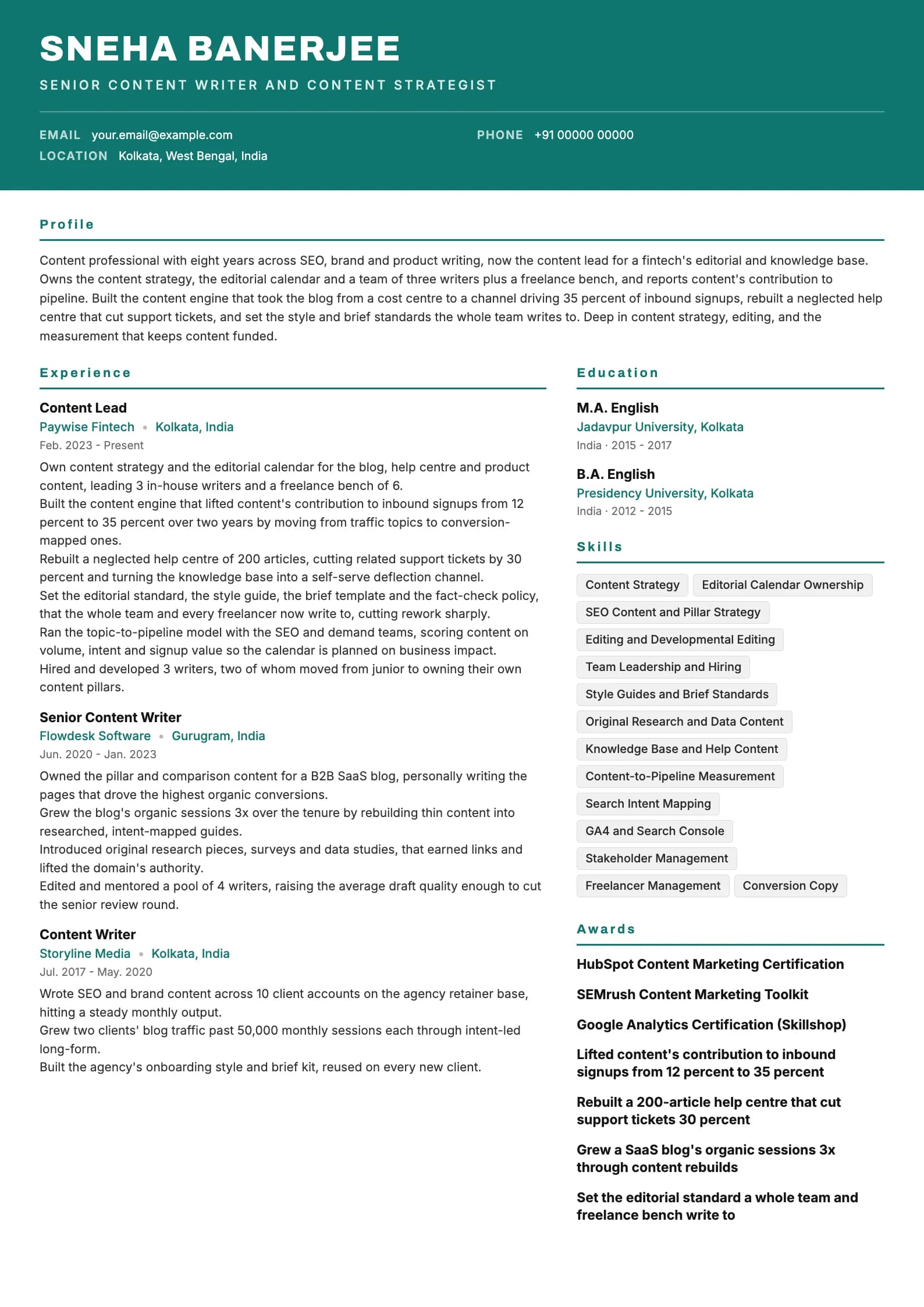
The format that works for content writer resumes in India
Reverse chronological is the only layout worth using. Put the most recent role first, work backwards, and keep the dates in plain view. Functional resumes that group everything under Skills and quietly drop the timeline read as an attempt to hide a gap, and reviewers treat them that way. For a writer, a clean, well-organised page is itself a work sample, so treat the layout as part of your audition. Length is decided by evidence. One page holds everything a fresher and most writers up to roughly five years have to say. Past that, a second page is fine when it carries real editorial ownership and results rather than a longer topic list. A page two padded with a hobbies line and a declaration is a one-page resume in disguise. Four things belong nowhere on a content resume here: a photograph, date of birth, marital status and father's name. They survive from an older template that circulated through college placement cells. Nobody hiring a writer needs them, and every line they occupy is a line a published clip or a traffic number could have used. Critically, put your portfolio link in the header, right under the headline, in plain text. An editor's first move is to read something you wrote, and a resume that hides the link fails at the one thing a writer's resume must do. Send a PDF unless the posting asks for DOCX, use a single column all the way down, and name the file with your name and the role. The table below sets out the section order.
| Section | Where it goes | Why |
|---|---|---|
| Name, headline and portfolio link | Top, above everything | The portfolio link is the point of a writer's resume. Make it impossible to miss. |
| Professional summary | Directly under the header | Three lines. Years, the kind of content, and one traffic or engagement result. |
| Work experience | Next, for anyone with a job | Most recent first. Newest role gets the most bullets and the biggest numbers. |
| Portfolio or selected clips | Above experience for freshers, alongside it after that | For a fresher this is the evidence. Name the piece, where it ran and the result. |
| Skills | Below experience | Grouped: content types, SEO, tools. Not a wall of soft-skill adjectives. |
| Education | Bottom, unless you are a fresher | Degree, institution, years. Drop the percentage after your first job. |
| Certifications | After education, or beside skills if only one or two | HubSpot and Google content certificates. Worth naming for a fresher. |
A portfolio beats an adjective, every time
The single most common content resume failure is a page full of self-description, excellent writing skills, creative, detail-oriented, passionate wordsmith, with no link to anything the person actually wrote. An editor cannot hire an adjective. The whole job is producing readable, published work, and the resume that shows it wins over the one that claims it. Build a portfolio before you build the resume. Three to six of your best pieces, published if possible, on a simple portfolio page, a personal site, a Google Doc or even a Notion page, is enough. For each piece, note where it ran and any result: it ranks for a query, it was republished, it drove signups, it has real reads. A ranked how-to guide with a link beats ten lines describing your writing style. Select for range and relevance. If you are applying for SEO content, lead with SEO pieces that ranked. If for brand or thought leadership, lead with the essay that got shared. Do not dump forty links; pick the handful that match the job and are genuinely your best work, because an editor judges you by the weakest piece you chose to show. Guard against the thing that quietly sinks writer resumes: your own copy having errors. A typo in a resume that claims strong editing skills ends the read. Proofread it, then have someone else proofread it, because you cannot see your own mistakes after the tenth pass.
Before you list a single adjective about your writing, ask: can an editor click and read three things I made in under a minute. If not, the resume is failing at the one job a writer's resume has.
Writing a summary an editor actually reads
The block under your name is the part you can be reasonably sure gets read, so it should carry three facts: what kind of content you write, how long you have been writing it, and the strongest thing that happened because of your work. Three or four lines, no adjectives that cannot be checked. The old objective line, seeking a challenging position where I can use my writing skills, tells the reader nothing they did not assume from the application. Replace it with a summary. An objective describes what you want, a summary describes what you have already published and moved, and only one is evidence. Freshers often believe they have nothing to summarise. Look at the fresher sample: it names the content types, states the internship length, and points at a republished essay and a ranked guide. That is a genuine summary built from coursework, one internship and a blog. What it avoids is passionate about storytelling, a phrase so common on graduate resumes it now carries no information. A practical test: read your summary and ask whether a classmate with the same degree could paste it onto their resume unchanged. If they could, it describes the course, not you. Add the specific publication, the specific traffic number and the specific ownership until it stops being transferable.
Professional summary, mid-level content writer
Weak
Creative and passionate content writer with 3+ years of experience in writing engaging and SEO-friendly content, seeking a challenging role to utilise my excellent writing skills.
Strong
Content writer with three years producing SEO long-form for a B2B SaaS brand, owning topics from keyword research through publish. Wrote the pillar pages that drive a third of the blog's organic traffic and took two guides to the top three for competitive queries.
The rewrite trades adjectives and a generic goal for a domain, an ownership scope and two verifiable results an editor can check.
Experience bullets: what you wrote, and what it did
Every strong bullet in the samples follows the same shape. It names the content you produced, the readers or the goal it served, and closes with what measurably happened. Wrote articles is a task. Wrote the pillar pages that drive a third of the blog's organic traffic is a result. The difference is whether the sentence ends in an outcome. Start with the outcome and work backwards. Writers usually write the activity first, then struggle to attach a number, which produces bullets like wrote SEO-friendly blog posts for clients. Instead ask what changed after your work went live: a page ranked, traffic rose, time on page went up, tickets fell, signups came, edit rounds dropped. Then write the sentence that ends in that fact. Vary the metric. Content work can be measured more ways than writers assume: organic sessions, rankings, time on page, newsletter open rate, edit rounds, support-ticket deflection, conversions and pieces shipped on deadline. The mid-level sample uses several types, which reads as range rather than one trick. Where you lack a clean number, give scope: how many articles a month, how many client accounts, how many words, how many interviews. Produced 12 to 16 SEO articles a month across 5 client accounts carries weight without inventing a percentage. Allocate bullets by recency. Current role gets five or six, the previous role four or five, anything older two or three.
| Level | What bullets must prove | Typical metric |
|---|---|---|
| Fresher | You can research, write and publish a clean piece | Pieces published, a ranked guide, edit rounds cut, republished clip |
| 1 to 3 years | You produce on a calendar and hit intent | Articles a month, traffic grown, client accounts, keywords mapped |
| 3 to 5 years | You own topics end to end and drive outcomes | Sessions to a page, rankings, time on page, conversions, briefs set |
| 6 years and up | You own strategy and tie content to pipeline | Signup contribution, ticket deflection, team and standards, hiring |
Experience bullet, SEO writing
Weak
Responsible for writing SEO-friendly blog posts and articles on various topics as per client requirements.
Strong
Wrote and own 3 pillar pages and 40-plus supporting posts that together drive roughly a third of the blog's 2 lakh monthly organic sessions.
"Responsible for" describes a job description; the rewrite names what you own and the share of traffic it drives.
Experience bullet, content quality
Weak
Wrote high-quality content that engaged readers and improved the overall performance of the blog.
Strong
Interviewed 15 subject experts to turn dry feature releases into use-case stories, lifting average time on page for those posts by a third.
Names the technique, the effort and the retention number, so an editor can picture the work instead of trusting the word high-quality.
If a bullet would read identically on any writer's resume, it is describing the job title, not your work. Rewrite it until it only fits the content you actually shipped.
The skills section: content types, SEO, and tools
A content writer's skills section has two audiences with opposite preferences. The parser wants literal terms it can match, SEO content writing and WordPress and content strategy. A human wants a short, organised list that signals what kind of writer you are. Grouping satisfies both. Group by function rather than one long line. Content types, SEO and research, and tools is a grouping that works for almost every content writer. The exact headings matter less than the fact that structure exists. Name content types the way editors do: long-form, pillar content, case studies, email sequences, landing-page copy, rather than the vague content writing repeated five ways. Resist the soft-skill dump. Communication, creativity, teamwork and attention to detail are assumed, not skills, and a writer's page has no room to waste on them. Ten to sixteen concrete skills is the working range. Below eight the section looks thin; above twenty it stops being a signal. Do not include a proficiency bar. Star ratings on writing invite an argument you cannot win, and nobody agrees what four stars in copywriting means. Let the portfolio and the experience prove the depth instead.
| Group | What goes in it | How many |
|---|---|---|
| Content types | Long-form, pillar, case studies, email, landing pages | 3 to 5 |
| SEO and research | SEO writing, keyword research, search intent, fact-checking | 3 to 4 |
| Editing | Self-editing, developmental editing, style guides, proofreading | 2 to 3 |
| Tools | WordPress, Surfer, Grammarly, Search Console, GA4 | 3 to 5 |
| Process | Content briefs, editorial calendar, SME interviews | 2 to 3 |
Skills section
Weak
Skills: Content Writing, Creative Writing, Article Writing, Blog Writing, Communication, Creativity, Teamwork, Time Management, Hard Working, Attention to Detail, MS Word, English, Writing, Editing, Research
Strong
Content: long-form, pillar pages, case studies, email sequences. SEO: SEO writing, keyword research, search intent. Editing: self-editing, style guides. Tools: WordPress, Surfer, Search Console.
Cuts the soft-skill filler and the five ways of saying writing, and groups real, checkable competencies so an editor reads it in one pass.
Selected clips and side projects: what to show and how
For a fresher, the clips are the resume. A blog, a newsletter, a republished essay or a ranked guide sits above experience, gets real space, and is where an editor decides whether you can actually write or only claim to. For an experienced writer, a selected-clips block stays useful, kept to the pieces that show a format or an outcome the day job does not. The common failure is listing a link with no context. A bare URL tells an editor nothing about why it matters. For each clip, name what it is, where it ran and any result: it ranks for a query, it was republished, it drove signups, it earned links, it has real reads. The republished essay in the fresher sample is a stronger entry than a longer list of unmarked links, because it carries a signal, someone else chose to run it. Pick clips that match the role. Applying for SEO content, lead with pieces that ranked. Applying for brand or narrative work, lead with the essay that got shared. Do not show a piece you are lukewarm about to pad the count, because an editor judges you by the weakest thing you chose to display. A self-run blog or newsletter is a genuine asset for a fresher, because it proves you write without being paid to and can hold a real audience. Name the numbers honestly, the subscriber count, the open rate, the monthly reads, since a modest true number beats an impressive vague one.
Selected clip, fresher resume
Weak
Blog post link: mywordpressblog.com/how-to-save-money (SEO article, 1500 words).
Strong
How-to guide on beginner budgeting, published on the client blog, reached page one of Google for its target query within eight weeks by matching search intent.
Swaps a bare link and word count for what the piece is, where it ran and the ranking result that proves it worked.
Where education and certifications belong
Education goes at the bottom for anyone with a full-time job, and near the top for a fresher, who has nothing stronger to lead with. Degree, institution, years. That is the whole entry for most people, and content is a field where a strong portfolio outweighs the degree. CGPA or percentage is worth keeping while you are a fresher and it is good, roughly 7.5 out of 10 and above, because early-career screening still filters on it. Once you have your first content role, drop it. A number from three years ago competes for space with clips and traffic that are far more predictive. Content writing is open on degrees: literature, journalism, commerce and science graduates all do it well, so do not apologise for the degree you hold. A literature or journalism background is a mild plus worth surfacing, but a ranked portfolio matters more than any of them. Certifications sit just below education, or beside skills if you hold only one or two. Write the full name, the issuing body and the year. The HubSpot content marketing certification, the SEMrush content academy and the Google digital marketing fundamentals are free and worth naming for a fresher, because they show initiative and a grasp of how content serves a business. They matter less once you have published work to point at, so keep the list short and let the writing be the credential.
Getting through the applicant tracking system
An applicant tracking system is a parser and a search index, not a judge. It reads your file, tries to break it into name, dates, employers, titles and skills, and stores the result so a recruiter can search across candidates. Almost every ATS problem is a parsing problem, and parsing problems come from layout, not wording. The layout rules are short. One column. Standard section headings, so use Work Experience rather than My Story, and Skills rather than What I Bring. No text inside images, because a designed banner reads as empty space. No critical information in the header or footer region, which some parsers drop, and that includes your portfolio link, so put it in the body as plain selectable text, not only in the header graphic. Avoid text boxes and nested tables. On wording, mirror the language of the job description where it is honest. If the posting says SEO content writing, write SEO content writing. If it says long-form, use long-form rather than only articles. Include the expansion alongside an acronym at least once, for example SME (subject matter expert) and GA4 (Google Analytics 4), so both searches find you. Writers sometimes over-design the resume to show creativity, and it backfires: a two-column layout with a coloured sidebar and icons is exactly what parsers read out of order. Show your creativity in the portfolio, and keep the resume clean and parseable. Save as PDF from a tool that embeds real text, then open the file and confirm you can select and copy a sentence, including your portfolio URL. If you cannot select it, neither can the parser.
Section heading
Weak
My Writing Journey
Strong
Work Experience
Parsers look for standard headings; a creative one can push the entire block into an unclassified bucket the recruiter never searches.
Test your own file before you send it. Copy the text out of the PDF into a plain text editor. Whatever you can read there, including your portfolio link, is roughly what the parser sees, and anything scrambled is a real risk.
What gets content writer resumes rejected
Most rejections at the resume stage are not close calls. They come from a small set of recurring problems, and all of them are fixable in an afternoon. The list below covers what editors and content leads reviewing Indian writer resumes see most often, in rough order of how much damage each one does.
- No portfolio link, or one buried where an editor cannot find it. A writer's resume that hides the writing has failed at its only job.
- Adjectives instead of evidence. "Excellent writing skills" and "passionate wordsmith" describe nobody; a ranked clip describes you.
- A typo or a clumsy sentence in the resume itself, which ends the read for a role that is entirely about clean copy.
- Job duties copied from the posting instead of what you wrote and what it did. "Responsible for writing content" is the tell.
- No numbers anywhere. Traffic, rankings, time on page, open rate, deadlines hit. Pick whichever is honest for the work.
- A soft-skill dump, communication, creativity, teamwork, that any candidate could claim and no editor reads.
- A wall of undifferentiated links with no note on what each is or why it matters.
- Over-designed two-column layouts with sidebars and icons that parse out of order and read as trying too hard.
- A photo, date of birth, marital status or father's name, none of which belongs on a content resume.
- AI-generated resume copy left unedited, which reads flat and, for a writer, signals you did not bother to write your own.
Read your resume aloud once before sending it. For a writer this matters double: any sentence that sounds off is a line an editor will notice and hold against a page that is meant to prove you write well.
Skills to put on a content writer resume
Technical
- SEO Content Writing
- Long-Form and Pillar Content
- Keyword Research
- Search Intent Mapping
- Content Strategy
- Editing and Developmental Editing
- Fact-Checking and Research
- SME Interviews
- Content Briefs
- Email and Product Copy
- Landing-Page Copy
- Content Pruning and Refresh
Tools and platforms
- WordPress and CMS
- Surfer SEO
- Grammarly and Hemingway
- Google Search Console
- Google Analytics 4
- Google Docs
- Ahrefs or SEMrush
- Notion
- Canva (basic)
Working skills
- Meeting deadlines
- Taking feedback
- Working with editors and SMEs
- Self-editing discipline
- Managing a content calendar
- Briefing writers
- Attention to detail
- Adaptability across formats
Certifications worth listing as a content writer
| Certification | Full name | Worth it for |
|---|---|---|
| HubSpot Content Marketing | HubSpot Content Marketing Certification | Free and worth naming for a fresher or a career switcher, since it shows you understand how content serves a business, not just how to write. Most useful in the zero-to-two-year range; once you have published, converting work to point at, it carries little weight. |
| SEMrush Content Marketing | SEMrush Content Marketing Toolkit Certification | A free SEMrush Academy credential covering content that is built to rank, useful for a fresher moving into SEO-led content teams. Signals tool and search awareness; drop it once your experience already shows ranked pieces. |
| Google Digital Marketing | Fundamentals of Digital Marketing (Google) | A broad, free certificate worth it for a fresher who wants a recognised name on the page and is entering marketing generally. It is entry-level, so it fills a certifications line early but adds little for experienced content hires. |
| Google Analytics | Google Analytics Certification (Skillshop) | Useful for a content writer who wants to prove they can read the traffic and engagement reports their work is judged on, which sets you apart from writers who never look at the data. Free, entry-level, and best paired with real reporting experience. |
| Copywriting course | A recognised copywriting or content-design course (Copyblogger, CXL, or similar) | Optional and worth it mainly for writers moving toward conversion copy or content design who want a structured credential. Skip it if your portfolio already shows the range; a strong clip always outweighs a course line. |
Keywords an ATS scans for in a content writer resume
These are the literal terms a parser matches against the job description. Use the ones that are true of you, in the sentences where you did the work, not as a list at the bottom.
- content writer
- content writing
- seo content writing
- long-form content
- blog writing
- content strategy
- keyword research
- search intent
- copywriting
- editing
- proofreading
- wordpress
- content marketing
- editorial calendar
- content briefs
- google analytics
- on-page seo
- case studies
- email copy
- fact-checking
Content Writer resume FAQ
What salary can a content writer expect in India?
A fresher typically starts around 2.5 to 4 LPA in agencies and content startups, a little higher in in-house brand and SaaS teams. A content writer with three to five years on SEO and long-form usually sits in the 5 to 10 LPA band. Senior writers and content leads with seven years and above who own strategy and tie content to pipeline commonly earn 12 to 22 LPA and more at strong product companies. A portfolio that proves traffic and conversion, plus SEO fluency, pushes the top of every band upward.
How long should a content writer resume be?
One page up to about five years of experience, two pages after that only if the second page carries real editorial ownership rather than a longer topic list. Nobody has been rejected for a resume that was too easy to read. If you are struggling to fit one page, cut the oldest role to a single line, remove coursework, and move your best clips to a linked portfolio instead of listing them all.
Do I need a portfolio, and where does the link go?
Yes, a portfolio is the single most important thing a writer brings, more than the resume itself. Put the link in the header right under your headline, in plain selectable text, and repeat it in the body so an ATS and a human both find it. Three to six of your best, relevant pieces on a simple page is enough. For each, note where it ran and any result. An editor's first move is to read something you wrote, so make that one click.
How does a fresher write a content resume with no job?
Publish something and describe it. A personal blog, a newsletter, a Medium piece or a college-magazine article is real evidence, so lead with clips above experience. Name where each ran and any result: a ranking, a republish, real reads, subscriber numbers. A self-run newsletter with a genuine open rate proves you can hold an audience. Add the free HubSpot and Google content certifications, since verifiable facts and published work carry far more weight than adjectives.
Do content writing certifications help?
They help most when you have little professional experience or are switching into content, and least once you have a portfolio that proves results. The HubSpot content marketing certification, the SEMrush content academy and the Google digital marketing fundamentals are all free and show initiative and business awareness. For experienced roles, published, converting work matters far more than any certificate, so keep the list short and let the portfolio carry it.
Should I mention AI writing tools on my resume?
Mention them the way you would any tool, honestly and in context, if you genuinely use them to research, outline or edit faster. What sinks a writer is submitting a resume, or clips, that read as unedited AI output, because a content team is hiring judgement and voice, which is exactly what raw AI copy lacks. Show that you direct and edit the tool rather than paste from it, and keep your portfolio pieces in a voice a machine could not have produced alone.
Does an ATS reject resumes with two columns?
It does not reject them outright, but some parsers read multi-column layouts out of order, which interleaves your sidebar with your experience and produces nonsense in the recruiter's view. Writers are tempted to over-design the resume to show creativity, and that is exactly what backfires here. Keep the resume single-column and clean, show your creativity in the portfolio, and test the file by copying the text into a plain editor to confirm it reads in order.
What metrics can a content writer put on a resume?
More than most writers think: organic sessions or traffic to pages you wrote, keyword rankings, average time on page, newsletter open and click rates, support-ticket deflection from help content, conversions or signups influenced, and output such as articles shipped on deadline. Tie the number to the piece where you honestly can. Even edit rounds cut and deadlines hit are legitimate signals for a fresher who has no traffic data yet.
Do I need a photo on a content writer resume in India?
No. Content and editorial recruiters do not expect one, and it takes space a clip or a traffic result should occupy. The same goes for date of birth, marital status, father's name, nationality and a declaration paragraph. These come from an older template that spread through college placement cells and add nothing to a content screen. The only exception is a role that explicitly asks for a photograph in the posting.
Related resume examples and guides
Build your own in any of these formats
Start from a blank resume or upload the one you have. Goodspace renders it in 24 templates and flags the content and SEO keywords an applicant tracking system will look for, and the adjective padding it will not credit.
Build my resume