Copywriter Resume Format, with 3 Full Samples
A copywriter is hired on proof that words moved a number, an open rate, a click, a sale, yet most copywriting resumes read like a job description and never link the work that would close the interview. Below are three complete resumes, one for a fresher building an agency portfolio, one for a performance copywriter with four years across brand and direct-response, and one for a senior copywriter owning voice and a team. After the samples come the format rules, why the portfolio link is the single most important line, the terms an applicant tracking system matches, and the mistakes that get a strong writer filtered before anyone reads a headline.
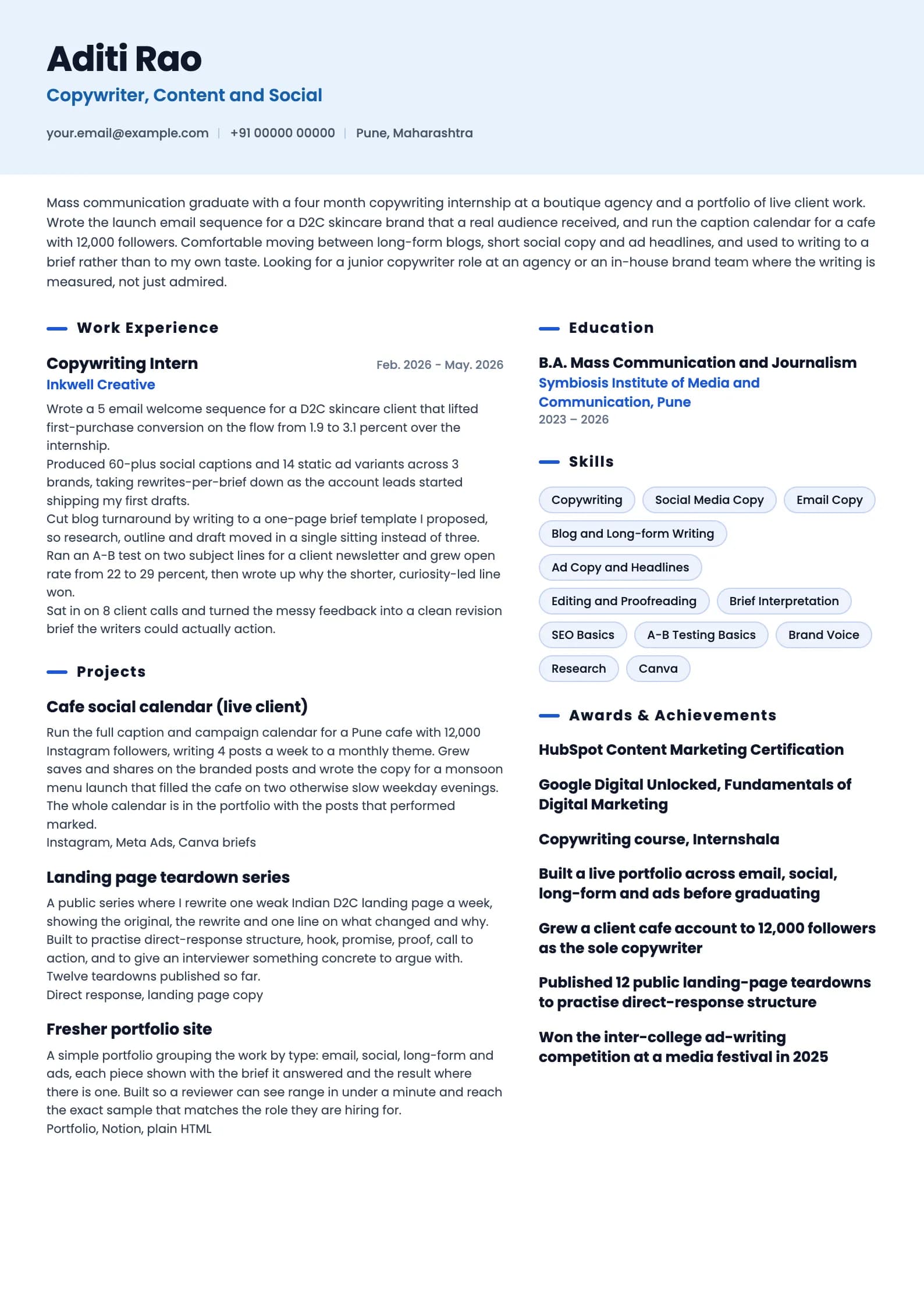
Build my resumeCopywriter resume example, Fresher (0 years)
ai-era templateIs your resume good enough?
Upload the resume you have now and see what an applicant tracking system reads before a copywriter recruiter ever does.
Free to run. Sign in with your mobile number to see your score.
Copywriter resume example, Mid-level (4 years)
professional template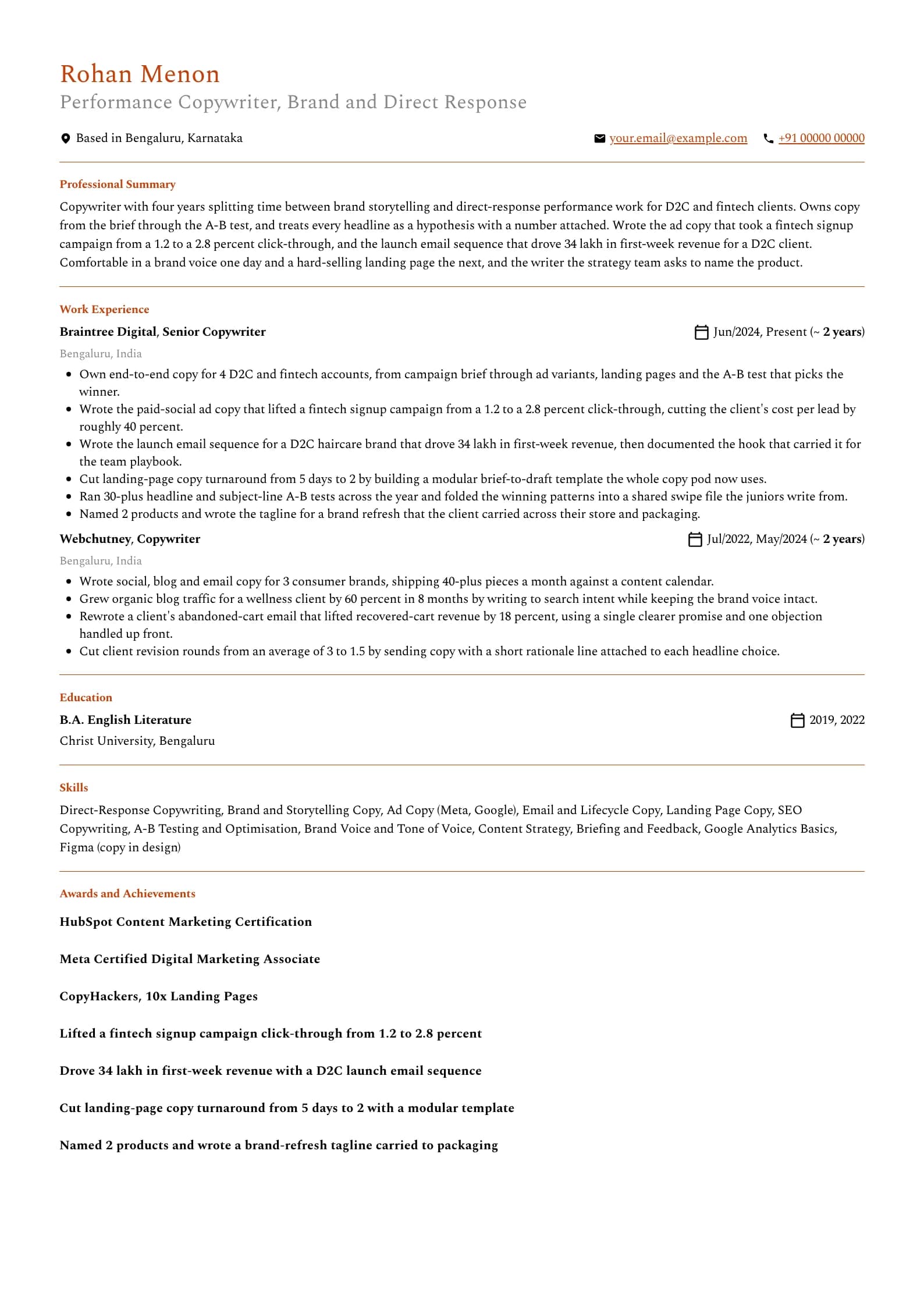
Want this structure with your own details? Build it in the resume builder.
Copywriter resume example, Senior (8 years)
header-band template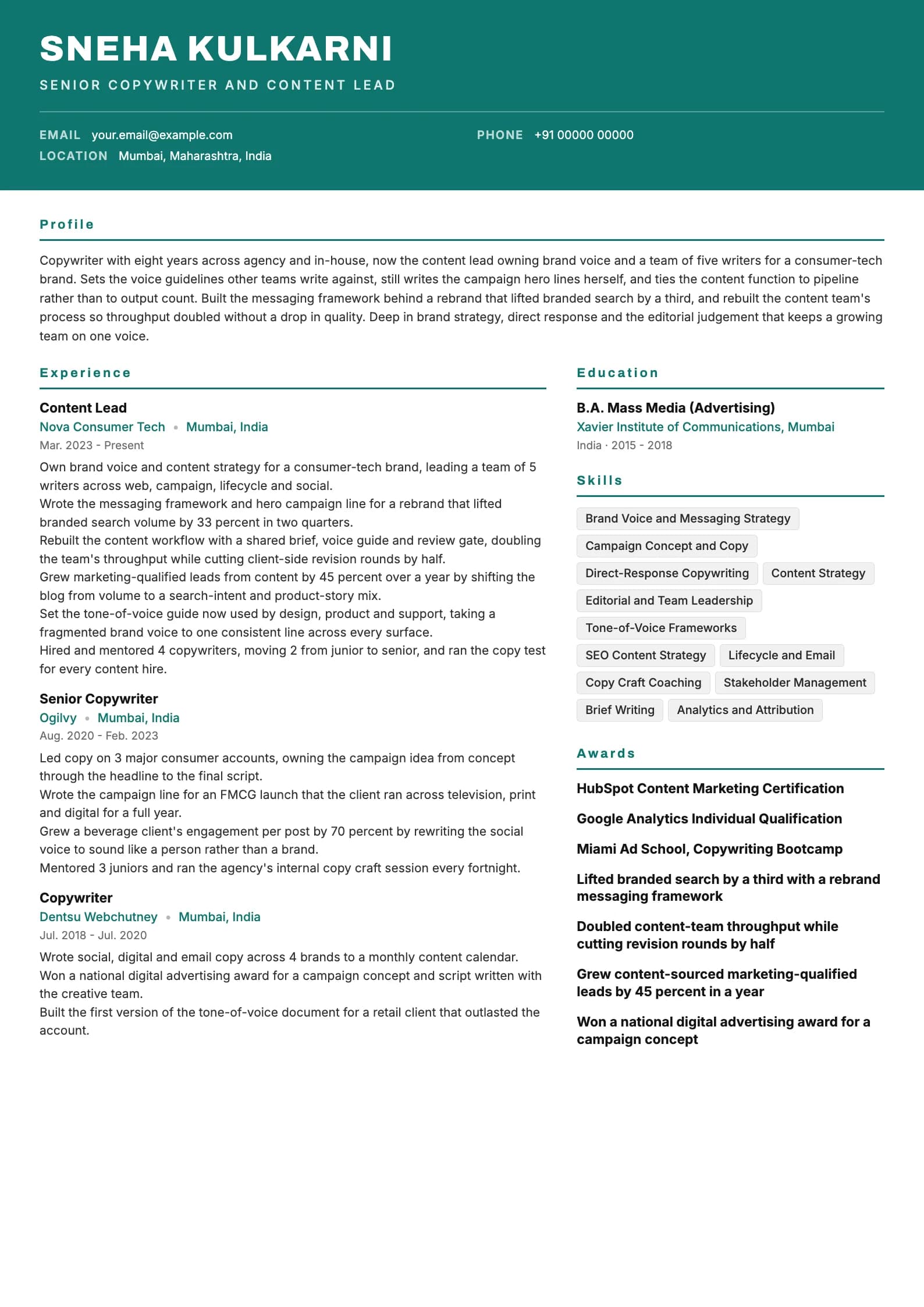
The format that works for copywriter resumes in India
Reverse chronological is the layout to use. Most recent role first, work backwards, dates in plain view. A functional resume that hides the timeline under a Skills grouping reads as an attempt to mask a gap, and reviewers treat it that way. If you freelanced through a gap, list it as freelance copywriting with the clients or the sectors, which is honest and often stronger than a full-time line. The portfolio link is not a nice-to-have, it is the most important line on the page. A copywriter resume without work to read is a claim with no evidence. Put a single clean portfolio URL near the top, and make sure the pieces behind it are grouped, current and load without a login. A reviewer who cannot reach your writing in one click usually moves to the next application. Length is one page up to roughly six years, two only when the second page carries campaigns and results rather than a longer list of tools. A copywriter's page is judged partly on how it is written, so tight, well-edited copy is itself a work sample. A padded, comma-spliced resume undercuts the one skill you are selling. Four things belong nowhere on a creative resume here: a photograph, date of birth, marital status and father's name. They come from an older campus template and take space a campaign result could use. Send a PDF unless the posting asks otherwise, name the file with your name and the role, and keep a single column so the layout parses cleanly. The table below sets out the section order.
| Section | Where it goes | Why |
|---|---|---|
| Name, headline and portfolio link | Top, above everything | The headline is the role you want, copywriter or content writer. The portfolio URL sits right beside it. |
| Professional summary | Directly under the header | Three lines. Formats you write, years, and the single strongest result. |
| Work experience | Next, for anyone with a job or freelance history | Most recent first. Lead with the campaign and the number it moved. |
| Portfolio highlights or projects | Above experience for freshers, below it after that | For a fresher this is the evidence. Pick range, not three of the same thing. |
| Skills | Below experience | Grouped: copy types, channels, tools. Not a 30-item wall of adjectives. |
| Education | Bottom, unless you are a fresher | Degree, institution, years. Drop the percentage after your first job. |
| Certifications | After education, or beside skills if only one or two | HubSpot, Meta or a named copy course earn a line early; less later. |
The portfolio link does the hiring, the resume gets you to it
For every other role the resume is the evidence. For a copywriter the resume is the trailer and the portfolio is the film. A hiring manager decides in seconds whether to open your work, so the resume's real job is to earn that click and point it at the right piece. Make the link impossible to miss and impossible to break. One clean URL near your name, not buried in a footer, not a Google Drive folder that asks for access, not a 40-piece dump with no order. Group the work by type, email, social, long-form, ads, and put the strongest piece first in each group. A reviewer hiring for landing pages should reach a landing page in one click, not scroll past your college blog. Show the brief and the result, not just the copy. A headline with no context is a nice sentence. A headline with the brief it answered and the click-through it earned is a case study, and a case study is what closes the interview. The mid-level sample links its ad copy to a 1.2-to-2.8 percent click-through for exactly this reason. Do not link work you cannot defend or did not write. Interviewers ask you to walk through a piece, explain the choice behind the hook, and describe what you would change now. If you cannot do that for something in your portfolio, it should not be there. Ghostwritten or team work is fine to show if you are clear about your part.
Before you send the resume, open your own portfolio link in a private browser window. If it asks for a login, loads slowly, or drops you into an unsorted pile, you have just failed the test a hiring manager runs in the first ten seconds.
Writing a summary that reads like a copywriter wrote it
The block under your name is the one part you can count on being read, and for a copywriter it is also an audition. Three or four lines carrying three facts: what you write, how long you have written it, and the strongest thing that happened because of your words. Written cleanly, because a clumsy summary on a copywriter's resume is a contradiction the reviewer notices. The old objective line, seeking a creative role in a reputed organisation to utilise my writing skills, tells the reader nothing and, worse, reads badly. Replace it with a summary. An objective describes what you want, a summary shows what you have already made happen, and only one of those is a work sample. Freshers often think they have nothing to summarise. Look at the fresher sample: it names the formats, states the internship length, and points at a live client account with a real number. That is a genuine summary built from one internship and side projects. What it avoids is passionate wordsmith with a way with words, a phrase that carries no information and, on a writing resume, actively hurts. A practical test: read your summary and ask whether another copywriter with your degree could paste it onto their resume unchanged. If they could, it describes the profession, not you. Add the specific campaign, the specific number and the specific voice you write in until it stops being transferable.
Professional summary, mid-level copywriter
Weak
Passionate and creative copywriter with 4+ years of experience and excellent communication skills seeking a challenging role in a reputed organisation to craft compelling content.
Strong
Copywriter with four years across brand and direct response for D2C and fintech, owning copy from brief to A-B test. Lifted a signup campaign from a 1.2 to a 2.8 percent click-through and drove 34 lakh in first-week revenue with a launch email sequence.
Trades adjectives and a wish for a domain, a way of working and two results a reviewer can ask about.
Experience bullets: verb, piece of copy, number it moved
Every strong bullet in the samples has the same shape. It opens with an action verb, names the specific piece of copy or campaign you wrote, and closes with what measurably moved. The verb says you did it. The piece tells a reviewer what kind of writing it was. The number does the persuading. Start from the result and work backwards. Writers tend to describe the task first, wrote social media posts for various clients, then cannot attach a number. Instead ask what changed after your copy went live: an open rate rose, a click-through improved, a cart was recovered, revenue landed, revision rounds fell. Then write the sentence that ends in that fact. Vary the metric. Five click-through numbers in a row read as one trick. Across real copywriting work you can honestly reach for open rate, click-through, conversion, revenue, organic traffic, engagement, cost per lead and turnaround time. The mid-level sample deliberately spreads across several so it reads as range, not a single lucky campaign. Where a number is genuinely not available, and it often is not for brand work, give scope and specifics: how many brands, how many pieces a month, which channels, what the copy was for. Named 2 products and wrote the tagline carried to packaging carries weight without a percentage. Allocate bullets by recency: current role five or six, previous four or five, older two or three.
| Level | What bullets must prove | Typical metric |
|---|---|---|
| Fresher | You can write to a brief and it works | Open rate, conversion on a flow, followers grown, pieces shipped |
| 1 to 3 years | You own copy for an account without hand-holding | Click-through, organic traffic, engagement, revision rounds cut |
| 4 to 6 years | Your copy moves a business number reliably | Conversion, revenue, cost per lead, turnaround, A-B test wins |
| 7 years and up | You set the voice and lead writers | Branded search, pipeline sourced, team throughput, awards |
Experience bullet, performance copy
Weak
Responsible for writing engaging and creative ad copy for social media campaigns for various brands.
Strong
Wrote the paid-social ad copy that lifted a fintech signup campaign from a 1.2 to a 2.8 percent click-through, cutting cost per lead by roughly 40 percent.
Responsible for describes a job description; the rewrite names the campaign, the before and after and the cost it saved.
Experience bullet, email copy
Weak
Wrote various email newsletters and marketing emails which improved customer engagement.
Strong
Rewrote a client's abandoned-cart email that lifted recovered-cart revenue by 18 percent, using a single clearer promise and one objection handled up front.
Names the exact email, the revenue it moved, and the two writing choices behind it, so an interviewer can ask a real follow-up.
If a bullet would read identically on another copywriter's resume, it is describing the job, not your work. Rewrite it until it only fits the campaign you actually wrote.
The skills section: copy types, channels and tools, not adjectives
A copywriter's skills section has a trap the role invites: filling it with adjectives. Creative, passionate, detail-oriented, excellent communication. None of that is a skill a parser matches or an interviewer can test, and on a writing resume it reads as filler where craft should be. List what you actually do. Group by copy type, direct response, brand, email, long-form, SEO, channel, Meta, Google, email platforms, and tool, the CMS, the analytics, the design tools you work inside. That grouping tells a reviewer what kind of copywriter you are in one pass and gives the parser the literal terms it searches for. Ten to sixteen items is the working range. Below eight it looks thin, above twenty it stops being a signal. Write names the way the industry does, click-through rate not CTR only, Google Analytics not GA, HubSpot not Hubspot. Every skill on the line is a promise an interviewer can call: if you list SEO copywriting, be ready to talk about search intent and how you keep voice while writing for a keyword. Do not use a star rating or a percentage bar for creative skills. Nobody agrees what four stars in storytelling means, and it invites an argument you cannot win. Let the portfolio and the experience prove the depth.
Skills section
Weak
Skills: Creative, Passionate, Hard-working, Excellent communication, Team player, Detail-oriented, Good writing, Time management, Fast learner, Adobe, MS Office
Strong
Copy: direct response, brand, email, long-form, SEO. Channels: Meta and Google ads, email lifecycle, landing pages. Tools: HubSpot, Google Analytics, WordPress, Figma.
Cuts the adjectives that no parser matches and no interviewer can test, and replaces them with copy types, channels and tools a reviewer reads in one pass.
Portfolio highlights and side projects: what to show and how
For a fresher, portfolio pieces are the resume. They sit above experience, get the most space, and are where a reviewer decides whether you can actually write for a brief or only for yourself. For an experienced copywriter they move below experience and shrink to the two or three campaigns worth naming outside the day job. The common failure is listing pieces by title with no context. Wrote a blog for a client tells a reviewer nothing. Show the brief the piece answered, the audience it was for, and the result where one exists. The fresher sample's cafe calendar is a stronger entry than a flashier passion project, because it names a real account, a real audience and posts that measurably performed. Pick pieces that show range rather than three versions of the same thing. One with live users and a result, one that shows a craft you want to be hired for such as direct-response structure, and one that shows voice, is a stronger set than three blog posts. Two well-framed pieces beat five listed by name. Spec work and self-initiated projects count, and freshers undersell them. A weekly landing-page teardown series, a rewritten brand's homepage done on your own, a newsletter you write for fun with real subscribers, all of these are legitimate evidence. Be honest about what was live client work and what was practice, because an interviewer will ask and the honesty reads well.
Where education and certifications belong
Education goes at the bottom for anyone with a job or a freelance history, and near the top for a fresher who has nothing stronger to lead with. Degree, institution, years. That is the whole entry for most people. Copywriting is one of the more degree-agnostic roles: English, mass communication, journalism, even an unrelated degree with a strong portfolio all work, so do not over-explain the qualification. CGPA or percentage is worth keeping while you are a fresher and it is good, roughly 7.5 out of 10 and above. Once you have your first role and a portfolio, drop it. A number from three years ago competes for space with campaigns that predict far more. Certifications sit just below education, or beside skills if you hold only one or two. Write the full name, the issuing body and the year. For copywriters the HubSpot content marketing certification, the Google and Meta marketing credentials and a named copy course such as CopyHackers or Copyblogger carry some early-career weight and signal you understand the funnel your copy sits in. None of them substitute for a portfolio, and beyond a couple of years the work is the only credential that matters. What does earn a permanent line is a genuine industry award, a national advertising award or a real competition win, because it is external validation of the craft. List it with the year and the campaign, not as a vague claim.
Getting through the applicant tracking system
An applicant tracking system is a parser and a search index, not a judge. It reads your file, breaks it into name, dates, employers, titles and skills, and stores the result so a recruiter can search across candidates. Agencies and larger brands run one, so a beautifully written resume that parses badly can still be filtered before a human reads a line. The layout rules are short. One column. Standard section headings, so use Work Experience rather than My Story, and Skills rather than My Superpowers. No text inside images or a graphic banner, because a designed header reads as empty space to a parser. Keep the portfolio URL as selectable text, not baked into an image, or the one link that matters becomes invisible. On wording, mirror the language of the posting where it is honest. If the role says copywriter, use copywriter, not wordsmith or content ninja. If it says direct response, use direct response. Include the expansion beside an acronym once, for example click-through rate (CTR), so both searches find you. Keyword stuffing does not work and reads especially badly for a writer. A hidden block of every marketing term in tiny text is caught quickly, and being caught is worse than being filtered. Write real bullets that naturally contain the right terms, because a bullet describing a landing page you wrote contains the words landing page and conversion in a context that survives human review too. Save as PDF from a tool that embeds real text, then open the file and confirm you can select and copy a sentence. If you cannot select the text, neither can the parser.
Section heading
Weak
My Creative Journey
Strong
Work Experience
Parsers look for standard headings; a creative one can push the whole block into an unclassified bucket the recruiter never searches.
Test your own file before you send it. Copy the text out of the PDF into a plain text editor, and check the portfolio link comes through as clickable text. Whatever you can read there is roughly what the parser sees.
What gets copywriter resumes rejected
Most rejections at the resume stage are not close calls. They come from a small set of recurring problems, and all of them are fixable in an afternoon. The list below covers what agency and in-house reviewers of Indian copywriter resumes see most often, in rough order of how much damage each one does.
- No portfolio link, or one that is broken, asks for a login, or drops the reviewer into an unsorted pile. This is the single most common reason a strong writer is skipped.
- A summary and bullets full of adjectives, creative, passionate, detail-oriented, with no campaign and no number behind them.
- Job duties copied from the brief instead of the copy you wrote. Responsible for writing content is the tell.
- Typos, comma splices and clumsy sentences on a writing resume, which contradict the one skill you are selling.
- No numbers anywhere. Open rate, click-through, conversion, revenue, traffic, engagement. Pick whichever is honest for the work.
- A wall of tools and adjectives as skills instead of the copy types and channels you actually work in.
- A generic objective line. Replace it with a summary that states formats, years and one result.
- Portfolio pieces you cannot defend or did not write, which unravel the moment an interviewer asks you to walk through one.
- A photo, date of birth, marital status or father's name, none of which belongs on a creative resume and all of which takes a campaign's space.
- Inflated titles or dates that do not match your offer letters, since background verification is standard and a mismatch ends the process.
Read your resume aloud once before sending it, the way you would read your own copy back. A line you would be embarrassed to defend in an interview is a line to cut or rewrite.
Skills to put on a copywriter resume
Technical
- Direct-Response Copywriting
- Brand and Storytelling Copy
- Email and Lifecycle Copy
- Landing Page Copy
- Ad Copy (Meta and Google)
- SEO Copywriting
- Long-form and Blog Writing
- Social Media Copy
- Editing and Proofreading
- A-B Testing and Optimisation
- Content Strategy
- Brand Voice and Tone of Voice
Tools and platforms
- HubSpot
- Google Analytics
- WordPress
- Mailchimp
- Meta Ads Manager
- Google Ads
- Figma
- Canva
- Notion
- Grammarly
- Semrush
- Google Docs
Working skills
- Writing to a brief
- Taking feedback
- Stakeholder communication
- Deadline discipline
- Curiosity and research
- Attention to detail
- Collaboration with design
- Presenting and defending copy
- Adaptable tone
Certifications worth listing as a copywriter
| Certification | Full name | Worth it for |
|---|---|---|
| HubSpot Content Marketing | HubSpot Content Marketing Certification | Worth it for a fresher or early-career copywriter who wants to show they understand the funnel their copy sits in, not just the writing. It is free, recognised and quick, so it is a clean early-career line. Beyond a couple of years your portfolio outranks it, so keep it but do not lead with it. |
| Google Digital Marketing | Google Digital Unlocked, Fundamentals of Digital Marketing | A useful entry credential for a copywriter moving into performance or D2C work, where knowing how ads and analytics fit together makes your copy more hireable. Most valuable for freshers and career switchers. Once you have run campaigns with real results, the results replace the badge. |
| Meta Certified | Meta Certified Digital Marketing Associate | Signals you understand the platform where a lot of paid-social copy runs. Worth it for a performance or direct-response copywriter who wants the ads keyword on the page. Less relevant for a pure brand or long-form writer, so match the certification to the kind of copy you sell. |
| CopyHackers | CopyHackers, 10x Landing Pages or 10x Emails | A named craft course that carries real signal with direct-response and conversion-focused teams, because it teaches the structure agencies test for. Worth it if you are targeting D2C, SaaS or performance roles. For brand and editorial roles it matters less than a strong campaign portfolio. |
| GAIQ | Google Analytics Individual Qualification | Worth it for a senior or performance copywriter who wants to speak fluently about what the copy did, not just what it said. It pairs well with lifecycle and landing-page work where you are expected to read the funnel. Skip it if you never touch the numbers behind your copy. |
Keywords an ATS scans for in a copywriter resume
These are the literal terms a parser matches against the job description. Use the ones that are true of you, in the sentences where you did the work, not as a list at the bottom.
- copywriter
- content writer
- copywriting
- direct response
- brand voice
- ad copy
- email copy
- landing page
- SEO copywriting
- content strategy
- conversion rate
- click-through rate
- A-B testing
- campaign
- social media
- editing
- proofreading
- portfolio
- tone of voice
- engagement
Copywriter resume FAQ
What salary can a copywriter expect in India?
A fresher typically starts around 2.5 to 4.5 LPA at an agency, and higher at a well-funded D2C or fintech in-house team. A copywriter with four to six years across brand and performance usually sits in the 8 to 16 LPA band, with strong direct-response writers at the top of it. Senior copywriters and content leads with eight years and above commonly earn 18 to 35 LPA and more at large brands and agencies. Proven direct-response results, where you can show a copy change that moved conversion or revenue, push the top of every band upward faster than brand-only work.
How long should a copywriter resume be?
One page up to about six years, two pages after that only if the second page carries campaigns and results rather than a longer list of tools. On a copywriter's resume the writing itself is a work sample, so tight, well-edited copy matters as much as length. If you are struggling to fit one page, cut the oldest role to a line, remove coursework, and trust the portfolio link to carry the depth.
Do I really need a portfolio link on my resume?
Yes, and it is the single most important line on the page. A copywriter resume without work to read is a claim with no evidence, and most reviewers will not chase a missing portfolio. Put one clean URL near your name, group the pieces by type, lead each group with your strongest work, and make sure it opens without a login. Show the brief and the result beside each piece, not just the copy, so the portfolio reads as case studies rather than a scrapbook.
How do I write a copywriter resume with no experience?
Lead with a portfolio of live or spec work, then education, then skills. Treat each piece as a case study: the brief, the audience, what you wrote and any number it moved. Real client work from an internship counts, a caption calendar you run for a local business counts, and a self-initiated series such as weekly landing-page teardowns counts. Add any checkable win, a HubSpot certification, an ad-writing competition, a newsletter with real subscribers, since verifiable proof beats adjectives on a writing resume.
Should I list brand or direct-response copy, or both?
Show whichever the target role wants first, but a resume that proves both reads as more hireable, especially at agencies that move writers across accounts. Brand work shows voice, concept and storytelling; direct-response work shows you can make copy sell and survive an A-B test. If you have both, group them clearly so a reviewer hiring for one can find it fast. If you only have one, be honest and deep in it rather than pretending at the other.
Do certifications like HubSpot help a copywriter?
They help most early, when you have little professional work to show, and least once you have a portfolio of campaigns with results. HubSpot content marketing, the Google and Meta marketing credentials and a named copy course signal that you understand the funnel your copy lives in, which reassures a performance team. None of them substitute for writing a reviewer can read, so keep the list short and let the portfolio be the real credential.
How many samples or projects should I include on the resume itself?
Two or three named highlights on the resume, with the full set behind the portfolio link. The resume is the trailer, not the film, so pick the pieces that show range and a result and point everything else to the portfolio. For each highlight, give the brief and the number it moved rather than just a title. Two well-framed case studies on the page beat five listed by name with no context.
Does an ATS reject creative resumes with fancy layouts?
It does not reject them outright, but a two-column, graphic-heavy layout often parses out of order or drops your portfolio link if that link is baked into an image. Some parsers read a designed sidebar as empty space and interleave it with your experience. A single-column layout with the portfolio URL as selectable text removes the risk, which is why all three samples use one. Copy the text out of your own PDF to check it reads in order and the link comes through clickable.
Should I include copy for clients I ghostwrote or worked on in a team?
Yes, as long as you are honest about your part. Most agency and in-house copy is collaborative, and reviewers know it. Show the campaign, name your specific contribution, the headline, the email sequence, the concept, and be ready to walk through the choices in the interview. Do not claim a whole campaign you wrote one line of, because interviewers probe portfolio pieces and a hollow claim unravels quickly and costs you the credibility of the rest.
Related resume examples and guides
Build your own in any of these formats
Start from a blank resume or upload the one you have. Goodspace renders it in 24 templates and flags the copywriting keywords an applicant tracking system will look for, and the adjectives it will not credit, so the writing does the talking.
Build my resume