Social Media Manager Resume Format, with 3 Full Samples
A social media manager is hired on evidence of communities grown, engagement earned and revenue driven from social, yet most resumes list Instagram, Facebook, Canva and Hootsuite and forget the audience those tools were used to build. Below are three complete resumes, one for a fresher who grew a real page and ran a small campaign, one for a social media manager with three years owning content and paid social for a D2C brand, and one for a lead owning the whole social strategy across channels and a team. After the samples come the format rules, why a portfolio of real posts beats a follower count, the terms a parser matches literally, and the mistakes that get a social resume filtered before a marketing lead scrolls your feed.
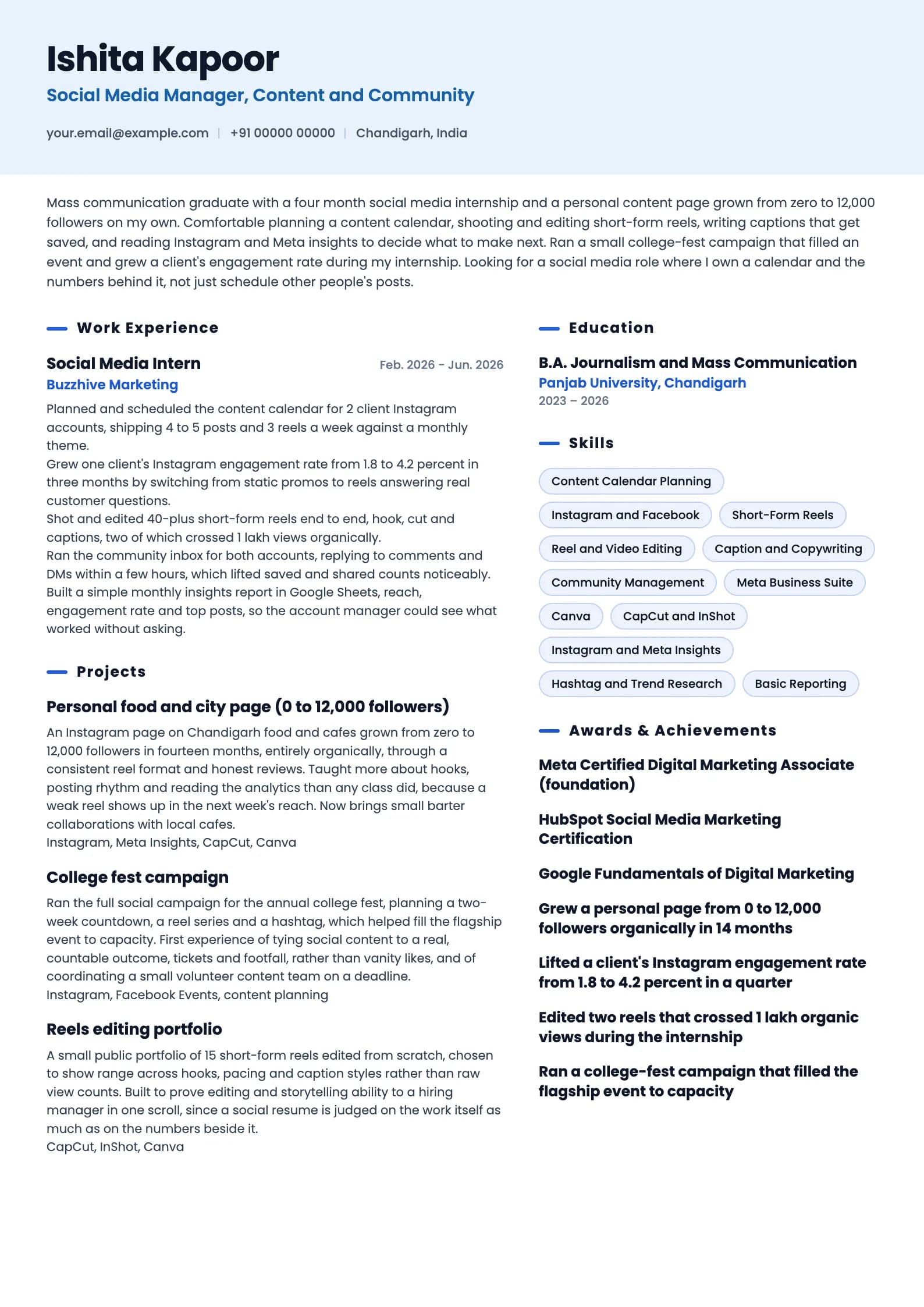
Build my resumeSocial Media Manager resume example, Fresher (0 to 1 year)
ai-era templateIs your resume good enough?
Upload the resume you have now and see what an applicant tracking system reads before a social media manager recruiter ever does.
Free to run. Sign in with your mobile number to see your score.
Social Media Manager resume example, Mid-level (3 years)
professional template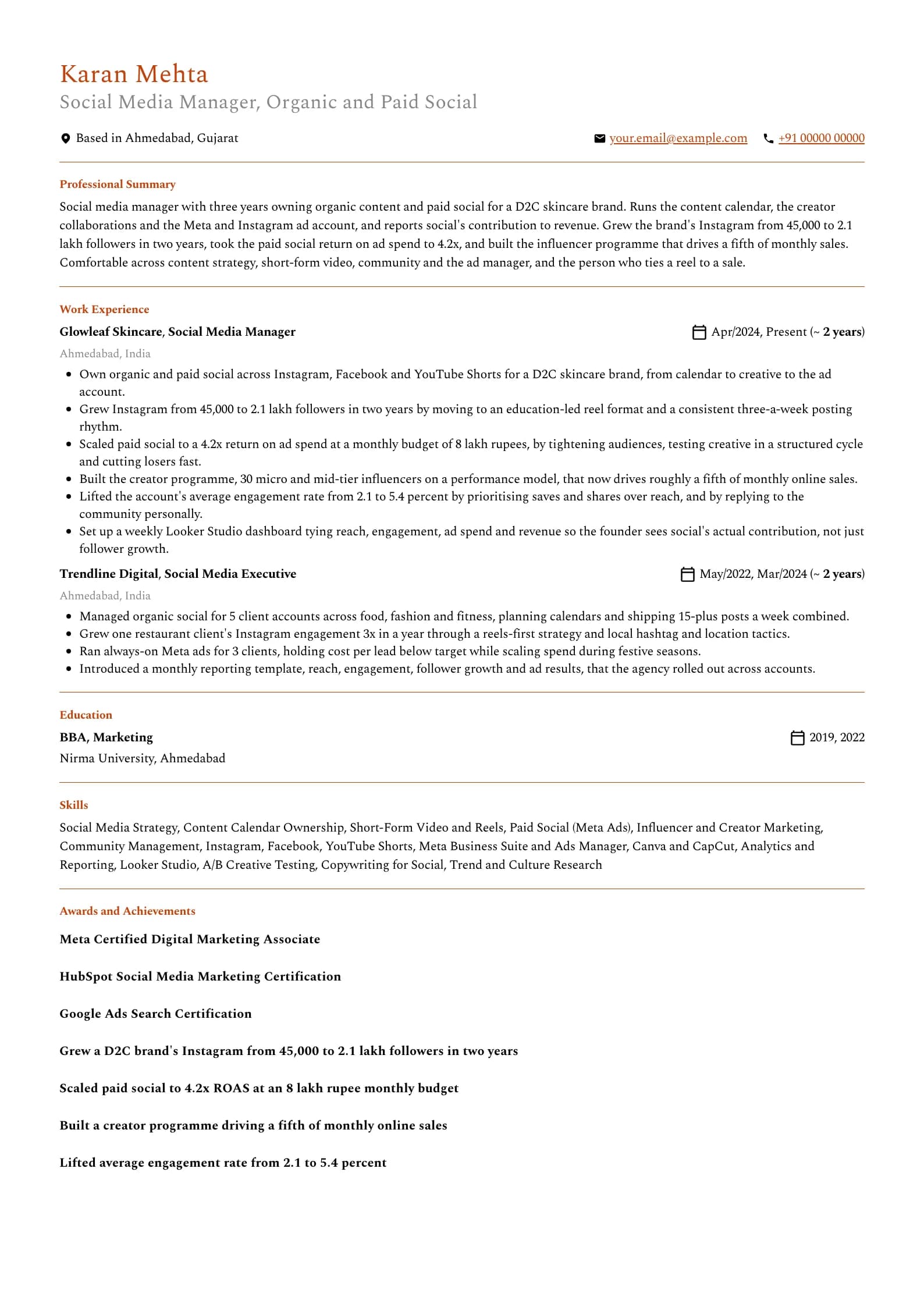
Want this structure with your own details? Build it in the resume builder.
Social Media Manager resume example, Lead (8 years)
header-band template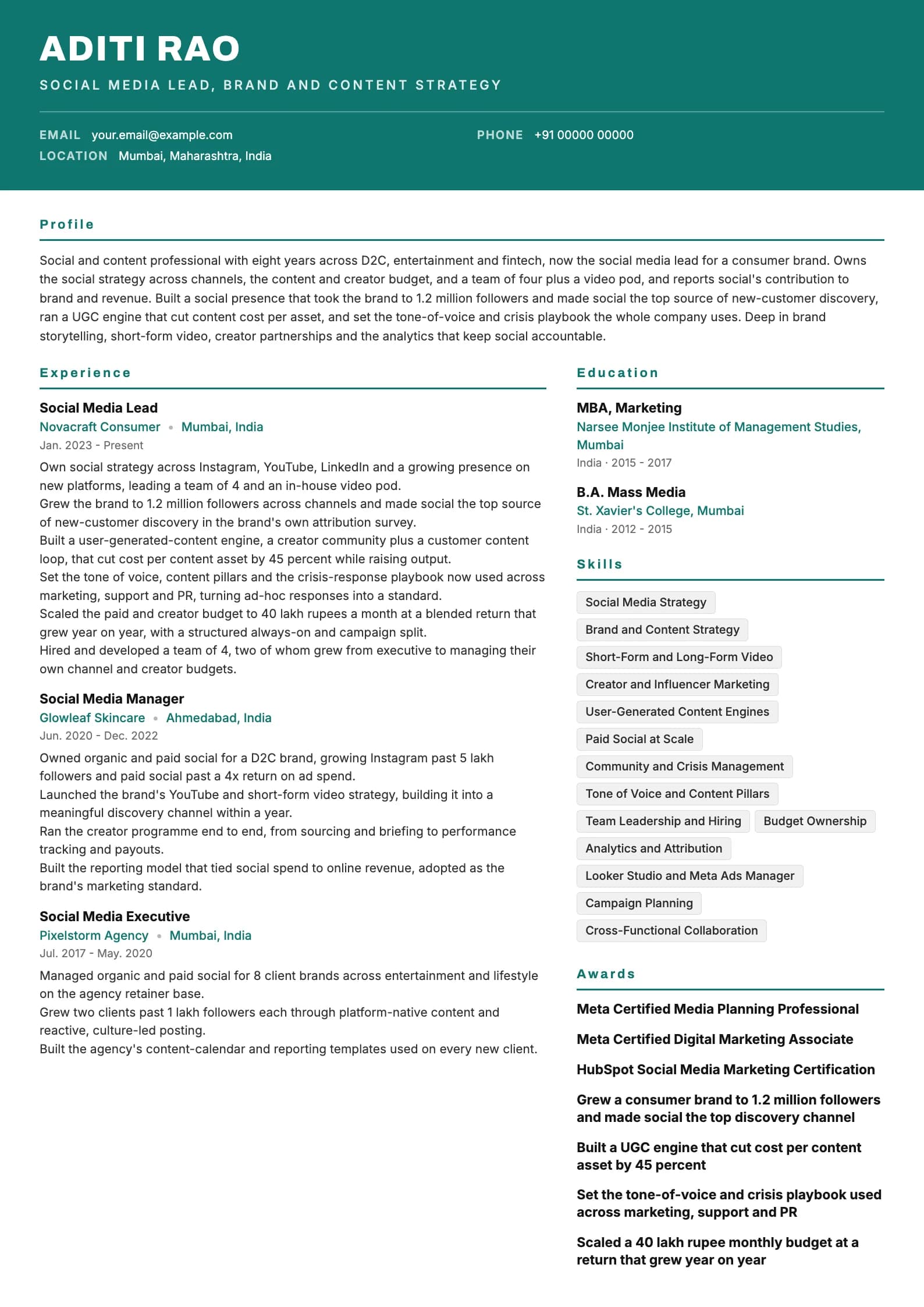
The format that works for social media manager resumes in India
Reverse chronological is the only layout worth using. Put the most recent role first, work backwards, and keep the dates in plain view. Functional resumes that group everything under Skills and quietly drop the timeline read as an attempt to hide a gap, and reviewers treat them that way. A short honest line explains a gap better than a hidden one. Length is decided by evidence. One page holds everything a fresher and most managers up to roughly five years have to say. Past that, a second page is fine when it carries real campaign and revenue work rather than a longer platform list. A page two padded with a hobbies line and a declaration is a one-page resume in disguise. Four things belong nowhere on a marketing resume here: a photograph, date of birth, marital status and father's name. They survive from an older template that circulated through college placement cells. Nobody hiring a social media manager needs them, and every line they occupy is a line an engagement number or a campaign result could have used. Put a link to your best work, a portfolio, a page you grew or a couple of accounts you ran, in the header in plain text. A marketing lead will look at the actual feed, so make that one click. Send a PDF unless the posting asks for DOCX, use a single column all the way down, and name the file with your name and the role. The table below sets out the section order.
| Section | Where it goes | Why |
|---|---|---|
| Name, headline and work link | Top, above everything | A link to accounts you grew is the point. A marketing lead will open the feed. |
| Professional summary | Directly under the header | Three lines. Years, channels, and one growth, engagement or revenue result. |
| Work experience | Next, for anyone with a job | Most recent first. Newest role gets the most bullets and the biggest numbers. |
| Portfolio or accounts managed | Above experience for freshers, alongside it after that | For a fresher a page you grew is the evidence. Name the account and the numbers. |
| Skills | Below experience | Grouped: strategy, content, paid, tools. Not a wall of every platform and app. |
| Education | Bottom, unless you are a fresher | Degree, institution, years. Drop the percentage after your first job. |
| Certifications | After education, or beside skills if only one or two | Meta and HubSpot social certificates. Worth naming for a fresher. |
Follower count is a vanity number until you attach a rate and a result
The most common social resume failure is a page built around raw follower counts and total likes, with no engagement rate, no growth window and no business result anywhere. A brand can buy a follower count. What a marketing lead actually wants to know is whether the audience reacts and whether social does anything for the business, and neither shows up in a bare number. The fix is to pair every audience number with a rate and a result. Grew Instagram from 45,000 to 2.1 lakh followers in two years is far stronger than 2.1 lakh followers, because it names the start point and the window. Add engagement rate, saves and shares, or better still a commercial outcome, return on ad spend, sales from creators, leads, footfall, and the resume moves from vanity to value. Be honest about organic versus paid, and about what you owned. A follower jump that came from a paid burst you did not run is not your growth. If you ran the ads, say so and give the ROAS. If the growth was organic, that is a stronger story, so make the distinction, because an interviewer will ask and a vague answer undoes the whole page. Do not lean on impressions and reach alone. Reach is a spend and luck number as much as a skill one. Engagement rate, saves, shares, comments, click-through and, above all, revenue or leads are the numbers that separate a social manager who drives outcomes from one who simply posts.
For every follower number on your resume, ask: does a rate and a result sit next to it. A count with no engagement rate and no business outcome is a vanity metric a marketing lead has learned to discount.
Writing a summary a marketing lead actually reads
The block under your name is the part you can be reasonably sure gets read, so it should carry three facts: what you manage, how long you have been doing it, and the strongest thing that happened because of your work. Three or four lines, no adjectives that cannot be checked. The old objective line, seeking a challenging position to use my creativity and social media skills, tells the reader nothing they did not assume from the application. Replace it with a summary. An objective describes what you want, a summary describes what you have already grown and driven, and only one is evidence. Freshers often believe they have nothing to summarise. Look at the fresher sample: it names the channels and skills, states the internship length, and points at a personal page grown from zero to 12,000 followers. That is a genuine summary built from coursework, one internship and a real page. What it avoids is creative and passionate about social media, a phrase so common on graduate resumes it now carries no information. A practical test: read your summary and ask whether a classmate with the same degree could paste it onto their resume unchanged. If they could, it describes the course, not you. Add the specific brand, the specific growth number and the specific ownership until it stops being transferable.
Professional summary, mid-level social media manager
Weak
Creative and passionate social media manager with 3+ years of experience in handling social media accounts and increasing followers, seeking a challenging role in a reputed organisation.
Strong
Social media manager with three years owning organic and paid social for a D2C brand. Grew Instagram from 45,000 to 2.1 lakh followers in two years and scaled paid social to a 4.2x return on ad spend.
The rewrite trades adjectives and a generic goal for a domain, an ownership scope and two verifiable results a lead can check.
Experience bullets: what you ran, and what it moved
Every strong bullet in the samples follows the same shape. It names what you ran, whether that is a content calendar, a paid account or a creator programme, and closes with what measurably moved. Handled social media accounts is a task. Grew Instagram from 45,000 to 2.1 lakh followers in two years is a result. The difference is whether the sentence ends in an outcome. Start with the outcome and work backwards. Managers usually write the activity first, then struggle to attach a number, which produces bullets like managed the brand's social media and increased engagement. Instead ask what changed after your work went out: followers grew in a window, engagement rate rose, ROAS improved, sales came from creators, cost per lead fell, views crossed a threshold. Then write the sentence that ends in that fact. Vary the metric. Social work can be measured many ways: follower growth with a window, engagement rate, saves and shares, ROAS, revenue or sales from social, cost per lead, view counts and content output. The mid-level sample uses several types, which reads as range rather than one trick. Where you lack a clean number, give scope: how many accounts, how many posts a week, how many creators, how big the ad budget. Managed organic social for 5 client accounts, shipping 15-plus posts a week carries weight without inventing a percentage. Allocate bullets by recency. Current role gets five or six, the previous role four or five, anything older two or three.
| Level | What bullets must prove | Typical metric |
|---|---|---|
| Fresher | You can grow a page and edit content | Followers grown, engagement rate lifted, views, reels shipped |
| 1 to 3 years | You own a calendar and some paid | Accounts managed, engagement growth, cost per lead, posting cadence |
| 3 to 5 years | You own organic and paid and tie it to revenue | Follower growth with window, ROAS, sales from social, creator programme |
| 6 years and up | You own strategy, budget and a team | Discovery share, budget scaled, UGC engine, standards, hiring |
Experience bullet, organic growth
Weak
Handled the brand's Instagram account and increased followers and engagement through regular posting.
Strong
Grew Instagram from 45,000 to 2.1 lakh followers in two years by moving to an education-led reel format and a consistent three-a-week posting rhythm.
"Handled" describes a task; the rewrite names the growth, the window and the strategy that produced it.
Experience bullet, paid social
Weak
Ran Facebook and Instagram ads for the brand and achieved good results within the budget.
Strong
Scaled paid social to a 4.2x return on ad spend at an 8 lakh rupee monthly budget by tightening audiences, testing creative in a structured cycle and cutting losers fast.
Names the ROAS, the budget and the method, so a lead can ask a real follow-up instead of trusting the word good.
If a bullet would read identically on any social manager's resume, it is describing the job title, not your work. Rewrite it until it only fits the account you actually grew.
The skills section: strategy, content, paid, and tools
A social media manager's skills section has two audiences with opposite preferences. The parser wants literal terms it can match, social media strategy and Meta Ads and community management. A human wants a short, organised list that signals what kind of social manager you are, an organic-content person, a paid person, or a full-stack one. Grouping satisfies both. Group by function rather than one long line. Strategy, content, paid, and tools is a grouping that works for almost every social manager. The exact headings matter less than the fact that structure exists. Name things the way the industry does: Meta Ads Manager not just Facebook ads, short-form video not just reels-making, and list only the platforms you have actually managed. Resist listing every platform and app you have ever touched. A wall of Instagram, Facebook, Twitter, LinkedIn, Snapchat, Pinterest, Threads, Canva, CapCut, InShot, VN, Hootsuite, Buffer, Later, Sprout reads as padding. Ten to sixteen concrete skills is the working range. Below eight the section looks thin; above twenty it stops being a signal. Do not include a proficiency bar. Star ratings invite an argument you cannot win, and nobody agrees what four stars in copywriting means. Let the portfolio and the numbers prove the depth instead.
| Group | What goes in it | How many |
|---|---|---|
| Strategy | Social strategy, content calendar, community, campaign planning | 3 to 4 |
| Content | Short-form video, reel editing, copywriting, content pillars | 3 to 4 |
| Paid and creators | Meta Ads, paid social, influencer and creator marketing | 2 to 3 |
| Analytics | Meta Insights, Looker Studio, reporting, A/B testing | 2 to 3 |
| Tools | Meta Business Suite, Canva, CapCut, a scheduler | 3 to 5 |
Skills section
Weak
Skills: Instagram, Facebook, Twitter, LinkedIn, Snapchat, Pinterest, Threads, YouTube, Canva, CapCut, InShot, VN, Hootsuite, Buffer, Later, Photoshop, Communication, Creativity, Teamwork, MS Office
Strong
Strategy: social strategy, content calendar, community management. Content: short-form video, reel editing, copywriting. Paid: Meta Ads, creator marketing. Analytics: Meta Insights, Looker Studio. Tools: Meta Business Suite, Canva, CapCut.
Cuts the platform-and-app wall and the soft-skill filler, and groups real competencies so a marketing lead reads it in one pass.
Portfolio and accounts managed: what to show and how
For a fresher, a page you grew is the resume. A personal Instagram, a niche page or a page you built for a college club sits above experience, gets real space, and is where a marketing lead decides whether you can actually build and hold an audience or only claim to. For an experienced manager, a short accounts-managed or portfolio block stays useful, showing the brands you ran and the results. The common failure is naming a platform with no proof. Managed social media for a brand tells a lead nothing. Name the account, the growth window, the engagement rate and any business result, and if the account is public, link it so the lead can scroll it. The personal page in the fresher sample is a stronger entry than a longer skills list, because a grown-from-zero page is proof of the exact skill the job needs. Pick work that shows range and matches the role. If the job is content-and-community, lead with a page whose engagement you grew. If it is performance and paid, lead with a ROAS result. A tidy reels portfolio that shows editing and storytelling is worth linking for a fresher, because a social resume is judged on the craft as much as the numbers. Be honest and specific about what you owned and whether growth was organic or paid. A public account an interviewer can open is the strongest possible proof, so only point at accounts that stand up to a scroll, and screenshot the insights if the numbers are your best evidence.
Accounts managed, fresher resume
Weak
Managed a personal Instagram page and gained a good number of followers with regular posting.
Strong
Personal food and city page: grew from 0 to 12,000 followers organically in 14 months through a consistent reel format and honest reviews, now bringing local barter collaborations.
Swaps a vague claim for a start point, a window, the method and a real outcome a lead can verify by opening the page.
Where education and certifications belong
Education goes at the bottom for anyone with a full-time job, and near the top for a fresher, who has nothing stronger to lead with. Degree, institution, years. That is the whole entry for most people, and social is a field where a grown account outweighs the degree. CGPA or percentage is worth keeping while you are a fresher and it is good, roughly 7.5 out of 10 and above, because early-career screening still filters on it. Once you have your first social role, drop it. A number from three years ago competes for space with audiences and campaigns that are far more predictive. Social media is open on degrees: mass communication, management, design and arts graduates all do it well, so do not apologise for the degree you hold. A mass-media or marketing background is a mild plus worth surfacing, but a page you grew and a ROAS you drove matter more than any of them. Certifications sit just below education, or beside skills if you hold only one or two. Write the full name, the issuing body and the year. The Meta certifications, the HubSpot social media certification and the Google digital marketing fundamentals are recognised and mostly free, and worth naming for a fresher because they show initiative and a grasp of the ad platforms you will actually use. They matter less once you have grown real accounts, so keep the list short and let the results be the credential.
Getting through the applicant tracking system
An applicant tracking system is a parser and a search index, not a judge. It reads your file, tries to break it into name, dates, employers, titles and skills, and stores the result so a recruiter can search across candidates. Almost every ATS problem is a parsing problem, and parsing problems come from layout, not wording. The layout rules are short. One column. Standard section headings, so use Work Experience rather than My Journey, and Skills rather than My Toolkit. No text inside images, because a designed banner or a grid of platform logos reads as empty space. No critical information in the header or footer region, which some parsers drop, and that includes the link to your accounts, so put it in the body as plain selectable text too. Avoid text boxes and nested tables. On wording, mirror the language of the job description where it is honest. If the posting says paid social, write paid social. If it says community management, use that phrase. Include the expansion alongside an acronym at least once, for example ROAS (return on ad spend) and UGC (user-generated content), so both searches find you. Social candidates are especially tempted to over-design the resume with brand colours, icons and a two-column grid to show creativity, and it backfires: that is exactly the layout parsers read out of order. Show your creativity in the linked accounts and portfolio, and keep the resume clean and parseable. Save as PDF from a tool that embeds real text, then open the file and confirm you can select and copy a sentence, including your account link. If you cannot select it, neither can the parser.
Section heading
Weak
My Social Media Journey
Strong
Work Experience
Parsers look for standard headings; a creative one can push the entire block into an unclassified bucket the recruiter never searches.
Test your own file before you send it. Copy the text out of the PDF into a plain text editor. Whatever you can read there, including your account link, is roughly what the parser sees, and anything scrambled is a real risk.
What gets social media manager resumes rejected
Most rejections at the resume stage are not close calls. They come from a small set of recurring problems, and all of them are fixable in an afternoon. The list below covers what marketing leads reviewing Indian social media resumes see most often, in rough order of how much damage each one does.
- Vanity follower counts with no engagement rate, no growth window and no business result. A count a brand could buy proves little on its own.
- No link to a single account you grew. A social resume that shows no actual social is failing at its main job.
- Job duties copied from the posting instead of what you ran and what it moved. "Handled social media accounts" is the tell.
- Claiming growth that came from paid bursts or a viral fluke you did not drive, which unravels the moment an interviewer probes it.
- No numbers anywhere. Follower growth, engagement rate, ROAS, sales, cost per lead. Pick whichever is honest for the work.
- A wall of every platform and editing app you have opened, which reads as padding rather than depth.
- A soft-skill dump, creative, passionate, team player, that any candidate could claim and no lead reads.
- Over-designed brand-coloured two-column layouts with icons that parse out of order and read as trying too hard.
- A photo, date of birth, marital status or father's name, none of which belongs on a marketing resume.
- No sign you understand paid or analytics at all, so a lead cannot tell whether you can do more than post pretty grids.
Before you send it, open the accounts you claim on your resume as if you were the hiring manager. If the feed does not back the numbers on the page, fix the resume, not the feed.
Skills to put on a social media manager resume
Technical
- Social Media Strategy
- Content Calendar Planning
- Short-Form Video and Reels
- Paid Social (Meta Ads)
- Influencer and Creator Marketing
- Community Management
- Copywriting for Social
- Campaign Planning
- A/B Creative Testing
- Analytics and Reporting
- Brand and Tone of Voice
- Trend and Culture Research
Tools and platforms
- Meta Business Suite and Ads Manager
- Instagram and Facebook
- YouTube and Shorts
- Canva
- CapCut and InShot
- Looker Studio
- Later or Buffer
- Meta and Instagram Insights
- Google Analytics 4
Working skills
- Content ideation
- Working with creators and designers
- Reactive, fast turnaround
- Community sensitivity
- Crisis handling
- Stakeholder reporting
- Team leadership
- Deadline management
Certifications worth listing as a social media manager
| Certification | Full name | Worth it for |
|---|---|---|
| Meta Digital Marketing Associate | Meta Certified Digital Marketing Associate | Meta's foundational certification, worth naming for a fresher or a career switcher, since it proves familiarity with the ad and business tools most social roles use daily. Recognised across Indian agencies and brands, but it carries less weight once you have run real ad accounts and grown accounts to point at. |
| Meta Media Planning Professional | Meta Certified Media Planning Professional | A more advanced Meta credential aimed at people who plan and buy paid social at scale, worth it for a mid-level or senior manager who owns a real ad budget. Overkill for a fresher; most valuable once paid social is a core part of your job. |
| HubSpot Social Media | HubSpot Social Media Marketing Certification | Free and worth naming for a fresher, covering social strategy, listening and analytics at a foundational level. Signals initiative and a grasp of how social fits a marketing funnel; drop it once your experience shows the same. |
| Google Ads | Google Ads Search or Video Certification | Useful for a social manager whose role spills into YouTube and broader performance marketing, since it broadens you beyond the Meta ecosystem. Worth it if you touch Google and YouTube ads; skip it if your work is purely organic and Meta-based. |
| Google Digital Marketing | Fundamentals of Digital Marketing (Google) | A broad, free entry certificate worth it for a fresher who wants a recognised name on the page while building a first resume. It is general rather than social-specific, so it fills a line early and adds little once you hold platform certifications and real results. |
Keywords an ATS scans for in a social media manager resume
These are the literal terms a parser matches against the job description. Use the ones that are true of you, in the sentences where you did the work, not as a list at the bottom.
- social media manager
- social media marketing
- content strategy
- instagram marketing
- paid social
- meta ads
- facebook ads
- influencer marketing
- creator marketing
- community management
- content calendar
- short-form video
- reels
- engagement rate
- ROAS
- analytics
- meta business suite
- copywriting
- campaign management
- brand marketing
Social Media Manager resume FAQ
What salary can a social media manager expect in India?
A fresher typically starts around 2.5 to 4.5 LPA in agencies and D2C startups, a little higher in in-house brand teams. A social media manager with three to five years owning organic and paid social usually sits in the 5 to 12 LPA band. Social leads with seven years and above who own strategy, budget and a team commonly earn 15 to 30 LPA and more at strong consumer brands. A track record of audience growth, healthy engagement rate and paid social that returns on spend pushes the top of every band upward.
How long should a social media manager resume be?
One page up to about five years of experience, two pages after that only if the second page carries real campaign and revenue work rather than a longer platform list. Nobody has been rejected for a resume that was too easy to read. If you are struggling to fit one page, cut the oldest role to a single line, remove coursework, and move a long accounts list to a linked portfolio instead.
Do I need a portfolio, and what goes in it?
Yes. A link to accounts you grew is the single strongest thing a social manager brings, so put it in the header in plain text and repeat it in the body. Include the accounts or pages you ran, with the growth window, engagement rate and any business result, plus a small reels or creative portfolio if editing is part of the role. A marketing lead's first move is to open the feed, so link only accounts that back the numbers on your page.
How does a fresher write a social media resume with no job?
Grow something and describe it. A personal page, a niche account or a page you built for a college club is real evidence, so lead with it above experience. Name the start point, the growth window, the engagement rate and any outcome, a campaign that filled an event, a collaboration you earned. A tidy reels portfolio proves editing ability. Add the free Meta and HubSpot certifications, since a grown account and verifiable numbers carry far more weight than adjectives.
Do social media certifications help?
They help most when you have little professional experience or are switching into social, and least once you have grown real accounts. The Meta certifications, the HubSpot social media certification and the Google digital marketing fundamentals are recognised and mostly free, and show initiative plus familiarity with the ad tools. For experienced roles, audience growth, engagement and paid results matter far more than any certificate, so keep the list short.
Should I put follower counts on my resume?
Yes, but never alone. A raw follower count is a vanity number a brand could buy, so pair it with a growth window, an engagement rate and, where you can, a business result such as return on ad spend, sales from social or leads. Grew a page from a stated start to a stated size in a stated period is far stronger than a single big number. Be honest about organic versus paid growth, because an interviewer will ask and a vague answer undoes the page.
Does an ATS reject resumes with two columns?
It does not reject them outright, but some parsers read multi-column layouts out of order, which interleaves your sidebar with your experience and produces nonsense in the recruiter's view. Social candidates are especially tempted to over-design the resume with brand colours and icons, and that is exactly what backfires here. Keep the resume single-column and clean, show your creativity in the linked accounts, and test the file by copying the text into a plain editor.
Should organic and paid social both be on my resume?
Show whichever you genuinely own, and be clear about the split. If you run organic content and community, lead with growth and engagement. If you run the ad account, lead with ROAS, budget scaled and cost per result. A manager who owns both, and ties organic and paid to revenue, is the most valuable profile, so if that is you, make the end-to-end ownership explicit rather than burying it in a platform list.
Do I need a photo on a social media manager resume in India?
No. Marketing recruiters do not expect one, and it takes space an engagement number or a campaign result should occupy. The same goes for date of birth, marital status, father's name, nationality and a declaration paragraph. These come from an older template that spread through college placement cells and add nothing to a marketing screen. The only exception is a role that explicitly asks for a photograph in the posting.
Related resume examples and guides
Build your own in any of these formats
Start from a blank resume or upload the one you have. Goodspace renders it in 24 templates and flags the social, content and paid keywords an applicant tracking system will look for, and the vanity padding it will not credit.
Build my resume