Technical Writer Resume Format, with 3 Full Samples
A technical writer is hired on evidence of documentation that reduced support load, onboarded users faster and let developers ship without a meeting to explain the API. Yet most technical writer resumes list tools and adjectives, proficient in MadCap, excellent communication skills, and never show what the writing achieved. Below are three complete resumes, one for a fresher breaking in from an English or engineering background, one for a mid-level writer owning a product's documentation set, and one for a senior writer running docs strategy and a small team. After the samples come the format rules, the difference between listing a tool and proving your docs cut tickets, the terms a parser matches literally, why the portfolio matters more here than in almost any other role, and the mistakes that end a screening before an editing test.
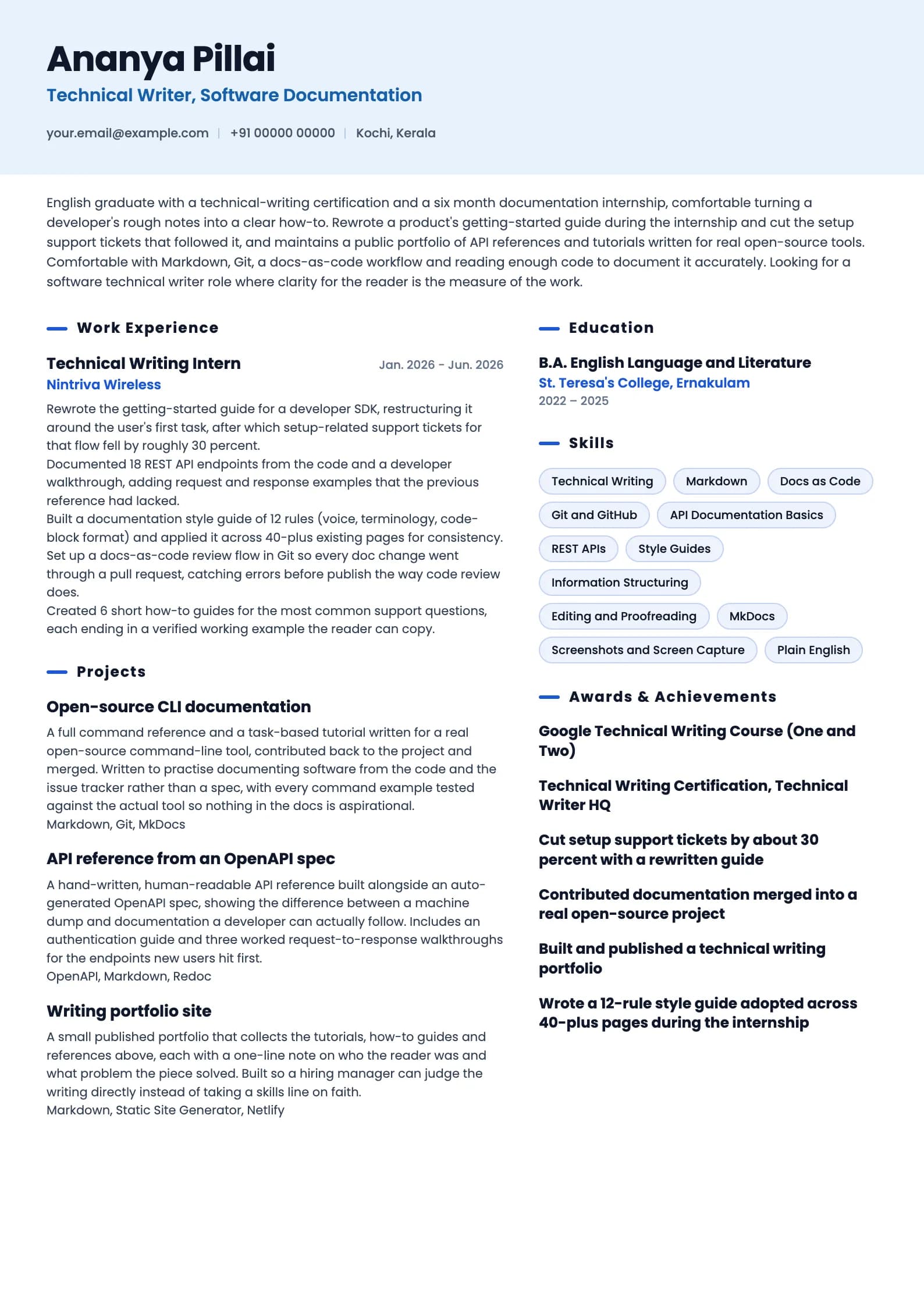
Build my resumeTechnical Writer resume example, Fresher (0 years)
ai-era templateIs your resume good enough?
Upload the resume you have now and see what an applicant tracking system reads before a technical writer recruiter ever does.
Free to run. Sign in with your mobile number to see your score.
Technical Writer resume example, Mid-level (4 years)
professional template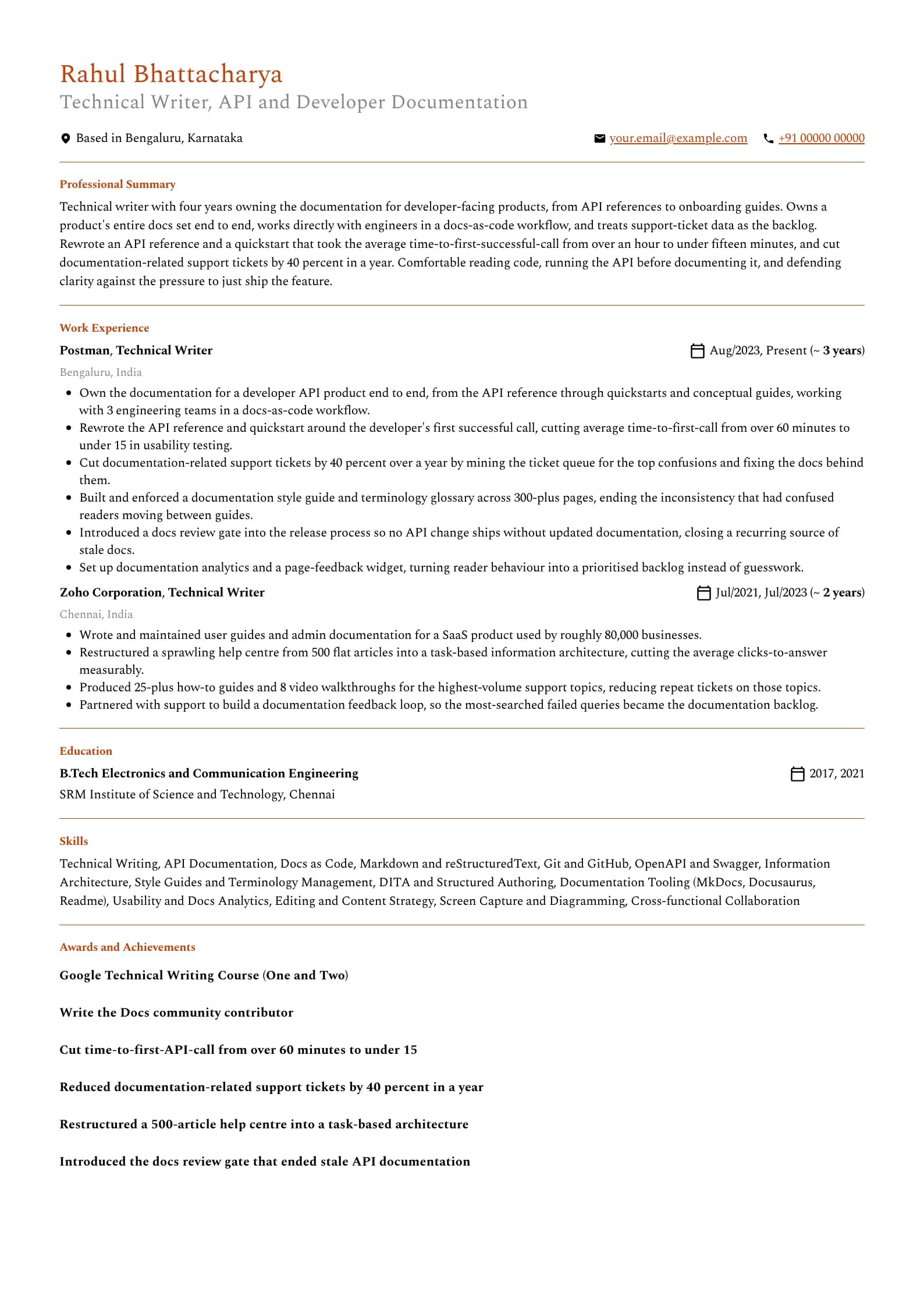
Want this structure with your own details? Build it in the resume builder.
Technical Writer resume example, Senior (8 years)
modern template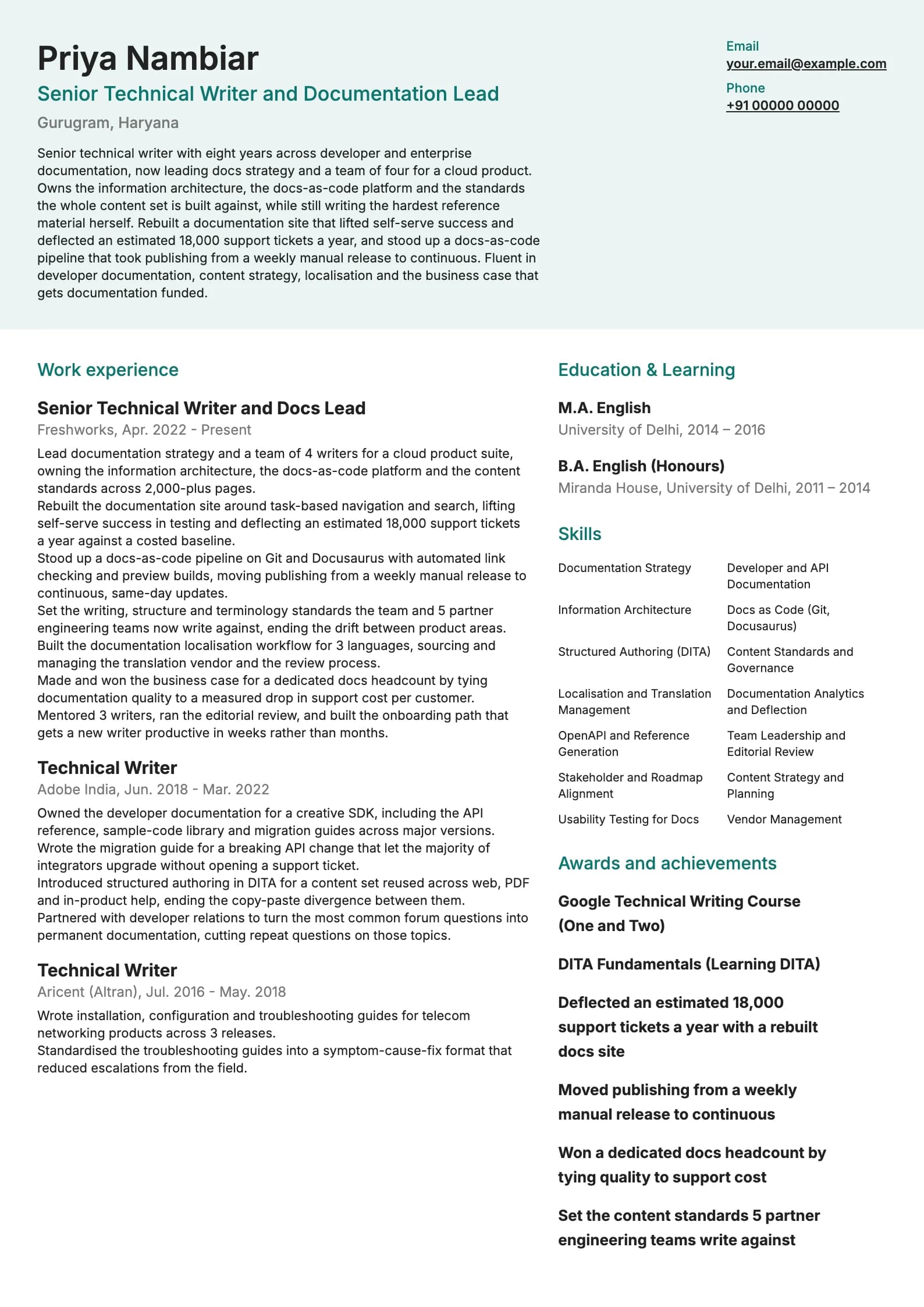
The format that works for technical writer resumes in India
Reverse chronological is the only layout worth using. Put the most recent role first, work backwards, and keep the dates in plain view. For a writer, the resume is also a writing sample, so a clean, well-structured, typo-free page is doing double duty: it argues by example that you can organise information and get the details right. A cluttered or error-strewn technical writer resume contradicts the one skill the job is about. Length is decided by evidence. One page holds everything a fresher and most writers up to about five years have to say. Past that, a second page is fine when it carries real documentation ownership and outcomes rather than a longer tools list. A page two built from a hobbies line and a declaration is a padded one-page resume. The single most important addition for this role is a portfolio link, placed right in the header alongside your name and headline. A technical writer without a portfolio is a developer without a GitHub: the reviewer cannot judge the actual work. More on that below, but the header must carry the link. Four things belong nowhere on this resume: a photograph, date of birth, marital status and father's name. They survive from an older campus template and take space a documentation outcome or a portfolio note should occupy. Send a PDF unless the posting asks for DOCX, use a single column all the way down because two-column layouts parse unpredictably, and name the file with your own name and the target role. The table below sets out the section order.
| Section | Where it goes | Why |
|---|---|---|
| Name, headline and portfolio link | Top, above everything | The portfolio link belongs here. For a writer it is the single most important thing on the page. |
| Professional summary | Directly under the header | Three or four lines. What you document, for whom, and the strongest documentation outcome. |
| Work experience | Next, for anyone with a job | Most recent first. Docs owned, and what the writing measurably changed. |
| Portfolio highlights | Above experience for freshers, alongside it after that | Two or three named pieces with the reader and the problem each solved. |
| Skills | Below experience | Grouped: writing, docs tooling, formats, domains. Not a 30-tool wall. |
| Certifications and education | Bottom, unless you are a fresher | Google Technical Writing course, degree, institution, years. |
Why the portfolio matters more than almost any other role
For a technical writer, the portfolio is not a nice extra, it is the evidence, and a resume without a link to real writing is asking the reviewer to take the whole page on faith. A hiring manager can read three of your pages in five minutes and learn more than a skills section could ever tell them. This is why every sample above carries a portfolio, and why a fresher with a strong public portfolio can beat someone with more experience and no samples to show. Build the portfolio to be judged, not just browsed. For each piece, add a one-line note on who the reader was and what problem the writing solved: a quickstart for developers new to the API, a troubleshooting guide for support to hand out, a migration guide for a breaking change. The context is what separates a writer who thinks about the reader from one who just produces pages, and it is exactly what a reviewer is looking for. Where your best work is behind a company login and cannot be shared, write something public that demonstrates the same skill. Documentation for an open-source tool is ideal, because the tool is real, the code is there to be documented accurately, and a merged contribution proves a maintainer accepted it. The fresher sample leans entirely on this, and it is a stronger position than a private claim nobody can check. Host the portfolio somewhere clean and fast, a simple static site, a docs site or even a well-organised GitHub repository, and make sure it works on a phone, because a recruiter will open it on one. A broken portfolio link on a technical writer's resume is the cruelest possible own goal: the one artefact that proves you handle detail, failing on a detail.
Put the portfolio link in the header, not buried at the bottom, and click it on a phone before you send the resume. For a writer, an unreachable or slow portfolio undermines the exact skill you are selling.
Listing a tool is not the same as proving your docs worked
The single most common technical writer resume failure is a page built from tools and adjectives, proficient in MadCap Flare, Adobe FrameMaker, Confluence and Microsoft Word, with excellent written and verbal communication skills, and not one line showing what the documentation achieved. A parser matches those terms, but a hiring manager reads the adjective wall and knows nothing about whether your writing actually helped anyone. The fix is to measure the documentation by its effect. Good docs do measurable things: they cut support tickets, they shorten time-to-first-success, they deflect load from the support queue, they let integrators upgrade without a ticket. The samples above name tickets down 40 percent, time-to-first-call under fifteen minutes, and 18,000 tickets deflected, because those are documentation outcomes. A tool name on its own is a job-description artefact. Where a hard number is genuinely unavailable, use scope and structure: how many endpoints you documented, how many articles you restructured, how many pages a style guide governs, how many teams write against your standards. "Restructured a 500-article help centre into a task-based architecture" carries weight without a percentage, because it names the mess and the shape you gave it. Drop the empty communication-skills line. Every candidate for every job claims excellent communication, so it carries no information, and for a writer it is doubly wasted: the resume itself, well-organised and error-free, is the proof, and the portfolio is the demonstration. Spend the space on what a document did instead of asserting that you write well.
Experience bullet, documentation impact
Weak
Responsible for creating and maintaining user documentation using MadCap Flare and Confluence with excellent attention to detail.
Strong
Cut documentation-related support tickets by 40 percent over a year by mining the ticket queue for the top confusions and fixing the docs behind them.
"Responsible for creating documentation" describes a task; the rewrite names the method and the support-load outcome a reviewer can probe.
Writing a summary a hiring manager actually reads
The block under your name is the part you can be reasonably sure gets read, and for a writer it is also an audition: a weak, generic summary tells the reviewer more than any claim of skill could. It should carry three facts: what you document, who you document it for, and the strongest thing your documentation achieved. Three or four tight lines that show, by their own quality, that you can write. The old objective line, seeking a challenging technical writer role in a reputed organisation to utilise your writing skills, tells the reader nothing and, worse for this role, reads badly. Replace it with a summary. An objective describes what you want, a summary describes the documentation you have already shipped and what it did, and only one is evidence for a role that is entirely about clear writing. Freshers often believe they have nothing to summarise. Look at the fresher sample: it names the internship, the certification, a rewritten guide that cut tickets, and a public portfolio. That is a genuine summary built from one internship, a course and open-source contributions. What it avoids is "passionate about writing and technology", a phrase so common it now carries no information and, on a writer's resume, actively reads as a red flag. A practical test: read your summary aloud. If it sounds like every other technical writer's summary, it is describing the job, not you. Add the specific product, the specific documentation outcome and the specific audience until it could only be yours, and make sure not a single word is doing nothing.
Professional summary, mid-level technical writer
Weak
Passionate technical writer with 4+ years of experience and excellent communication skills, proficient in various documentation tools, seeking a challenging role in a reputed organisation.
Strong
Technical writer with four years owning developer-facing documentation, from API references to onboarding guides. Rewrote a quickstart that took time-to-first-call from over an hour to under fifteen minutes and cut documentation support tickets by 40 percent.
The rewrite trades adjectives and a tool claim for an audience, an ownership scope and two measurable documentation outcomes.
Experience bullets: audience, artefact, outcome
Every strong bullet in the samples follows the same shape. It names the audience or the documentation you owned, states what you wrote or restructured, and closes with what measurably changed. The audience establishes you write for a reader, not for yourself. The artefact tells a reviewer what kind of documentation you produce. The number, in tickets, minutes or deflection, does the persuading. Start with the outcome and work backwards. Writers often write the task first, then struggle to attach a number, which produces bullets like "wrote and maintained documentation for the product". Instead ask what was different after your documentation shipped: support tickets fell, users onboarded faster, developers made a successful call sooner, integrators upgraded without help, search-to-answer got shorter. Then write the sentence that ends in that fact. Vary the metric. A technical writer can honestly reach for support-ticket reduction, time-to-first-success, deflection numbers, pages or endpoints documented, articles restructured, clicks-to-answer, adoption of a style guide and publishing speed. A page of nothing but page counts reads as volume without impact; a page that ties documentation to support and success reads as a writer who understands why the docs exist. Where you lack a clean number, give scope: how many endpoints, how many pages a style guide governs, how many teams adopted your standards, how many languages you localised into. "Built a terminology glossary across 300-plus pages" carries weight without inventing a percentage. Show the process work, not only the writing, as you go senior. A docs review gate, an analytics-driven backlog, a docs-as-code pipeline, content standards other teams adopt: these are the bullets that distinguish a documentation owner from a page producer. The table below maps what each level must prove.
| Level | What bullets must prove | Typical metric |
|---|---|---|
| Fresher | You can turn rough input into clear, correct docs | Endpoints documented, a guide rewritten, portfolio pieces |
| 1 to 3 years | You own a documentation area without hand-holding | Tickets cut, articles restructured, time-to-success |
| 4 to 6 years | You own a product's docs and the process behind them | Deflection, review gates, analytics backlog, style adoption |
| 7 years and up | You set docs strategy and standards across teams | Tickets deflected at scale, headcount won, standards adopted |
Experience bullet, onboarding docs
Weak
Wrote getting started guides and tutorials to help new users onboard to the product.
Strong
Rewrote the API reference and quickstart around the developer's first successful call, cutting average time-to-first-call from over 60 minutes to under 15 in usability testing.
Names the restructuring principle and the before-and-after measured in usability testing, instead of a generic claim any writer could make.
Experience bullet, information architecture
Weak
Organised and maintained the company help centre and knowledge base articles.
Strong
Restructured a sprawling help centre from 500 flat articles into a task-based information architecture, cutting the average clicks-to-answer measurably.
Names the starting mess, the structure applied and the reader outcome, so a reviewer can picture the actual work.
If a bullet would read identically on any writer's resume, it is describing the job, not your documentation. Rewrite it around the audience you wrote for, the artefact you produced, and what it changed for the reader or the support queue.
The skills section: grouped, current, and honest
A technical writer's skills section has two audiences with opposite preferences. The parser wants literal tool and format terms, Markdown and OpenAPI and DITA. A hiring manager wants a short, organised sense of what kind of writer you are and whether you fit their workflow. Grouping satisfies both. Group by function rather than one long line. Writing, documentation tooling, formats and structure, and domains is a grouping that works for almost every technical writer. Putting writing and information architecture first signals that the craft leads and the tools follow, which is the right order, because tools change and the ability to structure information for a reader does not. Write names the way the industry writes them: Markdown not markdown, OpenAPI not Open API, Docusaurus spelled correctly, because a writer with a typo in a tool name has undermined their own case. Twelve to sixteen skills is the working range. Below eight the section looks thin. Above twenty it stops being a signal, and technical writer resumes are prone to a specific padding: listing every help-authoring tool ever touched, MadCap Flare, RoboHelp, FrameMaker, Author-it, Paligo, when the modern developer-docs world has largely moved to docs-as-code. List the tools the target role actually uses, and know which ones signal legacy versus current for the job you want. Do not include a proficiency bar, and do not list Microsoft Word and email as skills. Word is assumed, email is not a skill, and a star rating on writing invites an argument you cannot win. The portfolio and the resume's own quality prove the depth, so let them.
| Group | What goes in it | How many |
|---|---|---|
| Writing and structure | Technical writing, information architecture, editing, style guides | 3 to 5 |
| Docs tooling | Git, Markdown, MkDocs or Docusaurus, docs-as-code | 3 to 5 |
| API and formats | OpenAPI, Swagger, DITA, reStructuredText, reference generation | 2 to 4 |
| Domains | Developer docs, SaaS, API products, the subject you know | 1 to 3 |
| Practices | Docs analytics, usability testing, localisation, content strategy | 2 to 4 |
Skills section
Weak
Skills: MS Word, MS Excel, MS PowerPoint, Email, MadCap Flare, RoboHelp, FrameMaker, Author-it, Confluence, SharePoint, Photoshop, Snagit, Communication, Teamwork, Attention to Detail, Time Management
Strong
Writing: technical writing, information architecture, editing, style guides. Docs tooling: Git, Markdown, Docusaurus, docs-as-code. API and formats: OpenAPI, DITA, reStructuredText. Practices: docs analytics, usability testing, localisation.
Drops office software and soft-skill filler, trims the legacy-tool list, leads with craft and adds the docs-as-code and API terms a modern developer-docs role searches for.
Where education, certifications and the domain fit
Technical writers come from mixed backgrounds, English, journalism, engineering, science, and the resume should not apologise for whichever one you have. An English or humanities degree signals the writing craft; an engineering or science degree signals you can understand what you document without hand-holding. Both are assets for the right role, so state your degree plainly and let the experience and portfolio carry the rest. Education goes at the bottom for anyone with a job, and near the top for a fresher who has nothing stronger to lead with. The domain you can write about is itself a credential, and it belongs on the resume. A writer who understands APIs, cloud, networking or a regulated field like medical devices or finance is worth more to a team in that space than a generalist, because the ramp-up is shorter and the docs are more accurate. If you have that domain knowledge, name it, in the summary and the skills, because it is often the deciding factor between two otherwise similar writers. Certifications are lighter-weight here than in engineering roles, but a few help, especially for freshers and career changers. The free Google Technical Writing courses are widely recognised and signal you know the fundamentals of the craft. A structured-authoring or DITA certification matters for enterprise and structured-content roles. Beyond those, the portfolio outweighs any certificate, so do not over-invest in badges when a strong sample would prove more. List certifications and the Google course just below skills or beside education, with the full name and the year. For a technical writer, one recognised writing course plus a portfolio of real documentation says far more than a stack of tool certificates.
Getting through the applicant tracking system
An applicant tracking system is a parser and a search index, not a judge. It reads your file, tries to break it into name, dates, employers, titles and skills, and stores the result so a recruiter can search across candidates. For technical writer roles the searches are specific, technical writer, API documentation, docs-as-code, DITA, and almost every failure is a parsing problem, not a wording one. There is a nice irony here: a role about clear communication is often filtered by a machine that reads structure, not prose, so the layout has to be clean. The layout rules are short. One column, because a two-column writer's resume with a skills sidebar is exactly the layout that parses out of order. Standard section headings, so Work Experience rather than My Journey, and Skills rather than My Toolbox. No text inside images, and keep the portfolio link as real selectable text, not hidden inside a logo or a QR code, because a parser and a recruiter both need to click it. No critical information in the header or footer region, which some parsers drop, which unfortunately includes the portfolio link, so also repeat it once in the body. On wording, mirror the job description where it is honest. If the posting says API documentation, write API documentation. If it says docs-as-code, use that exact phrase. Include the expansion alongside an acronym at least once, for example "DITA (Darwin information typing architecture)", so both searches find you. Keyword stuffing does not work and, for a writer, is self-defeating: a hiring manager who spots a keyword-stuffed technical writer resume concludes the one thing you cannot afford them to conclude, that you write badly. Write real bullets that naturally contain the right terms, because a bullet describing an API reference you wrote contains the words API documentation in a context that survives the human read too. Save as PDF from a tool that embeds real text, then open the file and confirm you can select and copy a sentence, and click the portfolio link. If you cannot select the text, neither can the parser.
Portfolio link placement
Weak
Portfolio available on request
Strong
Portfolio: [your-portfolio-url] (in the header, as selectable text)
"On request" adds a step a busy reviewer will not take; a live link in the header lets them judge your actual writing in the first minute.
Test your own file before you send it. Copy the text out of the PDF into a plain text editor, and separately click the portfolio link. Whatever you can read there is roughly what the parser sees, and a dead portfolio link is the worst failure a writer's resume can have.
What gets technical writer resumes rejected
Most rejections at the resume stage are not close calls. They come from a small set of recurring problems, and for a writer they carry extra weight because the resume is itself a writing sample. The list below covers what reviewers of Indian technical writer resumes see most often, in rough order of how much damage each one does.
- No portfolio link. For a writer this is the single biggest miss, because the reviewer cannot judge the actual work and will not chase it.
- Any typo or grammatical error. On a technical writer's resume a single typo contradicts the entire pitch and is often an instant reject.
- A wall of tools and adjectives with no outcome. "Proficient in MadCap, excellent communication" says nothing about whether your docs worked.
- The empty communication-skills line. Everyone claims it, it carries no information, and for a writer the resume itself is supposed to be the proof.
- No numbers anywhere. Support tickets, time-to-success, deflection, pages, endpoints. Documentation impact is measurable, so measure it.
- A legacy-tool list for a modern docs-as-code role, signalling a writer who has not kept up with how developer documentation is now made.
- A cluttered or badly structured layout, which for a writer undercuts the exact skill, organising information, that the job is about.
- A generic objective line instead of a summary that shows, by its own quality, that you can write clearly.
- A dead or slow portfolio link, the cruelest failure: the artefact meant to prove you handle detail, failing on a detail.
- A photo, date of birth, marital status or father's name. None of it belongs on this resume, and it takes space a documentation outcome should use.
Proofread your resume, then have someone else proofread it, then read it aloud once. For a technical writer, a clean, error-free page is not just good practice, it is the strongest sample you will submit.
Skills to put on a technical writer resume
Technical
- Technical Writing
- API Documentation
- Information Architecture
- Docs as Code
- Structured Authoring (DITA)
- Content Strategy
- Editing and Proofreading
- Style Guide Development
- Terminology Management
- Usability Testing for Docs
- Documentation Analytics
- Localisation Management
- Reference and Tutorial Writing
- Reading Code for Accuracy
Tools and platforms
- Git and GitHub
- Markdown and reStructuredText
- MkDocs and Docusaurus
- OpenAPI and Swagger
- Readme and Redoc
- MadCap Flare
- Confluence
- Snagit and Screen Capture
- Figma and Diagramming
- Postman
- VS Code
- DITA (Oxygen)
Working skills
- Writing for the reader
- Interviewing subject-matter experts
- Cross-functional collaboration
- Editorial judgement
- Prioritising against support data
- Mentoring and review
- Content planning
- Stakeholder communication
- Advocating for the user
Certifications worth listing as a technical writer
| Certification | Full name | Worth it for |
|---|---|---|
| Google Tech Writing | Google Technical Writing Courses (One and Two) | Free, widely recognised, and the standard entry credential for the craft in India. Genuinely useful for freshers and career changers to prove they know the fundamentals of clear technical writing, and worth naming on the resume. For senior writers it is assumed knowledge rather than a differentiator. |
| DITA Fundamentals | DITA Fundamentals (Learning DITA or equivalent) | Worth it for writers targeting enterprise, structured-content or component-content-management roles where DITA and reuse across web, PDF and in-product help are the norm. Less relevant for a modern docs-as-code developer-documentation role, which mostly lives in Markdown and Git. |
| Write the Docs | Write the Docs community participation | Not a certification but a recognised signal: active participation in the Write the Docs community, a talk, a meetup, a contribution, tells hiring teams you are engaged with the profession. A useful line for writers who want to show commitment to the craft beyond the day job. |
| API Docs Course | Documenting APIs course (Tom Johnson / I'd Rather Be Writing) | The best-known dedicated course for API documentation, valuable for writers moving into developer docs who need to prove they understand references, OpenAPI and the developer workflow. Pair it with an actual API reference in your portfolio, since for this specialism the sample matters more than the certificate. |
Keywords an ATS scans for in a technical writer resume
These are the literal terms a parser matches against the job description. Use the ones that are true of you, in the sentences where you did the work, not as a list at the bottom.
- technical writer
- technical writing
- API documentation
- docs as code
- information architecture
- developer documentation
- DITA
- markdown
- OpenAPI
- content strategy
- style guide
- structured authoring
- user guides
- git
- editing
- knowledge base
- release notes
- localisation
- usability
- documentation portal
Technical Writer resume FAQ
What salary can a technical writer expect in India?
A fresher typically starts around 3.5 to 6 LPA, higher in product and developer-tools companies. A technical writer with four to six years owning a product's documentation usually sits in the 8 to 18 LPA band, with API and developer-documentation specialists at the top of it. Senior writers and documentation leads with eight years and above commonly earn 20 to 40 LPA and more at strong product companies. Developer and API documentation, a docs-as-code skill set and a domain like cloud or fintech push the top of every band upward, since those writers are scarcer.
How long should a technical writer resume be?
One page up to about five years of experience, two pages after that only if the second page carries real documentation ownership and outcomes rather than a longer tools list. Because the resume is itself a writing sample, keeping it tight and well-structured is part of the pitch. If you are struggling to fit one page, cut the oldest role to a line, drop office software from the skills, and remember the portfolio, not the resume, is where the depth of your writing is proven.
Do I really need a portfolio for a technical writer role?
Yes, more than for almost any other role. A technical writer without a portfolio is like a developer without a GitHub: the reviewer cannot judge the actual work and usually will not take the skills on faith. Put the link in the header. If your best work is behind a company login, write something public, documentation for an open-source tool is ideal, so a hiring manager can read three of your pages and see the craft directly. A strong portfolio can beat more experience with no samples to show.
Can I become a technical writer without an engineering degree?
Yes. Technical writers come from English, journalism, science and engineering backgrounds, and a humanities degree signals the writing craft that the job is centrally about. What you do need is enough technical curiosity to understand what you document and the willingness to read code, run the API or try the product before writing about it. A portfolio that shows you documented something genuinely technical, accurately, closes the gap that a non-engineering degree might otherwise leave in a reviewer's mind.
What is docs-as-code and do I need it on my resume?
Docs-as-code means writing documentation in plain-text formats like Markdown, storing it in Git, and shipping it through pull requests and automated builds, the same workflow developers use for code. Most modern developer-documentation teams work this way, so if you are targeting software or API roles, having docs-as-code, Git and Markdown on your resume matters, often more than a legacy help-authoring tool. If you have never used it, documenting an open-source project on GitHub is a fast way to learn it and get a portfolio piece at once.
How do I quantify documentation work with numbers?
Tie the documentation to what it changed for readers or support. The strongest metrics are support tickets deflected or reduced, time-to-first-success shortened, and clicks-to-answer cut, all of which you can often get from support and analytics data. Where those are unavailable, use scope: endpoints documented, articles restructured, pages a style guide governs, teams that adopted your standards, languages localised into. "Cut setup tickets by 30 percent" and "restructured 500 articles into a task-based architecture" both work, and both beat "wrote documentation for the product".
Does an ATS reject technical writer resumes with two columns?
It does not reject them outright, but some parsers read multi-column layouts out of order, and a writer's resume with a skills sidebar is exactly the layout that interleaves your competencies with your experience and produces nonsense in the recruiter's view. A single-column layout removes the risk, which is why all three samples above use one. There is an irony worth heeding: a role about clear communication is often filtered by a machine that reads structure, so keep the portfolio link as selectable text and test the file by copying it into a plain text editor.
Should I list every documentation tool I have used?
No. List the tools the target role actually uses, and be aware that some signal current and some signal legacy. A wall including MadCap Flare, RoboHelp, FrameMaker and Author-it can read as dated for a modern docs-as-code developer role, while Git, Markdown and OpenAPI read as current. Lead your skills with the writing craft and information architecture, then name the specific tools that fit the job. Do not list Microsoft Word or email, since one is assumed and the other is not a skill.
Do I need a photo on a technical writer resume in India?
No. Recruiters do not expect one, and it takes space a documentation outcome or a portfolio note should occupy. The same goes for date of birth, marital status, father's name, nationality and a declaration paragraph. These come from an older campus template and add nothing to a role judged on writing and structure. Spend that space on the portfolio link and one more documentation outcome instead, which is what a hiring manager is actually looking for.
Related resume examples and guides
Build your own in any of these formats
Start from a blank resume or upload the one you have. Goodspace renders it in 24 templates and flags the docs-as-code, API documentation and information-architecture keywords an applicant tracking system will look for, and the tool-and-adjective padding it will not credit.
Build my resume